
Oracle Critical Patch Update October 2017
Released October 2017 · Oracle's advisory ↗ · ← Critical Patch Update, July 2017 · Critical Patch Update, January 2018 →
225 CVEs in this release, one square each
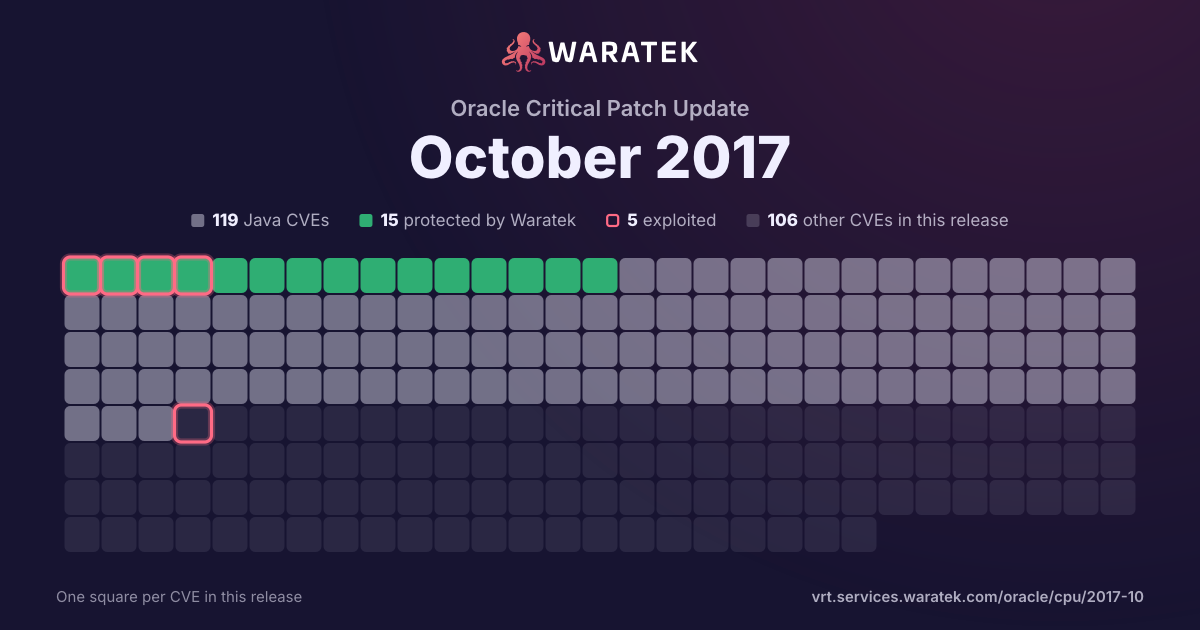
By status
18Protected by Waratek2Mitigation candidate109No exploit published17Outside Waratek scope79Not applicable
5Exploited, marked by the ring
No exploit published. For 103 of them, Oracle's security advisory is the source of public detail.
Protected by Waratek. Waratek RASP can block exploitation of these on systems that have not applied the patch yet.
Overview 129 matches · 17 protected · 4 exploited · 2 CISA KEV · 9 public PoC · 5 EPSS ≥ 0.5
Protected by Waratek
18
14.0%
Rule in development
0
0.0%
Mitigation candidate
2
1.6%
No exploit published
109
84.5%
blocked by ARMR today
17
13.2%
partly blocked
1
0.8%
not blocked
111
86.0%
not established
0
0.0%
unrecorded
0
0.0%
split by
peak 113 / quarter
Q2 142
Protected by Waratek2
High2
blocked by ARMR today2
Exploited1
No public exploit1
Q3 140
Q4 140
Q1 150
Q2 151
No exploit published1
Low1
not blocked1
Forecast only1
Q3 151
No exploit published1
Critical1
not blocked1
No public exploit1
Q4 151
No exploit published1
Medium1
not blocked1
No public exploit1
Q1 162
Protected by Waratek1
No exploit published1
Critical1
High1
blocked by ARMR today1
not blocked1
Proof of concept only1
No public exploit1
Q2 160
Q3 164
Protected by Waratek1
No exploit published3
High4
blocked by ARMR today1
not blocked3
No public exploit4
Q4 161
Protected by Waratek1
Critical1
blocked by ARMR today1
No public exploit1
Q1 170
Q2 173
Protected by Waratek2
No exploit published1
Critical1
High2
blocked by ARMR today2
not blocked1
Exploited1
No public exploit2
Q3 170
Q4 17113
Protected by Waratek10
Mitigation candidate2
No exploit published101
Critical9
High44
Medium56
Low4
blocked by ARMR today9
partly blocked1
not blocked103
Exploited2
Working exploit published3
Proof of concept only1
No public exploit107
Q1 181
Protected by Waratek1
Critical1
blocked by ARMR today1
No public exploit1
Q3 14Q1 15Q3 15Q1 16Q3 16Q1 17Q3 17Q1 18
| CVE | Severity | Published▾ | Status | Exploitation | Description |
|---|---|---|---|---|---|
| CVE-2017-10159 | Medium | 2017-10-19 | No exploit published | No public exploit | Vulnerability in the Oracle Communications Policy Management component of Oracle Communications Applications (subcomponent: Portal, CMP). Supported versions that are affected are 11.5 and 12.x. Easily exploitable vulnerability allows unauthenticated attacker with network access via HTTP to compromise Oracle Communications Policy Management. Successful attacks require human interaction from a person other than the attacker and while the vulnerability is in Oracle Communications Policy Management, attacks may significantly impact additional products. Successful attacks of this vulnerability can result in unauthorized update, insert or delete access to some of Oracle Communications Policy Management accessible data as well as unauthorized read access to a subset of Oracle Communications Policy Management accessible data. CVSS 3.0 Base Score 6.1 (Confidentiality and Integrity impacts). CVSS Vector: (CVSS:3.0/AV:N/AC:L/PR:N/UI:R/S:C/C:L/I:L/A:N). |
| CVE-2017-10158 | Medium | 2017-10-19 | No exploit published | No public exploit | Vulnerability in the PeopleSoft Enterprise PeopleTools component of Oracle PeopleSoft Products (subcomponent: Core). Supported versions that are affected are 8.54, 8.55 and 8.56. Easily exploitable vulnerability allows unauthenticated attacker with network access via HTTP to compromise PeopleSoft Enterprise PeopleTools. Successful attacks require human interaction from a person other than the attacker and while the vulnerability is in PeopleSoft Enterprise PeopleTools, attacks may significantly impact additional products. Successful attacks of this vulnerability can result in unauthorized update, insert or delete access to some of PeopleSoft Enterprise PeopleTools accessible data as well as unauthorized read access to a subset of PeopleSoft Enterprise PeopleTools accessible data. CVSS 3.0 Base Score 6.1 (Confidentiality and Integrity impacts). CVSS Vector: (CVSS:3.0/AV:N/AC:L/PR:N/UI:R/S:C/C:L/I:L/A:N). |
| CVE-2017-10154 | Medium | 2017-10-19 | No exploit published | No public exploit | Vulnerability in the Oracle Access Manager component of Oracle Fusion Middleware (subcomponent: Web Server Plugin). The supported version that is affected is 11.1.2.3.0. Easily exploitable vulnerability allows unauthenticated attacker with network access via HTTP to compromise Oracle Access Manager. Successful attacks of this vulnerability can result in unauthorized read access to a subset of Oracle Access Manager accessible data. CVSS 3.0 Base Score 5.3 (Confidentiality impacts). CVSS Vector: (CVSS:3.0/AV:N/AC:L/PR:N/UI:N/S:U/C:L/I:N/A:N). |
| CVE-2017-10153 | Medium | 2017-10-19 | No exploit published | No public exploit | Vulnerability in the Oracle Communications WebRTC Session Controller component of Oracle Communications Applications (subcomponent: Security (Gson)). Supported versions that are affected are 7.0, 7.1 and 7.2. Difficult to exploit vulnerability allows low privileged attacker with network access via multiple protocols to compromise Oracle Communications WebRTC Session Controller. While the vulnerability is in Oracle Communications WebRTC Session Controller, attacks may significantly impact additional products. Successful attacks of this vulnerability can result in unauthorized ability to cause a hang or frequently repeatable crash (complete DOS) of Oracle Communications WebRTC Session Controller. CVSS 3.0 Base Score 6.3 (Availability impacts). CVSS Vector: (CVSS:3.0/AV:N/AC:H/PR:L/UI:N/S:C/C:N/I:N/A:H). |
| CVE-2017-10152 | Medium | 2017-10-19 | No exploit published | No public exploit | Vulnerability in the Oracle WebLogic Server component of Oracle Fusion Middleware (subcomponent: Web Container). Supported versions that are affected are 10.3.6.0.0 and 12.1.3.0.0. Easily exploitable vulnerability allows low privileged attacker with network access via HTTP to compromise Oracle WebLogic Server. Successful attacks of this vulnerability can result in unauthorized access to critical data or complete access to all Oracle WebLogic Server accessible data. CVSS 3.0 Base Score 6.5 (Confidentiality impacts). CVSS Vector: (CVSS:3.0/AV:N/AC:L/PR:L/UI:N/S:U/C:H/I:N/A:N). |
| CVE-2017-10077 | Medium | 2017-10-19 | No exploit published | No public exploit | Vulnerability in the Oracle Applications DBA component of Oracle E-Business Suite (subcomponent: AD Utilities). Supported versions that are affected are 12.1.3, 12.2.3, 12.2.4, 12.2.5, 12.2.6 and 12.2.7. Easily exploitable vulnerability allows high privileged attacker with network access via HTTP to compromise Oracle Applications DBA. Successful attacks of this vulnerability can result in unauthorized creation, deletion or modification access to critical data or all Oracle Applications DBA accessible data as well as unauthorized access to critical data or complete access to all Oracle Applications DBA accessible data. CVSS 3.0 Base Score 6.5 (Confidentiality and Integrity impacts). CVSS Vector: (CVSS:3.0/AV:N/AC:L/PR:H/UI:N/S:U/C:H/I:H/A:N). |
| CVE-2017-10066 | Medium | 2017-10-19 | No exploit published | No public exploit | Vulnerability in the Oracle Applications Technology Stack component of Oracle E-Business Suite (subcomponent: Oracle Forms). Supported versions that are affected are 12.1.3, 12.2.3, 12.2.4, 12.2.5, 12.2.6 and 12.2.7. Easily exploitable vulnerability allows unauthenticated attacker with network access via HTTP to compromise Oracle Applications Technology Stack. Successful attacks of this vulnerability can result in unauthorized update, insert or delete access to some of Oracle Applications Technology Stack accessible data. CVSS 3.0 Base Score 5.3 (Integrity impacts). CVSS Vector: (CVSS:3.0/AV:N/AC:L/PR:N/UI:N/S:U/C:N/I:L/A:N). |
| CVE-2017-10065 | High | 2017-10-19 | No exploit published | No public exploit | Vulnerability in the Oracle Retail Point-of-Service component of Oracle Retail Applications (subcomponent: Security). Supported versions that are affected are 13.2, 13.3, 13.4, 14.0 and 14.1. Easily exploitable vulnerability allows low privileged attacker with network access via HTTP to compromise Oracle Retail Point-of-Service. While the vulnerability is in Oracle Retail Point-of-Service, attacks may significantly impact additional products. Successful attacks of this vulnerability can result in unauthorized creation, deletion or modification access to critical data or all Oracle Retail Point-of-Service accessible data as well as unauthorized read access to a subset of Oracle Retail Point-of-Service accessible data. CVSS 3.0 Base Score 8.5 (Confidentiality and Integrity impacts). CVSS Vector: (CVSS:3.0/AV:N/AC:L/PR:L/UI:N/S:C/C:L/I:H/A:N). |
| CVE-2017-10060 | High | 2017-10-19 | No exploit published | No public exploit | Vulnerability in the Oracle Business Intelligence Enterprise Edition component of Oracle Fusion Middleware (subcomponent: Analytics Web General). Supported versions that are affected are 11.1.1.7.0, 11.1.1.9.0, 12.2.1.1.0 and 12.2.1.2.0. Easily exploitable vulnerability allows unauthenticated attacker with network access via HTTP to compromise Oracle Business Intelligence Enterprise Edition. Successful attacks require human interaction from a person other than the attacker and while the vulnerability is in Oracle Business Intelligence Enterprise Edition, attacks may significantly impact additional products. Successful attacks of this vulnerability can result in unauthorized access to critical data or complete access to all Oracle Business Intelligence Enterprise Edition accessible data as well as unauthorized update, insert or delete access to some of Oracle Business Intelligence Enterprise Edition accessible data. CVSS 3.0 Base Score 8.2 (Confidentiality and Integrity impacts). CVSS Vector: (CVSS:3.0/AV:N/AC:L/PR:N/UI:R/S:C/C:H/I:L/A:N). |
| CVE-2017-10055 | Medium | 2017-10-19 | No exploit published | No public exploit | Vulnerability in the Oracle iPlanet Web Server component of Oracle Fusion Middleware (subcomponent: Admin Graphical User Interface). The supported version that is affected is 7.0. Easily exploitable vulnerability allows unauthenticated attacker with network access via HTTP to compromise Oracle iPlanet Web Server. Successful attacks require human interaction from a person other than the attacker and while the vulnerability is in Oracle iPlanet Web Server, attacks may significantly impact additional products. Successful attacks of this vulnerability can result in unauthorized update, insert or delete access to some of Oracle iPlanet Web Server accessible data as well as unauthorized read access to a subset of Oracle iPlanet Web Server accessible data. CVSS 3.0 Base Score 6.1 (Confidentiality and Integrity impacts). CVSS Vector: (CVSS:3.0/AV:N/AC:L/PR:N/UI:R/S:C/C:L/I:L/A:N). |
| CVE-2017-10037 | High | 2017-10-19 | No exploit published | No public exploit | Vulnerability in the Oracle BI Publisher component of Oracle Fusion Middleware (subcomponent: Web Service API). Supported versions that are affected are 11.1.1.7.0 and 11.1.1.9.0. Easily exploitable vulnerability allows unauthenticated attacker with network access via HTTP to compromise Oracle BI Publisher. Successful attacks of this vulnerability can result in unauthorized access to critical data or complete access to all Oracle BI Publisher accessible data. CVSS 3.0 Base Score 7.5 (Confidentiality impacts). CVSS Vector: (CVSS:3.0/AV:N/AC:L/PR:N/UI:N/S:U/C:H/I:N/A:N). |
| CVE-2017-10034 | High | 2017-10-19 | No exploit published | No public exploit | Vulnerability in the Oracle BI Publisher component of Oracle Fusion Middleware (subcomponent: Core Formatting API). Supported versions that are affected are 11.1.1.7.0 and 11.1.1.9.0. Easily exploitable vulnerability allows unauthenticated attacker with network access via HTTP to compromise Oracle BI Publisher. Successful attacks require human interaction from a person other than the attacker and while the vulnerability is in Oracle BI Publisher, attacks may significantly impact additional products. Successful attacks of this vulnerability can result in unauthorized access to critical data or complete access to all Oracle BI Publisher accessible data as well as unauthorized update, insert or delete access to some of Oracle BI Publisher accessible data. CVSS 3.0 Base Score 8.2 (Confidentiality and Integrity impacts). CVSS Vector: (CVSS:3.0/AV:N/AC:L/PR:N/UI:R/S:C/C:H/I:L/A:N). |
| CVE-2017-10033 | Medium | 2017-10-19 | Mitigation candidate | Working exploit published | Vulnerability in the Oracle WebCenter Sites component of Oracle Fusion Middleware (subcomponent: Support Tools). Supported versions that are affected are 11.1.1.8.0 and 12.2.1.2.0. Difficult to exploit vulnerability allows unauthenticated attacker with logon to the infrastructure where Oracle WebCenter Sites executes to compromise Oracle WebCenter Sites. Successful attacks of this vulnerability can result in unauthorized update, insert or delete access to some of Oracle WebCenter Sites accessible data as well as unauthorized read access to a subset of Oracle WebCenter Sites accessible data. Note: Please refer to Doc ID <a href="http://support.oracle.com/CSP/main/article?cmd=show&type=NOT&id=2318213.1">My Oracle Support Note 2318213.1 for instructions on how to address this issue. CVSS 3.0 Base Score 4.0 (Confidentiality and Integrity impacts). CVSS Vector: (CVSS:3.0/AV:L/AC:H/PR:N/UI:N/S:U/C:L/I:L/A:N). |
| CVE-2017-10026 | High | 2017-10-19 | No exploit published | No public exploit | Vulnerability in the Oracle SOA Suite component of Oracle Fusion Middleware (subcomponent: Fabric Layer). The supported version that is affected is 11.1.1.7.0. Easily exploitable vulnerability allows unauthenticated attacker with network access via HTTP to compromise Oracle SOA Suite. Successful attacks require human interaction from a person other than the attacker and while the vulnerability is in Oracle SOA Suite, attacks may significantly impact additional products. Successful attacks of this vulnerability can result in unauthorized access to critical data or complete access to all Oracle SOA Suite accessible data as well as unauthorized update, insert or delete access to some of Oracle SOA Suite accessible data. CVSS 3.0 Base Score 8.2 (Confidentiality and Integrity impacts). CVSS Vector: (CVSS:3.0/AV:N/AC:L/PR:N/UI:R/S:C/C:H/I:L/A:N). |
| CVE-2017-5664 | High | 2017-06-06 | No exploit published | No public exploit | The error page mechanism of the Java Servlet Specification requires that, when an error occurs and an error page is configured for the error that occurred, the original request and response are forwarded to the error page. This means that the request is presented to the error page with the original HTTP method. If the error page is a static file, expected behaviour is to serve content of the file as if processing a GET request, regardless of the actual HTTP method. The Default Servlet in Apache Tomcat 9.0.0.M1 to 9.0.0.M20, 8.5.0 to 8.5.14, 8.0.0.RC1 to 8.0.43 and 7.0.0 to 7.0.77 did not do this. Depending on the original request this could lead to unexpected and undesirable results for static error pages including, if the DefaultServlet is configured to permit writes, the replacement or removal of the custom error page. Notes for other user provided error pages: (1) Unless explicitly coded otherwise, JSPs ignore the HTTP method. JSPs used as error pages must must ensure that they handle any error dispatch as a GET request, regardless of the actual method. (2) By default, the response generated by a Servlet does depend on the HTTP method. Custom Servlets used as error pages must ensure that they handle any error dispatch as a GET request, regardless of the actual method. |
| CVE-2017-5662 | High | 2017-04-18 | Protected by Waratek | No public exploit | In Apache Batik before 1.9, files lying on the filesystem of the server which uses batik can be revealed to arbitrary users who send maliciously formed SVG files. The file types that can be shown depend on the user context in which the exploitable application is running. If the user is root a full compromise of the server - including confidential or sensitive files - would be possible. XXE can also be used to attack the availability of the server via denial of service as the references within a xml document can trivially trigger an amplification attack. |
| CVE-2016-8735 | Critical | 2017-04-06 | Protected by Waratek | Exploited | Remote code execution is possible with Apache Tomcat before 6.0.48, 7.x before 7.0.73, 8.x before 8.0.39, 8.5.x before 8.5.7, and 9.x before 9.0.0.M12 if JmxRemoteLifecycleListener is used and an attacker can reach JMX ports. The issue exists because this listener wasn't updated for consistency with the CVE-2016-3427 Oracle patch that affected credential types. |
| CVE-2016-5019 | Critical | 2016-10-03 | Protected by Waratek | No public exploit | CoreResponseStateManager in Apache MyFaces Trinidad 1.0.0 through 1.0.13, 1.2.x before 1.2.15, 2.0.x before 2.0.2, and 2.1.x before 2.1.2 might allow attackers to conduct deserialization attacks via a crafted serialized view state string. |
| CVE-2016-3506 | High | 2016-07-21 | No exploit published | No public exploit | Unspecified vulnerability in the JDBC component in Oracle Database Server 11.2.0.4, 12.1.0.1, and 12.1.0.2; the Oracle Retail Xstore Point of Service 5.5, 6.0, 6.5, 7.0, 7.1, 15.0, and 16.0; the Oracle Retail Warehouse Management System 14.04, 14.1.3, and 15.0.1; the Oracle Retail Workforce Management 1.60.7, and 1.64.0; the Oracle Retail Clearance Optimization Engine 13.4; the Oracle Retail Markdown Optimization 13.4 and 14.0; and Oracle Retail Merchandising System 16.0 allows remote attackers to affect confidentiality, integrity, and availability via unknown vectors. |
| CVE-2016-0635 | High | 2016-07-21 | No exploit published | No public exploit | Unspecified vulnerability in the Enterprise Manager Ops Center component in Oracle Enterprise Manager Grid Control 12.1.4, 12.2.2, and 12.3.2; the Oracle Health Sciences Information Manager component in Oracle Health Sciences Applications 1.2.8.3, 2.0.2.3, and 3.0.1.0; the Oracle Healthcare Master Person Index component in Oracle Health Sciences Applications 2.0.12, 3.0.0, and 4.0.1; the Oracle Documaker component in Oracle Insurance Applications before 12.5; the Oracle Insurance Calculation Engine component in Oracle Insurance Applications 9.7.1, 10.1.2, and 10.2.2; the Oracle Insurance Policy Administration J2EE and Oracle Insurance Rules Palette components in Oracle Insurance Applications 9.6.1, 9.7.1, 10.0.1, 10.1.2, 10.2.0, and 10.2.2; the Oracle Retail Integration Bus component in Oracle Retail Applications 15.0; the Oracle Retail Order Broker component in Oracle Retail Applications 5.1, 5.2, and 15.0; the Primavera Contract Management component in Oracle Primavera Products Suite 14.2; the Primavera P6 Enterprise Project Portfolio Management component in Oracle Primavera Products Suite 8.2, 8.3, 8.4, 15.1, 15.2, and 16.1; the Oracle Financial Services Analytical Applications Infrastructure component in Oracle Financial Services Applications 8.0.0, 8.0.1, 8.0.2, and 8.0.3; the Oracle Commerce Guided Search / Oracle Commerce Experience Manager component in Oracle Commerce 3.1.1, 3.1.2, 11.0, 11.1, and 11.2; the Oracle Agile PLM component in Oracle Supply Chain Products Suite 9.3.4 and 9.3.5; the Oracle Communications BRM - Elastic Charging Engine 11.2.0.0.0 and 11.3.0.0.0; the Oracle Enterprise Repository Enterprise Repository 12.1.3.0.0; the Oracle Financial Services Behavior Detection Platform 8.0.1 and 8.0.2; the Oracle Hyperion Essbase 12.2.1.1; the Oracle Tuxedo System and Applications Monitor (TSAM) 11.1.1.2.0, 11.1.1.2.1, 11.1.1.2.1, 12.1.1.1.0, 12.1.3.0.0, and 12.2.2.0.0; the Oracle Communications WebRTC Session Controller component of Oracle Communications Applications (subcomponent: Security (Spring)) 7.0, 7.1 and 7.2; the Oracle Endeca Information Discovery Integrator 3.2; the Converged Commerce component of Oracle Retail Applications 16.0.1; the Oracle Identity Manager 11.1.2.3.0; Oracle Enterprise Manager for MySQL Database 12.1.0.4; Oracle Retail Invoice Matching 12.0, 13.0, 13.1, 13.2, 14.0, and 14.1; Oracle Communications Performance Intelligence Center (PIC) Software Prior to 10.2.1 and the Oracle Knowledge component of Oracle Siebel CRM (subcomponent: AnswerFlow (Spring Framework)) version 8.5.1.0 - 8.5.1.7 and 8.6.0 allows remote authenticated users to affect confidentiality, integrity, and availability via unknown vectors. |
| CVE-2016-3092 | High | 2016-07-04 | No exploit published | No public exploit | The MultipartStream class in Apache Commons Fileupload before 1.3.2, as used in Apache Tomcat 7.x before 7.0.70, 8.x before 8.0.36, 8.5.x before 8.5.3, and 9.x before 9.0.0.M7 and other products, allows remote attackers to cause a denial of service (CPU consumption) via a long boundary string. |
| CVE-2016-1181 | High | 2016-07-04 | Protected by Waratek | No public exploit | ActionServlet.java in Apache Struts 1 1.x through 1.3.10 mishandles multithreaded access to an ActionForm instance, which allows remote attackers to execute arbitrary code or cause a denial of service (unexpected memory access) via a multipart request, a related issue to CVE-2015-0899. |
| CVE-2016-0714 | High | 2016-02-25 | No exploit published | No public exploit | The session-persistence implementation in Apache Tomcat 6.x before 6.0.45, 7.x before 7.0.68, 8.x before 8.0.31, and 9.x before 9.0.0.M2 mishandles session attributes, which allows remote authenticated users to bypass intended SecurityManager restrictions and execute arbitrary code in a privileged context via a web application that places a crafted object in a session. |
| CVE-2015-5254 | Critical | 2016-01-08 | Protected by Waratek | Proof of concept only | Apache ActiveMQ 5.x before 5.13.0 does not restrict the classes that can be serialized in the broker, which allows remote attackers to execute arbitrary code via a crafted serialized Java Message Service (JMS) ObjectMessage object. |
| CVE-2015-7940 | Medium | 2015-11-09 | No exploit published | No public exploit | The Bouncy Castle Java library before 1.51 does not validate a point is withing the elliptic curve, which makes it easier for remote attackers to obtain private keys via a series of crafted elliptic curve Diffie Hellman (ECDH) key exchanges, aka an "invalid curve attack." |
| CVE-2015-3253 | Critical | 2015-08-13 | No exploit published | No public exploit | The MethodClosure class in runtime/MethodClosure.java in Apache Groovy 1.7.0 through 2.4.3 allows remote attackers to execute arbitrary code or cause a denial of service via a crafted serialized object. |
| CVE-2015-2808 | Low | 2015-04-01 | No exploit published | Forecast only | The RC4 algorithm, as used in the TLS protocol and SSL protocol, does not properly combine state data with key data during the initialization phase, which makes it easier for remote attackers to conduct plaintext-recovery attacks against the initial bytes of a stream by sniffing network traffic that occasionally relies on keys affected by the Invariance Weakness, and then using a brute-force approach involving LSB values, aka the "Bar Mitzvah" issue. |
| CVE-2014-0114 | High | 2014-04-30 | Protected by Waratek | Exploited | Apache Commons BeanUtils, as distributed in lib/commons-beanutils-1.8.0.jar in Apache Struts 1.x through 1.3.10 and in other products requiring commons-beanutils through 1.9.2, does not suppress the class property, which allows remote attackers to "manipulate" the ClassLoader and execute arbitrary code via the class parameter, as demonstrated by the passing of this parameter to the getClass method of the ActionForm object in Struts 1. |
| CVE-2014-0107 | High | 2014-04-15 | Protected by Waratek | No public exploit | The TransformerFactory in Apache Xalan-Java before 2.7.2 does not properly restrict access to certain properties when FEATURE_SECURE_PROCESSING is enabled, which allows remote attackers to bypass expected restrictions and load arbitrary classes or access external resources via a crafted (1) xalan:content-header, (2) xalan:entities, (3) xslt:content-header, or (4) xslt:entities property, or a Java property that is bound to the XSLT 1.0 system-property function. |