
Oracle Critical Patch Update April 2025
Released April 2025 · Oracle's advisory ↗ · ← Critical Patch Update, January 2025 · Critical Patch Update, July 2025 →
255 CVEs in this release, one square each
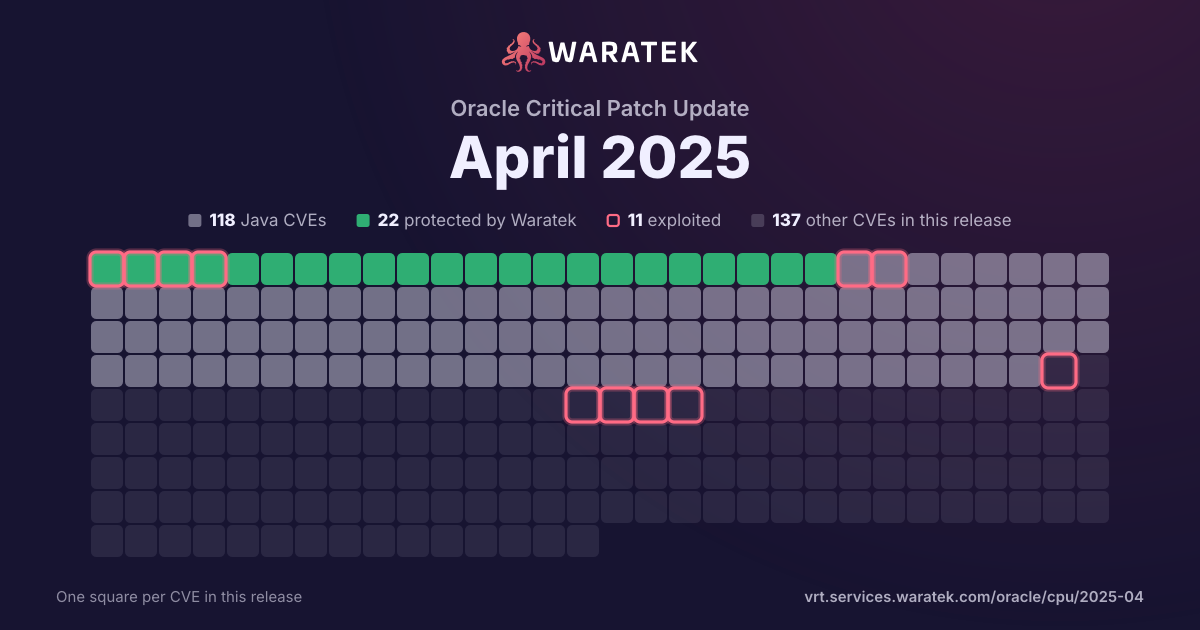
By status
22Protected by Waratek8Mitigation candidate88No exploit published16Outside Waratek scope121Not applicable
11Exploited, marked by the ring
No exploit published. For 33 of them, Oracle's security advisory is the source of public detail.
Protected by Waratek. Waratek RASP can block exploitation of these on systems that have not applied the patch yet.
Overview 255 matches · 118 in Waratek scope · 22 protected · 11 exploited · 6 CISA KEV · 21 public PoC · 12 EPSS ≥ 0.5
255matches
118in Waratek scope46.3%
22protected8.6%
11exploited4.3%
6CISA KEV2.4%
21public PoC8.2%
12EPSS ≥ 0.54.7%
Protected by Waratek
22
8.6%
Rule in development
0
0.0%
Mitigation candidate
8
3.1%
No exploit published
88
34.5%
Outside Waratek scope
16
6.3%
Not applicable
121
47.5%
Withdrawn CVE
0
0.0%
blocked by ARMR today
22
8.6%
partly blocked
0
0.0%
not blocked
233
91.4%
not established
0
0.0%
unrecorded
0
0.0%
split by
peak 75 / quarter
Q1 203
Protected by Waratek2
No exploit published1
Critical2
Medium1
blocked by ARMR today2
not blocked1
Exploited1
Proof of concept only1
No public exploit1
Q2 202
Protected by Waratek1
Mitigation candidate1
High2
blocked by ARMR today1
not blocked1
Working exploit published1
Proof of concept only1
Q3 201
Mitigation candidate1
High1
not blocked1
Working exploit published1
Q4 202
Protected by Waratek1
No exploit published1
High1
Medium1
blocked by ARMR today1
not blocked1
Forecast only1
No public exploit1
Q1 214
Protected by Waratek2
No exploit published2
High3
Medium1
blocked by ARMR today2
not blocked2
No public exploit4
Q2 212
No exploit published1
Outside Waratek scope1
High1
Medium1
not blocked2
No public exploit2
Q3 214
No exploit published4
High2
Medium2
not blocked4
Forecast only1
No public exploit3
Q4 213
No exploit published1
Outside Waratek scope2
Critical1
Medium2
not blocked3
Proof of concept only1
No public exploit2
Q1 221
No exploit published1
High1
not blocked1
No public exploit1
Q2 221
No exploit published1
High1
not blocked1
No public exploit1
Q3 222
Protected by Waratek1
No exploit published1
Medium1
Low1
blocked by ARMR today1
not blocked1
Proof of concept only1
No public exploit1
Q4 225
Protected by Waratek2
No exploit published2
Not applicable1
Critical1
High4
blocked by ARMR today2
not blocked3
Proof of concept only2
No public exploit3
Q1 235
Protected by Waratek2
No exploit published3
High4
Medium1
blocked by ARMR today2
not blocked3
Exploited1
Proof of concept only1
No public exploit3
Q2 231
No exploit published1
Medium1
not blocked1
No public exploit1
Q3 237
Protected by Waratek2
Mitigation candidate1
No exploit published3
Not applicable1
Critical1
High1
Medium4
Low1
blocked by ARMR today2
not blocked5
Proof of concept only1
No public exploit6
Q4 238
Mitigation candidate2
No exploit published3
Outside Waratek scope1
Not applicable2
High3
Medium4
Low1
not blocked8
Exploited2
Working exploit published1
No public exploit5
Q1 2414
Mitigation candidate1
No exploit published7
Not applicable6
Critical2
High6
Medium6
not blocked14
Proof of concept only3
No public exploit11
Q2 2411
No exploit published3
Outside Waratek scope2
Not applicable6
Critical1
High4
Medium6
not blocked11
Proof of concept only1
No public exploit10
Q3 2423
Protected by Waratek2
No exploit published6
Outside Waratek scope1
Not applicable14
Critical3
High9
Medium11
blocked by ARMR today2
not blocked21
Exploited1
Proof of concept only3
Forecast only1
No public exploit18
Q4 2454
Protected by Waratek5
Mitigation candidate2
No exploit published12
Outside Waratek scope4
Not applicable31
Critical7
High12
Medium33
Low2
blocked by ARMR today5
not blocked49
Exploited3
Working exploit published1
Proof of concept only14
No public exploit36
Q1 2527
Protected by Waratek1
No exploit published5
Outside Waratek scope3
Not applicable18
Critical3
High13
Medium11
blocked by ARMR today1
not blocked26
Exploited3
Proof of concept only5
No public exploit19
Q2 2575
Protected by Waratek1
No exploit published30
Outside Waratek scope2
Not applicable42
Critical1
High14
Medium56
Low4
blocked by ARMR today1
not blocked74
Proof of concept only1
No public exploit74
Q2 20Q4 20Q2 21Q4 21Q2 22Q4 22Q2 23Q4 23Q2 24Q4 24Q2 25
| CVE | Severity | Published▾ | Status | Exploitation | Description |
|---|---|---|---|---|---|
| CVE-2024-25710 | High | 2024-02-19 | No exploit published | No public exploit | Loop with Unreachable Exit Condition ('Infinite Loop') vulnerability in Apache Commons Compress.This issue affects Apache Commons Compress: from 1.3 through 1.25.0. Users are recommended to upgrade to version 1.26.0 which fixes the issue. |
| CVE-2023-52428 | High | 2024-02-11 | No exploit published | No public exploit | In Connect2id Nimbus JOSE+JWT before 9.37.2, an attacker can cause a denial of service (resource consumption) via a large JWE p2c header value (aka iteration count) for the PasswordBasedDecrypter (PBKDF2) component. |
| CVE-2022-34381 | Critical | 2024-02-02 | Not applicable | No public exploit | Dell BSAFE SSL-J version 7.0 and all versions prior to 6.5, and Dell BSAFE Crypto-J versions prior to 6.2.6.1 contain an unmaintained third-party component vulnerability. An unauthenticated remote attacker could potentially exploit this vulnerability, leading to the compromise of the impacted system. This is a Critical vulnerability and Dell recommends customers to upgrade at the earliest opportunity. |
| CVE-2023-51441 | High | 2024-01-06 | No exploit published | No public exploit | ** UNSUPPORTED WHEN ASSIGNED ** Improper Input Validation vulnerability in Apache Axis allowed users with access to the admin service to perform possible SSRF This issue affects Apache Axis: through 1.3. As Axis 1 has been EOL we recommend you migrate to a different SOAP engine, such as Apache Axis 2/Java. Alternatively you could use a build of Axis with the patch from https://github.com/apache/axis-axis1-java/commit/685c309febc64aa393b2d64a05f90e7eb9f73e06 applied. The Apache Axis project does not expect to create an Axis 1.x release fixing this problem, though contributors that would like to work towards this are welcome. |
| CVE-2023-51074 | Medium | 2023-12-27 | No exploit published | No public exploit | json-path v2.8.0 was discovered to contain a stack overflow via the Criteria.parse() method. |
| CVE-2023-48795 | Medium | 2023-12-18 | Outside Waratek scope | Exploited | The SSH transport protocol with certain OpenSSH extensions, found in OpenSSH before 9.6 and other products, allows remote attackers to bypass integrity checks such that some packets are omitted (from the extension negotiation message), and a client and server may consequently end up with a connection for which some security features have been downgraded or disabled, aka a Terrapin attack. This occurs because the SSH Binary Packet Protocol (BPP), implemented by these extensions, mishandles the handshake phase and mishandles use of sequence numbers. For example, there is an effective attack against SSH's use of ChaCha20-Poly1305 (and CBC with Encrypt-then-MAC). The bypass occurs in chacha20-poly1305@openssh.com and (if CBC is used) the -etm@openssh.com MAC algorithms. This also affects Maverick Synergy Java SSH API before 3.1.0-SNAPSHOT, Dropbear through 2022.83, Ssh before 5.1.1 in Erlang/OTP, PuTTY before 0.80, AsyncSSH before 2.14.2, golang.org/x/crypto before 0.17.0, libssh before 0.10.6, libssh2 through 1.11.0, Thorn Tech SFTP Gateway before 3.4.6, Tera Term before 5.1, Paramiko before 3.4.0, jsch before 0.2.15, SFTPGo before 2.5.6, Netgate pfSense Plus through 23.09.1, Netgate pfSense CE through 2.7.2, HPN-SSH through 18.2.0, ProFTPD before 1.3.8b (and before 1.3.9rc2), ORYX CycloneSSH before 2.3.4, NetSarang XShell 7 before Build 0144, CrushFTP before 10.6.0, ConnectBot SSH library before 2.2.22, Apache MINA sshd through 2.11.0, sshj through 0.37.0, TinySSH through 20230101, trilead-ssh2 6401, LANCOM LCOS and LANconfig, FileZilla before 3.66.4, Nova before 11.8, PKIX-SSH before 14.4, SecureCRT before 9.4.3, Transmit5 before 5.10.4, Win32-OpenSSH before 9.5.0.0p1-Beta, WinSCP before 6.2.2, Bitvise SSH Server before 9.32, Bitvise SSH Client before 9.33, KiTTY through 0.76.1.13, the net-ssh gem 7.2.0 for Ruby, the mscdex ssh2 module before 1.15.0 for Node.js, the thrussh library before 0.35.1 for Rust, and the Russh crate before 0.40.2 for Rust. |
| CVE-2023-46589 | High | 2023-11-28 | No exploit published | No public exploit | Improper Input Validation vulnerability in Apache Tomcat.Tomcat from 11.0.0-M1 through 11.0.0-M10, from 10.1.0-M1 through 10.1.15, from 9.0.0-M1 through 9.0.82 and from 8.5.0 through 8.5.95 did not correctly parse HTTP trailer headers. A trailer header that exceeded the header size limit could cause Tomcat to treat a single request as multiple requests leading to the possibility of request smuggling when behind a reverse proxy. Older, EOL versions may also be affected. Users are recommended to upgrade to version 11.0.0-M11 onwards, 10.1.16 onwards, 9.0.83 onwards or 8.5.96 onwards, which fix the issue. |
| CVE-2023-38546 | Low | 2023-10-18 | Not applicable | No public exploit | This flaw allows an attacker to insert cookies at will into a running program using libcurl, if the specific series of conditions are met. libcurl performs transfers. In its API, an application creates "easy handles" that are the individual handles for single transfers. libcurl provides a function call that duplicates en easy handle called [curl_easy_duphandle](https://curl.se/libcurl/c/curl_easy_duphandle.html). If a transfer has cookies enabled when the handle is duplicated, the cookie-enable state is also cloned - but without cloning the actual cookies. If the source handle did not read any cookies from a specific file on disk, the cloned version of the handle would instead store the file name as `none` (using the four ASCII letters, no quotes). Subsequent use of the cloned handle that does not explicitly set a source to load cookies from would then inadvertently load cookies from a file named `none` - if such a file exists and is readable in the current directory of the program using libcurl. And if using the correct file format of course. |
| CVE-2023-37536 | High | 2023-10-11 | Not applicable | No public exploit | An integer overflow in xerces-c++ 3.2.3 in BigFix Platform allows remote attackers to cause out-of-bound access via HTTP request. |
| CVE-2023-45648 | Medium | 2023-10-10 | Mitigation candidate | Working exploit published | Improper Input Validation vulnerability in Apache Tomcat.Tomcat from 11.0.0-M1 through 11.0.0-M11, from 10.1.0-M1 through 10.1.13, from 9.0.0-M1 through 9.0.81 and from 8.5.0 through 8.5.93 did not correctly parse HTTP trailer headers. A specially crafted, invalid trailer header could cause Tomcat to treat a single request as multiple requests leading to the possibility of request smuggling when behind a reverse proxy. Older, EOL versions may also be affected. Users are recommended to upgrade to version 11.0.0-M12 onwards, 10.1.14 onwards, 9.0.81 onwards or 8.5.94 onwards, which fix the issue. |
| CVE-2023-44487 | High | 2023-10-10 | Mitigation candidate | Exploited | The HTTP/2 protocol allows a denial of service (server resource consumption) because request cancellation can reset many streams quickly, as exploited in the wild in August through October 2023. |
| CVE-2023-42795 | Medium | 2023-10-10 | No exploit published | No public exploit | Incomplete Cleanup vulnerability in Apache Tomcat.When recycling various internal objects in Apache Tomcat from 11.0.0-M1 through 11.0.0-M11, from 10.1.0-M1 through 10.1.13, from 9.0.0-M1 through 9.0.80 and from 8.5.0 through 8.5.93, an error could cause Tomcat to skip some parts of the recycling process leading to information leaking from the current request/response to the next. Older, EOL versions may also be affected. Users are recommended to upgrade to version 11.0.0-M12 onwards, 10.1.14 onwards, 9.0.81 onwards or 8.5.94 onwards, which fixes the issue. |
| CVE-2023-39410 | High | 2023-09-29 | Protected by Waratek | No public exploit | When deserializing untrusted or corrupted data, it is possible for a reader to consume memory beyond the allowed constraints and thus lead to out of memory on the system. This issue affects Java applications using Apache Avro Java SDK up to and including 1.11.2. Users should update to apache-avro version 1.11.3 which addresses this issue. |
| CVE-2023-40167 | Medium | 2023-09-15 | No exploit published | No public exploit | Jetty is a Java based web server and servlet engine. Prior to versions 9.4.52, 10.0.16, 11.0.16, and 12.0.1, Jetty accepts the `+` character proceeding the content-length value in a HTTP/1 header field. This is more permissive than allowed by the RFC and other servers routinely reject such requests with 400 responses. There is no known exploit scenario, but it is conceivable that request smuggling could result if jetty is used in combination with a server that does not close the connection after sending such a 400 response. Versions 9.4.52, 10.0.16, 11.0.16, and 12.0.1 contain a patch for this issue. There is no workaround as there is no known exploit scenario. |
| CVE-2023-36479 | Low | 2023-09-15 | No exploit published | No public exploit | Eclipse Jetty Canonical Repository is the canonical repository for the Jetty project. Users of the CgiServlet with a very specific command structure may have the wrong command executed. If a user sends a request to a org.eclipse.jetty.servlets.CGI Servlet for a binary with a space in its name, the servlet will escape the command by wrapping it in quotation marks. This wrapped command, plus an optional command prefix, will then be executed through a call to Runtime.exec. If the original binary name provided by the user contains a quotation mark followed by a space, the resulting command line will contain multiple tokens instead of one. This issue was patched in version 9.4.52, 10.0.16, 11.0.16 and 12.0.0-beta2. |
| CVE-2023-40743 | Critical | 2023-09-05 | No exploit published | No public exploit | ** UNSUPPORTED WHEN ASSIGNED ** When integrating Apache Axis 1.x in an application, it may not have been obvious that looking up a service through "ServiceFactory.getService" allows potentially dangerous lookup mechanisms such as LDAP. When passing untrusted input to this API method, this could expose the application to DoS, SSRF and even attacks leading to RCE. As Axis 1 has been EOL we recommend you migrate to a different SOAP engine, such as Apache Axis 2/Java. As a workaround, you may review your code to verify no untrusted or unsanitized input is passed to "ServiceFactory.getService", or by applying the patch from https://github.com/apache/axis-axis1-java/commit/7e66753427466590d6def0125e448d2791723210 . The Apache Axis project does not expect to create an Axis 1.x release fixing this problem, though contributors that would like to work towards this are welcome. |
| CVE-2023-41080 | Medium | 2023-08-25 | Mitigation candidate | Proof of concept only | URL Redirection to Untrusted Site ('Open Redirect') vulnerability in FORM authentication feature Apache Tomcat.This issue affects Apache Tomcat: from 11.0.0-M1 through 11.0.0-M10, from 10.1.0-M1 through 10.0.12, from 9.0.0-M1 through 9.0.79 and from 8.5.0 through 8.5.92. Older, EOL versions may also be affected. The vulnerability is limited to the ROOT (default) web application. |
| CVE-2023-35887 | Medium | 2023-07-10 | Protected by Waratek | No public exploit | Exposure of Sensitive Information to an Unauthorized Actor vulnerability in Apache Software Foundation Apache MINA. In SFTP servers implemented using Apache MINA SSHD that use a RootedFileSystem, logged users may be able to discover "exists/does not exist" information about items outside the rooted tree via paths including parent navigation ("..") beyond the root, or involving symlinks. This issue affects Apache MINA: from 1.0 before 2.10. Users are recommended to upgrade to 2.10 |
| CVE-2023-25399 | Medium | 2023-07-05 | Not applicable | No public exploit | A refcounting issue which leads to potential memory leak was discovered in scipy commit 8627df31ab in Py_FindObjects() function. Note: This is disputed as a bug and not a vulnerability. SciPy is not designed to be exposed to untrusted users or data directly. |
| CVE-2023-35116 | Medium | 2023-06-14 | No exploit published | No public exploit | jackson-databind through 2.15.2 allows attackers to cause a denial of service or other unspecified impact via a crafted object that uses cyclic dependencies. NOTE: the vendor's perspective is that this is not a valid vulnerability report, because the steps of constructing a cyclic data structure and trying to serialize it cannot be achieved by an external attacker. |
| CVE-2023-28708 | Medium | 2023-03-22 | No exploit published | No public exploit | When using the RemoteIpFilter with requests received from a reverse proxy via HTTP that include the X-Forwarded-Proto header set to https, session cookies created by Apache Tomcat 11.0.0-M1 to 11.0.0.-M2, 10.1.0-M1 to 10.1.5, 9.0.0-M1 to 9.0.71 and 8.5.0 to 8.5.85 did not include the secure attribute. This could result in the user agent transmitting the session cookie over an insecure channel. Older, EOL versions may also be affected. |
| CVE-2023-1370 | High | 2023-03-22 | No exploit published | Proof of concept only | [Json-smart](https://netplex.github.io/json-smart/) is a performance focused, JSON processor lib. When reaching a ‘[‘ or ‘{‘ character in the JSON input, the code parses an array or an object respectively. It was discovered that the code does not have any limit to the nesting of such arrays or objects. Since the parsing of nested arrays and objects is done recursively, nesting too many of them can cause a stack exhaustion (stack overflow) and crash the software. |
| CVE-2021-46877 | High | 2023-03-18 | Protected by Waratek | No public exploit | jackson-databind 2.10.x through 2.12.x before 2.12.6 and 2.13.x before 2.13.1 allows attackers to cause a denial of service (2 GB transient heap usage per read) in uncommon situations involving JsonNode JDK serialization. |
| CVE-2023-26464 | High | 2023-03-10 | Protected by Waratek | Exploited | ** UNSUPPORTED WHEN ASSIGNED ** When using the Chainsaw or SocketAppender components with Log4j 1.x on JRE less than 1.7, an attacker that manages to cause a logging entry involving a specially-crafted (ie, deeply nested) hashmap or hashtable (depending on which logging component is in use) to be processed could exhaust the available memory in the virtual machine and achieve Denial of Service when the object is deserialized. This issue affects Apache Log4j before 2. Affected users are recommended to update to Log4j 2.x. NOTE: This vulnerability only affects products that are no longer supported by the maintainer. |
| CVE-2023-24998 | High | 2023-02-20 | No exploit published | No public exploit | Apache Commons FileUpload before 1.5 does not limit the number of request parts to be processed resulting in the possibility of an attacker triggering a DoS with a malicious upload or series of uploads. Note that, like all of the file upload limits, the new configuration option (FileUploadBase#setFileCountMax) is not enabled by default and must be explicitly configured. |
| CVE-2022-45047 | Critical | 2022-11-16 | Protected by Waratek | Proof of concept only | Class org.apache.sshd.server.keyprovider.SimpleGeneratorHostKeyProvider in Apache MINA SSHD <= 2.9.1 uses Java deserialization to load a serialized java.security.PrivateKey. The class is one of several implementations that an implementor using Apache MINA SSHD can choose for loading the host keys of an SSH server. |
| CVE-2022-42252 | High | 2022-11-01 | No exploit published | No public exploit | If Apache Tomcat 8.5.0 to 8.5.82, 9.0.0-M1 to 9.0.67, 10.0.0-M1 to 10.0.26 or 10.1.0-M1 to 10.1.0 was configured to ignore invalid HTTP headers via setting rejectIllegalHeader to false (the default for 8.5.x only), Tomcat did not reject a request containing an invalid Content-Length header making a request smuggling attack possible if Tomcat was located behind a reverse proxy that also failed to reject the request with the invalid header. |
| CVE-2022-3786 | High | 2022-11-01 | Not applicable | Proof of concept only | A buffer overrun can be triggered in X.509 certificate verification, specifically in name constraint checking. Note that this occurs after certificate chain signature verification and requires either a CA to have signed a malicious certificate or for an application to continue certificate verification despite failure to construct a path to a trusted issuer. An attacker can craft a malicious email address in a certificate to overflow an arbitrary number of bytes containing the `.' character (decimal 46) on the stack. This buffer overflow could result in a crash (causing a denial of service). In a TLS client, this can be triggered by connecting to a malicious server. In a TLS server, this can be triggered if the server requests client authentication and a malicious client connects. |
| CVE-2022-42004 | High | 2022-10-02 | Protected by Waratek | No public exploit | In FasterXML jackson-databind before 2.13.4, resource exhaustion can occur because of a lack of a check in BeanDeserializer._deserializeFromArray to prevent use of deeply nested arrays. An application is vulnerable only with certain customized choices for deserialization. |
| CVE-2022-42003 | High | 2022-10-02 | No exploit published | No public exploit | In FasterXML jackson-databind before versions 2.13.4.1 and 2.12.17.1, resource exhaustion can occur because of a lack of a check in primitive value deserializers to avoid deep wrapper array nesting, when the UNWRAP_SINGLE_VALUE_ARRAYS feature is enabled. |
| CVE-2021-43980 | Low | 2022-09-28 | No exploit published | No public exploit | The simplified implementation of blocking reads and writes introduced in Tomcat 10 and back-ported to Tomcat 9.0.47 onwards exposed a long standing (but extremely hard to trigger) concurrency bug in Apache Tomcat 10.1.0 to 10.1.0-M12, 10.0.0-M1 to 10.0.18, 9.0.0-M1 to 9.0.60 and 8.5.0 to 8.5.77 that could cause client connections to share an Http11Processor instance resulting in responses, or part responses, to be received by the wrong client. |
| CVE-2022-36033 | Medium | 2022-08-29 | Protected by Waratek | Proof of concept only | jsoup is a Java HTML parser, built for HTML editing, cleaning, scraping, and cross-site scripting (XSS) safety. jsoup may incorrectly sanitize HTML including `javascript:` URL expressions, which could allow XSS attacks when a reader subsequently clicks that link. If the non-default `SafeList.preserveRelativeLinks` option is enabled, HTML including `javascript:` URLs that have been crafted with control characters will not be sanitized. If the site that this HTML is published on does not set a Content Security Policy, an XSS attack is then possible. This issue is patched in jsoup 1.15.3. Users should upgrade to this version. Additionally, as the unsanitized input may have been persisted, old content should be cleaned again using the updated version. To remediate this issue without immediately upgrading: - disable `SafeList.preserveRelativeLinks`, which will rewrite input URLs as absolute URLs - ensure an appropriate [Content Security Policy](https://developer.mozilla.org/en-US/docs/Web/HTTP/CSP) is defined. (This should be used regardless of upgrading, as a defence-in-depth best practice.) |
| CVE-2022-25762 | High | 2022-05-13 | No exploit published | No public exploit | If a web application sends a WebSocket message concurrently with the WebSocket connection closing when running on Apache Tomcat 8.5.0 to 8.5.75 or Apache Tomcat 9.0.0.M1 to 9.0.20, it is possible that the application will continue to use the socket after it has been closed. The error handling triggered in this case could cause the a pooled object to be placed in the pool twice. This could result in subsequent connections using the same object concurrently which could result in data being returned to the wrong use and/or other errors. |
| CVE-2020-36518 | High | 2022-03-11 | No exploit published | No public exploit | jackson-databind before 2.13.0 allows a Java StackOverflow exception and denial of service via a large depth of nested objects. |
| CVE-2021-23450 | Critical | 2021-12-17 | Outside Waratek scope | No public exploit | All versions of package dojo are vulnerable to Prototype Pollution via the setObject function. |
| CVE-2021-41973 | Medium | 2021-11-01 | No exploit published | No public exploit | In Apache MINA, a specifically crafted, malformed HTTP request may cause the HTTP Header decoder to loop indefinitely. The decoder assumed that the HTTP Header begins at the beginning of the buffer and loops if there is more data than expected. Please update MINA to 2.1.5 or greater. |
| CVE-2021-41184 | Medium | 2021-10-26 | Outside Waratek scope | Proof of concept only | jQuery-UI is the official jQuery user interface library. Prior to version 1.13.0, accepting the value of the `of` option of the `.position()` util from untrusted sources may execute untrusted code. The issue is fixed in jQuery UI 1.13.0. Any string value passed to the `of` option is now treated as a CSS selector. A workaround is to not accept the value of the `of` option from untrusted sources. |
| CVE-2021-41079 | High | 2021-09-16 | No exploit published | No public exploit | Apache Tomcat 8.5.0 to 8.5.63, 9.0.0-M1 to 9.0.43 and 10.0.0-M1 to 10.0.2 did not properly validate incoming TLS packets. When Tomcat was configured to use NIO+OpenSSL or NIO2+OpenSSL for TLS, a specially crafted packet could be used to trigger an infinite loop resulting in a denial of service. |
| CVE-2021-37714 | High | 2021-08-18 | No exploit published | No public exploit | jsoup is a Java library for working with HTML. Those using jsoup versions prior to 1.14.2 to parse untrusted HTML or XML may be vulnerable to DOS attacks. If the parser is run on user supplied input, an attacker may supply content that causes the parser to get stuck (loop indefinitely until cancelled), to complete more slowly than usual, or to throw an unexpected exception. This effect may support a denial of service attack. The issue is patched in version 1.14.2. There are a few available workarounds. Users may rate limit input parsing, limit the size of inputs based on system resources, and/or implement thread watchdogs to cap and timeout parse runtimes. |
| CVE-2021-33037 | Medium | 2021-07-12 | No exploit published | Forecast only | Apache Tomcat 10.0.0-M1 to 10.0.6, 9.0.0.M1 to 9.0.46 and 8.5.0 to 8.5.66 did not correctly parse the HTTP transfer-encoding request header in some circumstances leading to the possibility to request smuggling when used with a reverse proxy. Specifically: - Tomcat incorrectly ignored the transfer encoding header if the client declared it would only accept an HTTP/1.0 response; - Tomcat honoured the identify encoding; and - Tomcat did not ensure that, if present, the chunked encoding was the final encoding. |
| CVE-2021-30640 | Medium | 2021-07-12 | No exploit published | No public exploit | A vulnerability in the JNDI Realm of Apache Tomcat allows an attacker to authenticate using variations of a valid user name and/or to bypass some of the protection provided by the LockOut Realm. This issue affects Apache Tomcat 10.0.0-M1 to 10.0.5; 9.0.0.M1 to 9.0.45; 8.5.0 to 8.5.65. |
| CVE-2021-31684 | High | 2021-06-01 | No exploit published | No public exploit | A vulnerability was discovered in the indexOf function of JSONParserByteArray in JSON Smart versions 1.3 and 2.4 which causes a denial of service (DOS) via a crafted web request. |
| CVE-2021-28170 | Medium | 2021-05-26 | Outside Waratek scope | No public exploit | In the Jakarta Expression Language implementation 3.0.3 and earlier, a bug in the ELParserTokenManager enables invalid EL expressions to be evaluated as if they were valid. |
| CVE-2020-13936 | High | 2021-03-10 | No exploit published | No public exploit | An attacker that is able to modify Velocity templates may execute arbitrary Java code or run arbitrary system commands with the same privileges as the account running the Servlet container. This applies to applications that allow untrusted users to upload/modify velocity templates running Apache Velocity Engine versions up to 2.2. |
| CVE-2021-25329 | High | 2021-03-01 | Protected by Waratek | No public exploit | The fix for CVE-2020-9484 was incomplete. When using Apache Tomcat 10.0.0-M1 to 10.0.0, 9.0.0.M1 to 9.0.41, 8.5.0 to 8.5.61 or 7.0.0. to 7.0.107 with a configuration edge case that was highly unlikely to be used, the Tomcat instance was still vulnerable to CVE-2020-9494. Note that both the previously published prerequisites for CVE-2020-9484 and the previously published mitigations for CVE-2020-9484 also apply to this issue. |
| CVE-2021-25122 | High | 2021-03-01 | Protected by Waratek | No public exploit | When responding to new h2c connection requests, Apache Tomcat versions 10.0.0-M1 to 10.0.0, 9.0.0.M1 to 9.0.41 and 8.5.0 to 8.5.61 could duplicate request headers and a limited amount of request body from one request to another meaning user A and user B could both see the results of user A's request. |
| CVE-2021-24122 | Medium | 2021-01-14 | No exploit published | No public exploit | When serving resources from a network location using the NTFS file system, Apache Tomcat versions 10.0.0-M1 to 10.0.0-M9, 9.0.0.M1 to 9.0.39, 8.5.0 to 8.5.59 and 7.0.0 to 7.0.106 were susceptible to JSP source code disclosure in some configurations. The root cause was the unexpected behaviour of the JRE API File.getCanonicalPath() which in turn was caused by the inconsistent behaviour of the Windows API (FindFirstFileW) in some circumstances. |
| CVE-2020-25649 | High | 2020-12-03 | Protected by Waratek | No public exploit | A flaw was found in FasterXML Jackson Databind, where it did not have entity expansion secured properly. This flaw allows vulnerability to XML external entity (XXE) attacks. The highest threat from this vulnerability is data integrity. |
| CVE-2020-13943 | Medium | 2020-10-12 | No exploit published | Forecast only | If an HTTP/2 client connecting to Apache Tomcat 10.0.0-M1 to 10.0.0-M7, 9.0.0.M1 to 9.0.37 or 8.5.0 to 8.5.57 exceeded the agreed maximum number of concurrent streams for a connection (in violation of the HTTP/2 protocol), it was possible that a subsequent request made on that connection could contain HTTP headers - including HTTP/2 pseudo headers - from a previous request rather than the intended headers. This could lead to users seeing responses for unexpected resources. |
| CVE-2020-13935 | High | 2020-07-14 | Mitigation candidate | Working exploit published | The payload length in a WebSocket frame was not correctly validated in Apache Tomcat 10.0.0-M1 to 10.0.0-M6, 9.0.0.M1 to 9.0.36, 8.5.0 to 8.5.56 and 7.0.27 to 7.0.104. Invalid payload lengths could trigger an infinite loop. Multiple requests with invalid payload lengths could lead to a denial of service. |
| CVE-2020-11996 | High | 2020-06-26 | Mitigation candidate | Proof of concept only | A specially crafted sequence of HTTP/2 requests sent to Apache Tomcat 10.0.0-M1 to 10.0.0-M5, 9.0.0.M1 to 9.0.35 and 8.5.0 to 8.5.55 could trigger high CPU usage for several seconds. If a sufficient number of such requests were made on concurrent HTTP/2 connections, the server could become unresponsive. |
| CVE-2020-9484 | High | 2020-05-20 | Protected by Waratek | Working exploit published | When using Apache Tomcat versions 10.0.0-M1 to 10.0.0-M4, 9.0.0.M1 to 9.0.34, 8.5.0 to 8.5.54 and 7.0.0 to 7.0.103 if a) an attacker is able to control the contents and name of a file on the server; and b) the server is configured to use the PersistenceManager with a FileStore; and c) the PersistenceManager is configured with sessionAttributeValueClassNameFilter="null" (the default unless a SecurityManager is used) or a sufficiently lax filter to allow the attacker provided object to be deserialized; and d) the attacker knows the relative file path from the storage location used by FileStore to the file the attacker has control over; then, using a specifically crafted request, the attacker will be able to trigger remote code execution via deserialization of the file under their control. Note that all of conditions a) to d) must be true for the attack to succeed. |
| CVE-2020-1938 | Critical | 2020-02-24 | Protected by Waratek | Exploited | When using the Apache JServ Protocol (AJP), care must be taken when trusting incoming connections to Apache Tomcat. Tomcat treats AJP connections as having higher trust than, for example, a similar HTTP connection. If such connections are available to an attacker, they can be exploited in ways that may be surprising. In Apache Tomcat 9.0.0.M1 to 9.0.0.30, 8.5.0 to 8.5.50 and 7.0.0 to 7.0.99, Tomcat shipped with an AJP Connector enabled by default that listened on all configured IP addresses. It was expected (and recommended in the security guide) that this Connector would be disabled if not required. This vulnerability report identified a mechanism that allowed: - returning arbitrary files from anywhere in the web application - processing any file in the web application as a JSP Further, if the web application allowed file upload and stored those files within the web application (or the attacker was able to control the content of the web application by some other means) then this, along with the ability to process a file as a JSP, made remote code execution possible. It is important to note that mitigation is only required if an AJP port is accessible to untrusted users. Users wishing to take a defence-in-depth approach and block the vector that permits returning arbitrary files and execution as JSP may upgrade to Apache Tomcat 9.0.31, 8.5.51 or 7.0.100 or later. A number of changes were made to the default AJP Connector configuration in 9.0.31 to harden the default configuration. It is likely that users upgrading to 9.0.31, 8.5.51 or 7.0.100 or later will need to make small changes to their configurations. |
| CVE-2020-1935 | Medium | 2020-02-24 | No exploit published | No public exploit | In Apache Tomcat 9.0.0.M1 to 9.0.30, 8.5.0 to 8.5.50 and 7.0.0 to 7.0.99 the HTTP header parsing code used an approach to end-of-line parsing that allowed some invalid HTTP headers to be parsed as valid. This led to a possibility of HTTP Request Smuggling if Tomcat was located behind a reverse proxy that incorrectly handled the invalid Transfer-Encoding header in a particular manner. Such a reverse proxy is considered unlikely. |
| CVE-2016-1000027 | Critical | 2020-01-02 | Protected by Waratek | Proof of concept only | Pivotal Spring Framework through 5.3.16 suffers from a potential remote code execution (RCE) issue if used for Java deserialization of untrusted data. Depending on how the library is implemented within a product, this issue may or not occur, and authentication may be required. NOTE: the vendor's position is that untrusted data is not an intended use case. The product's behavior will not be changed because some users rely on deserialization of trusted data. |