
Oracle Critical Patch Update January 2025
Released January 2025 · Oracle's advisory ↗ · ← Critical Patch Update, October 2024 · Critical Patch Update, April 2025 →
253 CVEs in this release, one square each
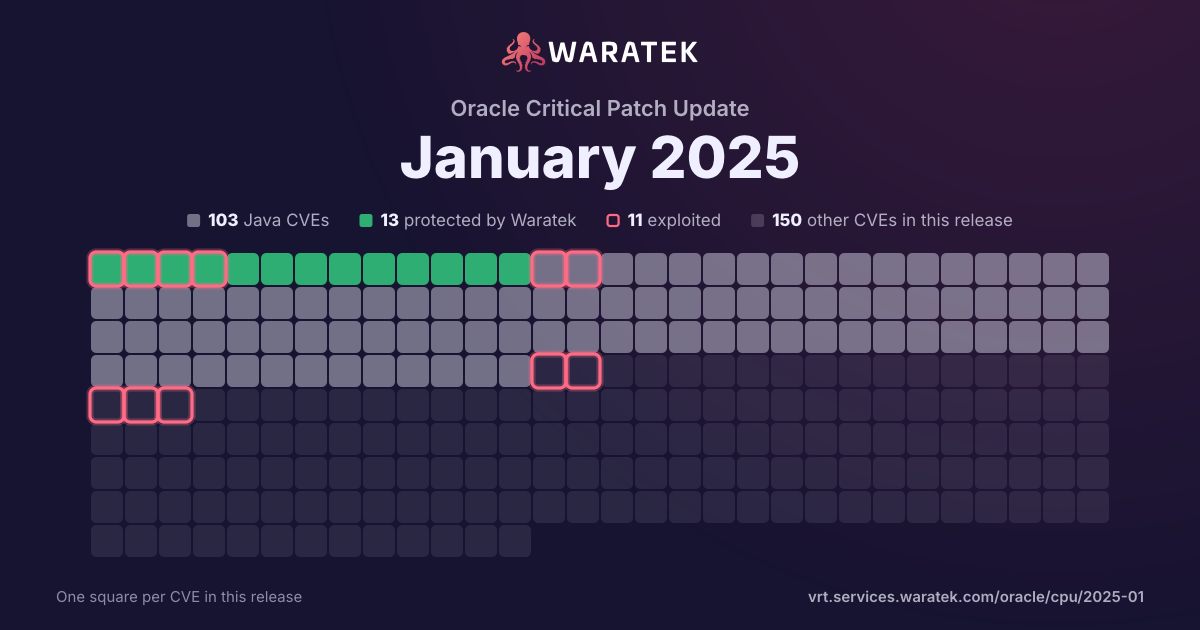
By status
13Protected by Waratek4Mitigation candidate86No exploit published17Outside Waratek scope133Not applicable
11Exploited, marked by the ring
No exploit published. For 48 of them, Oracle's security advisory is the source of public detail.
Protected by Waratek. Waratek RASP can block exploitation of these on systems that have not applied the patch yet.
Overview 103 matches · 13 protected · 6 exploited · 2 CISA KEV · 9 public PoC · 5 EPSS ≥ 0.5
Protected by Waratek
13
12.6%
Rule in development
0
0.0%
Mitigation candidate
4
3.9%
No exploit published
86
83.5%
blocked by ARMR today
13
12.6%
partly blocked
0
0.0%
not blocked
90
87.4%
not established
0
0.0%
unrecorded
0
0.0%
split by
peak 45 / quarter
Q3 191
No exploit published1
Medium1
not blocked1
No public exploit1
Q4 191
Protected by Waratek1
Medium1
blocked by ARMR today1
No public exploit1
Q1 201
Protected by Waratek1
Critical1
blocked by ARMR today1
Proof of concept only1
Q2 201
No exploit published1
High1
not blocked1
No public exploit1
Q3 200
Q4 202
No exploit published2
High2
not blocked2
No public exploit2
Q1 211
Protected by Waratek1
Critical1
blocked by ARMR today1
No public exploit1
Q2 213
Protected by Waratek1
No exploit published2
High2
Medium1
blocked by ARMR today1
not blocked2
No public exploit3
Q3 210
Q4 210
Q1 220
Q2 220
Q3 222
Protected by Waratek1
No exploit published1
High2
blocked by ARMR today1
not blocked1
Proof of concept only1
No public exploit1
Q4 220
Q1 231
No exploit published1
High1
not blocked1
No public exploit1
Q2 231
No exploit published1
High1
not blocked1
No public exploit1
Q3 232
Protected by Waratek1
No exploit published1
High1
Medium1
blocked by ARMR today1
not blocked1
No public exploit2
Q4 235
Protected by Waratek1
Mitigation candidate1
No exploit published3
Critical1
High1
Medium3
blocked by ARMR today1
not blocked4
Exploited2
No public exploit3
Q1 2410
Mitigation candidate1
No exploit published9
High4
Medium6
not blocked10
Proof of concept only3
No public exploit7
Q2 247
No exploit published7
High6
Medium1
not blocked7
No public exploit7
Q3 246
Protected by Waratek2
No exploit published4
High5
Medium1
blocked by ARMR today2
not blocked4
Exploited1
No public exploit5
Q4 2414
Protected by Waratek3
Mitigation candidate2
No exploit published9
Critical4
High1
Medium8
Low1
blocked by ARMR today3
not blocked11
Exploited2
Working exploit published1
Proof of concept only2
No public exploit9
Q1 2545
Protected by Waratek1
No exploit published44
Critical4
High10
Medium31
blocked by ARMR today1
not blocked44
Exploited1
No public exploit44
Q3 19Q1 20Q3 20Q1 21Q3 21Q1 22Q3 22Q1 23Q3 23Q1 24Q3 24Q1 25
| CVE | Severity | Published▾ | Status | Exploitation | Description |
|---|---|---|---|---|---|
| CVE-2025-21570 | Medium | 2025-01-21 | No exploit published | No public exploit | Vulnerability in the Oracle Life Sciences Argus Safety product of Oracle Health Sciences Applications (component: Login). The supported version that is affected is 8.2.3. Easily exploitable vulnerability allows unauthenticated attacker with network access via HTTP to compromise Oracle Life Sciences Argus Safety. Successful attacks require human interaction from a person other than the attacker and while the vulnerability is in Oracle Life Sciences Argus Safety, attacks may significantly impact additional products (scope change). Successful attacks of this vulnerability can result in unauthorized update, insert or delete access to some of Oracle Life Sciences Argus Safety accessible data as well as unauthorized read access to a subset of Oracle Life Sciences Argus Safety accessible data. CVSS 3.1 Base Score 6.1 (Confidentiality and Integrity impacts). CVSS Vector: (CVSS:3.1/AV:N/AC:L/PR:N/UI:R/S:C/C:L/I:L/A:N). |
| CVE-2025-21569 | Medium | 2025-01-21 | No exploit published | No public exploit | Vulnerability in the Oracle Hyperion Data Relationship Management product of Oracle Hyperion (component: Web Services). The supported version that is affected is 11.2.19.0.000. Difficult to exploit vulnerability allows high privileged attacker with network access via HTTP to compromise Oracle Hyperion Data Relationship Management. Successful attacks of this vulnerability can result in takeover of Oracle Hyperion Data Relationship Management. CVSS 3.1 Base Score 6.6 (Confidentiality, Integrity and Availability impacts). CVSS Vector: (CVSS:3.1/AV:N/AC:H/PR:H/UI:N/S:U/C:H/I:H/A:H). |
| CVE-2025-21568 | Medium | 2025-01-21 | No exploit published | No public exploit | Vulnerability in the Oracle Hyperion Data Relationship Management product of Oracle Hyperion (component: Access and Security). The supported version that is affected is 11.2.19.0.000. Easily exploitable vulnerability allows high privileged attacker with network access via HTTP to compromise Oracle Hyperion Data Relationship Management. Successful attacks require human interaction from a person other than the attacker. Successful attacks of this vulnerability can result in unauthorized access to critical data or complete access to all Oracle Hyperion Data Relationship Management accessible data. CVSS 3.1 Base Score 4.5 (Confidentiality impacts). CVSS Vector: (CVSS:3.1/AV:N/AC:L/PR:H/UI:R/S:U/C:H/I:N/A:N). |
| CVE-2025-21565 | High | 2025-01-21 | No exploit published | No public exploit | Vulnerability in the Oracle Agile PLM Framework product of Oracle Supply Chain (component: Install). The supported version that is affected is 9.3.6. Easily exploitable vulnerability allows unauthenticated attacker with network access via HTTP to compromise Oracle Agile PLM Framework. Successful attacks of this vulnerability can result in unauthorized access to critical data or complete access to all Oracle Agile PLM Framework accessible data. CVSS 3.1 Base Score 7.5 (Confidentiality impacts). CVSS Vector: (CVSS:3.1/AV:N/AC:L/PR:N/UI:N/S:U/C:H/I:N/A:N). |
| CVE-2025-21564 | High | 2025-01-21 | No exploit published | No public exploit | Vulnerability in the Oracle Agile PLM Framework product of Oracle Supply Chain (component: Agile Integration Services). The supported version that is affected is 9.3.6. Easily exploitable vulnerability allows low privileged attacker with network access via HTTP to compromise Oracle Agile PLM Framework. Successful attacks of this vulnerability can result in unauthorized access to critical data or complete access to all Oracle Agile PLM Framework accessible data and unauthorized ability to cause a hang or frequently repeatable crash (complete DOS) of Oracle Agile PLM Framework. CVSS 3.1 Base Score 8.1 (Confidentiality and Availability impacts). CVSS Vector: (CVSS:3.1/AV:N/AC:L/PR:L/UI:N/S:U/C:H/I:N/A:H). |
| CVE-2025-21563 | Medium | 2025-01-21 | No exploit published | No public exploit | Vulnerability in the PeopleSoft Enterprise CC Common Application Objects product of Oracle PeopleSoft (component: Run Control Management). The supported version that is affected is 9.2. Easily exploitable vulnerability allows low privileged attacker with network access via HTTP to compromise PeopleSoft Enterprise CC Common Application Objects. Successful attacks of this vulnerability can result in unauthorized update, insert or delete access to some of PeopleSoft Enterprise CC Common Application Objects accessible data. CVSS 3.1 Base Score 4.3 (Integrity impacts). CVSS Vector: (CVSS:3.1/AV:N/AC:L/PR:L/UI:N/S:U/C:N/I:L/A:N). |
| CVE-2025-21562 | Medium | 2025-01-21 | No exploit published | No public exploit | Vulnerability in the PeopleSoft Enterprise CC Common Application Objects product of Oracle PeopleSoft (component: Run Control Management). The supported version that is affected is 9.2. Easily exploitable vulnerability allows low privileged attacker with network access via HTTP to compromise PeopleSoft Enterprise CC Common Application Objects. Successful attacks of this vulnerability can result in unauthorized read access to a subset of PeopleSoft Enterprise CC Common Application Objects accessible data. CVSS 3.1 Base Score 4.3 (Confidentiality impacts). CVSS Vector: (CVSS:3.1/AV:N/AC:L/PR:L/UI:N/S:U/C:L/I:N/A:N). |
| CVE-2025-21561 | Medium | 2025-01-21 | No exploit published | No public exploit | Vulnerability in the PeopleSoft Enterprise SCM Purchasing product of Oracle PeopleSoft (component: Purchasing). The supported version that is affected is 9.2. Easily exploitable vulnerability allows low privileged attacker with network access via HTTP to compromise PeopleSoft Enterprise SCM Purchasing. Successful attacks of this vulnerability can result in unauthorized update, insert or delete access to some of PeopleSoft Enterprise SCM Purchasing accessible data as well as unauthorized read access to a subset of PeopleSoft Enterprise SCM Purchasing accessible data. CVSS 3.1 Base Score 5.4 (Confidentiality and Integrity impacts). CVSS Vector: (CVSS:3.1/AV:N/AC:L/PR:L/UI:N/S:U/C:L/I:L/A:N). |
| CVE-2025-21560 | Medium | 2025-01-21 | No exploit published | No public exploit | Vulnerability in the Oracle Agile PLM Framework product of Oracle Supply Chain (component: SDK-Software Development Kit). The supported version that is affected is 9.3.6. Easily exploitable vulnerability allows low privileged attacker with network access via HTTP to compromise Oracle Agile PLM Framework. Successful attacks of this vulnerability can result in unauthorized access to critical data or complete access to all Oracle Agile PLM Framework accessible data. CVSS 3.1 Base Score 6.5 (Confidentiality impacts). CVSS Vector: (CVSS:3.1/AV:N/AC:L/PR:L/UI:N/S:U/C:H/I:N/A:N). |
| CVE-2025-21558 | Medium | 2025-01-21 | No exploit published | No public exploit | Vulnerability in the Primavera P6 Enterprise Project Portfolio Management product of Oracle Construction and Engineering (component: Web Access). Supported versions that are affected are 20.12.1.0-20.12.21.5, 21.12.1.0-21.12.20.0 and 22.12.1.0. Easily exploitable vulnerability allows low privileged attacker with network access via HTTP to compromise Primavera P6 Enterprise Project Portfolio Management. Successful attacks require human interaction from a person other than the attacker and while the vulnerability is in Primavera P6 Enterprise Project Portfolio Management, attacks may significantly impact additional products (scope change). Successful attacks of this vulnerability can result in unauthorized update, insert or delete access to some of Primavera P6 Enterprise Project Portfolio Management accessible data as well as unauthorized read access to a subset of Primavera P6 Enterprise Project Portfolio Management accessible data. CVSS 3.1 Base Score 5.4 (Confidentiality and Integrity impacts). CVSS Vector: (CVSS:3.1/AV:N/AC:L/PR:L/UI:R/S:C/C:L/I:L/A:N). |
| CVE-2025-21556 | Critical | 2025-01-21 | No exploit published | No public exploit | Vulnerability in the Oracle Agile PLM Framework product of Oracle Supply Chain (component: Agile Integration Services). The supported version that is affected is 9.3.6. Easily exploitable vulnerability allows low privileged attacker with network access via HTTP to compromise Oracle Agile PLM Framework. While the vulnerability is in Oracle Agile PLM Framework, attacks may significantly impact additional products (scope change). Successful attacks of this vulnerability can result in takeover of Oracle Agile PLM Framework. CVSS 3.1 Base Score 9.9 (Confidentiality, Integrity and Availability impacts). CVSS Vector: (CVSS:3.1/AV:N/AC:L/PR:L/UI:N/S:C/C:H/I:H/A:H). |
| CVE-2025-21554 | Medium | 2025-01-21 | No exploit published | No public exploit | Vulnerability in the Oracle Communications Order and Service Management product of Oracle Communications Applications (component: Security). Supported versions that are affected are 7.4.0, 7.4.1 and 7.5.0. Easily exploitable vulnerability allows unauthenticated attacker with network access via HTTP to compromise Oracle Communications Order and Service Management. Successful attacks of this vulnerability can result in unauthorized read access to a subset of Oracle Communications Order and Service Management accessible data. CVSS 3.1 Base Score 5.3 (Confidentiality impacts). CVSS Vector: (CVSS:3.1/AV:N/AC:L/PR:N/UI:N/S:U/C:L/I:N/A:N). |
| CVE-2025-21552 | Medium | 2025-01-21 | No exploit published | No public exploit | Vulnerability in the JD Edwards EnterpriseOne Orchestrator product of Oracle JD Edwards (component: E1 IOT Orchestrator Security). Supported versions that are affected are Prior to 9.2.9.2. Easily exploitable vulnerability allows low privileged attacker with network access via HTTP to compromise JD Edwards EnterpriseOne Orchestrator. Successful attacks of this vulnerability can result in unauthorized access to critical data or complete access to all JD Edwards EnterpriseOne Orchestrator accessible data. CVSS 3.1 Base Score 6.5 (Confidentiality impacts). CVSS Vector: (CVSS:3.1/AV:N/AC:L/PR:L/UI:N/S:U/C:H/I:N/A:N). |
| CVE-2025-21550 | Medium | 2025-01-21 | No exploit published | No public exploit | Vulnerability in the Oracle Financial Services Behavior Detection Platform product of Oracle Financial Services Applications (component: Web UI). Supported versions that are affected are 8.0.8.1, 8.1.2.7 and 8.1.2.8. Easily exploitable vulnerability allows unauthenticated attacker with network access via HTTP to compromise Oracle Financial Services Behavior Detection Platform. Successful attacks require human interaction from a person other than the attacker and while the vulnerability is in Oracle Financial Services Behavior Detection Platform, attacks may significantly impact additional products (scope change). Successful attacks of this vulnerability can result in unauthorized update, insert or delete access to some of Oracle Financial Services Behavior Detection Platform accessible data as well as unauthorized read access to a subset of Oracle Financial Services Behavior Detection Platform accessible data. CVSS 3.1 Base Score 6.1 (Confidentiality and Integrity impacts). CVSS Vector: (CVSS:3.1/AV:N/AC:L/PR:N/UI:R/S:C/C:L/I:L/A:N). |
| CVE-2025-21549 | High | 2025-01-21 | No exploit published | No public exploit | Vulnerability in the Oracle WebLogic Server product of Oracle Fusion Middleware (component: Core). The supported version that is affected is 14.1.1.0.0. Easily exploitable vulnerability allows unauthenticated attacker with network access via HTTP/2 to compromise Oracle WebLogic Server. Successful attacks of this vulnerability can result in unauthorized ability to cause a hang or frequently repeatable crash (complete DOS) of Oracle WebLogic Server. CVSS 3.1 Base Score 7.5 (Availability impacts). CVSS Vector: (CVSS:3.1/AV:N/AC:L/PR:N/UI:N/S:U/C:N/I:N/A:H). |
| CVE-2025-21547 | Critical | 2025-01-21 | No exploit published | No public exploit | Vulnerability in the Oracle Hospitality OPERA 5 product of Oracle Hospitality Applications (component: Opera Servlet). Supported versions that are affected are 5.6.19.20, 5.6.25.8, 5.6.26.6 and 5.6.27.1. Easily exploitable vulnerability allows unauthenticated attacker with network access via HTTP to compromise Oracle Hospitality OPERA 5. Successful attacks of this vulnerability can result in unauthorized access to critical data or complete access to all Oracle Hospitality OPERA 5 accessible data and unauthorized ability to cause a hang or frequently repeatable crash (complete DOS) of Oracle Hospitality OPERA 5. CVSS 3.1 Base Score 9.1 (Confidentiality and Availability impacts). CVSS Vector: (CVSS:3.1/AV:N/AC:L/PR:N/UI:N/S:U/C:H/I:N/A:H). |
| CVE-2025-21545 | High | 2025-01-21 | No exploit published | No public exploit | Vulnerability in the PeopleSoft Enterprise PeopleTools product of Oracle PeopleSoft (component: OpenSearch). Supported versions that are affected are 8.60 and 8.61. Easily exploitable vulnerability allows unauthenticated attacker with network access via HTTP to compromise PeopleSoft Enterprise PeopleTools. Successful attacks of this vulnerability can result in unauthorized ability to cause a hang or frequently repeatable crash (complete DOS) of PeopleSoft Enterprise PeopleTools. CVSS 3.1 Base Score 7.5 (Availability impacts). CVSS Vector: (CVSS:3.1/AV:N/AC:L/PR:N/UI:N/S:U/C:N/I:N/A:H). |
| CVE-2025-21544 | Medium | 2025-01-21 | No exploit published | No public exploit | Vulnerability in the Oracle Communications Order and Service Management product of Oracle Communications Applications (component: Security). Supported versions that are affected are 7.4.0, 7.4.1 and 7.5.0. Easily exploitable vulnerability allows low privileged attacker with network access via HTTP to compromise Oracle Communications Order and Service Management. Successful attacks require human interaction from a person other than the attacker and while the vulnerability is in Oracle Communications Order and Service Management, attacks may significantly impact additional products (scope change). Successful attacks of this vulnerability can result in unauthorized update, insert or delete access to some of Oracle Communications Order and Service Management accessible data as well as unauthorized read access to a subset of Oracle Communications Order and Service Management accessible data. CVSS 3.1 Base Score 5.4 (Confidentiality and Integrity impacts). CVSS Vector: (CVSS:3.1/AV:N/AC:L/PR:L/UI:R/S:C/C:L/I:L/A:N). |
| CVE-2025-21542 | Medium | 2025-01-21 | No exploit published | No public exploit | Vulnerability in the Oracle Communications Order and Service Management product of Oracle Communications Applications (component: Security). Supported versions that are affected are 7.4.0, 7.4.1 and 7.5.0. Easily exploitable vulnerability allows low privileged attacker with network access via HTTP to compromise Oracle Communications Order and Service Management. Successful attacks of this vulnerability can result in unauthorized update, insert or delete access to some of Oracle Communications Order and Service Management accessible data as well as unauthorized read access to a subset of Oracle Communications Order and Service Management accessible data and unauthorized ability to cause a partial denial of service (partial DOS) of Oracle Communications Order and Service Management. CVSS 3.1 Base Score 6.3 (Confidentiality, Integrity and Availability impacts). CVSS Vector: (CVSS:3.1/AV:N/AC:L/PR:L/UI:N/S:U/C:L/I:L/A:L). |
| CVE-2025-21541 | Medium | 2025-01-21 | No exploit published | No public exploit | Vulnerability in the Oracle Workflow product of Oracle E-Business Suite (component: Admin Screens and Grants UI). Supported versions that are affected are 12.2.3-12.2.14. Easily exploitable vulnerability allows low privileged attacker with network access via HTTP to compromise Oracle Workflow. Successful attacks of this vulnerability can result in unauthorized update, insert or delete access to some of Oracle Workflow accessible data as well as unauthorized read access to a subset of Oracle Workflow accessible data. CVSS 3.1 Base Score 5.4 (Confidentiality and Integrity impacts). CVSS Vector: (CVSS:3.1/AV:N/AC:L/PR:L/UI:N/S:U/C:L/I:L/A:N). |
| CVE-2025-21539 | Medium | 2025-01-21 | No exploit published | No public exploit | Vulnerability in the PeopleSoft Enterprise FIN eSettlements product of Oracle PeopleSoft (component: eSettlements). The supported version that is affected is 9.2. Easily exploitable vulnerability allows low privileged attacker with network access via HTTP to compromise PeopleSoft Enterprise FIN eSettlements. Successful attacks of this vulnerability can result in unauthorized update, insert or delete access to some of PeopleSoft Enterprise FIN eSettlements accessible data as well as unauthorized read access to a subset of PeopleSoft Enterprise FIN eSettlements accessible data. CVSS 3.1 Base Score 5.4 (Confidentiality and Integrity impacts). CVSS Vector: (CVSS:3.1/AV:N/AC:L/PR:L/UI:N/S:U/C:L/I:L/A:N). |
| CVE-2025-21538 | Medium | 2025-01-21 | No exploit published | No public exploit | Vulnerability in the JD Edwards EnterpriseOne Tools product of Oracle JD Edwards (component: Web Runtime SEC). Supported versions that are affected are Prior to 9.2.9.2. Easily exploitable vulnerability allows unauthenticated attacker with network access via HTTP to compromise JD Edwards EnterpriseOne Tools. Successful attacks require human interaction from a person other than the attacker and while the vulnerability is in JD Edwards EnterpriseOne Tools, attacks may significantly impact additional products (scope change). Successful attacks of this vulnerability can result in unauthorized update, insert or delete access to some of JD Edwards EnterpriseOne Tools accessible data as well as unauthorized read access to a subset of JD Edwards EnterpriseOne Tools accessible data. CVSS 3.1 Base Score 6.1 (Confidentiality and Integrity impacts). CVSS Vector: (CVSS:3.1/AV:N/AC:L/PR:N/UI:R/S:C/C:L/I:L/A:N). |
| CVE-2025-21537 | Medium | 2025-01-21 | No exploit published | No public exploit | Vulnerability in the PeopleSoft Enterprise FIN Cash Management product of Oracle PeopleSoft (component: Cash Management). The supported version that is affected is 9.2. Easily exploitable vulnerability allows low privileged attacker with network access via HTTP to compromise PeopleSoft Enterprise FIN Cash Management. Successful attacks of this vulnerability can result in unauthorized update, insert or delete access to some of PeopleSoft Enterprise FIN Cash Management accessible data as well as unauthorized read access to a subset of PeopleSoft Enterprise FIN Cash Management accessible data. CVSS 3.1 Base Score 5.4 (Confidentiality and Integrity impacts). CVSS Vector: (CVSS:3.1/AV:N/AC:L/PR:L/UI:N/S:U/C:L/I:L/A:N). |
| CVE-2025-21535 | Critical | 2025-01-21 | Protected by Waratek | Exploited | Vulnerability in the Oracle WebLogic Server product of Oracle Fusion Middleware (component: Core). Supported versions that are affected are 12.2.1.4.0 and 14.1.1.0.0. Easily exploitable vulnerability allows unauthenticated attacker with network access via T3, IIOP to compromise Oracle WebLogic Server. Successful attacks of this vulnerability can result in takeover of Oracle WebLogic Server. CVSS 3.1 Base Score 9.8 (Confidentiality, Integrity and Availability impacts). CVSS Vector: (CVSS:3.1/AV:N/AC:L/PR:N/UI:N/S:U/C:H/I:H/A:H). |
| CVE-2025-21532 | High | 2025-01-21 | No exploit published | No public exploit | Vulnerability in the Oracle Analytics Desktop product of Oracle Analytics (component: Install). Supported versions that are affected are Prior to 8.1.0. Easily exploitable vulnerability allows low privileged attacker with logon to the infrastructure where Oracle Analytics Desktop executes to compromise Oracle Analytics Desktop. Successful attacks of this vulnerability can result in takeover of Oracle Analytics Desktop. CVSS 3.1 Base Score 7.8 (Confidentiality, Integrity and Availability impacts). CVSS Vector: (CVSS:3.1/AV:L/AC:L/PR:L/UI:N/S:U/C:H/I:H/A:H). |
| CVE-2025-21530 | Medium | 2025-01-21 | No exploit published | No public exploit | Vulnerability in the PeopleSoft Enterprise PeopleTools product of Oracle PeopleSoft (component: Panel Processor). Supported versions that are affected are 8.60 and 8.61. Easily exploitable vulnerability allows low privileged attacker with network access via HTTP to compromise PeopleSoft Enterprise PeopleTools. Successful attacks of this vulnerability can result in unauthorized read access to a subset of PeopleSoft Enterprise PeopleTools accessible data. CVSS 3.1 Base Score 4.3 (Confidentiality impacts). CVSS Vector: (CVSS:3.1/AV:N/AC:L/PR:L/UI:N/S:U/C:L/I:N/A:N). |
| CVE-2025-21528 | Medium | 2025-01-21 | No exploit published | No public exploit | Vulnerability in the Primavera P6 Enterprise Project Portfolio Management product of Oracle Construction and Engineering (component: Web Access). Supported versions that are affected are 20.12.1.0-20.12.21.5, 21.12.1.0-21.12.20.0, 22.12.1.0-22.12.16.0 and 23.12.1.0-23.12.10.0. Easily exploitable vulnerability allows unauthenticated attacker with network access via HTTP to compromise Primavera P6 Enterprise Project Portfolio Management. Successful attacks require human interaction from a person other than the attacker. Successful attacks of this vulnerability can result in unauthorized update, insert or delete access to some of Primavera P6 Enterprise Project Portfolio Management accessible data. CVSS 3.1 Base Score 4.3 (Integrity impacts). CVSS Vector: (CVSS:3.1/AV:N/AC:L/PR:N/UI:R/S:U/C:N/I:L/A:N). |
| CVE-2025-21527 | Medium | 2025-01-21 | No exploit published | No public exploit | Vulnerability in the JD Edwards EnterpriseOne Tools product of Oracle JD Edwards (component: Design Tools SEC). Supported versions that are affected are Prior to 9.2.9.0. Easily exploitable vulnerability allows unauthenticated attacker with network access via HTTP to compromise JD Edwards EnterpriseOne Tools. Successful attacks require human interaction from a person other than the attacker and while the vulnerability is in JD Edwards EnterpriseOne Tools, attacks may significantly impact additional products (scope change). Successful attacks of this vulnerability can result in unauthorized update, insert or delete access to some of JD Edwards EnterpriseOne Tools accessible data as well as unauthorized read access to a subset of JD Edwards EnterpriseOne Tools accessible data. CVSS 3.1 Base Score 6.1 (Confidentiality and Integrity impacts). CVSS Vector: (CVSS:3.1/AV:N/AC:L/PR:N/UI:R/S:C/C:L/I:L/A:N). |
| CVE-2025-21526 | Medium | 2025-01-21 | No exploit published | No public exploit | Vulnerability in the Primavera P6 Enterprise Project Portfolio Management product of Oracle Construction and Engineering (component: Web Access). Supported versions that are affected are 20.12.1.0-20.12.21.5, 21.12.1.0-21.12.20.0, 22.12.1.0-22.12.16.0 and 23.12.1.0-23.12.10.0. Easily exploitable vulnerability allows low privileged attacker with network access via HTTP to compromise Primavera P6 Enterprise Project Portfolio Management. Successful attacks require human interaction from a person other than the attacker and while the vulnerability is in Primavera P6 Enterprise Project Portfolio Management, attacks may significantly impact additional products (scope change). Successful attacks of this vulnerability can result in unauthorized update, insert or delete access to some of Primavera P6 Enterprise Project Portfolio Management accessible data as well as unauthorized read access to a subset of Primavera P6 Enterprise Project Portfolio Management accessible data. CVSS 3.1 Base Score 5.4 (Confidentiality and Integrity impacts). CVSS Vector: (CVSS:3.1/AV:N/AC:L/PR:L/UI:R/S:C/C:L/I:L/A:N). |
| CVE-2025-21524 | Critical | 2025-01-21 | No exploit published | No public exploit | Vulnerability in the JD Edwards EnterpriseOne Tools product of Oracle JD Edwards (component: Monitoring and Diagnostics SEC). Supported versions that are affected are Prior to 9.2.9.0. Easily exploitable vulnerability allows unauthenticated attacker with network access via HTTP to compromise JD Edwards EnterpriseOne Tools. Successful attacks of this vulnerability can result in takeover of JD Edwards EnterpriseOne Tools. CVSS 3.1 Base Score 9.8 (Confidentiality, Integrity and Availability impacts). CVSS Vector: (CVSS:3.1/AV:N/AC:L/PR:N/UI:N/S:U/C:H/I:H/A:H). |
| CVE-2025-21517 | Medium | 2025-01-21 | No exploit published | No public exploit | Vulnerability in the JD Edwards EnterpriseOne Tools product of Oracle JD Edwards (component: Web Runtime SEC). Supported versions that are affected are Prior to 9.2.9.0. Easily exploitable vulnerability allows low privileged attacker with network access via HTTP to compromise JD Edwards EnterpriseOne Tools. Successful attacks of this vulnerability can result in unauthorized update, insert or delete access to some of JD Edwards EnterpriseOne Tools accessible data. CVSS 3.1 Base Score 4.3 (Integrity impacts). CVSS Vector: (CVSS:3.1/AV:N/AC:L/PR:L/UI:N/S:U/C:N/I:L/A:N). |
| CVE-2025-21516 | High | 2025-01-21 | No exploit published | No public exploit | Vulnerability in the Oracle Customer Care product of Oracle E-Business Suite (component: Service Requests). Supported versions that are affected are 12.2.5-12.2.13. Easily exploitable vulnerability allows low privileged attacker with network access via HTTP to compromise Oracle Customer Care. Successful attacks of this vulnerability can result in unauthorized creation, deletion or modification access to critical data or all Oracle Customer Care accessible data as well as unauthorized access to critical data or complete access to all Oracle Customer Care accessible data. CVSS 3.1 Base Score 8.1 (Confidentiality and Integrity impacts). CVSS Vector: (CVSS:3.1/AV:N/AC:L/PR:L/UI:N/S:U/C:H/I:H/A:N). |
| CVE-2025-21515 | High | 2025-01-21 | No exploit published | No public exploit | Vulnerability in the JD Edwards EnterpriseOne Tools product of Oracle JD Edwards (component: Web Runtime SEC). Supported versions that are affected are Prior to 9.2.9.0. Easily exploitable vulnerability allows low privileged attacker with network access via HTTP to compromise JD Edwards EnterpriseOne Tools. Successful attacks of this vulnerability can result in takeover of JD Edwards EnterpriseOne Tools. CVSS 3.1 Base Score 8.8 (Confidentiality, Integrity and Availability impacts). CVSS Vector: (CVSS:3.1/AV:N/AC:L/PR:L/UI:N/S:U/C:H/I:H/A:H). |
| CVE-2025-21514 | Medium | 2025-01-21 | No exploit published | No public exploit | Vulnerability in the JD Edwards EnterpriseOne Tools product of Oracle JD Edwards (component: Web Runtime SEC). Supported versions that are affected are Prior to 9.2.9.0. Easily exploitable vulnerability allows unauthenticated attacker with network access via HTTP to compromise JD Edwards EnterpriseOne Tools. Successful attacks of this vulnerability can result in unauthorized read access to a subset of JD Edwards EnterpriseOne Tools accessible data. CVSS 3.1 Base Score 5.3 (Confidentiality impacts). CVSS Vector: (CVSS:3.1/AV:N/AC:L/PR:N/UI:N/S:U/C:L/I:N/A:N). |
| CVE-2025-21513 | Medium | 2025-01-21 | No exploit published | No public exploit | Vulnerability in the JD Edwards EnterpriseOne Tools product of Oracle JD Edwards (component: Web Runtime SEC). Supported versions that are affected are Prior to 9.2.9.0. Easily exploitable vulnerability allows unauthenticated attacker with network access via HTTP to compromise JD Edwards EnterpriseOne Tools. Successful attacks require human interaction from a person other than the attacker and while the vulnerability is in JD Edwards EnterpriseOne Tools, attacks may significantly impact additional products (scope change). Successful attacks of this vulnerability can result in unauthorized update, insert or delete access to some of JD Edwards EnterpriseOne Tools accessible data as well as unauthorized read access to a subset of JD Edwards EnterpriseOne Tools accessible data. CVSS 3.1 Base Score 6.1 (Confidentiality and Integrity impacts). CVSS Vector: (CVSS:3.1/AV:N/AC:L/PR:N/UI:R/S:C/C:L/I:L/A:N). |
| CVE-2025-21512 | Medium | 2025-01-21 | No exploit published | No public exploit | Vulnerability in the JD Edwards EnterpriseOne Tools product of Oracle JD Edwards (component: Web Runtime SEC). Supported versions that are affected are Prior to 9.2.9.0. Easily exploitable vulnerability allows unauthenticated attacker with network access via HTTP to compromise JD Edwards EnterpriseOne Tools. Successful attacks require human interaction from a person other than the attacker and while the vulnerability is in JD Edwards EnterpriseOne Tools, attacks may significantly impact additional products (scope change). Successful attacks of this vulnerability can result in unauthorized update, insert or delete access to some of JD Edwards EnterpriseOne Tools accessible data as well as unauthorized read access to a subset of JD Edwards EnterpriseOne Tools accessible data. CVSS 3.1 Base Score 6.1 (Confidentiality and Integrity impacts). CVSS Vector: (CVSS:3.1/AV:N/AC:L/PR:N/UI:R/S:C/C:L/I:L/A:N). |
| CVE-2025-21511 | High | 2025-01-21 | No exploit published | No public exploit | Vulnerability in the JD Edwards EnterpriseOne Tools product of Oracle JD Edwards (component: Web Runtime SEC). Supported versions that are affected are Prior to 9.2.9.0. Easily exploitable vulnerability allows unauthenticated attacker with network access via HTTP to compromise JD Edwards EnterpriseOne Tools. Successful attacks of this vulnerability can result in unauthorized access to critical data or complete access to all JD Edwards EnterpriseOne Tools accessible data. CVSS 3.1 Base Score 7.5 (Confidentiality impacts). CVSS Vector: (CVSS:3.1/AV:N/AC:L/PR:N/UI:N/S:U/C:H/I:N/A:N). |
| CVE-2025-21510 | High | 2025-01-21 | No exploit published | No public exploit | Vulnerability in the JD Edwards EnterpriseOne Tools product of Oracle JD Edwards (component: Web Runtime SEC). Supported versions that are affected are Prior to 9.2.9.0. Easily exploitable vulnerability allows unauthenticated attacker with network access via HTTP to compromise JD Edwards EnterpriseOne Tools. Successful attacks of this vulnerability can result in unauthorized access to critical data or complete access to all JD Edwards EnterpriseOne Tools accessible data. CVSS 3.1 Base Score 7.5 (Confidentiality impacts). CVSS Vector: (CVSS:3.1/AV:N/AC:L/PR:N/UI:N/S:U/C:H/I:N/A:N). |
| CVE-2025-21509 | Medium | 2025-01-21 | No exploit published | No public exploit | Vulnerability in the JD Edwards EnterpriseOne Tools product of Oracle JD Edwards (component: Web Runtime SEC). Supported versions that are affected are Prior to 9.2.9.0. Easily exploitable vulnerability allows low privileged attacker with network access via HTTP to compromise JD Edwards EnterpriseOne Tools. Successful attacks of this vulnerability can result in unauthorized ability to cause a hang or frequently repeatable crash (complete DOS) of JD Edwards EnterpriseOne Tools. CVSS 3.1 Base Score 6.5 (Availability impacts). CVSS Vector: (CVSS:3.1/AV:N/AC:L/PR:L/UI:N/S:U/C:N/I:N/A:H). |
| CVE-2025-21508 | Medium | 2025-01-21 | No exploit published | No public exploit | Vulnerability in the JD Edwards EnterpriseOne Tools product of Oracle JD Edwards (component: Web Runtime SEC). Supported versions that are affected are Prior to 9.2.9.0. Easily exploitable vulnerability allows low privileged attacker with network access via HTTP to compromise JD Edwards EnterpriseOne Tools. Successful attacks of this vulnerability can result in unauthorized ability to cause a hang or frequently repeatable crash (complete DOS) of JD Edwards EnterpriseOne Tools. CVSS 3.1 Base Score 6.5 (Availability impacts). CVSS Vector: (CVSS:3.1/AV:N/AC:L/PR:L/UI:N/S:U/C:N/I:N/A:H). |
| CVE-2025-21507 | Medium | 2025-01-21 | No exploit published | No public exploit | Vulnerability in the JD Edwards EnterpriseOne Tools product of Oracle JD Edwards (component: Web Runtime SEC). Supported versions that are affected are Prior to 9.2.9.0. Easily exploitable vulnerability allows low privileged attacker with network access via HTTP to compromise JD Edwards EnterpriseOne Tools. Successful attacks require human interaction from a person other than the attacker and while the vulnerability is in JD Edwards EnterpriseOne Tools, attacks may significantly impact additional products (scope change). Successful attacks of this vulnerability can result in unauthorized update, insert or delete access to some of JD Edwards EnterpriseOne Tools accessible data as well as unauthorized read access to a subset of JD Edwards EnterpriseOne Tools accessible data. CVSS 3.1 Base Score 5.4 (Confidentiality and Integrity impacts). CVSS Vector: (CVSS:3.1/AV:N/AC:L/PR:L/UI:R/S:C/C:L/I:L/A:N). |
| CVE-2025-21506 | High | 2025-01-21 | No exploit published | No public exploit | Vulnerability in the Oracle Project Foundation product of Oracle E-Business Suite (component: Technology Foundation). Supported versions that are affected are 12.2.3-12.2.13. Easily exploitable vulnerability allows low privileged attacker with network access via HTTP to compromise Oracle Project Foundation. Successful attacks of this vulnerability can result in unauthorized creation, deletion or modification access to critical data or all Oracle Project Foundation accessible data as well as unauthorized access to critical data or complete access to all Oracle Project Foundation accessible data. CVSS 3.1 Base Score 8.1 (Confidentiality and Integrity impacts). CVSS Vector: (CVSS:3.1/AV:N/AC:L/PR:L/UI:N/S:U/C:H/I:H/A:N). |
| CVE-2025-21502 | Medium | 2025-01-21 | No exploit published | No public exploit | Vulnerability in the Oracle Java SE, Oracle GraalVM for JDK, Oracle GraalVM Enterprise Edition product of Oracle Java SE (component: Hotspot). Supported versions that are affected are Oracle Java SE: 8u431-perf, 11.0.25, 17.0.13, 21.0.5, 23.0.1; Oracle GraalVM for JDK: 17.0.13, 21.0.5, 23.0.1; Oracle GraalVM Enterprise Edition: 20.3.16 and 21.3.12. Difficult to exploit vulnerability allows unauthenticated attacker with network access via multiple protocols to compromise Oracle Java SE, Oracle GraalVM for JDK, Oracle GraalVM Enterprise Edition. Successful attacks of this vulnerability can result in unauthorized update, insert or delete access to some of Oracle Java SE, Oracle GraalVM for JDK, Oracle GraalVM Enterprise Edition accessible data as well as unauthorized read access to a subset of Oracle Java SE, Oracle GraalVM for JDK, Oracle GraalVM Enterprise Edition accessible data. Note: This vulnerability can be exploited by using APIs in the specified Component, e.g., through a web service which supplies data to the APIs. This vulnerability also applies to Java deployments, typically in clients running sandboxed Java Web Start applications or sandboxed Java applets, that load and run untrusted code (e.g., code that comes from the internet) and rely on the Java sandbox for security. CVSS 3.1 Base Score 4.8 (Confidentiality and Integrity impacts). CVSS Vector: (CVSS:3.1/AV:N/AC:H/PR:N/UI:N/S:U/C:L/I:L/A:N). |
| CVE-2025-21489 | Medium | 2025-01-21 | No exploit published | No public exploit | Vulnerability in the Oracle Advanced Outbound Telephony product of Oracle E-Business Suite (component: Region Mapping). Supported versions that are affected are 12.2.3-12.2.10. Easily exploitable vulnerability allows unauthenticated attacker with network access via HTTP to compromise Oracle Advanced Outbound Telephony. Successful attacks require human interaction from a person other than the attacker and while the vulnerability is in Oracle Advanced Outbound Telephony, attacks may significantly impact additional products (scope change). Successful attacks of this vulnerability can result in unauthorized update, insert or delete access to some of Oracle Advanced Outbound Telephony accessible data as well as unauthorized read access to a subset of Oracle Advanced Outbound Telephony accessible data. CVSS 3.1 Base Score 6.1 (Confidentiality and Integrity impacts). CVSS Vector: (CVSS:3.1/AV:N/AC:L/PR:N/UI:R/S:C/C:L/I:L/A:N). |
| CVE-2024-21245 | Medium | 2025-01-21 | No exploit published | No public exploit | Vulnerability in the JD Edwards EnterpriseOne Tools product of Oracle JD Edwards (component: Business Logic Infra SEC). Supported versions that are affected are Prior to 9.2.9.0. Easily exploitable vulnerability allows low privileged attacker with network access via HTTP to compromise JD Edwards EnterpriseOne Tools. Successful attacks require human interaction from a person other than the attacker and while the vulnerability is in JD Edwards EnterpriseOne Tools, attacks may significantly impact additional products (scope change). Successful attacks of this vulnerability can result in unauthorized update, insert or delete access to some of JD Edwards EnterpriseOne Tools accessible data as well as unauthorized read access to a subset of JD Edwards EnterpriseOne Tools accessible data. CVSS 3.1 Base Score 5.4 (Confidentiality and Integrity impacts). CVSS Vector: (CVSS:3.1/AV:N/AC:L/PR:L/UI:R/S:C/C:L/I:L/A:N). |
| CVE-2024-56337 | Critical | 2024-12-20 | Mitigation candidate | Exploited | Time-of-check Time-of-use (TOCTOU) Race Condition vulnerability in Apache Tomcat. This issue affects Apache Tomcat: from 11.0.0-M1 through 11.0.1, from 10.1.0-M1 through 10.1.33, from 9.0.0.M1 through 9.0.97. The following versions were EOL at the time the CVE was created but are known to be affected: 8.5.0 though 8.5.100. Other, older, EOL versions may also be affected. The mitigation for CVE-2024-50379 was incomplete. Users running Tomcat on a case insensitive file system with the default servlet write enabled (readonly initialisation parameter set to the non-default value of false) may need additional configuration to fully mitigate CVE-2024-50379 depending on which version of Java they are using with Tomcat: - running on Java 8 or Java 11: the system property sun.io.useCanonCaches must be explicitly set to false (it defaults to true) - running on Java 17: the system property sun.io.useCanonCaches, if set, must be set to false (it defaults to false) - running on Java 21 onwards: no further configuration is required (the system property and the problematic cache have been removed) Tomcat 11.0.3, 10.1.35 and 9.0.99 onwards will include checks that sun.io.useCanonCaches is set appropriately before allowing the default servlet to be write enabled on a case insensitive file system. Tomcat will also set sun.io.useCanonCaches to false by default where it can. |
| CVE-2024-38819 | High | 2024-12-19 | Protected by Waratek | Working exploit published | Applications serving static resources through the functional web frameworks WebMvc.fn or WebFlux.fn are vulnerable to path traversal attacks. An attacker can craft malicious HTTP requests and obtain any file on the file system that is also accessible to the process in which the Spring application is running. |
| CVE-2024-54677 | Medium | 2024-12-17 | No exploit published | No public exploit | Uncontrolled Resource Consumption vulnerability in the examples web application provided with Apache Tomcat leads to denial of service. This issue affects Apache Tomcat: from 11.0.0-M1 through 11.0.1, from 10.1.0-M1 through 10.1.33, from 9.0.0.M1 through 9.9.97. The following versions were EOL at the time the CVE was created but are known to be affected: 8.5.0 though 8.5.100. Other, older, EOL versions may also be affected. Users are recommended to upgrade to version 11.0.2, 10.1.34 or 9.0.98, which fixes the issue. |
| CVE-2024-50379 | Critical | 2024-12-17 | Mitigation candidate | Proof of concept only | Time-of-check Time-of-use (TOCTOU) Race Condition vulnerability during JSP compilation in Apache Tomcat permits an RCE on case insensitive file systems when the default servlet is enabled for write (non-default configuration). This issue affects Apache Tomcat: from 11.0.0-M1 through 11.0.1, from 10.1.0-M1 through 10.1.33, from 9.0.0.M1 through 9.0.97. The following versions were EOL at the time the CVE was created but are known to be affected: 8.5.0 though 8.5.100. Other, older, EOL versions may also be affected. Users are recommended to upgrade to version 11.0.2, 10.1.34 or 9.0.98, which fixes the issue. |
| CVE-2024-53677 | Critical | 2024-12-11 | Protected by Waratek | Exploited | File upload logic in Apache Struts is flawed. An attacker can manipulate file upload params to enable paths traversal and under some circumstances this can lead to uploading a malicious file which can be used to perform Remote Code Execution. This issue affects Apache Struts: from 2.0.0 before 6.4.0. Users are recommended to upgrade to version 6.4.0 at least and migrate to the new file upload mechanism https://struts.apache.org/core-developers/file-upload . If you are not using an old file upload logic based on FileuploadInterceptor your application is safe. You can find more details in https://cwiki.apache.org/confluence/display/WW/S2-067 |
| CVE-2024-38827 | Medium | 2024-12-02 | No exploit published | No public exploit | The usage of String.toLowerCase() and String.toUpperCase() has some Locale dependent exceptions that could potentially result in authorization rules not working properly. |
| CVE-2024-47535 | Medium | 2024-11-12 | No exploit published | Proof of concept only | Netty is an asynchronous event-driven network application framework for rapid development of maintainable high performance protocol servers & clients. An unsafe reading of environment file could potentially cause a denial of service in Netty. When loaded on an Windows application, Netty attempts to load a file that does not exist. If an attacker creates such a large file, the Netty application crashes. This vulnerability is fixed in 4.1.115. |
| CVE-2024-43382 | Medium | 2024-10-30 | No exploit published | No public exploit | Snowflake JDBC driver versions >= 3.2.6 and <= 3.19.1 have an Incorrect Security Setting that can result in data being uploaded to an encrypted stage without the additional layer of protection provided by client side encryption. |
| CVE-2024-38820 | Medium | 2024-10-18 | No exploit published | No public exploit | The fix for CVE-2022-22968 made disallowedFields patterns in DataBinder case insensitive. However, String.toLowerCase() has some Locale dependent exceptions that could potentially result in fields not protected as expected. |
| CVE-2024-21211 | Low | 2024-10-15 | No exploit published | No public exploit | Vulnerability in the Oracle Java SE, Oracle GraalVM for JDK, Oracle GraalVM Enterprise Edition product of Oracle Java SE (component: Compiler). Supported versions that are affected are Oracle Java SE: 23; Oracle GraalVM for JDK: 17.0.12, 21.0.4, 23; Oracle GraalVM Enterprise Edition: 20.3.15 and 21.3.11. Difficult to exploit vulnerability allows unauthenticated attacker with network access via multiple protocols to compromise Oracle Java SE, Oracle GraalVM for JDK, Oracle GraalVM Enterprise Edition. Successful attacks of this vulnerability can result in unauthorized update, insert or delete access to some of Oracle Java SE, Oracle GraalVM for JDK, Oracle GraalVM Enterprise Edition accessible data. Note: This vulnerability can be exploited by using APIs in the specified Component, e.g., through a web service which supplies data to the APIs. This vulnerability also applies to Java deployments, typically in clients running sandboxed Java Web Start applications or sandboxed Java applets, that load and run untrusted code (e.g., code that comes from the internet) and rely on the Java sandbox for security. CVSS 3.1 Base Score 3.7 (Integrity impacts). CVSS Vector: (CVSS:3.1/AV:N/AC:H/PR:N/UI:N/S:U/C:N/I:L/A:N). |
| CVE-2024-47561 | Critical | 2024-10-03 | Protected by Waratek | No public exploit | Schema parsing in the Java SDK of Apache Avro 1.11.3 and previous versions allows bad actors to execute arbitrary code. Users are recommended to upgrade to version 1.11.4 or 1.12.0, which fix this issue. |
| CVE-2024-47554 | Medium | 2024-10-03 | No exploit published | No public exploit | Uncontrolled Resource Consumption vulnerability in Apache Commons IO. The org.apache.commons.io.input.XmlStreamReader class may excessively consume CPU resources when processing maliciously crafted input. This issue affects Apache Commons IO: from 2.0 before 2.14.0. Users are recommended to upgrade to version 2.14.0 or later, which fixes the issue. |
| CVE-2024-47804 | Medium | 2024-10-02 | No exploit published | No public exploit | If an attempt is made to create an item of a type prohibited by `ACL#hasCreatePermission2` or `TopLevelItemDescriptor#isApplicableIn(ItemGroup)` through the Jenkins CLI or the REST API and either of these checks fail, Jenkins 2.478 and earlier, LTS 2.462.2 and earlier creates the item in memory, only deleting it from disk, allowing attackers with Item/Configure permission to save the item to persist it, effectively bypassing the item creation restriction. |
| CVE-2024-47803 | Medium | 2024-10-02 | No exploit published | No public exploit | Jenkins 2.478 and earlier, LTS 2.462.2 and earlier does not redact multi-line secret values in error messages generated for form submissions involving the `secretTextarea` form field. |
| CVE-2024-7254 | High | 2024-09-19 | No exploit published | No public exploit | Any project that parses untrusted Protocol Buffers data containing an arbitrary number of nested groups / series of SGROUP tags can corrupted by exceeding the stack limit i.e. StackOverflow. Parsing nested groups as unknown fields with DiscardUnknownFieldsParser or Java Protobuf Lite parser, or against Protobuf map fields, creates unbounded recursions that can be abused by an attacker. |
| CVE-2024-38816 | High | 2024-09-13 | Protected by Waratek | Exploited | Applications serving static resources through the functional web frameworks WebMvc.fn or WebFlux.fn are vulnerable to path traversal attacks. An attacker can craft malicious HTTP requests and obtain any file on the file system that is also accessible to the process in which the Spring application is running. Specifically, an application is vulnerable when both of the following are true: * the web application uses RouterFunctions to serve static resources * resource handling is explicitly configured with a FileSystemResource location However, malicious requests are blocked and rejected when any of the following is true: * the Spring Security HTTP Firewall https://docs.spring.io/spring-security/reference/servlet/exploits/firewall.html is in use * the application runs on Tomcat or Jetty |
| CVE-2024-38807 | Medium | 2024-08-23 | Protected by Waratek | No public exploit | Applications that use spring-boot-loader or spring-boot-loader-classic and contain custom code that performs signature verification of nested jar files may be vulnerable to signature forgery where content that appears to have been signed by one signer has, in fact, been signed by another. |
| CVE-2024-7885 | High | 2024-08-21 | No exploit published | No public exploit | A vulnerability was found in Undertow where the ProxyProtocolReadListener reuses the same StringBuilder instance across multiple requests. This issue occurs when the parseProxyProtocolV1 method processes multiple requests on the same HTTP connection. As a result, different requests may share the same StringBuilder instance, potentially leading to information leakage between requests or responses. In some cases, a value from a previous request or response may be erroneously reused, which could lead to unintended data exposure. This issue primarily results in errors and connection termination but creates a risk of data leakage in multi-request environments. |
| CVE-2024-25638 | High | 2024-07-22 | No exploit published | No public exploit | dnsjava is an implementation of DNS in Java. Records in DNS replies are not checked for their relevance to the query, allowing an attacker to respond with RRs from different zones. This vulnerability is fixed in 3.6.0. |
| CVE-2024-34750 | High | 2024-07-03 | No exploit published | No public exploit | Improper Handling of Exceptional Conditions, Uncontrolled Resource Consumption vulnerability in Apache Tomcat. When processing an HTTP/2 stream, Tomcat did not handle some cases of excessive HTTP headers correctly. This led to a miscounting of active HTTP/2 streams which in turn led to the use of an incorrect infinite timeout which allowed connections to remain open which should have been closed. This issue affects Apache Tomcat: from 11.0.0-M1 through 11.0.0-M20, from 10.1.0-M1 through 10.1.24, from 9.0.0-M1 through 9.0.89. The following versions were EOL at the time the CVE was created but are known to be affected: 8.5.0 though 8.5.100. Other EOL versions may also be affected. Users are recommended to upgrade to version 11.0.0-M21, 10.1.25 or 9.0.90, which fixes the issue. |
| CVE-2024-6162 | High | 2024-06-20 | No exploit published | No public exploit | A vulnerability was found in Undertow, where URL-encoded request paths can be mishandled during concurrent requests on the AJP listener. This issue arises because the same buffer is used to decode the paths for multiple requests simultaneously, leading to incorrect path information being processed. As a result, the server may attempt to access the wrong path, causing errors such as "404 Not Found" or other application failures. This flaw can potentially lead to a denial of service, as legitimate resources become inaccessible due to the path mix-up. |
| CVE-2024-36114 | High | 2024-05-29 | No exploit published | No public exploit | Aircompressor is a library with ports of the Snappy, LZO, LZ4, and Zstandard compression algorithms to Java. All decompressor implementations of Aircompressor (LZ4, LZO, Snappy, Zstandard) can crash the JVM for certain input, and in some cases also leak the content of other memory of the Java process (which could contain sensitive information). When decompressing certain data, the decompressors try to access memory outside the bounds of the given byte arrays or byte buffers. Because Aircompressor uses the JDK class `sun.misc.Unsafe` to speed up memory access, no additional bounds checks are performed and this has similar security consequences as out-of-bounds access in C or C++, namely it can lead to non-deterministic behavior or crash the JVM. Users should update to Aircompressor 0.27 or newer where these issues have been fixed. When decompressing data from untrusted users, this can be exploited for a denial-of-service attack by crashing the JVM, or to leak other sensitive information from the Java process. There are no known workarounds for this issue. |
| CVE-2024-30172 | High | 2024-05-14 | No exploit published | No public exploit | An issue was discovered in Bouncy Castle Java Cryptography APIs before 1.78. An Ed25519 verification code infinite loop can occur via a crafted signature and public key. |
| CVE-2024-30171 | Medium | 2024-05-14 | No exploit published | No public exploit | An issue was discovered in Bouncy Castle Java TLS API and JSSE Provider before 1.78. Timing-based leakage may occur in RSA based handshakes because of exception processing. |
| CVE-2024-29857 | High | 2024-05-14 | No exploit published | No public exploit | An issue was discovered in ECCurve.java and ECCurve.cs in Bouncy Castle Java (BC Java) before 1.78, BC Java LTS before 2.73.6, BC-FJA before 1.0.2.5, and BC C# .Net before 2.3.1. Importing an EC certificate with crafted F2m parameters can lead to excessive CPU consumption during the evaluation of the curve parameters. |
| CVE-2024-34447 | High | 2024-05-03 | No exploit published | No public exploit | An issue was discovered in the Bouncy Castle Crypto Package For Java before BC TLS Java 1.0.19 (ships with BC Java 1.78, BC Java (LTS) 2.73.6) and before BC FIPS TLS Java 1.0.19. When endpoint identification is enabled in the BCJSSE and an SSL socket is created without an explicit hostname (as happens with HttpsURLConnection), hostname verification could be performed against a DNS-resolved IP address in some situations, opening up a possibility of DNS poisoning. |
| CVE-2024-27309 | High | 2024-04-12 | No exploit published | No public exploit | While an Apache Kafka cluster is being migrated from ZooKeeper mode to KRaft mode, in some cases ACLs will not be correctly enforced. Two preconditions are needed to trigger the bug: 1. The administrator decides to remove an ACL 2. The resource associated with the removed ACL continues to have two or more other ACLs associated with it after the removal. When those two preconditions are met, Kafka will treat the resource as if it had only one ACL associated with it after the removal, rather than the two or more that would be correct. The incorrect condition is cleared by removing all brokers in ZK mode, or by adding a new ACL to the affected resource. Once the migration is completed, there is no metadata loss (the ACLs all remain). The full impact depends on the ACLs in use. If only ALLOW ACLs were configured during the migration, the impact would be limited to availability impact. if DENY ACLs were configured, the impact could include confidentiality and integrity impact depending on the ACLs configured, as the DENY ACLs might be ignored due to this vulnerability during the migration period. |
| CVE-2024-29025 | Medium | 2024-03-25 | No exploit published | Proof of concept only | Netty is an asynchronous event-driven network application framework for rapid development of maintainable high performance protocol servers & clients. The `HttpPostRequestDecoder` can be tricked to accumulate data. While the decoder can store items on the disk if configured so, there are no limits to the number of fields the form can have, an attacher can send a chunked post consisting of many small fields that will be accumulated in the `bodyListHttpData` list. The decoder cumulates bytes in the `undecodedChunk` buffer until it can decode a field, this field can cumulate data without limits. This vulnerability is fixed in 4.1.108.Final. |
| CVE-2024-29133 | Medium | 2024-03-21 | No exploit published | No public exploit | Out-of-bounds Write vulnerability in Apache Commons Configuration.This issue affects Apache Commons Configuration: from 2.0 before 2.10.1. Users are recommended to upgrade to version 2.10.1, which fixes the issue. |
| CVE-2024-29131 | High | 2024-03-21 | No exploit published | No public exploit | Out-of-bounds Write vulnerability in Apache Commons Configuration.This issue affects Apache Commons Configuration: from 2.0 before 2.10.1. Users are recommended to upgrade to version 2.10.1, which fixes the issue. |
| CVE-2024-24549 | High | 2024-03-13 | Mitigation candidate | Proof of concept only | Denial of Service due to improper input validation vulnerability for HTTP/2 requests in Apache Tomcat. When processing an HTTP/2 request, if the request exceeded any of the configured limits for headers, the associated HTTP/2 stream was not reset until after all of the headers had been processed.This issue affects Apache Tomcat: from 11.0.0-M1 through 11.0.0-M16, from 10.1.0-M1 through 10.1.18, from 9.0.0-M1 through 9.0.85, from 8.5.0 through 8.5.98. Other, older, EOL versions may also be affected. Users are recommended to upgrade to version 11.0.0-M17, 10.1.19, 9.0.86 or 8.5.99 which fix the issue. |
| CVE-2024-23672 | Medium | 2024-03-13 | No exploit published | No public exploit | Denial of Service via incomplete cleanup vulnerability in Apache Tomcat. It was possible for WebSocket clients to keep WebSocket connections open leading to increased resource consumption.This issue affects Apache Tomcat: from 11.0.0-M1 through 11.0.0-M16, from 10.1.0-M1 through 10.1.18, from 9.0.0-M1 through 9.0.85, from 8.5.0 through 8.5.98. Older, EOL versions may also be affected. Users are recommended to upgrade to version 11.0.0-M17, 10.1.19, 9.0.86 or 8.5.99 which fix the issue. |
| CVE-2023-51775 | Medium | 2024-02-29 | No exploit published | Proof of concept only | The jose4j component before 0.9.4 for Java allows attackers to cause a denial of service (CPU consumption) via a large p2c (aka PBES2 Count) value. |
| CVE-2024-26308 | Medium | 2024-02-19 | No exploit published | No public exploit | Allocation of Resources Without Limits or Throttling vulnerability in Apache Commons Compress.This issue affects Apache Commons Compress: from 1.21 before 1.26. Users are recommended to upgrade to version 1.26, which fixes the issue. |
| CVE-2024-25710 | High | 2024-02-19 | No exploit published | No public exploit | Loop with Unreachable Exit Condition ('Infinite Loop') vulnerability in Apache Commons Compress.This issue affects Apache Commons Compress: from 1.3 through 1.25.0. Users are recommended to upgrade to version 1.26.0 which fixes the issue. |
| CVE-2023-52428 | High | 2024-02-11 | No exploit published | No public exploit | In Connect2id Nimbus JOSE+JWT before 9.37.2, an attacker can cause a denial of service (resource consumption) via a large JWE p2c header value (aka iteration count) for the PasswordBasedDecrypter (PBKDF2) component. |
| CVE-2024-23635 | Medium | 2024-02-02 | No exploit published | No public exploit | AntiSamy is a library for performing fast, configurable cleansing of HTML coming from untrusted sources. Prior to 1.7.5, there is a potential for a mutation XSS (mXSS) vulnerability in AntiSamy caused by flawed parsing of the HTML being sanitized. To be subject to this vulnerability the `preserveComments` directive must be enabled in your policy file. As a result, certain crafty inputs can result in elements in comment tags being interpreted as executable when using AntiSamy's sanitized output. Patched in AntiSamy 1.7.5 and later. |
| CVE-2023-51074 | Medium | 2023-12-27 | No exploit published | No public exploit | json-path v2.8.0 was discovered to contain a stack overflow via the Criteria.parse() method. |
| CVE-2023-33202 | Medium | 2023-11-23 | No exploit published | No public exploit | Bouncy Castle for Java before 1.73 contains a potential Denial of Service (DoS) issue within the Bouncy Castle org.bouncycastle.openssl.PEMParser class. This class parses OpenSSL PEM encoded streams containing X.509 certificates, PKCS8 encoded keys, and PKCS7 objects. Parsing a file that has crafted ASN.1 data through the PEMParser causes an OutOfMemoryError, which can enable a denial of service attack. (For users of the FIPS Java API: BC-FJA 1.0.2.3 and earlier are affected; BC-FJA 1.0.2.4 is fixed.) |
| CVE-2023-46604 | Critical | 2023-10-27 | Protected by Waratek | Exploited | The Java OpenWire protocol marshaller is vulnerable to Remote Code Execution. This vulnerability may allow a remote attacker with network access to either a Java-based OpenWire broker or client to run arbitrary shell commands by manipulating serialized class types in the OpenWire protocol to cause either the client or the broker (respectively) to instantiate any class on the classpath. Users are recommended to upgrade both brokers and clients to version 5.15.16, 5.16.7, 5.17.6, or 5.18.3 which fixes this issue. |
| CVE-2023-44483 | Medium | 2023-10-20 | No exploit published | No public exploit | All versions of Apache Santuario - XML Security for Java prior to 2.2.6, 2.3.4, and 3.0.3, when using the JSR 105 API, are vulnerable to an issue where a private key may be disclosed in log files when generating an XML Signature and logging with debug level is enabled. Users are recommended to upgrade to version 2.2.6, 2.3.4, or 3.0.3, which fixes this issue. |
| CVE-2023-44487 | High | 2023-10-10 | Mitigation candidate | Exploited | The HTTP/2 protocol allows a denial of service (server resource consumption) because request cancellation can reset many streams quickly, as exploited in the wild in August through October 2023. |
| CVE-2023-39410 | High | 2023-09-29 | Protected by Waratek | No public exploit | When deserializing untrusted or corrupted data, it is possible for a reader to consume memory beyond the allowed constraints and thus lead to out of memory on the system. This issue affects Java applications using Apache Avro Java SDK up to and including 1.11.2. Users should update to apache-avro version 1.11.3 which addresses this issue. |
| CVE-2023-33201 | Medium | 2023-07-05 | No exploit published | No public exploit | Bouncy Castle For Java before 1.74 is affected by an LDAP injection vulnerability. The vulnerability only affects applications that use an LDAP CertStore from Bouncy Castle to validate X.509 certificates. During the certificate validation process, Bouncy Castle inserts the certificate's Subject Name into an LDAP search filter without any escaping, which leads to an LDAP injection vulnerability. |
| CVE-2023-2976 | High | 2023-06-14 | No exploit published | No public exploit | Use of Java's default temporary directory for file creation in `FileBackedOutputStream` in Google Guava versions 1.0 to 31.1 on Unix systems and Android Ice Cream Sandwich allows other users and apps on the machine with access to the default Java temporary directory to be able to access the files created by the class. Even though the security vulnerability is fixed in version 32.0.0, we recommend using version 32.0.1 as version 32.0.0 breaks some functionality under Windows. |
| CVE-2023-24998 | High | 2023-02-20 | No exploit published | No public exploit | Apache Commons FileUpload before 1.5 does not limit the number of request parts to be processed resulting in the possibility of an attacker triggering a DoS with a malicious upload or series of uploads. Note that, like all of the file upload limits, the new configuration option (FileUploadBase#setFileCountMax) is not enabled by default and must be explicitly configured. |
| CVE-2022-40150 | High | 2022-09-16 | No exploit published | No public exploit | Those using Jettison to parse untrusted XML or JSON data may be vulnerable to Denial of Service attacks (DOS). If the parser is running on user supplied input, an attacker may supply content that causes the parser to crash by Out of memory. This effect may support a denial of service attack. |
| CVE-2022-34169 | High | 2022-07-19 | Protected by Waratek | Proof of concept only | The Apache Xalan Java XSLT library is vulnerable to an integer truncation issue when processing malicious XSLT stylesheets. This can be used to corrupt Java class files generated by the internal XSLTC compiler and execute arbitrary Java bytecode. Users are recommended to update to version 2.7.3 or later. Note: Java runtimes (such as OpenJDK) include repackaged copies of Xalan. |
| CVE-2021-33813 | High | 2021-06-16 | Protected by Waratek | No public exploit | An XXE issue in SAXBuilder in JDOM through 2.0.6 allows attackers to cause a denial of service via a crafted HTTP request. |
| CVE-2021-29428 | High | 2021-04-13 | No exploit published | No public exploit | In Gradle before version 7.0, on Unix-like systems, the system temporary directory can be created with open permissions that allow multiple users to create and delete files within it. Gradle builds could be vulnerable to a local privilege escalation from an attacker quickly deleting and recreating files in the system temporary directory. This vulnerability impacted builds using precompiled script plugins written in Kotlin DSL and tests for Gradle plugins written using ProjectBuilder or TestKit. If you are on Windows or modern versions of macOS, you are not vulnerable. If you are on a Unix-like operating system with the "sticky" bit set on your system temporary directory, you are not vulnerable. The problem has been patched and released with Gradle 7.0. As a workaround, on Unix-like operating systems, ensure that the "sticky" bit is set. This only allows the original user (or root) to delete a file. If you are unable to change the permissions of the system temporary directory, you can move the Java temporary directory by setting the System Property `java.io.tmpdir`. The new path needs to limit permissions to the build user only. For additional details refer to the referenced GitHub Security Advisory. |
| CVE-2021-29429 | Medium | 2021-04-12 | No exploit published | No public exploit | In Gradle before version 7.0, files created with open permissions in the system temporary directory can allow an attacker to access information downloaded by Gradle. Some builds could be vulnerable to a local information disclosure. Remote files accessed through TextResourceFactory are downloaded into the system temporary directory first. Sensitive information contained in these files can be exposed to other local users on the same system. If you do not use the `TextResourceFactory` API, you are not vulnerable. As of Gradle 7.0, uses of the system temporary directory have been moved to the Gradle User Home directory. By default, this directory is restricted to the user running the build. As a workaround, set a more restrictive umask that removes read access to other users. When files are created in the system temporary directory, they will not be accessible to other users. If you are unable to change your system's umask, you can move the Java temporary directory by setting the System Property `java.io.tmpdir`. The new path needs to limit permissions to the build user only. |
| CVE-2021-23926 | Critical | 2021-01-14 | Protected by Waratek | No public exploit | The XML parsers used by XMLBeans up to version 2.6.0 did not set the properties needed to protect the user from malicious XML input. Vulnerabilities include possibilities for XML Entity Expansion attacks. Affects XMLBeans up to and including v2.6.0. |
| CVE-2020-7760 | High | 2020-10-30 | No exploit published | No public exploit | This affects the package codemirror before 5.58.2; the package org.apache.marmotta.webjars:codemirror before 5.58.2. The vulnerable regular expression is located in https://github.com/codemirror/CodeMirror/blob/cdb228ac736369c685865b122b736cd0d397836c/mode/javascript/javascript.jsL129. The ReDOS vulnerability of the regex is mainly due to the sub-pattern (s|/*.*?*/)* |
| CVE-2020-11979 | High | 2020-10-01 | No exploit published | No public exploit | As mitigation for CVE-2020-1945 Apache Ant 1.10.8 changed the permissions of temporary files it created so that only the current user was allowed to access them. Unfortunately the fixcrlf task deleted the temporary file and created a new one without said protection, effectively nullifying the effort. This would still allow an attacker to inject modified source files into the build process. |
| CVE-2020-2849 | High | 2020-04-15 | No exploit published | No public exploit | Vulnerability in the Oracle Depot Repair product of Oracle E-Business Suite (component: Estimate and Actual Charges). Supported versions that are affected are 12.1.1-12.1.3. Easily exploitable vulnerability allows unauthenticated attacker with network access via HTTP to compromise Oracle Depot Repair. Successful attacks require human interaction from a person other than the attacker and while the vulnerability is in Oracle Depot Repair, attacks may significantly impact additional products. Successful attacks of this vulnerability can result in unauthorized access to critical data or complete access to all Oracle Depot Repair accessible data as well as unauthorized update, insert or delete access to some of Oracle Depot Repair accessible data. CVSS 3.0 Base Score 8.2 (Confidentiality and Integrity impacts). CVSS Vector: (CVSS:3.0/AV:N/AC:L/PR:N/UI:R/S:C/C:H/I:L/A:N). |