
Oracle Critical Patch Update April 2025
Released April 2025 · Oracle's advisory ↗ · ← Critical Patch Update, January 2025 · Critical Patch Update, July 2025 →
255 CVEs in this release, one square each
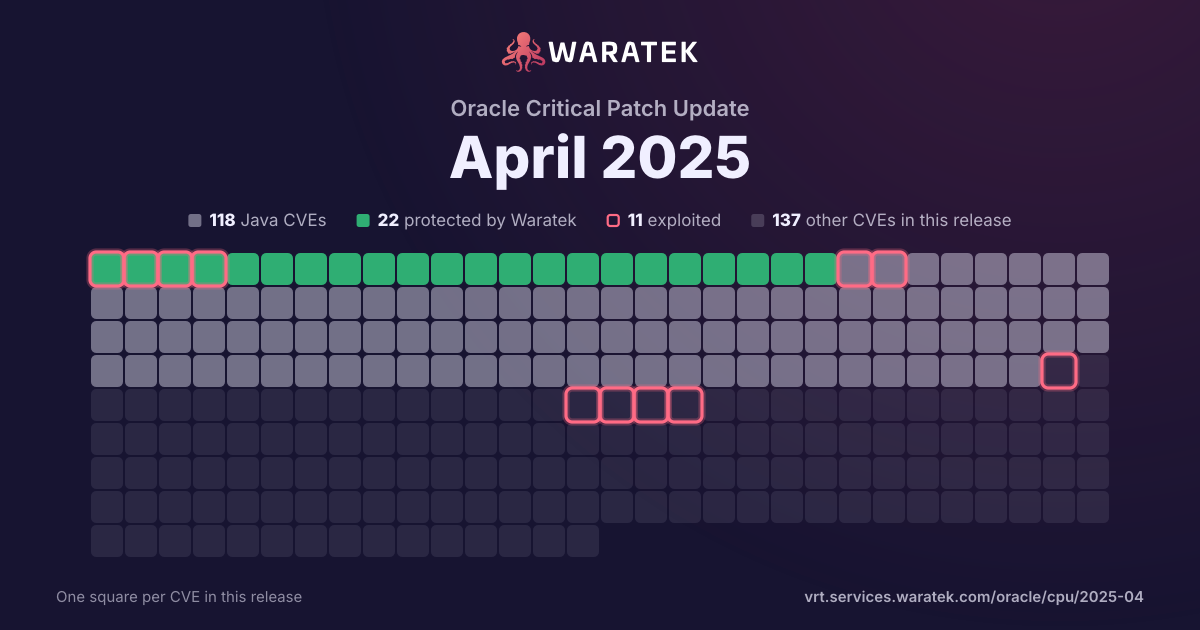
By status
22Protected by Waratek8Mitigation candidate88No exploit published16Outside Waratek scope121Not applicable
11Exploited, marked by the ring
No exploit published. For 33 of them, Oracle's security advisory is the source of public detail.
Protected by Waratek. Waratek RASP can block exploitation of these on systems that have not applied the patch yet.
Overview 39 matches · 10 protected · 3 exploited · 3 CISA KEV · 7 public PoC · 6 EPSS ≥ 0.5
Protected by Waratek
10
25.6%
Rule in development
0
0.0%
Mitigation candidate
3
7.7%
No exploit published
26
66.7%
blocked by ARMR today
10
25.6%
partly blocked
0
0.0%
not blocked
29
74.4%
not established
0
0.0%
unrecorded
0
0.0%
split by
peak 11 / quarter
Q1 201
Protected by Waratek1
Critical1
blocked by ARMR today1
Exploited1
Q2 201
Protected by Waratek1
High1
blocked by ARMR today1
Working exploit published1
Q3 200
Q4 201
Protected by Waratek1
High1
blocked by ARMR today1
No public exploit1
Q1 212
Protected by Waratek1
No exploit published1
High2
blocked by ARMR today1
not blocked1
No public exploit2
Q2 210
Q3 212
No exploit published2
High1
Medium1
not blocked2
Forecast only1
No public exploit1
Q4 210
Q1 221
No exploit published1
High1
not blocked1
No public exploit1
Q2 220
Q3 220
Q4 223
Protected by Waratek1
No exploit published2
High3
blocked by ARMR today1
not blocked2
No public exploit3
Q1 232
No exploit published2
High2
not blocked2
Proof of concept only1
No public exploit1
Q2 231
No exploit published1
Medium1
not blocked1
No public exploit1
Q3 230
Q4 234
Mitigation candidate2
No exploit published2
High1
Medium3
not blocked4
Exploited1
Working exploit published1
No public exploit2
Q1 244
Mitigation candidate1
No exploit published3
High2
Medium2
not blocked4
Proof of concept only2
No public exploit2
Q2 240
Q3 241
No exploit published1
High1
not blocked1
No public exploit1
Q4 2411
Protected by Waratek4
No exploit published7
Critical2
High2
Medium6
Low1
blocked by ARMR today4
not blocked7
Working exploit published1
Proof of concept only1
No public exploit9
Q1 254
Protected by Waratek1
No exploit published3
Critical1
High2
Medium1
blocked by ARMR today1
not blocked3
Exploited1
Proof of concept only2
No public exploit1
Q2 251
No exploit published1
Medium1
not blocked1
No public exploit1
Q2 20Q4 20Q2 21Q4 21Q2 22Q4 22Q2 23Q4 23Q2 24Q4 24Q2 25
| CVE | Severity | Published▾ | Status | Exploitation | Description |
|---|---|---|---|---|---|
| CVE-2025-30729 | Medium | 2025-04-15 | No exploit published | No public exploit | Vulnerability in the Oracle Communications Order and Service Management product of Oracle Communications Applications (component: Security). Supported versions that are affected are 7.4.0, 7.4.1 and 7.5.0. Easily exploitable vulnerability allows low privileged attacker with network access via HTTP to compromise Oracle Communications Order and Service Management. Successful attacks require human interaction from a person other than the attacker. Successful attacks of this vulnerability can result in unauthorized update, insert or delete access to some of Oracle Communications Order and Service Management accessible data as well as unauthorized read access to a subset of Oracle Communications Order and Service Management accessible data and unauthorized ability to cause a partial denial of service (partial DOS) of Oracle Communications Order and Service Management. CVSS 3.1 Base Score 5.5 (Confidentiality, Integrity and Availability impacts). CVSS Vector: (CVSS:3.1/AV:N/AC:L/PR:L/UI:R/S:U/C:L/I:L/A:L). |
| CVE-2025-24813 | Critical | 2025-03-10 | Protected by Waratek | Exploited | Path Equivalence: 'file.Name' (Internal Dot) leading to Remote Code Execution and/or Information disclosure and/or malicious content added to uploaded files via write enabled Default Servlet in Apache Tomcat. This issue affects Apache Tomcat: from 11.0.0-M1 through 11.0.2, from 10.1.0-M1 through 10.1.34, from 9.0.0.M1 through 9.0.98. The following versions were EOL at the time the CVE was created but are known to be affected: 8.5.0 though 8.5.100. Other, older, EOL versions may also be affected. If all of the following were true, a malicious user was able to view security sensitive files and/or inject content into those files: - writes enabled for the default servlet (disabled by default) - support for partial PUT (enabled by default) - a target URL for security sensitive uploads that was a sub-directory of a target URL for public uploads - attacker knowledge of the names of security sensitive files being uploaded - the security sensitive files also being uploaded via partial PUT If all of the following were true, a malicious user was able to perform remote code execution: - writes enabled for the default servlet (disabled by default) - support for partial PUT (enabled by default) - application was using Tomcat's file based session persistence with the default storage location - application included a library that may be leveraged in a deserialization attack Users are recommended to upgrade to version 11.0.3, 10.1.35 or 9.0.99, which fixes the issue. |
| CVE-2025-25193 | Medium | 2025-02-10 | No exploit published | Proof of concept only | Netty, an asynchronous, event-driven network application framework, has a vulnerability in versions up to and including 4.1.118.Final. An unsafe reading of environment file could potentially cause a denial of service in Netty. When loaded on an Windows application, Netty attempts to load a file that does not exist. If an attacker creates such a large file, the Netty application crash. A similar issue was previously reported as CVE-2024-47535. This issue was fixed, but the fix was incomplete in that null-bytes were not counted against the input limit. Commit d1fbda62d3a47835d3fb35db8bd42ecc205a5386 contains an updated fix. |
| CVE-2025-24970 | High | 2025-02-10 | No exploit published | Proof of concept only | Netty, an asynchronous, event-driven network application framework, has a vulnerability starting in version 4.1.91.Final and prior to version 4.1.118.Final. When a special crafted packet is received via SslHandler it doesn't correctly handle validation of such a packet in all cases which can lead to a native crash. Version 4.1.118.Final contains a patch. As workaround its possible to either disable the usage of the native SSLEngine or change the code manually. |
| CVE-2024-43709 | High | 2025-01-21 | No exploit published | No public exploit | An allocation of resources without limits or throttling in Elasticsearch can lead to an OutOfMemoryError exception resulting in a crash via a specially crafted query using an SQL function. |
| CVE-2024-52046 | Critical | 2024-12-25 | Protected by Waratek | No public exploit | The ObjectSerializationDecoder in Apache MINA uses Java’s native deserialization protocol to process incoming serialized data but lacks the necessary security checks and defenses. This vulnerability allows attackers to exploit the deserialization process by sending specially crafted malicious serialized data, potentially leading to remote code execution (RCE) attacks. This issue affects MINA core versions 2.0.X, 2.1.X and 2.2.X, and will be fixed by the releases 2.0.27, 2.1.10 and 2.2.4. It's also important to note that an application using MINA core library will only be affected if the IoBuffer#getObject() method is called, and this specific method is potentially called when adding a ProtocolCodecFilter instance using the ObjectSerializationCodecFactory class in the filter chain. If your application is specifically using those classes, you have to upgrade to the latest version of MINA core library. Upgrading will not be enough: you also need to explicitly allow the classes the decoder will accept in the ObjectSerializationDecoder instance, using one of the three new methods: /** * Accept class names where the supplied ClassNameMatcher matches for * deserialization, unless they are otherwise rejected. * * @param classNameMatcher the matcher to use */ public void accept(ClassNameMatcher classNameMatcher) /** * Accept class names that match the supplied pattern for * deserialization, unless they are otherwise rejected. * * @param pattern standard Java regexp */ public void accept(Pattern pattern) /** * Accept the wildcard specified classes for deserialization, * unless they are otherwise rejected. * * @param patterns Wildcard file name patterns as defined by * {@link org.apache.commons.io.FilenameUtils#wildcardMatch(String, String) FilenameUtils.wildcardMatch} */ public void accept(String... patterns) By default, the decoder will reject *all* classes that will be present in the incoming data. Note: The FtpServer, SSHd and Vysper sub-project are not affected by this issue. |
| CVE-2024-38819 | High | 2024-12-19 | Protected by Waratek | Working exploit published | Applications serving static resources through the functional web frameworks WebMvc.fn or WebFlux.fn are vulnerable to path traversal attacks. An attacker can craft malicious HTTP requests and obtain any file on the file system that is also accessible to the process in which the Spring application is running. |
| CVE-2024-12801 | Low | 2024-12-19 | No exploit published | No public exploit | Server-Side Request Forgery (SSRF) in SaxEventRecorder by QOS.CH logback version 0.1 to 1.3.14 and 1.4.0 to 1.5.12 on the Java platform, allows an attacker to forge requests by compromising logback configuration files in XML. The attacks involves the modification of DOCTYPE declaration in XML configuration files. |
| CVE-2024-12798 | Medium | 2024-12-19 | No exploit published | No public exploit | ACE vulnerability in JaninoEventEvaluator by QOS.CH logback-core upto including version 0.1 to 1.3.14 and 1.4.0 to 1.5.12 in Java applications allows attacker to execute arbitrary code by compromising an existing logback configuration file or by injecting an environment variable before program execution. Malicious logback configuration files can allow the attacker to execute arbitrary code using the JaninoEventEvaluator extension. A successful attack requires the user to have write access to a configuration file. Alternatively, the attacker could inject a malicious environment variable pointing to a malicious configuration file. In both cases, the attack requires existing privilege. |
| CVE-2024-56128 | Medium | 2024-12-18 | No exploit published | No public exploit | Incorrect Implementation of Authentication Algorithm in Apache Kafka's SCRAM implementation. Issue Summary: Apache Kafka's implementation of the Salted Challenge Response Authentication Mechanism (SCRAM) did not fully adhere to the requirements of RFC 5802 [1]. Specifically, as per RFC 5802, the server must verify that the nonce sent by the client in the second message matches the nonce sent by the server in its first message. However, Kafka's SCRAM implementation did not perform this validation. Impact: This vulnerability is exploitable only when an attacker has plaintext access to the SCRAM authentication exchange. However, the usage of SCRAM over plaintext is strongly discouraged as it is considered an insecure practice [2]. Apache Kafka recommends deploying SCRAM exclusively with TLS encryption to protect SCRAM exchanges from interception [3]. Deployments using SCRAM with TLS are not affected by this issue. How to Detect If You Are Impacted: If your deployment uses SCRAM authentication over plaintext communication channels (without TLS encryption), you are likely impacted. To check if TLS is enabled, review your server.properties configuration file for listeners property. If you have SASL_PLAINTEXT in the listeners, then you are likely impacted. Fix Details: The issue has been addressed by introducing nonce verification in the final message of the SCRAM authentication exchange to ensure compliance with RFC 5802. Affected Versions: Apache Kafka versions 0.10.2.0 through 3.9.0, excluding the fixed versions below. Fixed Versions: 3.9.0 3.8.1 3.7.2 Users are advised to upgrade to 3.7.2 or later to mitigate this issue. Recommendations for Mitigation: Users unable to upgrade to the fixed versions can mitigate the issue by: - Using TLS with SCRAM Authentication: Always deploy SCRAM over TLS to encrypt authentication exchanges and protect against interception. - Considering Alternative Authentication Mechanisms: Evaluate alternative authentication mechanisms, such as PLAIN, Kerberos or OAuth with TLS, which provide additional layers of security. |
| CVE-2024-38827 | Medium | 2024-12-02 | No exploit published | No public exploit | The usage of String.toLowerCase() and String.toUpperCase() has some Locale dependent exceptions that could potentially result in authorization rules not working properly. |
| CVE-2024-31141 | Medium | 2024-11-19 | No exploit published | No public exploit | Files or Directories Accessible to External Parties, Improper Privilege Management vulnerability in Apache Kafka Clients. Apache Kafka Clients accept configuration data for customizing behavior, and includes ConfigProvider plugins in order to manipulate these configurations. Apache Kafka also provides FileConfigProvider, DirectoryConfigProvider, and EnvVarConfigProvider implementations which include the ability to read from disk or environment variables. In applications where Apache Kafka Clients configurations can be specified by an untrusted party, attackers may use these ConfigProviders to read arbitrary contents of the disk and environment variables. In particular, this flaw may be used in Apache Kafka Connect to escalate from REST API access to filesystem/environment access, which may be undesirable in certain environments, including SaaS products. This issue affects Apache Kafka Clients: from 2.3.0 through 3.5.2, 3.6.2, 3.7.0. Users with affected applications are recommended to upgrade kafka-clients to version >=3.8.0, and set the JVM system property "org.apache.kafka.automatic.config.providers=none". Users of Kafka Connect with one of the listed ConfigProvider implementations specified in their worker config are also recommended to add appropriate "allowlist.pattern" and "allowed.paths" to restrict their operation to appropriate bounds. For users of Kafka Clients or Kafka Connect in environments that trust users with disk and environment variable access, it is not recommended to set the system property. For users of the Kafka Broker, Kafka MirrorMaker 2.0, Kafka Streams, and Kafka command-line tools, it is not recommended to set the system property. |
| CVE-2024-47535 | Medium | 2024-11-12 | No exploit published | Proof of concept only | Netty is an asynchronous event-driven network application framework for rapid development of maintainable high performance protocol servers & clients. An unsafe reading of environment file could potentially cause a denial of service in Netty. When loaded on an Windows application, Netty attempts to load a file that does not exist. If an attacker creates such a large file, the Netty application crashes. This vulnerability is fixed in 4.1.115. |
| CVE-2024-28168 | High | 2024-10-09 | Protected by Waratek | No public exploit | Improper Restriction of XML External Entity Reference ('XXE') vulnerability in Apache XML Graphics FOP. This issue affects Apache XML Graphics FOP: 2.9. Users are recommended to upgrade to version 2.10, which fixes the issue. |
| CVE-2024-47561 | Critical | 2024-10-03 | Protected by Waratek | No public exploit | Schema parsing in the Java SDK of Apache Avro 1.11.3 and previous versions allows bad actors to execute arbitrary code. Users are recommended to upgrade to version 1.11.4 or 1.12.0, which fix this issue. |
| CVE-2024-47554 | Medium | 2024-10-03 | No exploit published | No public exploit | Uncontrolled Resource Consumption vulnerability in Apache Commons IO. The org.apache.commons.io.input.XmlStreamReader class may excessively consume CPU resources when processing maliciously crafted input. This issue affects Apache Commons IO: from 2.0 before 2.14.0. Users are recommended to upgrade to version 2.14.0 or later, which fixes the issue. |
| CVE-2024-7254 | High | 2024-09-19 | No exploit published | No public exploit | Any project that parses untrusted Protocol Buffers data containing an arbitrary number of nested groups / series of SGROUP tags can corrupted by exceeding the stack limit i.e. StackOverflow. Parsing nested groups as unknown fields with DiscardUnknownFieldsParser or Java Protobuf Lite parser, or against Protobuf map fields, creates unbounded recursions that can be abused by an attacker. |
| CVE-2024-29025 | Medium | 2024-03-25 | No exploit published | Proof of concept only | Netty is an asynchronous event-driven network application framework for rapid development of maintainable high performance protocol servers & clients. The `HttpPostRequestDecoder` can be tricked to accumulate data. While the decoder can store items on the disk if configured so, there are no limits to the number of fields the form can have, an attacher can send a chunked post consisting of many small fields that will be accumulated in the `bodyListHttpData` list. The decoder cumulates bytes in the `undecodedChunk` buffer until it can decode a field, this field can cumulate data without limits. This vulnerability is fixed in 4.1.108.Final. |
| CVE-2024-24549 | High | 2024-03-13 | Mitigation candidate | Proof of concept only | Denial of Service due to improper input validation vulnerability for HTTP/2 requests in Apache Tomcat. When processing an HTTP/2 request, if the request exceeded any of the configured limits for headers, the associated HTTP/2 stream was not reset until after all of the headers had been processed.This issue affects Apache Tomcat: from 11.0.0-M1 through 11.0.0-M16, from 10.1.0-M1 through 10.1.18, from 9.0.0-M1 through 9.0.85, from 8.5.0 through 8.5.98. Other, older, EOL versions may also be affected. Users are recommended to upgrade to version 11.0.0-M17, 10.1.19, 9.0.86 or 8.5.99 which fix the issue. |
| CVE-2024-26308 | Medium | 2024-02-19 | No exploit published | No public exploit | Allocation of Resources Without Limits or Throttling vulnerability in Apache Commons Compress.This issue affects Apache Commons Compress: from 1.21 before 1.26. Users are recommended to upgrade to version 1.26, which fixes the issue. |
| CVE-2024-25710 | High | 2024-02-19 | No exploit published | No public exploit | Loop with Unreachable Exit Condition ('Infinite Loop') vulnerability in Apache Commons Compress.This issue affects Apache Commons Compress: from 1.3 through 1.25.0. Users are recommended to upgrade to version 1.26.0 which fixes the issue. |
| CVE-2023-51074 | Medium | 2023-12-27 | No exploit published | No public exploit | json-path v2.8.0 was discovered to contain a stack overflow via the Criteria.parse() method. |
| CVE-2023-45648 | Medium | 2023-10-10 | Mitigation candidate | Working exploit published | Improper Input Validation vulnerability in Apache Tomcat.Tomcat from 11.0.0-M1 through 11.0.0-M11, from 10.1.0-M1 through 10.1.13, from 9.0.0-M1 through 9.0.81 and from 8.5.0 through 8.5.93 did not correctly parse HTTP trailer headers. A specially crafted, invalid trailer header could cause Tomcat to treat a single request as multiple requests leading to the possibility of request smuggling when behind a reverse proxy. Older, EOL versions may also be affected. Users are recommended to upgrade to version 11.0.0-M12 onwards, 10.1.14 onwards, 9.0.81 onwards or 8.5.94 onwards, which fix the issue. |
| CVE-2023-44487 | High | 2023-10-10 | Mitigation candidate | Exploited | The HTTP/2 protocol allows a denial of service (server resource consumption) because request cancellation can reset many streams quickly, as exploited in the wild in August through October 2023. |
| CVE-2023-42795 | Medium | 2023-10-10 | No exploit published | No public exploit | Incomplete Cleanup vulnerability in Apache Tomcat.When recycling various internal objects in Apache Tomcat from 11.0.0-M1 through 11.0.0-M11, from 10.1.0-M1 through 10.1.13, from 9.0.0-M1 through 9.0.80 and from 8.5.0 through 8.5.93, an error could cause Tomcat to skip some parts of the recycling process leading to information leaking from the current request/response to the next. Older, EOL versions may also be affected. Users are recommended to upgrade to version 11.0.0-M12 onwards, 10.1.14 onwards, 9.0.81 onwards or 8.5.94 onwards, which fixes the issue. |
| CVE-2023-35116 | Medium | 2023-06-14 | No exploit published | No public exploit | jackson-databind through 2.15.2 allows attackers to cause a denial of service or other unspecified impact via a crafted object that uses cyclic dependencies. NOTE: the vendor's perspective is that this is not a valid vulnerability report, because the steps of constructing a cyclic data structure and trying to serialize it cannot be achieved by an external attacker. |
| CVE-2023-1370 | High | 2023-03-22 | No exploit published | Proof of concept only | [Json-smart](https://netplex.github.io/json-smart/) is a performance focused, JSON processor lib. When reaching a ‘[‘ or ‘{‘ character in the JSON input, the code parses an array or an object respectively. It was discovered that the code does not have any limit to the nesting of such arrays or objects. Since the parsing of nested arrays and objects is done recursively, nesting too many of them can cause a stack exhaustion (stack overflow) and crash the software. |
| CVE-2023-24998 | High | 2023-02-20 | No exploit published | No public exploit | Apache Commons FileUpload before 1.5 does not limit the number of request parts to be processed resulting in the possibility of an attacker triggering a DoS with a malicious upload or series of uploads. Note that, like all of the file upload limits, the new configuration option (FileUploadBase#setFileCountMax) is not enabled by default and must be explicitly configured. |
| CVE-2022-42252 | High | 2022-11-01 | No exploit published | No public exploit | If Apache Tomcat 8.5.0 to 8.5.82, 9.0.0-M1 to 9.0.67, 10.0.0-M1 to 10.0.26 or 10.1.0-M1 to 10.1.0 was configured to ignore invalid HTTP headers via setting rejectIllegalHeader to false (the default for 8.5.x only), Tomcat did not reject a request containing an invalid Content-Length header making a request smuggling attack possible if Tomcat was located behind a reverse proxy that also failed to reject the request with the invalid header. |
| CVE-2022-42004 | High | 2022-10-02 | Protected by Waratek | No public exploit | In FasterXML jackson-databind before 2.13.4, resource exhaustion can occur because of a lack of a check in BeanDeserializer._deserializeFromArray to prevent use of deeply nested arrays. An application is vulnerable only with certain customized choices for deserialization. |
| CVE-2022-42003 | High | 2022-10-02 | No exploit published | No public exploit | In FasterXML jackson-databind before versions 2.13.4.1 and 2.12.17.1, resource exhaustion can occur because of a lack of a check in primitive value deserializers to avoid deep wrapper array nesting, when the UNWRAP_SINGLE_VALUE_ARRAYS feature is enabled. |
| CVE-2020-36518 | High | 2022-03-11 | No exploit published | No public exploit | jackson-databind before 2.13.0 allows a Java StackOverflow exception and denial of service via a large depth of nested objects. |
| CVE-2021-37714 | High | 2021-08-18 | No exploit published | No public exploit | jsoup is a Java library for working with HTML. Those using jsoup versions prior to 1.14.2 to parse untrusted HTML or XML may be vulnerable to DOS attacks. If the parser is run on user supplied input, an attacker may supply content that causes the parser to get stuck (loop indefinitely until cancelled), to complete more slowly than usual, or to throw an unexpected exception. This effect may support a denial of service attack. The issue is patched in version 1.14.2. There are a few available workarounds. Users may rate limit input parsing, limit the size of inputs based on system resources, and/or implement thread watchdogs to cap and timeout parse runtimes. |
| CVE-2021-33037 | Medium | 2021-07-12 | No exploit published | Forecast only | Apache Tomcat 10.0.0-M1 to 10.0.6, 9.0.0.M1 to 9.0.46 and 8.5.0 to 8.5.66 did not correctly parse the HTTP transfer-encoding request header in some circumstances leading to the possibility to request smuggling when used with a reverse proxy. Specifically: - Tomcat incorrectly ignored the transfer encoding header if the client declared it would only accept an HTTP/1.0 response; - Tomcat honoured the identify encoding; and - Tomcat did not ensure that, if present, the chunked encoding was the final encoding. |
| CVE-2020-13936 | High | 2021-03-10 | No exploit published | No public exploit | An attacker that is able to modify Velocity templates may execute arbitrary Java code or run arbitrary system commands with the same privileges as the account running the Servlet container. This applies to applications that allow untrusted users to upload/modify velocity templates running Apache Velocity Engine versions up to 2.2. |
| CVE-2021-25122 | High | 2021-03-01 | Protected by Waratek | No public exploit | When responding to new h2c connection requests, Apache Tomcat versions 10.0.0-M1 to 10.0.0, 9.0.0.M1 to 9.0.41 and 8.5.0 to 8.5.61 could duplicate request headers and a limited amount of request body from one request to another meaning user A and user B could both see the results of user A's request. |
| CVE-2020-25649 | High | 2020-12-03 | Protected by Waratek | No public exploit | A flaw was found in FasterXML Jackson Databind, where it did not have entity expansion secured properly. This flaw allows vulnerability to XML external entity (XXE) attacks. The highest threat from this vulnerability is data integrity. |
| CVE-2020-9484 | High | 2020-05-20 | Protected by Waratek | Working exploit published | When using Apache Tomcat versions 10.0.0-M1 to 10.0.0-M4, 9.0.0.M1 to 9.0.34, 8.5.0 to 8.5.54 and 7.0.0 to 7.0.103 if a) an attacker is able to control the contents and name of a file on the server; and b) the server is configured to use the PersistenceManager with a FileStore; and c) the PersistenceManager is configured with sessionAttributeValueClassNameFilter="null" (the default unless a SecurityManager is used) or a sufficiently lax filter to allow the attacker provided object to be deserialized; and d) the attacker knows the relative file path from the storage location used by FileStore to the file the attacker has control over; then, using a specifically crafted request, the attacker will be able to trigger remote code execution via deserialization of the file under their control. Note that all of conditions a) to d) must be true for the attack to succeed. |
| CVE-2020-1938 | Critical | 2020-02-24 | Protected by Waratek | Exploited | When using the Apache JServ Protocol (AJP), care must be taken when trusting incoming connections to Apache Tomcat. Tomcat treats AJP connections as having higher trust than, for example, a similar HTTP connection. If such connections are available to an attacker, they can be exploited in ways that may be surprising. In Apache Tomcat 9.0.0.M1 to 9.0.0.30, 8.5.0 to 8.5.50 and 7.0.0 to 7.0.99, Tomcat shipped with an AJP Connector enabled by default that listened on all configured IP addresses. It was expected (and recommended in the security guide) that this Connector would be disabled if not required. This vulnerability report identified a mechanism that allowed: - returning arbitrary files from anywhere in the web application - processing any file in the web application as a JSP Further, if the web application allowed file upload and stored those files within the web application (or the attacker was able to control the content of the web application by some other means) then this, along with the ability to process a file as a JSP, made remote code execution possible. It is important to note that mitigation is only required if an AJP port is accessible to untrusted users. Users wishing to take a defence-in-depth approach and block the vector that permits returning arbitrary files and execution as JSP may upgrade to Apache Tomcat 9.0.31, 8.5.51 or 7.0.100 or later. A number of changes were made to the default AJP Connector configuration in 9.0.31 to harden the default configuration. It is likely that users upgrading to 9.0.31, 8.5.51 or 7.0.100 or later will need to make small changes to their configurations. |