
Oracle Critical Patch Update October 2017
Released October 2017 · Oracle's advisory ↗ · ← Critical Patch Update, July 2017 · Critical Patch Update, January 2018 →
225 CVEs in this release, one square each
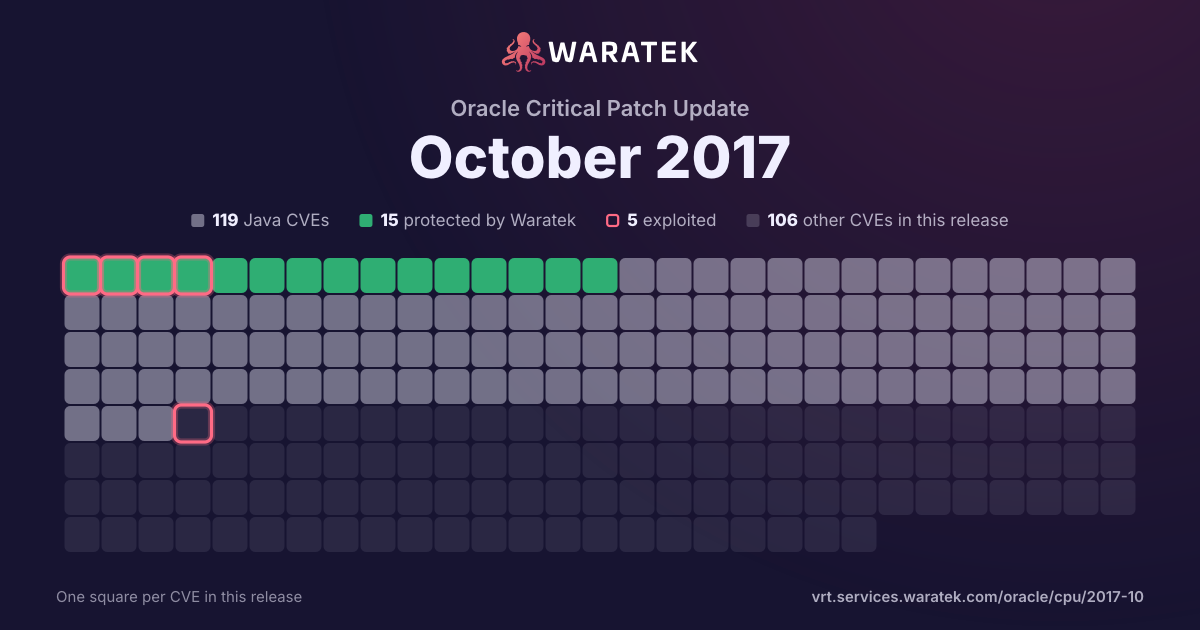
By status
15Protected by Waratek3Mitigation candidate101No exploit published34Outside Waratek scope72Not applicable
5Exploited, marked by the ring
No exploit published. For 100 of them, Oracle's security advisory is the source of public detail.
Protected by Waratek. Waratek RASP can block exploitation of these on systems that have not applied the patch yet.
Overview 38 matches · 7 in Waratek scope · 6 protected · 3 exploited · 1 CISA KEV · 6 public PoC · 9 EPSS ≥ 0.5
38matches
7in Waratek scope18.4%
6protected15.8%
3exploited7.9%
1CISA KEV2.6%
6public PoC15.8%
9EPSS ≥ 0.523.7%
Protected by Waratek
6
15.8%
Rule in development
0
0.0%
Mitigation candidate
0
0.0%
No exploit published
1
2.6%
Outside Waratek scope
11
28.9%
Not applicable
20
52.6%
Withdrawn CVE
0
0.0%
blocked by ARMR today
6
15.8%
partly blocked
0
0.0%
not blocked
32
84.2%
not established
0
0.0%
unrecorded
0
0.0%
split by
peak 13 / year
20031
Not applicable1
Medium1
not blocked1
No public exploit1
20040
20050
20060
20070
20080
20090
20100
20110
20120
20131
Not applicable1
High1
not blocked1
No public exploit1
20148
Protected by Waratek2
Outside Waratek scope1
Not applicable5
High4
Medium4
blocked by ARMR today2
not blocked6
Exploited2
No public exploit6
20154
Outside Waratek scope4
Critical1
High1
Medium1
Low1
not blocked4
Working exploit published1
Forecast only1
No public exploit2
201613
Protected by Waratek3
No exploit published1
Outside Waratek scope3
Not applicable6
Critical2
High10
Medium1
blocked by ARMR today3
not blocked10
Working exploit published1
Proof of concept only2
Forecast only1
No public exploit9
201711
Protected by Waratek1
Outside Waratek scope3
Not applicable7
Critical4
High5
Medium2
blocked by ARMR today1
not blocked10
Exploited1
Forecast only1
No public exploit9
20032005200720092011201320152017
| CVE | Severity | Published▾ | Status | Exploitation | Description |
|---|---|---|---|---|---|
| CVE-2017-3167 | Critical | 2017-06-20 | Outside Waratek scope | No public exploit | In Apache httpd 2.2.x before 2.2.33 and 2.4.x before 2.4.26, use of the ap_get_basic_auth_pw() by third-party modules outside of the authentication phase may lead to authentication requirements being bypassed. |
| CVE-2017-5664 | High | 2017-06-06 | Outside Waratek scope | No public exploit | The error page mechanism of the Java Servlet Specification requires that, when an error occurs and an error page is configured for the error that occurred, the original request and response are forwarded to the error page. This means that the request is presented to the error page with the original HTTP method. If the error page is a static file, expected behaviour is to serve content of the file as if processing a GET request, regardless of the actual HTTP method. The Default Servlet in Apache Tomcat 9.0.0.M1 to 9.0.0.M20, 8.5.0 to 8.5.14, 8.0.0.RC1 to 8.0.43 and 7.0.0 to 7.0.77 did not do this. Depending on the original request this could lead to unexpected and undesirable results for static error pages including, if the DefaultServlet is configured to permit writes, the replacement or removal of the custom error page. Notes for other user provided error pages: (1) Unless explicitly coded otherwise, JSPs ignore the HTTP method. JSPs used as error pages must must ensure that they handle any error dispatch as a GET request, regardless of the actual method. (2) By default, the response generated by a Servlet does depend on the HTTP method. Custom Servlets used as error pages must ensure that they handle any error dispatch as a GET request, regardless of the actual method. |
| CVE-2016-9841 | Critical | 2017-05-23 | Not applicable | No public exploit | inffast.c in zlib 1.2.8 might allow context-dependent attackers to have unspecified impact by leveraging improper pointer arithmetic. |
| CVE-2017-5461 | Critical | 2017-05-11 | Not applicable | No public exploit | Mozilla Network Security Services (NSS) before 3.21.4, 3.22.x through 3.28.x before 3.28.4, 3.29.x before 3.29.5, and 3.30.x before 3.30.1 allows remote attackers to cause a denial of service (out-of-bounds write) or possibly have unspecified other impact by leveraging incorrect base64 operations. |
| CVE-2017-3733 | High | 2017-05-04 | Not applicable | No public exploit | During a renegotiation handshake if the Encrypt-Then-Mac extension is negotiated where it was not in the original handshake (or vice-versa) then this can cause OpenSSL 1.1.0 before 1.1.0e to crash (dependent on ciphersuite). Both clients and servers are affected. |
| CVE-2017-3732 | Medium | 2017-05-04 | Not applicable | No public exploit | There is a carry propagating bug in the x86_64 Montgomery squaring procedure in OpenSSL 1.0.2 before 1.0.2k and 1.1.0 before 1.1.0d. No EC algorithms are affected. Analysis suggests that attacks against RSA and DSA as a result of this defect would be very difficult to perform and are not believed likely. Attacks against DH are considered just feasible (although very difficult) because most of the work necessary to deduce information about a private key may be performed offline. The amount of resources required for such an attack would be very significant and likely only accessible to a limited number of attackers. An attacker would additionally need online access to an unpatched system using the target private key in a scenario with persistent DH parameters and a private key that is shared between multiple clients. For example this can occur by default in OpenSSL DHE based SSL/TLS ciphersuites. Note: This issue is very similar to CVE-2015-3193 but must be treated as a separate problem. |
| CVE-2017-3731 | High | 2017-05-04 | Not applicable | Forecast only | If an SSL/TLS server or client is running on a 32-bit host, and a specific cipher is being used, then a truncated packet can cause that server or client to perform an out-of-bounds read, usually resulting in a crash. For OpenSSL 1.1.0, the crash can be triggered when using CHACHA20/POLY1305; users should upgrade to 1.1.0d. For Openssl 1.0.2, the crash can be triggered when using RC4-MD5; users who have not disabled that algorithm should update to 1.0.2k. |
| CVE-2017-5662 | High | 2017-04-18 | Not applicable | No public exploit | In Apache Batik before 1.9, files lying on the filesystem of the server which uses batik can be revealed to arbitrary users who send maliciously formed SVG files. The file types that can be shown depend on the user context in which the exploitable application is running. If the user is root a full compromise of the server - including confidential or sensitive files - would be possible. XXE can also be used to attack the availability of the server via denial of service as the references within a xml document can trivially trigger an amplification attack. |
| CVE-2016-8735 | Critical | 2017-04-06 | Protected by Waratek | Exploited | Remote code execution is possible with Apache Tomcat before 6.0.48, 7.x before 7.0.73, 8.x before 8.0.39, 8.5.x before 8.5.7, and 9.x before 9.0.0.M12 if JmxRemoteLifecycleListener is used and an attacker can reach JMX ports. The issue exists because this listener wasn't updated for consistency with the CVE-2016-3427 Oracle patch that affected credential types. |
| CVE-2016-10165 | High | 2017-02-03 | Outside Waratek scope | No public exploit | The Type_MLU_Read function in cmstypes.c in Little CMS (aka lcms2) allows remote attackers to obtain sensitive information or cause a denial of service via an image with a crafted ICC profile, which triggers an out-of-bounds heap read. |
| CVE-2016-7431 | Medium | 2017-01-13 | Not applicable | No public exploit | NTP before 4.2.8p9 allows remote attackers to bypass the origin timestamp protection mechanism via an origin timestamp of zero. NOTE: this vulnerability exists because of a CVE-2015-8138 regression. |
| CVE-2016-5019 | Critical | 2016-10-03 | Protected by Waratek | No public exploit | CoreResponseStateManager in Apache MyFaces Trinidad 1.0.0 through 1.0.13, 1.2.x before 1.2.15, 2.0.x before 2.0.2, and 2.1.x before 2.1.2 might allow attackers to conduct deserialization attacks via a crafted serialized view state string. |
| CVE-2016-7052 | High | 2016-09-26 | Not applicable | No public exploit | crypto/x509/x509_vfy.c in OpenSSL 1.0.2i allows remote attackers to cause a denial of service (NULL pointer dereference and application crash) by triggering a CRL operation. |
| CVE-2016-6304 | High | 2016-09-26 | Not applicable | Forecast only | Multiple memory leaks in t1_lib.c in OpenSSL before 1.0.1u, 1.0.2 before 1.0.2i, and 1.1.0 before 1.1.0a allow remote attackers to cause a denial of service (memory consumption) via large OCSP Status Request extensions. |
| CVE-2016-2183 | High | 2016-09-01 | Outside Waratek scope | Proof of concept only | The DES and Triple DES ciphers, as used in the TLS, SSH, and IPSec protocols and other protocols and products, have a birthday bound of approximately four billion blocks, which makes it easier for remote attackers to obtain cleartext data via a birthday attack against a long-duration encrypted session, as demonstrated by an HTTPS session using Triple DES in CBC mode, aka a "Sweet32" attack. |
| CVE-2016-3506 | High | 2016-07-21 | Not applicable | No public exploit | Unspecified vulnerability in the JDBC component in Oracle Database Server 11.2.0.4, 12.1.0.1, and 12.1.0.2; the Oracle Retail Xstore Point of Service 5.5, 6.0, 6.5, 7.0, 7.1, 15.0, and 16.0; the Oracle Retail Warehouse Management System 14.04, 14.1.3, and 15.0.1; the Oracle Retail Workforce Management 1.60.7, and 1.64.0; the Oracle Retail Clearance Optimization Engine 13.4; the Oracle Retail Markdown Optimization 13.4 and 14.0; and Oracle Retail Merchandising System 16.0 allows remote attackers to affect confidentiality, integrity, and availability via unknown vectors. |
| CVE-2016-0635 | High | 2016-07-21 | Outside Waratek scope | No public exploit | Unspecified vulnerability in the Enterprise Manager Ops Center component in Oracle Enterprise Manager Grid Control 12.1.4, 12.2.2, and 12.3.2; the Oracle Health Sciences Information Manager component in Oracle Health Sciences Applications 1.2.8.3, 2.0.2.3, and 3.0.1.0; the Oracle Healthcare Master Person Index component in Oracle Health Sciences Applications 2.0.12, 3.0.0, and 4.0.1; the Oracle Documaker component in Oracle Insurance Applications before 12.5; the Oracle Insurance Calculation Engine component in Oracle Insurance Applications 9.7.1, 10.1.2, and 10.2.2; the Oracle Insurance Policy Administration J2EE and Oracle Insurance Rules Palette components in Oracle Insurance Applications 9.6.1, 9.7.1, 10.0.1, 10.1.2, 10.2.0, and 10.2.2; the Oracle Retail Integration Bus component in Oracle Retail Applications 15.0; the Oracle Retail Order Broker component in Oracle Retail Applications 5.1, 5.2, and 15.0; the Primavera Contract Management component in Oracle Primavera Products Suite 14.2; the Primavera P6 Enterprise Project Portfolio Management component in Oracle Primavera Products Suite 8.2, 8.3, 8.4, 15.1, 15.2, and 16.1; the Oracle Financial Services Analytical Applications Infrastructure component in Oracle Financial Services Applications 8.0.0, 8.0.1, 8.0.2, and 8.0.3; the Oracle Commerce Guided Search / Oracle Commerce Experience Manager component in Oracle Commerce 3.1.1, 3.1.2, 11.0, 11.1, and 11.2; the Oracle Agile PLM component in Oracle Supply Chain Products Suite 9.3.4 and 9.3.5; the Oracle Communications BRM - Elastic Charging Engine 11.2.0.0.0 and 11.3.0.0.0; the Oracle Enterprise Repository Enterprise Repository 12.1.3.0.0; the Oracle Financial Services Behavior Detection Platform 8.0.1 and 8.0.2; the Oracle Hyperion Essbase 12.2.1.1; the Oracle Tuxedo System and Applications Monitor (TSAM) 11.1.1.2.0, 11.1.1.2.1, 11.1.1.2.1, 12.1.1.1.0, 12.1.3.0.0, and 12.2.2.0.0; the Oracle Communications WebRTC Session Controller component of Oracle Communications Applications (subcomponent: Security (Spring)) 7.0, 7.1 and 7.2; the Oracle Endeca Information Discovery Integrator 3.2; the Converged Commerce component of Oracle Retail Applications 16.0.1; the Oracle Identity Manager 11.1.2.3.0; Oracle Enterprise Manager for MySQL Database 12.1.0.4; Oracle Retail Invoice Matching 12.0, 13.0, 13.1, 13.2, 14.0, and 14.1; Oracle Communications Performance Intelligence Center (PIC) Software Prior to 10.2.1 and the Oracle Knowledge component of Oracle Siebel CRM (subcomponent: AnswerFlow (Spring Framework)) version 8.5.1.0 - 8.5.1.7 and 8.6.0 allows remote authenticated users to affect confidentiality, integrity, and availability via unknown vectors. |
| CVE-2016-3092 | High | 2016-07-04 | No exploit published | No public exploit | The MultipartStream class in Apache Commons Fileupload before 1.3.2, as used in Apache Tomcat 7.x before 7.0.70, 8.x before 8.0.36, 8.5.x before 8.5.3, and 9.x before 9.0.0.M7 and other products, allows remote attackers to cause a denial of service (CPU consumption) via a long boundary string. |
| CVE-2016-1181 | High | 2016-07-04 | Protected by Waratek | No public exploit | ActionServlet.java in Apache Struts 1 1.x through 1.3.10 mishandles multithreaded access to an ActionForm instance, which allows remote attackers to execute arbitrary code or cause a denial of service (unexpected memory access) via a multipart request, a related issue to CVE-2015-0899. |
| CVE-2016-2834 | High | 2016-06-13 | Not applicable | No public exploit | Mozilla Network Security Services (NSS) before 3.23, as used in Mozilla Firefox before 47.0, allows remote attackers to cause a denial of service (memory corruption and application crash) or possibly have unspecified other impact via unknown vectors. |
| CVE-2016-2107 | Medium | 2016-05-05 | Not applicable | Working exploit published | The AES-NI implementation in OpenSSL before 1.0.1t and 1.0.2 before 1.0.2h does not consider memory allocation during a certain padding check, which allows remote attackers to obtain sensitive cleartext information via a padding-oracle attack against an AES CBC session. NOTE: this vulnerability exists because of an incorrect fix for CVE-2013-0169. |
| CVE-2016-2381 | High | 2016-04-08 | Not applicable | No public exploit | Perl might allow context-dependent attackers to bypass the taint protection mechanism in a child process via duplicate environment variables in envp. |
| CVE-2016-0714 | High | 2016-02-25 | Outside Waratek scope | No public exploit | The session-persistence implementation in Apache Tomcat 6.x before 6.0.45, 7.x before 7.0.68, 8.x before 8.0.31, and 9.x before 9.0.0.M2 mishandles session attributes, which allows remote authenticated users to bypass intended SecurityManager restrictions and execute arbitrary code in a privileged context via a web application that places a crafted object in a session. |
| CVE-2015-5254 | Critical | 2016-01-08 | Protected by Waratek | Proof of concept only | Apache ActiveMQ 5.x before 5.13.0 does not restrict the classes that can be serialized in the broker, which allows remote attackers to execute arbitrary code via a crafted serialized Java Message Service (JMS) ObjectMessage object. |
| CVE-2015-7940 | Medium | 2015-11-09 | Outside Waratek scope | No public exploit | The Bouncy Castle Java library before 1.51 does not validate a point is withing the elliptic curve, which makes it easier for remote attackers to obtain private keys via a series of crafted elliptic curve Diffie Hellman (ECDH) key exchanges, aka an "invalid curve attack." |
| CVE-2015-3253 | Critical | 2015-08-13 | Outside Waratek scope | No public exploit | The MethodClosure class in runtime/MethodClosure.java in Apache Groovy 1.7.0 through 2.4.3 allows remote attackers to execute arbitrary code or cause a denial of service via a crafted serialized object. |
| CVE-2015-2808 | Low | 2015-04-01 | Outside Waratek scope | Forecast only | The RC4 algorithm, as used in the TLS protocol and SSL protocol, does not properly combine state data with key data during the initialization phase, which makes it easier for remote attackers to conduct plaintext-recovery attacks against the initial bytes of a stream by sniffing network traffic that occasionally relies on keys affected by the Invariance Weakness, and then using a brute-force approach involving LSB values, aka the "Bar Mitzvah" issue. |
| CVE-2015-0235 | High | 2015-01-28 | Outside Waratek scope | Working exploit published | Heap-based buffer overflow in the __nss_hostname_digits_dots function in glibc 2.2, and other 2.x versions before 2.18, allows context-dependent attackers to execute arbitrary code via vectors related to the (1) gethostbyname or (2) gethostbyname2 function, aka "GHOST." |
| CVE-2014-8714 | Medium | 2014-11-23 | Not applicable | No public exploit | The dissect_write_structured_field function in epan/dissectors/packet-tn5250.c in the TN5250 dissector in Wireshark 1.10.x before 1.10.11 and 1.12.x before 1.12.2 allows remote attackers to cause a denial of service (infinite loop) via a crafted packet. |
| CVE-2014-3707 | Medium | 2014-11-15 | Not applicable | No public exploit | The curl_easy_duphandle function in libcurl 7.17.1 through 7.38.0, when running with the CURLOPT_COPYPOSTFIELDS option, does not properly copy HTTP POST data for an easy handle, which triggers an out-of-bounds read that allows remote web servers to read sensitive memory information. |
| CVE-2014-4345 | High | 2014-08-14 | Not applicable | No public exploit | Off-by-one error in the krb5_encode_krbsecretkey function in plugins/kdb/ldap/libkdb_ldap/ldap_principal2.c in the LDAP KDB module in kadmind in MIT Kerberos 5 (aka krb5) 1.6.x through 1.11.x before 1.11.6 and 1.12.x before 1.12.2 allows remote authenticated users to cause a denial of service (buffer overflow) or possibly execute arbitrary code via a series of "cpw -keepold" commands. |
| CVE-2014-3538 | Medium | 2014-07-03 | Not applicable | No public exploit | file before 5.19 does not properly restrict the amount of data read during a regex search, which allows remote attackers to cause a denial of service (CPU consumption) via a crafted file that triggers backtracking during processing of an awk rule. NOTE: this vulnerability exists because of an incomplete fix for CVE-2013-7345. |
| CVE-2014-0224 | High | 2014-06-05 | Outside Waratek scope | Exploited | OpenSSL before 0.9.8za, 1.0.0 before 1.0.0m, and 1.0.1 before 1.0.1h does not properly restrict processing of ChangeCipherSpec messages, which allows man-in-the-middle attackers to trigger use of a zero-length master key in certain OpenSSL-to-OpenSSL communications, and consequently hijack sessions or obtain sensitive information, via a crafted TLS handshake, aka the "CCS Injection" vulnerability. |
| CVE-2014-0114 | High | 2014-04-30 | Protected by Waratek | Exploited | Apache Commons BeanUtils, as distributed in lib/commons-beanutils-1.8.0.jar in Apache Struts 1.x through 1.3.10 and in other products requiring commons-beanutils through 1.9.2, does not suppress the class property, which allows remote attackers to "manipulate" the ClassLoader and execute arbitrary code via the class parameter, as demonstrated by the passing of this parameter to the getClass method of the ActionForm object in Struts 1. |
| CVE-2014-0107 | High | 2014-04-15 | Protected by Waratek | No public exploit | The TransformerFactory in Apache Xalan-Java before 2.7.2 does not properly restrict access to certain properties when FEATURE_SECURE_PROCESSING is enabled, which allows remote attackers to bypass expected restrictions and load arbitrary classes or access external resources via a crafted (1) xalan:content-header, (2) xalan:entities, (3) xslt:content-header, or (4) xslt:entities property, or a Java property that is bound to the XSLT 1.0 system-property function. |
| CVE-2014-0062 | Medium | 2014-03-31 | Not applicable | No public exploit | Race condition in the (1) CREATE INDEX and (2) unspecified ALTER TABLE commands in PostgreSQL before 8.4.20, 9.0.x before 9.0.16, 9.1.x before 9.1.12, 9.2.x before 9.2.7, and 9.3.x before 9.3.3 allows remote authenticated users to create an unauthorized index or read portions of unauthorized tables by creating or deleting a table with the same name during the timing window. |
| CVE-2013-1903 | High | 2013-04-04 | Not applicable | No public exploit | PostgreSQL, possibly 9.2.x before 9.2.4, 9.1.x before 9.1.9, 9.0.x before 9.0.13, 8.4.x before 8.4.17, and 8.3.x before 8.3.23 incorrectly provides the superuser password to scripts related to "graphical installers for Linux and Mac OS X," which has unspecified impact and attack vectors. |
| CVE-2003-1418 | Medium | 2003-12-31 | Not applicable | No public exploit | Apache HTTP Server 1.3.22 through 1.3.27 on OpenBSD allows remote attackers to obtain sensitive information via (1) the ETag header, which reveals the inode number, or (2) multipart MIME boundary, which reveals child process IDs (PID). |