
Oracle Critical Patch Update April 2025
Released April 2025 · Oracle's advisory ↗ · ← Critical Patch Update, January 2025 · Critical Patch Update, July 2025 →
255 CVEs in this release, one square each
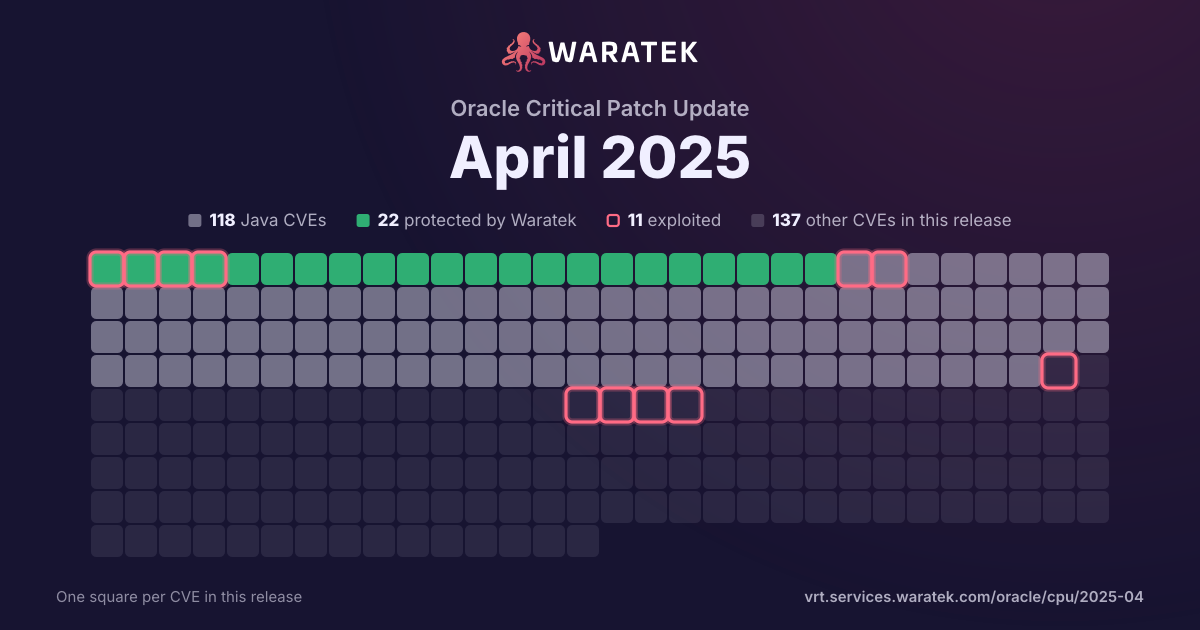
By status
22Protected by Waratek8Mitigation candidate94No exploit published3Outside Waratek scope128Not applicable
11Exploited, marked by the ring
No exploit published. For 29 of them, Oracle's security advisory is the source of public detail.
Protected by Waratek. Waratek RASP can block exploitation of these on systems that have not applied the patch yet.
Overview 36 matches · 0 protected · 1 exploited · 1 CISA KEV · 5 public PoC · 1 EPSS ≥ 0.5
Protected by Waratek
0
0.0%
Rule in development
0
0.0%
Mitigation candidate
5
13.9%
No exploit published
31
86.1%
blocked by ARMR today
0
0.0%
partly blocked
0
0.0%
not blocked
36
100.0%
not established
0
0.0%
unrecorded
0
0.0%
split by
peak 9 / quarter
Q3 233
Mitigation candidate1
No exploit published2
Medium2
Low1
not blocked3
Proof of concept only1
No public exploit2
Q4 235
Mitigation candidate2
No exploit published3
High2
Medium3
not blocked5
Exploited1
Working exploit published1
No public exploit3
Q1 246
Mitigation candidate1
No exploit published5
High3
Medium3
not blocked6
Proof of concept only2
No public exploit4
Q2 242
No exploit published2
High2
not blocked2
No public exploit2
Q3 245
No exploit published5
Critical1
High3
Medium1
not blocked5
No public exploit5
Q4 249
Mitigation candidate1
No exploit published8
Critical2
High1
Medium6
not blocked9
Proof of concept only2
No public exploit7
Q1 254
No exploit published4
High3
Medium1
not blocked4
Proof of concept only3
No public exploit1
Q2 252
No exploit published2
Medium2
not blocked2
No public exploit2
Q3 23Q4 23Q1 24Q2 24Q3 24Q4 24Q1 25Q2 25
| CVE | Severity | Published▾ | Status | Exploitation | Description |
|---|---|---|---|---|---|
| CVE-2025-31721 | Medium | 2025-04-02 | No exploit published | No public exploit | A missing permission check in Jenkins 2.503 and earlier, LTS 2.492.2 and earlier allows attackers with Computer/Create permission but without Computer/Configure permission to copy an agent, gaining access to encrypted secrets in its configuration. |
| CVE-2025-31720 | Medium | 2025-04-02 | No exploit published | No public exploit | A missing permission check in Jenkins 2.503 and earlier, LTS 2.492.2 and earlier allows attackers with Computer/Create permission but without Computer/Extended Read permission to copy an agent, gaining access to its configuration. |
| CVE-2025-25193 | Medium | 2025-02-10 | No exploit published | Proof of concept only | Netty, an asynchronous, event-driven network application framework, has a vulnerability in versions up to and including 4.1.118.Final. An unsafe reading of environment file could potentially cause a denial of service in Netty. When loaded on an Windows application, Netty attempts to load a file that does not exist. If an attacker creates such a large file, the Netty application crash. A similar issue was previously reported as CVE-2024-47535. This issue was fixed, but the fix was incomplete in that null-bytes were not counted against the input limit. Commit d1fbda62d3a47835d3fb35db8bd42ecc205a5386 contains an updated fix. |
| CVE-2025-24970 | High | 2025-02-10 | No exploit published | Proof of concept only | Netty, an asynchronous, event-driven network application framework, has a vulnerability starting in version 4.1.91.Final and prior to version 4.1.118.Final. When a special crafted packet is received via SslHandler it doesn't correctly handle validation of such a packet in all cases which can lead to a native crash. Version 4.1.118.Final contains a patch. As workaround its possible to either disable the usage of the native SSLEngine or change the code manually. |
| CVE-2024-57699 | High | 2025-02-05 | No exploit published | Proof of concept only | A security issue was found in Netplex Json-smart 2.5.0 through 2.5.1. When loading a specially crafted JSON input, containing a large number of ’{’, a stack exhaustion can be trigger, which could allow an attacker to cause a Denial of Service (DoS). This issue exists because of an incomplete fix for CVE-2023-1370. |
| CVE-2025-23184 | High | 2025-01-21 | No exploit published | No public exploit | A potential denial of service vulnerability is present in versions of Apache CXF before 3.5.10, 3.6.5 and 4.0.6. In some edge cases, the CachedOutputStream instances may not be closed and, if backed by temporary files, may fill up the file system (it applies to servers and clients). |
| CVE-2024-56128 | Medium | 2024-12-18 | No exploit published | No public exploit | Incorrect Implementation of Authentication Algorithm in Apache Kafka's SCRAM implementation. Issue Summary: Apache Kafka's implementation of the Salted Challenge Response Authentication Mechanism (SCRAM) did not fully adhere to the requirements of RFC 5802 [1]. Specifically, as per RFC 5802, the server must verify that the nonce sent by the client in the second message matches the nonce sent by the server in its first message. However, Kafka's SCRAM implementation did not perform this validation. Impact: This vulnerability is exploitable only when an attacker has plaintext access to the SCRAM authentication exchange. However, the usage of SCRAM over plaintext is strongly discouraged as it is considered an insecure practice [2]. Apache Kafka recommends deploying SCRAM exclusively with TLS encryption to protect SCRAM exchanges from interception [3]. Deployments using SCRAM with TLS are not affected by this issue. How to Detect If You Are Impacted: If your deployment uses SCRAM authentication over plaintext communication channels (without TLS encryption), you are likely impacted. To check if TLS is enabled, review your server.properties configuration file for listeners property. If you have SASL_PLAINTEXT in the listeners, then you are likely impacted. Fix Details: The issue has been addressed by introducing nonce verification in the final message of the SCRAM authentication exchange to ensure compliance with RFC 5802. Affected Versions: Apache Kafka versions 0.10.2.0 through 3.9.0, excluding the fixed versions below. Fixed Versions: 3.9.0 3.8.1 3.7.2 Users are advised to upgrade to 3.7.2 or later to mitigate this issue. Recommendations for Mitigation: Users unable to upgrade to the fixed versions can mitigate the issue by: - Using TLS with SCRAM Authentication: Always deploy SCRAM over TLS to encrypt authentication exchanges and protect against interception. - Considering Alternative Authentication Mechanisms: Evaluate alternative authentication mechanisms, such as PLAIN, Kerberos or OAuth with TLS, which provide additional layers of security. |
| CVE-2024-54677 | Medium | 2024-12-17 | No exploit published | No public exploit | Uncontrolled Resource Consumption vulnerability in the examples web application provided with Apache Tomcat leads to denial of service. This issue affects Apache Tomcat: from 11.0.0-M1 through 11.0.1, from 10.1.0-M1 through 10.1.33, from 9.0.0.M1 through 9.9.97. The following versions were EOL at the time the CVE was created but are known to be affected: 8.5.0 though 8.5.100. Other, older, EOL versions may also be affected. Users are recommended to upgrade to version 11.0.2, 10.1.34 or 9.0.98, which fixes the issue. |
| CVE-2024-50379 | Critical | 2024-12-17 | Mitigation candidate | Proof of concept only | Time-of-check Time-of-use (TOCTOU) Race Condition vulnerability during JSP compilation in Apache Tomcat permits an RCE on case insensitive file systems when the default servlet is enabled for write (non-default configuration). This issue affects Apache Tomcat: from 11.0.0-M1 through 11.0.1, from 10.1.0-M1 through 10.1.33, from 9.0.0.M1 through 9.0.97. The following versions were EOL at the time the CVE was created but are known to be affected: 8.5.0 though 8.5.100. Other, older, EOL versions may also be affected. Users are recommended to upgrade to version 11.0.2, 10.1.34 or 9.0.98, which fixes the issue. |
| CVE-2024-38827 | Medium | 2024-12-02 | No exploit published | No public exploit | The usage of String.toLowerCase() and String.toUpperCase() has some Locale dependent exceptions that could potentially result in authorization rules not working properly. |
| CVE-2024-52316 | Critical | 2024-11-18 | No exploit published | No public exploit | Unchecked Error Condition vulnerability in Apache Tomcat. If Tomcat is configured to use a custom Jakarta Authentication (formerly JASPIC) ServerAuthContext component which may throw an exception during the authentication process without explicitly setting an HTTP status to indicate failure, the authentication may not fail, allowing the user to bypass the authentication process. There are no known Jakarta Authentication components that behave in this way. This issue affects Apache Tomcat: from 11.0.0-M1 through 11.0.0-M26, from 10.1.0-M1 through 10.1.30, from 9.0.0-M1 through 9.0.95. The following versions were EOL at the time the CVE was created but are known to be affected: 8.5.0 though 8.5.100. Other EOL versions may also be affected. Users are recommended to upgrade to version 11.0.0, 10.1.31 or 9.0.96, which fix the issue. |
| CVE-2024-47072 | High | 2024-11-08 | No exploit published | No public exploit | XStream is a simple library to serialize objects to XML and back again. This vulnerability may allow a remote attacker to terminate the application with a stack overflow error resulting in a denial of service only by manipulating the processed input stream when XStream is configured to use the BinaryStreamDriver. XStream 1.4.21 has been patched to detect the manipulation in the binary input stream causing the the stack overflow and raises an InputManipulationException instead. Users are advised to upgrade. Users unable to upgrade may catch the StackOverflowError in the client code calling XStream if XStream is configured to use the BinaryStreamDriver. |
| CVE-2024-38820 | Medium | 2024-10-18 | No exploit published | No public exploit | The fix for CVE-2022-22968 made disallowedFields patterns in DataBinder case insensitive. However, String.toLowerCase() has some Locale dependent exceptions that could potentially result in fields not protected as expected. |
| CVE-2024-6763 | Medium | 2024-10-14 | No exploit published | Proof of concept only | Eclipse Jetty is a lightweight, highly scalable, Java-based web server and Servlet engine . It includes a utility class, HttpURI, for URI/URL parsing. The HttpURI class does insufficient validation on the authority segment of a URI. However the behaviour of HttpURI differs from the common browsers in how it handles a URI that would be considered invalid if fully validated against the RRC. Specifically HttpURI and the browser may differ on the value of the host extracted from an invalid URI and thus a combination of Jetty and a vulnerable browser may be vulnerable to a open redirect attack or to a SSRF attack if the URI is used after passing validation checks. |
| CVE-2024-47554 | Medium | 2024-10-03 | No exploit published | No public exploit | Uncontrolled Resource Consumption vulnerability in Apache Commons IO. The org.apache.commons.io.input.XmlStreamReader class may excessively consume CPU resources when processing maliciously crafted input. This issue affects Apache Commons IO: from 2.0 before 2.14.0. Users are recommended to upgrade to version 2.14.0 or later, which fixes the issue. |
| CVE-2024-7254 | High | 2024-09-19 | No exploit published | No public exploit | Any project that parses untrusted Protocol Buffers data containing an arbitrary number of nested groups / series of SGROUP tags can corrupted by exceeding the stack limit i.e. StackOverflow. Parsing nested groups as unknown fields with DiscardUnknownFieldsParser or Java Protobuf Lite parser, or against Protobuf map fields, creates unbounded recursions that can be abused by an attacker. |
| CVE-2024-43045 | Medium | 2024-08-07 | No exploit published | No public exploit | Jenkins 2.470 and earlier, LTS 2.452.3 and earlier does not perform a permission check in an HTTP endpoint, allowing attackers with Overall/Read permission to access other users' "My Views". |
| CVE-2024-25638 | High | 2024-07-22 | No exploit published | No public exploit | dnsjava is an implementation of DNS in Java. Records in DNS replies are not checked for their relevance to the query, allowing an attacker to respond with RRs from different zones. This vulnerability is fixed in 3.6.0. |
| CVE-2024-32007 | High | 2024-07-19 | No exploit published | No public exploit | An improper input validation of the p2c parameter in the Apache CXF JOSE code before 4.0.5, 3.6.4 and 3.5.9 allows an attacker to perform a denial of service attack by specifying a large value for this parameter in a token. |
| CVE-2024-29736 | Critical | 2024-07-19 | No exploit published | No public exploit | A SSRF vulnerability in WADL service description in versions of Apache CXF before 4.0.5, 3.6.4 and 3.5.9 allows an attacker to perform SSRF style attacks on REST webservices. The attack only applies if a custom stylesheet parameter is configured. |
| CVE-2024-30172 | High | 2024-05-14 | No exploit published | No public exploit | An issue was discovered in Bouncy Castle Java Cryptography APIs before 1.78. An Ed25519 verification code infinite loop can occur via a crafted signature and public key. |
| CVE-2024-29857 | High | 2024-05-14 | No exploit published | No public exploit | An issue was discovered in ECCurve.java and ECCurve.cs in Bouncy Castle Java (BC Java) before 1.78, BC Java LTS before 2.73.6, BC-FJA before 1.0.2.5, and BC C# .Net before 2.3.1. Importing an EC certificate with crafted F2m parameters can lead to excessive CPU consumption during the evaluation of the curve parameters. |
| CVE-2024-29025 | Medium | 2024-03-25 | No exploit published | Proof of concept only | Netty is an asynchronous event-driven network application framework for rapid development of maintainable high performance protocol servers & clients. The `HttpPostRequestDecoder` can be tricked to accumulate data. While the decoder can store items on the disk if configured so, there are no limits to the number of fields the form can have, an attacher can send a chunked post consisting of many small fields that will be accumulated in the `bodyListHttpData` list. The decoder cumulates bytes in the `undecodedChunk` buffer until it can decode a field, this field can cumulate data without limits. This vulnerability is fixed in 4.1.108.Final. |
| CVE-2023-5685 | High | 2024-03-22 | No exploit published | No public exploit | A flaw was found in XNIO. The XNIO NotifierState that can cause a Stack Overflow Exception when the chain of notifier states becomes problematically large can lead to uncontrolled resource management and a possible denial of service (DoS). |
| CVE-2024-24549 | High | 2024-03-13 | Mitigation candidate | Proof of concept only | Denial of Service due to improper input validation vulnerability for HTTP/2 requests in Apache Tomcat. When processing an HTTP/2 request, if the request exceeded any of the configured limits for headers, the associated HTTP/2 stream was not reset until after all of the headers had been processed.This issue affects Apache Tomcat: from 11.0.0-M1 through 11.0.0-M16, from 10.1.0-M1 through 10.1.18, from 9.0.0-M1 through 9.0.85, from 8.5.0 through 8.5.98. Other, older, EOL versions may also be affected. Users are recommended to upgrade to version 11.0.0-M17, 10.1.19, 9.0.86 or 8.5.99 which fix the issue. |
| CVE-2024-23672 | Medium | 2024-03-13 | No exploit published | No public exploit | Denial of Service via incomplete cleanup vulnerability in Apache Tomcat. It was possible for WebSocket clients to keep WebSocket connections open leading to increased resource consumption.This issue affects Apache Tomcat: from 11.0.0-M1 through 11.0.0-M16, from 10.1.0-M1 through 10.1.18, from 9.0.0-M1 through 9.0.85, from 8.5.0 through 8.5.98. Older, EOL versions may also be affected. Users are recommended to upgrade to version 11.0.0-M17, 10.1.19, 9.0.86 or 8.5.99 which fix the issue. |
| CVE-2024-26308 | Medium | 2024-02-19 | No exploit published | No public exploit | Allocation of Resources Without Limits or Throttling vulnerability in Apache Commons Compress.This issue affects Apache Commons Compress: from 1.21 before 1.26. Users are recommended to upgrade to version 1.26, which fixes the issue. |
| CVE-2024-25710 | High | 2024-02-19 | No exploit published | No public exploit | Loop with Unreachable Exit Condition ('Infinite Loop') vulnerability in Apache Commons Compress.This issue affects Apache Commons Compress: from 1.3 through 1.25.0. Users are recommended to upgrade to version 1.26.0 which fixes the issue. |
| CVE-2023-51074 | Medium | 2023-12-27 | No exploit published | No public exploit | json-path v2.8.0 was discovered to contain a stack overflow via the Criteria.parse() method. |
| CVE-2023-46589 | High | 2023-11-28 | No exploit published | No public exploit | Improper Input Validation vulnerability in Apache Tomcat.Tomcat from 11.0.0-M1 through 11.0.0-M10, from 10.1.0-M1 through 10.1.15, from 9.0.0-M1 through 9.0.82 and from 8.5.0 through 8.5.95 did not correctly parse HTTP trailer headers. A trailer header that exceeded the header size limit could cause Tomcat to treat a single request as multiple requests leading to the possibility of request smuggling when behind a reverse proxy. Older, EOL versions may also be affected. Users are recommended to upgrade to version 11.0.0-M11 onwards, 10.1.16 onwards, 9.0.83 onwards or 8.5.96 onwards, which fix the issue. |
| CVE-2023-45648 | Medium | 2023-10-10 | Mitigation candidate | Working exploit published | Improper Input Validation vulnerability in Apache Tomcat.Tomcat from 11.0.0-M1 through 11.0.0-M11, from 10.1.0-M1 through 10.1.13, from 9.0.0-M1 through 9.0.81 and from 8.5.0 through 8.5.93 did not correctly parse HTTP trailer headers. A specially crafted, invalid trailer header could cause Tomcat to treat a single request as multiple requests leading to the possibility of request smuggling when behind a reverse proxy. Older, EOL versions may also be affected. Users are recommended to upgrade to version 11.0.0-M12 onwards, 10.1.14 onwards, 9.0.81 onwards or 8.5.94 onwards, which fix the issue. |
| CVE-2023-44487 | High | 2023-10-10 | Mitigation candidate | Exploited | The HTTP/2 protocol allows a denial of service (server resource consumption) because request cancellation can reset many streams quickly, as exploited in the wild in August through October 2023. |
| CVE-2023-42795 | Medium | 2023-10-10 | No exploit published | No public exploit | Incomplete Cleanup vulnerability in Apache Tomcat.When recycling various internal objects in Apache Tomcat from 11.0.0-M1 through 11.0.0-M11, from 10.1.0-M1 through 10.1.13, from 9.0.0-M1 through 9.0.80 and from 8.5.0 through 8.5.93, an error could cause Tomcat to skip some parts of the recycling process leading to information leaking from the current request/response to the next. Older, EOL versions may also be affected. Users are recommended to upgrade to version 11.0.0-M12 onwards, 10.1.14 onwards, 9.0.81 onwards or 8.5.94 onwards, which fixes the issue. |
| CVE-2023-40167 | Medium | 2023-09-15 | No exploit published | No public exploit | Jetty is a Java based web server and servlet engine. Prior to versions 9.4.52, 10.0.16, 11.0.16, and 12.0.1, Jetty accepts the `+` character proceeding the content-length value in a HTTP/1 header field. This is more permissive than allowed by the RFC and other servers routinely reject such requests with 400 responses. There is no known exploit scenario, but it is conceivable that request smuggling could result if jetty is used in combination with a server that does not close the connection after sending such a 400 response. Versions 9.4.52, 10.0.16, 11.0.16, and 12.0.1 contain a patch for this issue. There is no workaround as there is no known exploit scenario. |
| CVE-2023-36479 | Low | 2023-09-15 | No exploit published | No public exploit | Eclipse Jetty Canonical Repository is the canonical repository for the Jetty project. Users of the CgiServlet with a very specific command structure may have the wrong command executed. If a user sends a request to a org.eclipse.jetty.servlets.CGI Servlet for a binary with a space in its name, the servlet will escape the command by wrapping it in quotation marks. This wrapped command, plus an optional command prefix, will then be executed through a call to Runtime.exec. If the original binary name provided by the user contains a quotation mark followed by a space, the resulting command line will contain multiple tokens instead of one. This issue was patched in version 9.4.52, 10.0.16, 11.0.16 and 12.0.0-beta2. |
| CVE-2023-41080 | Medium | 2023-08-25 | Mitigation candidate | Proof of concept only | URL Redirection to Untrusted Site ('Open Redirect') vulnerability in FORM authentication feature Apache Tomcat.This issue affects Apache Tomcat: from 11.0.0-M1 through 11.0.0-M10, from 10.1.0-M1 through 10.0.12, from 9.0.0-M1 through 9.0.79 and from 8.5.0 through 8.5.92. Older, EOL versions may also be affected. The vulnerability is limited to the ROOT (default) web application. |