
Oracle Critical Patch Update April 2021
Released April 2021 · Oracle's advisory ↗ · ← Critical Patch Update, January 2021 · Critical Patch Update, July 2021 →
258 CVEs in this release, one square each
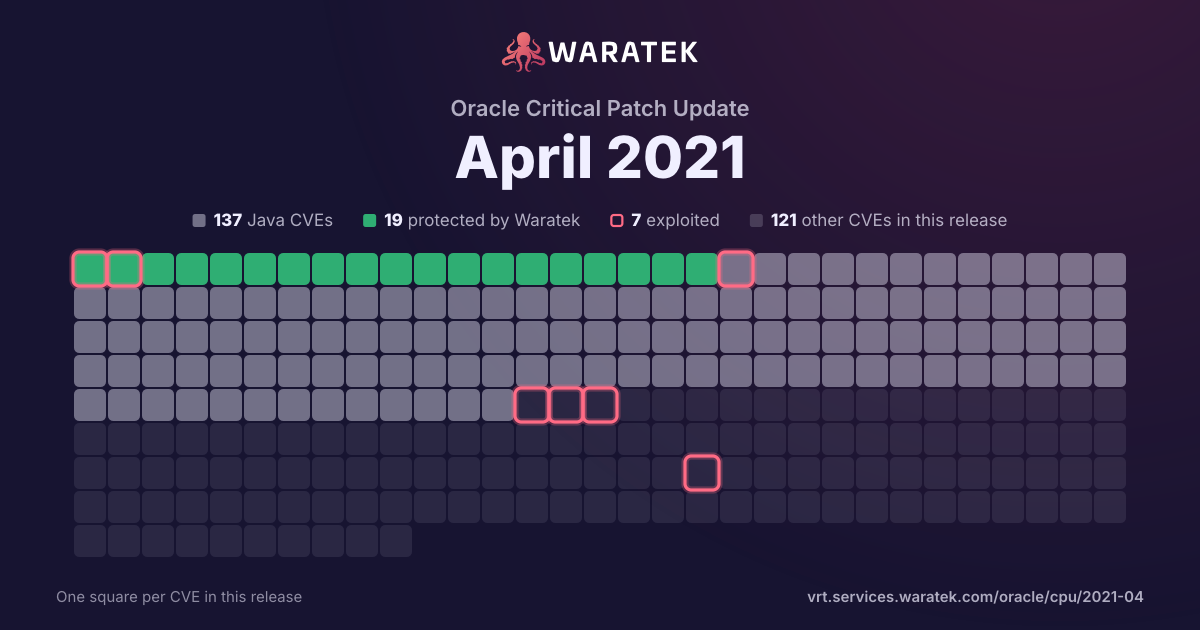
By status
19Protected by Waratek3Mitigation candidate115No exploit published67Outside Waratek scope54Not applicable
7Exploited, marked by the ring
No exploit published. For 97 of them, Oracle's security advisory is the source of public detail.
Protected by Waratek. Waratek RASP can block exploitation of these on systems that have not applied the patch yet.
Overview 258 matches · 137 in Waratek scope · 19 protected · 7 exploited · 3 CISA KEV · 18 public PoC · 18 EPSS ≥ 0.5
258matches
137in Waratek scope53.1%
19protected7.4%
7exploited2.7%
3CISA KEV1.2%
18public PoC7.0%
18EPSS ≥ 0.57.0%
Protected by Waratek
19
7.4%
Rule in development
0
0.0%
Mitigation candidate
3
1.2%
No exploit published
115
44.6%
Outside Waratek scope
67
26.0%
Not applicable
54
20.9%
Withdrawn CVE
0
0.0%
blocked by ARMR today
19
7.4%
partly blocked
0
0.0%
not blocked
239
92.6%
not established
0
0.0%
unrecorded
0
0.0%
split by
peak 179 / quarter
Q1 172
Protected by Waratek1
Outside Waratek scope1
Medium2
blocked by ARMR today1
not blocked1
Working exploit published1
No public exploit1
Q2 170
Q3 172
Protected by Waratek1
Not applicable1
High1
Medium1
blocked by ARMR today1
not blocked1
No public exploit2
Q4 170
Q1 181
No exploit published1
High1
not blocked1
No public exploit1
Q2 181
No exploit published1
High1
not blocked1
No public exploit1
Q3 180
Q4 180
Q1 192
Protected by Waratek1
Not applicable1
Critical1
Medium1
blocked by ARMR today1
not blocked1
No public exploit2
Q2 196
Protected by Waratek1
Mitigation candidate1
Outside Waratek scope3
Not applicable1
Critical1
High3
Medium2
blocked by ARMR today1
not blocked5
Exploited1
Working exploit published2
No public exploit3
Q3 193
Protected by Waratek1
No exploit published1
Outside Waratek scope1
High2
Medium1
blocked by ARMR today1
not blocked2
No public exploit3
Q4 195
Protected by Waratek2
No exploit published2
Outside Waratek scope1
Critical3
High1
Medium1
blocked by ARMR today2
not blocked3
Proof of concept only1
No public exploit4
Q1 206
No exploit published2
Outside Waratek scope3
Not applicable1
Critical2
High3
Medium1
not blocked6
Proof of concept only1
Forecast only1
No public exploit4
Q2 2015
Protected by Waratek2
Mitigation candidate1
No exploit published2
Outside Waratek scope9
Not applicable1
Critical3
High5
Medium6
Low1
blocked by ARMR today2
not blocked13
Exploited3
Proof of concept only1
Forecast only1
No public exploit10
Q3 208
Protected by Waratek2
No exploit published4
Not applicable2
Critical4
High3
Medium1
blocked by ARMR today2
not blocked6
Exploited1
No public exploit7
Q4 2019
Protected by Waratek5
No exploit published7
Outside Waratek scope6
Not applicable1
Critical1
High11
Medium6
Low1
blocked by ARMR today5
not blocked14
Exploited1
Working exploit published1
Proof of concept only2
No public exploit15
Q1 219
No exploit published3
Outside Waratek scope2
Not applicable4
High4
Medium5
not blocked9
Proof of concept only1
Forecast only2
No public exploit6
Q2 21179
Protected by Waratek3
Mitigation candidate1
No exploit published92
Outside Waratek scope41
Not applicable42
Critical15
High86
Medium67
Low11
blocked by ARMR today3
not blocked176
Exploited1
Proof of concept only1
Forecast only2
No public exploit175
Q2 17Q4 17Q2 18Q4 18Q2 19Q4 19Q2 20Q4 20Q2 21
| CVE | Severity | Published▾ | Status | Exploitation | Description |
|---|---|---|---|---|---|
| CVE-2020-26217 | High | 2020-11-16 | Protected by Waratek | Working exploit published | XStream before version 1.4.14 is vulnerable to Remote Code Execution.The vulnerability may allow a remote attacker to run arbitrary shell commands only by manipulating the processed input stream. Only users who rely on blocklists are affected. Anyone using XStream's Security Framework allowlist is not affected. The linked advisory provides code workarounds for users who cannot upgrade. The issue is fixed in version 1.4.14. |
| CVE-2020-27193 | Medium | 2020-11-12 | Outside Waratek scope | No public exploit | A cross-site scripting (XSS) vulnerability in the Color Dialog plugin for CKEditor 4.15.0 allows remote attackers to run arbitrary web script after persuading a user to copy and paste crafted HTML code into one of editor inputs. |
| CVE-2020-13954 | Medium | 2020-11-12 | No exploit published | No public exploit | By default, Apache CXF creates a /services page containing a listing of the available endpoint names and addresses. This webpage is vulnerable to a reflected Cross-Site Scripting (XSS) attack via the styleSheetPath, which allows a malicious actor to inject javascript into the web page. This vulnerability affects all versions of Apache CXF prior to 3.4.1 and 3.3.8. Please note that this is a separate issue to CVE-2019-17573. |
| CVE-2019-17566 | High | 2020-11-12 | Protected by Waratek | No public exploit | Apache Batik is vulnerable to server-side request forgery, caused by improper input validation by the "xlink:href" attributes. By using a specially-crafted argument, an attacker could exploit this vulnerability to cause the underlying server to make arbitrary GET requests. |
| CVE-2020-28196 | High | 2020-11-06 | Outside Waratek scope | No public exploit | MIT Kerberos 5 (aka krb5) before 1.17.2 and 1.18.x before 1.18.3 allows unbounded recursion via an ASN.1-encoded Kerberos message because the lib/krb5/asn.1/asn1_encode.c support for BER indefinite lengths lacks a recursion limit. |
| CVE-2020-7760 | High | 2020-10-30 | No exploit published | No public exploit | This affects the package codemirror before 5.58.2; the package org.apache.marmotta.webjars:codemirror before 5.58.2. The vulnerable regular expression is located in https://github.com/codemirror/CodeMirror/blob/cdb228ac736369c685865b122b736cd0d397836c/mode/javascript/javascript.jsL129. The ReDOS vulnerability of the regex is mainly due to the sub-pattern (s|/*.*?*/)* |
| CVE-2020-11979 | High | 2020-10-01 | No exploit published | No public exploit | As mitigation for CVE-2020-1945 Apache Ant 1.10.8 changed the permissions of temporary files it created so that only the current user was allowed to access them. Unfortunately the fixcrlf task deleted the temporary file and created a new one without said protection, effectively nullifying the effort. This would still allow an attacker to inject modified source files into the build process. |
| CVE-2020-5421 | Medium | 2020-09-19 | No exploit published | No public exploit | In Spring Framework versions 5.2.0 - 5.2.8, 5.1.0 - 5.1.17, 5.0.0 - 5.0.18, 4.3.0 - 4.3.28, and older unsupported versions, the protections against RFD attacks from CVE-2015-5211 may be bypassed depending on the browser used through the use of a jsessionid path parameter. |
| CVE-2020-24750 | High | 2020-09-17 | Protected by Waratek | No public exploit | FasterXML jackson-databind 2.x before 2.9.10.6 mishandles the interaction between serialization gadgets and typing, related to com.pastdev.httpcomponents.configuration.JndiConfiguration. |
| CVE-2020-11998 | Critical | 2020-09-10 | Protected by Waratek | No public exploit | A regression has been introduced in the commit preventing JMX re-bind. By passing an empty environment map to RMIConnectorServer, instead of the map that contains the authentication credentials, it leaves ActiveMQ open to the following attack: https://docs.oracle.com/javase/8/docs/technotes/guides/management/agent.html "A remote client could create a javax.management.loading.MLet MBean and use it to create new MBeans from arbitrary URLs, at least if there is no security manager. In other words, a rogue remote client could make your Java application execute arbitrary code." Mitigation: Upgrade to Apache ActiveMQ 5.15.13 |
| CVE-2020-1472 | Critical | 2020-08-17 | Not applicable | Exploited | An elevation of privilege vulnerability exists when an attacker establishes a vulnerable Netlogon secure channel connection to a domain controller, using the Netlogon Remote Protocol (MS-NRPC). An attacker who successfully exploited the vulnerability could run a specially crafted application on a device on the network. To exploit the vulnerability, an unauthenticated attacker would be required to use MS-NRPC to connect to a domain controller to obtain domain administrator access. Microsoft is addressing the vulnerability in a phased two-part rollout. These updates address the vulnerability by modifying how Netlogon handles the usage of Netlogon secure channels. For guidelines on how to manage the changes required for this vulnerability and more information on the phased rollout, see How to manage the changes in Netlogon secure channel connections associated with CVE-2020-1472 (updated September 28, 2020). When the second phase of Windows updates become available in Q1 2021, customers will be notified via a revision to this security vulnerability. If you wish to be notified when these updates are released, we recommend that you register for the security notifications mailer to be alerted of content changes to this advisory. See Microsoft Technical Security Notifications. |
| CVE-2020-5413 | Critical | 2020-07-31 | No exploit published | No public exploit | Spring Integration framework provides Kryo Codec implementations as an alternative for Java (de)serialization. When Kryo is configured with default options, all unregistered classes are resolved on demand. This leads to the "deserialization gadgets" exploit when provided data contains malicious code for execution during deserialization. In order to protect against this type of attack, Kryo can be configured to require a set of trusted classes for (de)serialization. Spring Integration should be proactive against blocking unknown "deserialization gadgets" when configuring Kryo in code. |
| CVE-2020-8203 | High | 2020-07-15 | Not applicable | No public exploit | Prototype pollution attack when using _.zipObjectDeep in lodash before 4.17.20. |
| CVE-2019-17638 | Critical | 2020-07-09 | No exploit published | No public exploit | In Eclipse Jetty, versions 9.4.27.v20200227 to 9.4.29.v20200521, in case of too large response headers, Jetty throws an exception to produce an HTTP 431 error. When this happens, the ByteBuffer containing the HTTP response headers is released back to the ByteBufferPool twice. Because of this double release, two threads can acquire the same ByteBuffer from the pool and while thread1 is about to use the ByteBuffer to write response1 data, thread2 fills the ByteBuffer with other data. Thread1 then proceeds to write the buffer that now contains different data. This results in client1, which issued request1 seeing data from another request or response which could contain sensitive data belonging to client2 (HTTP session ids, authentication credentials, etc.). If the Jetty version cannot be upgraded, the vulnerability can be significantly reduced by configuring a responseHeaderSize significantly larger than the requestHeaderSize (12KB responseHeaderSize and 8KB requestHeaderSize). |
| CVE-2020-11994 | High | 2020-07-08 | No exploit published | No public exploit | Server-Side Template Injection and arbitrary file disclosure on Camel templating components |
| CVE-2020-9480 | Critical | 2020-06-23 | Mitigation candidate | Exploited | In Apache Spark 2.4.5 and earlier, a standalone resource manager's master may be configured to require authentication (spark.authenticate) via a shared secret. When enabled, however, a specially-crafted RPC to the master can succeed in starting an application's resources on the Spark cluster, even without the shared key. This can be leveraged to execute shell commands on the host machine. This does not affect Spark clusters using other resource managers (YARN, Mesos, etc). |
| CVE-2020-14195 | High | 2020-06-16 | Protected by Waratek | No public exploit | FasterXML jackson-databind 2.x before 2.9.10.5 mishandles the interaction between serialization gadgets and typing, related to org.jsecurity.realm.jndi.JndiRealmFactory (aka org.jsecurity). |
| CVE-2020-13871 | High | 2020-06-06 | Not applicable | No public exploit | SQLite 3.32.2 has a use-after-free in resetAccumulator in select.c because the parse tree rewrite for window functions is too late. |
| CVE-2020-10878 | High | 2020-06-05 | Outside Waratek scope | No public exploit | Perl before 5.30.3 has an integer overflow related to mishandling of a "PL_regkind[OP(n)] == NOTHING" situation. A crafted regular expression could lead to malformed bytecode with a possibility of instruction injection. |
| CVE-2020-5408 | Medium | 2020-05-14 | No exploit published | No public exploit | Spring Security versions 5.3.x prior to 5.3.2, 5.2.x prior to 5.2.4, 5.1.x prior to 5.1.10, 5.0.x prior to 5.0.16 and 4.2.x prior to 4.2.16 use a fixed null initialization vector with CBC Mode in the implementation of the queryable text encryptor. A malicious user with access to the data that has been encrypted using such an encryptor may be able to derive the unencrypted values using a dictionary attack. |
| CVE-2020-1945 | Medium | 2020-05-14 | Outside Waratek scope | No public exploit | Apache Ant 1.1 to 1.9.14 and 1.10.0 to 1.10.7 uses the default temporary directory identified by the Java system property java.io.tmpdir for several tasks and may thus leak sensitive information. The fixcrlf and replaceregexp tasks also copy files from the temporary directory back into the build tree allowing an attacker to inject modified source files into the build process. |
| CVE-2018-1285 | Critical | 2020-05-11 | Outside Waratek scope | No public exploit | Apache log4net versions before 2.0.10 do not disable XML external entities when parsing log4net configuration files. This allows for XXE-based attacks in applications that accept attacker-controlled log4net configuration files. |
| CVE-2020-10683 | Critical | 2020-05-01 | Protected by Waratek | No public exploit | dom4j before 2.0.3 and 2.1.x before 2.1.3 allows external DTDs and External Entities by default, which might enable XXE attacks. However, there is popular external documentation from OWASP showing how to enable the safe, non-default behavior in any application that uses dom4j. |
| CVE-2020-11023 | Medium | 2020-04-29 | Outside Waratek scope | Exploited | In jQuery versions greater than or equal to 1.0.3 and before 3.5.0, passing HTML containing <option> elements from untrusted sources - even after sanitizing it - to one of jQuery's DOM manipulation methods (i.e. .html(), .append(), and others) may execute untrusted code. This problem is patched in jQuery 3.5.0. |
| CVE-2020-11022 | Medium | 2020-04-29 | Outside Waratek scope | Exploited | In jQuery starting with 1.12.0 and before 3.5.0, passing HTML from untrusted sources - even after sanitizing it - to one of jQuery's DOM manipulation methods (i.e. .html(), .append(), and others) may execute untrusted code. This problem is patched in jQuery 3.5.0. |
| CVE-2020-9489 | Medium | 2020-04-27 | No exploit published | No public exploit | A carefully crafted or corrupt file may trigger a System.exit in Tika's OneNote Parser. Crafted or corrupted files can also cause out of memory errors and/or infinite loops in Tika's ICNSParser, MP3Parser, MP4Parser, SAS7BDATParser, OneNoteParser and ImageParser. Apache Tika users should upgrade to 1.24.1 or later. The vulnerabilities in the MP4Parser were partially fixed by upgrading the com.googlecode:isoparser:1.1.22 dependency to org.tallison:isoparser:1.9.41.2. For unrelated security reasons, we upgraded org.apache.cxf to 3.3.6 as part of the 1.24.1 release. |
| CVE-2020-9488 | Low | 2020-04-27 | Outside Waratek scope | No public exploit | Improper validation of certificate with host mismatch in Apache Log4j SMTP appender. This could allow an SMTPS connection to be intercepted by a man-in-the-middle attack which could leak any log messages sent through that appender. Fixed in Apache Log4j 2.12.3 and 2.13.1 |
| CVE-2020-1967 | High | 2020-04-21 | Outside Waratek scope | Proof of concept only | Server or client applications that call the SSL_check_chain() function during or after a TLS 1.3 handshake may crash due to a NULL pointer dereference as a result of incorrect handling of the "signature_algorithms_cert" TLS extension. The crash occurs if an invalid or unrecognised signature algorithm is received from the peer. This could be exploited by a malicious peer in a Denial of Service attack. OpenSSL version 1.1.1d, 1.1.1e, and 1.1.1f are affected by this issue. This issue did not affect OpenSSL versions prior to 1.1.1d. Fixed in OpenSSL 1.1.1g (Affected 1.1.1d-1.1.1f). |
| CVE-2020-11612 | High | 2020-04-07 | Outside Waratek scope | No public exploit | The ZlibDecoders in Netty 4.1.x before 4.1.46 allow for unbounded memory allocation while decoding a ZlibEncoded byte stream. An attacker could send a large ZlibEncoded byte stream to the Netty server, forcing the server to allocate all of its free memory to a single decoder. |
| CVE-2020-1927 | Medium | 2020-04-02 | Outside Waratek scope | Forecast only | In Apache HTTP Server 2.4.0 to 2.4.41, redirects configured with mod_rewrite that were intended to be self-referential might be fooled by encoded newlines and redirect instead to an an unexpected URL within the request URL. |
| CVE-2020-9281 | Medium | 2020-03-07 | Outside Waratek scope | No public exploit | A cross-site scripting (XSS) vulnerability in the HTML Data Processor for CKEditor 4.0 before 4.14 allows remote attackers to inject arbitrary web script through a crafted "protected" comment (with the cke_protected syntax). |
| CVE-2020-10188 | Critical | 2020-03-06 | Outside Waratek scope | Forecast only | utility.c in telnetd in netkit telnet through 0.17 allows remote attackers to execute arbitrary code via short writes or urgent data, because of a buffer overflow involving the netclear and nextitem functions. |
| CVE-2020-5398 | High | 2020-01-17 | Outside Waratek scope | Proof of concept only | In Spring Framework, versions 5.2.x prior to 5.2.3, versions 5.1.x prior to 5.1.13, and versions 5.0.x prior to 5.0.16, an application is vulnerable to a reflected file download (RFD) attack when it sets a "Content-Disposition" header in the response where the filename attribute is derived from user supplied input. |
| CVE-2019-12423 | High | 2020-01-16 | No exploit published | No public exploit | Apache CXF ships with a OpenId Connect JWK Keys service, which allows a client to obtain the public keys in JWK format, which can then be used to verify the signature of tokens issued by the service. Typically, the service obtains the public key from a local keystore (JKS/PKCS12) by specifing the path of the keystore and the alias of the keystore entry. This case is not vulnerable. However it is also possible to obtain the keys from a JWK keystore file, by setting the configuration parameter "rs.security.keystore.type" to "jwk". For this case all keys are returned in this file "as is", including all private key and secret key credentials. This is an obvious security risk if the user has configured the signature keystore file with private or secret key credentials. From CXF 3.3.5 and 3.2.12, it is mandatory to specify an alias corresponding to the id of the key in the JWK file, and only this key is returned. In addition, any private key information is omitted by default. "oct" keys, which contain secret keys, are not returned at all. |
| CVE-2019-0219 | Critical | 2020-01-14 | No exploit published | No public exploit | A website running in the InAppBrowser webview on Android could execute arbitrary JavaScript in the main application's webview using a specially crafted gap-iab: URI. |
| CVE-2019-5064 | High | 2020-01-03 | Not applicable | No public exploit | An exploitable heap buffer overflow vulnerability exists in the data structure persistence functionality of OpenCV, before version 4.2.0. A specially crafted JSON file can cause a buffer overflow, resulting in multiple heap corruptions and potentially code execution. An attacker can provide a specially crafted file to trigger this vulnerability. |
| CVE-2017-18640 | High | 2019-12-12 | Protected by Waratek | No public exploit | The Alias feature in SnakeYAML before 1.26 allows entity expansion during a load operation, a related issue to CVE-2003-1564. |
| CVE-2019-10080 | Medium | 2019-11-19 | Protected by Waratek | No public exploit | The XMLFileLookupService in NiFi versions 1.3.0 to 1.9.2 allowed trusted users to inadvertently configure a potentially malicious XML file. The XML file has the ability to make external calls to services (via XXE) and reveal information such as the versions of Java, Jersey, and Apache that the NiFI instance uses. |
| CVE-2019-2904 | Critical | 2019-10-16 | No exploit published | No public exploit | Vulnerability in the Oracle JDeveloper and ADF product of Oracle Fusion Middleware (component: ADF Faces). Supported versions that are affected are 11.1.1.9.0, 12.1.3.0.0 and 12.2.1.3.0. Easily exploitable vulnerability allows unauthenticated attacker with network access via HTTP to compromise Oracle JDeveloper and ADF. Successful attacks of this vulnerability can result in takeover of Oracle JDeveloper and ADF. CVSS 3.0 Base Score 9.8 (Confidentiality, Integrity and Availability impacts). CVSS Vector: (CVSS:3.0/AV:N/AC:L/PR:N/UI:N/S:U/C:H/I:H/A:H). |
| CVE-2019-17195 | Critical | 2019-10-15 | Outside Waratek scope | Proof of concept only | Connect2id Nimbus JOSE+JWT before v7.9 can throw various uncaught exceptions while parsing a JWT, which could result in an application crash (potential information disclosure) or a potential authentication bypass. |
| CVE-2019-17495 | Critical | 2019-10-10 | No exploit published | No public exploit | A Cascading Style Sheets (CSS) injection vulnerability in Swagger UI before 3.23.11 allows attackers to use the Relative Path Overwrite (RPO) technique to perform CSS-based input field value exfiltration, such as exfiltration of a CSRF token value. In other words, this product intentionally allows the embedding of untrusted JSON data from remote servers, but it was not previously known that <style>@import within the JSON data was a functional attack method. |
| CVE-2019-3740 | Medium | 2019-09-18 | Outside Waratek scope | No public exploit | RSA BSAFE Crypto-J versions prior to 6.2.5 are vulnerable to an Information Exposure Through Timing Discrepancy vulnerabilities during DSA key generation. A malicious remote attacker could potentially exploit those vulnerabilities to recover DSA keys. |
| CVE-2019-12402 | High | 2019-08-30 | No exploit published | No public exploit | The file name encoding algorithm used internally in Apache Commons Compress 1.15 to 1.18 can get into an infinite loop when faced with specially crafted inputs. This can lead to a denial of service attack if an attacker can choose the file names inside of an archive created by Compress. |
| CVE-2019-10086 | High | 2019-08-20 | Protected by Waratek | No public exploit | In Apache Commons Beanutils 1.9.2, a special BeanIntrospector class was added which allows suppressing the ability for an attacker to access the classloader via the class property available on all Java objects. We, however were not using this by default characteristic of the PropertyUtilsBean. |
| CVE-2018-20843 | High | 2019-06-24 | Not applicable | No public exploit | In libexpat in Expat before 2.2.7, XML input including XML names that contain a large number of colons could make the XML parser consume a high amount of RAM and CPU resources while processing (enough to be usable for denial-of-service attacks). |
| CVE-2019-0221 | Medium | 2019-05-28 | Mitigation candidate | Working exploit published | The SSI printenv command in Apache Tomcat 9.0.0.M1 to 9.0.0.17, 8.5.0 to 8.5.39 and 7.0.0 to 7.0.93 echoes user provided data without escaping and is, therefore, vulnerable to XSS. SSI is disabled by default. The printenv command is intended for debugging and is unlikely to be present in a production website. |
| CVE-2019-0227 | High | 2019-05-01 | Outside Waratek scope | Working exploit published | A Server Side Request Forgery (SSRF) vulnerability affected the Apache Axis 1.4 distribution that was last released in 2006. Security and bug commits commits continue in the projects Axis 1.x Subversion repository, legacy users are encouraged to build from source. The successor to Axis 1.x is Axis2, the latest version is 1.7.9 and is not vulnerable to this issue. |
| CVE-2019-3900 | High | 2019-04-25 | Outside Waratek scope | No public exploit | An infinite loop issue was found in the vhost_net kernel module in Linux Kernel up to and including v5.1-rc6, while handling incoming packets in handle_rx(). It could occur if one end sends packets faster than the other end can process them. A guest user, maybe remote one, could use this flaw to stall the vhost_net kernel thread, resulting in a DoS scenario. |
| CVE-2019-11358 | Medium | 2019-04-20 | Outside Waratek scope | Exploited | jQuery before 3.4.0, as used in Drupal, Backdrop CMS, and other products, mishandles jQuery.extend(true, {}, ...) because of Object.prototype pollution. If an unsanitized source object contained an enumerable __proto__ property, it could extend the native Object.prototype. |
| CVE-2019-0228 | Critical | 2019-04-17 | Protected by Waratek | No public exploit | Apache PDFBox 2.0.14 does not properly initialize the XML parser, which allows context-dependent attackers to conduct XML External Entity (XXE) attacks via a crafted XFDF. |
| CVE-2019-7317 | Medium | 2019-02-04 | Not applicable | No public exploit | png_image_free in png.c in libpng 1.6.x before 1.6.37 has a use-after-free because png_image_free_function is called under png_safe_execute. |
| CVE-2019-3773 | Critical | 2019-01-18 | Protected by Waratek | No public exploit | Spring Web Services, versions 2.4.3, 3.0.4, and older unsupported versions of all three projects, were susceptible to XML External Entity Injection (XXE) when receiving XML data from untrusted sources. |
| CVE-2018-1000180 | High | 2018-06-05 | No exploit published | No public exploit | Bouncy Castle BC 1.54 - 1.59, BC-FJA 1.0.0, BC-FJA 1.0.1 and earlier have a flaw in the Low-level interface to RSA key pair generator, specifically RSA Key Pairs generated in low-level API with added certainty may have less M-R tests than expected. This appears to be fixed in versions BC 1.60 beta 4 and later, BC-FJA 1.0.2 and later. |
| CVE-2017-12626 | High | 2018-01-29 | No exploit published | No public exploit | Apache POI in versions prior to release 3.17 are vulnerable to Denial of Service Attacks: 1) Infinite Loops while parsing crafted WMF, EMF, MSG and macros (POI bugs 61338 and 61294), and 2) Out of Memory Exceptions while parsing crafted DOC, PPT and XLS (POI bugs 52372 and 61295). |
| CVE-2017-14735 | Medium | 2017-09-25 | Protected by Waratek | No public exploit | OWASP AntiSamy before 1.5.7 allows XSS via HTML5 entities, as demonstrated by use of : to construct a javascript: URL. |
| CVE-2017-1000061 | High | 2017-07-17 | Not applicable | No public exploit | xmlsec 1.2.23 and before is vulnerable to XML External Entity Expansion when parsing crafted input documents, resulting in possible information disclosure or denial of service |
| CVE-2016-7103 | Medium | 2017-03-15 | Outside Waratek scope | No public exploit | Cross-site scripting (XSS) vulnerability in jQuery UI before 1.12.0 might allow remote attackers to inject arbitrary web script or HTML via the closeText parameter of the dialog function. |
| CVE-2016-5725 | Medium | 2017-01-19 | Protected by Waratek | Working exploit published | Directory traversal vulnerability in JCraft JSch before 0.1.54 on Windows, when the mode is ChannelSftp.OVERWRITE, allows remote SFTP servers to write to arbitrary files via a ..\ (dot dot backslash) in a response to a recursive GET command. |