
Oracle Critical Patch Update January 2021
Released January 2021 · Oracle's advisory ↗ · ← Critical Patch Update, October 2020 · Critical Patch Update, April 2021 →
202 CVEs in this release, one square each
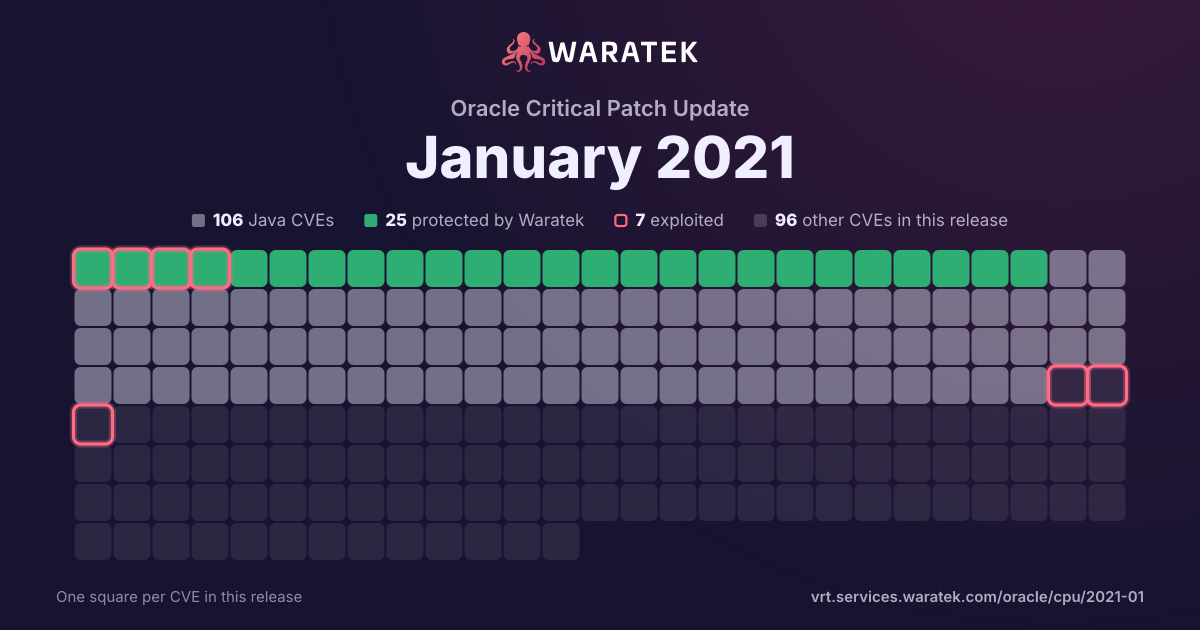
By status
25Protected by Waratek3Mitigation candidate78No exploit published59Outside Waratek scope37Not applicable
7Exploited, marked by the ring
No exploit published. For 66 of them, Oracle's security advisory is the source of public detail.
Protected by Waratek. Waratek RASP can block exploitation of these on systems that have not applied the patch yet.
Overview 106 matches · 25 protected · 4 exploited · 1 CISA KEV · 9 public PoC · 8 EPSS ≥ 0.5
Protected by Waratek
25
23.6%
Rule in development
0
0.0%
Mitigation candidate
3
2.8%
No exploit published
78
73.6%
blocked by ARMR today
25
23.6%
partly blocked
0
0.0%
not blocked
81
76.4%
not established
0
0.0%
unrecorded
0
0.0%
split by
peak 68 / quarter
Q4 161
Protected by Waratek1
Critical1
blocked by ARMR today1
No public exploit1
Q1 171
Protected by Waratek1
Medium1
blocked by ARMR today1
Working exploit published1
Q2 171
No exploit published1
Critical1
not blocked1
No public exploit1
Q3 170
Q4 171
No exploit published1
High1
not blocked1
No public exploit1
Q1 181
No exploit published1
High1
not blocked1
No public exploit1
Q2 182
Protected by Waratek2
Medium2
blocked by ARMR today2
No public exploit2
Q3 180
Q4 180
Q1 191
Protected by Waratek1
Critical1
blocked by ARMR today1
No public exploit1
Q2 192
Mitigation candidate1
No exploit published1
Medium2
not blocked2
Working exploit published1
No public exploit1
Q3 193
Protected by Waratek2
No exploit published1
Critical1
High2
blocked by ARMR today2
not blocked1
Forecast only1
No public exploit2
Q4 194
Protected by Waratek3
No exploit published1
High2
Medium2
blocked by ARMR today3
not blocked1
No public exploit4
Q1 203
Protected by Waratek1
Mitigation candidate1
No exploit published1
Critical2
High1
blocked by ARMR today1
not blocked2
Exploited1
No public exploit2
Q2 205
Protected by Waratek4
No exploit published1
Critical2
High2
Medium1
blocked by ARMR today4
not blocked1
Working exploit published1
No public exploit4
Q3 207
Protected by Waratek4
Mitigation candidate1
No exploit published2
Critical3
High3
Medium1
blocked by ARMR today4
not blocked3
Exploited1
Working exploit published1
No public exploit5
Q4 206
Protected by Waratek3
No exploit published3
High3
Medium3
blocked by ARMR today3
not blocked3
No public exploit6
Q1 2168
Protected by Waratek3
No exploit published65
Critical9
High43
Medium15
Low1
blocked by ARMR today3
not blocked65
Exploited2
Proof of concept only1
Forecast only1
No public exploit64
Q1 17Q3 17Q1 18Q3 18Q1 19Q3 19Q1 20Q3 20Q1 21
| CVE | Severity | Published▾ | Status | Exploitation | Description |
|---|---|---|---|---|---|
| CVE-2021-2118 | High | 2021-01-20 | No exploit published | No public exploit | Vulnerability in the Oracle Marketing product of Oracle E-Business Suite (component: Marketing Administration). Supported versions that are affected are 12.1.1-12.1.3 and 12.2.3-12.2.10. Easily exploitable vulnerability allows unauthenticated attacker with network access via HTTP to compromise Oracle Marketing. Successful attacks require human interaction from a person other than the attacker and while the vulnerability is in Oracle Marketing, attacks may significantly impact additional products. Successful attacks of this vulnerability can result in unauthorized access to critical data or complete access to all Oracle Marketing accessible data as well as unauthorized update, insert or delete access to some of Oracle Marketing accessible data. CVSS 3.1 Base Score 8.2 (Confidentiality and Integrity impacts). CVSS Vector: (CVSS:3.1/AV:N/AC:L/PR:N/UI:R/S:C/C:H/I:L/A:N). |
| CVE-2021-2115 | High | 2021-01-20 | No exploit published | No public exploit | Vulnerability in the Oracle Common Applications Calendar product of Oracle E-Business Suite (component: Tasks). Supported versions that are affected are 12.1.1-12.1.3 and 12.2.3-12.2.10. Easily exploitable vulnerability allows low privileged attacker with network access via HTTP to compromise Oracle Common Applications Calendar. Successful attacks require human interaction from a person other than the attacker and while the vulnerability is in Oracle Common Applications Calendar, attacks may significantly impact additional products. Successful attacks of this vulnerability can result in unauthorized access to critical data or complete access to all Oracle Common Applications Calendar accessible data as well as unauthorized update, insert or delete access to some of Oracle Common Applications Calendar accessible data. CVSS 3.1 Base Score 7.6 (Confidentiality and Integrity impacts). CVSS Vector: (CVSS:3.1/AV:N/AC:L/PR:L/UI:R/S:C/C:H/I:L/A:N). |
| CVE-2021-2114 | High | 2021-01-20 | No exploit published | Forecast only | Vulnerability in the Oracle Common Applications Calendar product of Oracle E-Business Suite (component: Applications Calendar). Supported versions that are affected are 12.1.1-12.1.3 and 12.2.3-12.2.10. Easily exploitable vulnerability allows unauthenticated attacker with network access via HTTP to compromise Oracle Common Applications Calendar. Successful attacks require human interaction from a person other than the attacker and while the vulnerability is in Oracle Common Applications Calendar, attacks may significantly impact additional products. Successful attacks of this vulnerability can result in unauthorized access to critical data or complete access to all Oracle Common Applications Calendar accessible data as well as unauthorized update, insert or delete access to some of Oracle Common Applications Calendar accessible data. CVSS 3.1 Base Score 8.2 (Confidentiality and Integrity impacts). CVSS Vector: (CVSS:3.1/AV:N/AC:L/PR:N/UI:R/S:C/C:H/I:L/A:N). |
| CVE-2021-2113 | Medium | 2021-01-20 | No exploit published | No public exploit | Vulnerability in the Oracle Financial Services Revenue Management and Billing product of Oracle Financial Services Applications (component: On Demand Billing). Supported versions that are affected are 2.9.0.0 and 2.9.0.1. Easily exploitable vulnerability allows low privileged attacker with network access via HTTP to compromise Oracle Financial Services Revenue Management and Billing. Successful attacks of this vulnerability can result in unauthorized update, insert or delete access to some of Oracle Financial Services Revenue Management and Billing accessible data. CVSS 3.1 Base Score 4.3 (Integrity impacts). CVSS Vector: (CVSS:3.1/AV:N/AC:L/PR:L/UI:N/S:U/C:N/I:L/A:N). |
| CVE-2021-2110 | Medium | 2021-01-20 | No exploit published | No public exploit | Vulnerability in the Oracle Argus Safety product of Oracle Health Sciences Applications (component: Letters). The supported version that is affected is 8.2.2. Easily exploitable vulnerability allows low privileged attacker with network access via HTTP to compromise Oracle Argus Safety. While the vulnerability is in Oracle Argus Safety, attacks may significantly impact additional products. Successful attacks of this vulnerability can result in unauthorized read access to a subset of Oracle Argus Safety accessible data. CVSS 3.1 Base Score 5.0 (Confidentiality impacts). CVSS Vector: (CVSS:3.1/AV:N/AC:L/PR:L/UI:N/S:C/C:L/I:N/A:N). |
| CVE-2021-2109 | High | 2021-01-20 | Protected by Waratek | Exploited | Vulnerability in the Oracle WebLogic Server product of Oracle Fusion Middleware (component: Console). Supported versions that are affected are 10.3.6.0.0, 12.1.3.0.0, 12.2.1.3.0, 12.2.1.4.0 and 14.1.1.0.0. Easily exploitable vulnerability allows high privileged attacker with network access via HTTP to compromise Oracle WebLogic Server. Successful attacks of this vulnerability can result in takeover of Oracle WebLogic Server. CVSS 3.1 Base Score 7.2 (Confidentiality, Integrity and Availability impacts). CVSS Vector: (CVSS:3.1/AV:N/AC:L/PR:H/UI:N/S:U/C:H/I:H/A:H). |
| CVE-2021-2108 | Critical | 2021-01-20 | No exploit published | No public exploit | Vulnerability in the Oracle WebLogic Server product of Oracle Fusion Middleware (component: Core Components). The supported version that is affected is 12.1.3.0.0. Easily exploitable vulnerability allows unauthenticated attacker with network access via IIOP, T3 to compromise Oracle WebLogic Server. Successful attacks of this vulnerability can result in takeover of Oracle WebLogic Server. CVSS 3.1 Base Score 9.8 (Confidentiality, Integrity and Availability impacts). CVSS Vector: (CVSS:3.1/AV:N/AC:L/PR:N/UI:N/S:U/C:H/I:H/A:H). |
| CVE-2021-2107 | High | 2021-01-20 | No exploit published | No public exploit | Vulnerability in the Oracle Customer Interaction History product of Oracle E-Business Suite (component: Outcome-Result). Supported versions that are affected are 12.1.1-12.1.3 and 12.2.3-12.2.10. Easily exploitable vulnerability allows unauthenticated attacker with network access via HTTP to compromise Oracle Customer Interaction History. Successful attacks require human interaction from a person other than the attacker and while the vulnerability is in Oracle Customer Interaction History, attacks may significantly impact additional products. Successful attacks of this vulnerability can result in unauthorized access to critical data or complete access to all Oracle Customer Interaction History accessible data as well as unauthorized update, insert or delete access to some of Oracle Customer Interaction History accessible data. CVSS 3.1 Base Score 8.2 (Confidentiality and Integrity impacts). CVSS Vector: (CVSS:3.1/AV:N/AC:L/PR:N/UI:R/S:C/C:H/I:L/A:N). |
| CVE-2021-2106 | High | 2021-01-20 | No exploit published | No public exploit | Vulnerability in the Oracle Customer Interaction History product of Oracle E-Business Suite (component: Outcome-Result). Supported versions that are affected are 12.1.1-12.1.3 and 12.2.3-12.2.10. Easily exploitable vulnerability allows unauthenticated attacker with network access via HTTP to compromise Oracle Customer Interaction History. Successful attacks require human interaction from a person other than the attacker and while the vulnerability is in Oracle Customer Interaction History, attacks may significantly impact additional products. Successful attacks of this vulnerability can result in unauthorized access to critical data or complete access to all Oracle Customer Interaction History accessible data as well as unauthorized update, insert or delete access to some of Oracle Customer Interaction History accessible data. CVSS 3.1 Base Score 8.2 (Confidentiality and Integrity impacts). CVSS Vector: (CVSS:3.1/AV:N/AC:L/PR:N/UI:R/S:C/C:H/I:L/A:N). |
| CVE-2021-2105 | High | 2021-01-20 | No exploit published | No public exploit | Vulnerability in the Oracle Customer Interaction History product of Oracle E-Business Suite (component: Outcome-Result). Supported versions that are affected are 12.1.1-12.1.3 and 12.2.3-12.2.10. Easily exploitable vulnerability allows unauthenticated attacker with network access via HTTP to compromise Oracle Customer Interaction History. Successful attacks require human interaction from a person other than the attacker and while the vulnerability is in Oracle Customer Interaction History, attacks may significantly impact additional products. Successful attacks of this vulnerability can result in unauthorized access to critical data or complete access to all Oracle Customer Interaction History accessible data as well as unauthorized update, insert or delete access to some of Oracle Customer Interaction History accessible data. CVSS 3.1 Base Score 8.2 (Confidentiality and Integrity impacts). CVSS Vector: (CVSS:3.1/AV:N/AC:L/PR:N/UI:R/S:C/C:H/I:L/A:N). |
| CVE-2021-2104 | High | 2021-01-20 | No exploit published | No public exploit | Vulnerability in the Oracle Complex Maintenance, Repair, and Overhaul product of Oracle Supply Chain (component: Dialog Box). Supported versions that are affected are 11.5.10, 12.1 and 12.2. Easily exploitable vulnerability allows unauthenticated attacker with network access via HTTP to compromise Oracle Complex Maintenance, Repair, and Overhaul. Successful attacks require human interaction from a person other than the attacker and while the vulnerability is in Oracle Complex Maintenance, Repair, and Overhaul, attacks may significantly impact additional products. Successful attacks of this vulnerability can result in unauthorized access to critical data or complete access to all Oracle Complex Maintenance, Repair, and Overhaul accessible data as well as unauthorized update, insert or delete access to some of Oracle Complex Maintenance, Repair, and Overhaul accessible data. CVSS 3.1 Base Score 8.2 (Confidentiality and Integrity impacts). CVSS Vector: (CVSS:3.1/AV:N/AC:L/PR:N/UI:R/S:C/C:H/I:L/A:N). |
| CVE-2021-2103 | High | 2021-01-20 | No exploit published | No public exploit | Vulnerability in the Oracle Complex Maintenance, Repair, and Overhaul product of Oracle Supply Chain (component: Dialog Box). Supported versions that are affected are 11.5.10, 12.1 and 12.2. Easily exploitable vulnerability allows unauthenticated attacker with network access via HTTP to compromise Oracle Complex Maintenance, Repair, and Overhaul. Successful attacks require human interaction from a person other than the attacker and while the vulnerability is in Oracle Complex Maintenance, Repair, and Overhaul, attacks may significantly impact additional products. Successful attacks of this vulnerability can result in unauthorized access to critical data or complete access to all Oracle Complex Maintenance, Repair, and Overhaul accessible data as well as unauthorized update, insert or delete access to some of Oracle Complex Maintenance, Repair, and Overhaul accessible data. CVSS 3.1 Base Score 8.2 (Confidentiality and Integrity impacts). CVSS Vector: (CVSS:3.1/AV:N/AC:L/PR:N/UI:R/S:C/C:H/I:L/A:N). |
| CVE-2021-2102 | High | 2021-01-20 | No exploit published | No public exploit | Vulnerability in the Oracle Complex Maintenance, Repair, and Overhaul product of Oracle Supply Chain (component: Dialog Box). Supported versions that are affected are 11.5.10, 12.1 and 12.2. Easily exploitable vulnerability allows unauthenticated attacker with network access via HTTP to compromise Oracle Complex Maintenance, Repair, and Overhaul. Successful attacks require human interaction from a person other than the attacker and while the vulnerability is in Oracle Complex Maintenance, Repair, and Overhaul, attacks may significantly impact additional products. Successful attacks of this vulnerability can result in unauthorized access to critical data or complete access to all Oracle Complex Maintenance, Repair, and Overhaul accessible data as well as unauthorized update, insert or delete access to some of Oracle Complex Maintenance, Repair, and Overhaul accessible data. CVSS 3.1 Base Score 8.2 (Confidentiality and Integrity impacts). CVSS Vector: (CVSS:3.1/AV:N/AC:L/PR:N/UI:R/S:C/C:H/I:L/A:N). |
| CVE-2021-2101 | Critical | 2021-01-20 | No exploit published | No public exploit | Vulnerability in the Oracle One-to-One Fulfillment product of Oracle E-Business Suite (component: Print Server). Supported versions that are affected are 12.1.1-12.1.3 and 12.2.3-12.2.10. Easily exploitable vulnerability allows unauthenticated attacker with network access via HTTP to compromise Oracle One-to-One Fulfillment. Successful attacks of this vulnerability can result in unauthorized creation, deletion or modification access to critical data or all Oracle One-to-One Fulfillment accessible data as well as unauthorized access to critical data or complete access to all Oracle One-to-One Fulfillment accessible data. CVSS 3.1 Base Score 9.1 (Confidentiality and Integrity impacts). CVSS Vector: (CVSS:3.1/AV:N/AC:L/PR:N/UI:N/S:U/C:H/I:H/A:N). |
| CVE-2021-2100 | Critical | 2021-01-20 | No exploit published | No public exploit | Vulnerability in the Oracle One-to-One Fulfillment product of Oracle E-Business Suite (component: Print Server). Supported versions that are affected are 12.1.1-12.1.3 and 12.2.3-12.2.10. Easily exploitable vulnerability allows unauthenticated attacker with network access via HTTP to compromise Oracle One-to-One Fulfillment. Successful attacks of this vulnerability can result in unauthorized creation, deletion or modification access to critical data or all Oracle One-to-One Fulfillment accessible data as well as unauthorized access to critical data or complete access to all Oracle One-to-One Fulfillment accessible data. CVSS 3.1 Base Score 9.1 (Confidentiality and Integrity impacts). CVSS Vector: (CVSS:3.1/AV:N/AC:L/PR:N/UI:N/S:U/C:H/I:H/A:N). |
| CVE-2021-2099 | High | 2021-01-20 | No exploit published | No public exploit | Vulnerability in the Oracle CRM Technical Foundation product of Oracle E-Business Suite (component: Preferences). Supported versions that are affected are 12.2.3-12.2.10. Easily exploitable vulnerability allows unauthenticated attacker with network access via HTTP to compromise Oracle CRM Technical Foundation. Successful attacks require human interaction from a person other than the attacker and while the vulnerability is in Oracle CRM Technical Foundation, attacks may significantly impact additional products. Successful attacks of this vulnerability can result in unauthorized access to critical data or complete access to all Oracle CRM Technical Foundation accessible data as well as unauthorized update, insert or delete access to some of Oracle CRM Technical Foundation accessible data. CVSS 3.1 Base Score 8.2 (Confidentiality and Integrity impacts). CVSS Vector: (CVSS:3.1/AV:N/AC:L/PR:N/UI:R/S:C/C:H/I:L/A:N). |
| CVE-2021-2098 | High | 2021-01-20 | No exploit published | No public exploit | Vulnerability in the Oracle Email Center product of Oracle E-Business Suite (component: Message Display). Supported versions that are affected are 12.1.1-12.1.3 and 12.2.3-12.2.10. Easily exploitable vulnerability allows unauthenticated attacker with network access via HTTP to compromise Oracle Email Center. Successful attacks require human interaction from a person other than the attacker and while the vulnerability is in Oracle Email Center, attacks may significantly impact additional products. Successful attacks of this vulnerability can result in unauthorized access to critical data or complete access to all Oracle Email Center accessible data as well as unauthorized update, insert or delete access to some of Oracle Email Center accessible data. CVSS 3.1 Base Score 8.2 (Confidentiality and Integrity impacts). CVSS Vector: (CVSS:3.1/AV:N/AC:L/PR:N/UI:R/S:C/C:H/I:L/A:N). |
| CVE-2021-2097 | High | 2021-01-20 | No exploit published | No public exploit | Vulnerability in the Oracle iSupport product of Oracle E-Business Suite (component: Profile). Supported versions that are affected are 12.1.1-12.1.3 and 12.2.3-12.2.10. Easily exploitable vulnerability allows unauthenticated attacker with network access via HTTP to compromise Oracle iSupport. Successful attacks require human interaction from a person other than the attacker and while the vulnerability is in Oracle iSupport, attacks may significantly impact additional products. Successful attacks of this vulnerability can result in unauthorized access to critical data or complete access to all Oracle iSupport accessible data as well as unauthorized update, insert or delete access to some of Oracle iSupport accessible data. CVSS 3.1 Base Score 8.2 (Confidentiality and Integrity impacts). CVSS Vector: (CVSS:3.1/AV:N/AC:L/PR:N/UI:R/S:C/C:H/I:L/A:N). |
| CVE-2021-2096 | High | 2021-01-20 | No exploit published | No public exploit | Vulnerability in the Oracle iStore product of Oracle E-Business Suite (component: Shopping Cart). Supported versions that are affected are 12.1.1-12.1.3 and 12.2.3-12.2.10. Easily exploitable vulnerability allows unauthenticated attacker with network access via HTTP to compromise Oracle iStore. Successful attacks require human interaction from a person other than the attacker and while the vulnerability is in Oracle iStore, attacks may significantly impact additional products. Successful attacks of this vulnerability can result in unauthorized access to critical data or complete access to all Oracle iStore accessible data as well as unauthorized update, insert or delete access to some of Oracle iStore accessible data. CVSS 3.1 Base Score 8.2 (Confidentiality and Integrity impacts). CVSS Vector: (CVSS:3.1/AV:N/AC:L/PR:N/UI:R/S:C/C:H/I:L/A:N). |
| CVE-2021-2094 | High | 2021-01-20 | No exploit published | No public exploit | Vulnerability in the Oracle One-to-One Fulfillment product of Oracle E-Business Suite (component: Print Server). Supported versions that are affected are 12.1.1-12.1.3 and 12.2.3-12.2.10. Easily exploitable vulnerability allows unauthenticated attacker with network access via HTTP to compromise Oracle One-to-One Fulfillment. Successful attacks require human interaction from a person other than the attacker and while the vulnerability is in Oracle One-to-One Fulfillment, attacks may significantly impact additional products. Successful attacks of this vulnerability can result in unauthorized access to critical data or complete access to all Oracle One-to-One Fulfillment accessible data as well as unauthorized update, insert or delete access to some of Oracle One-to-One Fulfillment accessible data. CVSS 3.1 Base Score 8.2 (Confidentiality and Integrity impacts). CVSS Vector: (CVSS:3.1/AV:N/AC:L/PR:N/UI:R/S:C/C:H/I:L/A:N). |
| CVE-2021-2093 | High | 2021-01-20 | No exploit published | No public exploit | Vulnerability in the Oracle Common Applications product of Oracle E-Business Suite (component: CRM User Management Framework). Supported versions that are affected are 12.1.1-12.1.3 and 12.2.3-12.2.10. Easily exploitable vulnerability allows unauthenticated attacker with network access via HTTP to compromise Oracle Common Applications. Successful attacks require human interaction from a person other than the attacker and while the vulnerability is in Oracle Common Applications, attacks may significantly impact additional products. Successful attacks of this vulnerability can result in unauthorized access to critical data or complete access to all Oracle Common Applications accessible data as well as unauthorized update, insert or delete access to some of Oracle Common Applications accessible data. CVSS 3.1 Base Score 8.2 (Confidentiality and Integrity impacts). CVSS Vector: (CVSS:3.1/AV:N/AC:L/PR:N/UI:R/S:C/C:H/I:L/A:N). |
| CVE-2021-2092 | High | 2021-01-20 | No exploit published | No public exploit | Vulnerability in the Oracle CRM Technical Foundation product of Oracle E-Business Suite (component: Preferences). Supported versions that are affected are 12.1.3 and 12.2.3-12.2.10. Easily exploitable vulnerability allows unauthenticated attacker with network access via HTTP to compromise Oracle CRM Technical Foundation. Successful attacks require human interaction from a person other than the attacker and while the vulnerability is in Oracle CRM Technical Foundation, attacks may significantly impact additional products. Successful attacks of this vulnerability can result in unauthorized access to critical data or complete access to all Oracle CRM Technical Foundation accessible data as well as unauthorized update, insert or delete access to some of Oracle CRM Technical Foundation accessible data. CVSS 3.1 Base Score 8.2 (Confidentiality and Integrity impacts). CVSS Vector: (CVSS:3.1/AV:N/AC:L/PR:N/UI:R/S:C/C:H/I:L/A:N). |
| CVE-2021-2091 | High | 2021-01-20 | No exploit published | No public exploit | Vulnerability in the Oracle Scripting product of Oracle E-Business Suite (component: Miscellaneous). Supported versions that are affected are 12.1.1-12.1.3 and 12.2.3-12.2.10. Easily exploitable vulnerability allows unauthenticated attacker with network access via HTTP to compromise Oracle Scripting. Successful attacks require human interaction from a person other than the attacker and while the vulnerability is in Oracle Scripting, attacks may significantly impact additional products. Successful attacks of this vulnerability can result in unauthorized access to critical data or complete access to all Oracle Scripting accessible data as well as unauthorized update, insert or delete access to some of Oracle Scripting accessible data. CVSS 3.1 Base Score 8.2 (Confidentiality and Integrity impacts). CVSS Vector: (CVSS:3.1/AV:N/AC:L/PR:N/UI:R/S:C/C:H/I:L/A:N). |
| CVE-2021-2090 | High | 2021-01-20 | No exploit published | No public exploit | Vulnerability in the Oracle Email Center product of Oracle E-Business Suite (component: Message Display). Supported versions that are affected are 12.1.1-12.1.3 and 12.2.3-12.2.10. Easily exploitable vulnerability allows unauthenticated attacker with network access via HTTP to compromise Oracle Email Center. Successful attacks require human interaction from a person other than the attacker and while the vulnerability is in Oracle Email Center, attacks may significantly impact additional products. Successful attacks of this vulnerability can result in unauthorized access to critical data or complete access to all Oracle Email Center accessible data as well as unauthorized update, insert or delete access to some of Oracle Email Center accessible data. CVSS 3.1 Base Score 8.2 (Confidentiality and Integrity impacts). CVSS Vector: (CVSS:3.1/AV:N/AC:L/PR:N/UI:R/S:C/C:H/I:L/A:N). |
| CVE-2021-2089 | High | 2021-01-20 | No exploit published | No public exploit | Vulnerability in the Oracle iStore product of Oracle E-Business Suite (component: Runtime Catalog). Supported versions that are affected are 12.1.1-12.1.3 and 12.2.3-12.2.10. Easily exploitable vulnerability allows unauthenticated attacker with network access via HTTP to compromise Oracle iStore. Successful attacks require human interaction from a person other than the attacker and while the vulnerability is in Oracle iStore, attacks may significantly impact additional products. Successful attacks of this vulnerability can result in unauthorized access to critical data or complete access to all Oracle iStore accessible data as well as unauthorized update, insert or delete access to some of Oracle iStore accessible data. CVSS 3.1 Base Score 8.2 (Confidentiality and Integrity impacts). CVSS Vector: (CVSS:3.1/AV:N/AC:L/PR:N/UI:R/S:C/C:H/I:L/A:N). |
| CVE-2021-2085 | High | 2021-01-20 | No exploit published | No public exploit | Vulnerability in the Oracle CRM Technical Foundation product of Oracle E-Business Suite (component: Preferences). Supported versions that are affected are 12.1.3 and 12.2.3-12.2.10. Easily exploitable vulnerability allows unauthenticated attacker with network access via HTTP to compromise Oracle CRM Technical Foundation. Successful attacks require human interaction from a person other than the attacker and while the vulnerability is in Oracle CRM Technical Foundation, attacks may significantly impact additional products. Successful attacks of this vulnerability can result in unauthorized access to critical data or complete access to all Oracle CRM Technical Foundation accessible data as well as unauthorized update, insert or delete access to some of Oracle CRM Technical Foundation accessible data. CVSS 3.1 Base Score 8.2 (Confidentiality and Integrity impacts). CVSS Vector: (CVSS:3.1/AV:N/AC:L/PR:N/UI:R/S:C/C:H/I:L/A:N). |
| CVE-2021-2084 | High | 2021-01-20 | No exploit published | No public exploit | Vulnerability in the Oracle CRM Technical Foundation product of Oracle E-Business Suite (component: Preferences). Supported versions that are affected are 12.1.3 and 12.2.3-12.2.10. Easily exploitable vulnerability allows unauthenticated attacker with network access via HTTP to compromise Oracle CRM Technical Foundation. Successful attacks require human interaction from a person other than the attacker and while the vulnerability is in Oracle CRM Technical Foundation, attacks may significantly impact additional products. Successful attacks of this vulnerability can result in unauthorized access to critical data or complete access to all Oracle CRM Technical Foundation accessible data as well as unauthorized update, insert or delete access to some of Oracle CRM Technical Foundation accessible data. CVSS 3.1 Base Score 8.2 (Confidentiality and Integrity impacts). CVSS Vector: (CVSS:3.1/AV:N/AC:L/PR:N/UI:R/S:C/C:H/I:L/A:N). |
| CVE-2021-2083 | High | 2021-01-20 | No exploit published | No public exploit | Vulnerability in the Oracle iSupport product of Oracle E-Business Suite (component: User Responsibilities). Supported versions that are affected are 12.1.1-12.1.3 and 12.2.3-12.2.10. Easily exploitable vulnerability allows unauthenticated attacker with network access via HTTP to compromise Oracle iSupport. Successful attacks require human interaction from a person other than the attacker and while the vulnerability is in Oracle iSupport, attacks may significantly impact additional products. Successful attacks of this vulnerability can result in unauthorized access to critical data or complete access to all Oracle iSupport accessible data as well as unauthorized update, insert or delete access to some of Oracle iSupport accessible data. CVSS 3.1 Base Score 8.2 (Confidentiality and Integrity impacts). CVSS Vector: (CVSS:3.1/AV:N/AC:L/PR:N/UI:R/S:C/C:H/I:L/A:N). |
| CVE-2021-2082 | High | 2021-01-20 | No exploit published | No public exploit | Vulnerability in the Oracle iStore product of Oracle E-Business Suite (component: Shopping Cart). Supported versions that are affected are 12.1.1-12.1.3 and 12.2.3-12.2.10. Easily exploitable vulnerability allows unauthenticated attacker with network access via HTTP to compromise Oracle iStore. Successful attacks require human interaction from a person other than the attacker and while the vulnerability is in Oracle iStore, attacks may significantly impact additional products. Successful attacks of this vulnerability can result in unauthorized access to critical data or complete access to all Oracle iStore accessible data as well as unauthorized update, insert or delete access to some of Oracle iStore accessible data. CVSS 3.1 Base Score 8.2 (Confidentiality and Integrity impacts). CVSS Vector: (CVSS:3.1/AV:N/AC:L/PR:N/UI:R/S:C/C:H/I:L/A:N). |
| CVE-2021-2080 | High | 2021-01-20 | No exploit published | No public exploit | Vulnerability in the Oracle Configurator product of Oracle Supply Chain (component: UI Servlet). Supported versions that are affected are 12.1 and 12.2. Easily exploitable vulnerability allows unauthenticated attacker with network access via HTTP to compromise Oracle Configurator. Successful attacks require human interaction from a person other than the attacker and while the vulnerability is in Oracle Configurator, attacks may significantly impact additional products. Successful attacks of this vulnerability can result in unauthorized access to critical data or complete access to all Oracle Configurator accessible data as well as unauthorized update, insert or delete access to some of Oracle Configurator accessible data. CVSS 3.1 Base Score 8.2 (Confidentiality and Integrity impacts). CVSS Vector: (CVSS:3.1/AV:N/AC:L/PR:N/UI:R/S:C/C:H/I:L/A:N). |
| CVE-2021-2079 | High | 2021-01-20 | No exploit published | No public exploit | Vulnerability in the Oracle Configurator product of Oracle Supply Chain (component: UI Servlet). Supported versions that are affected are 12.1 and 12.2. Easily exploitable vulnerability allows unauthenticated attacker with network access via HTTP to compromise Oracle Configurator. Successful attacks require human interaction from a person other than the attacker and while the vulnerability is in Oracle Configurator, attacks may significantly impact additional products. Successful attacks of this vulnerability can result in unauthorized access to critical data or complete access to all Oracle Configurator accessible data as well as unauthorized update, insert or delete access to some of Oracle Configurator accessible data. CVSS 3.1 Base Score 8.2 (Confidentiality and Integrity impacts). CVSS Vector: (CVSS:3.1/AV:N/AC:L/PR:N/UI:R/S:C/C:H/I:L/A:N). |
| CVE-2021-2078 | High | 2021-01-20 | No exploit published | No public exploit | Vulnerability in the Oracle Configurator product of Oracle Supply Chain (component: UI Servlet). Supported versions that are affected are 12.1 and 12.2. Easily exploitable vulnerability allows unauthenticated attacker with network access via HTTP to compromise Oracle Configurator. Successful attacks require human interaction from a person other than the attacker and while the vulnerability is in Oracle Configurator, attacks may significantly impact additional products. Successful attacks of this vulnerability can result in unauthorized access to critical data or complete access to all Oracle Configurator accessible data as well as unauthorized update, insert or delete access to some of Oracle Configurator accessible data. CVSS 3.1 Base Score 8.2 (Confidentiality and Integrity impacts). CVSS Vector: (CVSS:3.1/AV:N/AC:L/PR:N/UI:R/S:C/C:H/I:L/A:N). |
| CVE-2021-2077 | High | 2021-01-20 | No exploit published | No public exploit | Vulnerability in the Oracle iStore product of Oracle E-Business Suite (component: Shopping Cart). Supported versions that are affected are 12.1.1-12.1.3 and 12.2.3-12.2.10. Easily exploitable vulnerability allows unauthenticated attacker with network access via HTTP to compromise Oracle iStore. Successful attacks require human interaction from a person other than the attacker and while the vulnerability is in Oracle iStore, attacks may significantly impact additional products. Successful attacks of this vulnerability can result in unauthorized access to critical data or complete access to all Oracle iStore accessible data as well as unauthorized update, insert or delete access to some of Oracle iStore accessible data. CVSS 3.1 Base Score 8.2 (Confidentiality and Integrity impacts). CVSS Vector: (CVSS:3.1/AV:N/AC:L/PR:N/UI:R/S:C/C:H/I:L/A:N). |
| CVE-2021-2075 | Critical | 2021-01-20 | No exploit published | No public exploit | Vulnerability in the Oracle WebLogic Server product of Oracle Fusion Middleware (component: Samples). Supported versions that are affected are 10.3.6.0.0, 12.1.3.0.0, 12.2.1.3.0, 12.2.1.4.0 and 14.1.1.0.0. Easily exploitable vulnerability allows unauthenticated attacker with network access via IIOP, T3 to compromise Oracle WebLogic Server. Successful attacks of this vulnerability can result in takeover of Oracle WebLogic Server. CVSS 3.1 Base Score 9.8 (Confidentiality, Integrity and Availability impacts). CVSS Vector: (CVSS:3.1/AV:N/AC:L/PR:N/UI:N/S:U/C:H/I:H/A:H). |
| CVE-2021-2071 | High | 2021-01-20 | No exploit published | No public exploit | Vulnerability in the PeopleSoft Enterprise PeopleTools product of Oracle PeopleSoft (component: Elastic Search). Supported versions that are affected are 8.56, 8.57 and 8.58. Difficult to exploit vulnerability allows unauthenticated attacker with network access via HTTP to compromise PeopleSoft Enterprise PeopleTools. Successful attacks of this vulnerability can result in takeover of PeopleSoft Enterprise PeopleTools. CVSS 3.1 Base Score 8.1 (Confidentiality, Integrity and Availability impacts). CVSS Vector: (CVSS:3.1/AV:N/AC:H/PR:N/UI:N/S:U/C:H/I:H/A:H). |
| CVE-2021-2064 | Critical | 2021-01-20 | No exploit published | No public exploit | Vulnerability in the Oracle WebLogic Server product of Oracle Fusion Middleware (component: Core Components). The supported version that is affected is 12.1.3.0.0. Easily exploitable vulnerability allows unauthenticated attacker with network access via IIOP, T3 to compromise Oracle WebLogic Server. Successful attacks of this vulnerability can result in takeover of Oracle WebLogic Server. CVSS 3.1 Base Score 9.8 (Confidentiality, Integrity and Availability impacts). CVSS Vector: (CVSS:3.1/AV:N/AC:L/PR:N/UI:N/S:U/C:H/I:H/A:H). |
| CVE-2021-2063 | High | 2021-01-20 | No exploit published | No public exploit | Vulnerability in the PeopleSoft Enterprise PeopleTools product of Oracle PeopleSoft (component: Portal). Supported versions that are affected are 8.56, 8.57 and 8.58. Easily exploitable vulnerability allows unauthenticated attacker with logon to the infrastructure where PeopleSoft Enterprise PeopleTools executes to compromise PeopleSoft Enterprise PeopleTools. Successful attacks of this vulnerability can result in takeover of PeopleSoft Enterprise PeopleTools. CVSS 3.1 Base Score 8.4 (Confidentiality, Integrity and Availability impacts). CVSS Vector: (CVSS:3.1/AV:L/AC:L/PR:N/UI:N/S:U/C:H/I:H/A:H). |
| CVE-2021-2062 | High | 2021-01-20 | No exploit published | No public exploit | Vulnerability in the Oracle BI Publisher product of Oracle Fusion Middleware (component: Web Server). Supported versions that are affected are 5.5.0.0.0, 11.1.1.9.0, 12.2.1.3.0 and 12.2.1.4.0. Easily exploitable vulnerability allows low privileged attacker with network access via HTTP to compromise Oracle BI Publisher. Successful attacks require human interaction from a person other than the attacker and while the vulnerability is in Oracle BI Publisher, attacks may significantly impact additional products. Successful attacks of this vulnerability can result in unauthorized access to critical data or complete access to all Oracle BI Publisher accessible data as well as unauthorized update, insert or delete access to some of Oracle BI Publisher accessible data. CVSS 3.1 Base Score 7.6 (Confidentiality and Integrity impacts). CVSS Vector: (CVSS:3.1/AV:N/AC:L/PR:L/UI:R/S:C/C:H/I:L/A:N). |
| CVE-2021-2059 | Medium | 2021-01-20 | No exploit published | No public exploit | Vulnerability in the Oracle iStore product of Oracle E-Business Suite (component: Web interface). Supported versions that are affected are 12.1.1-12.1.3 and 12.2.3-12.2.10. Easily exploitable vulnerability allows unauthenticated attacker with network access via HTTP to compromise Oracle iStore. Successful attacks of this vulnerability can result in unauthorized read access to a subset of Oracle iStore accessible data. CVSS 3.1 Base Score 5.3 (Confidentiality impacts). CVSS Vector: (CVSS:3.1/AV:N/AC:L/PR:N/UI:N/S:U/C:L/I:N/A:N). |
| CVE-2021-2057 | Medium | 2021-01-20 | No exploit published | No public exploit | Vulnerability in the Oracle Retail Customer Management and Segmentation Foundation product of Oracle Retail Applications (component: Internal Operations). The supported version that is affected is 19.0. Easily exploitable vulnerability allows low privileged attacker with network access via HTTP to compromise Oracle Retail Customer Management and Segmentation Foundation. Successful attacks of this vulnerability can result in unauthorized update, insert or delete access to some of Oracle Retail Customer Management and Segmentation Foundation accessible data as well as unauthorized read access to a subset of Oracle Retail Customer Management and Segmentation Foundation accessible data and unauthorized ability to cause a partial denial of service (partial DOS) of Oracle Retail Customer Management and Segmentation Foundation. CVSS 3.1 Base Score 6.3 (Confidentiality, Integrity and Availability impacts). CVSS Vector: (CVSS:3.1/AV:N/AC:L/PR:L/UI:N/S:U/C:L/I:L/A:L). |
| CVE-2021-2052 | Medium | 2021-01-20 | No exploit published | No public exploit | Vulnerability in the JD Edwards EnterpriseOne Orchestrator product of Oracle JD Edwards (component: E1 IOT Orchestrator Security). The supported version that is affected is Prior to 9.2.5.1. Easily exploitable vulnerability allows unauthenticated attacker with network access via HTTP to compromise JD Edwards EnterpriseOne Orchestrator. While the vulnerability is in JD Edwards EnterpriseOne Orchestrator, attacks may significantly impact additional products. Successful attacks of this vulnerability can result in unauthorized read access to a subset of JD Edwards EnterpriseOne Orchestrator accessible data. CVSS 3.1 Base Score 5.8 (Confidentiality impacts). CVSS Vector: (CVSS:3.1/AV:N/AC:L/PR:N/UI:N/S:C/C:L/I:N/A:N). |
| CVE-2021-2051 | High | 2021-01-20 | No exploit published | No public exploit | Vulnerability in the Oracle BI Publisher product of Oracle Fusion Middleware (component: E-Business Suite - XDO). Supported versions that are affected are 5.5.0.0.0, 11.1.1.9.0, 12.2.1.3.0 and 12.2.1.4.0. Easily exploitable vulnerability allows low privileged attacker with network access via HTTP to compromise Oracle BI Publisher. Successful attacks of this vulnerability can result in unauthorized access to critical data or complete access to all Oracle BI Publisher accessible data as well as unauthorized update, insert or delete access to some of Oracle BI Publisher accessible data and unauthorized ability to cause a partial denial of service (partial DOS) of Oracle BI Publisher. CVSS 3.1 Base Score 7.6 (Confidentiality, Integrity and Availability impacts). CVSS Vector: (CVSS:3.1/AV:N/AC:L/PR:L/UI:N/S:U/C:H/I:L/A:L). |
| CVE-2021-2050 | High | 2021-01-20 | No exploit published | No public exploit | Vulnerability in the Oracle BI Publisher product of Oracle Fusion Middleware (component: E-Business Suite - XDO). Supported versions that are affected are 5.5.0.0.0, 11.1.1.9.0, 12.2.1.3.0 and 12.2.1.4.0. Easily exploitable vulnerability allows low privileged attacker with network access via HTTP to compromise Oracle BI Publisher. Successful attacks of this vulnerability can result in unauthorized access to critical data or complete access to all Oracle BI Publisher accessible data as well as unauthorized update, insert or delete access to some of Oracle BI Publisher accessible data and unauthorized ability to cause a partial denial of service (partial DOS) of Oracle BI Publisher. CVSS 3.1 Base Score 7.6 (Confidentiality, Integrity and Availability impacts). CVSS Vector: (CVSS:3.1/AV:N/AC:L/PR:L/UI:N/S:U/C:H/I:L/A:L). |
| CVE-2021-2049 | High | 2021-01-20 | No exploit published | No public exploit | Vulnerability in the Oracle BI Publisher product of Oracle Fusion Middleware (component: Administration). Supported versions that are affected are 5.5.0.0.0, 11.1.1.9.0, 12.2.1.3.0 and 12.2.1.4.0. Easily exploitable vulnerability allows low privileged attacker with network access via HTTP to compromise Oracle BI Publisher. Successful attacks of this vulnerability can result in unauthorized access to critical data or complete access to all Oracle BI Publisher accessible data as well as unauthorized update, insert or delete access to some of Oracle BI Publisher accessible data and unauthorized ability to cause a partial denial of service (partial DOS) of Oracle BI Publisher. CVSS 3.1 Base Score 7.6 (Confidentiality, Integrity and Availability impacts). CVSS Vector: (CVSS:3.1/AV:N/AC:L/PR:L/UI:N/S:U/C:H/I:L/A:L). |
| CVE-2021-2047 | Critical | 2021-01-20 | No exploit published | No public exploit | Vulnerability in the Oracle WebLogic Server product of Oracle Fusion Middleware (component: Core Components). Supported versions that are affected are 10.3.6.0.0, 12.1.3.0.0, and 12.2.1.3.0. Easily exploitable vulnerability allows unauthenticated attacker with network access via IIOP, T3 to compromise Oracle WebLogic Server. Successful attacks of this vulnerability can result in takeover of Oracle WebLogic Server. CVSS 3.1 Base Score 9.8 (Confidentiality, Integrity and Availability impacts). CVSS Vector: (CVSS:3.1/AV:N/AC:L/PR:N/UI:N/S:U/C:H/I:H/A:H). |
| CVE-2021-2044 | Medium | 2021-01-20 | No exploit published | No public exploit | Vulnerability in the PeopleSoft Enterprise FIN Payables product of Oracle PeopleSoft (component: Financial Sanctions). The supported version that is affected is 9.2. Easily exploitable vulnerability allows low privileged attacker with network access via HTTP to compromise PeopleSoft Enterprise FIN Payables. Successful attacks of this vulnerability can result in unauthorized access to critical data or complete access to all PeopleSoft Enterprise FIN Payables accessible data. CVSS 3.1 Base Score 6.5 (Confidentiality impacts). CVSS Vector: (CVSS:3.1/AV:N/AC:L/PR:L/UI:N/S:U/C:H/I:N/A:N). |
| CVE-2021-2043 | Medium | 2021-01-20 | No exploit published | No public exploit | Vulnerability in the PeopleSoft Enterprise PeopleTools product of Oracle PeopleSoft (component: Portal). Supported versions that are affected are 8.56, 8.57 and 8.58. Easily exploitable vulnerability allows unauthenticated attacker with network access via HTTP to compromise PeopleSoft Enterprise PeopleTools. Successful attacks require human interaction from a person other than the attacker and while the vulnerability is in PeopleSoft Enterprise PeopleTools, attacks may significantly impact additional products. Successful attacks of this vulnerability can result in unauthorized update, insert or delete access to some of PeopleSoft Enterprise PeopleTools accessible data as well as unauthorized read access to a subset of PeopleSoft Enterprise PeopleTools accessible data. CVSS 3.1 Base Score 6.1 (Confidentiality and Integrity impacts). CVSS Vector: (CVSS:3.1/AV:N/AC:L/PR:N/UI:R/S:C/C:L/I:L/A:N). |
| CVE-2021-2041 | High | 2021-01-20 | No exploit published | No public exploit | Vulnerability in the Oracle Business Intelligence Enterprise Edition product of Oracle Fusion Middleware (component: Installation). Supported versions that are affected are 12.2.1.3.0 and 12.2.1.4.0. Difficult to exploit vulnerability allows unauthenticated attacker with network access via HTTP to compromise Oracle Business Intelligence Enterprise Edition. Successful attacks of this vulnerability can result in takeover of Oracle Business Intelligence Enterprise Edition. CVSS 3.1 Base Score 8.1 (Confidentiality, Integrity and Availability impacts). CVSS Vector: (CVSS:3.1/AV:N/AC:H/PR:N/UI:N/S:U/C:H/I:H/A:H). |
| CVE-2021-2040 | Medium | 2021-01-20 | No exploit published | No public exploit | Vulnerability in the Oracle Argus Safety product of Oracle Health Sciences Applications (component: Case Form, Local Affiliate Form). The supported version that is affected is 8.2.2. Easily exploitable vulnerability allows unauthenticated attacker with network access via HTTP to compromise Oracle Argus Safety. Successful attacks require human interaction from a person other than the attacker and while the vulnerability is in Oracle Argus Safety, attacks may significantly impact additional products. Successful attacks of this vulnerability can result in unauthorized update, insert or delete access to some of Oracle Argus Safety accessible data as well as unauthorized read access to a subset of Oracle Argus Safety accessible data. CVSS 3.1 Base Score 6.1 (Confidentiality and Integrity impacts). CVSS Vector: (CVSS:3.1/AV:N/AC:L/PR:N/UI:R/S:C/C:L/I:L/A:N). |
| CVE-2021-2039 | High | 2021-01-20 | No exploit published | No public exploit | Vulnerability in the Siebel Core - Server Framework product of Oracle Siebel CRM (component: Search). Supported versions that are affected are 20.12 and prior. Easily exploitable vulnerability allows low privileged attacker with network access via HTTP to compromise Siebel Core - Server Framework. Successful attacks require human interaction from a person other than the attacker and while the vulnerability is in Siebel Core - Server Framework, attacks may significantly impact additional products. Successful attacks of this vulnerability can result in unauthorized access to critical data or complete access to all Siebel Core - Server Framework accessible data as well as unauthorized update, insert or delete access to some of Siebel Core - Server Framework accessible data. CVSS 3.1 Base Score 7.6 (Confidentiality and Integrity impacts). CVSS Vector: (CVSS:3.1/AV:N/AC:L/PR:L/UI:R/S:C/C:H/I:L/A:N). |
| CVE-2021-2034 | High | 2021-01-20 | No exploit published | No public exploit | Vulnerability in the Oracle Common Applications Calendar product of Oracle E-Business Suite (component: Tasks). Supported versions that are affected are 12.1.1-12.1.3. Easily exploitable vulnerability allows unauthenticated attacker with network access via HTTP to compromise Oracle Common Applications Calendar. Successful attacks require human interaction from a person other than the attacker and while the vulnerability is in Oracle Common Applications Calendar, attacks may significantly impact additional products. Successful attacks of this vulnerability can result in unauthorized access to critical data or complete access to all Oracle Common Applications Calendar accessible data as well as unauthorized update, insert or delete access to some of Oracle Common Applications Calendar accessible data. CVSS 3.1 Base Score 8.2 (Confidentiality and Integrity impacts). CVSS Vector: (CVSS:3.1/AV:N/AC:L/PR:N/UI:R/S:C/C:H/I:L/A:N). |
| CVE-2021-2033 | Medium | 2021-01-20 | No exploit published | No public exploit | Vulnerability in the Oracle WebLogic Server product of Oracle Fusion Middleware (component: Core Components). Supported versions that are affected are 12.1.3.0.0, 12.2.1.3.0, 12.2.1.4.0 and 14.1.1.0.0. Easily exploitable vulnerability allows low privileged attacker with network access via HTTP to compromise Oracle WebLogic Server. Successful attacks of this vulnerability can result in unauthorized ability to cause a partial denial of service (partial DOS) of Oracle WebLogic Server. CVSS 3.1 Base Score 4.3 (Availability impacts). CVSS Vector: (CVSS:3.1/AV:N/AC:L/PR:L/UI:N/S:U/C:N/I:N/A:L). |
| CVE-2021-2029 | Critical | 2021-01-20 | No exploit published | No public exploit | Vulnerability in the Oracle Scripting product of Oracle E-Business Suite (component: Miscellaneous). Supported versions that are affected are 12.1.1-12.1.3 and 12.2.3-12.2.8. Easily exploitable vulnerability allows unauthenticated attacker with network access via HTTP to compromise Oracle Scripting. Successful attacks of this vulnerability can result in takeover of Oracle Scripting. CVSS 3.1 Base Score 9.8 (Confidentiality, Integrity and Availability impacts). CVSS Vector: (CVSS:3.1/AV:N/AC:L/PR:N/UI:N/S:U/C:H/I:H/A:H). |
| CVE-2021-2027 | High | 2021-01-20 | No exploit published | No public exploit | Vulnerability in the Oracle Marketing product of Oracle E-Business Suite (component: Marketing Administration). Supported versions that are affected are 12.1.1-12.1.3 and 12.2.3-12.2.10. Easily exploitable vulnerability allows unauthenticated attacker with network access via HTTP to compromise Oracle Marketing. Successful attacks require human interaction from a person other than the attacker and while the vulnerability is in Oracle Marketing, attacks may significantly impact additional products. Successful attacks of this vulnerability can result in unauthorized access to critical data or complete access to all Oracle Marketing accessible data as well as unauthorized update, insert or delete access to some of Oracle Marketing accessible data. CVSS 3.1 Base Score 8.2 (Confidentiality and Integrity impacts). CVSS Vector: (CVSS:3.1/AV:N/AC:L/PR:N/UI:R/S:C/C:H/I:L/A:N). |
| CVE-2021-2026 | High | 2021-01-20 | No exploit published | No public exploit | Vulnerability in the Oracle Marketing product of Oracle E-Business Suite (component: Marketing Administration). Supported versions that are affected are 12.1.1-12.1.3 and 12.2.3-12.2.10. Easily exploitable vulnerability allows unauthenticated attacker with network access via HTTP to compromise Oracle Marketing. Successful attacks require human interaction from a person other than the attacker and while the vulnerability is in Oracle Marketing, attacks may significantly impact additional products. Successful attacks of this vulnerability can result in unauthorized access to critical data or complete access to all Oracle Marketing accessible data as well as unauthorized update, insert or delete access to some of Oracle Marketing accessible data. CVSS 3.1 Base Score 8.2 (Confidentiality and Integrity impacts). CVSS Vector: (CVSS:3.1/AV:N/AC:L/PR:N/UI:R/S:C/C:H/I:L/A:N). |
| CVE-2021-2025 | High | 2021-01-20 | No exploit published | No public exploit | Vulnerability in the Oracle Business Intelligence Enterprise Edition product of Oracle Fusion Middleware (component: Analytics Web General). Supported versions that are affected are 5.5.0.0.0, 11.1.1.9.0, 12.2.1.3.0 and 12.2.1.4.0. Easily exploitable vulnerability allows unauthenticated attacker with network access via HTTP to compromise Oracle Business Intelligence Enterprise Edition. Successful attacks require human interaction from a person other than the attacker and while the vulnerability is in Oracle Business Intelligence Enterprise Edition, attacks may significantly impact additional products. Successful attacks of this vulnerability can result in unauthorized access to critical data or complete access to all Oracle Business Intelligence Enterprise Edition accessible data as well as unauthorized update, insert or delete access to some of Oracle Business Intelligence Enterprise Edition accessible data. CVSS 3.1 Base Score 8.2 (Confidentiality and Integrity impacts). CVSS Vector: (CVSS:3.1/AV:N/AC:L/PR:N/UI:R/S:C/C:H/I:L/A:N). |
| CVE-2021-2023 | Medium | 2021-01-20 | No exploit published | No public exploit | Vulnerability in the Oracle Installed Base product of Oracle E-Business Suite (component: APIs). Supported versions that are affected are 12.1.1-12.1.3 and 12.2.3-12.2.9. Easily exploitable vulnerability allows unauthenticated attacker with network access via HTTP to compromise Oracle Installed Base. Successful attacks require human interaction from a person other than the attacker and while the vulnerability is in Oracle Installed Base, attacks may significantly impact additional products. Successful attacks of this vulnerability can result in unauthorized update, insert or delete access to some of Oracle Installed Base accessible data. CVSS 3.1 Base Score 4.7 (Integrity impacts). CVSS Vector: (CVSS:3.1/AV:N/AC:L/PR:N/UI:R/S:C/C:N/I:L/A:N). |
| CVE-2021-2017 | Medium | 2021-01-20 | No exploit published | No public exploit | Vulnerability in the Oracle User Management product of Oracle E-Business Suite (component: Proxy User Delegation). Supported versions that are affected are 12.1.3 and 12.2.3-12.2.10. Easily exploitable vulnerability allows low privileged attacker with network access via HTTP to compromise Oracle User Management. Successful attacks of this vulnerability can result in unauthorized read access to a subset of Oracle User Management accessible data. CVSS 3.1 Base Score 4.3 (Confidentiality impacts). CVSS Vector: (CVSS:3.1/AV:N/AC:L/PR:L/UI:N/S:U/C:L/I:N/A:N). |
| CVE-2021-2015 | High | 2021-01-20 | No exploit published | No public exploit | Vulnerability in the Oracle Workflow product of Oracle E-Business Suite (component: Worklist). Supported versions that are affected are 12.2.3-12.2.10. Easily exploitable vulnerability allows unauthenticated attacker with network access via HTTP to compromise Oracle Workflow. Successful attacks require human interaction from a person other than the attacker and while the vulnerability is in Oracle Workflow, attacks may significantly impact additional products. Successful attacks of this vulnerability can result in unauthorized access to critical data or complete access to all Oracle Workflow accessible data as well as unauthorized update, insert or delete access to some of Oracle Workflow accessible data. CVSS 3.1 Base Score 8.2 (Confidentiality and Integrity impacts). CVSS Vector: (CVSS:3.1/AV:N/AC:L/PR:N/UI:R/S:C/C:H/I:L/A:N). |
| CVE-2021-2013 | High | 2021-01-20 | No exploit published | No public exploit | Vulnerability in the Oracle BI Publisher product of Oracle Fusion Middleware (component: BI Publisher Security). Supported versions that are affected are 5.5.0.0.0, 11.1.1.9.0, 12.2.1.3.0 and 12.2.1.4.0. Easily exploitable vulnerability allows low privileged attacker with network access via HTTP to compromise Oracle BI Publisher. Successful attacks of this vulnerability can result in unauthorized access to critical data or complete access to all Oracle BI Publisher accessible data as well as unauthorized update, insert or delete access to some of Oracle BI Publisher accessible data and unauthorized ability to cause a partial denial of service (partial DOS) of Oracle BI Publisher. CVSS 3.1 Base Score 7.6 (Confidentiality, Integrity and Availability impacts). CVSS Vector: (CVSS:3.1/AV:N/AC:L/PR:L/UI:N/S:U/C:H/I:L/A:L). |
| CVE-2021-2005 | Medium | 2021-01-20 | No exploit published | No public exploit | Vulnerability in the Oracle Business Intelligence Enterprise Edition product of Oracle Fusion Middleware (component: BI Platform Security). Supported versions that are affected are 12.2.1.3.0 and 12.2.1.4.0. Easily exploitable vulnerability allows unauthenticated attacker with network access via HTTP to compromise Oracle Business Intelligence Enterprise Edition. Successful attacks require human interaction from a person other than the attacker and while the vulnerability is in Oracle Business Intelligence Enterprise Edition, attacks may significantly impact additional products. Successful attacks of this vulnerability can result in unauthorized read access to a subset of Oracle Business Intelligence Enterprise Edition accessible data. CVSS 3.1 Base Score 4.7 (Confidentiality impacts). CVSS Vector: (CVSS:3.1/AV:N/AC:L/PR:N/UI:R/S:C/C:L/I:N/A:N). |
| CVE-2021-2004 | Medium | 2021-01-20 | No exploit published | No public exploit | Vulnerability in the Siebel Core - Server BizLogic Script product of Oracle Siebel CRM (component: Integration - Scripting). Supported versions that are affected are 20.12 and prior. Easily exploitable vulnerability allows low privileged attacker with network access via HTTP to compromise Siebel Core - Server BizLogic Script. Successful attacks of this vulnerability can result in unauthorized read access to a subset of Siebel Core - Server BizLogic Script accessible data. CVSS 3.1 Base Score 4.3 (Confidentiality impacts). CVSS Vector: (CVSS:3.1/AV:N/AC:L/PR:L/UI:N/S:U/C:L/I:N/A:N). |
| CVE-2021-2003 | Medium | 2021-01-20 | No exploit published | No public exploit | Vulnerability in the Business Intelligence Enterprise Edition product of Oracle Fusion Middleware (component: Analytics Web Dashboards). Supported versions that are affected are 5.5.0.0.0, 11.1.1.9.0, 12.2.1.3.0 and 12.2.1.4.0. Easily exploitable vulnerability allows low privileged attacker with network access via HTTP to compromise Business Intelligence Enterprise Edition. Successful attacks require human interaction from a person other than the attacker and while the vulnerability is in Business Intelligence Enterprise Edition, attacks may significantly impact additional products. Successful attacks of this vulnerability can result in unauthorized update, insert or delete access to some of Business Intelligence Enterprise Edition accessible data as well as unauthorized read access to a subset of Business Intelligence Enterprise Edition accessible data. CVSS 3.1 Base Score 5.4 (Confidentiality and Integrity impacts). CVSS Vector: (CVSS:3.1/AV:N/AC:L/PR:L/UI:R/S:C/C:L/I:L/A:N). |
| CVE-2021-1997 | High | 2021-01-20 | No exploit published | No public exploit | Vulnerability in the Oracle Hospitality Reporting and Analytics product of Oracle Food and Beverage Applications (component: Report). The supported version that is affected is 9.1.0. Easily exploitable vulnerability allows low privileged attacker with network access via HTTP to compromise Oracle Hospitality Reporting and Analytics. Successful attacks of this vulnerability can result in unauthorized creation, deletion or modification access to critical data or all Oracle Hospitality Reporting and Analytics accessible data as well as unauthorized access to critical data or complete access to all Oracle Hospitality Reporting and Analytics accessible data. CVSS 3.1 Base Score 8.1 (Confidentiality and Integrity impacts). CVSS Vector: (CVSS:3.1/AV:N/AC:L/PR:L/UI:N/S:U/C:H/I:H/A:N). |
| CVE-2021-1996 | Low | 2021-01-20 | No exploit published | No public exploit | Vulnerability in the Oracle WebLogic Server product of Oracle Fusion Middleware (component: Web Services). Supported versions that are affected are 10.3.6.0.0 and 12.1.3.0.0. Easily exploitable vulnerability allows high privileged attacker with network access via HTTP to compromise Oracle WebLogic Server. Successful attacks require human interaction from a person other than the attacker. Successful attacks of this vulnerability can result in unauthorized read access to a subset of Oracle WebLogic Server accessible data. CVSS 3.1 Base Score 2.4 (Confidentiality impacts). CVSS Vector: (CVSS:3.1/AV:N/AC:L/PR:H/UI:R/S:U/C:L/I:N/A:N). |
| CVE-2021-1995 | Medium | 2021-01-20 | No exploit published | No public exploit | Vulnerability in the Oracle WebLogic Server product of Oracle Fusion Middleware (component: Web Services). Supported versions that are affected are 10.3.6.0.0 and 12.1.3.0.0. Easily exploitable vulnerability allows low privileged attacker with network access via HTTP to compromise Oracle WebLogic Server. Successful attacks of this vulnerability can result in unauthorized creation, deletion or modification access to critical data or all Oracle WebLogic Server accessible data. CVSS 3.1 Base Score 6.5 (Integrity impacts). CVSS Vector: (CVSS:3.1/AV:N/AC:L/PR:L/UI:N/S:U/C:N/I:H/A:N). |
| CVE-2021-1994 | Critical | 2021-01-20 | Protected by Waratek | Proof of concept only | Vulnerability in the Oracle WebLogic Server product of Oracle Fusion Middleware (component: Web Services). Supported versions that are affected are 10.3.6.0.0 and 12.1.3.0.0. Easily exploitable vulnerability allows unauthenticated attacker with network access via HTTP to compromise Oracle WebLogic Server. Successful attacks of this vulnerability can result in takeover of Oracle WebLogic Server. CVSS 3.1 Base Score 9.8 (Confidentiality, Integrity and Availability impacts). CVSS Vector: (CVSS:3.1/AV:N/AC:L/PR:N/UI:N/S:U/C:H/I:H/A:H). |
| CVE-2020-14756 | Critical | 2021-01-20 | Protected by Waratek | Exploited | Vulnerability in the Oracle Coherence product of Oracle Fusion Middleware (component: Core Components). Supported versions that are affected are 3.7.1.0, 12.1.3.0.0, 12.2.1.3.0, 12.2.1.4.0 and 14.1.1.0.0. Easily exploitable vulnerability allows unauthenticated attacker with network access via IIOP, T3 to compromise Oracle Coherence. Successful attacks of this vulnerability can result in takeover of Oracle Coherence. CVSS 3.1 Base Score 9.8 (Confidentiality, Integrity and Availability impacts). CVSS Vector: (CVSS:3.1/AV:N/AC:L/PR:N/UI:N/S:U/C:H/I:H/A:H). |
| CVE-2020-17521 | Medium | 2020-12-07 | Protected by Waratek | No public exploit | Apache Groovy provides extension methods to aid with creating temporary directories. Prior to this fix, Groovy's implementation of those extension methods was using a now superseded Java JDK method call that is potentially not secure on some operating systems in some contexts. Users not using the extension methods mentioned in the advisory are not affected, but may wish to read the advisory for further details. Versions Affected: 2.0 to 2.4.20, 2.5.0 to 2.5.13, 3.0.0 to 3.0.6, and 4.0.0-alpha-1. Fixed in versions 2.4.21, 2.5.14, 3.0.7, 4.0.0-alpha-2. |
| CVE-2020-13954 | Medium | 2020-11-12 | No exploit published | No public exploit | By default, Apache CXF creates a /services page containing a listing of the available endpoint names and addresses. This webpage is vulnerable to a reflected Cross-Site Scripting (XSS) attack via the styleSheetPath, which allows a malicious actor to inject javascript into the web page. This vulnerability affects all versions of Apache CXF prior to 3.4.1 and 3.3.8. Please note that this is a separate issue to CVE-2019-17573. |
| CVE-2019-17566 | High | 2020-11-12 | Protected by Waratek | No public exploit | Apache Batik is vulnerable to server-side request forgery, caused by improper input validation by the "xlink:href" attributes. By using a specially-crafted argument, an attacker could exploit this vulnerability to cause the underlying server to make arbitrary GET requests. |
| CVE-2020-27216 | High | 2020-10-23 | No exploit published | No public exploit | In Eclipse Jetty versions 1.0 thru 9.4.32.v20200930, 10.0.0.alpha1 thru 10.0.0.beta2, and 11.0.0.alpha1 thru 11.0.0.beta2O, on Unix like systems, the system's temporary directory is shared between all users on that system. A collocated user can observe the process of creating a temporary sub directory in the shared temporary directory and race to complete the creation of the temporary subdirectory. If the attacker wins the race then they will have read and write permission to the subdirectory used to unpack web applications, including their WEB-INF/lib jar files and JSP files. If any code is ever executed out of this temporary directory, this can lead to a local privilege escalation vulnerability. |
| CVE-2020-14803 | Medium | 2020-10-21 | Protected by Waratek | No public exploit | Vulnerability in the Java SE product of Oracle Java SE (component: Libraries). Supported versions that are affected are Java SE: 11.0.8 and 15. Easily exploitable vulnerability allows unauthenticated attacker with network access via multiple protocols to compromise Java SE. Successful attacks of this vulnerability can result in unauthorized read access to a subset of Java SE accessible data. Note: This vulnerability applies to Java deployments, typically in clients running sandboxed Java Web Start applications or sandboxed Java applets, that load and run untrusted code (e.g., code that comes from the internet) and rely on the Java sandbox for security. This vulnerability does not apply to Java deployments, typically in servers, that load and run only trusted code (e.g., code installed by an administrator). CVSS 3.1 Base Score 5.3 (Confidentiality impacts). CVSS Vector: (CVSS:3.1/AV:N/AC:L/PR:N/UI:N/S:U/C:L/I:N/A:N). |
| CVE-2020-11979 | High | 2020-10-01 | No exploit published | No public exploit | As mitigation for CVE-2020-1945 Apache Ant 1.10.8 changed the permissions of temporary files it created so that only the current user was allowed to access them. Unfortunately the fixcrlf task deleted the temporary file and created a new one without said protection, effectively nullifying the effort. This would still allow an attacker to inject modified source files into the build process. |
| CVE-2020-5421 | Medium | 2020-09-19 | No exploit published | No public exploit | In Spring Framework versions 5.2.0 - 5.2.8, 5.1.0 - 5.1.17, 5.0.0 - 5.0.18, 4.3.0 - 4.3.28, and older unsupported versions, the protections against RFD attacks from CVE-2015-5211 may be bypassed depending on the browser used through the use of a jsessionid path parameter. |
| CVE-2020-24750 | High | 2020-09-17 | Protected by Waratek | No public exploit | FasterXML jackson-databind 2.x before 2.9.10.6 mishandles the interaction between serialization gadgets and typing, related to com.pastdev.httpcomponents.configuration.JndiConfiguration. |
| CVE-2019-0230 | Critical | 2020-09-14 | Protected by Waratek | Exploited | Apache Struts 2.0.0 to 2.5.20 forced double OGNL evaluation, when evaluated on raw user input in tag attributes, may lead to remote code execution. |
| CVE-2020-11998 | Critical | 2020-09-10 | Protected by Waratek | No public exploit | A regression has been introduced in the commit preventing JMX re-bind. By passing an empty environment map to RMIConnectorServer, instead of the map that contains the authentication credentials, it leaves ActiveMQ open to the following attack: https://docs.oracle.com/javase/8/docs/technotes/guides/management/agent.html "A remote client could create a javax.management.loading.MLet MBean and use it to create new MBeans from arbitrary URLs, at least if there is no security manager. In other words, a rogue remote client could make your Java application execute arbitrary code." Mitigation: Upgrade to Apache ActiveMQ 5.15.13 |
| CVE-2020-25020 | Critical | 2020-08-29 | Protected by Waratek | No public exploit | MPXJ through 8.1.3 allows XXE attacks. This affects the GanttProjectReader and PhoenixReader components. |
| CVE-2020-13935 | High | 2020-07-14 | Mitigation candidate | Working exploit published | The payload length in a WebSocket frame was not correctly validated in Apache Tomcat 10.0.0-M1 to 10.0.0-M6, 9.0.0.M1 to 9.0.36, 8.5.0 to 8.5.56 and 7.0.27 to 7.0.104. Invalid payload lengths could trigger an infinite loop. Multiple requests with invalid payload lengths could lead to a denial of service. |
| CVE-2020-11994 | High | 2020-07-08 | No exploit published | No public exploit | Server-Side Template Injection and arbitrary file disclosure on Camel templating components |
| CVE-2020-14195 | High | 2020-06-16 | Protected by Waratek | No public exploit | FasterXML jackson-databind 2.x before 2.9.10.5 mishandles the interaction between serialization gadgets and typing, related to org.jsecurity.realm.jndi.JndiRealmFactory (aka org.jsecurity). |
| CVE-2020-9484 | High | 2020-05-20 | Protected by Waratek | Working exploit published | When using Apache Tomcat versions 10.0.0-M1 to 10.0.0-M4, 9.0.0.M1 to 9.0.34, 8.5.0 to 8.5.54 and 7.0.0 to 7.0.103 if a) an attacker is able to control the contents and name of a file on the server; and b) the server is configured to use the PersistenceManager with a FileStore; and c) the PersistenceManager is configured with sessionAttributeValueClassNameFilter="null" (the default unless a SecurityManager is used) or a sufficiently lax filter to allow the attacker provided object to be deserialized; and d) the attacker knows the relative file path from the storage location used by FileStore to the file the attacker has control over; then, using a specifically crafted request, the attacker will be able to trigger remote code execution via deserialization of the file under their control. Note that all of conditions a) to d) must be true for the attack to succeed. |
| CVE-2020-5408 | Medium | 2020-05-14 | No exploit published | No public exploit | Spring Security versions 5.3.x prior to 5.3.2, 5.2.x prior to 5.2.4, 5.1.x prior to 5.1.10, 5.0.x prior to 5.0.16 and 4.2.x prior to 4.2.16 use a fixed null initialization vector with CBC Mode in the implementation of the queryable text encryptor. A malicious user with access to the data that has been encrypted using such an encryptor may be able to derive the unencrypted values using a dictionary attack. |
| CVE-2020-11973 | Critical | 2020-05-14 | Protected by Waratek | No public exploit | Apache Camel Netty enables Java deserialization by default. Apache Camel 2.22.x, 2.23.x, 2.24.x, 2.25.0, 3.0.0 up to 3.1.0 are affected. 2.x users should upgrade to 2.25.1, 3.x users should upgrade to 3.2.0. |
| CVE-2020-10683 | Critical | 2020-05-01 | Protected by Waratek | No public exploit | dom4j before 2.0.3 and 2.1.x before 2.1.3 allows external DTDs and External Entities by default, which might enable XXE attacks. However, there is popular external documentation from OWASP showing how to enable the safe, non-default behavior in any application that uses dom4j. |
| CVE-2020-9546 | Critical | 2020-03-02 | Mitigation candidate | No public exploit | FasterXML jackson-databind 2.x before 2.9.10.4 mishandles the interaction between serialization gadgets and typing, related to org.apache.hadoop.shaded.com.zaxxer.hikari.HikariConfig (aka shaded hikari-config). |
| CVE-2020-2555 | Critical | 2020-01-15 | Protected by Waratek | Exploited | Vulnerability in the Oracle Coherence product of Oracle Fusion Middleware (component: Caching,CacheStore,Invocation). Supported versions that are affected are 3.7.1.0, 12.1.3.0.0, 12.2.1.3.0 and 12.2.1.4.0. Easily exploitable vulnerability allows unauthenticated attacker with network access via T3 to compromise Oracle Coherence. Successful attacks of this vulnerability can result in takeover of Oracle Coherence. CVSS 3.0 Base Score 9.8 (Confidentiality, Integrity and Availability impacts). CVSS Vector: (CVSS:3.0/AV:N/AC:L/PR:N/UI:N/S:U/C:H/I:H/A:H). |
| CVE-2019-12399 | High | 2020-01-14 | No exploit published | No public exploit | When Connect workers in Apache Kafka 2.0.0, 2.0.1, 2.1.0, 2.1.1, 2.2.0, 2.2.1, or 2.3.0 are configured with one or more config providers, and a connector is created/updated on that Connect cluster to use an externalized secret variable in a substring of a connector configuration property value, then any client can issue a request to the same Connect cluster to obtain the connector's task configuration and the response will contain the plaintext secret rather than the externalized secrets variables. |
| CVE-2019-17563 | High | 2019-12-23 | Protected by Waratek | No public exploit | When using FORM authentication with Apache Tomcat 9.0.0.M1 to 9.0.29, 8.5.0 to 8.5.49 and 7.0.0 to 7.0.98 there was a narrow window where an attacker could perform a session fixation attack. The window was considered too narrow for an exploit to be practical but, erring on the side of caution, this issue has been treated as a security vulnerability. |
| CVE-2019-12415 | Medium | 2019-10-23 | Protected by Waratek | No public exploit | In Apache POI up to 4.1.0, when using the tool XSSFExportToXml to convert user-provided Microsoft Excel documents, a specially crafted document can allow an attacker to read files from the local filesystem or from internal network resources via XML External Entity (XXE) Processing. |
| CVE-2019-17359 | High | 2019-10-08 | No exploit published | No public exploit | The ASN.1 parser in Bouncy Castle Crypto (aka BC Java) 1.63 can trigger a large attempted memory allocation, and resultant OutOfMemoryError error, via crafted ASN.1 data. This is fixed in 1.64. |
| CVE-2019-17091 | Medium | 2019-10-02 | Protected by Waratek | No public exploit | faces/context/PartialViewContextImpl.java in Eclipse Mojarra, as used in Mojarra for Eclipse EE4J before 2.3.10 and Mojarra JavaServer Faces before 2.2.20, allows Reflected XSS because a client window field is mishandled. |
| CVE-2019-12402 | High | 2019-08-30 | No exploit published | No public exploit | The file name encoding algorithm used internally in Apache Commons Compress 1.15 to 1.18 can get into an infinite loop when faced with specially crafted inputs. This can lead to a denial of service attack if an attacker can choose the file names inside of an archive created by Compress. |
| CVE-2019-10086 | High | 2019-08-20 | Protected by Waratek | No public exploit | In Apache Commons Beanutils 1.9.2, a special BeanIntrospector class was added which allows suppressing the ability for an attacker to access the classloader via the class property available on all Java objects. We, however were not using this by default characteristic of the PropertyUtilsBean. |
| CVE-2019-10173 | Critical | 2019-07-23 | Protected by Waratek | Forecast only | It was found that xstream API version 1.4.10 before 1.4.11 introduced a regression for a previous deserialization flaw. If the security framework has not been initialized, it may allow a remote attacker to run arbitrary shell commands when unmarshalling XML or any supported format. e.g. JSON. (regression of CVE-2013-7285) |
| CVE-2019-11269 | Medium | 2019-06-12 | Mitigation candidate | Working exploit published | Spring Security OAuth versions 2.3 prior to 2.3.6, 2.2 prior to 2.2.5, 2.1 prior to 2.1.5, and 2.0 prior to 2.0.18, as well as older unsupported versions could be susceptible to an open redirector attack that can leak an authorization code. A malicious user or attacker can craft a request to the authorization endpoint using the authorization code grant type, and specify a manipulated redirection URI via the redirect_uri parameter. This can cause the authorization server to redirect the resource owner user-agent to a URI under the control of the attacker with the leaked authorization code. |
| CVE-2019-10247 | Medium | 2019-04-22 | No exploit published | No public exploit | In Eclipse Jetty version 7.x, 8.x, 9.2.27 and older, 9.3.26 and older, and 9.4.16 and older, the server running on any OS and Jetty version combination will reveal the configured fully qualified directory base resource location on the output of the 404 error for not finding a Context that matches the requested path. The default server behavior on jetty-distribution and jetty-home will include at the end of the Handler tree a DefaultHandler, which is responsible for reporting this 404 error, it presents the various configured contexts as HTML for users to click through to. This produced HTML includes output that contains the configured fully qualified directory base resource location for each context. |
| CVE-2019-3773 | Critical | 2019-01-18 | Protected by Waratek | No public exploit | Spring Web Services, versions 2.4.3, 3.0.4, and older unsupported versions of all three projects, were susceptible to XML External Entity Injection (XXE) when receiving XML data from untrusted sources. |
| CVE-2018-10237 | Medium | 2018-04-26 | Protected by Waratek | No public exploit | Unbounded memory allocation in Google Guava 11.0 through 24.x before 24.1.1 allows remote attackers to conduct denial of service attacks against servers that depend on this library and deserialize attacker-provided data, because the AtomicDoubleArray class (when serialized with Java serialization) and the CompoundOrdering class (when serialized with GWT serialization) perform eager allocation without appropriate checks on what a client has sent and whether the data size is reasonable. |