
Oracle Critical Patch Update October 2017
Released October 2017 · Oracle's advisory ↗ · ← Critical Patch Update, July 2017 · Critical Patch Update, January 2018 →
225 CVEs in this release, one square each
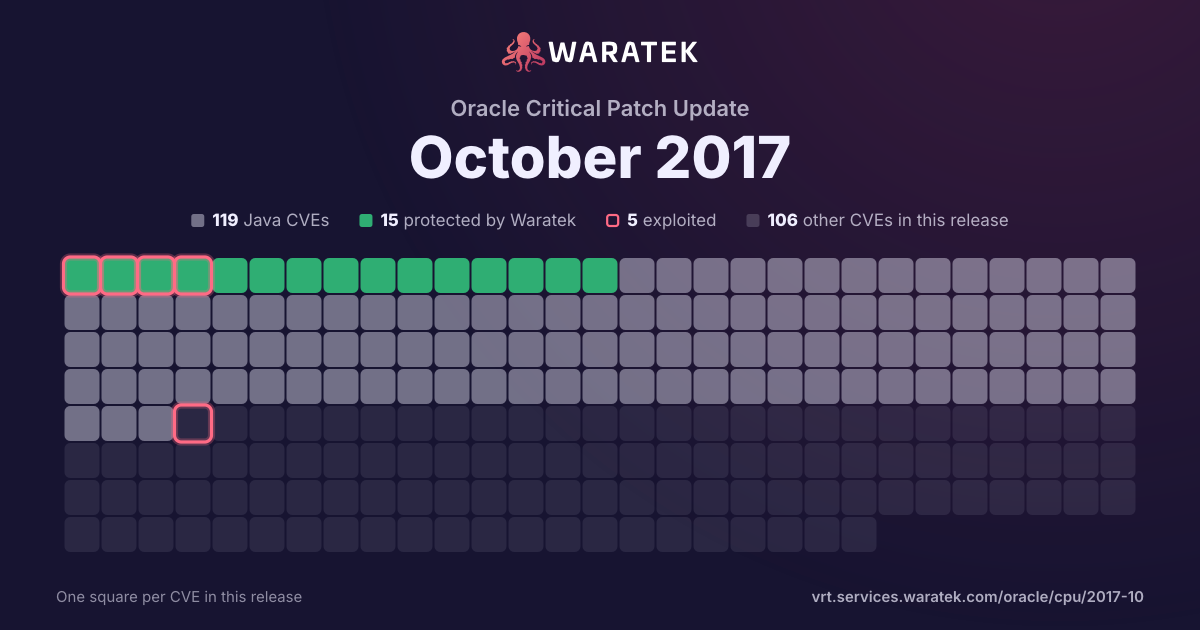
By status
15Protected by Waratek3Mitigation candidate101No exploit published34Outside Waratek scope72Not applicable
5Exploited, marked by the ring
No exploit published. For 100 of them, Oracle's security advisory is the source of public detail.
Protected by Waratek. Waratek RASP can block exploitation of these on systems that have not applied the patch yet.
Overview 109 matches · 8 protected · 0 exploited · 0 CISA KEV · 0 public PoC · 0 EPSS ≥ 0.5
Protected by Waratek
8
7.3%
Rule in development
0
0.0%
Mitigation candidate
0
0.0%
No exploit published
101
92.7%
blocked by ARMR today
8
7.3%
partly blocked
0
0.0%
not blocked
101
92.7%
not established
0
0.0%
unrecorded
0
0.0%
Exploited
0
0.0%
Working exploit published
0
0.0%
Proof of concept only
0
0.0%
Forecast only
0
0.0%
No public exploit
109
100.0%
split by
peak 106 / month
Jul 162
Protected by Waratek1
No exploit published1
High2
blocked by ARMR today1
not blocked1
No public exploit2
Aug 160
Sep 160
Oct 161
Protected by Waratek1
Critical1
blocked by ARMR today1
No public exploit1
Nov 160
Dec 160
Jan 170
Feb 170
Mar 170
Apr 170
May 170
Jun 170
Jul 170
Aug 170
Sep 170
Oct 17106
Protected by Waratek6
No exploit published100
Critical6
High42
Medium54
Low4
blocked by ARMR today6
not blocked100
No public exploit106
Aug 16Oct 16Dec 16Feb 17Apr 17Jun 17Aug 17Oct 17
| CVE | Severity | Published▾ | Status | Exploitation | Description |
|---|---|---|---|---|---|
| CVE-2017-10065 | High | 2017-10-19 | No exploit published | No public exploit | Vulnerability in the Oracle Retail Point-of-Service component of Oracle Retail Applications (subcomponent: Security). Supported versions that are affected are 13.2, 13.3, 13.4, 14.0 and 14.1. Easily exploitable vulnerability allows low privileged attacker with network access via HTTP to compromise Oracle Retail Point-of-Service. While the vulnerability is in Oracle Retail Point-of-Service, attacks may significantly impact additional products. Successful attacks of this vulnerability can result in unauthorized creation, deletion or modification access to critical data or all Oracle Retail Point-of-Service accessible data as well as unauthorized read access to a subset of Oracle Retail Point-of-Service accessible data. CVSS 3.0 Base Score 8.5 (Confidentiality and Integrity impacts). CVSS Vector: (CVSS:3.0/AV:N/AC:L/PR:L/UI:N/S:C/C:L/I:H/A:N). |
| CVE-2017-10060 | High | 2017-10-19 | No exploit published | No public exploit | Vulnerability in the Oracle Business Intelligence Enterprise Edition component of Oracle Fusion Middleware (subcomponent: Analytics Web General). Supported versions that are affected are 11.1.1.7.0, 11.1.1.9.0, 12.2.1.1.0 and 12.2.1.2.0. Easily exploitable vulnerability allows unauthenticated attacker with network access via HTTP to compromise Oracle Business Intelligence Enterprise Edition. Successful attacks require human interaction from a person other than the attacker and while the vulnerability is in Oracle Business Intelligence Enterprise Edition, attacks may significantly impact additional products. Successful attacks of this vulnerability can result in unauthorized access to critical data or complete access to all Oracle Business Intelligence Enterprise Edition accessible data as well as unauthorized update, insert or delete access to some of Oracle Business Intelligence Enterprise Edition accessible data. CVSS 3.0 Base Score 8.2 (Confidentiality and Integrity impacts). CVSS Vector: (CVSS:3.0/AV:N/AC:L/PR:N/UI:R/S:C/C:H/I:L/A:N). |
| CVE-2017-10055 | Medium | 2017-10-19 | No exploit published | No public exploit | Vulnerability in the Oracle iPlanet Web Server component of Oracle Fusion Middleware (subcomponent: Admin Graphical User Interface). The supported version that is affected is 7.0. Easily exploitable vulnerability allows unauthenticated attacker with network access via HTTP to compromise Oracle iPlanet Web Server. Successful attacks require human interaction from a person other than the attacker and while the vulnerability is in Oracle iPlanet Web Server, attacks may significantly impact additional products. Successful attacks of this vulnerability can result in unauthorized update, insert or delete access to some of Oracle iPlanet Web Server accessible data as well as unauthorized read access to a subset of Oracle iPlanet Web Server accessible data. CVSS 3.0 Base Score 6.1 (Confidentiality and Integrity impacts). CVSS Vector: (CVSS:3.0/AV:N/AC:L/PR:N/UI:R/S:C/C:L/I:L/A:N). |
| CVE-2017-10037 | High | 2017-10-19 | No exploit published | No public exploit | Vulnerability in the Oracle BI Publisher component of Oracle Fusion Middleware (subcomponent: Web Service API). Supported versions that are affected are 11.1.1.7.0 and 11.1.1.9.0. Easily exploitable vulnerability allows unauthenticated attacker with network access via HTTP to compromise Oracle BI Publisher. Successful attacks of this vulnerability can result in unauthorized access to critical data or complete access to all Oracle BI Publisher accessible data. CVSS 3.0 Base Score 7.5 (Confidentiality impacts). CVSS Vector: (CVSS:3.0/AV:N/AC:L/PR:N/UI:N/S:U/C:H/I:N/A:N). |
| CVE-2017-10034 | High | 2017-10-19 | No exploit published | No public exploit | Vulnerability in the Oracle BI Publisher component of Oracle Fusion Middleware (subcomponent: Core Formatting API). Supported versions that are affected are 11.1.1.7.0 and 11.1.1.9.0. Easily exploitable vulnerability allows unauthenticated attacker with network access via HTTP to compromise Oracle BI Publisher. Successful attacks require human interaction from a person other than the attacker and while the vulnerability is in Oracle BI Publisher, attacks may significantly impact additional products. Successful attacks of this vulnerability can result in unauthorized access to critical data or complete access to all Oracle BI Publisher accessible data as well as unauthorized update, insert or delete access to some of Oracle BI Publisher accessible data. CVSS 3.0 Base Score 8.2 (Confidentiality and Integrity impacts). CVSS Vector: (CVSS:3.0/AV:N/AC:L/PR:N/UI:R/S:C/C:H/I:L/A:N). |
| CVE-2017-10026 | High | 2017-10-19 | No exploit published | No public exploit | Vulnerability in the Oracle SOA Suite component of Oracle Fusion Middleware (subcomponent: Fabric Layer). The supported version that is affected is 11.1.1.7.0. Easily exploitable vulnerability allows unauthenticated attacker with network access via HTTP to compromise Oracle SOA Suite. Successful attacks require human interaction from a person other than the attacker and while the vulnerability is in Oracle SOA Suite, attacks may significantly impact additional products. Successful attacks of this vulnerability can result in unauthorized access to critical data or complete access to all Oracle SOA Suite accessible data as well as unauthorized update, insert or delete access to some of Oracle SOA Suite accessible data. CVSS 3.0 Base Score 8.2 (Confidentiality and Integrity impacts). CVSS Vector: (CVSS:3.0/AV:N/AC:L/PR:N/UI:R/S:C/C:H/I:L/A:N). |
| CVE-2016-5019 | Critical | 2016-10-03 | Protected by Waratek | No public exploit | CoreResponseStateManager in Apache MyFaces Trinidad 1.0.0 through 1.0.13, 1.2.x before 1.2.15, 2.0.x before 2.0.2, and 2.1.x before 2.1.2 might allow attackers to conduct deserialization attacks via a crafted serialized view state string. |
| CVE-2016-3092 | High | 2016-07-04 | No exploit published | No public exploit | The MultipartStream class in Apache Commons Fileupload before 1.3.2, as used in Apache Tomcat 7.x before 7.0.70, 8.x before 8.0.36, 8.5.x before 8.5.3, and 9.x before 9.0.0.M7 and other products, allows remote attackers to cause a denial of service (CPU consumption) via a long boundary string. |
| CVE-2016-1181 | High | 2016-07-04 | Protected by Waratek | No public exploit | ActionServlet.java in Apache Struts 1 1.x through 1.3.10 mishandles multithreaded access to an ActionForm instance, which allows remote attackers to execute arbitrary code or cause a denial of service (unexpected memory access) via a multipart request, a related issue to CVE-2015-0899. |