
Oracle Critical Patch Update April 2017
Released April 2017 · Oracle's advisory ↗ · ← Critical Patch Update, January 2017 · Critical Patch Update, July 2017 →
227 CVEs in this release, one square each
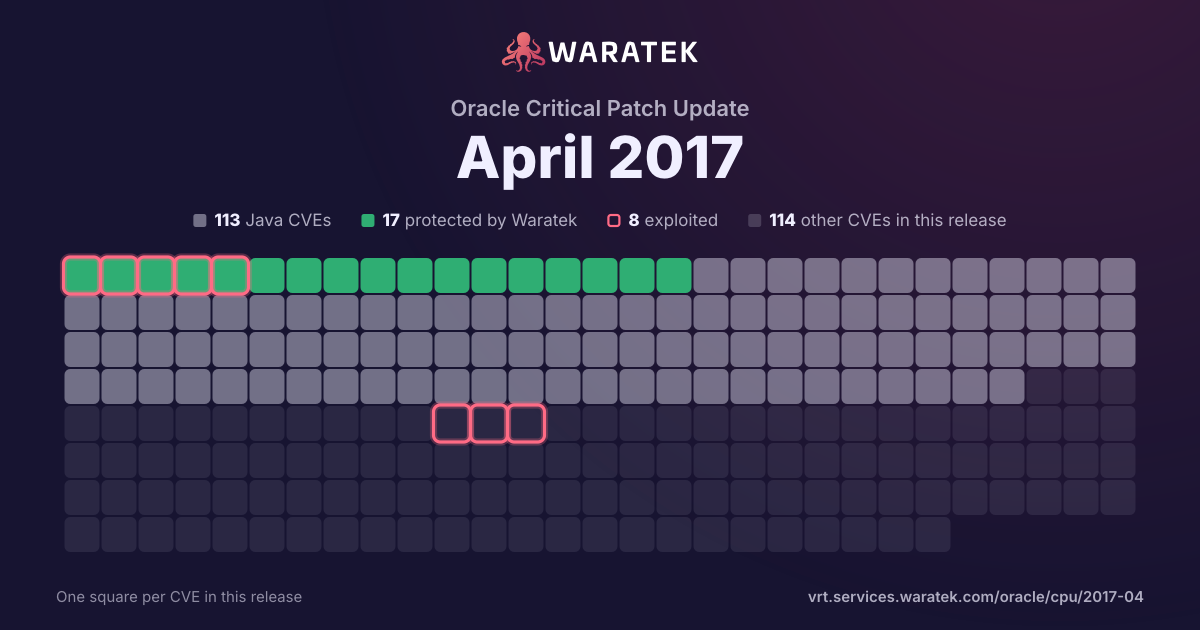
By status
17Protected by Waratek1Mitigation candidate95No exploit published13Outside Waratek scope101Not applicable
8Exploited, marked by the ring
No exploit published. For 93 of them, Oracle's security advisory is the source of public detail.
Protected by Waratek. Waratek RASP can block exploitation of these on systems that have not applied the patch yet.
Overview 17 matches · 5 exploited · 3 CISA KEV · 8 public PoC · 7 EPSS ≥ 0.5
Protected by Waratek
17
100.0%
Rule in development
0
0.0%
Mitigation candidate
0
0.0%
No exploit published
0
0.0%
blocked by ARMR today
17
100.0%
partly blocked
0
0.0%
not blocked
0
0.0%
not established
0
0.0%
unrecorded
0
0.0%
Exploited
5
29.4%
Working exploit published
3
17.6%
Proof of concept only
0
0.0%
Forecast only
1
5.9%
No public exploit
8
47.1%
split by
peak 9 / quarter
Q2 141
Protected by Waratek1
High1
blocked by ARMR today1
Exploited1
Q3 140
Q4 140
Q1 150
Q2 150
Q3 150
Q4 151
Protected by Waratek1
Critical1
blocked by ARMR today1
Exploited1
Q1 160
Q2 162
Protected by Waratek2
High2
blocked by ARMR today2
Forecast only1
No public exploit1
Q3 161
Protected by Waratek1
High1
blocked by ARMR today1
No public exploit1
Q4 161
Protected by Waratek1
Critical1
blocked by ARMR today1
No public exploit1
Q1 171
Protected by Waratek1
Critical1
blocked by ARMR today1
Exploited1
Q2 179
Protected by Waratek9
Critical1
High3
Medium3
Low2
blocked by ARMR today9
Exploited1
Working exploit published3
No public exploit5
Q3 170
Q4 171
Protected by Waratek1
Critical1
blocked by ARMR today1
Exploited1
Q2 14Q4 14Q2 15Q4 15Q2 16Q4 16Q2 17Q4 17
| CVE | Severity | Published▾ | Status | Exploitation | Description |
|---|---|---|---|---|---|
| CVE-2015-7501 | Critical | 2017-11-09 | Protected by Waratek | Exploited | Red Hat JBoss A-MQ 6.x; BPM Suite (BPMS) 6.x; BRMS 6.x and 5.x; Data Grid (JDG) 6.x; Data Virtualization (JDV) 6.x and 5.x; Enterprise Application Platform 6.x, 5.x, and 4.3.x; Fuse 6.x; Fuse Service Works (FSW) 6.x; Operations Network (JBoss ON) 3.x; Portal 6.x; SOA Platform (SOA-P) 5.x; Web Server (JWS) 3.x; Red Hat OpenShift/xPAAS 3.x; and Red Hat Subscription Asset Manager 1.3 allow remote attackers to execute arbitrary commands via a crafted serialized Java object, related to the Apache Commons Collections (ACC) library. |
| CVE-2017-3549 | Critical | 2017-04-24 | Protected by Waratek | Working exploit published | Vulnerability in the Oracle Scripting component of Oracle E-Business Suite (subcomponent: Scripting Administration). Supported versions that are affected are 12.1.1, 12.1.2, 12.1.3, 12.2.3, 12.2.4, 12.2.5 and 12.2.6. Easily "exploitable" vulnerability allows unauthenticated attacker with network access via HTTP to compromise Oracle Scripting. Successful attacks of this vulnerability can result in unauthorized creation, deletion or modification access to critical data or all Oracle Scripting accessible data as well as unauthorized access to critical data or complete access to all Oracle Scripting accessible data. CVSS 3.0 Base Score 9.1 (Confidentiality and Integrity impacts). CVSS Vector: (CVSS:3.0/AV:N/AC:L/PR:N/UI:N/S:U/C:H/I:H/A:N). |
| CVE-2017-3548 | Medium | 2017-04-24 | Protected by Waratek | Working exploit published | Vulnerability in the PeopleSoft Enterprise PeopleTools component of Oracle PeopleSoft Products (subcomponent: Integration Broker). Supported versions that are affected are 8.54 and 8.55. Easily "exploitable" vulnerability allows unauthenticated attacker with network access via HTTP to compromise PeopleSoft Enterprise PeopleTools. Successful attacks of this vulnerability can result in unauthorized read access to a subset of PeopleSoft Enterprise PeopleTools accessible data and unauthorized ability to cause a partial denial of service (partial DOS) of PeopleSoft Enterprise PeopleTools. CVSS 3.0 Base Score 6.5 (Confidentiality and Availability impacts). CVSS Vector: (CVSS:3.0/AV:N/AC:L/PR:N/UI:N/S:U/C:L/I:N/A:L). |
| CVE-2017-3546 | Medium | 2017-04-24 | Protected by Waratek | Working exploit published | Vulnerability in the PeopleSoft Enterprise PeopleTools component of Oracle PeopleSoft Products (subcomponent: MultiChannel Framework). Supported versions that are affected are 8.54 and 8.55. Easily "exploitable" vulnerability allows unauthenticated attacker with network access via HTTP to compromise PeopleSoft Enterprise PeopleTools. Successful attacks of this vulnerability can result in unauthorized update, insert or delete access to some of PeopleSoft Enterprise PeopleTools accessible data as well as unauthorized read access to a subset of PeopleSoft Enterprise PeopleTools accessible data. CVSS 3.0 Base Score 6.5 (Confidentiality and Integrity impacts). CVSS Vector: (CVSS:3.0/AV:N/AC:L/PR:N/UI:N/S:U/C:L/I:L/A:N). |
| CVE-2017-3544 | Low | 2017-04-24 | Protected by Waratek | No public exploit | Vulnerability in the Java SE, Java SE Embedded, JRockit component of Oracle Java SE (subcomponent: Networking). Supported versions that are affected are Java SE: 6u141, 7u131 and 8u121; Java SE Embedded: 8u121; JRockit: R28.3.13. Difficult to exploit vulnerability allows unauthenticated attacker with network access via SMTP to compromise Java SE, Java SE Embedded, JRockit. Successful attacks of this vulnerability can result in unauthorized update, insert or delete access to some of Java SE, Java SE Embedded, JRockit accessible data. Note: Applies to client and server deployment of Java. This vulnerability can be exploited through sandboxed Java Web Start applications and sandboxed Java applets. It can also be exploited by supplying data to APIs in the specified Component without using sandboxed Java Web Start applications or sandboxed Java applets, such as through a web service. CVSS 3.0 Base Score 3.7 (Integrity impacts). CVSS Vector: (CVSS:3.0/AV:N/AC:H/PR:N/UI:N/S:U/C:N/I:L/A:N). |
| CVE-2017-3533 | Low | 2017-04-24 | Protected by Waratek | No public exploit | Vulnerability in the Java SE, Java SE Embedded, JRockit component of Oracle Java SE (subcomponent: Networking). Supported versions that are affected are Java SE: 6u141, 7u131 and 8u121; Java SE Embedded: 8u121; JRockit: R28.3.13. Difficult to exploit vulnerability allows unauthenticated attacker with network access via FTP to compromise Java SE, Java SE Embedded, JRockit. Successful attacks of this vulnerability can result in unauthorized update, insert or delete access to some of Java SE, Java SE Embedded, JRockit accessible data. Note: Applies to client and server deployment of Java. This vulnerability can be exploited through sandboxed Java Web Start applications and sandboxed Java applets. It can also be exploited by supplying data to APIs in the specified Component without using sandboxed Java Web Start applications or sandboxed Java applets, such as through a web service. CVSS 3.0 Base Score 3.7 (Integrity impacts). CVSS Vector: (CVSS:3.0/AV:N/AC:H/PR:N/UI:N/S:U/C:N/I:L/A:N). |
| CVE-2017-3531 | High | 2017-04-24 | Protected by Waratek | No public exploit | Vulnerability in the Oracle WebLogic Server component of Oracle Fusion Middleware (subcomponent: Servlet Runtime). Supported versions that are affected are 12.1.3.0, 12.2.1.0, 12.2.1.1 and 12.2.1.2. Easily "exploitable" vulnerability allows unauthenticated attacker with network access via HTTP to compromise Oracle WebLogic Server. While the vulnerability is in Oracle WebLogic Server, attacks may significantly impact additional products. Successful attacks of this vulnerability can result in unauthorized update, insert or delete access to some of Oracle WebLogic Server accessible data and unauthorized ability to cause a partial denial of service (partial DOS) of Oracle WebLogic Server. CVSS 3.0 Base Score 7.2 (Integrity and Availability impacts). CVSS Vector: (CVSS:3.0/AV:N/AC:L/PR:N/UI:N/S:C/C:N/I:L/A:L). |
| CVE-2017-3526 | Medium | 2017-04-24 | Protected by Waratek | No public exploit | Vulnerability in the Java SE, Java SE Embedded, JRockit component of Oracle Java SE (subcomponent: JAXP). Supported versions that are affected are Java SE: 6u141, 7u131 and 8u121; Java SE Embedded: 8u121; JRockit: R28.3.13. Difficult to exploit vulnerability allows unauthenticated attacker with network access via multiple protocols to compromise Java SE, Java SE Embedded, JRockit. Successful attacks of this vulnerability can result in unauthorized ability to cause a hang or frequently repeatable crash (complete DOS) of Java SE, Java SE Embedded, JRockit. Note: Applies to client and server deployment of Java. This vulnerability can be exploited through sandboxed Java Web Start applications and sandboxed Java applets. It can also be exploited by supplying data to APIs in the specified Component without using sandboxed Java Web Start applications or sandboxed Java applets, such as through a web service. CVSS 3.0 Base Score 5.9 (Availability impacts). CVSS Vector: (CVSS:3.0/AV:N/AC:H/PR:N/UI:N/S:U/C:N/I:N/A:H). |
| CVE-2017-3511 | High | 2017-04-24 | Protected by Waratek | No public exploit | Vulnerability in the Java SE, Java SE Embedded, JRockit component of Oracle Java SE (subcomponent: JCE). Supported versions that are affected are Java SE: 7u131 and 8u121; Java SE Embedded: 8u121; JRockit: R28.3.13. Difficult to exploit vulnerability allows unauthenticated attacker with logon to the infrastructure where Java SE, Java SE Embedded, JRockit executes to compromise Java SE, Java SE Embedded, JRockit. Successful attacks require human interaction from a person other than the attacker and while the vulnerability is in Java SE, Java SE Embedded, JRockit, attacks may significantly impact additional products. Successful attacks of this vulnerability can result in takeover of Java SE, Java SE Embedded, JRockit. Note: Applies to client and server deployment of Java. This vulnerability can be exploited through sandboxed Java Web Start applications and sandboxed Java applets. It can also be exploited by supplying data to APIs in the specified Component without using sandboxed Java Web Start applications or sandboxed Java applets, such as through a web service. CVSS 3.0 Base Score 7.7 (Confidentiality, Integrity and Availability impacts). CVSS Vector: (CVSS:3.0/AV:L/AC:H/PR:N/UI:R/S:C/C:H/I:H/A:H). |
| CVE-2017-3506 | High | 2017-04-24 | Protected by Waratek | Exploited | Vulnerability in the Oracle WebLogic Server component of Oracle Fusion Middleware (subcomponent: Web Services). Supported versions that are affected are 10.3.6.0, 12.1.3.0, 12.2.1.0, 12.2.1.1 and 12.2.1.2. Difficult to exploit vulnerability allows unauthenticated attacker with network access via HTTP to compromise Oracle WebLogic Server. Successful attacks of this vulnerability can result in unauthorized creation, deletion or modification access to critical data or all Oracle WebLogic Server accessible data as well as unauthorized access to critical data or complete access to all Oracle WebLogic Server accessible data. CVSS 3.0 Base Score 7.4 (Confidentiality and Integrity impacts). CVSS Vector: (CVSS:3.0/AV:N/AC:H/PR:N/UI:N/S:U/C:H/I:H/A:N). |
| CVE-2017-5638 | Critical | 2017-03-11 | Protected by Waratek | Exploited | The Jakarta Multipart parser in Apache Struts 2 2.3.x before 2.3.32 and 2.5.x before 2.5.10.1 has incorrect exception handling and error-message generation during file-upload attempts, which allows remote attackers to execute arbitrary commands via a crafted Content-Type, Content-Disposition, or Content-Length HTTP header, as exploited in the wild in March 2017 with a Content-Type header containing a #cmd= string. |
| CVE-2016-5019 | Critical | 2016-10-03 | Protected by Waratek | No public exploit | CoreResponseStateManager in Apache MyFaces Trinidad 1.0.0 through 1.0.13, 1.2.x before 1.2.15, 2.0.x before 2.0.2, and 2.1.x before 2.1.2 might allow attackers to conduct deserialization attacks via a crafted serialized view state string. |
| CVE-2016-1181 | High | 2016-07-04 | Protected by Waratek | No public exploit | ActionServlet.java in Apache Struts 1 1.x through 1.3.10 mishandles multithreaded access to an ActionForm instance, which allows remote attackers to execute arbitrary code or cause a denial of service (unexpected memory access) via a multipart request, a related issue to CVE-2015-0899. |
| CVE-2016-3674 | High | 2016-05-17 | Protected by Waratek | No public exploit | Multiple XML external entity (XXE) vulnerabilities in the (1) Dom4JDriver, (2) DomDriver, (3) JDomDriver, (4) JDom2Driver, (5) SjsxpDriver, (6) StandardStaxDriver, and (7) WstxDriver drivers in XStream before 1.4.9 allow remote attackers to read arbitrary files via a crafted XML document. |
| CVE-2016-2510 | High | 2016-04-07 | Protected by Waratek | Forecast only | BeanShell (bsh) before 2.0b6, when included on the classpath by an application that uses Java serialization or XStream, allows remote attackers to execute arbitrary code via crafted serialized data, related to XThis.Handler. |
| CVE-2015-4852 | Critical | 2015-11-18 | Protected by Waratek | Exploited | The WLS Security component in Oracle WebLogic Server 10.3.6.0, 12.1.2.0, 12.1.3.0, and 12.2.1.0 allows remote attackers to execute arbitrary commands via a crafted serialized Java object in T3 protocol traffic to TCP port 7001, related to oracle_common/modules/com.bea.core.apache.commons.collections.jar. NOTE: the scope of this CVE is limited to the WebLogic Server product. |
| CVE-2014-0114 | High | 2014-04-30 | Protected by Waratek | Exploited | Apache Commons BeanUtils, as distributed in lib/commons-beanutils-1.8.0.jar in Apache Struts 1.x through 1.3.10 and in other products requiring commons-beanutils through 1.9.2, does not suppress the class property, which allows remote attackers to "manipulate" the ClassLoader and execute arbitrary code via the class parameter, as demonstrated by the passing of this parameter to the getClass method of the ActionForm object in Struts 1. |