
Oracle Critical Patch Update October 2026
Released October 2026 · Oracle's advisory ↗ · ← Security Patch Update, September 2026 · Security Patch Update, November 2026 →
1,693 CVEs in this release, one square each
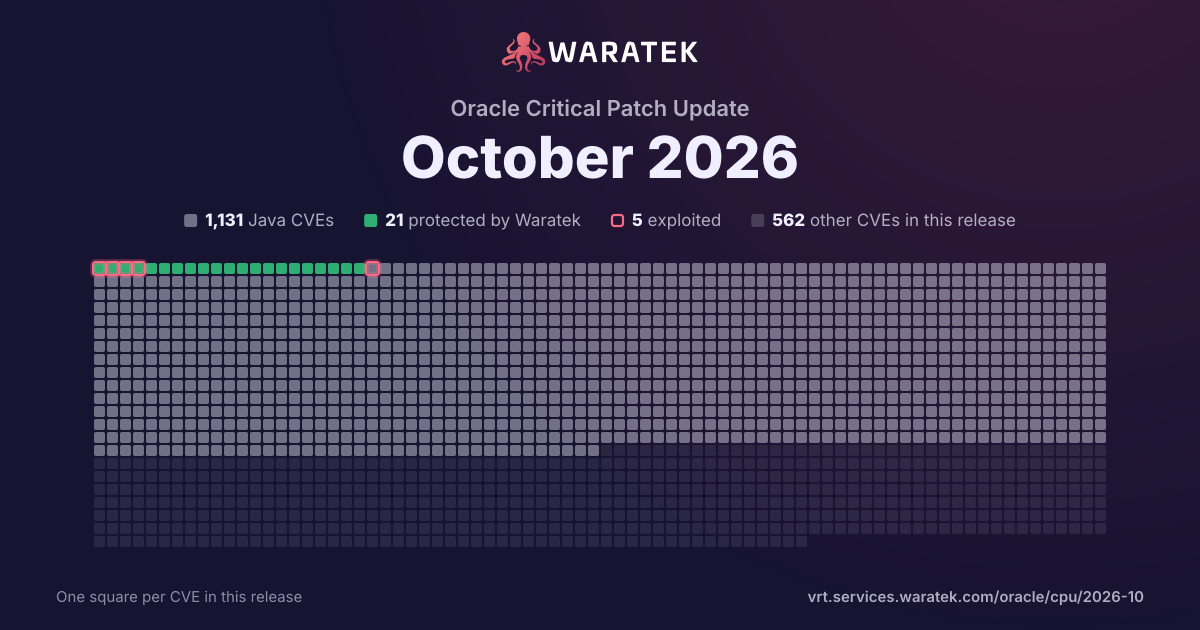
By status
20Protected by Waratek3Mitigation candidate1,109No exploit published12Outside Waratek scope549Not applicable
7Exploited, marked by the ring
No exploit published. For 855 of them, Oracle's security advisory is the source of public detail.
Protected by Waratek. Waratek RASP can block exploitation of these on systems that have not applied the patch yet.
Overview 116 matches · 11 protected · 2 exploited · 1 CISA KEV · 4 public PoC · 2 EPSS ≥ 0.5
Protected by Waratek
11
9.5%
Rule in development
0
0.0%
Mitigation candidate
1
0.9%
No exploit published
104
89.7%
blocked by ARMR today
11
9.5%
partly blocked
0
0.0%
not blocked
105
90.5%
not established
0
0.0%
unrecorded
0
0.0%
Exploited
2
1.7%
Working exploit published
0
0.0%
Proof of concept only
24
20.7%
Forecast only
0
0.0%
No public exploit
90
77.6%
split by
peak 52 / quarter
Q3 221
Protected by Waratek1
High1
blocked by ARMR today1
Proof of concept only1
Q4 223
Protected by Waratek2
No exploit published1
Critical3
blocked by ARMR today2
not blocked1
Exploited1
No public exploit2
Q1 230
Q2 233
No exploit published3
Medium3
not blocked3
No public exploit3
Q3 230
Q4 231
Mitigation candidate1
High1
not blocked1
Exploited1
Q1 241
No exploit published1
High1
not blocked1
No public exploit1
Q2 240
Q3 240
Q4 244
No exploit published4
High1
Medium3
not blocked4
Proof of concept only1
No public exploit3
Q1 251
No exploit published1
Medium1
not blocked1
Proof of concept only1
Q2 252
Protected by Waratek1
No exploit published1
High1
Medium1
blocked by ARMR today1
not blocked1
Proof of concept only2
Q3 253
No exploit published3
Medium3
not blocked3
Proof of concept only1
No public exploit2
Q4 251
No exploit published1
Medium1
not blocked1
No public exploit1
Q1 264
Protected by Waratek1
No exploit published3
High1
Medium2
Low1
blocked by ARMR today1
not blocked3
No public exploit4
Q2 2652
Protected by Waratek6
No exploit published46
Critical10
High18
Medium22
Low2
blocked by ARMR today6
not blocked46
Proof of concept only11
No public exploit41
Q3 2640
No exploit published40
Critical4
High26
Medium10
not blocked40
Proof of concept only7
No public exploit33
Q3 22Q1 23Q3 23Q1 24Q3 24Q1 25Q3 25Q1 26Q3 26
| CVE | Severity | Published▾ | Status | Exploitation | Description |
|---|---|---|---|---|---|
| CVE-2026-91777 | High | 2026-09-23 | No exploit published | Proof of concept only | Forward-reference completion for @JsonIdentityInfo object IDs in FasterXML jackson-databind performs a linear scan of the pending-reference accumulator for every resolved ID. The affected paths are CollectionDeserializer.CollectionReferringAccumulator.resolveForwardReference() and the equivalent implementation in MapDeserializer. When a document first creates N unresolved object-ID references in an identity-enabled collection or map and then defines those same IDs in reverse order, completion performs on the order of N * (N + 1) / 2 identity comparisons, so a shallow document whose size grows linearly causes quadratic CPU work during deserialization. The reporter instrumented equals() calls on the ID class and measured exactly 2,003,000 comparisons at N = 2,000, against zero comparisons in the pending-reference lookup path for an equally sized control in which every reference was already resolved. The input requires no deep nesting and no syntactically unusual JSON. Exploitation requires an application that deserializes attacker-influenced JSON into an identity-enabled collection or map. The fix replaces the repeated linear lookup with a keyed pending-reference structure. |
| CVE-2026-91776 | High | 2026-09-23 | No exploit published | Proof of concept only | TypeDeserializerBase._findDeserializer() in FasterXML jackson-databind caches the resolved deserializer under the raw, attacker-supplied type ID. When name-based polymorphism is configured with a fallback, for example @JsonTypeInfo(use = Id.NAME, defaultImpl = ...), every distinct unrecognized type ID resolves to the same fallback deserializer but is retained as its own key in the _deserializers map. That map has no configurable bound and lives for the lifetime of the type deserializer, so an attacker who can repeatedly supply fresh unknown type IDs causes monotonic memory retention across requests. The reporter observed 10,000 retained entries from 10,000 distinct unknown IDs, against a single entry for a control that repeated one unknown ID the same number of times, isolating attacker-controlled key cardinality from request volume. Exploitation requires an application that enables name-based polymorphism with a defaultImpl or equivalent fallback, accepts attacker-influenced type IDs, and reuses a long-lived ObjectMapper across requests. The fix stops caching fallback resolutions for unrecognized IDs and bounds both the number of cached entries and the length of a cacheable type ID. |
| CVE-2026-89425 | High | 2026-09-23 | No exploit published | Proof of concept only | UTF8DataInputJsonParser._reportInvalidToken() in FasterXML jackson-core builds the offending-token text for its error message by appending Java identifier characters to a StringBuilder in a loop that has no upper bound. Unlike the three sibling parser implementations, including UTF8StreamJsonParser, it never consults ErrorReportConfiguration.getMaxErrorTokenLength() (default 256). A malformed token supplied to a parser created through JsonFactory.createParser(DataInput) is therefore accumulated in full. No StreamReadConstraints setting mitigates this: maxDocumentLength cannot be applied to DataInput sources at all, and maxStringLength does not cover this path because the accumulation bypasses ReadConstrainedTextBuffer. The reporter measured a 20,000,109-character exception message from a 20-million-character malformed token on the DataInput path, against 367 characters for identical input on the InputStream path. Scaling the payload drives the StringBuilder, which also incurs byte-to-char expansion and internal array doubling, to many times the raw payload size and can trigger OutOfMemoryError for the whole JVM. UTF8DataInputJsonParser was introduced in 2.8.0 together with createParser(DataInput); releases before 2.8.0 do not contain the affected class. |
| CVE-2026-77422 | High | 2026-09-23 | No exploit published | Proof of concept only | JLine is a Java library for handling console input. From 3.0.0 until 3.30.15 and 4.3.1, the JLine built-in grep command in builtins/src/main/java/org/jline/builtins/PosixCommands.java accepts a user-controlled regular expression in grep(...) and, unless line-regexp mode is used, automatically adds a dot-star prefix and suffix before compiling it with Java's backtracking regular expression engine. The wrapping expands the backtracking search space, so a short nested-quantifier expression evaluated against non-matching input can consume excessive CPU and indefinitely block a command worker, including in remotely exposed shell sessions. This issue is fixed in versions 3.30.15 and 4.3.1. |
| CVE-2026-77421 | Medium | 2026-09-23 | No exploit published | No public exploit | JLine is a Java library for handling console input. From 3.0.0 until 3.30.15 and 4.3.1, the JLine built-in nano editor's regex search mode passes a user-controlled search term from doSearch(String text) in builtins/src/main/java/org/jline/builtins/Nano.java to Java's backtracking regular expression engine without a timeout or backtracking bound. A nested-quantifier expression evaluated against non-matching buffer content can consume excessive CPU and indefinitely block the editor session thread, and remote multi-user deployments can lose a worker thread for each affected session. This issue is fixed in versions 3.30.15 and 4.3.1. |
| CVE-2026-77420 | Medium | 2026-09-23 | No exploit published | Proof of concept only | JLine is a Java library for handling console input. From 3.0.0 until 3.30.15 and 4.3.1, DefaultHistory.matchPatterns(String patterns, String line) in reader/src/main/java/org/jline/reader/impl/history/DefaultHistory.java converts the HISTORY_IGNORE configuration value into a Java regular expression while escaping only part of its syntax, allowing other regex metacharacters to reach the backtracking engine. An attacker who can control application or user configuration can supply a nested-quantifier expression that is reevaluated whenever a command is added to history, consuming excessive CPU and indefinitely blocking the reader thread. This issue is fixed in versions 3.30.15 and 4.3.1. |
| CVE-2026-89407 | High | 2026-09-22 | No exploit published | Proof of concept only | NumberInput.looksLikeValidNumber() in FasterXML jackson-core pre-validates "stringified numbers" with two regular expressions: PATTERN_FLOAT ([+-]?[0-9]*[\.]?[0-9]+([eE][+-]?[0-9]+)?), present since 2.17.0, and PATTERN_FLOAT_TRAILING_DOT, added in 2.17.2. PATTERN_FLOAT places adjacent quantifiers over the same character class -- an optional [0-9]* run, an optional dot, then a required [0-9]+ run -- so input that ultimately fails to match forces Java's backtracking engine to retry every possible split point of the digit run. Matching cost therefore grows with the square of the input length. An attacker who can supply JSON that an application deserializes into a numeric target type reaches this method through jackson-databind's default String-to-number coercion (StdDeserializer and NumberDeserializers for BigDecimal, BigInteger, Double and Float). Because StreamReadConstraints.maxStringLength defaults to 20,000,000 characters, no constraint bounds the input before it reaches the regex. Testing by the reporter confirmed O(n^2) growth across five consecutive input-size doublings, with a single 160,000-character string consuming roughly 74 seconds in one call; a small number of concurrent requests of ordinary body size can therefore exhaust a server's request-handling thread pool. The affected method does not exist before 2.17.0, so 2.16.x and earlier releases are not affected. The fix replaces both regular expressions with a hand-rolled single-pass scan. |
| CVE-2026-75596 | High | 2026-08-19 | No exploit published | No public exploit | Netty is an asynchronous, event-driven network application framework. Prior to 4.1.137.Final and 4.2.17.Final, the default io.netty.handler.ssl.SniHandler constructors use the pre-handshake ClientHello aggregation path in handler/src/main/java/io/netty/handler/ssl/SslClientHelloHandler.java at io.netty.handler.ssl.SslClientHelloHandler#decode, where handshakeBuffer.clear() and writeBytes() recopy all previously received body bytes for every additional TLS record. An unauthenticated remote peer can advertise a large ClientHello and deliver its body in thousands of tiny records, causing quadratic CPU work on the event loop before the TLS handshake completes and degrading TLS handling for other clients. This issue is fixed in versions 4.1.137.Final and 4.2.17.Final. |
| CVE-2026-75595 | Critical | 2026-08-19 | No exploit published | No public exploit | Netty is an asynchronous, event-driven network application framework. Prior to 4.1.137.Fina and 4.2.17.Final, io.netty.handler.ssl.SslClientHelloHandler#decode checks the wrong offset before reading the four-byte TLS handshake header, so a ClientHello whose handshake header spans records can cause an IndexOutOfBoundsException and invoke select(ctx, null). This selects the default SslContext instead of the SNI-specific context. In deployments where per-SNI clientAuth=REQUIRE is the sole mutual TLS gate, the default SslContext uses clientAuth=NONE or clientAuth=OPTIONAL, and no application-layer certificate verification exists, an unauthenticated remote attacker can bypass the protected route's mutual TLS requirement. This issue is fixed in versions 4.1.137.Final and 4.2.17.Final. |
| CVE-2026-59903 | High | 2026-08-17 | No exploit published | No public exploit | Netty is an asynchronous, event-driven network application framework. Prior to 4.1.137.Final and 4.2.17.Final, io.netty.handler.codec.http.cors.CorsHandler setVaryHeader replaces application Vary headers such as Authorization or Cookie with Origin, allowing a caching proxy or CDN to reuse authenticated responses across users and disclose sensitive information. This issue is fixed in versions 4.1.137.Final and 4.2.17.Final. |
| CVE-2026-8763 | Critical | 2026-08-03 | No exploit published | No public exploit | In Bouncy Castle for Java before 1.85, Name Constraints bypass via trailing dot in rfc822Name and URI. This issue also affects Bouncy Castle for Java LTS before 2.73.12, and Bouncy Castle for Java FIPS (BC-FJA) before bc-fips 1.0.2.7 (1.0.X series), 2.0.2 (2.0.X series) and 2.1.3 (2.1.X series). |
| CVE-2026-59652 | Medium | 2026-08-03 | No exploit published | No public exploit | In Bouncy Castle for Java before 1.85, LDAP filter injection in legacy jdk1.4 LDAPStoreHelper. |
| CVE-2026-59651 | High | 2026-08-03 | No exploit published | No public exploit | In Bouncy Castle for Java before 1.85, BKS keystore accepts legacy version with 16-bit integrity MAC key. This issue also affects Bouncy Castle for Java LTS before 2.73.12. |
| CVE-2026-59650 | Critical | 2026-08-03 | No exploit published | No public exploit | In Bouncy Castle for Java before 1.85, MTI/A0 DH agreement exponentiates unvalidated peer value. This issue also affects Bouncy Castle for Java LTS before 2.73.12. |
| CVE-2026-59649 | High | 2026-08-03 | No exploit published | No public exploit | In Bouncy Castle for Java before 1.85, OpenPGP user-attribute subpacket length bounded only by JVM max memory. This issue also affects Bouncy Castle for Java LTS before 2.73.12, and Bouncy Castle for Java FIPS (BC-FJA) before bcpg-fips 1.0.13 (1.0.X series), 2.0.13 (2.0.X series) and 2.1.13 (2.1.X series). |
| CVE-2026-59647 | Medium | 2026-08-03 | No exploit published | No public exploit | In Bouncy Castle for Java before 1.85, CRMF/CMP password-MAC honours unbounded iteration count. This issue also affects Bouncy Castle for Java LTS before 2.73.12, and Bouncy Castle for Java FIPS (BC-FJA) before bcpkix-fips 1.0.12 (1.0.X series), 2.0.12 (2.0.X series) and 2.1.12 (2.1.X series). |
| CVE-2026-59645 | High | 2026-08-03 | No exploit published | No public exploit | In Bouncy Castle for Java before 1.85, OER parser recurses without depth limit on self-referential IEEE 1609.2 schema. This issue also affects Bouncy Castle for Java LTS before 2.73.12, and Bouncy Castle for Java FIPS (BC-FJA) before bcutil-fips 2.0.7 (2.0.X series) and 2.1.7 (2.1.X series). |
| CVE-2026-59642 | High | 2026-08-03 | No exploit published | No public exploit | In Bouncy Castle for Java before 1.85, CMS AuthenticatedData content not bound to MAC when authAttrs present. This issue also affects Bouncy Castle for Java LTS before 2.73.12, and Bouncy Castle for Java FIPS (BC-FJA) before bcpkix-fips 1.0.12 (1.0.X series), 2.0.12 (2.0.X series) and 2.1.12 (2.1.X series). |
| CVE-2026-59639 | High | 2026-08-03 | No exploit published | No public exploit | In Bouncy Castle for Java before 1.85, CMS verifySignatures returns true for SignedData with zero signers. This issue also affects Bouncy Castle for Java LTS before 2.73.12, and Bouncy Castle for Java FIPS (BC-FJA) before bcpkix-fips 1.0.12 (1.0.X series), 2.0.12 (2.0.X series) and 2.1.12 (2.1.X series). |
| CVE-2026-58063 | Medium | 2026-08-03 | No exploit published | No public exploit | In Bouncy Castle for Java before 1.85, BCFKS keystore load honours unbounded KDF cost from untrusted file. This issue also affects Bouncy Castle for Java LTS before 2.73.12, and Bouncy Castle for Java FIPS (BC-FJA) before bc-fips 1.0.2.7 (1.0.X series), 2.0.2 (2.0.X series) and 2.1.3 (2.1.X series). |
| CVE-2026-58062 | Critical | 2026-08-03 | No exploit published | No public exploit | In Bouncy Castle for Java before 1.85, Stapled OCSP response accepted without binding to the checked certificate. This issue also affects Bouncy Castle for Java LTS before 2.73.12, and Bouncy Castle for Java FIPS (BC-FJA) before bc-fips 2.0.2 (2.0.X series) and 2.1.3 (2.1.X series). |
| CVE-2026-58061 | High | 2026-08-03 | No exploit published | No public exploit | In Bouncy Castle for Java before 1.85, CCM-family modes write plaintext to caller buffer before tag check. This issue also affects Bouncy Castle for Java LTS before 2.73.12, and Bouncy Castle for Java FIPS (BC-FJA) before bc-fips 1.0.2.7 (1.0.X series), 2.0.2 (2.0.X series) and 2.1.3 (2.1.X series). |
| CVE-2026-58060 | High | 2026-08-03 | No exploit published | No public exploit | In Bouncy Castle for Java before 1.85, HSS public-key level count unbounded, enabling huge allocation on verify. This issue also affects Bouncy Castle for Java LTS before 2.73.12, and Bouncy Castle for Java FIPS (BC-FJA) before bc-fips 2.0.2 (2.0.X series) and 2.1.3 (2.1.X series). |
| CVE-2026-58059 | High | 2026-08-03 | No exploit published | No public exploit | In Bouncy Castle for Java before 1.85, Quadratic-time escaping when stringifying X.500 distinguished names. This issue also affects Bouncy Castle for Java LTS before 2.73.12, and Bouncy Castle for Java FIPS (BC-FJA) before bc-fips 1.0.2.7 (1.0.X series), 2.0.2 (2.0.X series) and 2.1.3 (2.1.X series). |
| CVE-2026-15055 | Medium | 2026-08-03 | No exploit published | No public exploit | In Bouncy Castle for Java before 1.85, PKCS#8 / PBES2 decryptors honour unbounded KDF cost from input. This issue also affects Bouncy Castle for Java LTS before 2.73.12, and Bouncy Castle for Java FIPS (BC-FJA) before bcpkix-fips 1.0.12 (1.0.X series), 2.0.12 (2.0.X series) and 2.1.12 (2.1.X series). |
| CVE-2026-14682 | High | 2026-08-03 | No exploit published | No public exploit | In Bouncy Castle for Java before 1.85, Possible OOM from unbounded up-front allocation on a definite-length read. This issue also affects Bouncy Castle for Java LTS before 2.73.12, and Bouncy Castle for Java FIPS (BC-FJA) before bc-fips 1.0.2.7 (1.0.X series), 2.0.2 (2.0.X series) and 2.1.3 (2.1.X series), and before bctls-fips 1.0.24. |
| CVE-2026-13586 | Medium | 2026-08-03 | No exploit published | No public exploit | In Bouncy Castle for Java before 1.85, PKCS#12 MAC and bag-decryption KDF iteration-count bound (DoS). This issue also affects Bouncy Castle for Java LTS before 2.73.12, and Bouncy Castle for Java FIPS (BC-FJA) before bc-fips 1.0.2.7 (1.0.X series), 2.0.2 (2.0.X series) and 2.1.3 (2.1.X series). |
| CVE-2026-13506 | High | 2026-08-03 | No exploit published | No public exploit | In Bouncy Castle for Java before 1.85, Lazy ASN.1 sequence forcing resets nesting-depth guard. This issue also affects Bouncy Castle for Java LTS before 2.73.12, and Bouncy Castle for Java FIPS (BC-FJA) before bc-fips 1.0.2.7 (1.0.X series), 2.0.2 (2.0.X series) and 2.1.3 (2.1.X series). |
| CVE-2026-12860 | High | 2026-08-03 | No exploit published | No public exploit | In Bouncy Castle for Java before 1.85, RSA PKCS#1 verification skips last two hash bytes in NULL-omitted path. This issue also affects Bouncy Castle for Java LTS before 2.73.12. |
| CVE-2026-12817 | High | 2026-08-03 | No exploit published | No public exploit | In Bouncy Castle for Java before 1.85, OpenPGP AEAD decryption skips final tag on chunk-aligned data. This issue also affects Bouncy Castle for Java LTS before 2.73.12, and Bouncy Castle for Java FIPS (BC-FJA) before bcpg-fips 1.0.13 (1.0.X series), 2.0.13 (2.0.X series) and 2.1.13 (2.1.X series). |
| CVE-2026-12816 | High | 2026-08-03 | No exploit published | No public exploit | In Bouncy Castle for Java before 1.85, IESEngine stream-mode MAC forgery via length-dependent KDF split. This issue also affects Bouncy Castle for Java LTS before 2.73.12. |
| CVE-2026-12803 | High | 2026-08-03 | No exploit published | No public exploit | In Bouncy Castle for Java before 1.85, KCCMBlockCipher MAC does not bind nonce when AAD is absent (cross-nonce AEAD forgery). This issue also affects Bouncy Castle for Java LTS before 2.73.12. |
| CVE-2026-12802 | High | 2026-08-03 | No exploit published | No public exploit | In Bouncy Castle for Java before 1.85, CMS AuthEnvelopedData fails to enforce tag-length on decryption. This issue also affects Bouncy Castle for Java LTS before 2.73.12, and Bouncy Castle for Java FIPS (BC-FJA) before bcpkix-fips 1.0.12 (1.0.X series), 2.0.12 (2.0.X series) and 2.1.12 (2.1.X series). |
| CVE-2026-12185 | High | 2026-08-03 | No exploit published | No public exploit | In Bouncy Castle for Java before 1.85, BKS/UBER keystore allocates from untrusted lengths before integrity check. This issue also affects Bouncy Castle for Java LTS before 2.73.12. |
| CVE-2026-64607 | Medium | 2026-07-31 | No exploit published | No public exploit | HttpClient based on the classic i/o model fails to correctly release the underlying connection back to the connection manager if it encounters an invalid or unsupported `Content-Encoding` header value in the response message. Please note this defect does not affect HttpClient based on the async i/o model. This issue affects Apache HttpComponents Client: from 5.0-alpha1 through 5.6.2. |
| CVE-2026-56741 | High | 2026-07-17 | No exploit published | Proof of concept only | JLine is a Java library for handling console input. Prior to 3.30.14, 4.0.16, and 4.2.1, the JLine3 Telnet server remote-telnet module does not apply an upper bound to terminal dimensions received via the Telnet NAWS option, and TelnetIO.handleNAWS() in TelnetIO.java:856-879 reads client-supplied width and height as 16-bit unsigned integers and passes values such as 65535x65535 to setTerminalGeometry(), allowing an unauthenticated remote attacker to repeatedly alternate values and trigger continuous expensive rendering work that causes CPU exhaustion and denial of service. This issue is fixed in versions 3.30.14, 4.0.16, and 4.2.1. |
| CVE-2026-59889 | Medium | 2026-07-14 | No exploit published | No public exploit | jackson-databind contains the general-purpose data-binding functionality and tree-model for Jackson Data Processor. From 2.18.0 until 2.18.9, 2.21.5, 2.22.1, 3.1.5, and 3.2.1, UnwrappedPropertyHandler.processUnwrapped() replays buffered JSON for a @JsonUnwrapped property and calls prop.deserializeAndSet() without a prop.visibleInView(ctxt.getActiveView()) guard, allowing a property annotated with both @JsonView and @JsonUnwrapped to be written from attacker JSON under a less-privileged active view. This issue is fixed in versions 2.18.9, 2.21.5, 2.22.1, 3.1.5, and 3.2.1. |
| CVE-2026-49844 | Medium | 2026-07-10 | No exploit published | No public exploit | Improper encoding of non-finite floating-point values during MapMessage JSON serialization in Apache Log4j API produces output that is not valid JSON. This issue affects Apache Log4j API versions 2.13.1 through 2.25.4 and version 2.26.0. The fix for CVE-2026-34481 did not cover all code paths: when a MapMessage contains a non-finite IEEE 754 value (NaN, Infinity, or -Infinity), MapMessage.asJson() emits the corresponding bare token. RFC 8259 does not permit these tokens, so a conformant parser rejects the resulting document. The defect is reachable only when both of the following conditions hold: * The application uses the message resolver https://logging.apache.org/log4j/2.x/manual/json-template-layout.html#event-template-resolver-message of JsonTemplateLayout or any other layout that relies on MapMessage.asJson() or MapMessage.getFormattedMessage(new String[]{"JSON"}). * The application logs a MapMessage that contains an attacker-controlled floating-point value. An attacker who can supply a non-finite value can cause the affected layout to emit malformed JSON, which may corrupt the enclosing log record or disrupt downstream log ingestion and parsing. Users are advised to upgrade to Apache Log4j API 2.25.5 or 2.26.1, both of which emit RFC 8259-compliant JSON for non-finite values. |
| CVE-2026-54428 | High | 2026-07-01 | No exploit published | No public exploit | Allocation of resources without limits or throttling in the HTTP/2 HPACK decoder in Apache HttpComponents Core (5.4.2 and earlier, 5.5-beta1 and earlier) allows an remote attacker to cause a denial of service through memory exhaustion by sending oversized compressed header blocks before the HTTP/2 SETTINGS acknowledgement causes the configured header list size limit to be applied. |
| CVE-2026-54399 | High | 2026-07-01 | No exploit published | No public exploit | Uncontrolled Resource Consumption vulnerability in the HTTP/1.1 message parser in Apache HttpComponents Core (5.4.2 and earlier, 5.5-beta1 and earlier) allows an remote attacker to cause a denial of service through memory exhaustion by sending messages with excessive number of headers / excessive header length |
| CVE-2026-54518 | Medium | 2026-06-23 | No exploit published | No public exploit | jackson-databind contains the general-purpose data-binding functionality and tree-model for Jackson Data Processor. From 2.21.0 until 2.21.4 and 3.1.4, UnwrappedPropertyHandler.processUnwrappedCreatorProperties() replays buffered JSON into creator parameters but never consults prop.visibleInView(activeView). The normal property-based creator path gates creator properties on the active view, but this unwrapped-creator replay path bypasses that check, so a constructor parameter annotated with both @JsonView(AdminView.class) and @JsonUnwrapped is populated from attacker JSON even when a more restrictive view is active. This vulnerability is fixed in 2.21.4 and 3.1.4. |
| CVE-2026-54517 | Medium | 2026-06-23 | No exploit published | No public exploit | jackson-databind contains the general-purpose data-binding functionality and tree-model for Jackson Data Processor. From 2.21.0 until 2.21.4 and 3.1.4, in BeanDeserializer._deserializeUsingPropertyBased, the active-view (@JsonView) filter was applied only to creator properties; the regular property-buffering branch performed no prop.visibleInView(activeView) check. A change making SetterlessProperty.isMerging() return true routed setterless Collection/Map properties through this unguarded path, so a setterless collection annotated with a restricted @JsonView is populated from attacker JSON even when the active view excludes it. This vulnerability is fixed in 2.21.4 and 3.1.4. |
| CVE-2026-54516 | Medium | 2026-06-23 | No exploit published | No public exploit | jackson-databind contains the general-purpose data-binding functionality and tree-model for Jackson Data Processor. From 2.21.0 until 2.21.4 and 3.1.4, POJOPropertiesCollector._renameProperties() allows a property with @JsonProperty("renamed") on the getter and @JsonIgnore on the setter to be renamed rather than dropped. With MapperFeature.INFER_PROPERTY_MUTATORS enabled (default), the private backing field is retained; during deserialization BeanDeserializerFactory.addBeanProps() sees hasField()==true, builds a FieldProperty, and makes the backing field writable. An attacker supplying the renamed JSON key writes the backing field directly, bypassing the @JsonIgnore on the setter. This vulnerability is fixed in 3.1.4. |
| CVE-2026-54514 | Medium | 2026-06-23 | No exploit published | No public exploit | jackson-databind contains the general-purpose data-binding functionality and tree-model for Jackson Data Processor. From 2.0.0 until 2.18.8, 2.21.4, and 3.1.4, JDKFromStringDeserializer constructed InetSocketAddress with new InetSocketAddress(host, port), which performs eager DNS name resolution for hostname inputs at deserialization time. An application that binds untrusted JSON into a type containing an InetSocketAddress field issues an attacker-chosen DNS query during readValue, before any application-level validation or connect logic. The fix uses InetSocketAddress.createUnresolved(host, port), deferring DNS to an explicit connect. This vulnerability is fixed in 2.18.8, 2.21.4, and 3.1.4. |
| CVE-2026-54513 | High | 2026-06-23 | No exploit published | No public exploit | jackson-databind contains the general-purpose data-binding functionality and tree-model for Jackson Data Processor. From 2.10.0 until 2.18.8, 2.21.4, and 3.1.4, BasicPolymorphicTypeValidator.Builder.allowIfSubTypeIsArray() allowlists any array type based only on clazz.isArray(), without validating the array's component (element) type against the configured allowlist. A PTV built with allowIfSubTypeIsArray() plus an explicit concrete-type allowlist therefore still permits EvilType[] even though EvilType is not allowlisted. When Jackson deserializes the elements and no per-element type IDs are present, it instantiates the component type directly with no further PTV check, bypassing the allowlist. This vulnerability is fixed in 2.18.8, 2.21.4, and 3.1.4. |
| CVE-2026-54512 | High | 2026-06-23 | No exploit published | Proof of concept only | jackson-databind contains the general-purpose data-binding functionality and tree-model for Jackson Data Processor. From 2.10.0 until 2.18.8, 2.21.4, and 3.1.4, jackson-databind's PolymorphicTypeValidator (PTV) is the primary safety mechanism guarding polymorphic deserialization. When polymorphic typing is enabled and a type identifier contains generic parameters (i.e. the type ID string contains <), DatabindContext._resolveAndValidateGeneric() validates only the raw container class name (the substring before <) against the configured PTV. If the container type is approved, the method parses the full canonical type string via TypeFactory.constructFromCanonical() and returns the fully parameterized type without ever validating the nested type arguments against the PTV. The nested type arguments are then resolved, instantiated, and populated as beans during deserialization. An attacker who controls the type ID can therefore place a denied class as a generic type parameter of an allowed container — for example java.util.ArrayList<com.evil.Gadget> when only java.util.ArrayList is allow-listed. The container passes the PTV check; com.evil.Gadget is loaded via Class.forName(name, true, loader), instantiated, and its properties are set from attacker-controlled JSON. This completely bypasses an explicitly configured PTV allow-list. This vulnerability is fixed in 2.18.8, 2.21.4, and 3.1.4. |
| CVE-2026-41855 | Critical | 2026-06-09 | No exploit published | No public exploit | In an untrusted JMS environment, org.springframework.jms.support.converter.MappingJackson2MessageConverter and org.springframework.jms.support.converter.JacksonJsonMessageConverter allow arbitrary class instantiation, which can lead to unauthorized actions via gadget class deserialization. Affected versions: Spring Framework 7.0.0 through 7.0.7; 6.2.0 through 6.2.18; 6.1.0 through 6.1.27; 5.3.0 through 5.3.48. |
| CVE-2026-41854 | Medium | 2026-06-09 | No exploit published | No public exploit | Due to incorrect host parsing, applications that rely on UriComponentsBuilder to parse and validate an externally provided URL string may be exposed to a server-side request forgery (SSRF) attack. Affected versions: Spring Framework 7.0.0 through 7.0.7; 6.2.0 through 6.2.18. |
| CVE-2026-41852 | Medium | 2026-06-09 | No exploit published | No public exploit | A vulnerability in Spring Expression Language (SpEL) evaluation logic allows for arbitrary zero-argument method invocation, even within restricted or read-only contexts, which may allow an attacker to invoke unintended application logic. Affected versions: Spring Framework 7.0.0 through 7.0.7; 6.2.0 through 6.2.18; 6.1.0 through 6.1.27; 5.3.0 through 5.3.48. |
| CVE-2026-41851 | High | 2026-06-09 | No exploit published | No public exploit | Applications which accept user-supplied Spring Expression Language (SpEL) expressions may be vulnerable to a Denial of Service (DoS) attack if the evaluation of a SpEL expression triggers unbounded cache growth. Affected versions: Spring Framework 7.0.0 through 7.0.7; 6.2.0 through 6.2.18; 6.1.0 through 6.1.27; 5.3.0 through 5.3.48. |
| CVE-2026-41850 | High | 2026-06-09 | No exploit published | No public exploit | Applications that evaluate user-supplied Spring Expression Language (SpEL) expressions are vulnerable to an Algorithmic Denial of Service (DoS). By providing a specially crafted expression, an attacker can trigger excessive resource consumption during evaluation, leading to application degradation or unavailability. Affected versions: Spring Framework 7.0.0 through 7.0.7; 6.2.0 through 6.2.18; 6.1.0 through 6.1.27; 5.3.0 through 5.3.48. |
| CVE-2026-41849 | High | 2026-06-09 | No exploit published | No public exploit | An integer overflow vulnerability exists in the evaluation logic of the Spring Expression Language (SpEL). An attacker can exploit this by supplying a specially crafted SpEL expression that triggers excessive resource consumption, resulting in a Denial of Service (DoS). Affected versions: Spring Framework 5.3.0 through 5.3.48. |
| CVE-2026-41848 | High | 2026-06-09 | No exploit published | No public exploit | Applications may be vulnerable to a Regular Expression Denial of Service (ReDoS) attack if an attacker is able to provide a pattern which is then directly or indirectly supplied to one of the following methods in AntPathMatcher: match(String pattern, String path), matchStart(String pattern, String path), extractUriTemplateVariables(String pattern, String path). Affected versions: Spring Framework 7.0.0 through 7.0.7; 6.2.0 through 6.2.18; 6.1.0 through 6.1.27; 5.3.0 through 5.3.48. |
| CVE-2026-41847 | Medium | 2026-06-09 | No exploit published | No public exploit | Spring WebFlux applications may be vulnerable to a security bypass when using the Kotlin Router DSL. Affected versions: Spring Framework 5.3.0 through 5.3.48. |
| CVE-2026-41846 | Medium | 2026-06-09 | No exploit published | No public exploit | Spring MVC applications which accept user-supplied values in the cssClass, cssErrorClass, or cssStyle attributes of JSP form tags allow arbitrary HTML/JavaScript code injection, potentially resulting in a cross-site scripting (XSS) vulnerability. Affected versions: Spring Framework 7.0.0 through 7.0.7; 6.2.0 through 6.2.18; 6.1.0 through 6.1.27; 5.3.0 through 5.3.48. |
| CVE-2026-41845 | High | 2026-06-09 | No exploit published | No public exploit | Due to incorrect escaping, the use of JavaScriptUtils.javaScriptEscape() may lead to JavaScript code injection in the browser, potentially resulting in a cross-site scripting (XSS) vulnerability. Affected versions: Spring Framework 7.0.0 through 7.0.7; 6.2.0 through 6.2.18; 6.1.0 through 6.1.27; 5.3.0 through 5.3.48. |
| CVE-2026-41844 | Medium | 2026-06-09 | No exploit published | No public exploit | A Spring MVC or Spring WebFlux application which configures a mapping for "/**" where the view name is not explicitly specified allows an attacker to craft a link resulting in a 302 redirect to an arbitrary external host via the redirect: prefix. Affected versions: Spring Framework 7.0.0 through 7.0.7; 6.2.0 through 6.2.18; 6.1.0 through 6.1.27; 5.3.0 through 5.3.48. |
| CVE-2026-41843 | Medium | 2026-06-09 | Protected by Waratek | No public exploit | Spring MVC and WebFlux applications are vulnerable to Path Traversal attacks when resolving static resources. Affected versions: Spring Framework 7.0.0 through 7.0.7; 6.2.0 through 6.2.18; 6.1.0 through 6.1.27; 5.3.0 through 5.3.48. |
| CVE-2026-41842 | High | 2026-06-09 | No exploit published | No public exploit | Spring MVC and WebFlux applications are vulnerable to Denial of Service (DoS) attacks when resolving static resources. Affected versions: Spring Framework 7.0.0 through 7.0.7; 6.2.0 through 6.2.18; 6.1.0 through 6.1.27; 5.3.0 through 5.3.48. |
| CVE-2026-41841 | Medium | 2026-06-09 | No exploit published | No public exploit | Spring MVC and WebFlux applications are vulnerable to Information Disclosure attacks when resolving static resources. Affected versions: Spring Framework 7.0.0 through 7.0.7; 6.2.0 through 6.2.18; 6.1.0 through 6.1.27; 5.3.0 through 5.3.48. |
| CVE-2026-41840 | Medium | 2026-06-09 | No exploit published | No public exploit | Spring WebFlux applications are vulnerable to Denial of Service (DoS) attacks when processing multipart requests. Affected versions: Spring Framework 7.0.0 through 7.0.7, 6.2.0 through 6.2.18, 6.1.0 through 6.1.27, 5.3.0 through 5.3.48. |
| CVE-2026-41839 | Medium | 2026-06-09 | No exploit published | No public exploit | A WebFlux application with a compromised subdomain (for example, compromised via cross-site scripting (XSS)) is vulnerable to an escalation attack exchanging a known session ID for that of an authenticated user. Affected versions: Spring Framework 7.0.0 through 7.0.7; 6.2.0 through 6.2.18; 6.1.0 through 6.1.27; 5.3.0 through 5.3.48. |
| CVE-2026-41838 | High | 2026-06-09 | No exploit published | No public exploit | IDs for WebSocket sessions in the spring-websocket module are not cryptographically unpredictable, which may be possible to exploit in combination with inadequate authorization rules. Affected versions: Spring Framework 7.0.0 through 7.0.7; 6.2.0 through 6.2.18; 6.1.0 through 6.1.27; 5.3.0 through 5.3.48. |
| CVE-2026-47065 | Critical | 2026-06-03 | Protected by Waratek | No public exploit | ZDRES-232: resolveProxyClass Not Overridden - acceptMatchers Filter Bypass via java.lang.reflect.Proxy Assessment: Fully addressed. When the serialised stream contains a TC_PROXYCLASSDESC (the marker for a java.lang.reflect.Proxy ), JDK’s ObjectInputStream.readProxyDesc() is dispatched. JDK then calls the default ObjectInputStream.resolveProxyClass(interfaces) implementation, which performs Class.forName(intf, false, latestUserDefinedLoader()) for EACH interface name and constructs the proxy class — bypassing the accepted classes list . ZDRES-233: Class.forName(name, initialize=true, classLoader) in readClassDescriptor Triggers Static Initialiser of Allow-Listed Classes Assessment: Fully addressed. For ANY class on the allow-list, deserialising a stream that names it triggers the class’s (static initialiser) BEFORE any instance is constructed. This means an attacker who supplies a class name on the allow-list (e.g., the developer wrote accept(“com.myapp.*") , attacker supplies com.myapp.SomeClass ) causes <clinit> of SomeClass — and many real-world classes have side-effecting static initialisers Both issues have been fixed. |
| CVE-2026-44248 | High | 2026-05-13 | No exploit published | No public exploit | Netty is an asynchronous, event-driven network application framework. Prior to 4.2.13.Final and 4.1.133.Final, the MQTT 5 header Properties section is parsed and buffered before any message size limit is applied. Specifically, in MqttDecoder, the decodeVariableHeader() method is called before the bytesRemainingBeforeVariableHeader > maxBytesInMessage check. The decodeVariableHeader() can call other methods which will call decodeProperties(). Effectively, Netty does not apply any limits to the size of the properties being decoded. Additionally, because MqttDecoder extends ReplayingDecoder, Netty will repeatedly re-parse the enormous Properties sections and buffer the bytes in memory, until the entire thing parses to completion. This can cause high resource usage in both CPU and memory. This vulnerability is fixed in 4.2.13.Final and 4.1.133.Final. |
| CVE-2026-42587 | High | 2026-05-13 | No exploit published | Proof of concept only | Netty is an asynchronous, event-driven network application framework. Prior to 4.2.13.Final and 4.1.133.Final, HttpContentDecompressor accepts a maxAllocation parameter to limit decompression buffer size and prevent decompression bomb attacks. This limit is correctly enforced for gzip and deflate encodings via ZlibDecoder, but is silently ignored when the content encoding is br (Brotli), zstd, or snappy. An attacker can bypass the configured decompression limit by sending a compressed payload with Content-Encoding: br instead of Content-Encoding: gzip, causing unbounded memory allocation and out-of-memory denial of service. The same vulnerability exists in DelegatingDecompressorFrameListener for HTTP/2 connections. This vulnerability is fixed in 4.2.13.Final and 4.1.133.Final. |
| CVE-2026-42586 | High | 2026-05-13 | No exploit published | No public exploit | Netty is an asynchronous, event-driven network application framework. Prior to 4.2.13.Final and 4.1.133.Final, the Netty Redis codec encoder (RedisEncoder) writes user-controlled string content directly to the network output buffer without validating or sanitizing CRLF (\r\n) characters. Since the Redis Serialization Protocol (RESP) uses CRLF as the command/response delimiter, an attacker who can control the content of a Redis message can inject arbitrary Redis commands or forge fake responses. This vulnerability is fixed in 4.2.13.Final and 4.1.133.Final. |
| CVE-2026-42585 | High | 2026-05-13 | No exploit published | Proof of concept only | Netty is an asynchronous, event-driven network application framework. Prior to 4.2.13.Final and 4.1.133.Final, Netty incorrectly parses malformed Transfer-Encoding, enabling request smuggling attacks. This vulnerability is fixed in 4.2.13.Final and 4.1.133.Final. |
| CVE-2026-42584 | Critical | 2026-05-13 | No exploit published | Proof of concept only | Netty is an asynchronous, event-driven network application framework. Prior to 4.2.13.Final and 4.1.133.Final, HttpClientCodec pairs each inbound response with an outbound request by queue.poll() once per response, including for 1xx. If the client pipelines GET then HEAD and the server sends 103, then 200 with GET body, then 200 for HEAD, the queue pairs HEAD with the first 200. The HEAD rule then skips reading that message’s body, so the GET entity bytes stay on the stream and the following 200 is parsed from the wrong offset. This vulnerability is fixed in 4.2.13.Final and 4.1.133.Final. |
| CVE-2026-42583 | High | 2026-05-13 | No exploit published | Proof of concept only | Netty is an asynchronous, event-driven network application framework. Prior to 4.2.13.Final and 4.1.133.Final, Lz4FrameDecoder allocates a ByteBuf of size decompressedLength (up to 32 MB per block) before LZ4 runs. A peer only needs a 21-byte header plus compressedLength payload bytes - 22 bytes if compressedLength == 1 - to force that allocation. This vulnerability is fixed in 4.2.13.Final and 4.1.133.Final. |
| CVE-2026-42581 | Critical | 2026-05-13 | No exploit published | Proof of concept only | Netty is an asynchronous, event-driven network application framework. Prior to 4.2.13.Final and 4.1.133.Final, HttpObjectDecoder strips a conflicting Content-Length header when a request carries both Transfer-Encoding: chunked and Content-Length, but only for HTTP/1.1 messages. The guard is absent for HTTP/1.0. An attacker that sends an HTTP/1.0 request with both headers causes Netty to decode the body as chunked while leaving Content-Length intact in the forwarded HttpMessage. Any downstream proxy or handler that trusts Content-Length over Transfer-Encoding will disagree on message boundaries, enabling request smuggling. This vulnerability is fixed in 4.2.13.Final and 4.1.133.Final. |
| CVE-2026-42580 | Medium | 2026-05-13 | No exploit published | Proof of concept only | Netty is an asynchronous, event-driven network application framework. Prior to 4.2.13.Final and 4.1.133.Final, Netty's chunk size parser silently overflows int, enabling request smuggling attacks. This vulnerability is fixed in 4.2.13.Final and 4.1.133.Final. |
| CVE-2026-42579 | Critical | 2026-05-13 | No exploit published | Proof of concept only | Netty is an asynchronous, event-driven network application framework. Prior to 4.2.13.Final and 4.1.133.Final, Netty's DNS codec does not enforce RFC 1035 domain name constraints during either encoding or decoding. This creates a bidirectional attack surface: malicious DNS responses can exploit the decoder, and user-influenced hostnames can exploit the encoder. This vulnerability is fixed in 4.2.13.Final and 4.1.133.Final. |
| CVE-2026-42578 | Low | 2026-05-13 | No exploit published | Proof of concept only | Netty is an asynchronous, event-driven network application framework. Prior to 4.2.13.Final and 4.1.133.Final, Netty's HttpProxyHandler constructs HTTP CONNECT requests with header validation explicitly disabled. The newInitialMessage() method creates headers using DefaultHttpHeadersFactory.headersFactory().withValidation(false), then adds user-provided outboundHeaders without any CRLF validation. This allows an attacker who can influence the outbound headers to inject arbitrary HTTP headers into the CONNECT request sent to the proxy server. This vulnerability is fixed in 4.2.13.Final and 4.1.133.Final. |
| CVE-2026-41417 | Medium | 2026-05-06 | No exploit published | Proof of concept only | Netty allows request-line validation to be bypassed when a `DefaultHttpRequest` or `DefaultFullHttpRequest` is created first and its URI is later changed via `setUri()`. The constructors reject CRLF and whitespace characters that would break the start-line, but `setUri()` does not apply the same validation. `HttpRequestEncoder` and `RtspEncoder` then write the URI into the request line verbatim. If attacker-controlled input reaches `setUri()`, this enables CRLF injection and insertion of additional HTTP or RTSP requests, leading to HTTP request smuggling or desynchronization on the HTTP side and request injection on the RTSP side. This issue is fixed in versions 4.2.13.Final and 4.1.133.Final. |
| CVE-2026-42779 | Critical | 2026-05-01 | Protected by Waratek | Proof of concept only | The fix for CVE-2026-41635 was not applied to the 2.1.X and 2.2.X branches. Here was the original issue description: Apache MINA's AbstractIoBuffer.resolveClass() contains two branches, one of them (for static classes or primitive types) does not check the class at all, bypassing the classname allowlist and allowing arbitrary code to be executed. The fix checks if the class is present in the accepted class filter before calling Class.forName(). Affected versions are Apache MINA 2.1.0 <= 2.1.11, and 2.2.0 <= 2.2.6. The problem is resolved in Apache MINA 2.1.12, and 2.2.7 by applying the classname allowlist earlier. Affected are applications using Apache MINA that call IoBuffer.getObject(). Applications using Apache MINA are advised to upgrade. |
| CVE-2026-42778 | Critical | 2026-05-01 | Protected by Waratek | No public exploit | The fix for CVE-2026-41409 was not applied to the 2.1.X and 2.2.X branches. Here was the original issue description: The fix for CVE-2024-52046 in Apache MINA AbstractIoBuffer.getObject() was incomplete. The classname allowlist of classes allowed to be deserialized was applied too late after a static initializer in a class to be read might already have been executed. Affected versions are Apache MINA 2.1.0 <= 2.1.11, and 2.2.0 <= 2.2.6. The problem is resolved in Apache MINA 2.1.12, and 2.2.7 by applying the classname allowlist earlier. Affected are applications using Apache MINA that call IoBuffer.getObject(). Applications using Apache MINA are advised to upgrade The fix for CVE-2024-52046 in Apache MINA AbstractIoBuffer.getObject() was incomplete. The classname allowlist of classes allowed to be deserialized was applied too late after a static initializer in a class to be read might already have been executed. Affected versions are Apache MINA 2.1.0 <= 2.1.110, and 2.2.0 <= 2.2.6. The problem is resolved in Apache MINA 2.1.12, and 2.2.7 by applying the classname allowlist earlier. Affected are applications using Apache MINA that call IoBuffer.getObject(). Applications using Apache MINA are advised to upgrade |
| CVE-2026-42404 | High | 2026-05-01 | No exploit published | No public exploit | Apache Neethi does not impose any restrictions on URIs when manually fetching remote policy references through the PolicyReference API. When an application explicitly calls the API to retrieve a policy from a remote URI, an outbound request is made for arbitrary protocols and internal IP adddresses. From 3.2.2, only http or https URIs are allowed, and link-local/multicast/any-local addresses are forbidden. Users are recommended to upgrade to version 3.2.2, which fixes this issue. |
| CVE-2026-42403 | High | 2026-05-01 | No exploit published | No public exploit | Apache Neethi does not properly detect circular references in policy definitions. When a WS-Policy document contains circular policy references (where Policy A references Policy B which references Policy A), the policy normalization process can enter an infinite loop or cause excessive recursion, leading to a stack overflow or application hang. An attacker can craft malicious policy documents with circular references to cause a Denial of Service condition Users are recommended to upgrade to version 3.2.2, which fixes this issue. |
| CVE-2026-42402 | High | 2026-05-01 | No exploit published | No public exploit | Apache Neethi is vulnerable to a Denial of Service attack through algorithmic complexity in policy normalization. Specially crafted WS-Policy documents can trigger an exponential Cartesian cross-product expansion during the normalization process, causing unbounded memory allocation that exhausts the JVM heap. This occurs when the normalization process generates an excessive number of policy alternatives without bounds, leading to runtime memory exhaustion. Users should upgrade to 3.2.2 which limits the maximum number of normalized policy alternatives. |
| CVE-2026-22745 | Medium | 2026-04-29 | No exploit published | No public exploit | Spring MVC and WebFlux applications are vulnerable to Denial of Service attacks when resolving static resources. More precisely, an application can be vulnerable when all the following are true: * the application is using Spring MVC or Spring WebFlux * the application is serving static resources from the file system * the application is running on a Windows platform When all the conditions above are met, the attacker can send malicious requests that are slow to resolve and that can keep HTTP connections in use. This can cause a Denial of Service on the application. |
| CVE-2026-22741 | Low | 2026-04-29 | No exploit published | No public exploit | Spring MVC and WebFlux applications are vulnerable to cache poisoning when resolving static resources. More precisely, an application can be vulnerable when all the following are true: * the application is using Spring MVC or Spring WebFlux * the application is configuring the resource chain support https://docs.spring.io/spring-framework/reference/web/webmvc/mvc-config/static-resources.html#page-title with caching enabled * the application adds support for encoded resources resolution * the resource cache must be empty when the attacker has access to the application When all the conditions above are met, the attacker can send malicious requests and poison the resource cache with resources using the wrong encoding. This can cause a denial of service by breaking the front-end application for clients. |
| CVE-2026-22740 | Medium | 2026-04-29 | No exploit published | No public exploit | A WebFlux server application that processes multipart requests creates temp files for parts larger than 10 K. Under some circumstances, temp files may remain not deleted after the request is fully processed. This allows an attacker to consume available disk space. Older, unsupported versions are also affected. |
| CVE-2026-41635 | Critical | 2026-04-27 | Protected by Waratek | No public exploit | Apache MINA's AbstractIoBuffer.resolveClass() contains two branches, one of them (for static classes or primitive types) does not check the class at all, bypassing the classname allowlist and allowing arbitrary code to be executed. The fix checks if the class is present in the accepted class filter before calling Class.forName(). Affected versions are Apache MINA 2.0.0 <= 2.0.27, 2.1.0 <= 2.1.10, and 2.2.0 <= 2.2.5. The problem is resolved in Apache MINA 2.0.28, 2.1.11, and 2.2.6 by applying the classname allowlist earlier. Affected are applications using Apache MINA that call IoBuffer.getObject(). Applications using Apache MINA are advised to upgrade. |
| CVE-2026-41409 | Critical | 2026-04-27 | Protected by Waratek | No public exploit | The fix for CVE-2024-52046 in Apache MINA AbstractIoBuffer.getObject() was incomplete. The classname allowlist of classes allowed to be deserialized was applied too late after a static initializer in a class to be read might already have been executed. Affected versions are Apache MINA 2.0.0 <= 2.0.27, 2.1.0 <= 2.1.10, and 2.2.0 <= 2.2.5. The problem is resolved in Apache MINA 2.0.28, 2.1.11, and 2.2.6 by applying the classname allowlist earlier. Affected are applications using Apache MINA that call IoBuffer.getObject(). Applications using Apache MINA are advised to upgrade |
| CVE-2026-5598 | High | 2026-04-15 | No exploit published | No public exploit | Covert timing channel vulnerability in Legion of the Bouncy Castle Inc. BC-JAVA core on all (core modules). This vulnerability is associated with program files FrodoEngine.Java. This issue affects BC-JAVA: from 1.71 before 1.80.2, from 1.81 before 1.81.1, from 1.82 before 1.84. |
| CVE-2026-0636 | Medium | 2026-04-15 | No exploit published | No public exploit | Improper neutralization of special elements used in an LDAP query ('LDAP injection') vulnerability in Legion of the Bouncy Castle Inc. BC-JAVA bcprov on all (prov modules). This vulnerability is associated with program files LDAPStoreHelper. This issue affects BC-JAVA: from 1.74 before 1.80.2, from 1.81 before 1.81.1, from 1.82 before 1.84. |
| CVE-2025-14813 | Critical | 2026-04-15 | No exploit published | No public exploit | : Use of a Broken or Risky Cryptographic Algorithm vulnerability in Legion of the Bouncy Castle Inc. BC-JAVA bcprov on all (core modules). This vulnerability is associated with program files G3413CTRBlockCipher. This issue affects BC-JAVA: from 1.59 before 1.80.2, from 1.81 before 1.81.1, from 1.82 before 1.84. |
| CVE-2026-34481 | Medium | 2026-04-10 | No exploit published | No public exploit | Apache Log4j's JsonTemplateLayout https://logging.apache.org/log4j/2.x/manual/json-template-layout.html , in versions up to and including 2.25.3, produces invalid JSON output when log events contain non-finite floating-point values (NaN, Infinity, or -Infinity), which are prohibited by RFC 8259. This may cause downstream log processing systems to reject or fail to index affected records. An attacker can exploit this issue only if both of the following conditions are met: * The application uses JsonTemplateLayout. * The application logs a MapMessage, or logs an object directly (e.g., via Logger.info(Object), which wraps it in an ObjectMessage), where the message contains an attacker-controlled floating-point value. Users are advised to upgrade to Apache Log4j JSON Template Layout 2.25.4, which corrects this issue. Note: The fix released in version 2.25.4 did not cover all affected code paths. CVE-2026-49844 was assigned to the remaining issue, which concerns the MapMessage.asJson() serialization in Apache Log4j API and is fixed in versions 2.25.5 and 2.26.1. |
| CVE-2026-34480 | Medium | 2026-04-10 | No exploit published | No public exploit | Apache Log4j Core's XmlLayout https://logging.apache.org/log4j/2.x/manual/layouts.html#XmlLayout , in versions up to and including 2.25.3, fails to sanitize characters forbidden by the XML 1.0 specification https://www.w3.org/TR/xml/#charsets producing invalid XML output whenever a log message or MDC value contains such characters. The impact depends on the StAX implementation in use: * JRE built-in StAX: Forbidden characters are silently written to the output, producing malformed XML. Conforming parsers must reject such documents with a fatal error, which may cause downstream log-processing systems to drop the affected records. * Alternative StAX implementations (e.g., Woodstox https://github.com/FasterXML/woodstox , a transitive dependency of the Jackson XML Dataformat module): An exception is thrown during the logging call, and the log event is never delivered to its intended appender, only to Log4j's internal status logger. Users are advised to upgrade to Apache Log4j Core 2.25.4, which corrects this issue by sanitizing forbidden characters before XML output. |
| CVE-2026-34479 | Medium | 2026-04-10 | No exploit published | No public exploit | The Log4j1XmlLayout from the Apache Log4j 1-to-Log4j 2 bridge fails to escape characters forbidden by the XML 1.0 standard, producing malformed XML output. Conforming XML parsers are required to reject documents containing such characters with a fatal error, which may cause downstream log processing systems to drop or fail to index affected records. Two groups of users are affected: * Those using Log4j1XmlLayout directly in a Log4j Core 2 configuration file. * Those using the Log4j 1 configuration compatibility layer with org.apache.log4j.xml.XMLLayout specified as the layout class. Users are advised to upgrade to Apache Log4j 1-to-Log4j 2 bridge version 2.25.4, which corrects this issue. Note: The Apache Log4j 1-to-Log4j 2 bridge is deprecated and will not be present in Log4j 3. Users are encouraged to consult the Log4j 1 to Log4j 2 migration guide https://logging.apache.org/log4j/2.x/migrate-from-log4j1.html , and specifically the section on eliminating reliance on the bridge. |
| CVE-2026-34477 | Medium | 2026-04-10 | No exploit published | No public exploit | The fix for CVE-2025-68161 https://logging.apache.org/security.html#CVE-2025-68161 was incomplete: it addressed hostname verification only when enabled via the log4j2.sslVerifyHostName https://logging.apache.org/log4j/2.x/manual/systemproperties.html#log4j2.sslVerifyHostName system property, but not when configured through the verifyHostName https://logging.apache.org/log4j/2.x/manual/appenders/network.html#SslConfiguration-attr-verifyHostName attribute of the <Ssl> element. Although the verifyHostName configuration attribute was introduced in Log4j Core 2.12.0, it was silently ignored in all versions through 2.25.3, leaving TLS connections vulnerable to interception regardless of the configured value. A network-based attacker may be able to perform a man-in-the-middle attack when all of the following conditions are met: * An SMTP, Socket, or Syslog appender is in use. * TLS is configured via a nested <Ssl> element. * The attacker can present a certificate issued by a CA trusted by the appender's configured trust store, or by the default Java trust store if none is configured. This issue does not affect users of the HTTP appender, which uses a separate verifyHostname https://logging.apache.org/log4j/2.x/manual/appenders/network.html#HttpAppender-attr-verifyHostName attribute that was not subject to this bug and verifies host names by default. Users are advised to upgrade to Apache Log4j Core 2.25.4, which corrects this issue. |
| CVE-2025-67030 | High | 2026-03-25 | Protected by Waratek | No public exploit | Directory Traversal vulnerability in the extractFile method of org.codehaus.plexus.util.Expand in plexus-utils before 6d780b3378829318ba5c2d29547e0012d5b29642. This allows an attacker to execute arbitrary code |
| CVE-2026-22737 | Medium | 2026-03-20 | No exploit published | No public exploit | Use of Java scripting engine enabled (e.g. JRuby, Jython) template views in Spring MVC and Spring WebFlux applications can result in disclosure of content from files outside the configured locations for script template views. This issue affects Spring Framework: from 7.0.0 through 7.0.5, from 6.2.0 through 6.2.16, from 6.1.0 through 6.1.25, from 5.3.0 through 5.3.46. |
| CVE-2026-22735 | Low | 2026-03-20 | No exploit published | No public exploit | Spring MVC and WebFlux applications are vulnerable to stream corruption when using Server-Sent Events (SSE). This issue affects Spring Foundation: from 7.0.0 through 7.0.5, from 6.2.0 through 6.2.16, from 6.1.0 through 6.1.25, from 5.3.0 through 5.3.46. |
| CVE-2025-11143 | Medium | 2026-03-05 | No exploit published | No public exploit | The Jetty URI parser has some key differences to other common parsers when evaluating invalid or unusual URIs. Differential parsing of URIs in systems using multiple components may result in security by-pass. For example a component that enforces a black list may interpret the URIs differently from one that generates a response. At the very least, differential parsing may divulge implementation details. |
| CVE-2025-68161 | Medium | 2025-12-18 | No exploit published | No public exploit | The Socket Appender in Apache Log4j Core versions 2.0-beta9 through 2.25.2 does not perform TLS hostname verification of the peer certificate, even when the verifyHostName https://logging.apache.org/log4j/2.x/manual/appenders/network.html#SslConfiguration-attr-verifyHostName configuration attribute or the log4j2.sslVerifyHostName https://logging.apache.org/log4j/2.x/manual/systemproperties.html#log4j2.sslVerifyHostName system property is set to true. This issue may allow a man-in-the-middle attacker to intercept or redirect log traffic under the following conditions: * The attacker is able to intercept or redirect network traffic between the client and the log receiver. * The attacker can present a server certificate issued by a certification authority trusted by the Socket Appender’s configured trust store (or by the default Java trust store if no custom trust store is configured). Users are advised to upgrade to Apache Log4j Core version 2.25.3, which addresses this issue. As an alternative mitigation, the Socket Appender may be configured to use a private or restricted trust root to limit the set of trusted certificates. |
| CVE-2025-7962 | Medium | 2025-07-21 | No exploit published | No public exploit | In Jakarta Mail versions prior to 2.0.2 it is possible to perform an SMTP Injection by utilizing the \r and \n UTF-8 characters to separate different messages. |
| CVE-2025-53864 | Medium | 2025-07-11 | No exploit published | Proof of concept only | Connect2id Nimbus JOSE + JWT 10.0.x before 10.0.2 and 9.37.x before 9.37.4 allows a remote attacker to cause a denial of service via a deeply nested JSON object supplied in a JWT claim set, because of uncontrolled recursion. NOTE: this is independent of the Gson 2.11.0 issue because the Connect2id product could have checked the JSON object nesting depth, regardless of what limits (if any) were imposed by Gson. |
| CVE-2025-48924 | Medium | 2025-07-11 | No exploit published | No public exploit | Uncontrolled Recursion vulnerability in Apache Commons Lang. This issue affects Apache Commons Lang: Starting with commons-lang:commons-lang 2.0 to 2.6, and, from org.apache.commons:commons-lang3 3.0 before 3.18.0. The methods ClassUtils.getClass(...) can throw StackOverflowError on very long inputs. Because an Error is usually not handled by applications and libraries, a StackOverflowError could cause an application to stop. Users are recommended to upgrade to version 3.18.0, which fixes the issue. |