
Oracle Critical Patch Update October 2026
Released October 2026 · Oracle's advisory ↗ · ← Security Patch Update, September 2026 · Security Patch Update, November 2026 →
1,693 CVEs in this release, one square each
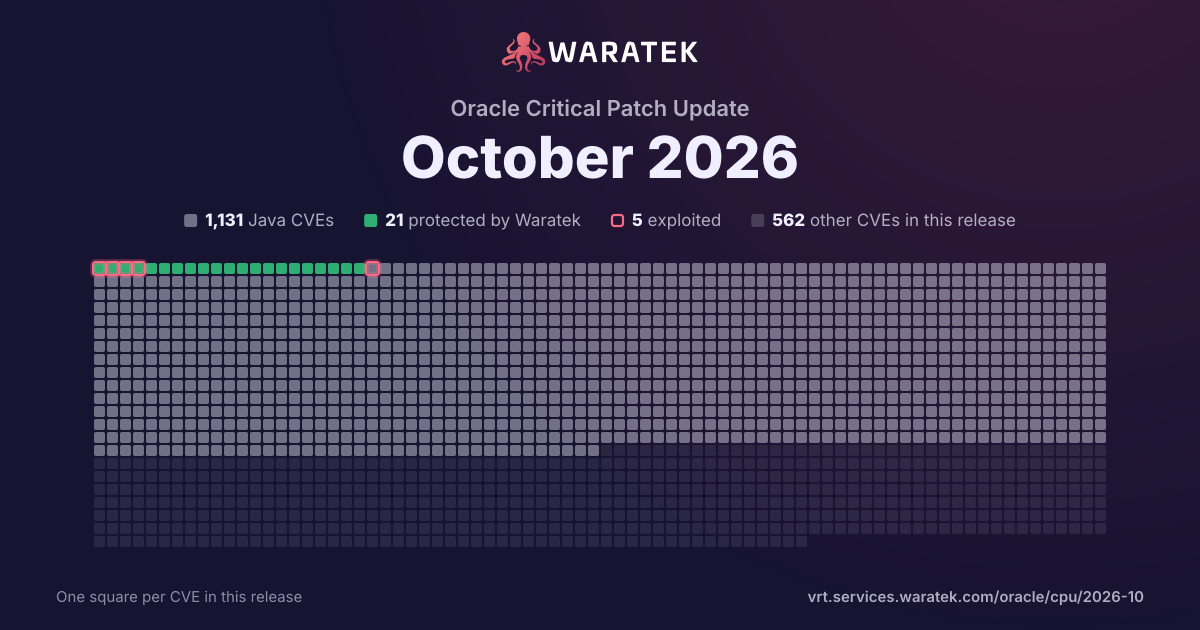
By status
20Protected by Waratek3Mitigation candidate1,109No exploit published12Outside Waratek scope549Not applicable
7Exploited, marked by the ring
No exploit published. For 855 of them, Oracle's security advisory is the source of public detail.
Protected by Waratek. Waratek RASP can block exploitation of these on systems that have not applied the patch yet.
Overview 129 matches · 11 protected · 4 exploited · 3 CISA KEV · 7 public PoC · 3 EPSS ≥ 0.5
Protected by Waratek
11
8.5%
Rule in development
0
0.0%
Mitigation candidate
1
0.8%
No exploit published
117
90.7%
blocked by ARMR today
11
8.5%
partly blocked
0
0.0%
not blocked
118
91.5%
not established
0
0.0%
unrecorded
0
0.0%
split by
peak 73 / quarter
Q1 221
Protected by Waratek1
High1
blocked by ARMR today1
No public exploit1
Q2 220
Q3 223
Protected by Waratek1
No exploit published2
High2
Low1
blocked by ARMR today1
not blocked2
Proof of concept only1
No public exploit2
Q4 221
Protected by Waratek1
Critical1
blocked by ARMR today1
Exploited1
Q1 230
Q2 232
No exploit published2
Medium2
not blocked2
No public exploit2
Q3 230
Q4 231
Mitigation candidate1
High1
not blocked1
Exploited1
Q1 240
Q2 240
Q3 240
Q4 244
No exploit published4
Critical1
High1
Medium2
not blocked4
Proof of concept only1
No public exploit3
Q1 252
Protected by Waratek1
No exploit published1
Critical1
Medium1
blocked by ARMR today1
not blocked1
Exploited1
Proof of concept only1
Q2 251
No exploit published1
High1
not blocked1
Proof of concept only1
Q3 252
No exploit published2
Medium2
not blocked2
No public exploit2
Q4 251
No exploit published1
Medium1
not blocked1
No public exploit1
Q1 267
Protected by Waratek1
No exploit published6
Critical4
High1
Medium2
blocked by ARMR today1
not blocked6
Proof of concept only1
No public exploit6
Q2 2673
Protected by Waratek5
No exploit published68
Critical11
High28
Medium30
Low3
None1
blocked by ARMR today5
not blocked68
Exploited1
Working exploit published1
Proof of concept only12
No public exploit59
Q3 2631
Protected by Waratek1
No exploit published30
Critical2
High17
Medium12
blocked by ARMR today1
not blocked30
Proof of concept only10
No public exploit21
Q1 22Q3 22Q1 23Q3 23Q1 24Q3 24Q1 25Q3 25Q1 26Q3 26
| CVE | Severity | Published▾ | Status | Exploitation | Description |
|---|---|---|---|---|---|
| CVE-2026-34486 | High | 2026-04-09 | Protected by Waratek | Exploited | Missing Encryption of Sensitive Data vulnerability in Apache Tomcat due to the fix for CVE-2026-29146 allowing the bypass of the EncryptInterceptor. This issue affects Apache Tomcat: 11.0.20, 10.1.53, 9.0.116. Users are recommended to upgrade to version 11.0.21, 10.1.54 or 9.0.117, which fix the issue. |
| CVE-2026-34483 | High | 2026-04-09 | No exploit published | No public exploit | Improper Encoding or Escaping of Output vulnerability in the JsonAccessLogValve component of Apache Tomcat. This issue affects Apache Tomcat: from 11.0.0-M1 through 11.0.20, from 10.1.0-M1 through 10.1.53, from 9.0.40 through 9.0.116. Users are recommended to upgrade to version 11.0.21, 10.1.54 or 9.0.117 , which fix the issue. |
| CVE-2026-24880 | High | 2026-04-09 | No exploit published | No public exploit | Inconsistent Interpretation of HTTP Requests ('HTTP Request/Response Smuggling') vulnerability in Apache Tomcat via invalid chunk extension. This issue affects Apache Tomcat: from 11.0.0-M1 through 11.0.18, from 10.1.0-M1 through 10.1.52, from 9.0.0.M1 through 9.0.115, from 8.5.0 through 8.5.100, from 7.0.0 through 7.0.109. Other, unsupported versions may also be affected. Users are recommended to upgrade to version 11.0.20, 10.1.52 or 9.0.116, which fix the issue. |
| CVE-2026-5795 | High | 2026-04-08 | No exploit published | No public exploit | In Eclipse Jetty, the class JASPIAuthenticator initiates the authentication checks, which set two ThreadLocal variable. Upon returning from the initial checks, there are conditions that cause an early return from the JASPIAuthenticator code without clearing those ThreadLocals. A subsequent request using the same thread inherits the ThreadLocal values, leading to a broken access control and privilege escalation. |
| CVE-2026-33870 | High | 2026-03-27 | No exploit published | Proof of concept only | Netty is an asynchronous, event-driven network application framework. In versions prior to 4.1.132.Final and 4.2.10.Final, Netty incorrectly parses quoted strings in HTTP/1.1 chunked transfer encoding extension values, enabling request smuggling attacks. Versions 4.1.132.Final and 4.2.10.Final fix the issue. |
| CVE-2026-33701 | Critical | 2026-03-27 | Protected by Waratek | No public exploit | OpenTelemetry Java Instrumentation provides OpenTelemetry auto-instrumentation and instrumentation libraries for Java. In versions prior to 2.26.1, the RMI instrumentation registered a custom endpoint that deserialized incoming data without applying serialization filters. On JDK version 16 and earlier, an attacker with network access to a JMX or RMI port on an instrumented JVM could exploit this to potentially achieve remote code execution. All three of the following conditions must be true to exploit this vulnerability: First, OpenTelemetry Java instrumentation is attached as a Java agent (`-javaagent`) on Java 16 or earlier. Second, JMX/RMI port has been explicitly configured via `-Dcom.sun.management.jmxremote.port` and is network-reachable. Third, gadget-chain-compatible library is present on the classpath. This results in arbitrary remote code execution with the privileges of the user running the instrumented JVM. For JDK >= 17, no action is required, but upgrading is strongly encouraged. For JDK < 17, upgrade to version 2.26.1 or later. As a workaround, set the system property `-Dotel.instrumentation.rmi.enabled=false` to disable the RMI integration. |
| CVE-2026-28369 | Critical | 2026-03-27 | No exploit published | No public exploit | A flaw was found in Undertow. When Undertow receives an HTTP request where the first header line starts with one or more spaces, it incorrectly processes the request by stripping these leading spaces. This behavior, which violates HTTP standards, can be exploited by a remote attacker to perform request smuggling. Request smuggling allows an attacker to bypass security mechanisms, access restricted information, or manipulate web caches, potentially leading to unauthorized actions or data exposure. |
| CVE-2026-28368 | Critical | 2026-03-27 | No exploit published | No public exploit | A flaw was found in Undertow. This vulnerability allows a remote attacker to construct specially crafted requests where header names are parsed differently by Undertow compared to upstream proxies. This discrepancy in header interpretation can be exploited to launch request smuggling attacks, potentially bypassing security controls and accessing unauthorized resources. |
| CVE-2026-28367 | Critical | 2026-03-27 | No exploit published | No public exploit | A flaw was found in Undertow. A remote attacker can exploit this vulnerability by sending `\r\r\r` as a header block terminator. This can be used for request smuggling with certain proxy servers, such as older versions of Apache Traffic Server and Google Cloud Classic Application Load Balancer, potentially leading to unauthorized access or manipulation of web requests. |
| CVE-2025-11143 | Medium | 2026-03-05 | No exploit published | No public exploit | The Jetty URI parser has some key differences to other common parsers when evaluating invalid or unusual URIs. Differential parsing of URIs in systems using multiple components may result in security by-pass. For example a component that enforces a black list may interpret the URIs differently from one that generates a response. At the very least, differential parsing may divulge implementation details. |
| CVE-2026-24733 | Medium | 2026-02-17 | No exploit published | No public exploit | Improper Input Validation vulnerability in Apache Tomcat. Tomcat did not limit HTTP/0.9 requests to the GET method. If a security constraint was configured to allow HEAD requests to a URI but deny GET requests, the user could bypass that constraint on GET requests by sending a (specification invalid) HEAD request using HTTP/0.9. This issue affects Apache Tomcat: from 11.0.0-M1 through 11.0.14, from 10.1.0-M1 through 10.1.49, from 9.0.0.M1 through 9.0.112. Older, EOL versions are also affected. Users are recommended to upgrade to version 11.0.15 or later, 10.1.50 or later or 9.0.113 or later, which fixes the issue. |
| CVE-2025-68161 | Medium | 2025-12-18 | No exploit published | No public exploit | The Socket Appender in Apache Log4j Core versions 2.0-beta9 through 2.25.2 does not perform TLS hostname verification of the peer certificate, even when the verifyHostName https://logging.apache.org/log4j/2.x/manual/appenders/network.html#SslConfiguration-attr-verifyHostName configuration attribute or the log4j2.sslVerifyHostName https://logging.apache.org/log4j/2.x/manual/systemproperties.html#log4j2.sslVerifyHostName system property is set to true. This issue may allow a man-in-the-middle attacker to intercept or redirect log traffic under the following conditions: * The attacker is able to intercept or redirect network traffic between the client and the log receiver. * The attacker can present a server certificate issued by a certification authority trusted by the Socket Appender’s configured trust store (or by the default Java trust store if no custom trust store is configured). Users are advised to upgrade to Apache Log4j Core version 2.25.3, which addresses this issue. As an alternative mitigation, the Socket Appender may be configured to use a private or restricted trust root to limit the set of trusted certificates. |
| CVE-2025-7962 | Medium | 2025-07-21 | No exploit published | No public exploit | In Jakarta Mail versions prior to 2.0.2 it is possible to perform an SMTP Injection by utilizing the \r and \n UTF-8 characters to separate different messages. |
| CVE-2025-48924 | Medium | 2025-07-11 | No exploit published | No public exploit | Uncontrolled Recursion vulnerability in Apache Commons Lang. This issue affects Apache Commons Lang: Starting with commons-lang:commons-lang 2.0 to 2.6, and, from org.apache.commons:commons-lang3 3.0 before 3.18.0. The methods ClassUtils.getClass(...) can throw StackOverflowError on very long inputs. Because an Error is usually not handled by applications and libraries, a StackOverflowError could cause an application to stop. Users are recommended to upgrade to version 3.18.0, which fixes the issue. |
| CVE-2025-48734 | High | 2025-05-28 | No exploit published | Proof of concept only | Improper Access Control vulnerability in Apache Commons. A special BeanIntrospector class was added in version 1.9.2. This can be used to stop attackers from using the declared class property of Java enum objects to get access to the classloader. However this protection was not enabled by default. PropertyUtilsBean (and consequently BeanUtilsBean) now disallows declared class level property access by default. Releases 1.11.0 and 2.0.0-M2 address a potential security issue when accessing enum properties in an uncontrolled way. If an application using Commons BeanUtils passes property paths from an external source directly to the getProperty() method of PropertyUtilsBean, an attacker can access the enum’s class loader via the “declaredClass” property available on all Java “enum” objects. Accessing the enum’s “declaredClass” allows remote attackers to access the ClassLoader and execute arbitrary code. The same issue exists with PropertyUtilsBean.getNestedProperty(). Starting in versions 1.11.0 and 2.0.0-M2 a special BeanIntrospector suppresses the “declaredClass” property. Note that this new BeanIntrospector is enabled by default, but you can disable it to regain the old behavior; see section 2.5 of the user's guide and the unit tests. This issue affects Apache Commons BeanUtils 1.x before 1.11.0, and 2.x before 2.0.0-M2.Users of the artifact commons-beanutils:commons-beanutils 1.x are recommended to upgrade to version 1.11.0, which fixes the issue. Users of the artifact org.apache.commons:commons-beanutils2 2.x are recommended to upgrade to version 2.0.0-M2, which fixes the issue. |
| CVE-2025-24813 | Critical | 2025-03-10 | Protected by Waratek | Exploited | Path Equivalence: 'file.Name' (Internal Dot) leading to Remote Code Execution and/or Information disclosure and/or malicious content added to uploaded files via write enabled Default Servlet in Apache Tomcat. This issue affects Apache Tomcat: from 11.0.0-M1 through 11.0.2, from 10.1.0-M1 through 10.1.34, from 9.0.0.M1 through 9.0.98. The following versions were EOL at the time the CVE was created but are known to be affected: 8.5.0 though 8.5.100. Other, older, EOL versions may also be affected. If all of the following were true, a malicious user was able to view security sensitive files and/or inject content into those files: - writes enabled for the default servlet (disabled by default) - support for partial PUT (enabled by default) - a target URL for security sensitive uploads that was a sub-directory of a target URL for public uploads - attacker knowledge of the names of security sensitive files being uploaded - the security sensitive files also being uploaded via partial PUT If all of the following were true, a malicious user was able to perform remote code execution: - writes enabled for the default servlet (disabled by default) - support for partial PUT (enabled by default) - application was using Tomcat's file based session persistence with the default storage location - application included a library that may be leveraged in a deserialization attack Users are recommended to upgrade to version 11.0.3, 10.1.35 or 9.0.99, which fixes the issue. |
| CVE-2025-25193 | Medium | 2025-02-10 | No exploit published | Proof of concept only | Netty, an asynchronous, event-driven network application framework, has a vulnerability in versions up to and including 4.1.118.Final. An unsafe reading of environment file could potentially cause a denial of service in Netty. When loaded on an Windows application, Netty attempts to load a file that does not exist. If an attacker creates such a large file, the Netty application crash. A similar issue was previously reported as CVE-2024-47535. This issue was fixed, but the fix was incomplete in that null-bytes were not counted against the input limit. Commit d1fbda62d3a47835d3fb35db8bd42ecc205a5386 contains an updated fix. |
| CVE-2024-52316 | Critical | 2024-11-18 | No exploit published | No public exploit | Unchecked Error Condition vulnerability in Apache Tomcat. If Tomcat is configured to use a custom Jakarta Authentication (formerly JASPIC) ServerAuthContext component which may throw an exception during the authentication process without explicitly setting an HTTP status to indicate failure, the authentication may not fail, allowing the user to bypass the authentication process. There are no known Jakarta Authentication components that behave in this way. This issue affects Apache Tomcat: from 11.0.0-M1 through 11.0.0-M26, from 10.1.0-M1 through 10.1.30, from 9.0.0-M1 through 9.0.95. The following versions were EOL at the time the CVE was created but are known to be affected: 8.5.0 though 8.5.100. Other EOL versions may also be affected. Users are recommended to upgrade to version 11.0.0, 10.1.31 or 9.0.96, which fix the issue. |
| CVE-2024-47072 | High | 2024-11-08 | No exploit published | No public exploit | XStream is a simple library to serialize objects to XML and back again. This vulnerability may allow a remote attacker to terminate the application with a stack overflow error resulting in a denial of service only by manipulating the processed input stream when XStream is configured to use the BinaryStreamDriver. XStream 1.4.21 has been patched to detect the manipulation in the binary input stream causing the the stack overflow and raises an InputManipulationException instead. Users are advised to upgrade. Users unable to upgrade may catch the StackOverflowError in the client code calling XStream if XStream is configured to use the BinaryStreamDriver. |
| CVE-2024-6763 | Medium | 2024-10-14 | No exploit published | Proof of concept only | Eclipse Jetty is a lightweight, highly scalable, Java-based web server and Servlet engine . It includes a utility class, HttpURI, for URI/URL parsing. The HttpURI class does insufficient validation on the authority segment of a URI. However the behaviour of HttpURI differs from the common browsers in how it handles a URI that would be considered invalid if fully validated against the RRC. Specifically HttpURI and the browser may differ on the value of the host extracted from an invalid URI and thus a combination of Jetty and a vulnerable browser may be vulnerable to a open redirect attack or to a SSRF attack if the URI is used after passing validation checks. |
| CVE-2024-47554 | Medium | 2024-10-03 | No exploit published | No public exploit | Uncontrolled Resource Consumption vulnerability in Apache Commons IO. The org.apache.commons.io.input.XmlStreamReader class may excessively consume CPU resources when processing maliciously crafted input. This issue affects Apache Commons IO: from 2.0 before 2.14.0. Users are recommended to upgrade to version 2.14.0 or later, which fixes the issue. |
| CVE-2023-44487 | High | 2023-10-10 | Mitigation candidate | Exploited | The HTTP/2 protocol allows a denial of service (server resource consumption) because request cancellation can reset many streams quickly, as exploited in the wild in August through October 2023. |
| CVE-2023-26049 | Medium | 2023-04-18 | No exploit published | No public exploit | Jetty is a java based web server and servlet engine. Nonstandard cookie parsing in Jetty may allow an attacker to smuggle cookies within other cookies, or otherwise perform unintended behavior by tampering with the cookie parsing mechanism. If Jetty sees a cookie VALUE that starts with `"` (double quote), it will continue to read the cookie string until it sees a closing quote -- even if a semicolon is encountered. So, a cookie header such as: `DISPLAY_LANGUAGE="b; JSESSIONID=1337; c=d"` will be parsed as one cookie, with the name DISPLAY_LANGUAGE and a value of b; JSESSIONID=1337; c=d instead of 3 separate cookies. This has security implications because if, say, JSESSIONID is an HttpOnly cookie, and the DISPLAY_LANGUAGE cookie value is rendered on the page, an attacker can smuggle the JSESSIONID cookie into the DISPLAY_LANGUAGE cookie and thereby exfiltrate it. This is significant when an intermediary is enacting some policy based on cookies, so a smuggled cookie can bypass that policy yet still be seen by the Jetty server or its logging system. This issue has been addressed in versions 9.4.51, 10.0.14, 11.0.14, and 12.0.0.beta0 and users are advised to upgrade. There are no known workarounds for this issue. |
| CVE-2023-26048 | Medium | 2023-04-18 | No exploit published | No public exploit | Jetty is a java based web server and servlet engine. In affected versions servlets with multipart support (e.g. annotated with `@MultipartConfig`) that call `HttpServletRequest.getParameter()` or `HttpServletRequest.getParts()` may cause `OutOfMemoryError` when the client sends a multipart request with a part that has a name but no filename and very large content. This happens even with the default settings of `fileSizeThreshold=0` which should stream the whole part content to disk. An attacker client may send a large multipart request and cause the server to throw `OutOfMemoryError`. However, the server may be able to recover after the `OutOfMemoryError` and continue its service -- although it may take some time. This issue has been patched in versions 9.4.51, 10.0.14, and 11.0.14. Users are advised to upgrade. Users unable to upgrade may set the multipart parameter `maxRequestSize` which must be set to a non-negative value, so the whole multipart content is limited (although still read into memory). |
| CVE-2022-1471 | Critical | 2022-12-01 | Protected by Waratek | Exploited | SnakeYaml's Constructor() class does not restrict types which can be instantiated during deserialization. Deserializing yaml content provided by an attacker can lead to remote code execution. We recommend using SnakeYaml's SafeConsturctor when parsing untrusted content to restrict deserialization. We recommend upgrading to version 2.0 and beyond. |
| CVE-2022-34169 | High | 2022-07-19 | Protected by Waratek | Proof of concept only | The Apache Xalan Java XSLT library is vulnerable to an integer truncation issue when processing malicious XSLT stylesheets. This can be used to corrupt Java class files generated by the internal XSLTC compiler and execute arbitrary Java bytecode. Users are recommended to update to version 2.7.3 or later. Note: Java runtimes (such as OpenJDK) include repackaged copies of Xalan. |
| CVE-2022-2048 | High | 2022-07-07 | No exploit published | No public exploit | In Eclipse Jetty HTTP/2 server implementation, when encountering an invalid HTTP/2 request, the error handling has a bug that can wind up not properly cleaning up the active connections and associated resources. This can lead to a Denial of Service scenario where there are no enough resources left to process good requests. |
| CVE-2022-2047 | Low | 2022-07-07 | No exploit published | No public exploit | In Eclipse Jetty versions 9.4.0 thru 9.4.46, and 10.0.0 thru 10.0.9, and 11.0.0 thru 11.0.9 versions, the parsing of the authority segment of an http scheme URI, the Jetty HttpURI class improperly detects an invalid input as a hostname. This can lead to failures in a Proxy scenario. |
| CVE-2022-23181 | High | 2022-01-27 | Protected by Waratek | No public exploit | The fix for bug CVE-2020-9484 introduced a time of check, time of use vulnerability into Apache Tomcat 10.1.0-M1 to 10.1.0-M8, 10.0.0-M5 to 10.0.14, 9.0.35 to 9.0.56 and 8.5.55 to 8.5.73 that allowed a local attacker to perform actions with the privileges of the user that the Tomcat process is using. This issue is only exploitable when Tomcat is configured to persist sessions using the FileStore. |