
Oracle Critical Patch Update October 2026
Released October 2026 · Oracle's advisory ↗ · ← Security Patch Update, September 2026
1,693 CVEs in this release, one square each
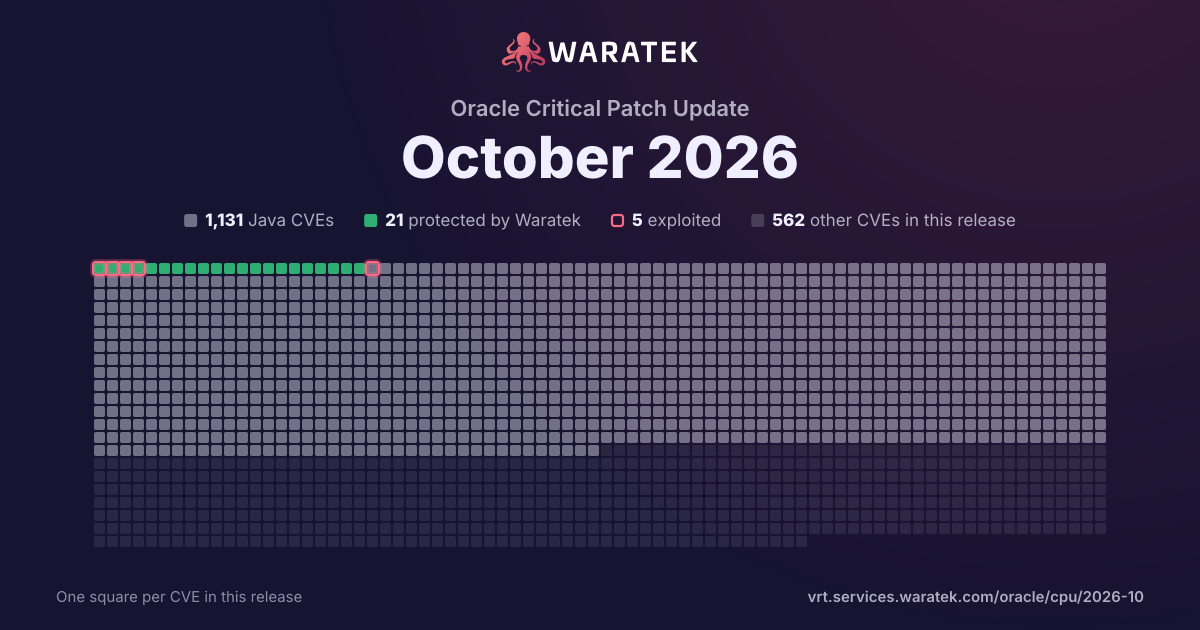
By status
21Protected by Waratek1Mitigation candidate1,109No exploit published13Outside Waratek scope549Not applicable
5Exploited, marked by the ring
No exploit published. For 858 of them, Oracle's security advisory is the source of public detail.
Protected by Waratek. Waratek RASP can block exploitation of these on systems that have not applied the patch yet.
Overview 94 matches · 10 protected · 3 exploited · 1 CISA KEV · 3 public PoC · 2 EPSS ≥ 0.5
Protected by Waratek
10
10.6%
Rule in development
0
0.0%
Mitigation candidate
0
0.0%
No exploit published
84
89.4%
blocked by ARMR today
10
10.6%
partly blocked
0
0.0%
not blocked
84
89.4%
not established
0
0.0%
unrecorded
0
0.0%
Exploited
3
3.2%
Working exploit published
0
0.0%
Proof of concept only
6
6.4%
Forecast only
0
0.0%
No public exploit
85
90.4%
split by
peak 55 / quarter
Q4 223
Protected by Waratek2
No exploit published1
Critical3
blocked by ARMR today2
not blocked1
Exploited1
No public exploit2
Q1 230
Q2 230
Q3 230
Q4 230
Q1 240
Q2 240
Q3 240
Q4 241
No exploit published1
Critical1
not blocked1
No public exploit1
Q1 251
Protected by Waratek1
Critical1
blocked by ARMR today1
Exploited1
Q2 250
Q3 250
Q4 250
Q1 264
Protected by Waratek1
No exploit published3
Critical4
blocked by ARMR today1
not blocked3
No public exploit4
Q2 2615
Protected by Waratek5
No exploit published10
Critical15
blocked by ARMR today5
not blocked10
Proof of concept only5
No public exploit10
Q3 2615
No exploit published15
Critical15
not blocked15
Proof of concept only1
No public exploit14
Q4 2655
Protected by Waratek1
No exploit published54
Critical55
blocked by ARMR today1
not blocked54
Exploited1
No public exploit54
Q4 22Q2 23Q4 23Q2 24Q4 24Q2 25Q4 25Q2 26Q4 26
| CVE | Severity | Published▾ | Status | Exploitation | Description |
|---|---|---|---|---|---|
| CVE-2026-91665 | Critical | 2026-10-20 | No exploit published | No public exploit | Vulnerability in Oracle Essbase (component: Security). The supported version that is affected is 21.8.3.0.0. Easily exploitable vulnerability allows unauthenticated attacker with network access via TCP to compromise Oracle Essbase. Successful attacks of this vulnerability can result in takeover of Oracle Essbase. CVSS 3.1 Base Score 9.8 (Confidentiality, Integrity and Availability impacts). CVSS Vector: (CVSS:3.1/AV:N/AC:L/PR:N/UI:N/S:U/C:H/I:H/A:H). |
| CVE-2026-91663 | Critical | 2026-10-20 | No exploit published | No public exploit | Vulnerability in Oracle Essbase (component: Security). The supported version that is affected is 21.8.3.0.0. Easily exploitable vulnerability allows low privileged attacker with network access via T3, IIOP to compromise Oracle Essbase. While the vulnerability is in Oracle Essbase, attacks may significantly impact additional products (scope change). Successful attacks of this vulnerability can result in takeover of Oracle Essbase. CVSS 3.1 Base Score 9.9 (Confidentiality, Integrity and Availability impacts). CVSS Vector: (CVSS:3.1/AV:N/AC:L/PR:L/UI:N/S:C/C:H/I:H/A:H). |
| CVE-2026-91658 | Critical | 2026-10-20 | No exploit published | No public exploit | Vulnerability in Oracle Essbase (component: Security). The supported version that is affected is 21.8.3.0.0. Easily exploitable vulnerability allows low privileged attacker with network access via HTTP to compromise Oracle Essbase. While the vulnerability is in Oracle Essbase, attacks may significantly impact additional products (scope change). Successful attacks of this vulnerability can result in takeover of Oracle Essbase. CVSS 3.1 Base Score 9.9 (Confidentiality, Integrity and Availability impacts). CVSS Vector: (CVSS:3.1/AV:N/AC:L/PR:L/UI:N/S:C/C:H/I:H/A:H). |
| CVE-2026-91656 | Critical | 2026-10-20 | No exploit published | No public exploit | Vulnerability in Oracle Essbase (component: Federated Partitions). The supported version that is affected is 21.8.3.0.0. Easily exploitable vulnerability allows low privileged attacker with network access via HTTP to compromise Oracle Essbase. While the vulnerability is in Oracle Essbase, attacks may significantly impact additional products (scope change). Successful attacks of this vulnerability can result in unauthorized access to critical data or complete access to all Oracle Essbase accessible data as well as unauthorized update, insert or delete access to some of Oracle Essbase accessible data and unauthorized ability to cause a partial denial of service (partial DOS) of Oracle Essbase. CVSS 3.1 Base Score 9.1 (Confidentiality, Integrity and Availability impacts). CVSS Vector: (CVSS:3.1/AV:N/AC:L/PR:L/UI:N/S:C/C:H/I:L/A:L). |
| CVE-2026-91655 | Critical | 2026-10-20 | No exploit published | No public exploit | Vulnerability in Oracle Essbase (component: Security). The supported version that is affected is 21.8.3.0.0. Easily exploitable vulnerability allows low privileged attacker with network access via HTTP to compromise Oracle Essbase. While the vulnerability is in Oracle Essbase, attacks may significantly impact additional products (scope change). Successful attacks of this vulnerability can result in unauthorized access to critical data or complete access to all Oracle Essbase accessible data as well as unauthorized update, insert or delete access to some of Oracle Essbase accessible data and unauthorized ability to cause a partial denial of service (partial DOS) of Oracle Essbase. CVSS 3.1 Base Score 9.1 (Confidentiality, Integrity and Availability impacts). CVSS Vector: (CVSS:3.1/AV:N/AC:L/PR:L/UI:N/S:C/C:H/I:L/A:L). |
| CVE-2026-91644 | Critical | 2026-10-20 | No exploit published | No public exploit | Vulnerability in Oracle Essbase (component: Security). The supported version that is affected is 21.8.3.0.0. Easily exploitable vulnerability allows unauthenticated attacker with network access via HTTP to compromise Oracle Essbase. While the vulnerability is in Oracle Essbase, attacks may significantly impact additional products (scope change). Successful attacks of this vulnerability can result in unauthorized access to critical data or complete access to all Oracle Essbase accessible data as well as unauthorized update, insert or delete access to some of Oracle Essbase accessible data. CVSS 3.1 Base Score 9.3 (Confidentiality and Integrity impacts). CVSS Vector: (CVSS:3.1/AV:N/AC:L/PR:N/UI:N/S:C/C:H/I:L/A:N). |
| CVE-2026-91638 | Critical | 2026-10-20 | No exploit published | No public exploit | Vulnerability in Oracle Essbase (component: Security). The supported version that is affected is 21.8.3.0.0. Easily exploitable vulnerability allows low privileged attacker with network access via HTTP to compromise Oracle Essbase. While the vulnerability is in Oracle Essbase, attacks may significantly impact additional products (scope change). Successful attacks of this vulnerability can result in takeover of Oracle Essbase. CVSS 3.1 Base Score 9.9 (Confidentiality, Integrity and Availability impacts). CVSS Vector: (CVSS:3.1/AV:N/AC:L/PR:L/UI:N/S:C/C:H/I:H/A:H). |
| CVE-2026-91637 | Critical | 2026-10-20 | No exploit published | No public exploit | Vulnerability in Oracle Essbase (component: Security). The supported version that is affected is 21.8.3.0.0. Easily exploitable vulnerability allows low privileged attacker with network access via HTTP to compromise Oracle Essbase. While the vulnerability is in Oracle Essbase, attacks may significantly impact additional products (scope change). Successful attacks of this vulnerability can result in takeover of Oracle Essbase. CVSS 3.1 Base Score 9.9 (Confidentiality, Integrity and Availability impacts). CVSS Vector: (CVSS:3.1/AV:N/AC:L/PR:L/UI:N/S:C/C:H/I:H/A:H). |
| CVE-2026-91624 | Critical | 2026-10-20 | No exploit published | No public exploit | Vulnerability in the Oracle Agile Product Lifecycle Management for Process product of Oracle Supply Chain (component: Product Quality Management). The supported version that is affected is 6.2.4. Easily exploitable vulnerability allows unauthenticated attacker with network access via HTTP to compromise Oracle Agile Product Lifecycle Management for Process. Successful attacks of this vulnerability can result in unauthorized creation, deletion or modification access to critical data or all Oracle Agile Product Lifecycle Management for Process accessible data as well as unauthorized access to critical data or complete access to all Oracle Agile Product Lifecycle Management for Process accessible data. CVSS 3.1 Base Score 9.1 (Confidentiality and Integrity impacts). CVSS Vector: (CVSS:3.1/AV:N/AC:L/PR:N/UI:N/S:U/C:H/I:H/A:N). |
| CVE-2026-91622 | Critical | 2026-10-20 | No exploit published | No public exploit | Vulnerability in the Oracle Agile Product Lifecycle Management for Process product of Oracle Supply Chain (component: Product Quality Management). The supported version that is affected is 6.2.4. Easily exploitable vulnerability allows unauthenticated attacker with network access via HTTP to compromise Oracle Agile Product Lifecycle Management for Process. Successful attacks require human interaction from a person other than the attacker and while the vulnerability is in Oracle Agile Product Lifecycle Management for Process, attacks may significantly impact additional products (scope change). Successful attacks of this vulnerability can result in unauthorized creation, deletion or modification access to critical data or all Oracle Agile Product Lifecycle Management for Process accessible data as well as unauthorized access to critical data or complete access to all Oracle Agile Product Lifecycle Management for Process accessible data. CVSS 3.1 Base Score 9.3 (Confidentiality and Integrity impacts). CVSS Vector: (CVSS:3.1/AV:N/AC:L/PR:N/UI:R/S:C/C:H/I:H/A:N). |
| CVE-2026-91495 | Critical | 2026-10-20 | No exploit published | No public exploit | Vulnerability in the Oracle WebCenter Content product of Oracle Fusion Middleware (component: Content Server). Supported versions that are affected are 12.2.1.4.0 and 14.1.2.0.0. Easily exploitable vulnerability allows unauthenticated attacker with network access via HTTP to compromise Oracle WebCenter Content. Successful attacks of this vulnerability can result in takeover of Oracle WebCenter Content. CVSS 3.1 Base Score 9.8 (Confidentiality, Integrity and Availability impacts). CVSS Vector: (CVSS:3.1/AV:N/AC:L/PR:N/UI:N/S:U/C:H/I:H/A:H). |
| CVE-2026-91491 | Critical | 2026-10-20 | No exploit published | No public exploit | Vulnerability in the Oracle Identity Manager Connector product of Oracle Fusion Middleware (component: LDAP Gateway). Supported versions that are affected are 12.2.1.4.0 and 14.1.2.1.0. Easily exploitable vulnerability allows unauthenticated attacker with network access via LDAP to compromise Oracle Identity Manager Connector. Successful attacks of this vulnerability can result in takeover of Oracle Identity Manager Connector. CVSS 3.1 Base Score 9.8 (Confidentiality, Integrity and Availability impacts). CVSS Vector: (CVSS:3.1/AV:N/AC:L/PR:N/UI:N/S:U/C:H/I:H/A:H). |
| CVE-2026-91490 | Critical | 2026-10-20 | No exploit published | No public exploit | Vulnerability in the Oracle Identity Manager Connector product of Oracle Fusion Middleware (component: LDAP Gateway). Supported versions that are affected are 12.2.1.4.0 and 14.1.2.1.0. Easily exploitable vulnerability allows unauthenticated attacker with network access via LDAP to compromise Oracle Identity Manager Connector. Successful attacks of this vulnerability can result in unauthorized creation, deletion or modification access to critical data or all Oracle Identity Manager Connector accessible data as well as unauthorized access to critical data or complete access to all Oracle Identity Manager Connector accessible data. CVSS 3.1 Base Score 9.1 (Confidentiality and Integrity impacts). CVSS Vector: (CVSS:3.1/AV:N/AC:L/PR:N/UI:N/S:U/C:H/I:H/A:N). |
| CVE-2026-91408 | Critical | 2026-10-20 | No exploit published | No public exploit | Vulnerability in the Oracle Identity Manager product of Oracle Fusion Middleware (component: End User Self Service). Supported versions that are affected are 12.2.1.4.0 and 14.1.2.1.0. Easily exploitable vulnerability allows unauthenticated attacker with network access via T3, IIOP to compromise Oracle Identity Manager. Successful attacks of this vulnerability can result in takeover of Oracle Identity Manager. CVSS 3.1 Base Score 9.8 (Confidentiality, Integrity and Availability impacts). CVSS Vector: (CVSS:3.1/AV:N/AC:L/PR:N/UI:N/S:U/C:H/I:H/A:H). |
| CVE-2026-91323 | Critical | 2026-10-20 | No exploit published | No public exploit | Vulnerability in the Oracle WebLogic Server product of Oracle Fusion Middleware (component: Core). Supported versions that are affected are 12.2.1.4.0, 14.1.1.0.0, 14.1.2.0.0 and 15.1.1.0.0. Easily exploitable vulnerability allows unauthenticated attacker with network access via HTTP to compromise Oracle WebLogic Server. Successful attacks of this vulnerability can result in takeover of Oracle WebLogic Server. CVSS 3.1 Base Score 9.8 (Confidentiality, Integrity and Availability impacts). CVSS Vector: (CVSS:3.1/AV:N/AC:L/PR:N/UI:N/S:U/C:H/I:H/A:H). |
| CVE-2026-91305 | Critical | 2026-10-20 | No exploit published | No public exploit | Vulnerability in the JD Edwards EnterpriseOne Tools product of Oracle JD Edwards (component: Installation Security). Supported versions that are affected are 9.2.0.0-9.2.26.5. Easily exploitable vulnerability allows unauthenticated attacker with network access via HTTPS to compromise JD Edwards EnterpriseOne Tools. Successful attacks of this vulnerability can result in unauthorized creation, deletion or modification access to critical data or all JD Edwards EnterpriseOne Tools accessible data as well as unauthorized access to critical data or complete access to all JD Edwards EnterpriseOne Tools accessible data. CVSS 3.1 Base Score 9.1 (Confidentiality and Integrity impacts). CVSS Vector: (CVSS:3.1/AV:N/AC:L/PR:N/UI:N/S:U/C:H/I:H/A:N). |
| CVE-2026-91299 | Critical | 2026-10-20 | No exploit published | No public exploit | Vulnerability in the JD Edwards EnterpriseOne Orchestrator product of Oracle JD Edwards (component: E1 IOT Orchestrator Security). Supported versions that are affected are 9.2.0.0-9.2.26.5. Easily exploitable vulnerability allows unauthenticated attacker with network access via HTTP to compromise JD Edwards EnterpriseOne Orchestrator. While the vulnerability is in JD Edwards EnterpriseOne Orchestrator, attacks may significantly impact additional products (scope change). Successful attacks of this vulnerability can result in takeover of JD Edwards EnterpriseOne Orchestrator. CVSS 3.1 Base Score 10.0 (Confidentiality, Integrity and Availability impacts). CVSS Vector: (CVSS:3.1/AV:N/AC:L/PR:N/UI:N/S:C/C:H/I:H/A:H). |
| CVE-2026-91265 | Critical | 2026-10-20 | No exploit published | No public exploit | Vulnerability in the JD Edwards EnterpriseOne Tools product of Oracle JD Edwards (component: Enterprise Infrastructure SEC). Supported versions that are affected are 9.2.0.0-9.2.26.5. Easily exploitable vulnerability allows unauthenticated attacker with network access via HTTP to compromise JD Edwards EnterpriseOne Tools. Successful attacks of this vulnerability can result in unauthorized creation, deletion or modification access to critical data or all JD Edwards EnterpriseOne Tools accessible data as well as unauthorized access to critical data or complete access to all JD Edwards EnterpriseOne Tools accessible data. CVSS 3.1 Base Score 9.1 (Confidentiality and Integrity impacts). CVSS Vector: (CVSS:3.1/AV:N/AC:L/PR:N/UI:N/S:U/C:H/I:H/A:N). |
| CVE-2026-91251 | Critical | 2026-10-20 | No exploit published | No public exploit | Vulnerability in the Oracle SOA Suite product of Oracle Fusion Middleware (component: Adapters). Supported versions that are affected are 12.2.1.4.0 and 14.1.2.0.0. Easily exploitable vulnerability allows low privileged attacker with network access via HTTP to compromise Oracle SOA Suite. While the vulnerability is in Oracle SOA Suite, attacks may significantly impact additional products (scope change). Successful attacks of this vulnerability can result in takeover of Oracle SOA Suite. CVSS 3.1 Base Score 9.9 (Confidentiality, Integrity and Availability impacts). CVSS Vector: (CVSS:3.1/AV:N/AC:L/PR:L/UI:N/S:C/C:H/I:H/A:H). |
| CVE-2026-91250 | Critical | 2026-10-20 | No exploit published | No public exploit | Vulnerability in the Oracle SOA Suite product of Oracle Fusion Middleware (component: Adapters). Supported versions that are affected are 12.2.1.4.0 and 14.1.2.0.0. Easily exploitable vulnerability allows low privileged attacker with network access via multiple protocols to compromise Oracle SOA Suite. While the vulnerability is in Oracle SOA Suite, attacks may significantly impact additional products (scope change). Successful attacks of this vulnerability can result in takeover of Oracle SOA Suite. CVSS 3.1 Base Score 9.9 (Confidentiality, Integrity and Availability impacts). CVSS Vector: (CVSS:3.1/AV:N/AC:L/PR:L/UI:N/S:C/C:H/I:H/A:H). |
| CVE-2026-91243 | Critical | 2026-10-20 | No exploit published | No public exploit | Vulnerability in the Oracle Business Process Management Suite product of Oracle Fusion Middleware (component: Fabric Layer). Supported versions that are affected are 12.2.1.4.0 and 14.1.2.0.0. Easily exploitable vulnerability allows low privileged attacker with network access via HTTP to compromise Oracle Business Process Management Suite. While the vulnerability is in Oracle Business Process Management Suite, attacks may significantly impact additional products (scope change). Successful attacks of this vulnerability can result in unauthorized creation, deletion or modification access to critical data or all Oracle Business Process Management Suite accessible data as well as unauthorized access to critical data or complete access to all Oracle Business Process Management Suite accessible data. CVSS 3.1 Base Score 9.6 (Confidentiality and Integrity impacts). CVSS Vector: (CVSS:3.1/AV:N/AC:L/PR:L/UI:N/S:C/C:H/I:H/A:N). |
| CVE-2026-91241 | Critical | 2026-10-20 | No exploit published | No public exploit | Vulnerability in the Oracle Business Intelligence Enterprise Edition product of Oracle Analytics (component: Analytics Web Administration). Supported versions that are affected are 8.2.0.0.0, 12.2.1.4.0 and 26.01.0.0.0. Easily exploitable vulnerability allows high privileged attacker with network access via HTTP to compromise Oracle Business Intelligence Enterprise Edition. While the vulnerability is in Oracle Business Intelligence Enterprise Edition, attacks may significantly impact additional products (scope change). Successful attacks of this vulnerability can result in takeover of Oracle Business Intelligence Enterprise Edition. CVSS 3.1 Base Score 9.1 (Confidentiality, Integrity and Availability impacts). CVSS Vector: (CVSS:3.1/AV:N/AC:L/PR:H/UI:N/S:C/C:H/I:H/A:H). |
| CVE-2026-91236 | Critical | 2026-10-20 | No exploit published | No public exploit | Vulnerability in the Oracle SOA Suite product of Oracle Fusion Middleware (component: Fabric Layer). Supported versions that are affected are 12.2.1.4.0 and 14.1.2.0.0. Easily exploitable vulnerability allows unauthenticated attacker with network access via HTTP to compromise Oracle SOA Suite. Successful attacks of this vulnerability can result in takeover of Oracle SOA Suite. CVSS 3.1 Base Score 9.8 (Confidentiality, Integrity and Availability impacts). CVSS Vector: (CVSS:3.1/AV:N/AC:L/PR:N/UI:N/S:U/C:H/I:H/A:H). |
| CVE-2026-91235 | Critical | 2026-10-20 | No exploit published | No public exploit | Vulnerability in the Oracle SOA Suite product of Oracle Fusion Middleware (component: Fabric Layer). Supported versions that are affected are 12.2.1.4.0 and 14.1.2.0.0. Easily exploitable vulnerability allows unauthenticated attacker with network access via HTTP to compromise Oracle SOA Suite. Successful attacks of this vulnerability can result in takeover of Oracle SOA Suite. CVSS 3.1 Base Score 9.8 (Confidentiality, Integrity and Availability impacts). CVSS Vector: (CVSS:3.1/AV:N/AC:L/PR:N/UI:N/S:U/C:H/I:H/A:H). |
| CVE-2026-91234 | Critical | 2026-10-20 | No exploit published | No public exploit | Vulnerability in the Oracle SOA Suite product of Oracle Fusion Middleware (component: Fabric Layer). Supported versions that are affected are 12.2.1.4.0 and 14.1.2.0.0. Easily exploitable vulnerability allows unauthenticated attacker with network access via HTTP to compromise Oracle SOA Suite. Successful attacks of this vulnerability can result in takeover of Oracle SOA Suite. CVSS 3.1 Base Score 9.8 (Confidentiality, Integrity and Availability impacts). CVSS Vector: (CVSS:3.1/AV:N/AC:L/PR:N/UI:N/S:U/C:H/I:H/A:H). |
| CVE-2026-91233 | Critical | 2026-10-20 | No exploit published | No public exploit | Vulnerability in the Oracle SOA Suite product of Oracle Fusion Middleware (component: Enterprise Scheduling System). Supported versions that are affected are 12.2.1.4.0 and 14.1.2.0.0. Easily exploitable vulnerability allows unauthenticated attacker with network access via SOAP to compromise Oracle SOA Suite. Successful attacks of this vulnerability can result in takeover of Oracle SOA Suite. CVSS 3.1 Base Score 9.8 (Confidentiality, Integrity and Availability impacts). CVSS Vector: (CVSS:3.1/AV:N/AC:L/PR:N/UI:N/S:U/C:H/I:H/A:H). |
| CVE-2026-91232 | Critical | 2026-10-20 | No exploit published | No public exploit | Vulnerability in the Oracle SOA Suite product of Oracle Fusion Middleware (component: Fabric Layer). Supported versions that are affected are 12.2.1.4.0 and 14.1.2.0.0. Easily exploitable vulnerability allows low privileged attacker with network access via HTTP to compromise Oracle SOA Suite. While the vulnerability is in Oracle SOA Suite, attacks may significantly impact additional products (scope change). Successful attacks of this vulnerability can result in takeover of Oracle SOA Suite. CVSS 3.1 Base Score 9.9 (Confidentiality, Integrity and Availability impacts). CVSS Vector: (CVSS:3.1/AV:N/AC:L/PR:L/UI:N/S:C/C:H/I:H/A:H). |
| CVE-2026-91231 | Critical | 2026-10-20 | No exploit published | No public exploit | Vulnerability in the Oracle SOA Suite product of Oracle Fusion Middleware (component: Adapters). Supported versions that are affected are 12.2.1.4.0 and 14.1.2.0.0. Easily exploitable vulnerability allows unauthenticated attacker with network access via HTTP to compromise Oracle SOA Suite. While the vulnerability is in Oracle SOA Suite, attacks may significantly impact additional products (scope change). Successful attacks of this vulnerability can result in takeover of Oracle SOA Suite. CVSS 3.1 Base Score 10.0 (Confidentiality, Integrity and Availability impacts). CVSS Vector: (CVSS:3.1/AV:N/AC:L/PR:N/UI:N/S:C/C:H/I:H/A:H). |
| CVE-2026-91230 | Critical | 2026-10-20 | No exploit published | No public exploit | Vulnerability in the Oracle SOA Suite product of Oracle Fusion Middleware (component: Fabric Layer). Supported versions that are affected are 12.2.1.4.0 and 14.1.2.0.0. Easily exploitable vulnerability allows unauthenticated attacker with network access via HTTP to compromise Oracle SOA Suite. While the vulnerability is in Oracle SOA Suite, attacks may significantly impact additional products (scope change). Successful attacks of this vulnerability can result in unauthorized access to critical data or complete access to all Oracle SOA Suite accessible data as well as unauthorized update, insert or delete access to some of Oracle SOA Suite accessible data. CVSS 3.1 Base Score 9.3 (Confidentiality and Integrity impacts). CVSS Vector: (CVSS:3.1/AV:N/AC:L/PR:N/UI:N/S:C/C:H/I:L/A:N). |
| CVE-2026-91225 | Critical | 2026-10-20 | No exploit published | No public exploit | Vulnerability in the Oracle SOA Suite product of Oracle Fusion Middleware (component: Adapters). Supported versions that are affected are 12.2.1.4.0 and 14.1.2.0.0. Easily exploitable vulnerability allows unauthenticated attacker with network access via HTTP to compromise Oracle SOA Suite. Successful attacks of this vulnerability can result in unauthorized creation, deletion or modification access to critical data or all Oracle SOA Suite accessible data and unauthorized ability to cause a hang or frequently repeatable crash (complete DOS) of Oracle SOA Suite. CVSS 3.1 Base Score 9.1 (Integrity and Availability impacts). CVSS Vector: (CVSS:3.1/AV:N/AC:L/PR:N/UI:N/S:U/C:N/I:H/A:H). |
| CVE-2026-91224 | Critical | 2026-10-20 | No exploit published | No public exploit | Vulnerability in the Oracle SOA Suite product of Oracle Fusion Middleware (component: Fabric Layer). Supported versions that are affected are 12.2.1.4.0 and 14.1.2.0.0. Easily exploitable vulnerability allows low privileged attacker with network access via HTTP to compromise Oracle SOA Suite. While the vulnerability is in Oracle SOA Suite, attacks may significantly impact additional products (scope change). Successful attacks of this vulnerability can result in takeover of Oracle SOA Suite. CVSS 3.1 Base Score 9.9 (Confidentiality, Integrity and Availability impacts). CVSS Vector: (CVSS:3.1/AV:N/AC:L/PR:L/UI:N/S:C/C:H/I:H/A:H). |
| CVE-2026-91222 | Critical | 2026-10-20 | No exploit published | No public exploit | Vulnerability in the Oracle Business Process Management Suite product of Oracle Fusion Middleware (component: Human Workflow (11g+)). Supported versions that are affected are 12.2.1.4.0 and 14.1.2.0.0. Easily exploitable vulnerability allows low privileged attacker with network access via SOAP to compromise Oracle Business Process Management Suite. While the vulnerability is in Oracle Business Process Management Suite, attacks may significantly impact additional products (scope change). Successful attacks of this vulnerability can result in takeover of Oracle Business Process Management Suite. CVSS 3.1 Base Score 9.9 (Confidentiality, Integrity and Availability impacts). CVSS Vector: (CVSS:3.1/AV:N/AC:L/PR:L/UI:N/S:C/C:H/I:H/A:H). |
| CVE-2026-91221 | Critical | 2026-10-20 | No exploit published | No public exploit | Vulnerability in the Oracle SOA Suite product of Oracle Fusion Middleware (component: Fabric Layer). Supported versions that are affected are 12.2.1.4.0 and 14.1.2.0.0. Easily exploitable vulnerability allows unauthenticated attacker with network access via T3, IIOP to compromise Oracle SOA Suite. While the vulnerability is in Oracle SOA Suite, attacks may significantly impact additional products (scope change). Successful attacks of this vulnerability can result in takeover of Oracle SOA Suite. CVSS 3.1 Base Score 10.0 (Confidentiality, Integrity and Availability impacts). CVSS Vector: (CVSS:3.1/AV:N/AC:L/PR:N/UI:N/S:C/C:H/I:H/A:H). |
| CVE-2026-91220 | Critical | 2026-10-20 | No exploit published | No public exploit | Vulnerability in the Oracle Business Process Management Suite product of Oracle Fusion Middleware (component: Human Workflow). Supported versions that are affected are 12.2.1.4.0 and 14.1.2.0.0. Easily exploitable vulnerability allows unauthenticated attacker with network access via HTTP to compromise Oracle Business Process Management Suite. Successful attacks of this vulnerability can result in takeover of Oracle Business Process Management Suite. CVSS 3.1 Base Score 9.8 (Confidentiality, Integrity and Availability impacts). CVSS Vector: (CVSS:3.1/AV:N/AC:L/PR:N/UI:N/S:U/C:H/I:H/A:H). |
| CVE-2026-91218 | Critical | 2026-10-20 | No exploit published | No public exploit | Vulnerability in the Oracle SOA Suite product of Oracle Fusion Middleware (component: Fabric Layer). Supported versions that are affected are 12.2.1.4.0 and 14.1.2.0.0. Easily exploitable vulnerability allows low privileged attacker with network access via HTTP to compromise Oracle SOA Suite. While the vulnerability is in Oracle SOA Suite, attacks may significantly impact additional products (scope change). Successful attacks of this vulnerability can result in unauthorized creation, deletion or modification access to critical data or all Oracle SOA Suite accessible data as well as unauthorized access to critical data or complete access to all Oracle SOA Suite accessible data. CVSS 3.1 Base Score 9.6 (Confidentiality and Integrity impacts). CVSS Vector: (CVSS:3.1/AV:N/AC:L/PR:L/UI:N/S:C/C:H/I:H/A:N). |
| CVE-2026-91216 | Critical | 2026-10-20 | No exploit published | No public exploit | Vulnerability in the Oracle SOA Suite product of Oracle Fusion Middleware (component: Fabric Layer). Supported versions that are affected are 12.2.1.4.0 and 14.1.2.0.0. Easily exploitable vulnerability allows unauthenticated attacker with network access via T3, IIOP to compromise Oracle SOA Suite. While the vulnerability is in Oracle SOA Suite, attacks may significantly impact additional products (scope change). Successful attacks of this vulnerability can result in takeover of Oracle SOA Suite. CVSS 3.1 Base Score 10.0 (Confidentiality, Integrity and Availability impacts). CVSS Vector: (CVSS:3.1/AV:N/AC:L/PR:N/UI:N/S:C/C:H/I:H/A:H). |
| CVE-2026-91214 | Critical | 2026-10-20 | No exploit published | No public exploit | Vulnerability in the Oracle SOA Suite product of Oracle Fusion Middleware (component: Fabric Layer). Supported versions that are affected are 12.2.1.4.0 and 14.1.2.0.0. Easily exploitable vulnerability allows unauthenticated attacker with network access via HTTP to compromise Oracle SOA Suite. Successful attacks of this vulnerability can result in takeover of Oracle SOA Suite. CVSS 3.1 Base Score 9.8 (Confidentiality, Integrity and Availability impacts). CVSS Vector: (CVSS:3.1/AV:N/AC:L/PR:N/UI:N/S:U/C:H/I:H/A:H). |
| CVE-2026-87337 | Critical | 2026-10-20 | No exploit published | No public exploit | Vulnerability in the Oracle Access Manager product of Oracle Fusion Middleware (component: Authentication Engine). Supported versions that are affected are 12.2.1.4.0 and 14.1.2.1.0. Easily exploitable vulnerability allows unauthenticated attacker with network access via HTTP to compromise Oracle Access Manager. While the vulnerability is in Oracle Access Manager, attacks may significantly impact additional products (scope change). Successful attacks of this vulnerability can result in unauthorized creation, deletion or modification access to critical data or all Oracle Access Manager accessible data as well as unauthorized access to critical data or complete access to all Oracle Access Manager accessible data. CVSS 3.1 Base Score 10.0 (Confidentiality and Integrity impacts). CVSS Vector: (CVSS:3.1/AV:N/AC:L/PR:N/UI:N/S:C/C:H/I:H/A:N). |
| CVE-2026-87302 | Critical | 2026-10-20 | No exploit published | No public exploit | Vulnerability in the Oracle WebLogic Server product of Oracle Fusion Middleware (component: Core). Supported versions that are affected are 12.2.1.4.0, 14.1.1.0.0, 14.1.2.0.0 and 15.1.1.0.0. Easily exploitable vulnerability allows unauthenticated attacker with network access via HTTP to compromise Oracle WebLogic Server. Successful attacks of this vulnerability can result in unauthorized creation, deletion or modification access to critical data or all Oracle WebLogic Server accessible data as well as unauthorized access to critical data or complete access to all Oracle WebLogic Server accessible data. CVSS 3.1 Base Score 9.1 (Confidentiality and Integrity impacts). CVSS Vector: (CVSS:3.1/AV:N/AC:L/PR:N/UI:N/S:U/C:H/I:H/A:N). |
| CVE-2026-87251 | Critical | 2026-10-20 | No exploit published | No public exploit | Vulnerability in the Oracle Access Manager product of Oracle Fusion Middleware (component: Authentication Engine). Supported versions that are affected are 12.2.1.4.0 and 14.1.2.1.0. Easily exploitable vulnerability allows unauthenticated attacker with network access via SAML to compromise Oracle Access Manager. Successful attacks of this vulnerability can result in takeover of Oracle Access Manager. CVSS 3.1 Base Score 9.8 (Confidentiality, Integrity and Availability impacts). CVSS Vector: (CVSS:3.1/AV:N/AC:L/PR:N/UI:N/S:U/C:H/I:H/A:H). |
| CVE-2026-83399 | Critical | 2026-10-20 | No exploit published | No public exploit | Vulnerability in the Oracle WebLogic Server product of Oracle Fusion Middleware (component: Core). Supported versions that are affected are 12.2.1.4.0, 14.1.1.0.0, 14.1.2.0.0 and 15.1.1.0.0. Easily exploitable vulnerability allows unauthenticated attacker with network access via T3, IIOP to compromise Oracle WebLogic Server. Successful attacks of this vulnerability can result in takeover of Oracle WebLogic Server. CVSS 3.1 Base Score 9.8 (Confidentiality, Integrity and Availability impacts). CVSS Vector: (CVSS:3.1/AV:N/AC:L/PR:N/UI:N/S:U/C:H/I:H/A:H). |
| CVE-2026-83397 | Critical | 2026-10-20 | No exploit published | No public exploit | Vulnerability in the Oracle Data Integrator product of Oracle Fusion Middleware (component: Console / Repository Explorer). Supported versions that are affected are 12.2.1.4.0 and 14.1.2.0.0. Easily exploitable vulnerability allows unauthenticated attacker with network access via HTTP to compromise Oracle Data Integrator. Successful attacks of this vulnerability can result in takeover of Oracle Data Integrator. CVSS 3.1 Base Score 9.8 (Confidentiality, Integrity and Availability impacts). CVSS Vector: (CVSS:3.1/AV:N/AC:L/PR:N/UI:N/S:U/C:H/I:H/A:H). |
| CVE-2026-83396 | Critical | 2026-10-20 | No exploit published | No public exploit | Vulnerability in the Oracle Data Integrator product of Oracle Fusion Middleware (component: Console / Repository Explorer). Supported versions that are affected are 12.2.1.4.0 and 14.1.2.0.0. Easily exploitable vulnerability allows unauthenticated attacker with network access via RMI to compromise Oracle Data Integrator. Successful attacks of this vulnerability can result in takeover of Oracle Data Integrator. CVSS 3.1 Base Score 9.8 (Confidentiality, Integrity and Availability impacts). CVSS Vector: (CVSS:3.1/AV:N/AC:L/PR:N/UI:N/S:U/C:H/I:H/A:H). |
| CVE-2026-101809 | Critical | 2026-10-20 | No exploit published | No public exploit | Vulnerability in the Workflow product of Oracle E-Business Suite (component: Workflow Notification Mailer). Supported versions that are affected are 12.2.3-12.2.15. Easily exploitable vulnerability allows unauthenticated attacker with network access via HTTP to compromise Workflow. While the vulnerability is in Workflow, attacks may significantly impact additional products (scope change). Successful attacks of this vulnerability can result in takeover of Workflow. CVSS 3.1 Base Score 10.0 (Confidentiality, Integrity and Availability impacts). CVSS Vector: (CVSS:3.1/AV:N/AC:L/PR:N/UI:N/S:C/C:H/I:H/A:H). |
| CVE-2026-101808 | Critical | 2026-10-20 | No exploit published | No public exploit | Vulnerability in the Oracle Product Workbench product of Oracle E-Business Suite (component: WebUI). Supported versions that are affected are 12.2.3-12.2.15. Easily exploitable vulnerability allows unauthenticated attacker with network access via HTTP to compromise Oracle Product Workbench. Successful attacks of this vulnerability can result in unauthorized creation, deletion or modification access to critical data or all Oracle Product Workbench accessible data as well as unauthorized access to critical data or complete access to all Oracle Product Workbench accessible data. CVSS 3.1 Base Score 9.1 (Confidentiality and Integrity impacts). CVSS Vector: (CVSS:3.1/AV:N/AC:L/PR:N/UI:N/S:U/C:H/I:H/A:N). |
| CVE-2026-101767 | Critical | 2026-10-20 | Protected by Waratek | Exploited | Vulnerability in the Oracle Application Object Library product of Oracle E-Business Suite (component: Core). Supported versions that are affected are 12.2.3-12.2.15. Easily exploitable vulnerability allows unauthenticated attacker with network access via HTTP to compromise Oracle Application Object Library. Successful attacks of this vulnerability can result in takeover of Oracle Application Object Library. CVSS 3.1 Base Score 9.8 (Confidentiality, Integrity and Availability impacts). CVSS Vector: (CVSS:3.1/AV:N/AC:L/PR:N/UI:N/S:U/C:H/I:H/A:H). |
| CVE-2026-101765 | Critical | 2026-10-20 | No exploit published | No public exploit | Vulnerability in the Oracle Communications Billing and Revenue Management product of Oracle Communications (component: BRM Server). Supported versions that are affected are 15.0.0.0.0, 15.0.1.0.0, 15.1.0.0.0 and 15.2.0.0.0. Easily exploitable vulnerability allows unauthenticated attacker with network access via HTTP to compromise Oracle Communications Billing and Revenue Management. Successful attacks of this vulnerability can result in unauthorized creation, deletion or modification access to critical data or all Oracle Communications Billing and Revenue Management accessible data as well as unauthorized access to critical data or complete access to all Oracle Communications Billing and Revenue Management accessible data. CVSS 3.1 Base Score 9.1 (Confidentiality and Integrity impacts). CVSS Vector: (CVSS:3.1/AV:N/AC:L/PR:N/UI:N/S:U/C:H/I:H/A:N). |
| CVE-2026-101763 | Critical | 2026-10-20 | No exploit published | No public exploit | Vulnerability in the Oracle Communications BRM - Elastic Charging Engine product of Oracle Communications (component: Cloud native deployment). Supported versions that are affected are 15.0.0.0.0, 15.0.1.0.0, 15.1.0.0.0 and 15.2.0.0.0. Easily exploitable vulnerability allows unauthenticated attacker with network access via RMI to compromise Oracle Communications BRM - Elastic Charging Engine. Successful attacks of this vulnerability can result in takeover of Oracle Communications BRM - Elastic Charging Engine. CVSS 3.1 Base Score 9.8 (Confidentiality, Integrity and Availability impacts). CVSS Vector: (CVSS:3.1/AV:N/AC:L/PR:N/UI:N/S:U/C:H/I:H/A:H). |
| CVE-2026-101634 | Critical | 2026-10-20 | No exploit published | No public exploit | Vulnerability in the Oracle Mobile Field Service product of Oracle E-Business Suite (component: Internal Operations). Supported versions that are affected are 12.2.3-12.2.15. Easily exploitable vulnerability allows unauthenticated attacker with network access via HTTP to compromise Oracle Mobile Field Service. Successful attacks of this vulnerability can result in unauthorized access to critical data or complete access to all Oracle Mobile Field Service accessible data and unauthorized ability to cause a hang or frequently repeatable crash (complete DOS) of Oracle Mobile Field Service. CVSS 3.1 Base Score 9.1 (Confidentiality and Availability impacts). CVSS Vector: (CVSS:3.1/AV:N/AC:L/PR:N/UI:N/S:U/C:H/I:N/A:H). |
| CVE-2026-101590 | Critical | 2026-10-20 | No exploit published | No public exploit | Vulnerability in the Helidon product of Oracle Fusion Middleware (component: helidon-microprofile-security). Supported versions that are affected are 4.0.0-4.5.5. Easily exploitable vulnerability allows unauthenticated attacker with network access via HTTP to compromise Helidon. Successful attacks of this vulnerability can result in unauthorized creation, deletion or modification access to critical data or all Helidon accessible data as well as unauthorized access to critical data or complete access to all Helidon accessible data. CVSS 3.1 Base Score 9.1 (Confidentiality and Integrity impacts). CVSS Vector: (CVSS:3.1/AV:N/AC:L/PR:N/UI:N/S:U/C:H/I:H/A:N). |
| CVE-2026-101529 | Critical | 2026-10-20 | No exploit published | No public exploit | Vulnerability in the Oracle Enterprise Manager for Oracle Database product of Oracle Enterprise Manager (component: Data Guard Management). Supported versions that are affected are 13.5 and 24.1. Easily exploitable vulnerability allows low privileged attacker with network access via HTTP to compromise Oracle Enterprise Manager for Oracle Database. While the vulnerability is in Oracle Enterprise Manager for Oracle Database, attacks may significantly impact additional products (scope change). Successful attacks of this vulnerability can result in takeover of Oracle Enterprise Manager for Oracle Database. CVSS 3.1 Base Score 9.9 (Confidentiality, Integrity and Availability impacts). CVSS Vector: (CVSS:3.1/AV:N/AC:L/PR:L/UI:N/S:C/C:H/I:H/A:H). |
| CVE-2026-101528 | Critical | 2026-10-20 | No exploit published | No public exploit | Vulnerability in the Oracle Enterprise Manager for Oracle Database product of Oracle Enterprise Manager (component: Data Guard Management). Supported versions that are affected are 13.5 and 24.1. Easily exploitable vulnerability allows low privileged attacker with network access via HTTP to compromise Oracle Enterprise Manager for Oracle Database. While the vulnerability is in Oracle Enterprise Manager for Oracle Database, attacks may significantly impact additional products (scope change). Successful attacks of this vulnerability can result in takeover of Oracle Enterprise Manager for Oracle Database. CVSS 3.1 Base Score 9.9 (Confidentiality, Integrity and Availability impacts). CVSS Vector: (CVSS:3.1/AV:N/AC:L/PR:L/UI:N/S:C/C:H/I:H/A:H). |
| CVE-2026-101499 | Critical | 2026-10-20 | No exploit published | No public exploit | Vulnerability in the Oracle WebCenter Sites product of Oracle Fusion Middleware (component: WebCenter Sites). Supported versions that are affected are 12.2.1.4.0 and 14.1.2.0.0. Easily exploitable vulnerability allows unauthenticated attacker with network access via HTTP to compromise Oracle WebCenter Sites. Successful attacks of this vulnerability can result in takeover of Oracle WebCenter Sites. CVSS 3.1 Base Score 9.8 (Confidentiality, Integrity and Availability impacts). CVSS Vector: (CVSS:3.1/AV:N/AC:L/PR:N/UI:N/S:U/C:H/I:H/A:H). |
| CVE-2026-101446 | Critical | 2026-10-20 | No exploit published | No public exploit | Vulnerability in the Siebel CRM Cloud Applications product of Oracle Siebel CRM (component: Siebel Cloud Manager). Supported versions that are affected are 17.0-26.9. Easily exploitable vulnerability allows low privileged attacker with network access via HTTP to compromise Siebel CRM Cloud Applications. While the vulnerability is in Siebel CRM Cloud Applications, attacks may significantly impact additional products (scope change). Successful attacks of this vulnerability can result in takeover of Siebel CRM Cloud Applications. CVSS 3.1 Base Score 9.9 (Confidentiality, Integrity and Availability impacts). CVSS Vector: (CVSS:3.1/AV:N/AC:L/PR:L/UI:N/S:C/C:H/I:H/A:H). |
| CVE-2026-101420 | Critical | 2026-10-20 | No exploit published | No public exploit | Vulnerability in the PeopleSoft Enterprise PeopleTools product of Oracle PeopleSoft (component: SQR). Supported versions that are affected are 8.61-8.63. Easily exploitable vulnerability allows low privileged attacker with network access via HTTP to compromise PeopleSoft Enterprise PeopleTools. While the vulnerability is in PeopleSoft Enterprise PeopleTools, attacks may significantly impact additional products (scope change). Successful attacks of this vulnerability can result in unauthorized creation, deletion or modification access to critical data or all PeopleSoft Enterprise PeopleTools accessible data as well as unauthorized access to critical data or complete access to all PeopleSoft Enterprise PeopleTools accessible data. CVSS 3.1 Base Score 9.6 (Confidentiality and Integrity impacts). CVSS Vector: (CVSS:3.1/AV:N/AC:L/PR:L/UI:N/S:C/C:H/I:H/A:N). |
| CVE-2026-84939 | Critical | 2026-09-10 | No exploit published | No public exploit | Path traversal vulnerability in Apache FreeMarker template loading mechanism, if the attacker can specify an arbitrary malformed locale identifier to FreeMarker, and the localized lookup configuration setting is enabled (it's by default enabled). This issue affects Apache FreeMarker from 2.2.0 through 2.3.34. Users are recommended to upgrade to version 2.3.35. Disabling localized lookup in previous versions also mitigates this. Note that even in versions affected by this vulnerability, the files that can be loaded remain restricted by the TemplateLoader that FreeMarker is configured to use. In particular, FileTemplateLoader prevents attempts to traverse outside the baseDir specified in its constructor. Other TemplateLoader implementations may allow access outside their designated base directory, but they are still constrained by the underlying storage mechanism—for example, a loader wrapping a Java class loader can only access resources that the class loader can load, while one wrapping a web application context can only access resources available through that context. |
| CVE-2026-59313 | Critical | 2026-08-27 | No exploit published | No public exploit | Spring MVC applications using the functional web framework are vulnerable to stream corruption when using Server-Sent Events (SSE). Spring Framework 7.0.0 - 7.0.8 Spring Framework 6.2.0 - 6.2.19 Spring Framework 6.1.0 - 6.1.28 Spring Framework 6.0.0 - 6.0.30 Spring Framework 5.3.0 - 5.3.49 |
| CVE-2026-59283 | Critical | 2026-08-27 | No exploit published | No public exploit | Applications that evaluate Spring Expression Language (SpEL) expressions using SimpleEvaluationContext may be vulnerable to a safety guard bypass when the SpEL expression compiler is active. Spring Framework 7.0.0 - 7.0.8 Spring Framework 6.2.0 - 6.2.19 Spring Framework 6.1.0 - 6.1.28 Spring Framework 6.0.0 - 6.0.30 Spring Framework 5.3.0 - 5.3.49 Spring Framework 5.2.25.RELEASE and earlier |
| CVE-2026-47892 | Critical | 2026-08-27 | No exploit published | No public exploit | A WebFlux application using functional endpoints and deployed with DispatcherServlet may be vulnerable to a header predicate bypass in a pre-flight request. Spring Framework 7.0.0 - 7.0.8 Spring Framework 6.2.0 - 6.2.19 Spring Framework 6.1.0 - 6.1.28 Spring Framework 6.0.0 - 6.0.30 Spring Framework 5.3.0 - 5.3.49 Spring Framework 5.2.5.RELEASE - 5.2.25.RELEASE |
| CVE-2026-47891 | Critical | 2026-08-27 | No exploit published | No public exploit | A Spring WebFlux application that relies on the Aalto XML processor to parse XML input does not correctly enforce the maxInMemorySize limit. Spring Framework 7.0.0 - 7.0.8 Spring Framework 6.2.0 - 6.2.19 Spring Framework 6.1.0 - 6.1.28 Spring Framework 6.0.0 - 6.0.30 Spring Framework 5.3.0 - 5.3.49 Spring Framework 5.2.25.RELEASE and earlier |
| CVE-2026-68525 | Critical | 2026-08-25 | No exploit published | No public exploit | Incorrect Authorization vulnerability in Apache Tomcat's FORM authentication process allows the bypassing of a security constraint that limits user has access to a resource POST but not GET. This issue affects Apache Tomcat: from 11.0.0-M1 through 11.0.24, from 10.1.0-M1 through 10.1.57, from 9.0.0.M1 through 9.0.120. The following versions were EOL at the time the CVE was created but are known to be affected: from 8.5.0 through 8.5.100, from 7.0.0 through 7.0.109. Other unsupported versions may also be affected. Users are recommended to upgrade to version 11.0.25, 10.1.58 or 9.0.121, which fixes the issue. |
| CVE-2026-65905 | Critical | 2026-08-25 | No exploit published | No public exploit | Authentication Bypass by Capture-replay vulnerability in Apache Tomcat's DIGEST authenticator. If, before windowSize requests have been made, a client makes a DIGEST authenticated request with a nonceCount on the upper boundary of the replay window then that request is replayable once only while the associated nonceCount remains within the replay window. This issue affects Apache Tomcat: from 11.0.0-M1 through 11.0.24, from 10.1.0-M1 through 10.1.57, from 9.0.0.M1 through 9.0.120. The following versions were EOL at the time the CVE was created but are known to be affected: from 8.5.0 through 8.5.100, from 7.0.30 through 7.0.109. Other unsupported versions may also be affected. Users are recommended to upgrade to version 11.0.25, 10.1.58 or 9.0.121, which fix the issue. |
| CVE-2026-65637 | Critical | 2026-08-25 | No exploit published | No public exploit | Improper Input Validation vulnerability in Apache Tomcat due to incomplete fix for CVE-2026-32990. This issue affects Apache Tomcat: from 11.0.20 through 11.0.24, from 10.1.53 through 10.1.57, from 9.0.115 through 9.0.120. Users are recommended to upgrade to version 11.0.25, 10.1.58 or 9.0.121, which fix the issue. |
| CVE-2026-65182 | Critical | 2026-08-25 | No exploit published | No public exploit | Improper Access Control, Incorrect Authorization vulnerability in Apache Tomcat leads to security constraint bypass if a constraint for a longer path is specified before a more restrictive constraint for a shorter sub-path. This issue affects Apache Tomcat: from 11.0.0-M1 through 11.0.24, from 10.1.0-M1 through 10.1.57, from 9.0.0.M1 through 9.0.120, from 8.5.0 through 8.5.100, from 7.0.0 through 7.0.109. Users are recommended to upgrade to version 11.0.25, 10.1.58, 9.0.121, which fixes the issue. |
| CVE-2026-75595 | Critical | 2026-08-19 | No exploit published | No public exploit | Netty is an asynchronous, event-driven network application framework. Prior to 4.1.137.Fina and 4.2.17.Final, io.netty.handler.ssl.SslClientHelloHandler#decode checks the wrong offset before reading the four-byte TLS handshake header, so a ClientHello whose handshake header spans records can cause an IndexOutOfBoundsException and invoke select(ctx, null). This selects the default SslContext instead of the SNI-specific context. In deployments where per-SNI clientAuth=REQUIRE is the sole mutual TLS gate, the default SslContext uses clientAuth=NONE or clientAuth=OPTIONAL, and no application-layer certificate verification exists, an unauthenticated remote attacker can bypass the protected route's mutual TLS requirement. This issue is fixed in versions 4.1.137.Final and 4.2.17.Final. |
| CVE-2026-8763 | Critical | 2026-08-03 | No exploit published | No public exploit | In Bouncy Castle for Java before 1.85, Name Constraints bypass via trailing dot in rfc822Name and URI. This issue also affects Bouncy Castle for Java LTS before 2.73.12, and Bouncy Castle for Java FIPS (BC-FJA) before bc-fips 1.0.2.7 (1.0.X series), 2.0.2 (2.0.X series) and 2.1.3 (2.1.X series). |
| CVE-2026-59650 | Critical | 2026-08-03 | No exploit published | No public exploit | In Bouncy Castle for Java before 1.85, MTI/A0 DH agreement exponentiates unvalidated peer value. This issue also affects Bouncy Castle for Java LTS before 2.73.12. |
| CVE-2026-58062 | Critical | 2026-08-03 | No exploit published | No public exploit | In Bouncy Castle for Java before 1.85, Stapled OCSP response accepted without binding to the checked certificate. This issue also affects Bouncy Castle for Java LTS before 2.73.12, and Bouncy Castle for Java FIPS (BC-FJA) before bc-fips 2.0.2 (2.0.X series) and 2.1.3 (2.1.X series). |
| CVE-2026-56820 | Critical | 2026-07-21 | No exploit published | Proof of concept only | Netty is a network application framework for development of protocol servers and clients. In versions 4.2.0.Final through 4.2.15.Final and prior to 4.1.135.Final, `OcspClient` does not validate that the `CertificateID` in an OCSP response matches the requested `CertificateID`, which can lead to replay attack. `OcspClient.validateResponse` accepts a legitimately signed `GOOD` status response for an unrelated certificate issued by the same CA, allowing bypass of revocation checks for another certificate. This issue is fixed in versions 4.1.136.Final and 4.2.16.Final. |
| CVE-2026-59083 | Critical | 2026-07-14 | No exploit published | No public exploit | Improper Handling of URL Encoding (Hex Encoding) vulnerability in Apache Tomcat's rewrite valve allowed security constraint bypass for some configurations. This issue affects Apache Tomcat: from 11.0.0-M1 through 11.0.23, from 10.1.0-M1 through 10.1.56, from 9.0.0.M1 through 9.0.119, from 8.5.0 through 8.5.100. Other versions that have reached end of support may also be affected. Users are recommended to upgrade to version 11.0.24, 10.1.57 or 9.0.120, which fix the issue. |
| CVE-2026-55276 | Critical | 2026-06-29 | No exploit published | No public exploit | Always-Incorrect Control Flow Implementation vulnerability in Apache Tomcat meant that special roles and empty authorisation constraints were not included when the effective web.xml was logged. This issue affects Apache Tomcat: from 11.0.0-M1 through 11.0.22, from 10.1.0-M1 through 10.1.55, from 9.0.0.M1 through 9.0.118, from 8.5.0 through 8.5.100. Other versions that have reached end of support may also be affected. Users are recommended to upgrade to version 11.0.23, 10.1.56 or 9.0.119 which fixes the issue. |
| CVE-2026-53434 | Critical | 2026-06-29 | No exploit published | No public exploit | Detection of Error Condition Without Action vulnerability in Apache Tomcat when configuring CRLs for a FFM based connector. This issue affects Apache Tomcat: from 11.0.0-M1 through 11.0.22, from 10.1.0-M7 through 10.1.55, from 9.0.83 through 9.0.118. Users are recommended to upgrade to version 11.0.23, 10.1.56 or 9.0.119, which fixes the issue. |
| CVE-2026-41855 | Critical | 2026-06-09 | No exploit published | No public exploit | In an untrusted JMS environment, org.springframework.jms.support.converter.MappingJackson2MessageConverter and org.springframework.jms.support.converter.JacksonJsonMessageConverter allow arbitrary class instantiation, which can lead to unauthorized actions via gadget class deserialization. Affected versions: Spring Framework 7.0.0 through 7.0.7; 6.2.0 through 6.2.18; 6.1.0 through 6.1.27; 5.3.0 through 5.3.48. |
| CVE-2026-47065 | Critical | 2026-06-03 | Protected by Waratek | No public exploit | ZDRES-232: resolveProxyClass Not Overridden - acceptMatchers Filter Bypass via java.lang.reflect.Proxy Assessment: Fully addressed. When the serialised stream contains a TC_PROXYCLASSDESC (the marker for a java.lang.reflect.Proxy ), JDK’s ObjectInputStream.readProxyDesc() is dispatched. JDK then calls the default ObjectInputStream.resolveProxyClass(interfaces) implementation, which performs Class.forName(intf, false, latestUserDefinedLoader()) for EACH interface name and constructs the proxy class — bypassing the accepted classes list . ZDRES-233: Class.forName(name, initialize=true, classLoader) in readClassDescriptor Triggers Static Initialiser of Allow-Listed Classes Assessment: Fully addressed. For ANY class on the allow-list, deserialising a stream that names it triggers the class’s (static initialiser) BEFORE any instance is constructed. This means an attacker who supplies a class name on the allow-list (e.g., the developer wrote accept(“com.myapp.*") , attacker supplies com.myapp.SomeClass ) causes <clinit> of SomeClass — and many real-world classes have side-effecting static initialisers Both issues have been fixed. |
| CVE-2026-42584 | Critical | 2026-05-13 | No exploit published | Proof of concept only | Netty is an asynchronous, event-driven network application framework. Prior to 4.2.13.Final and 4.1.133.Final, HttpClientCodec pairs each inbound response with an outbound request by queue.poll() once per response, including for 1xx. If the client pipelines GET then HEAD and the server sends 103, then 200 with GET body, then 200 for HEAD, the queue pairs HEAD with the first 200. The HEAD rule then skips reading that message’s body, so the GET entity bytes stay on the stream and the following 200 is parsed from the wrong offset. This vulnerability is fixed in 4.2.13.Final and 4.1.133.Final. |
| CVE-2026-42581 | Critical | 2026-05-13 | No exploit published | Proof of concept only | Netty is an asynchronous, event-driven network application framework. Prior to 4.2.13.Final and 4.1.133.Final, HttpObjectDecoder strips a conflicting Content-Length header when a request carries both Transfer-Encoding: chunked and Content-Length, but only for HTTP/1.1 messages. The guard is absent for HTTP/1.0. An attacker that sends an HTTP/1.0 request with both headers causes Netty to decode the body as chunked while leaving Content-Length intact in the forwarded HttpMessage. Any downstream proxy or handler that trusts Content-Length over Transfer-Encoding will disagree on message boundaries, enabling request smuggling. This vulnerability is fixed in 4.2.13.Final and 4.1.133.Final. |
| CVE-2026-42579 | Critical | 2026-05-13 | No exploit published | Proof of concept only | Netty is an asynchronous, event-driven network application framework. Prior to 4.2.13.Final and 4.1.133.Final, Netty's DNS codec does not enforce RFC 1035 domain name constraints during either encoding or decoding. This creates a bidirectional attack surface: malicious DNS responses can exploit the decoder, and user-influenced hostnames can exploit the encoder. This vulnerability is fixed in 4.2.13.Final and 4.1.133.Final. |
| CVE-2026-43515 | Critical | 2026-05-12 | No exploit published | No public exploit | Improper Authorization vulnerability when multiple method constraints define an HTTP method for the same extension in Apache Tomcat. This issue affects Apache Tomcat: from 11.0.0-M1 through 11.0.21, from 10.1.0-M1 through 10.1.54, from 9.0.0.M1 through 9.0.117, from 8.5.0 through 8.5.100, from 7.0.0 through 7.0.109. Users are recommended to upgrade to version 11.0.22, 10.1.55 or 9.0.118 which fix the issue. |
| CVE-2026-43512 | Critical | 2026-05-12 | No exploit published | No public exploit | DEPRECATED: Authentication Bypass Issues vulnerability in digest authentication in Apache Tomcat. This issue affects Apache Tomcat: from 11.0.0-M1 through 11.0.21, from 10.1.0-M1 through 10.1.54, from 9.0.0.M1 through 9.0.117, from 8.5.0 through 8.5.100, from before 7.0.0. Older unsupported versions any also be affect Users are recommended to upgrade to version 11.0.22, 10.1.55 or 9.0.118 which fix the issue. |
| CVE-2026-42779 | Critical | 2026-05-01 | Protected by Waratek | Proof of concept only | The fix for CVE-2026-41635 was not applied to the 2.1.X and 2.2.X branches. Here was the original issue description: Apache MINA's AbstractIoBuffer.resolveClass() contains two branches, one of them (for static classes or primitive types) does not check the class at all, bypassing the classname allowlist and allowing arbitrary code to be executed. The fix checks if the class is present in the accepted class filter before calling Class.forName(). Affected versions are Apache MINA 2.1.0 <= 2.1.11, and 2.2.0 <= 2.2.6. The problem is resolved in Apache MINA 2.1.12, and 2.2.7 by applying the classname allowlist earlier. Affected are applications using Apache MINA that call IoBuffer.getObject(). Applications using Apache MINA are advised to upgrade. |
| CVE-2026-42778 | Critical | 2026-05-01 | Protected by Waratek | No public exploit | The fix for CVE-2026-41409 was not applied to the 2.1.X and 2.2.X branches. Here was the original issue description: The fix for CVE-2024-52046 in Apache MINA AbstractIoBuffer.getObject() was incomplete. The classname allowlist of classes allowed to be deserialized was applied too late after a static initializer in a class to be read might already have been executed. Affected versions are Apache MINA 2.1.0 <= 2.1.11, and 2.2.0 <= 2.2.6. The problem is resolved in Apache MINA 2.1.12, and 2.2.7 by applying the classname allowlist earlier. Affected are applications using Apache MINA that call IoBuffer.getObject(). Applications using Apache MINA are advised to upgrade The fix for CVE-2024-52046 in Apache MINA AbstractIoBuffer.getObject() was incomplete. The classname allowlist of classes allowed to be deserialized was applied too late after a static initializer in a class to be read might already have been executed. Affected versions are Apache MINA 2.1.0 <= 2.1.110, and 2.2.0 <= 2.2.6. The problem is resolved in Apache MINA 2.1.12, and 2.2.7 by applying the classname allowlist earlier. Affected are applications using Apache MINA that call IoBuffer.getObject(). Applications using Apache MINA are advised to upgrade |
| CVE-2026-41635 | Critical | 2026-04-27 | Protected by Waratek | No public exploit | Apache MINA's AbstractIoBuffer.resolveClass() contains two branches, one of them (for static classes or primitive types) does not check the class at all, bypassing the classname allowlist and allowing arbitrary code to be executed. The fix checks if the class is present in the accepted class filter before calling Class.forName(). Affected versions are Apache MINA 2.0.0 <= 2.0.27, 2.1.0 <= 2.1.10, and 2.2.0 <= 2.2.5. The problem is resolved in Apache MINA 2.0.28, 2.1.11, and 2.2.6 by applying the classname allowlist earlier. Affected are applications using Apache MINA that call IoBuffer.getObject(). Applications using Apache MINA are advised to upgrade. |
| CVE-2026-41409 | Critical | 2026-04-27 | Protected by Waratek | No public exploit | The fix for CVE-2024-52046 in Apache MINA AbstractIoBuffer.getObject() was incomplete. The classname allowlist of classes allowed to be deserialized was applied too late after a static initializer in a class to be read might already have been executed. Affected versions are Apache MINA 2.0.0 <= 2.0.27, 2.1.0 <= 2.1.10, and 2.2.0 <= 2.2.5. The problem is resolved in Apache MINA 2.0.28, 2.1.11, and 2.2.6 by applying the classname allowlist earlier. Affected are applications using Apache MINA that call IoBuffer.getObject(). Applications using Apache MINA are advised to upgrade |
| CVE-2025-14813 | Critical | 2026-04-15 | No exploit published | No public exploit | : Use of a Broken or Risky Cryptographic Algorithm vulnerability in Legion of the Bouncy Castle Inc. BC-JAVA bcprov on all (core modules). This vulnerability is associated with program files G3413CTRBlockCipher. This issue affects BC-JAVA: from 1.59 before 1.80.2, from 1.81 before 1.81.1, from 1.82 before 1.84. |
| CVE-2026-2332 | Critical | 2026-04-14 | No exploit published | Proof of concept only | In Eclipse Jetty, the HTTP/1.1 parser is vulnerable to request smuggling when chunk extensions are used, similar to the "funky chunks" techniques outlined here: * https://w4ke.info/2025/06/18/funky-chunks.html * https://w4ke.info/2025/10/29/funky-chunks-2.html Jetty terminates chunk extension parsing at \r\n inside quoted strings instead of treating this as an error. POST / HTTP/1.1 Host: localhost Transfer-Encoding: chunked 1;ext="val X 0 GET /smuggled HTTP/1.1 ... Note how the chunk extension does not close the double quotes, and it is able to inject a smuggled request. |
| CVE-2026-33701 | Critical | 2026-03-27 | Protected by Waratek | No public exploit | OpenTelemetry Java Instrumentation provides OpenTelemetry auto-instrumentation and instrumentation libraries for Java. In versions prior to 2.26.1, the RMI instrumentation registered a custom endpoint that deserialized incoming data without applying serialization filters. On JDK version 16 and earlier, an attacker with network access to a JMX or RMI port on an instrumented JVM could exploit this to potentially achieve remote code execution. All three of the following conditions must be true to exploit this vulnerability: First, OpenTelemetry Java instrumentation is attached as a Java agent (`-javaagent`) on Java 16 or earlier. Second, JMX/RMI port has been explicitly configured via `-Dcom.sun.management.jmxremote.port` and is network-reachable. Third, gadget-chain-compatible library is present on the classpath. This results in arbitrary remote code execution with the privileges of the user running the instrumented JVM. For JDK >= 17, no action is required, but upgrading is strongly encouraged. For JDK < 17, upgrade to version 2.26.1 or later. As a workaround, set the system property `-Dotel.instrumentation.rmi.enabled=false` to disable the RMI integration. |
| CVE-2026-28369 | Critical | 2026-03-27 | No exploit published | No public exploit | A flaw was found in Undertow. When Undertow receives an HTTP request where the first header line starts with one or more spaces, it incorrectly processes the request by stripping these leading spaces. This behavior, which violates HTTP standards, can be exploited by a remote attacker to perform request smuggling. Request smuggling allows an attacker to bypass security mechanisms, access restricted information, or manipulate web caches, potentially leading to unauthorized actions or data exposure. |
| CVE-2026-28368 | Critical | 2026-03-27 | No exploit published | No public exploit | A flaw was found in Undertow. This vulnerability allows a remote attacker to construct specially crafted requests where header names are parsed differently by Undertow compared to upstream proxies. This discrepancy in header interpretation can be exploited to launch request smuggling attacks, potentially bypassing security controls and accessing unauthorized resources. |
| CVE-2026-28367 | Critical | 2026-03-27 | No exploit published | No public exploit | A flaw was found in Undertow. A remote attacker can exploit this vulnerability by sending `\r\r\r` as a header block terminator. This can be used for request smuggling with certain proxy servers, such as older versions of Apache Traffic Server and Google Cloud Classic Application Load Balancer, potentially leading to unauthorized access or manipulation of web requests. |
| CVE-2025-24813 | Critical | 2025-03-10 | Protected by Waratek | Exploited | Path Equivalence: 'file.Name' (Internal Dot) leading to Remote Code Execution and/or Information disclosure and/or malicious content added to uploaded files via write enabled Default Servlet in Apache Tomcat. This issue affects Apache Tomcat: from 11.0.0-M1 through 11.0.2, from 10.1.0-M1 through 10.1.34, from 9.0.0.M1 through 9.0.98. The following versions were EOL at the time the CVE was created but are known to be affected: 8.5.0 though 8.5.100. Other, older, EOL versions may also be affected. If all of the following were true, a malicious user was able to view security sensitive files and/or inject content into those files: - writes enabled for the default servlet (disabled by default) - support for partial PUT (enabled by default) - a target URL for security sensitive uploads that was a sub-directory of a target URL for public uploads - attacker knowledge of the names of security sensitive files being uploaded - the security sensitive files also being uploaded via partial PUT If all of the following were true, a malicious user was able to perform remote code execution: - writes enabled for the default servlet (disabled by default) - support for partial PUT (enabled by default) - application was using Tomcat's file based session persistence with the default storage location - application included a library that may be leveraged in a deserialization attack Users are recommended to upgrade to version 11.0.3, 10.1.35 or 9.0.99, which fixes the issue. |
| CVE-2024-52316 | Critical | 2024-11-18 | No exploit published | No public exploit | Unchecked Error Condition vulnerability in Apache Tomcat. If Tomcat is configured to use a custom Jakarta Authentication (formerly JASPIC) ServerAuthContext component which may throw an exception during the authentication process without explicitly setting an HTTP status to indicate failure, the authentication may not fail, allowing the user to bypass the authentication process. There are no known Jakarta Authentication components that behave in this way. This issue affects Apache Tomcat: from 11.0.0-M1 through 11.0.0-M26, from 10.1.0-M1 through 10.1.30, from 9.0.0-M1 through 9.0.95. The following versions were EOL at the time the CVE was created but are known to be affected: 8.5.0 though 8.5.100. Other EOL versions may also be affected. Users are recommended to upgrade to version 11.0.0, 10.1.31 or 9.0.96, which fix the issue. |
| CVE-2022-1471 | Critical | 2022-12-01 | Protected by Waratek | Exploited | SnakeYaml's Constructor() class does not restrict types which can be instantiated during deserialization. Deserializing yaml content provided by an attacker can lead to remote code execution. We recommend using SnakeYaml's SafeConsturctor when parsing untrusted content to restrict deserialization. We recommend upgrading to version 2.0 and beyond. |
| CVE-2022-45378 | Critical | 2022-11-14 | No exploit published | No public exploit | In the default configuration of Apache SOAP, an RPCRouterServlet is available without authentication. This gives an attacker the possibility to invoke methods on the classpath that meet certain criteria. Depending on what classes are available on the classpath this might even lead to arbitrary remote code execution. NOTE: This vulnerability only affects products that are no longer supported by the maintainer. |
| CVE-2022-41853 | Critical | 2022-10-06 | Protected by Waratek | No public exploit | Those using java.sql.Statement or java.sql.PreparedStatement in hsqldb (HyperSQL DataBase) to process untrusted input may be vulnerable to a remote code execution attack. By default it is allowed to call any static method of any Java class in the classpath resulting in code execution. The issue can be prevented by updating to 2.7.1 or by setting the system property "hsqldb.method_class_names" to classes which are allowed to be called. For example, System.setProperty("hsqldb.method_class_names", "abc") or Java argument -Dhsqldb.method_class_names="abc" can be used. From version 2.7.1 all classes by default are not accessible except those in java.lang.Math and need to be manually enabled. |