
Oracle Critical Patch Update July 2026
Released July 2026 · Oracle's advisory ↗ · ← Security Patch Update, June 2026 · Security Patch Update, August 2026 →
1,433 CVEs in this release, one square each
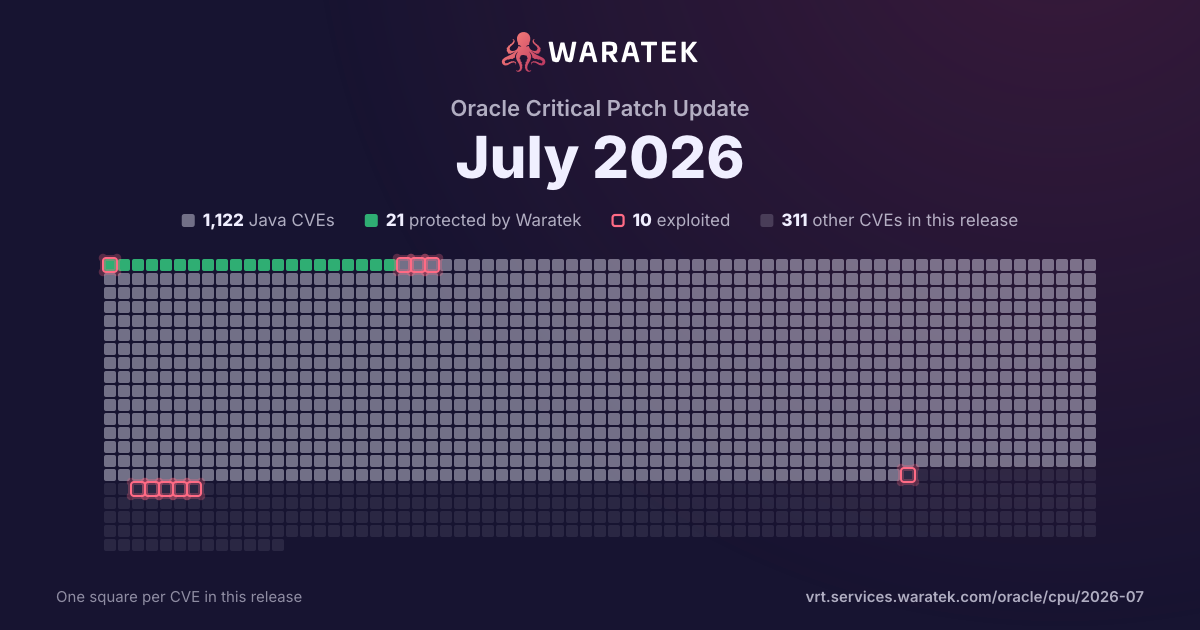
By status
21Protected by Waratek8Mitigation candidate1,093No exploit published16Outside Waratek scope295Not applicable
10Exploited, marked by the ring
No exploit published. For 971 of them, Oracle's security advisory is the source of public detail.
Protected by Waratek. Waratek RASP can block exploitation of these on systems that have not applied the patch yet.
Overview 21 matches · 1 exploited · 1 CISA KEV · 2 public PoC · 1 EPSS ≥ 0.5
Protected by Waratek
21
100.0%
Rule in development
0
0.0%
Mitigation candidate
0
0.0%
No exploit published
0
0.0%
blocked by ARMR today
21
100.0%
partly blocked
0
0.0%
not blocked
0
0.0%
not established
0
0.0%
unrecorded
0
0.0%
Exploited
1
4.8%
Working exploit published
0
0.0%
Proof of concept only
2
9.5%
Forecast only
0
0.0%
No public exploit
18
85.7%
split by
peak 15 / year
20191
Protected by Waratek1
High1
blocked by ARMR today1
No public exploit1
20200
20210
20220
20231
Protected by Waratek1
High1
blocked by ARMR today1
No public exploit1
20243
Protected by Waratek3
Critical2
High1
blocked by ARMR today3
No public exploit3
20251
Protected by Waratek1
High1
blocked by ARMR today1
No public exploit1
202615
Protected by Waratek15
Critical4
High10
Medium1
blocked by ARMR today15
Exploited1
Proof of concept only2
No public exploit12
20192020202120222023202420252026
| CVE | Severity | Published▾ | Status | Exploitation | Description |
|---|---|---|---|---|---|
| CVE-2026-47063 | High | 2026-07-21 | Protected by Waratek | No public exploit | Vulnerability in the Oracle Java SE, Oracle GraalVM for JDK, Oracle GraalVM Enterprise Edition product of Oracle Java SE (component: Libraries). Supported versions that are affected are Oracle Java SE: 8u491, 8u491-perf, 11.0.31, 17.0.19, 21.0.11, 25.0.3, 26.0.1; Oracle GraalVM for JDK: 17.0.19 and 21.0.11; Oracle GraalVM Enterprise Edition: 21.3.18. Easily exploitable vulnerability allows unauthenticated attacker with network access via multiple protocols to compromise Oracle Java SE, Oracle GraalVM for JDK, Oracle GraalVM Enterprise Edition. Successful attacks of this vulnerability can result in unauthorized creation, deletion or modification access to critical data or all Oracle Java SE, Oracle GraalVM for JDK, Oracle GraalVM Enterprise Edition accessible data. Note: This vulnerability can be exploited by using APIs in the specified Component, e.g., through a web service which supplies data to the APIs. This vulnerability also applies to Java deployments, typically in clients running sandboxed Java Web Start applications or sandboxed Java applets, that load and run untrusted code (e.g., code that comes from the internet) and rely on the Java sandbox for security. CVSS 3.1 Base Score 7.5 (Integrity impacts). CVSS Vector: (CVSS:3.1/AV:N/AC:L/PR:N/UI:N/S:U/C:N/I:H/A:N). |
| CVE-2026-47058 | High | 2026-07-21 | Protected by Waratek | No public exploit | Vulnerability in Oracle Java SE (component: Scripting). Supported versions that are affected are Oracle Java SE: 8u491, 8u491-perf and 11.0.31. Difficult to exploit vulnerability allows unauthenticated attacker with network access via multiple protocols to compromise Oracle Java SE. Successful attacks of this vulnerability can result in unauthorized creation, deletion or modification access to critical data or all Oracle Java SE accessible data as well as unauthorized access to critical data or complete access to all Oracle Java SE accessible data. Note: This vulnerability can be exploited by using APIs in the specified Component, e.g., through a web service which supplies data to the APIs. This vulnerability also applies to Java deployments, typically in clients running sandboxed Java Web Start applications or sandboxed Java applets, that load and run untrusted code (e.g., code that comes from the internet) and rely on the Java sandbox for security. CVSS 3.1 Base Score 7.4 (Confidentiality and Integrity impacts). CVSS Vector: (CVSS:3.1/AV:N/AC:H/PR:N/UI:N/S:U/C:H/I:H/A:N). |
| CVE-2026-47057 | High | 2026-07-21 | Protected by Waratek | No public exploit | Vulnerability in Oracle Java SE (component: Scripting). Supported versions that are affected are Oracle Java SE: 8u491, 8u491-perf and 11.0.31. Easily exploitable vulnerability allows unauthenticated attacker with network access via multiple protocols to compromise Oracle Java SE. Successful attacks of this vulnerability can result in unauthorized ability to cause a hang or frequently repeatable crash (complete DOS) of Oracle Java SE. Note: This vulnerability can be exploited by using APIs in the specified Component, e.g., through a web service which supplies data to the APIs. This vulnerability also applies to Java deployments, typically in clients running sandboxed Java Web Start applications or sandboxed Java applets, that load and run untrusted code (e.g., code that comes from the internet) and rely on the Java sandbox for security. CVSS 3.1 Base Score 7.5 (Availability impacts). CVSS Vector: (CVSS:3.1/AV:N/AC:L/PR:N/UI:N/S:U/C:N/I:N/A:H). |
| CVE-2026-41843 | Medium | 2026-06-09 | Protected by Waratek | No public exploit | Spring MVC and WebFlux applications are vulnerable to Path Traversal attacks when resolving static resources. Affected versions: Spring Framework 7.0.0 through 7.0.7; 6.2.0 through 6.2.18; 6.1.0 through 6.1.27; 5.3.0 through 5.3.48. |
| CVE-2026-42779 | Critical | 2026-05-01 | Protected by Waratek | Proof of concept only | The fix for CVE-2026-41635 was not applied to the 2.1.X and 2.2.X branches. Here was the original issue description: Apache MINA's AbstractIoBuffer.resolveClass() contains two branches, one of them (for static classes or primitive types) does not check the class at all, bypassing the classname allowlist and allowing arbitrary code to be executed. The fix checks if the class is present in the accepted class filter before calling Class.forName(). Affected versions are Apache MINA 2.1.0 <= 2.1.11, and 2.2.0 <= 2.2.6. The problem is resolved in Apache MINA 2.1.12, and 2.2.7 by applying the classname allowlist earlier. Affected are applications using Apache MINA that call IoBuffer.getObject(). Applications using Apache MINA are advised to upgrade. |
| CVE-2026-42778 | Critical | 2026-05-01 | Protected by Waratek | No public exploit | The fix for CVE-2026-41409 was not applied to the 2.1.X and 2.2.X branches. Here was the original issue description: The fix for CVE-2024-52046 in Apache MINA AbstractIoBuffer.getObject() was incomplete. The classname allowlist of classes allowed to be deserialized was applied too late after a static initializer in a class to be read might already have been executed. Affected versions are Apache MINA 2.1.0 <= 2.1.11, and 2.2.0 <= 2.2.6. The problem is resolved in Apache MINA 2.1.12, and 2.2.7 by applying the classname allowlist earlier. Affected are applications using Apache MINA that call IoBuffer.getObject(). Applications using Apache MINA are advised to upgrade The fix for CVE-2024-52046 in Apache MINA AbstractIoBuffer.getObject() was incomplete. The classname allowlist of classes allowed to be deserialized was applied too late after a static initializer in a class to be read might already have been executed. Affected versions are Apache MINA 2.1.0 <= 2.1.110, and 2.2.0 <= 2.2.6. The problem is resolved in Apache MINA 2.1.12, and 2.2.7 by applying the classname allowlist earlier. Affected are applications using Apache MINA that call IoBuffer.getObject(). Applications using Apache MINA are advised to upgrade |
| CVE-2026-41635 | Critical | 2026-04-27 | Protected by Waratek | No public exploit | Apache MINA's AbstractIoBuffer.resolveClass() contains two branches, one of them (for static classes or primitive types) does not check the class at all, bypassing the classname allowlist and allowing arbitrary code to be executed. The fix checks if the class is present in the accepted class filter before calling Class.forName(). Affected versions are Apache MINA 2.0.0 <= 2.0.27, 2.1.0 <= 2.1.10, and 2.2.0 <= 2.2.5. The problem is resolved in Apache MINA 2.0.28, 2.1.11, and 2.2.6 by applying the classname allowlist earlier. Affected are applications using Apache MINA that call IoBuffer.getObject(). Applications using Apache MINA are advised to upgrade. |
| CVE-2026-41409 | Critical | 2026-04-27 | Protected by Waratek | No public exploit | The fix for CVE-2024-52046 in Apache MINA AbstractIoBuffer.getObject() was incomplete. The classname allowlist of classes allowed to be deserialized was applied too late after a static initializer in a class to be read might already have been executed. Affected versions are Apache MINA 2.0.0 <= 2.0.27, 2.1.0 <= 2.1.10, and 2.2.0 <= 2.2.5. The problem is resolved in Apache MINA 2.0.28, 2.1.11, and 2.2.6 by applying the classname allowlist earlier. Affected are applications using Apache MINA that call IoBuffer.getObject(). Applications using Apache MINA are advised to upgrade |
| CVE-2026-22016 | High | 2026-04-21 | Protected by Waratek | No public exploit | Vulnerability in the Oracle Java SE, Oracle GraalVM for JDK, Oracle GraalVM Enterprise Edition product of Oracle Java SE (component: JAXP). Supported versions that are affected are Oracle Java SE: 8u481, 8u481-b50, 8u481-perf, 11.0.30, 17.0.18, 21.0.10, 25.0.2, 26; Oracle GraalVM for JDK: 17.0.18 and 21.0.10; Oracle GraalVM Enterprise Edition: 21.3.17. Easily exploitable vulnerability allows unauthenticated attacker with network access via multiple protocols to compromise Oracle Java SE, Oracle GraalVM for JDK, Oracle GraalVM Enterprise Edition. Successful attacks of this vulnerability can result in unauthorized access to critical data or complete access to all Oracle Java SE, Oracle GraalVM for JDK, Oracle GraalVM Enterprise Edition accessible data. Note: This vulnerability can be exploited by using APIs in the specified Component, e.g., through a web service which supplies data to the APIs. This vulnerability also applies to Java deployments, typically in clients running sandboxed Java Web Start applications or sandboxed Java applets, that load and run untrusted code (e.g., code that comes from the internet) and rely on the Java sandbox for security. CVSS 3.1 Base Score 7.5 (Confidentiality impacts). CVSS Vector: (CVSS:3.1/AV:N/AC:L/PR:N/UI:N/S:U/C:H/I:N/A:N). |
| CVE-2026-34486 | High | 2026-04-09 | Protected by Waratek | Exploited | Missing Encryption of Sensitive Data vulnerability in Apache Tomcat due to the fix for CVE-2026-29146 allowing the bypass of the EncryptInterceptor. This issue affects Apache Tomcat: 11.0.20, 10.1.53, 9.0.116. Users are recommended to upgrade to version 11.0.21, 10.1.54 or 9.0.117, which fix the issue. |
| CVE-2026-35554 | High | 2026-04-07 | Protected by Waratek | No public exploit | A race condition in the Apache Kafka Java producer client’s buffer pool management can cause messages to be silently delivered to incorrect topics. When a produce batch expires due to delivery.timeout.ms while a network request containing that batch is still in flight, the batch’s ByteBuffer is prematurely deallocated and returned to the buffer pool. If a subsequent producer batch—potentially destined for a different topic—reuses this freed buffer before the original network request completes, the buffer contents may become corrupted. This can result in messages being delivered to unintended topics without any error being reported to the producer. Data Confidentiality: Messages intended for one topic may be delivered to a different topic, potentially exposing sensitive data to consumers who have access to the destination topic but not the intended source topic. Data Integrity: Consumers on the receiving topic may encounter unexpected or incompatible messages, leading to deserialization failures, processing errors, and corrupted downstream data. This issue affects Apache Kafka versions ≤ 3.9.1, ≤ 4.0.1, and ≤ 4.1.1. Kafka users are advised to upgrade to 3.9.2, 4.0.2, 4.1.2, 4.2.0, or later to address this vulnerability. |
| CVE-2025-67030 | High | 2026-03-25 | Protected by Waratek | No public exploit | Directory Traversal vulnerability in the extractFile method of org.codehaus.plexus.util.Expand in plexus-utils before 6d780b3378829318ba5c2d29547e0012d5b29642. This allows an attacker to execute arbitrary code |
| CVE-2025-54920 | High | 2026-03-16 | Protected by Waratek | No public exploit | This issue affects Apache Spark: before 3.5.7 and 4.0.1. Users are recommended to upgrade to version 3.5.7 or 4.0.1 and above, which fixes the issue. Summary Apache Spark 3.5.4 and earlier versions contain a code execution vulnerability in the Spark History Web UI due to overly permissive Jackson deserialization of event log data. This allows an attacker with access to the Spark event logs directory to inject malicious JSON payloads that trigger deserialization of arbitrary classes, enabling command execution on the host running the Spark History Server. Details The vulnerability arises because the Spark History Server uses Jackson polymorphic deserialization with @JsonTypeInfo.Id.CLASS on SparkListenerEvent objects, allowing an attacker to specify arbitrary class names in the event JSON. This behavior permits instantiating unintended classes, such as org.apache.hive.jdbc.HiveConnection, which can perform network calls or other malicious actions during deserialization. The attacker can exploit this by injecting crafted JSON content into the Spark event log files, which the History Server then deserializes on startup or when loading event logs. For example, the attacker can force the History Server to open a JDBC connection to a remote attacker-controlled server, demonstrating remote command injection capability. Proof of Concept: 1. Run Spark with event logging enabled, writing to a writable directory (spark-logs). 2. Inject the following JSON at the beginning of an event log file: { "Event": "org.apache.hive.jdbc.HiveConnection", "uri": "jdbc:hive2://<IP>:<PORT>/", "info": { "hive.metastore.uris": "thrift://<IP>:<PORT>" } } 3. Start the Spark History Server with logs pointing to the modified directory. 4. The Spark History Server initiates a JDBC connection to the attacker’s server, confirming the injection. Impact An attacker with write access to Spark event logs can execute arbitrary code on the server running the History Server, potentially compromising the entire system. |
| CVE-2026-24400 | High | 2026-01-26 | Protected by Waratek | No public exploit | AssertJ provides Fluent testing assertions for Java and the Java Virtual Machine (JVM). Starting in version 1.4.0 and prior to version 3.27.7, an XML External Entity (XXE) vulnerability exists in `org.assertj.core.util.xml.XmlStringPrettyFormatter`: the `toXmlDocument(String)` method initializes `DocumentBuilderFactory` with default settings, without disabling DTDs or external entities. This formatter is used by the `isXmlEqualTo(CharSequence)` assertion for `CharSequence` values. An application is vulnerable only when it uses untrusted XML input with either `isXmlEqualTo(CharSequence)` from `org.assertj.core.api.AbstractCharSequenceAssert` or `xmlPrettyFormat(String)` from `org.assertj.core.util.xml.XmlStringPrettyFormatter`. If untrusted XML input is processed by tone of these methods, an attacker couldnread arbitrary local files via `file://` URIs (e.g., `/etc/passwd`, application configuration files); perform Server-Side Request Forgery (SSRF) via HTTP/HTTPS URIs, and/or cause Denial of Service via "Billion Laughs" entity expansion attacks. `isXmlEqualTo(CharSequence)` has been deprecated in favor of XMLUnit in version 3.18.0 and will be removed in version 4.0. Users of affected versions should, in order of preference: replace `isXmlEqualTo(CharSequence)` with XMLUnit, upgrade to version 3.27.7, or avoid using `isXmlEqualTo(CharSequence)` or `XmlStringPrettyFormatter` with untrusted input. `XmlStringPrettyFormatter` has historically been considered a utility for `isXmlEqualTo(CharSequence)` rather than a feature for AssertJ users, so it is deprecated in version 3.27.7 and removed in version 4.0, with no replacement. |
| CVE-2026-21452 | High | 2026-01-02 | Protected by Waratek | Proof of concept only | MessagePack for Java is a serializer implementation for Java. A denial-of-service vulnerability exists in versions prior to 0.9.11 when deserializing .msgpack files containing EXT32 objects with attacker-controlled payload lengths. While MessagePack-Java parses extension headers lazily, it later trusts the declared EXT payload length when materializing the extension data. When ExtensionValue.getData() is invoked, the library attempts to allocate a byte array of the declared length without enforcing any upper bound. A malicious .msgpack file of only a few bytes can therefore trigger unbounded heap allocation, resulting in JVM heap exhaustion, process termination, or service unavailability. This vulnerability is triggered during model loading / deserialization, making it a model format vulnerability suitable for remote exploitation. The vulnerability enables a remote denial-of-service attack against applications that deserialize untrusted .msgpack model files using MessagePack for Java. A specially crafted but syntactically valid .msgpack file containing an EXT32 object with an attacker-controlled, excessively large payload length can trigger unbounded memory allocation during deserialization. When the model file is loaded, the library trusts the declared length metadata and attempts to allocate a byte array of that size, leading to rapid heap exhaustion, excessive garbage collection, or immediate JVM termination with an OutOfMemoryError. The attack requires no malformed bytes, user interaction, or elevated privileges and can be exploited remotely in real-world environments such as model registries, inference services, CI/CD pipelines, and cloud-based model hosting platforms that accept or fetch .msgpack artifacts. Because the malicious file is extremely small yet valid, it can bypass basic validation and scanning mechanisms, resulting in complete service unavailability and potential cascading failures in production systems. Version 0.9.11 fixes the vulnerability. |
| CVE-2025-27553 | High | 2025-03-23 | Protected by Waratek | No public exploit | Relative Path Traversal vulnerability in Apache Commons VFS before 2.10.0. The FileObject API in Commons VFS has a 'resolveFile' method that takes a 'scope' parameter. Specifying 'NameScope.DESCENDENT' promises that "an exception is thrown if the resolved file is not a descendent of the base file". However, when the path contains encoded ".." characters (for example, "%2E%2E/bar.txt"), it might return file objects that are not a descendent of the base file, without throwing an exception. This issue affects Apache Commons VFS: before 2.10.0. Users are recommended to upgrade to version 2.10.0, which fixes the issue. |
| CVE-2024-52046 | Critical | 2024-12-25 | Protected by Waratek | No public exploit | The ObjectSerializationDecoder in Apache MINA uses Java’s native deserialization protocol to process incoming serialized data but lacks the necessary security checks and defenses. This vulnerability allows attackers to exploit the deserialization process by sending specially crafted malicious serialized data, potentially leading to remote code execution (RCE) attacks. This issue affects MINA core versions 2.0.X, 2.1.X and 2.2.X, and will be fixed by the releases 2.0.27, 2.1.10 and 2.2.4. It's also important to note that an application using MINA core library will only be affected if the IoBuffer#getObject() method is called, and this specific method is potentially called when adding a ProtocolCodecFilter instance using the ObjectSerializationCodecFactory class in the filter chain. If your application is specifically using those classes, you have to upgrade to the latest version of MINA core library. Upgrading will not be enough: you also need to explicitly allow the classes the decoder will accept in the ObjectSerializationDecoder instance, using one of the three new methods: /** * Accept class names where the supplied ClassNameMatcher matches for * deserialization, unless they are otherwise rejected. * * @param classNameMatcher the matcher to use */ public void accept(ClassNameMatcher classNameMatcher) /** * Accept class names that match the supplied pattern for * deserialization, unless they are otherwise rejected. * * @param pattern standard Java regexp */ public void accept(Pattern pattern) /** * Accept the wildcard specified classes for deserialization, * unless they are otherwise rejected. * * @param patterns Wildcard file name patterns as defined by * {@link org.apache.commons.io.FilenameUtils#wildcardMatch(String, String) FilenameUtils.wildcardMatch} */ public void accept(String... patterns) By default, the decoder will reject *all* classes that will be present in the incoming data. Note: The FtpServer, SSHd and Vysper sub-project are not affected by this issue. |
| CVE-2024-28168 | High | 2024-10-09 | Protected by Waratek | No public exploit | Improper Restriction of XML External Entity Reference ('XXE') vulnerability in Apache XML Graphics FOP. This issue affects Apache XML Graphics FOP: 2.9. Users are recommended to upgrade to version 2.10, which fixes the issue. |
| CVE-2024-47561 | Critical | 2024-10-03 | Protected by Waratek | No public exploit | Schema parsing in the Java SDK of Apache Avro 1.11.3 and previous versions allows bad actors to execute arbitrary code. Users are recommended to upgrade to version 1.11.4 or 1.12.0, which fix this issue. |
| CVE-2023-39410 | High | 2023-09-29 | Protected by Waratek | No public exploit | When deserializing untrusted or corrupted data, it is possible for a reader to consume memory beyond the allowed constraints and thus lead to out of memory on the system. This issue affects Java applications using Apache Avro Java SDK up to and including 1.11.2. Users should update to apache-avro version 1.11.3 which addresses this issue. |
| CVE-2014-3643 | High | 2019-12-15 | Protected by Waratek | No public exploit | jersey: XXE via parameter entities not disabled by the jersey SAX parser |