
Oracle Critical Patch Update July 2026
Released July 2026 · Oracle's advisory ↗ · ← Security Patch Update, June 2026 · Security Patch Update, August 2026 →
1,433 CVEs in this release, one square each
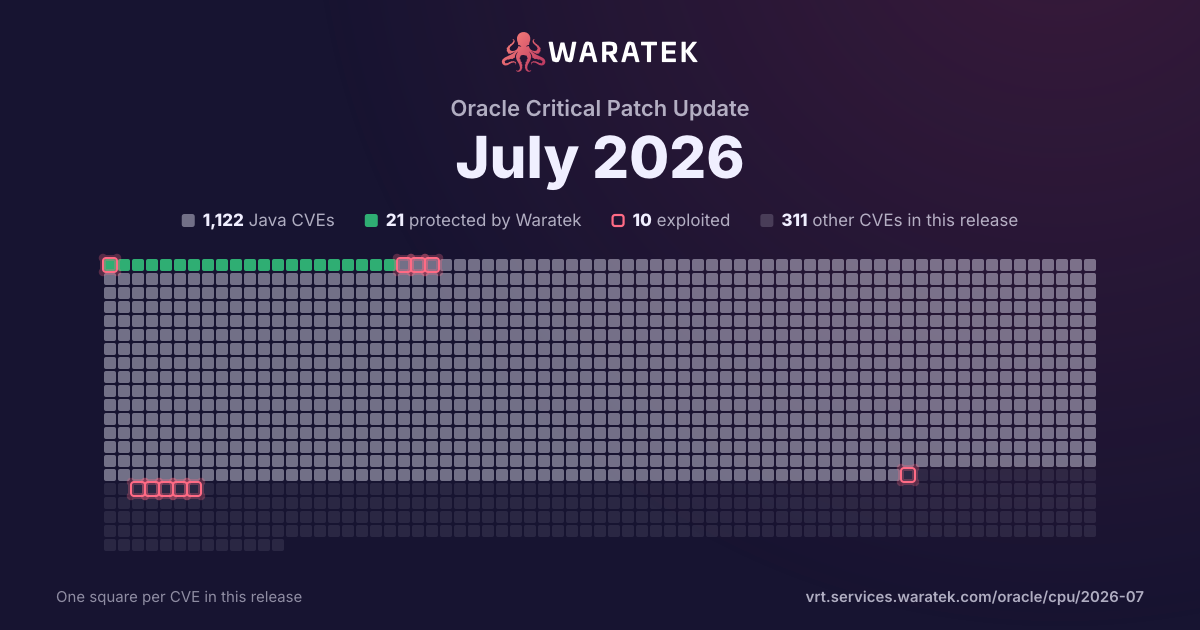
By status
21Protected by Waratek3Rule in development5Mitigation candidate1,095No exploit published13Outside Waratek scope296Not applicable
10Exploited, marked by the ring
No exploit published. For 968 of them, Oracle's security advisory is the source of public detail.
Protected by Waratek. Waratek RASP can block exploitation of these on systems that have not applied the patch yet.
Overview 44 matches · 0 protected · 0 exploited · 0 CISA KEV · 0 public PoC · 0 EPSS ≥ 0.5
44matches
0protected0.0%
0exploited0.0%
0CISA KEV0.0%
0public PoC0.0%
0EPSS ≥ 0.50.0%
Protected by Waratek
0
0.0%
Rule in development
0
0.0%
Mitigation candidate
0
0.0%
No exploit published
44
100.0%
blocked by ARMR today
0
0.0%
partly blocked
0
0.0%
not blocked
44
100.0%
not established
0
0.0%
unrecorded
0
0.0%
Exploited
0
0.0%
Working exploit published
0
0.0%
Proof of concept only
10
22.7%
Forecast only
0
0.0%
No public exploit
34
77.3%
split by
peak 24 / quarter
Q4 221
No exploit published1
High1
not blocked1
No public exploit1
Q1 230
Q2 231
No exploit published1
Medium1
not blocked1
No public exploit1
Q3 230
Q4 230
Q1 240
Q2 240
Q3 241
No exploit published1
High1
not blocked1
No public exploit1
Q4 243
No exploit published3
Medium3
not blocked3
Proof of concept only1
No public exploit2
Q1 250
Q2 252
No exploit published2
Critical1
High1
not blocked2
No public exploit2
Q3 255
No exploit published5
High2
Medium3
not blocked5
No public exploit5
Q4 252
No exploit published2
Critical1
Medium1
not blocked2
No public exploit2
Q1 265
No exploit published5
High2
Medium2
Low1
not blocked5
No public exploit5
Q2 2624
No exploit published24
Critical4
High10
Medium9
Low1
not blocked24
Proof of concept only9
No public exploit15
Q4 22Q2 23Q4 23Q2 24Q4 24Q2 25Q4 25Q2 26
| CVE | Severity | Published▾ | Status | Exploitation | Description |
|---|---|---|---|---|---|
| CVE-2026-44248 | High | 2026-05-13 | No exploit published | No public exploit | Netty is an asynchronous, event-driven network application framework. Prior to 4.2.13.Final and 4.1.133.Final, the MQTT 5 header Properties section is parsed and buffered before any message size limit is applied. Specifically, in MqttDecoder, the decodeVariableHeader() method is called before the bytesRemainingBeforeVariableHeader > maxBytesInMessage check. The decodeVariableHeader() can call other methods which will call decodeProperties(). Effectively, Netty does not apply any limits to the size of the properties being decoded. Additionally, because MqttDecoder extends ReplayingDecoder, Netty will repeatedly re-parse the enormous Properties sections and buffer the bytes in memory, until the entire thing parses to completion. This can cause high resource usage in both CPU and memory. This vulnerability is fixed in 4.2.13.Final and 4.1.133.Final. |
| CVE-2026-42587 | High | 2026-05-13 | No exploit published | Proof of concept only | Netty is an asynchronous, event-driven network application framework. Prior to 4.2.13.Final and 4.1.133.Final, HttpContentDecompressor accepts a maxAllocation parameter to limit decompression buffer size and prevent decompression bomb attacks. This limit is correctly enforced for gzip and deflate encodings via ZlibDecoder, but is silently ignored when the content encoding is br (Brotli), zstd, or snappy. An attacker can bypass the configured decompression limit by sending a compressed payload with Content-Encoding: br instead of Content-Encoding: gzip, causing unbounded memory allocation and out-of-memory denial of service. The same vulnerability exists in DelegatingDecompressorFrameListener for HTTP/2 connections. This vulnerability is fixed in 4.2.13.Final and 4.1.133.Final. |
| CVE-2026-42586 | High | 2026-05-13 | No exploit published | No public exploit | Netty is an asynchronous, event-driven network application framework. Prior to 4.2.13.Final and 4.1.133.Final, the Netty Redis codec encoder (RedisEncoder) writes user-controlled string content directly to the network output buffer without validating or sanitizing CRLF (\r\n) characters. Since the Redis Serialization Protocol (RESP) uses CRLF as the command/response delimiter, an attacker who can control the content of a Redis message can inject arbitrary Redis commands or forge fake responses. This vulnerability is fixed in 4.2.13.Final and 4.1.133.Final. |
| CVE-2026-42585 | High | 2026-05-13 | No exploit published | Proof of concept only | Netty is an asynchronous, event-driven network application framework. Prior to 4.2.13.Final and 4.1.133.Final, Netty incorrectly parses malformed Transfer-Encoding, enabling request smuggling attacks. This vulnerability is fixed in 4.2.13.Final and 4.1.133.Final. |
| CVE-2026-42584 | Critical | 2026-05-13 | No exploit published | Proof of concept only | Netty is an asynchronous, event-driven network application framework. Prior to 4.2.13.Final and 4.1.133.Final, HttpClientCodec pairs each inbound response with an outbound request by queue.poll() once per response, including for 1xx. If the client pipelines GET then HEAD and the server sends 103, then 200 with GET body, then 200 for HEAD, the queue pairs HEAD with the first 200. The HEAD rule then skips reading that message’s body, so the GET entity bytes stay on the stream and the following 200 is parsed from the wrong offset. This vulnerability is fixed in 4.2.13.Final and 4.1.133.Final. |
| CVE-2026-42583 | High | 2026-05-13 | No exploit published | Proof of concept only | Netty is an asynchronous, event-driven network application framework. Prior to 4.2.13.Final and 4.1.133.Final, Lz4FrameDecoder allocates a ByteBuf of size decompressedLength (up to 32 MB per block) before LZ4 runs. A peer only needs a 21-byte header plus compressedLength payload bytes - 22 bytes if compressedLength == 1 - to force that allocation. This vulnerability is fixed in 4.2.13.Final and 4.1.133.Final. |
| CVE-2026-42581 | Critical | 2026-05-13 | No exploit published | Proof of concept only | Netty is an asynchronous, event-driven network application framework. Prior to 4.2.13.Final and 4.1.133.Final, HttpObjectDecoder strips a conflicting Content-Length header when a request carries both Transfer-Encoding: chunked and Content-Length, but only for HTTP/1.1 messages. The guard is absent for HTTP/1.0. An attacker that sends an HTTP/1.0 request with both headers causes Netty to decode the body as chunked while leaving Content-Length intact in the forwarded HttpMessage. Any downstream proxy or handler that trusts Content-Length over Transfer-Encoding will disagree on message boundaries, enabling request smuggling. This vulnerability is fixed in 4.2.13.Final and 4.1.133.Final. |
| CVE-2026-42580 | Medium | 2026-05-13 | No exploit published | Proof of concept only | Netty is an asynchronous, event-driven network application framework. Prior to 4.2.13.Final and 4.1.133.Final, Netty's chunk size parser silently overflows int, enabling request smuggling attacks. This vulnerability is fixed in 4.2.13.Final and 4.1.133.Final. |
| CVE-2026-42579 | Critical | 2026-05-13 | No exploit published | Proof of concept only | Netty is an asynchronous, event-driven network application framework. Prior to 4.2.13.Final and 4.1.133.Final, Netty's DNS codec does not enforce RFC 1035 domain name constraints during either encoding or decoding. This creates a bidirectional attack surface: malicious DNS responses can exploit the decoder, and user-influenced hostnames can exploit the encoder. This vulnerability is fixed in 4.2.13.Final and 4.1.133.Final. |
| CVE-2026-42578 | Low | 2026-05-13 | No exploit published | Proof of concept only | Netty is an asynchronous, event-driven network application framework. Prior to 4.2.13.Final and 4.1.133.Final, Netty's HttpProxyHandler constructs HTTP CONNECT requests with header validation explicitly disabled. The newInitialMessage() method creates headers using DefaultHttpHeadersFactory.headersFactory().withValidation(false), then adds user-provided outboundHeaders without any CRLF validation. This allows an attacker who can influence the outbound headers to inject arbitrary HTTP headers into the CONNECT request sent to the proxy server. This vulnerability is fixed in 4.2.13.Final and 4.1.133.Final. |
| CVE-2026-41417 | Medium | 2026-05-06 | No exploit published | Proof of concept only | Netty allows request-line validation to be bypassed when a `DefaultHttpRequest` or `DefaultFullHttpRequest` is created first and its URI is later changed via `setUri()`. The constructors reject CRLF and whitespace characters that would break the start-line, but `setUri()` does not apply the same validation. `HttpRequestEncoder` and `RtspEncoder` then write the URI into the request line verbatim. If attacker-controlled input reaches `setUri()`, this enables CRLF injection and insertion of additional HTTP or RTSP requests, leading to HTTP request smuggling or desynchronization on the HTTP side and request injection on the RTSP side. This issue is fixed in versions 4.2.13.Final and 4.1.133.Final. |
| CVE-2026-42404 | High | 2026-05-01 | No exploit published | No public exploit | Apache Neethi does not impose any restrictions on URIs when manually fetching remote policy references through the PolicyReference API. When an application explicitly calls the API to retrieve a policy from a remote URI, an outbound request is made for arbitrary protocols and internal IP adddresses. From 3.2.2, only http or https URIs are allowed, and link-local/multicast/any-local addresses are forbidden. Users are recommended to upgrade to version 3.2.2, which fixes this issue. |
| CVE-2026-42403 | High | 2026-05-01 | No exploit published | No public exploit | Apache Neethi does not properly detect circular references in policy definitions. When a WS-Policy document contains circular policy references (where Policy A references Policy B which references Policy A), the policy normalization process can enter an infinite loop or cause excessive recursion, leading to a stack overflow or application hang. An attacker can craft malicious policy documents with circular references to cause a Denial of Service condition Users are recommended to upgrade to version 3.2.2, which fixes this issue. |
| CVE-2026-42402 | High | 2026-05-01 | No exploit published | No public exploit | Apache Neethi is vulnerable to a Denial of Service attack through algorithmic complexity in policy normalization. Specially crafted WS-Policy documents can trigger an exponential Cartesian cross-product expansion during the normalization process, causing unbounded memory allocation that exhausts the JVM heap. This occurs when the normalization process generates an excessive number of policy alternatives without bounds, leading to runtime memory exhaustion. Users should upgrade to 3.2.2 which limits the maximum number of normalized policy alternatives. |
| CVE-2026-41044 | High | 2026-04-24 | No exploit published | No public exploit | Improper Input Validation, Improper Control of Generation of Code ('Code Injection') vulnerability in Apache ActiveMQ, Apache ActiveMQ Broker, Apache ActiveMQ All. An authenticated attacker can use the admin web console page to construct a malicious broker name that bypasses name validation to include an xbean binding that can be later used by a VM transport to load a remote Spring XML application. The attacker can then use the DestinationView mbean to send a message to trigger a VM transport creation that will reference this malicious broker name which can lead to loading the malicious Spring XML context file. Because Spring's ResourceXmlApplicationContext instantiates all singleton beans before the BrokerService validates the configuration, arbitrary code execution occurs on the broker's JVM through bean factory methods such as Runtime.exec(). This issue affects Apache ActiveMQ: before 5.19.6, from 6.0.0 before 6.2.5; Apache ActiveMQ Broker: before 5.19.6, from 6.0.0 before 6.2.5; Apache ActiveMQ All: before 5.19.6, from 6.0.0 before 6.2.5. Users are recommended to upgrade to version 6.2.5 or 5.19.6, which fixes the issue. |
| CVE-2026-41043 | Medium | 2026-04-24 | No exploit published | No public exploit | Improper Neutralization of Script-Related HTML Tags in a Web Page (Basic XSS) vulnerability in Apache ActiveMQ, Apache ActiveMQ Web. An authenticated attacker can show malicious content when browsing queues in the web console by overriding the content type to be HTML (instead of XML) and by injecting HTML into a JMS selector field. This issue affects Apache ActiveMQ: before 5.19.6, from 6.0.0 before 6.2.5; Apache ActiveMQ Web: before 5.19.6, from 6.0.0 before 6.2.5. Users are recommended to upgrade to version 6.2.5 or 5.19.6, which fixes the issue. |
| CVE-2026-33557 | Critical | 2026-04-20 | No exploit published | No public exploit | A possible security vulnerability has been identified in Apache Kafka. By default, the broker property `sasl.oauthbearer.jwt.validator.class` is set to `org.apache.kafka.common.security.oauthbearer.DefaultJwtValidator`. It accepts any JWT token without validating its signature, issuer, or audience. An attacker can generate a JWT token from any issuer with the `preferred_username` set to any user, and the broker will accept it. We advise the Kafka users using kafka v4.1.0 or v4.1.1 to set the config `sasl.oauthbearer.jwt.validator.class` to `org.apache.kafka.common.security.oauthbearer.BrokerJwtValidator` explicitly to avoid this vulnerability. Since Kafka v4.1.2 and v4.2.0 and later, the issue is fixed and will correctly validate the JWT token. |
| CVE-2026-5598 | High | 2026-04-15 | No exploit published | No public exploit | Covert timing channel vulnerability in Legion of the Bouncy Castle Inc. BC-JAVA core on all (core modules). This vulnerability is associated with program files FrodoEngine.Java. This issue affects BC-JAVA: from 1.71 before 1.80.2, from 1.81 before 1.81.1, from 1.82 before 1.84. |
| CVE-2026-5588 | Medium | 2026-04-15 | No exploit published | No public exploit | Use of a Broken or Risky Cryptographic Algorithm vulnerability in Legion of the Bouncy Castle Inc. BC-JAVA bcpkix on all (pkix modules), Legion of the Bouncy Castle Inc. BCPKIX-FIPS bcpkix on All (pkix modules), Legion of the Bouncy Castle Inc. BCPIX-LTS bcpkix on All (pkix modules). This vulnerability is associated with program files JcaContentVerifierProviderBuilder.Java, JcaContentVerfierProviderBuilder.Java. This issue affects BC-JAVA: from 1.67 before 1.80.2, from 1.81 before 1.81.1, from 1.82 before 1.84; BCPKIX-FIPS: from 2.0.6 before 2.0.11, from 2.1.7 before 2.1.11; BCPIX-LTS: from 2.73.7 before 2.73.11. |
| CVE-2026-0636 | Medium | 2026-04-15 | No exploit published | No public exploit | Improper neutralization of special elements used in an LDAP query ('LDAP injection') vulnerability in Legion of the Bouncy Castle Inc. BC-JAVA bcprov on all (prov modules). This vulnerability is associated with program files LDAPStoreHelper. This issue affects BC-JAVA: from 1.74 before 1.80.2, from 1.81 before 1.81.1, from 1.82 before 1.84. |
| CVE-2026-34481 | Medium | 2026-04-10 | No exploit published | No public exploit | Apache Log4j's JsonTemplateLayout https://logging.apache.org/log4j/2.x/manual/json-template-layout.html , in versions up to and including 2.25.3, produces invalid JSON output when log events contain non-finite floating-point values (NaN, Infinity, or -Infinity), which are prohibited by RFC 8259. This may cause downstream log processing systems to reject or fail to index affected records. An attacker can exploit this issue only if both of the following conditions are met: * The application uses JsonTemplateLayout. * The application logs a MapMessage, or logs an object directly (e.g., via Logger.info(Object), which wraps it in an ObjectMessage), where the message contains an attacker-controlled floating-point value. Users are advised to upgrade to Apache Log4j JSON Template Layout 2.25.4, which corrects this issue. Note: The fix released in version 2.25.4 did not cover all affected code paths. CVE-2026-49844 was assigned to the remaining issue, which concerns the MapMessage.asJson() serialization in Apache Log4j API and is fixed in versions 2.25.5 and 2.26.1. |
| CVE-2026-34480 | Medium | 2026-04-10 | No exploit published | No public exploit | Apache Log4j Core's XmlLayout https://logging.apache.org/log4j/2.x/manual/layouts.html#XmlLayout , in versions up to and including 2.25.3, fails to sanitize characters forbidden by the XML 1.0 specification https://www.w3.org/TR/xml/#charsets producing invalid XML output whenever a log message or MDC value contains such characters. The impact depends on the StAX implementation in use: * JRE built-in StAX: Forbidden characters are silently written to the output, producing malformed XML. Conforming parsers must reject such documents with a fatal error, which may cause downstream log-processing systems to drop the affected records. * Alternative StAX implementations (e.g., Woodstox https://github.com/FasterXML/woodstox , a transitive dependency of the Jackson XML Dataformat module): An exception is thrown during the logging call, and the log event is never delivered to its intended appender, only to Log4j's internal status logger. Users are advised to upgrade to Apache Log4j Core 2.25.4, which corrects this issue by sanitizing forbidden characters before XML output. |
| CVE-2026-34479 | Medium | 2026-04-10 | No exploit published | No public exploit | The Log4j1XmlLayout from the Apache Log4j 1-to-Log4j 2 bridge fails to escape characters forbidden by the XML 1.0 standard, producing malformed XML output. Conforming XML parsers are required to reject documents containing such characters with a fatal error, which may cause downstream log processing systems to drop or fail to index affected records. Two groups of users are affected: * Those using Log4j1XmlLayout directly in a Log4j Core 2 configuration file. * Those using the Log4j 1 configuration compatibility layer with org.apache.log4j.xml.XMLLayout specified as the layout class. Users are advised to upgrade to Apache Log4j 1-to-Log4j 2 bridge version 2.25.4, which corrects this issue. Note: The Apache Log4j 1-to-Log4j 2 bridge is deprecated and will not be present in Log4j 3. Users are encouraged to consult the Log4j 1 to Log4j 2 migration guide https://logging.apache.org/log4j/2.x/migrate-from-log4j1.html , and specifically the section on eliminating reliance on the bridge. |
| CVE-2026-34477 | Medium | 2026-04-10 | No exploit published | No public exploit | The fix for CVE-2025-68161 https://logging.apache.org/security.html#CVE-2025-68161 was incomplete: it addressed hostname verification only when enabled via the log4j2.sslVerifyHostName https://logging.apache.org/log4j/2.x/manual/systemproperties.html#log4j2.sslVerifyHostName system property, but not when configured through the verifyHostName https://logging.apache.org/log4j/2.x/manual/appenders/network.html#SslConfiguration-attr-verifyHostName attribute of the <Ssl> element. Although the verifyHostName configuration attribute was introduced in Log4j Core 2.12.0, it was silently ignored in all versions through 2.25.3, leaving TLS connections vulnerable to interception regardless of the configured value. A network-based attacker may be able to perform a man-in-the-middle attack when all of the following conditions are met: * An SMTP, Socket, or Syslog appender is in use. * TLS is configured via a nested <Ssl> element. * The attacker can present a certificate issued by a CA trusted by the appender's configured trust store, or by the default Java trust store if none is configured. This issue does not affect users of the HTTP appender, which uses a separate verifyHostname https://logging.apache.org/log4j/2.x/manual/appenders/network.html#HttpAppender-attr-verifyHostName attribute that was not subject to this bug and verifies host names by default. Users are advised to upgrade to Apache Log4j Core 2.25.4, which corrects this issue. |
| CVE-2026-22737 | Medium | 2026-03-20 | No exploit published | No public exploit | Use of Java scripting engine enabled (e.g. JRuby, Jython) template views in Spring MVC and Spring WebFlux applications can result in disclosure of content from files outside the configured locations for script template views. This issue affects Spring Framework: from 7.0.0 through 7.0.5, from 6.2.0 through 6.2.16, from 6.1.0 through 6.1.25, from 5.3.0 through 5.3.46. |
| CVE-2026-22735 | Low | 2026-03-20 | No exploit published | No public exploit | Spring MVC and WebFlux applications are vulnerable to stream corruption when using Server-Sent Events (SSE). This issue affects Spring Foundation: from 7.0.0 through 7.0.5, from 6.2.0 through 6.2.16, from 6.1.0 through 6.1.25, from 5.3.0 through 5.3.46. |
| CVE-2026-1605 | High | 2026-03-05 | No exploit published | No public exploit | In Eclipse Jetty, versions 12.0.0-12.0.31 and 12.1.0-12.0.5, class GzipHandler exposes a vulnerability when a compressed HTTP request, with Content-Encoding: gzip, is processed and the corresponding response is not compressed. This happens because the JDK Inflater is allocated for decompressing the request, but it is not released because the release mechanism is tied to the compressed response. In this case, since the response is not compressed, the release mechanism does not trigger, causing the leak. |
| CVE-2025-11143 | Medium | 2026-03-05 | No exploit published | No public exploit | The Jetty URI parser has some key differences to other common parsers when evaluating invalid or unusual URIs. Differential parsing of URIs in systems using multiple components may result in security by-pass. For example a component that enforces a black list may interpret the URIs differently from one that generates a response. At the very least, differential parsing may divulge implementation details. |
| CVE-2025-33042 | High | 2026-02-13 | No exploit published | No public exploit | Improper Control of Generation of Code ('Code Injection') vulnerability in Apache Avro Java SDK when generating specific records from untrusted Avro schemas. This issue affects Apache Avro Java SDK: all versions through 1.11.4 and version 1.12.0. Users are recommended to upgrade to version 1.12.1 or 1.11.5, which fix the issue. |
| CVE-2025-68161 | Medium | 2025-12-18 | No exploit published | No public exploit | The Socket Appender in Apache Log4j Core versions 2.0-beta9 through 2.25.2 does not perform TLS hostname verification of the peer certificate, even when the verifyHostName https://logging.apache.org/log4j/2.x/manual/appenders/network.html#SslConfiguration-attr-verifyHostName configuration attribute or the log4j2.sslVerifyHostName https://logging.apache.org/log4j/2.x/manual/systemproperties.html#log4j2.sslVerifyHostName system property is set to true. This issue may allow a man-in-the-middle attacker to intercept or redirect log traffic under the following conditions: * The attacker is able to intercept or redirect network traffic between the client and the log receiver. * The attacker can present a server certificate issued by a certification authority trusted by the Socket Appender’s configured trust store (or by the default Java trust store if no custom trust store is configured). Users are advised to upgrade to Apache Log4j Core version 2.25.3, which addresses this issue. As an alternative mitigation, the Socket Appender may be configured to use a private or restricted trust root to limit the set of trusted certificates. |
| CVE-2025-12383 | Critical | 2025-11-18 | No exploit published | No public exploit | In Eclipse Jersey versions 2.45, 3.0.16, 3.1.9 a race condition can cause ignoring of critical SSL configurations - such as mutual authentication, custom key/trust stores, and other security settings. This issue may result in SSLHandshakeException under normal circumstances, but under certain conditions, it could lead to unauthorized trust in insecure servers (see PoC) |
| CVE-2025-41249 | High | 2025-09-16 | No exploit published | No public exploit | The Spring Framework annotation detection mechanism may not correctly resolve annotations on methods within type hierarchies with a parameterized super type with unbounded generics. This can be an issue if such annotations are used for authorization decisions. Your application may be affected by this if you are using Spring Security's @EnableMethodSecurity feature. You are not affected by this if you are not using @EnableMethodSecurity or if you do not use security annotations on methods in generic superclasses or generic interfaces. This CVE is published in conjunction with CVE-2025-41248 https://spring.io/security/cve-2025-41248 . |
| CVE-2025-41248 | High | 2025-09-16 | No exploit published | No public exploit | The Spring Security annotation detection mechanism may not correctly resolve annotations on methods within type hierarchies with a parameterized super type with unbounded generics. This can be an issue when using @PreAuthorize and other method security annotations, resulting in an authorization bypass. Your application may be affected by this if you are using Spring Security's @EnableMethodSecurity feature. You are not affected by this if you are not using @EnableMethodSecurity or if you do not use security annotations on methods in generic superclasses or generic interfaces. This CVE is published in conjunction with CVE-2025-41249 https://spring.io/security/cve-2025-41249 . |
| CVE-2025-8916 | Medium | 2025-08-13 | No exploit published | No public exploit | Allocation of Resources Without Limits or Throttling vulnerability in Legion of the Bouncy Castle Inc. BC Java bcpkix on All (API modules), Legion of the Bouncy Castle Inc. BC Java bcprov on All (API modules), Legion of the Bouncy Castle Inc. BCPKIX FIPS bcpkix-fips on All (API modules) allows Excessive Allocation. This vulnerability is associated with program files https://github.Com/bcgit/bc-java/blob/main/pkix/src/main/java/org/bouncycastle/pkix/jcajce/PKIXCertPathReviewer.Java, https://github.Com/bcgit/bc-java/blob/main/prov/src/main/java/org/bouncycastle/x509/PKIXCertPathReviewer.Java. This issue affects BC Java: from 1.44 through 1.78; BC Java: from 1.44 through 1.78; BCPKIX FIPS: from 1.0.0 through 1.0.7, from 2.0.0 through 2.0.7. |
| CVE-2025-7962 | Medium | 2025-07-21 | No exploit published | No public exploit | In Jakarta Mail versions prior to 2.0.2 it is possible to perform an SMTP Injection by utilizing the \r and \n UTF-8 characters to separate different messages. |
| CVE-2025-48924 | Medium | 2025-07-11 | No exploit published | No public exploit | Uncontrolled Recursion vulnerability in Apache Commons Lang. This issue affects Apache Commons Lang: Starting with commons-lang:commons-lang 2.0 to 2.6, and, from org.apache.commons:commons-lang3 3.0 before 3.18.0. The methods ClassUtils.getClass(...) can throw StackOverflowError on very long inputs. Because an Error is usually not handled by applications and libraries, a StackOverflowError could cause an application to stop. Users are recommended to upgrade to version 3.18.0, which fixes the issue. |
| CVE-2025-48976 | High | 2025-06-16 | No exploit published | No public exploit | Allocation of resources for multipart headers with insufficient limits enabled a DoS vulnerability in Apache Commons FileUpload. This issue affects Apache Commons FileUpload: from 1.0 before 1.6; from 2.0.0-M1 before 2.0.0-M4. Users are recommended to upgrade to versions 1.6 or 2.0.0-M4, which fix the issue. |
| CVE-2025-31651 | Critical | 2025-04-28 | No exploit published | No public exploit | Improper Neutralization of Escape, Meta, or Control Sequences vulnerability in Apache Tomcat. For a subset of unlikely rewrite rule configurations, it was possible for a specially crafted request to bypass some rewrite rules. If those rewrite rules effectively enforced security constraints, those constraints could be bypassed. This issue affects Apache Tomcat: from 11.0.0-M1 through 11.0.5, from 10.1.0-M1 through 10.1.39, from 9.0.0.M1 through 9.0.102. The following versions were EOL at the time the CVE was created but are known to be affected: 8.5.0 though 8.5.100. Other, older, EOL versions may also be affected. Users are recommended to upgrade to version [FIXED_VERSION], which fixes the issue. |
| CVE-2024-38820 | Medium | 2024-10-18 | No exploit published | No public exploit | The fix for CVE-2022-22968 made disallowedFields patterns in DataBinder case insensitive. However, String.toLowerCase() has some Locale dependent exceptions that could potentially result in fields not protected as expected. |
| CVE-2024-6763 | Medium | 2024-10-14 | No exploit published | Proof of concept only | Eclipse Jetty is a lightweight, highly scalable, Java-based web server and Servlet engine . It includes a utility class, HttpURI, for URI/URL parsing. The HttpURI class does insufficient validation on the authority segment of a URI. However the behaviour of HttpURI differs from the common browsers in how it handles a URI that would be considered invalid if fully validated against the RRC. Specifically HttpURI and the browser may differ on the value of the host extracted from an invalid URI and thus a combination of Jetty and a vulnerable browser may be vulnerable to a open redirect attack or to a SSRF attack if the URI is used after passing validation checks. |
| CVE-2024-47554 | Medium | 2024-10-03 | No exploit published | No public exploit | Uncontrolled Resource Consumption vulnerability in Apache Commons IO. The org.apache.commons.io.input.XmlStreamReader class may excessively consume CPU resources when processing maliciously crafted input. This issue affects Apache Commons IO: from 2.0 before 2.14.0. Users are recommended to upgrade to version 2.14.0 or later, which fixes the issue. |
| CVE-2024-7254 | High | 2024-09-19 | No exploit published | No public exploit | Any project that parses untrusted Protocol Buffers data containing an arbitrary number of nested groups / series of SGROUP tags can corrupted by exceeding the stack limit i.e. StackOverflow. Parsing nested groups as unknown fields with DiscardUnknownFieldsParser or Java Protobuf Lite parser, or against Protobuf map fields, creates unbounded recursions that can be abused by an attacker. |
| CVE-2023-35116 | Medium | 2023-06-14 | No exploit published | No public exploit | jackson-databind through 2.15.2 allows attackers to cause a denial of service or other unspecified impact via a crafted object that uses cyclic dependencies. NOTE: the vendor's perspective is that this is not a valid vulnerability report, because the steps of constructing a cyclic data structure and trying to serialize it cannot be achieved by an external attacker. |
| CVE-2022-3171 | High | 2022-10-12 | No exploit published | No public exploit | A parsing issue with binary data in protobuf-java core and lite versions prior to 3.21.7, 3.20.3, 3.19.6 and 3.16.3 can lead to a denial of service attack. Inputs containing multiple instances of non-repeated embedded messages with repeated or unknown fields causes objects to be converted back-n-forth between mutable and immutable forms, resulting in potentially long garbage collection pauses. We recommend updating to the versions mentioned above. |