
Oracle Critical Patch Update July 2026
Released July 2026 · Oracle's advisory ↗ · ← Security Patch Update, June 2026 · Security Patch Update, August 2026 →
1,433 CVEs in this release, one square each
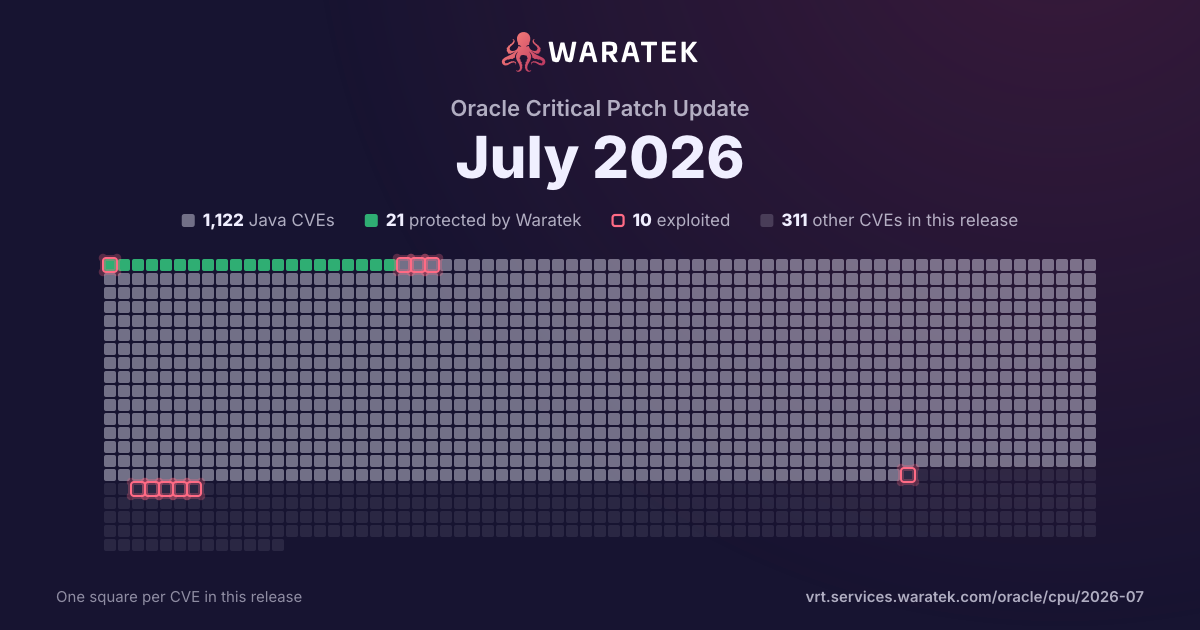
By status
21Protected by Waratek3Rule in development5Mitigation candidate1,095No exploit published13Outside Waratek scope296Not applicable
10Exploited, marked by the ring
No exploit published. For 968 of them, Oracle's security advisory is the source of public detail.
Protected by Waratek. Waratek RASP can block exploitation of these on systems that have not applied the patch yet.
Overview 121 matches · 14 protected · 2 exploited · 1 CISA KEV · 3 public PoC · 0 EPSS ≥ 0.5
Protected by Waratek
14
11.6%
Rule in development
1
0.8%
Mitigation candidate
3
2.5%
No exploit published
103
85.1%
blocked by ARMR today
14
11.6%
partly blocked
0
0.0%
not blocked
107
88.4%
not established
0
0.0%
unrecorded
0
0.0%
Exploited
2
1.7%
Working exploit published
0
0.0%
Proof of concept only
16
13.2%
Forecast only
0
0.0%
No public exploit
103
85.1%
split by
peak 69 / quarter
Q3 241
No exploit published1
High1
not blocked1
No public exploit1
Q4 246
Protected by Waratek2
No exploit published4
Critical1
High1
Medium4
blocked by ARMR today2
not blocked4
Proof of concept only1
No public exploit5
Q1 251
Protected by Waratek1
High1
blocked by ARMR today1
No public exploit1
Q2 252
No exploit published2
Critical1
High1
not blocked2
No public exploit2
Q3 256
No exploit published6
High2
Medium4
not blocked6
Proof of concept only1
No public exploit5
Q4 254
No exploit published4
Critical1
High2
Medium1
not blocked4
No public exploit4
Q1 2613
Protected by Waratek2
Mitigation candidate2
No exploit published9
Critical1
High8
Medium3
Low1
blocked by ARMR today2
not blocked11
Proof of concept only2
No public exploit11
Q2 2669
Protected by Waratek6
Rule in development1
Mitigation candidate1
No exploit published61
Critical11
High27
Medium27
Low4
blocked by ARMR today6
not blocked63
Exploited2
Proof of concept only12
No public exploit55
Q3 2619
Protected by Waratek3
No exploit published16
Critical1
High12
Medium5
Low1
blocked by ARMR today3
not blocked16
No public exploit19
Q3 24Q4 24Q1 25Q2 25Q3 25Q4 25Q1 26Q2 26Q3 26
| CVE | Severity | Published▾ | Status | Exploitation | Description |
|---|---|---|---|---|---|
| CVE-2026-21452 | High | 2026-01-02 | Protected by Waratek | Proof of concept only | MessagePack for Java is a serializer implementation for Java. A denial-of-service vulnerability exists in versions prior to 0.9.11 when deserializing .msgpack files containing EXT32 objects with attacker-controlled payload lengths. While MessagePack-Java parses extension headers lazily, it later trusts the declared EXT payload length when materializing the extension data. When ExtensionValue.getData() is invoked, the library attempts to allocate a byte array of the declared length without enforcing any upper bound. A malicious .msgpack file of only a few bytes can therefore trigger unbounded heap allocation, resulting in JVM heap exhaustion, process termination, or service unavailability. This vulnerability is triggered during model loading / deserialization, making it a model format vulnerability suitable for remote exploitation. The vulnerability enables a remote denial-of-service attack against applications that deserialize untrusted .msgpack model files using MessagePack for Java. A specially crafted but syntactically valid .msgpack file containing an EXT32 object with an attacker-controlled, excessively large payload length can trigger unbounded memory allocation during deserialization. When the model file is loaded, the library trusts the declared length metadata and attempts to allocate a byte array of that size, leading to rapid heap exhaustion, excessive garbage collection, or immediate JVM termination with an OutOfMemoryError. The attack requires no malformed bytes, user interaction, or elevated privileges and can be exploited remotely in real-world environments such as model registries, inference services, CI/CD pipelines, and cloud-based model hosting platforms that accept or fetch .msgpack artifacts. Because the malicious file is extremely small yet valid, it can bypass basic validation and scanning mechanisms, resulting in complete service unavailability and potential cascading failures in production systems. Version 0.9.11 fixes the vulnerability. |
| CVE-2025-68161 | Medium | 2025-12-18 | No exploit published | No public exploit | The Socket Appender in Apache Log4j Core versions 2.0-beta9 through 2.25.2 does not perform TLS hostname verification of the peer certificate, even when the verifyHostName https://logging.apache.org/log4j/2.x/manual/appenders/network.html#SslConfiguration-attr-verifyHostName configuration attribute or the log4j2.sslVerifyHostName https://logging.apache.org/log4j/2.x/manual/systemproperties.html#log4j2.sslVerifyHostName system property is set to true. This issue may allow a man-in-the-middle attacker to intercept or redirect log traffic under the following conditions: * The attacker is able to intercept or redirect network traffic between the client and the log receiver. * The attacker can present a server certificate issued by a certification authority trusted by the Socket Appender’s configured trust store (or by the default Java trust store if no custom trust store is configured). Users are advised to upgrade to Apache Log4j Core version 2.25.3, which addresses this issue. As an alternative mitigation, the Socket Appender may be configured to use a private or restricted trust root to limit the set of trusted certificates. |
| CVE-2025-37731 | High | 2025-12-15 | No exploit published | No public exploit | Improper Authentication in Elasticsearch PKI realm can lead to user impersonation via specially crafted client certificates. A malicious actor would need to have such a crafted client certificate signed by a legitimate, trusted Certificate Authority. |
| CVE-2025-66566 | High | 2025-12-05 | No exploit published | No public exploit | yawkat LZ4 Java provides LZ4 compression for Java. Insufficient clearing of the output buffer in Java-based decompressor implementations in lz4-java 1.10.0 and earlier allows remote attackers to read previous buffer contents via crafted compressed input. In applications where the output buffer is reused without being cleared, this may lead to disclosure of sensitive data. JNI-based implementations are not affected. This vulnerability is fixed in 1.10.1. |
| CVE-2025-12383 | Critical | 2025-11-18 | No exploit published | No public exploit | In Eclipse Jersey versions 2.45, 3.0.16, 3.1.9 a race condition can cause ignoring of critical SSL configurations - such as mutual authentication, custom key/trust stores, and other security settings. This issue may result in SSLHandshakeException under normal circumstances, but under certain conditions, it could lead to unauthorized trust in insecure servers (see PoC) |
| CVE-2025-41249 | High | 2025-09-16 | No exploit published | No public exploit | The Spring Framework annotation detection mechanism may not correctly resolve annotations on methods within type hierarchies with a parameterized super type with unbounded generics. This can be an issue if such annotations are used for authorization decisions. Your application may be affected by this if you are using Spring Security's @EnableMethodSecurity feature. You are not affected by this if you are not using @EnableMethodSecurity or if you do not use security annotations on methods in generic superclasses or generic interfaces. This CVE is published in conjunction with CVE-2025-41248 https://spring.io/security/cve-2025-41248 . |
| CVE-2025-41248 | High | 2025-09-16 | No exploit published | No public exploit | The Spring Security annotation detection mechanism may not correctly resolve annotations on methods within type hierarchies with a parameterized super type with unbounded generics. This can be an issue when using @PreAuthorize and other method security annotations, resulting in an authorization bypass. Your application may be affected by this if you are using Spring Security's @EnableMethodSecurity feature. You are not affected by this if you are not using @EnableMethodSecurity or if you do not use security annotations on methods in generic superclasses or generic interfaces. This CVE is published in conjunction with CVE-2025-41249 https://spring.io/security/cve-2025-41249 . |
| CVE-2025-58057 | Medium | 2025-09-04 | No exploit published | Proof of concept only | Netty is an asynchronous event-driven network application framework for rapid development of maintainable high performance protocol servers & clients. In netty-codec-compression versions 4.1.124.Final and below, and netty-codec versions 4.2.4.Final and below, when supplied with specially crafted input, BrotliDecoder and certain other decompression decoders will allocate a large number of reachable byte buffers, which can lead to denial of service. BrotliDecoder.decompress has no limit in how often it calls pull, decompressing data 64K bytes at a time. The buffers are saved in the output list, and remain reachable until OOM is hit. This is fixed in versions 4.1.125.Final of netty-codec and 4.2.5.Final of netty-codec-compression. |
| CVE-2025-8916 | Medium | 2025-08-13 | No exploit published | No public exploit | Allocation of Resources Without Limits or Throttling vulnerability in Legion of the Bouncy Castle Inc. BC Java bcpkix on All (API modules), Legion of the Bouncy Castle Inc. BC Java bcprov on All (API modules), Legion of the Bouncy Castle Inc. BCPKIX FIPS bcpkix-fips on All (API modules) allows Excessive Allocation. This vulnerability is associated with program files https://github.Com/bcgit/bc-java/blob/main/pkix/src/main/java/org/bouncycastle/pkix/jcajce/PKIXCertPathReviewer.Java, https://github.Com/bcgit/bc-java/blob/main/prov/src/main/java/org/bouncycastle/x509/PKIXCertPathReviewer.Java. This issue affects BC Java: from 1.44 through 1.78; BC Java: from 1.44 through 1.78; BCPKIX FIPS: from 1.0.0 through 1.0.7, from 2.0.0 through 2.0.7. |
| CVE-2025-7962 | Medium | 2025-07-21 | No exploit published | No public exploit | In Jakarta Mail versions prior to 2.0.2 it is possible to perform an SMTP Injection by utilizing the \r and \n UTF-8 characters to separate different messages. |
| CVE-2025-48924 | Medium | 2025-07-11 | No exploit published | No public exploit | Uncontrolled Recursion vulnerability in Apache Commons Lang. This issue affects Apache Commons Lang: Starting with commons-lang:commons-lang 2.0 to 2.6, and, from org.apache.commons:commons-lang3 3.0 before 3.18.0. The methods ClassUtils.getClass(...) can throw StackOverflowError on very long inputs. Because an Error is usually not handled by applications and libraries, a StackOverflowError could cause an application to stop. Users are recommended to upgrade to version 3.18.0, which fixes the issue. |
| CVE-2025-48976 | High | 2025-06-16 | No exploit published | No public exploit | Allocation of resources for multipart headers with insufficient limits enabled a DoS vulnerability in Apache Commons FileUpload. This issue affects Apache Commons FileUpload: from 1.0 before 1.6; from 2.0.0-M1 before 2.0.0-M4. Users are recommended to upgrade to versions 1.6 or 2.0.0-M4, which fix the issue. |
| CVE-2025-31651 | Critical | 2025-04-28 | No exploit published | No public exploit | Improper Neutralization of Escape, Meta, or Control Sequences vulnerability in Apache Tomcat. For a subset of unlikely rewrite rule configurations, it was possible for a specially crafted request to bypass some rewrite rules. If those rewrite rules effectively enforced security constraints, those constraints could be bypassed. This issue affects Apache Tomcat: from 11.0.0-M1 through 11.0.5, from 10.1.0-M1 through 10.1.39, from 9.0.0.M1 through 9.0.102. The following versions were EOL at the time the CVE was created but are known to be affected: 8.5.0 though 8.5.100. Other, older, EOL versions may also be affected. Users are recommended to upgrade to version [FIXED_VERSION], which fixes the issue. |
| CVE-2025-27553 | High | 2025-03-23 | Protected by Waratek | No public exploit | Relative Path Traversal vulnerability in Apache Commons VFS before 2.10.0. The FileObject API in Commons VFS has a 'resolveFile' method that takes a 'scope' parameter. Specifying 'NameScope.DESCENDENT' promises that "an exception is thrown if the resolved file is not a descendent of the base file". However, when the path contains encoded ".." characters (for example, "%2E%2E/bar.txt"), it might return file objects that are not a descendent of the base file, without throwing an exception. This issue affects Apache Commons VFS: before 2.10.0. Users are recommended to upgrade to version 2.10.0, which fixes the issue. |
| CVE-2024-52046 | Critical | 2024-12-25 | Protected by Waratek | No public exploit | The ObjectSerializationDecoder in Apache MINA uses Java’s native deserialization protocol to process incoming serialized data but lacks the necessary security checks and defenses. This vulnerability allows attackers to exploit the deserialization process by sending specially crafted malicious serialized data, potentially leading to remote code execution (RCE) attacks. This issue affects MINA core versions 2.0.X, 2.1.X and 2.2.X, and will be fixed by the releases 2.0.27, 2.1.10 and 2.2.4. It's also important to note that an application using MINA core library will only be affected if the IoBuffer#getObject() method is called, and this specific method is potentially called when adding a ProtocolCodecFilter instance using the ObjectSerializationCodecFactory class in the filter chain. If your application is specifically using those classes, you have to upgrade to the latest version of MINA core library. Upgrading will not be enough: you also need to explicitly allow the classes the decoder will accept in the ObjectSerializationDecoder instance, using one of the three new methods: /** * Accept class names where the supplied ClassNameMatcher matches for * deserialization, unless they are otherwise rejected. * * @param classNameMatcher the matcher to use */ public void accept(ClassNameMatcher classNameMatcher) /** * Accept class names that match the supplied pattern for * deserialization, unless they are otherwise rejected. * * @param pattern standard Java regexp */ public void accept(Pattern pattern) /** * Accept the wildcard specified classes for deserialization, * unless they are otherwise rejected. * * @param patterns Wildcard file name patterns as defined by * {@link org.apache.commons.io.FilenameUtils#wildcardMatch(String, String) FilenameUtils.wildcardMatch} */ public void accept(String... patterns) By default, the decoder will reject *all* classes that will be present in the incoming data. Note: The FtpServer, SSHd and Vysper sub-project are not affected by this issue. |
| CVE-2024-56128 | Medium | 2024-12-18 | No exploit published | No public exploit | Incorrect Implementation of Authentication Algorithm in Apache Kafka's SCRAM implementation. Issue Summary: Apache Kafka's implementation of the Salted Challenge Response Authentication Mechanism (SCRAM) did not fully adhere to the requirements of RFC 5802 [1]. Specifically, as per RFC 5802, the server must verify that the nonce sent by the client in the second message matches the nonce sent by the server in its first message. However, Kafka's SCRAM implementation did not perform this validation. Impact: This vulnerability is exploitable only when an attacker has plaintext access to the SCRAM authentication exchange. However, the usage of SCRAM over plaintext is strongly discouraged as it is considered an insecure practice [2]. Apache Kafka recommends deploying SCRAM exclusively with TLS encryption to protect SCRAM exchanges from interception [3]. Deployments using SCRAM with TLS are not affected by this issue. How to Detect If You Are Impacted: If your deployment uses SCRAM authentication over plaintext communication channels (without TLS encryption), you are likely impacted. To check if TLS is enabled, review your server.properties configuration file for listeners property. If you have SASL_PLAINTEXT in the listeners, then you are likely impacted. Fix Details: The issue has been addressed by introducing nonce verification in the final message of the SCRAM authentication exchange to ensure compliance with RFC 5802. Affected Versions: Apache Kafka versions 0.10.2.0 through 3.9.0, excluding the fixed versions below. Fixed Versions: 3.9.0 3.8.1 3.7.2 Users are advised to upgrade to 3.7.2 or later to mitigate this issue. Recommendations for Mitigation: Users unable to upgrade to the fixed versions can mitigate the issue by: - Using TLS with SCRAM Authentication: Always deploy SCRAM over TLS to encrypt authentication exchanges and protect against interception. - Considering Alternative Authentication Mechanisms: Evaluate alternative authentication mechanisms, such as PLAIN, Kerberos or OAuth with TLS, which provide additional layers of security. |
| CVE-2024-38820 | Medium | 2024-10-18 | No exploit published | No public exploit | The fix for CVE-2022-22968 made disallowedFields patterns in DataBinder case insensitive. However, String.toLowerCase() has some Locale dependent exceptions that could potentially result in fields not protected as expected. |
| CVE-2024-6763 | Medium | 2024-10-14 | No exploit published | Proof of concept only | Eclipse Jetty is a lightweight, highly scalable, Java-based web server and Servlet engine . It includes a utility class, HttpURI, for URI/URL parsing. The HttpURI class does insufficient validation on the authority segment of a URI. However the behaviour of HttpURI differs from the common browsers in how it handles a URI that would be considered invalid if fully validated against the RRC. Specifically HttpURI and the browser may differ on the value of the host extracted from an invalid URI and thus a combination of Jetty and a vulnerable browser may be vulnerable to a open redirect attack or to a SSRF attack if the URI is used after passing validation checks. |
| CVE-2024-28168 | High | 2024-10-09 | Protected by Waratek | No public exploit | Improper Restriction of XML External Entity Reference ('XXE') vulnerability in Apache XML Graphics FOP. This issue affects Apache XML Graphics FOP: 2.9. Users are recommended to upgrade to version 2.10, which fixes the issue. |
| CVE-2024-47554 | Medium | 2024-10-03 | No exploit published | No public exploit | Uncontrolled Resource Consumption vulnerability in Apache Commons IO. The org.apache.commons.io.input.XmlStreamReader class may excessively consume CPU resources when processing maliciously crafted input. This issue affects Apache Commons IO: from 2.0 before 2.14.0. Users are recommended to upgrade to version 2.14.0 or later, which fixes the issue. |
| CVE-2024-7254 | High | 2024-09-19 | No exploit published | No public exploit | Any project that parses untrusted Protocol Buffers data containing an arbitrary number of nested groups / series of SGROUP tags can corrupted by exceeding the stack limit i.e. StackOverflow. Parsing nested groups as unknown fields with DiscardUnknownFieldsParser or Java Protobuf Lite parser, or against Protobuf map fields, creates unbounded recursions that can be abused by an attacker. |