
Oracle Critical Patch Update January 2026
Released January 2026 · Oracle's advisory ↗ · ← Critical Patch Update, October 2025 · Critical Patch Update, April 2026 →
219 CVEs in this release, one square each
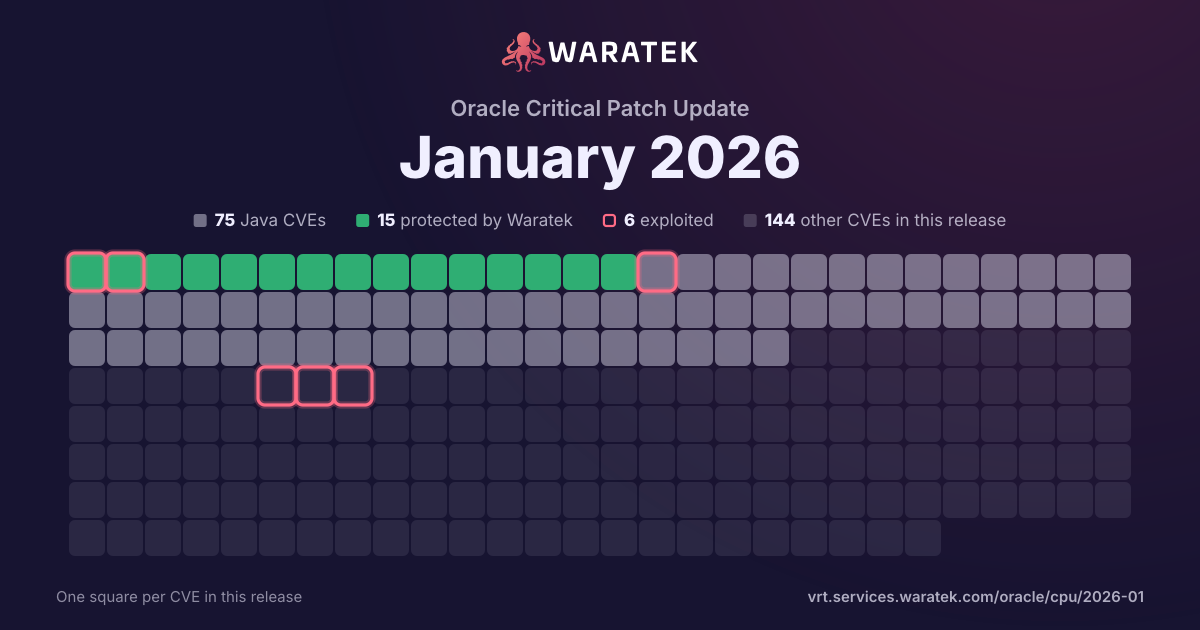
By status
15Protected by Waratek2Mitigation candidate58No exploit published14Outside Waratek scope130Not applicable
6Exploited, marked by the ring
No exploit published. For 26 of them, Oracle's security advisory is the source of public detail.
Protected by Waratek. Waratek RASP can block exploitation of these on systems that have not applied the patch yet.
Overview 84 matches · 18 in Waratek scope · 0 protected · 2 exploited · 1 CISA KEV · 9 public PoC · 2 EPSS ≥ 0.5
84matches
18in Waratek scope21.4%
0protected0.0%
2exploited2.4%
1CISA KEV1.2%
9public PoC10.7%
2EPSS ≥ 0.52.4%
Protected by Waratek
0
0.0%
Rule in development
0
0.0%
Mitigation candidate
1
1.2%
No exploit published
17
20.2%
Outside Waratek scope
9
10.7%
Not applicable
57
67.9%
Withdrawn CVE
0
0.0%
blocked by ARMR today
0
0.0%
partly blocked
0
0.0%
not blocked
84
100.0%
not established
0
0.0%
unrecorded
0
0.0%
split by
peak 27 / quarter
Q1 233
Not applicable3
High3
not blocked3
No public exploit3
Q2 230
Q3 230
Q4 231
Not applicable1
High1
not blocked1
No public exploit1
Q1 240
Q2 240
Q3 240
Q4 241
Not applicable1
High1
not blocked1
No public exploit1
Q1 253
No exploit published1
Not applicable2
High3
not blocked3
Exploited1
Proof of concept only1
No public exploit1
Q2 2516
Mitigation candidate1
No exploit published4
Outside Waratek scope2
Not applicable9
High16
not blocked16
Exploited1
Proof of concept only5
No public exploit10
Q3 2527
No exploit published5
Outside Waratek scope4
Not applicable18
High27
not blocked27
Working exploit published2
Proof of concept only4
No public exploit21
Q4 2514
No exploit published3
Not applicable11
High14
not blocked14
Working exploit published3
Proof of concept only2
No public exploit9
Q1 2619
No exploit published4
Outside Waratek scope3
Not applicable12
High19
not blocked19
No public exploit19
Q1 23Q3 23Q1 24Q3 24Q1 25Q3 25Q1 26
| CVE | Severity | Published▾ | Status | Exploitation | Description |
|---|---|---|---|---|---|
| CVE-2026-21990 | High | 2026-01-20 | Not applicable | No public exploit | Vulnerability in the Oracle VM VirtualBox product of Oracle Virtualization (component: Core). Supported versions that are affected are 7.1.14 and 7.2.4. Easily exploitable vulnerability allows high privileged attacker with logon to the infrastructure where Oracle VM VirtualBox executes to compromise Oracle VM VirtualBox. While the vulnerability is in Oracle VM VirtualBox, attacks may significantly impact additional products (scope change). Successful attacks of this vulnerability can result in takeover of Oracle VM VirtualBox. CVSS 3.1 Base Score 8.2 (Confidentiality, Integrity and Availability impacts). CVSS Vector: (CVSS:3.1/AV:L/AC:L/PR:H/UI:N/S:C/C:H/I:H/A:H). |
| CVE-2026-21989 | High | 2026-01-20 | Not applicable | No public exploit | Vulnerability in the Oracle VM VirtualBox product of Oracle Virtualization (component: Core). Supported versions that are affected are 7.1.14 and 7.2.4. Easily exploitable vulnerability allows high privileged attacker with logon to the infrastructure where Oracle VM VirtualBox executes to compromise Oracle VM VirtualBox. While the vulnerability is in Oracle VM VirtualBox, attacks may significantly impact additional products (scope change). Successful attacks of this vulnerability can result in unauthorized creation, deletion or modification access to critical data or all Oracle VM VirtualBox accessible data as well as unauthorized access to critical data or complete access to all Oracle VM VirtualBox accessible data and unauthorized ability to cause a partial denial of service (partial DOS) of Oracle VM VirtualBox. CVSS 3.1 Base Score 8.1 (Confidentiality, Integrity and Availability impacts). CVSS Vector: (CVSS:3.1/AV:L/AC:L/PR:H/UI:N/S:C/C:H/I:H/A:L). |
| CVE-2026-21988 | High | 2026-01-20 | Not applicable | No public exploit | Vulnerability in the Oracle VM VirtualBox product of Oracle Virtualization (component: Core). Supported versions that are affected are 7.1.14 and 7.2.4. Easily exploitable vulnerability allows high privileged attacker with logon to the infrastructure where Oracle VM VirtualBox executes to compromise Oracle VM VirtualBox. While the vulnerability is in Oracle VM VirtualBox, attacks may significantly impact additional products (scope change). Successful attacks of this vulnerability can result in takeover of Oracle VM VirtualBox. CVSS 3.1 Base Score 8.2 (Confidentiality, Integrity and Availability impacts). CVSS Vector: (CVSS:3.1/AV:L/AC:L/PR:H/UI:N/S:C/C:H/I:H/A:H). |
| CVE-2026-21987 | High | 2026-01-20 | Not applicable | No public exploit | Vulnerability in the Oracle VM VirtualBox product of Oracle Virtualization (component: Core). Supported versions that are affected are 7.1.14 and 7.2.4. Easily exploitable vulnerability allows high privileged attacker with logon to the infrastructure where Oracle VM VirtualBox executes to compromise Oracle VM VirtualBox. While the vulnerability is in Oracle VM VirtualBox, attacks may significantly impact additional products (scope change). Successful attacks of this vulnerability can result in takeover of Oracle VM VirtualBox. CVSS 3.1 Base Score 8.2 (Confidentiality, Integrity and Availability impacts). CVSS Vector: (CVSS:3.1/AV:L/AC:L/PR:H/UI:N/S:C/C:H/I:H/A:H). |
| CVE-2026-21986 | High | 2026-01-20 | Not applicable | No public exploit | Vulnerability in the Oracle VM VirtualBox product of Oracle Virtualization (component: Core). Supported versions that are affected are 7.1.14 and 7.2.4. Easily exploitable vulnerability allows unauthenticated attacker with logon to the infrastructure where Oracle VM VirtualBox executes to compromise Oracle VM VirtualBox. While the vulnerability is in Oracle VM VirtualBox, attacks may significantly impact additional products (scope change). Successful attacks of this vulnerability can result in unauthorized ability to cause a hang or frequently repeatable crash (complete DOS) of Oracle VM VirtualBox. Note: This vulnerability applies to Windows VMs only. CVSS 3.1 Base Score 7.1 (Availability impacts). CVSS Vector: (CVSS:3.1/AV:L/AC:L/PR:N/UI:N/S:C/C:N/I:N/A:H). |
| CVE-2026-21984 | High | 2026-01-20 | Not applicable | No public exploit | Vulnerability in the Oracle VM VirtualBox product of Oracle Virtualization (component: Core). Supported versions that are affected are 7.1.14 and 7.2.4. Difficult to exploit vulnerability allows high privileged attacker with logon to the infrastructure where Oracle VM VirtualBox executes to compromise Oracle VM VirtualBox. While the vulnerability is in Oracle VM VirtualBox, attacks may significantly impact additional products (scope change). Successful attacks of this vulnerability can result in takeover of Oracle VM VirtualBox. CVSS 3.1 Base Score 7.5 (Confidentiality, Integrity and Availability impacts). CVSS Vector: (CVSS:3.1/AV:L/AC:H/PR:H/UI:N/S:C/C:H/I:H/A:H). |
| CVE-2026-21983 | High | 2026-01-20 | Not applicable | No public exploit | Vulnerability in the Oracle VM VirtualBox product of Oracle Virtualization (component: Core). Supported versions that are affected are 7.1.14 and 7.2.4. Difficult to exploit vulnerability allows high privileged attacker with logon to the infrastructure where Oracle VM VirtualBox executes to compromise Oracle VM VirtualBox. While the vulnerability is in Oracle VM VirtualBox, attacks may significantly impact additional products (scope change). Successful attacks of this vulnerability can result in takeover of Oracle VM VirtualBox. CVSS 3.1 Base Score 7.5 (Confidentiality, Integrity and Availability impacts). CVSS Vector: (CVSS:3.1/AV:L/AC:H/PR:H/UI:N/S:C/C:H/I:H/A:H). |
| CVE-2026-21982 | High | 2026-01-20 | Not applicable | No public exploit | Vulnerability in the Oracle VM VirtualBox product of Oracle Virtualization (component: Core). Supported versions that are affected are 7.1.14 and 7.2.4. Difficult to exploit vulnerability allows unauthenticated attacker with access to the physical communication segment attached to the hardware where the Oracle VM VirtualBox executes to compromise Oracle VM VirtualBox. Successful attacks of this vulnerability can result in takeover of Oracle VM VirtualBox. CVSS 3.1 Base Score 7.5 (Confidentiality, Integrity and Availability impacts). CVSS Vector: (CVSS:3.1/AV:A/AC:H/PR:N/UI:N/S:U/C:H/I:H/A:H). |
| CVE-2026-21976 | High | 2026-01-20 | Outside Waratek scope | No public exploit | Vulnerability in the Oracle Business Intelligence Enterprise Edition product of Oracle Analytics (component: Oracle Analytics Cloud). Supported versions that are affected are 7.6.0.0.0 and 8.2.0.0.0. Easily exploitable vulnerability allows low privileged attacker with logon to the infrastructure where Oracle Business Intelligence Enterprise Edition executes to compromise Oracle Business Intelligence Enterprise Edition. Successful attacks of this vulnerability can result in unauthorized creation, deletion or modification access to critical data or all Oracle Business Intelligence Enterprise Edition accessible data as well as unauthorized access to critical data or complete access to all Oracle Business Intelligence Enterprise Edition accessible data. CVSS 3.1 Base Score 7.1 (Confidentiality and Integrity impacts). CVSS Vector: (CVSS:3.1/AV:L/AC:L/PR:L/UI:N/S:U/C:H/I:H/A:N). |
| CVE-2026-21973 | High | 2026-01-20 | No exploit published | No public exploit | Vulnerability in the Oracle FLEXCUBE Investor Servicing product of Oracle Financial Services Applications (component: Security Management System). Supported versions that are affected are 14.5.0.15.0, 14.7.0.8.0 and 14.8.0.1.0. Easily exploitable vulnerability allows low privileged attacker with network access via HTTP to compromise Oracle FLEXCUBE Investor Servicing. Successful attacks of this vulnerability can result in unauthorized creation, deletion or modification access to critical data or all Oracle FLEXCUBE Investor Servicing accessible data as well as unauthorized access to critical data or complete access to all Oracle FLEXCUBE Investor Servicing accessible data. CVSS 3.1 Base Score 8.1 (Confidentiality and Integrity impacts). CVSS Vector: (CVSS:3.1/AV:N/AC:L/PR:L/UI:N/S:U/C:H/I:H/A:N). |
| CVE-2026-21967 | High | 2026-01-20 | No exploit published | No public exploit | Vulnerability in the Oracle Hospitality OPERA 5 product of Oracle Hospitality Applications (component: Opera Servlet). Supported versions that are affected are 5.6.19.23, 5.6.25.17, 5.6.26.10 and 5.6.27.4. Easily exploitable vulnerability allows unauthenticated attacker with network access via HTTP to compromise Oracle Hospitality OPERA 5. Successful attacks of this vulnerability can result in unauthorized access to critical data or complete access to all Oracle Hospitality OPERA 5 accessible data as well as unauthorized update, insert or delete access to some of Oracle Hospitality OPERA 5 accessible data and unauthorized ability to cause a partial denial of service (partial DOS) of Oracle Hospitality OPERA 5. CVSS 3.1 Base Score 8.6 (Confidentiality, Integrity and Availability impacts). CVSS Vector: (CVSS:3.1/AV:N/AC:L/PR:N/UI:N/S:U/C:H/I:L/A:L). |
| CVE-2026-21957 | High | 2026-01-20 | Not applicable | No public exploit | Vulnerability in the Oracle VM VirtualBox product of Oracle Virtualization (component: Core). Supported versions that are affected are 7.1.14 and 7.2.4. Difficult to exploit vulnerability allows high privileged attacker with logon to the infrastructure where Oracle VM VirtualBox executes to compromise Oracle VM VirtualBox. While the vulnerability is in Oracle VM VirtualBox, attacks may significantly impact additional products (scope change). Successful attacks of this vulnerability can result in takeover of Oracle VM VirtualBox. CVSS 3.1 Base Score 7.5 (Confidentiality, Integrity and Availability impacts). CVSS Vector: (CVSS:3.1/AV:L/AC:H/PR:H/UI:N/S:C/C:H/I:H/A:H). |
| CVE-2026-21956 | High | 2026-01-20 | Not applicable | No public exploit | Vulnerability in the Oracle VM VirtualBox product of Oracle Virtualization (component: Core). Supported versions that are affected are 7.1.14 and 7.2.4. Easily exploitable vulnerability allows high privileged attacker with logon to the infrastructure where Oracle VM VirtualBox executes to compromise Oracle VM VirtualBox. While the vulnerability is in Oracle VM VirtualBox, attacks may significantly impact additional products (scope change). Successful attacks of this vulnerability can result in takeover of Oracle VM VirtualBox. CVSS 3.1 Base Score 8.2 (Confidentiality, Integrity and Availability impacts). CVSS Vector: (CVSS:3.1/AV:L/AC:L/PR:H/UI:N/S:C/C:H/I:H/A:H). |
| CVE-2026-21955 | High | 2026-01-20 | Not applicable | No public exploit | Vulnerability in the Oracle VM VirtualBox product of Oracle Virtualization (component: Core). Supported versions that are affected are 7.1.14 and 7.2.4. Easily exploitable vulnerability allows high privileged attacker with logon to the infrastructure where Oracle VM VirtualBox executes to compromise Oracle VM VirtualBox. While the vulnerability is in Oracle VM VirtualBox, attacks may significantly impact additional products (scope change). Successful attacks of this vulnerability can result in takeover of Oracle VM VirtualBox. CVSS 3.1 Base Score 8.2 (Confidentiality, Integrity and Availability impacts). CVSS Vector: (CVSS:3.1/AV:L/AC:L/PR:H/UI:N/S:C/C:H/I:H/A:H). |
| CVE-2026-21945 | High | 2026-01-20 | Outside Waratek scope | No public exploit | Vulnerability in the Oracle Java SE, Oracle GraalVM for JDK, Oracle GraalVM Enterprise Edition product of Oracle Java SE (component: Security). Supported versions that are affected are Oracle Java SE: 8u471, 8u471-b50, 8u471-perf, 11.0.29, 17.0.17, 21.0.9, 25.0.1; Oracle GraalVM for JDK: 17.0.17 and 21.0.9; Oracle GraalVM Enterprise Edition: 21.3.16. Easily exploitable vulnerability allows unauthenticated attacker with network access via multiple protocols to compromise Oracle Java SE, Oracle GraalVM for JDK, Oracle GraalVM Enterprise Edition. Successful attacks of this vulnerability can result in unauthorized ability to cause a hang or frequently repeatable crash (complete DOS) of Oracle Java SE, Oracle GraalVM for JDK, Oracle GraalVM Enterprise Edition. Note: This vulnerability applies to Java deployments, typically in clients running sandboxed Java Web Start applications or sandboxed Java applets, that load and run untrusted code (e.g., code that comes from the internet) and rely on the Java sandbox for security. This vulnerability does not apply to Java deployments, typically in servers, that load and run only trusted code (e.g., code installed by an administrator). CVSS 3.1 Base Score 7.5 (Availability impacts). CVSS Vector: (CVSS:3.1/AV:N/AC:L/PR:N/UI:N/S:U/C:N/I:N/A:H). |
| CVE-2026-21940 | High | 2026-01-20 | No exploit published | No public exploit | Vulnerability in the Oracle Agile PLM product of Oracle Supply Chain (component: User and User Group). The supported version that is affected is 9.3.6. Easily exploitable vulnerability allows unauthenticated attacker with network access via HTTP to compromise Oracle Agile PLM. Successful attacks of this vulnerability can result in unauthorized access to critical data or complete access to all Oracle Agile PLM accessible data. CVSS 3.1 Base Score 7.5 (Confidentiality impacts). CVSS Vector: (CVSS:3.1/AV:N/AC:L/PR:N/UI:N/S:U/C:H/I:N/A:N). |
| CVE-2026-21939 | High | 2026-01-20 | Not applicable | No public exploit | Vulnerability in the SQLcl component of Oracle Database Server. Supported versions that are affected are 23.4.0-23.26.0. Difficult to exploit vulnerability allows unauthenticated attacker with logon to the infrastructure where SQLcl executes to compromise SQLcl. Successful attacks require human interaction from a person other than the attacker. Successful attacks of this vulnerability can result in takeover of SQLcl. CVSS 3.1 Base Score 7.0 (Confidentiality, Integrity and Availability impacts). CVSS Vector: (CVSS:3.1/AV:L/AC:H/PR:N/UI:R/S:U/C:H/I:H/A:H). |
| CVE-2026-21932 | High | 2026-01-20 | Outside Waratek scope | No public exploit | Vulnerability in the Oracle Java SE, Oracle GraalVM for JDK, Oracle GraalVM Enterprise Edition product of Oracle Java SE (component: AWT, JavaFX). Supported versions that are affected are Oracle Java SE: 8u471, 8u471-b50, 8u471-perf, 11.0.29, 17.0.17, 21.0.9, 25.0.1; Oracle GraalVM for JDK: 17.0.17 and 21.0.9; Oracle GraalVM Enterprise Edition: 21.3.16. Easily exploitable vulnerability allows unauthenticated attacker with network access via multiple protocols to compromise Oracle Java SE, Oracle GraalVM for JDK, Oracle GraalVM Enterprise Edition. Successful attacks require human interaction from a person other than the attacker and while the vulnerability is in Oracle Java SE, Oracle GraalVM for JDK, Oracle GraalVM Enterprise Edition, attacks may significantly impact additional products (scope change). Successful attacks of this vulnerability can result in unauthorized creation, deletion or modification access to critical data or all Oracle Java SE, Oracle GraalVM for JDK, Oracle GraalVM Enterprise Edition accessible data. Note: This vulnerability applies to Java deployments, typically in clients running sandboxed Java Web Start applications or sandboxed Java applets, that load and run untrusted code (e.g., code that comes from the internet) and rely on the Java sandbox for security. This vulnerability does not apply to Java deployments, typically in servers, that load and run only trusted code (e.g., code installed by an administrator). CVSS 3.1 Base Score 7.4 (Integrity impacts). CVSS Vector: (CVSS:3.1/AV:N/AC:L/PR:N/UI:R/S:C/C:N/I:H/A:N). |
| CVE-2026-21926 | High | 2026-01-20 | No exploit published | No public exploit | Vulnerability in the Siebel CRM Deployment product of Oracle Siebel CRM (component: Server Infrastructure). Supported versions that are affected are 17.0-25.2. Easily exploitable vulnerability allows unauthenticated attacker with network access via TLS to compromise Siebel CRM Deployment. Successful attacks of this vulnerability can result in unauthorized ability to cause a hang or frequently repeatable crash (complete DOS) of Siebel CRM Deployment. CVSS 3.1 Base Score 7.5 (Availability impacts). CVSS Vector: (CVSS:3.1/AV:N/AC:L/PR:N/UI:N/S:U/C:N/I:N/A:H). |
| CVE-2025-66566 | High | 2025-12-05 | No exploit published | No public exploit | yawkat LZ4 Java provides LZ4 compression for Java. Insufficient clearing of the output buffer in Java-based decompressor implementations in lz4-java 1.10.0 and earlier allows remote attackers to read previous buffer contents via crafted compressed input. In applications where the output buffer is reused without being cleared, this may lead to disclosure of sensitive data. JNI-based implementations are not affected. This vulnerability is fixed in 1.10.1. |
| CVE-2025-66471 | High | 2025-12-05 | Not applicable | No public exploit | urllib3 is a user-friendly HTTP client library for Python. Starting in version 1.0 and prior to 2.6.0, the Streaming API improperly handles highly compressed data. urllib3's streaming API is designed for the efficient handling of large HTTP responses by reading the content in chunks, rather than loading the entire response body into memory at once. When streaming a compressed response, urllib3 can perform decoding or decompression based on the HTTP Content-Encoding header (e.g., gzip, deflate, br, or zstd). The library must read compressed data from the network and decompress it until the requested chunk size is met. Any resulting decompressed data that exceeds the requested amount is held in an internal buffer for the next read operation. The decompression logic could cause urllib3 to fully decode a small amount of highly compressed data in a single operation. This can result in excessive resource consumption (high CPU usage and massive memory allocation for the decompressed data. |
| CVE-2025-66418 | High | 2025-12-05 | Not applicable | No public exploit | urllib3 is a user-friendly HTTP client library for Python. Starting in version 1.24 and prior to 2.6.0, the number of links in the decompression chain was unbounded allowing a malicious server to insert a virtually unlimited number of compression steps leading to high CPU usage and massive memory allocation for the decompressed data. This vulnerability is fixed in 2.6.0. |
| CVE-2025-59775 | High | 2025-12-05 | Not applicable | No public exploit | Server-Side Request Forgery (SSRF) vulnerability in Apache HTTP Server on Windows with AllowEncodedSlashes On and MergeSlashes Off allows to potentially leak NTLM hashes to a malicious server via SSRF and malicious requests or content Users are recommended to upgrade to version 2.4.66, which fixes the issue. |
| CVE-2025-58098 | High | 2025-12-05 | Not applicable | No public exploit | Apache HTTP Server 2.4.65 and earlier with Server Side Includes (SSI) enabled and mod_cgid (but not mod_cgi) passes the shell-escaped query string to #exec cmd="..." directives. This issue affects Apache HTTP Server before 2.4.66. Users are recommended to upgrade to version 2.4.66, which fixes the issue. |
| CVE-2025-55753 | High | 2025-12-05 | Not applicable | No public exploit | An integer overflow in the case of failed ACME certificate renewal leads, after a number of failures (~30 days in default configurations), to the backoff timer becoming 0. Attempts to renew the certificate then are repeated without delays until it succeeds. This issue affects Apache HTTP Server: from 2.4.30 before 2.4.66. Users are recommended to upgrade to version 2.4.66, which fixes the issue. |
| CVE-2025-12183 | High | 2025-11-28 | No exploit published | No public exploit | Out-of-bounds memory operations in org.lz4:lz4-java 1.8.0 and earlier allow remote attackers to cause denial of service and read adjacent memory via untrusted compressed input. |
| CVE-2025-65018 | High | 2025-11-25 | Not applicable | Proof of concept only | LIBPNG is a reference library for use in applications that read, create, and manipulate PNG (Portable Network Graphics) raster image files. From version 1.6.0 to before 1.6.51, there is a heap buffer overflow vulnerability in the libpng simplified API function png_image_finish_read when processing 16-bit interlaced PNGs with 8-bit output format. Attacker-crafted interlaced PNG files cause heap writes beyond allocated buffer bounds. This issue has been patched in version 1.6.51. |
| CVE-2025-64720 | High | 2025-11-25 | Not applicable | Proof of concept only | LIBPNG is a reference library for use in applications that read, create, and manipulate PNG (Portable Network Graphics) raster image files. From version 1.6.0 to before 1.6.51, an out-of-bounds read vulnerability exists in png_image_read_composite when processing palette images with PNG_FLAG_OPTIMIZE_ALPHA enabled. The palette compositing code in png_init_read_transformations incorrectly applies background compositing during premultiplication, violating the invariant component ≤ alpha × 257 required by the simplified PNG API. This issue has been patched in version 1.6.51. |
| CVE-2025-12816 | High | 2025-11-25 | Not applicable | No public exploit | An interpretation-conflict (CWE-436) vulnerability in node-forge versions 1.3.1 and earlier enables unauthenticated attackers to craft ASN.1 structures to desynchronize schema validations, yielding a semantic divergence that may bypass downstream cryptographic verifications and security decisions. |
| CVE-2025-59250 | High | 2025-10-14 | No exploit published | No public exploit | Improper input validation in JDBC Driver for SQL Server allows an unauthorized attacker to perform spoofing over a network. |
| CVE-2025-46819 | High | 2025-10-03 | Not applicable | Working exploit published | Redis is an open source, in-memory database that persists on disk. Versions 8.2.1 and below allow an authenticated user to use a specially crafted LUA script to read out-of-bound data or crash the server and subsequent denial of service. The problem exists in all versions of Redis with Lua scripting. This issue is fixed in version 8.2.2. To workaround this issue without patching the redis-server executable is to prevent users from executing Lua scripts. This can be done using ACL to block a script by restricting both the EVAL and FUNCTION command families. |
| CVE-2025-46818 | High | 2025-10-03 | Not applicable | Working exploit published | Redis is an open source, in-memory database that persists on disk. Versions 8.2.1 and below allow an authenticated user to use a specially crafted Lua script to manipulate different LUA objects and potentially run their own code in the context of another user. The problem exists in all versions of Redis with LUA scripting. This issue is fixed in version 8.2.2. A workaround to mitigate the problem without patching the redis-server executable is to prevent users from executing LUA scripts. This can be done using ACL to block a script by restricting both the EVAL and FUNCTION command families. |
| CVE-2025-46817 | High | 2025-10-03 | Not applicable | Working exploit published | Redis is an open source, in-memory database that persists on disk. Versions 8.2.1 and below allow an authenticated user to use a specially crafted Lua script to cause an integer overflow and potentially lead to remote code execution The problem exists in all versions of Redis with Lua scripting. This issue is fixed in version 8.2.2. |
| CVE-2025-26333 | High | 2025-09-25 | Not applicable | No public exploit | Dell BSAFE Crypto-J generates an error message that includes sensitive information about its environment and associated data. A remote attacker could potentially exploit this vulnerability, leading to information exposure. |
| CVE-2025-9900 | High | 2025-09-23 | Not applicable | Proof of concept only | A flaw was found in Libtiff. This vulnerability is a "write-what-where" condition, triggered when the library processes a specially crafted TIFF image file. By providing an abnormally large image height value in the file's metadata, an attacker can trick the library into writing attacker-controlled color data to an arbitrary memory location. This memory corruption can be exploited to cause a denial of service (application crash) or to achieve arbitrary code execution with the permissions of the user. |
| CVE-2025-41249 | High | 2025-09-16 | No exploit published | No public exploit | The Spring Framework annotation detection mechanism may not correctly resolve annotations on methods within type hierarchies with a parameterized super type with unbounded generics. This can be an issue if such annotations are used for authorization decisions. Your application may be affected by this if you are using Spring Security's @EnableMethodSecurity feature. You are not affected by this if you are not using @EnableMethodSecurity or if you do not use security annotations on methods in generic superclasses or generic interfaces. This CVE is published in conjunction with CVE-2025-41248 https://spring.io/security/cve-2025-41248 . |
| CVE-2025-41248 | High | 2025-09-16 | No exploit published | No public exploit | The Spring Security annotation detection mechanism may not correctly resolve annotations on methods within type hierarchies with a parameterized super type with unbounded generics. This can be an issue when using @PreAuthorize and other method security annotations, resulting in an authorization bypass. Your application may be affected by this if you are using Spring Security's @EnableMethodSecurity feature. You are not affected by this if you are not using @EnableMethodSecurity or if you do not use security annotations on methods in generic superclasses or generic interfaces. This CVE is published in conjunction with CVE-2025-41249 https://spring.io/security/cve-2025-41249 . |
| CVE-2025-59375 | High | 2025-09-15 | Not applicable | No public exploit | libexpat in Expat before 2.7.2 allows attackers to trigger large dynamic memory allocations via a small document that is submitted for parsing. |
| CVE-2025-9086 | High | 2025-09-12 | Not applicable | No public exploit | 1. A cookie is set using the `secure` keyword for `https://target` 2. curl is redirected to or otherwise made to speak with `http://target` (same hostname, but using clear text HTTP) using the same cookie set 3. The same cookie name is set - but with only a slash as path (`path="/"`). Since this site is not secure, the cookie *should* be ignored. 4. A bug in the path comparison logic makes curl read outside a heap buffer boundary The bug either causes a crash or it potentially makes the comparison come to the wrong conclusion and lets the clear-text site override the contents of the secure cookie, contrary to expectations and depending on the memory contents immediately following the single-byte allocation that holds the path. The presumed and correct behavior would be to plainly ignore the second set of the cookie since it was already set as secure on a secure host so overriding it on an insecure host should not be okay. |
| CVE-2025-5115 | High | 2025-08-20 | No exploit published | No public exploit | In Eclipse Jetty, versions <=9.4.57, <=10.0.25, <=11.0.25, <=12.0.21, <=12.1.0.alpha2, an HTTP/2 client may trigger the server to send RST_STREAM frames, for example by sending frames that are malformed or that should not be sent in a particular stream state, therefore forcing the server to consume resources such as CPU and memory. For example, a client can open a stream and then send WINDOW_UPDATE frames with window size increment of 0, which is illegal. Per specification https://www.rfc-editor.org/rfc/rfc9113.html#name-window_update , the server should send a RST_STREAM frame. The client can now open another stream and send another bad WINDOW_UPDATE, therefore causing the server to consume more resources than necessary, as this case does not exceed the max number of concurrent streams, yet the client is able to create an enormous amount of streams in a short period of time. The attack can be performed with other conditions (for example, a DATA frame for a closed stream) that cause the server to send a RST_STREAM frame. Links: * https://github.com/jetty/jetty.project/security/advisories/GHSA-mmxm-8w33-wc4h |
| CVE-2025-55163 | High | 2025-08-13 | Outside Waratek scope | No public exploit | Netty is an asynchronous, event-driven network application framework. Prior to versions 4.1.124.Final and 4.2.4.Final, Netty is vulnerable to MadeYouReset DDoS. This is a logical vulnerability in the HTTP/2 protocol, that uses malformed HTTP/2 control frames in order to break the max concurrent streams limit - which results in resource exhaustion and distributed denial of service. This issue has been patched in versions 4.1.124.Final and 4.2.4.Final. |
| CVE-2025-48989 | High | 2025-08-13 | No exploit published | No public exploit | Improper Resource Shutdown or Release vulnerability in Apache Tomcat made Tomcat vulnerable to the made you reset attack. This issue affects Apache Tomcat: from 11.0.0-M1 through 11.0.9, from 10.1.0-M1 through 10.1.43 and from 9.0.0.M1 through 9.0.107. Older, EOL versions may also be affected. Users are recommended to upgrade to one of versions 11.0.10, 10.1.44 or 9.0.108 which fix the issue. |
| CVE-2025-47219 | High | 2025-08-07 | Not applicable | Proof of concept only | In GStreamer through 1.26.1, the isomp4 plugin's qtdemux_parse_trak function may read past the end of a heap buffer while parsing an MP4 file, possibly leading to information disclosure. |
| CVE-2025-8194 | High | 2025-07-28 | Not applicable | No public exploit | There is a defect in the CPython “tarfile” module affecting the “TarFile” extraction and entry enumeration APIs. The tar implementation would process tar archives with negative offsets without error, resulting in an infinite loop and deadlock during the parsing of maliciously crafted tar archives. This vulnerability can be mitigated by including the following patch after importing the “tarfile” module: https://gist.github.com/sethmlarson/1716ac5b82b73dbcbf23ad2eff8b33e1 |
| CVE-2025-27210 | High | 2025-07-18 | Not applicable | Working exploit published | An incomplete fix has been identified for CVE-2025-23084 in Node.js, specifically affecting Windows device names like CON, PRN, and AUX. This vulnerability affects Windows users of `path.join` API. |
| CVE-2025-27209 | High | 2025-07-18 | Not applicable | No public exploit | The V8 release used in Node.js v24.0.0 has changed how string hashes are computed using rapidhash. This implementation re-introduces the HashDoS vulnerability as an attacker who can control the strings to be hashed can generate many hash collisions - an attacker can generate collisions even without knowing the hash-seed. * This vulnerability affects Node.js v24.x users. |
| CVE-2025-6965 | High | 2025-07-15 | Not applicable | Working exploit published | There exists a vulnerability in SQLite versions before 3.50.2 where the number of aggregate terms could exceed the number of columns available. This could lead to a memory corruption issue. We recommend upgrading to version 3.50.2 or above. |
| CVE-2025-50059 | High | 2025-07-15 | Outside Waratek scope | No public exploit | Vulnerability in the Oracle Java SE, Oracle GraalVM for JDK, Oracle GraalVM Enterprise Edition product of Oracle Java SE (component: Networking). Supported versions that are affected are Oracle Java SE: 8u451-perf, 11.0.27, 17.0.15, 21.0.7, 24.0.1; Oracle GraalVM for JDK: 17.0.15, 21.0.7 and 24.0.1; Oracle GraalVM Enterprise Edition: 21.3.14. Easily exploitable vulnerability allows unauthenticated attacker with network access via multiple protocols to compromise Oracle Java SE, Oracle GraalVM for JDK, Oracle GraalVM Enterprise Edition. While the vulnerability is in Oracle Java SE, Oracle GraalVM for JDK, Oracle GraalVM Enterprise Edition, attacks may significantly impact additional products (scope change). Successful attacks of this vulnerability can result in unauthorized access to critical data or complete access to all Oracle Java SE, Oracle GraalVM for JDK, Oracle GraalVM Enterprise Edition accessible data. Note: This vulnerability applies to Java deployments, typically in clients running sandboxed Java Web Start applications or sandboxed Java applets, that load and run untrusted code (e.g., code that comes from the internet) and rely on the Java sandbox for security. This vulnerability does not apply to Java deployments, typically in servers, that load and run only trusted code (e.g., code installed by an administrator). CVSS 3.1 Base Score 8.6 (Confidentiality impacts). CVSS Vector: (CVSS:3.1/AV:N/AC:L/PR:N/UI:N/S:C/C:H/I:N/A:N). |
| CVE-2025-7425 | High | 2025-07-10 | Outside Waratek scope | Proof of concept only | A flaw was found in libxslt where the attribute type, atype, flags are modified in a way that corrupts internal memory management. When XSLT functions, such as the key() process, result in tree fragments, this corruption prevents the proper cleanup of ID attributes. As a result, the system may access freed memory, causing crashes or enabling attackers to trigger heap corruption. |
| CVE-2025-7424 | High | 2025-07-10 | Outside Waratek scope | No public exploit | A flaw was found in the libxslt library. The same memory field, psvi, is used for both stylesheet and input data, which can lead to type confusion during XML transformations. This vulnerability allows an attacker to crash the application or corrupt memory. In some cases, it may lead to denial of service or unexpected behavior. |
| CVE-2025-52520 | High | 2025-07-10 | No exploit published | No public exploit | For some unlikely configurations of multipart upload, an Integer Overflow vulnerability in Apache Tomcat could lead to a DoS via bypassing of size limits. This issue affects Apache Tomcat: from 11.0.0-M1 through 11.0.8, from 10.1.0-M1 through 10.1.42, from 9.0.0.M1 through 9.0.106. The following versions were EOL at the time the CVE was created but are known to be affected: 8.5.0 through 8.5.100. Other, older, EOL versions may also be affected. Users are recommended to upgrade to version 11.0.9, 10.1.43 or 9.0.107, which fix the issue. |
| CVE-2025-49812 | High | 2025-07-10 | Not applicable | No public exploit | In some mod_ssl configurations on Apache HTTP Server versions through to 2.4.63, an HTTP desynchronisation attack allows a man-in-the-middle attacker to hijack an HTTP session via a TLS upgrade. Only configurations using "SSLEngine optional" to enable TLS upgrades are affected. Users are recommended to upgrade to version 2.4.64, which removes support for TLS upgrade. |
| CVE-2025-32990 | High | 2025-07-10 | Not applicable | No public exploit | A heap-buffer-overflow (off-by-one) flaw was found in the GnuTLS software in the template parsing logic within the certtool utility. When it reads certain settings from a template file, it allows an attacker to cause an out-of-bounds (OOB) NULL pointer write, resulting in memory corruption and a denial-of-service (DoS) that could potentially crash the system. |
| CVE-2025-32988 | High | 2025-07-10 | Not applicable | No public exploit | A flaw was found in GnuTLS. A double-free vulnerability exists in GnuTLS due to incorrect ownership handling in the export logic of Subject Alternative Name (SAN) entries containing an otherName. If the type-id OID is invalid or malformed, GnuTLS will call asn1_delete_structure() on an ASN.1 node it does not own, leading to a double-free condition when the parent function or caller later attempts to free the same structure. This vulnerability can be triggered using only public GnuTLS APIs and may result in denial of service or memory corruption, depending on allocator behavior. |
| CVE-2024-47252 | High | 2025-07-10 | Not applicable | No public exploit | Insufficient escaping of user-supplied data in mod_ssl in Apache HTTP Server 2.4.63 and earlier allows an untrusted SSL/TLS client to insert escape characters into log files in some configurations. In a logging configuration where CustomLog is used with "%{varname}x" or "%{varname}c" to log variables provided by mod_ssl such as SSL_TLS_SNI, no escaping is performed by either mod_log_config or mod_ssl and unsanitized data provided by the client may appear in log files. |
| CVE-2024-43204 | High | 2025-07-10 | Not applicable | No public exploit | SSRF in Apache HTTP Server with mod_proxy loaded allows an attacker to send outbound proxy requests to a URL controlled by the attacker. Requires an unlikely configuration where mod_headers is configured to modify the Content-Type request or response header with a value provided in the HTTP request. Users are recommended to upgrade to version 2.4.64 which fixes this issue. |
| CVE-2024-42516 | High | 2025-07-10 | Not applicable | No public exploit | HTTP response splitting in the core of Apache HTTP Server allows an attacker who can manipulate the Content-Type response headers of applications hosted or proxied by the server can split the HTTP response. This vulnerability was described as CVE-2023-38709 but the patch included in Apache HTTP Server 2.4.59 did not address the issue. Users are recommended to upgrade to version 2.4.64, which fixes this issue. |
| CVE-2025-53547 | High | 2025-07-08 | Not applicable | Proof of concept only | Helm is a package manager for Charts for Kubernetes. Prior to 3.18.4, a specially crafted Chart.yaml file along with a specially linked Chart.lock file can lead to local code execution when dependencies are updated. Fields in a Chart.yaml file, that are carried over to a Chart.lock file when dependencies are updated and this file is written, can be crafted in a way that can cause execution if that same content were in a file that is executed (e.g., a bash.rc file or shell script). If the Chart.lock file is symlinked to one of these files updating dependencies will write the lock file content to the symlinked file. This can lead to unwanted execution. Helm warns of the symlinked file but did not stop execution due to symlinking. This issue has been resolved in Helm v3.18.4. |
| CVE-2025-5987 | High | 2025-07-07 | Not applicable | No public exploit | A flaw was found in libssh when using the ChaCha20 cipher with the OpenSSL library. If an attacker manages to exhaust the heap space, this error is not detected and may lead to libssh using a partially initialized cipher context. This occurs because the OpenSSL error code returned aliases with the SSH_OK code, resulting in libssh not properly detecting the error returned by the OpenSSL library. This issue can lead to undefined behavior, including compromised data confidentiality and integrity or crashes. |
| CVE-2025-5372 | High | 2025-07-04 | Not applicable | No public exploit | A flaw was found in libssh versions built with OpenSSL versions older than 3.0, specifically in the ssh_kdf() function responsible for key derivation. Due to inconsistent interpretation of return values where OpenSSL uses 0 to indicate failure and libssh uses 0 for success—the function may mistakenly return a success status even when key derivation fails. This results in uninitialized cryptographic key buffers being used in subsequent communication, potentially compromising SSH sessions' confidentiality, integrity, and availability. |
| CVE-2025-52999 | High | 2025-06-25 | No exploit published | No public exploit | jackson-core contains core low-level incremental ("streaming") parser and generator abstractions used by Jackson Data Processor. In versions prior to 2.15.0, if a user parses an input file and it has deeply nested data, Jackson could end up throwing a StackoverflowError if the depth is particularly large. jackson-core 2.15.0 contains a configurable limit for how deep Jackson will traverse in an input document, defaulting to an allowable depth of 1000. jackson-core will throw a StreamConstraintsException if the limit is reached. jackson-databind also benefits from this change because it uses jackson-core to parse JSON inputs. As a workaround, users should avoid parsing input files from untrusted sources. |
| CVE-2025-5318 | High | 2025-06-24 | Not applicable | No public exploit | A flaw was found in the libssh library in versions less than 0.11.2. An out-of-bounds read can be triggered in the sftp_handle function due to an incorrect comparison check that permits the function to access memory beyond the valid handle list and to return an invalid pointer, which is used in further processing. This vulnerability allows an authenticated remote attacker to potentially read unintended memory regions, exposing sensitive information or affect service behavior. |
| CVE-2025-49795 | High | 2025-06-16 | Not applicable | No public exploit | A NULL pointer dereference vulnerability was found in libxml2 when processing XPath XML expressions. This flaw allows an attacker to craft a malicious XML input to libxml2, leading to a denial of service. |
| CVE-2025-48976 | High | 2025-06-16 | No exploit published | No public exploit | Allocation of resources for multipart headers with insufficient limits enabled a DoS vulnerability in Apache Commons FileUpload. This issue affects Apache Commons FileUpload: from 1.0 before 1.6; from 2.0.0-M1 before 2.0.0-M4. Users are recommended to upgrade to versions 1.6 or 2.0.0-M4, which fix the issue. |
| CVE-2025-6052 | High | 2025-06-13 | Outside Waratek scope | No public exploit | A flaw was found in how GLib’s GString manages memory when adding data to strings. If a string is already very large, combining it with more input can cause a hidden overflow in the size calculation. This makes the system think it has enough memory when it doesn’t. As a result, data may be written past the end of the allocated memory, leading to crashes or memory corruption. |
| CVE-2025-6021 | High | 2025-06-12 | Outside Waratek scope | Proof of concept only | A flaw was found in libxml2's xmlBuildQName function, where integer overflows in buffer size calculations can lead to a stack-based buffer overflow. This issue can result in memory corruption or a denial of service when processing crafted input. |
| CVE-2025-27817 | High | 2025-06-10 | Mitigation candidate | Exploited | A possible arbitrary file read and SSRF vulnerability has been identified in Apache Kafka Client. Apache Kafka Clients accept configuration data for setting the SASL/OAUTHBEARER connection with the brokers, including "sasl.oauthbearer.token.endpoint.url" and "sasl.oauthbearer.jwks.endpoint.url". Apache Kafka allows clients to read an arbitrary file and return the content in the error log, or sending requests to an unintended location. In applications where Apache Kafka Clients configurations can be specified by an untrusted party, attackers may use the "sasl.oauthbearer.token.endpoint.url" and "sasl.oauthbearer.jwks.endpoint.url" configuratin to read arbitrary contents of the disk and environment variables or make requests to an unintended location. In particular, this flaw may be used in Apache Kafka Connect to escalate from REST API access to filesystem/environment/URL access, which may be undesirable in certain environments, including SaaS products. Since Apache Kafka 3.9.1/4.0.0, we have added a system property ("-Dorg.apache.kafka.sasl.oauthbearer.allowed.urls") to set the allowed urls in SASL JAAS configuration. In 3.9.1, it accepts all urls by default for backward compatibility. However in 4.0.0 and newer, the default value is empty list and users have to set the allowed urls explicitly. |
| CVE-2025-48866 | High | 2025-06-02 | Not applicable | Proof of concept only | ModSecurity is an open source, cross platform web application firewall (WAF) engine for Apache, IIS and Nginx. Versions prior to 2.9.10 contain a denial of service vulnerability similar to GHSA-859r-vvv8-rm8r/CVE-2025-47947. The `sanitiseArg` (and `sanitizeArg` - this is the same action but an alias) is vulnerable to adding an excessive number of arguments, thereby leading to denial of service. Version 2.9.10 fixes the issue. As a workaround, avoid using rules that contain the `sanitiseArg` (or `sanitizeArg`) action. |
| CVE-2025-48734 | High | 2025-05-28 | No exploit published | Proof of concept only | Improper Access Control vulnerability in Apache Commons. A special BeanIntrospector class was added in version 1.9.2. This can be used to stop attackers from using the declared class property of Java enum objects to get access to the classloader. However this protection was not enabled by default. PropertyUtilsBean (and consequently BeanUtilsBean) now disallows declared class level property access by default. Releases 1.11.0 and 2.0.0-M2 address a potential security issue when accessing enum properties in an uncontrolled way. If an application using Commons BeanUtils passes property paths from an external source directly to the getProperty() method of PropertyUtilsBean, an attacker can access the enum’s class loader via the “declaredClass” property available on all Java “enum” objects. Accessing the enum’s “declaredClass” allows remote attackers to access the ClassLoader and execute arbitrary code. The same issue exists with PropertyUtilsBean.getNestedProperty(). Starting in versions 1.11.0 and 2.0.0-M2 a special BeanIntrospector suppresses the “declaredClass” property. Note that this new BeanIntrospector is enabled by default, but you can disable it to regain the old behavior; see section 2.5 of the user's guide and the unit tests. This issue affects Apache Commons BeanUtils 1.x before 1.11.0, and 2.x before 2.0.0-M2.Users of the artifact commons-beanutils:commons-beanutils 1.x are recommended to upgrade to version 1.11.0, which fixes the issue. Users of the artifact org.apache.commons:commons-beanutils2 2.x are recommended to upgrade to version 2.0.0-M2, which fixes the issue. |
| CVE-2025-48060 | High | 2025-05-21 | Not applicable | Proof of concept only | jq is a command-line JSON processor. In versions up to and including 1.7.1, a heap-buffer-overflow is present in function `jv_string_vfmt` in the jq_fuzz_execute harness from oss-fuzz. This crash happens on file jv.c, line 1456 `void* p = malloc(sz);`. As of time of publication, no patched versions are available. |
| CVE-2025-47947 | High | 2025-05-21 | Not applicable | Proof of concept only | ModSecurity is an open source, cross platform web application firewall (WAF) engine for Apache, IIS and Nginx. Versions up to and including 2.9.8 are vulnerable to denial of service in one special case (in stable released versions): when the payload's content type is `application/json`, and there is at least one rule which does a `sanitiseMatchedBytes` action. A patch is available at pull request 3389 and expected to be part of version 2.9.9. No known workarounds are available. |
| CVE-2024-13009 | High | 2025-05-08 | No exploit published | No public exploit | In Eclipse Jetty versions 9.4.0 to 9.4.56 a buffer can be incorrectly released when confronted with a gzip error when inflating a request body. This can result in corrupted and/or inadvertent sharing of data between requests. |
| CVE-2025-46727 | High | 2025-05-07 | Not applicable | No public exploit | Rack is a modular Ruby web server interface. Prior to versions 2.2.14, 3.0.16, and 3.1.14, `Rack::QueryParser` parses query strings and `application/x-www-form-urlencoded` bodies into Ruby data structures without imposing any limit on the number of parameters, allowing attackers to send requests with extremely large numbers of parameters. The vulnerability arises because `Rack::QueryParser` iterates over each `&`-separated key-value pair and adds it to a Hash without enforcing an upper bound on the total number of parameters. This allows an attacker to send a single request containing hundreds of thousands (or more) of parameters, which consumes excessive memory and CPU during parsing. An attacker can trigger denial of service by sending specifically crafted HTTP requests, which can cause memory exhaustion or pin CPU resources, stalling or crashing the Rack server. This results in full service disruption until the affected worker is restarted. Versions 2.2.14, 3.0.16, and 3.1.14 fix the issue. Some other mitigations are available. One may use middleware to enforce a maximum query string size or parameter count, or employ a reverse proxy (such as Nginx) to limit request sizes and reject oversized query strings or bodies. Limiting request body sizes and query string lengths at the web server or CDN level is an effective mitigation. |
| CVE-2025-43967 | High | 2025-04-21 | Not applicable | No public exploit | libheif before 1.19.6 has a NULL pointer dereference in ImageItem_Grid::get_decoder in image-items/grid.cc because a grid image can reference a nonexistent image item. |
| CVE-2025-43966 | High | 2025-04-21 | Not applicable | No public exploit | libheif before 1.19.6 has a NULL pointer dereference in ImageItem_iden in image-items/iden.cc. |
| CVE-2024-56406 | High | 2025-04-13 | Not applicable | No public exploit | A heap buffer overflow vulnerability was discovered in Perl. Release branches 5.34, 5.36, 5.38 and 5.40 are affected, including development versions from 5.33.1 through 5.41.10. When there are non-ASCII bytes in the left-hand-side of the `tr` operator, `S_do_trans_invmap` can overflow the destination pointer `d`. $ perl -e '$_ = "\x{FF}" x 1000000; tr/\xFF/\x{100}/;' Segmentation fault (core dumped) It is believed that this vulnerability can enable Denial of Service and possibly Code Execution attacks on platforms that lack sufficient defenses. |
| CVE-2025-22228 | High | 2025-03-20 | No exploit published | No public exploit | BCryptPasswordEncoder.matches(CharSequence,String) will incorrectly return true for passwords larger than 72 characters as long as the first 72 characters are the same. |
| CVE-2025-27363 | High | 2025-03-11 | Not applicable | Exploited | An out of bounds write exists in FreeType versions 2.13.0 and below (newer versions of FreeType are not vulnerable) when attempting to parse font subglyph structures related to TrueType GX and variable font files. The vulnerable code assigns a signed short value to an unsigned long and then adds a static value causing it to wrap around and allocate too small of a heap buffer. The code then writes up to 6 signed long integers out of bounds relative to this buffer. This may result in arbitrary code execution. This vulnerability may have been exploited in the wild. |
| CVE-2024-57699 | High | 2025-02-05 | Not applicable | Proof of concept only | A security issue was found in Netplex Json-smart 2.5.0 through 2.5.1. When loading a specially crafted JSON input, containing a large number of ’{’, a stack exhaustion can be trigger, which could allow an attacker to cause a Denial of Service (DoS). This issue exists because of an incomplete fix for CVE-2023-1370. |
| CVE-2024-45720 | High | 2024-10-09 | Not applicable | No public exploit | On Windows platforms, a "best fit" character encoding conversion of command line arguments to Subversion's executables (e.g., svn.exe, etc.) may lead to unexpected command line argument interpretation, including argument injection and execution of other programs, if a specially crafted command line argument string is processed. All versions of Subversion up to and including Subversion 1.14.3 are affected on Windows platforms only. Users are recommended to upgrade to version Subversion 1.14.4, which fixes this issue. Subversion is not affected on UNIX-like platforms. |
| CVE-2023-4154 | High | 2023-11-07 | Not applicable | No public exploit | A design flaw was found in Samba's DirSync control implementation, which exposes passwords and secrets in Active Directory to privileged users and Read-Only Domain Controllers (RODCs). This flaw allows RODCs and users possessing the GET_CHANGES right to access all attributes, including sensitive secrets and passwords. Even in a default setup, RODC DC accounts, which should only replicate some passwords, can gain access to all domain secrets, including the vital krbtgt, effectively eliminating the RODC / DC distinction. Furthermore, the vulnerability fails to account for error conditions (fail open), like out-of-memory situations, potentially granting access to secret attributes, even under low-privileged attacker influence. |
| CVE-2023-1393 | High | 2023-03-30 | Not applicable | No public exploit | A flaw was found in X.Org Server Overlay Window. A Use-After-Free may lead to local privilege escalation. If a client explicitly destroys the compositor overlay window (aka COW), the Xserver would leave a dangling pointer to that window in the CompScreen structure, which will trigger a use-after-free later. |
| CVE-2022-41342 | High | 2023-02-06 | Not applicable | No public exploit | Improper buffer restrictions in the Intel(R) C++ Compiler Classic before version 2021.7.1 for some Intel(R) oneAPI Toolkits before version 2022.3.1 may allow a privileged user to potentially enable escalation of privilege via local access. |
| CVE-2022-40196 | High | 2023-02-06 | Not applicable | No public exploit | Improper access control in the Intel(R) oneAPI DPC++/C++ Compiler before version 2022.2.1 and Intel C++ Compiler Classic before version 2021.7.1 for some Intel(R) oneAPI Toolkits before version 2022.3.1 may allow an authenticated user to potentially enable escalation of privilege via local access. |