
Oracle Critical Patch Update January 2026
Released January 2026 · Oracle's advisory ↗ · ← Critical Patch Update, October 2025 · Critical Patch Update, April 2026 →
219 CVEs in this release, one square each
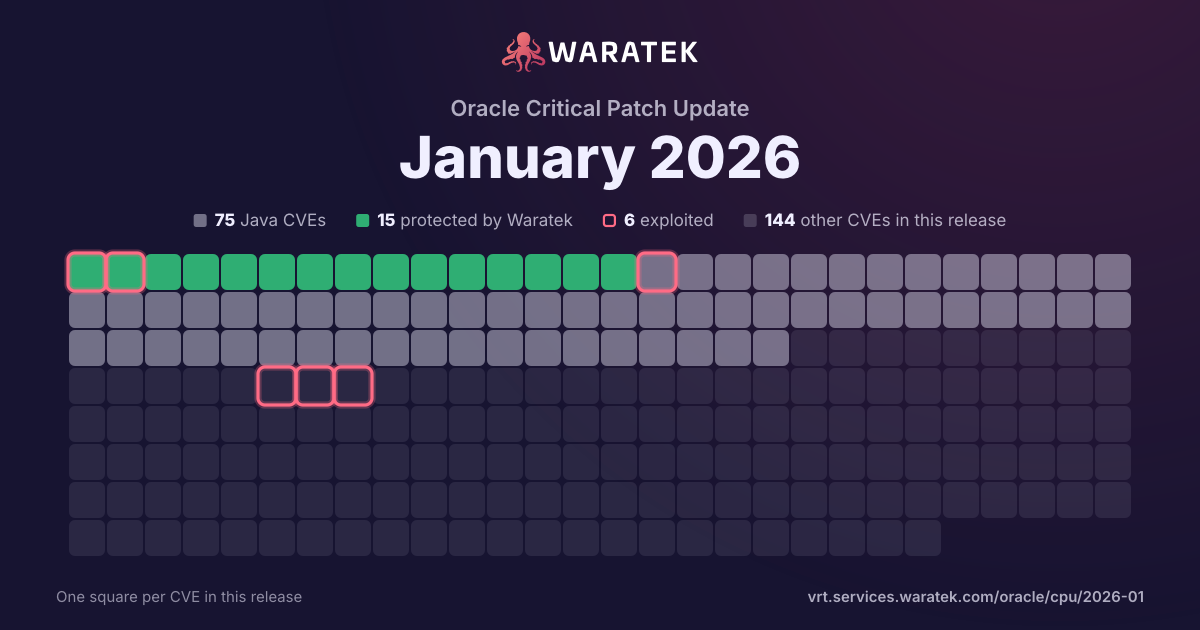
By status
15Protected by Waratek2Mitigation candidate58No exploit published14Outside Waratek scope130Not applicable
6Exploited, marked by the ring
No exploit published. For 26 of them, Oracle's security advisory is the source of public detail.
Protected by Waratek. Waratek RASP can block exploitation of these on systems that have not applied the patch yet.
Overview 22 matches · 0 protected · 0 exploited · 0 CISA KEV · 0 public PoC · 0 EPSS ≥ 0.5
22matches
0protected0.0%
0exploited0.0%
0CISA KEV0.0%
0public PoC0.0%
0EPSS ≥ 0.50.0%
Protected by Waratek
0
0.0%
Rule in development
0
0.0%
Mitigation candidate
0
0.0%
No exploit published
22
100.0%
blocked by ARMR today
0
0.0%
partly blocked
0
0.0%
not blocked
22
100.0%
not established
0
0.0%
unrecorded
0
0.0%
Exploited
0
0.0%
Working exploit published
0
0.0%
Proof of concept only
4
18.2%
Forecast only
0
0.0%
No public exploit
18
81.8%
split by
peak 4 / month
Oct 241
No exploit published1
Medium1
not blocked1
No public exploit1
Nov 240
Dec 240
Jan 250
Feb 251
No exploit published1
Medium1
not blocked1
Proof of concept only1
Mar 251
No exploit published1
High1
not blocked1
No public exploit1
Apr 251
No exploit published1
Medium1
not blocked1
No public exploit1
May 252
No exploit published2
High1
Low1
not blocked2
Proof of concept only1
No public exploit1
Jun 251
No exploit published1
High1
not blocked1
No public exploit1
Jul 252
No exploit published2
Medium2
not blocked2
No public exploit2
Aug 252
No exploit published2
High2
not blocked2
No public exploit2
Sep 254
No exploit published4
High2
Medium1
Low1
not blocked4
Proof of concept only1
No public exploit3
Oct 251
No exploit published1
Medium1
not blocked1
No public exploit1
Nov 251
No exploit published1
High1
not blocked1
No public exploit1
Dec 253
No exploit published3
High1
Medium2
not blocked3
Proof of concept only1
No public exploit2
Jan 262
No exploit published2
High1
Medium1
not blocked2
No public exploit2
Nov 24Jan 25Mar 25May 25Jul 25Sep 25Nov 25Jan 26
| CVE | Severity | Published▾ | Status | Exploitation | Description |
|---|---|---|---|---|---|
| CVE-2026-21978 | Medium | 2026-01-20 | No exploit published | No public exploit | Vulnerability in the Oracle FLEXCUBE Universal Banking product of Oracle Financial Services Applications (component: Relationship Pricing). Supported versions that are affected are 14.0.0.0.0-14.8.0.0.0. Easily exploitable vulnerability allows low privileged attacker with network access via HTTP to compromise Oracle FLEXCUBE Universal Banking. Successful attacks of this vulnerability can result in unauthorized access to critical data or complete access to all Oracle FLEXCUBE Universal Banking accessible data. CVSS 3.1 Base Score 6.5 (Confidentiality impacts). CVSS Vector: (CVSS:3.1/AV:N/AC:L/PR:L/UI:N/S:U/C:H/I:N/A:N). |
| CVE-2026-21973 | High | 2026-01-20 | No exploit published | No public exploit | Vulnerability in the Oracle FLEXCUBE Investor Servicing product of Oracle Financial Services Applications (component: Security Management System). Supported versions that are affected are 14.5.0.15.0, 14.7.0.8.0 and 14.8.0.1.0. Easily exploitable vulnerability allows low privileged attacker with network access via HTTP to compromise Oracle FLEXCUBE Investor Servicing. Successful attacks of this vulnerability can result in unauthorized creation, deletion or modification access to critical data or all Oracle FLEXCUBE Investor Servicing accessible data as well as unauthorized access to critical data or complete access to all Oracle FLEXCUBE Investor Servicing accessible data. CVSS 3.1 Base Score 8.1 (Confidentiality and Integrity impacts). CVSS Vector: (CVSS:3.1/AV:N/AC:L/PR:L/UI:N/S:U/C:H/I:H/A:N). |
| CVE-2025-68161 | Medium | 2025-12-18 | No exploit published | No public exploit | The Socket Appender in Apache Log4j Core versions 2.0-beta9 through 2.25.2 does not perform TLS hostname verification of the peer certificate, even when the verifyHostName https://logging.apache.org/log4j/2.x/manual/appenders/network.html#SslConfiguration-attr-verifyHostName configuration attribute or the log4j2.sslVerifyHostName https://logging.apache.org/log4j/2.x/manual/systemproperties.html#log4j2.sslVerifyHostName system property is set to true. This issue may allow a man-in-the-middle attacker to intercept or redirect log traffic under the following conditions: * The attacker is able to intercept or redirect network traffic between the client and the log receiver. * The attacker can present a server certificate issued by a certification authority trusted by the Socket Appender’s configured trust store (or by the default Java trust store if no custom trust store is configured). Users are advised to upgrade to Apache Log4j Core version 2.25.3, which addresses this issue. As an alternative mitigation, the Socket Appender may be configured to use a private or restricted trust root to limit the set of trusted certificates. |
| CVE-2025-67735 | Medium | 2025-12-16 | No exploit published | Proof of concept only | Netty is an asynchronous, event-driven network application framework. In versions prior to 4.1.129.Final and 4.2.8.Final, the `io.netty.handler.codec.http.HttpRequestEncoder` has a CRLF injection with the request URI when constructing a request. This leads to request smuggling when `HttpRequestEncoder` is used without proper sanitization of the URI. Any application / framework using `HttpRequestEncoder` can be subject to be abused to perform request smuggling using CRLF injection. Versions 4.1.129.Final and 4.2.8.Final fix the issue. |
| CVE-2025-66566 | High | 2025-12-05 | No exploit published | No public exploit | yawkat LZ4 Java provides LZ4 compression for Java. Insufficient clearing of the output buffer in Java-based decompressor implementations in lz4-java 1.10.0 and earlier allows remote attackers to read previous buffer contents via crafted compressed input. In applications where the output buffer is reused without being cleared, this may lead to disclosure of sensitive data. JNI-based implementations are not affected. This vulnerability is fixed in 1.10.1. |
| CVE-2025-12183 | High | 2025-11-28 | No exploit published | No public exploit | Out-of-bounds memory operations in org.lz4:lz4-java 1.8.0 and earlier allow remote attackers to cause denial of service and read adjacent memory via untrusted compressed input. |
| CVE-2025-61795 | Medium | 2025-10-27 | No exploit published | No public exploit | Improper Resource Shutdown or Release vulnerability in Apache Tomcat. If an error occurred (including exceeding limits) during the processing of a multipart upload, temporary copies of the uploaded parts written to disc were not cleaned up immediately but left for the garbage collection process to delete. Depending on JVM settings, application memory usage and application load, it was possible that space for the temporary copies of uploaded parts would be filled faster than GC cleared it, leading to a DoS. This issue affects Apache Tomcat: from 11.0.0-M1 through 11.0.11, from 10.1.0-M1 through 10.1.46, from 9.0.0.M1 through 9.0.109. The following versions were EOL at the time the CVE was created but are known to be affected: 8.5.0 though 8.5.100. Other, older, EOL versions may also be affected. Users are recommended to upgrade to version 11.0.12 or later, 10.1.47 or later or 9.0.110 or later which fixes the issue. |
| CVE-2025-41249 | High | 2025-09-16 | No exploit published | No public exploit | The Spring Framework annotation detection mechanism may not correctly resolve annotations on methods within type hierarchies with a parameterized super type with unbounded generics. This can be an issue if such annotations are used for authorization decisions. Your application may be affected by this if you are using Spring Security's @EnableMethodSecurity feature. You are not affected by this if you are not using @EnableMethodSecurity or if you do not use security annotations on methods in generic superclasses or generic interfaces. This CVE is published in conjunction with CVE-2025-41248 https://spring.io/security/cve-2025-41248 . |
| CVE-2025-41248 | High | 2025-09-16 | No exploit published | No public exploit | The Spring Security annotation detection mechanism may not correctly resolve annotations on methods within type hierarchies with a parameterized super type with unbounded generics. This can be an issue when using @PreAuthorize and other method security annotations, resulting in an authorization bypass. Your application may be affected by this if you are using Spring Security's @EnableMethodSecurity feature. You are not affected by this if you are not using @EnableMethodSecurity or if you do not use security annotations on methods in generic superclasses or generic interfaces. This CVE is published in conjunction with CVE-2025-41249 https://spring.io/security/cve-2025-41249 . |
| CVE-2025-58057 | Medium | 2025-09-04 | No exploit published | Proof of concept only | Netty is an asynchronous event-driven network application framework for rapid development of maintainable high performance protocol servers & clients. In netty-codec-compression versions 4.1.124.Final and below, and netty-codec versions 4.2.4.Final and below, when supplied with specially crafted input, BrotliDecoder and certain other decompression decoders will allocate a large number of reachable byte buffers, which can lead to denial of service. BrotliDecoder.decompress has no limit in how often it calls pull, decompressing data 64K bytes at a time. The buffers are saved in the output list, and remain reachable until OOM is hit. This is fixed in versions 4.1.125.Final of netty-codec and 4.2.5.Final of netty-codec-compression. |
| CVE-2025-58056 | Low | 2025-09-03 | No exploit published | No public exploit | Netty is an asynchronous event-driven network application framework for development of maintainable high performance protocol servers and clients. In versions 4.1.124.Final, and 4.2.0.Alpha3 through 4.2.4.Final, Netty incorrectly accepts standalone newline characters (LF) as a chunk-size line terminator, regardless of a preceding carriage return (CR), instead of requiring CRLF per HTTP/1.1 standards. When combined with reverse proxies that parse LF differently (treating it as part of the chunk extension), attackers can craft requests that the proxy sees as one request but Netty processes as two, enabling request smuggling attacks. This is fixed in versions 4.1.125.Final and 4.2.5.Final. |
| CVE-2025-5115 | High | 2025-08-20 | No exploit published | No public exploit | In Eclipse Jetty, versions <=9.4.57, <=10.0.25, <=11.0.25, <=12.0.21, <=12.1.0.alpha2, an HTTP/2 client may trigger the server to send RST_STREAM frames, for example by sending frames that are malformed or that should not be sent in a particular stream state, therefore forcing the server to consume resources such as CPU and memory. For example, a client can open a stream and then send WINDOW_UPDATE frames with window size increment of 0, which is illegal. Per specification https://www.rfc-editor.org/rfc/rfc9113.html#name-window_update , the server should send a RST_STREAM frame. The client can now open another stream and send another bad WINDOW_UPDATE, therefore causing the server to consume more resources than necessary, as this case does not exceed the max number of concurrent streams, yet the client is able to create an enormous amount of streams in a short period of time. The attack can be performed with other conditions (for example, a DATA frame for a closed stream) that cause the server to send a RST_STREAM frame. Links: * https://github.com/jetty/jetty.project/security/advisories/GHSA-mmxm-8w33-wc4h |
| CVE-2025-48989 | High | 2025-08-13 | No exploit published | No public exploit | Improper Resource Shutdown or Release vulnerability in Apache Tomcat made Tomcat vulnerable to the made you reset attack. This issue affects Apache Tomcat: from 11.0.0-M1 through 11.0.9, from 10.1.0-M1 through 10.1.43 and from 9.0.0.M1 through 9.0.107. Older, EOL versions may also be affected. Users are recommended to upgrade to one of versions 11.0.10, 10.1.44 or 9.0.108 which fix the issue. |
| CVE-2025-48795 | Medium | 2025-07-15 | No exploit published | No public exploit | Apache CXF stores large stream based messages as temporary files on the local filesystem. A bug was introduced which means that the entire temporary file is read into memory and then logged. An attacker might be able to exploit this to cause a denial of service attack by causing an out of memory exception. In addition, it is possible to configure CXF to encrypt temporary files to prevent sensitive credentials from being cached unencrypted on the local filesystem, however this bug means that the cached files are written out to logs unencrypted. Users are recommended to upgrade to versions 3.5.11, 3.6.6, 4.0.7 or 4.1.1, which fixes this issue. |
| CVE-2025-48924 | Medium | 2025-07-11 | No exploit published | No public exploit | Uncontrolled Recursion vulnerability in Apache Commons Lang. This issue affects Apache Commons Lang: Starting with commons-lang:commons-lang 2.0 to 2.6, and, from org.apache.commons:commons-lang3 3.0 before 3.18.0. The methods ClassUtils.getClass(...) can throw StackOverflowError on very long inputs. Because an Error is usually not handled by applications and libraries, a StackOverflowError could cause an application to stop. Users are recommended to upgrade to version 3.18.0, which fixes the issue. |
| CVE-2025-48976 | High | 2025-06-16 | No exploit published | No public exploit | Allocation of resources for multipart headers with insufficient limits enabled a DoS vulnerability in Apache Commons FileUpload. This issue affects Apache Commons FileUpload: from 1.0 before 1.6; from 2.0.0-M1 before 2.0.0-M4. Users are recommended to upgrade to versions 1.6 or 2.0.0-M4, which fix the issue. |
| CVE-2025-48734 | High | 2025-05-28 | No exploit published | Proof of concept only | Improper Access Control vulnerability in Apache Commons. A special BeanIntrospector class was added in version 1.9.2. This can be used to stop attackers from using the declared class property of Java enum objects to get access to the classloader. However this protection was not enabled by default. PropertyUtilsBean (and consequently BeanUtilsBean) now disallows declared class level property access by default. Releases 1.11.0 and 2.0.0-M2 address a potential security issue when accessing enum properties in an uncontrolled way. If an application using Commons BeanUtils passes property paths from an external source directly to the getProperty() method of PropertyUtilsBean, an attacker can access the enum’s class loader via the “declaredClass” property available on all Java “enum” objects. Accessing the enum’s “declaredClass” allows remote attackers to access the ClassLoader and execute arbitrary code. The same issue exists with PropertyUtilsBean.getNestedProperty(). Starting in versions 1.11.0 and 2.0.0-M2 a special BeanIntrospector suppresses the “declaredClass” property. Note that this new BeanIntrospector is enabled by default, but you can disable it to regain the old behavior; see section 2.5 of the user's guide and the unit tests. This issue affects Apache Commons BeanUtils 1.x before 1.11.0, and 2.x before 2.0.0-M2.Users of the artifact commons-beanutils:commons-beanutils 1.x are recommended to upgrade to version 1.11.0, which fixes the issue. Users of the artifact org.apache.commons:commons-beanutils2 2.x are recommended to upgrade to version 2.0.0-M2, which fixes the issue. |
| CVE-2025-22233 | Low | 2025-05-16 | No exploit published | No public exploit | CVE-2024-38820 ensured Locale-independent, lowercase conversion for both the configured disallowedFields patterns and for request parameter names. However, there are still cases where it is possible to bypass the disallowedFields checks. Affected Spring Products and Versions Spring Framework: * 6.2.0 - 6.2.6 * 6.1.0 - 6.1.19 * 6.0.0 - 6.0.27 * 5.3.0 - 5.3.42 * Older, unsupported versions are also affected Mitigation Users of affected versions should upgrade to the corresponding fixed version. Affected version(s)Fix Version Availability 6.2.x 6.2.7 OSS6.1.x 6.1.20 OSS6.0.x 6.0.28 Commercial https://enterprise.spring.io/ 5.3.x 5.3.43 Commercial https://enterprise.spring.io/ No further mitigation steps are necessary. Generally, we recommend using a dedicated model object with properties only for data binding, or using constructor binding since constructor arguments explicitly declare what to bind together with turning off setter binding through the declarativeBinding flag. See the Model Design section in the reference documentation. For setting binding, prefer the use of allowedFields (an explicit list) over disallowedFields. Credit This issue was responsibly reported by the TERASOLUNA Framework Development Team from NTT DATA Group Corporation. |
| CVE-2025-31672 | Medium | 2025-04-09 | No exploit published | No public exploit | Improper Input Validation vulnerability in Apache POI. The issue affects the parsing of OOXML format files like xlsx, docx and pptx. These file formats are basically zip files and it is possible for malicious users to add zip entries with duplicate names (including the path) in the zip. In this case, products reading the affected file could read different data because 1 of the zip entries with the duplicate name is selected over another but different products may choose a different zip entry. This issue affects Apache POI poi-ooxml before 5.4.0. poi-ooxml 5.4.0 has a check that throws an exception if zip entries with duplicate file names are found in the input file. Users are recommended to upgrade to version poi-ooxml 5.4.0, which fixes the issue. Please read https://poi.apache.org/security.html for recommendations about how to use the POI libraries securely. |
| CVE-2025-22228 | High | 2025-03-20 | No exploit published | No public exploit | BCryptPasswordEncoder.matches(CharSequence,String) will incorrectly return true for passwords larger than 72 characters as long as the first 72 characters are the same. |
| CVE-2025-25193 | Medium | 2025-02-10 | No exploit published | Proof of concept only | Netty, an asynchronous, event-driven network application framework, has a vulnerability in versions up to and including 4.1.118.Final. An unsafe reading of environment file could potentially cause a denial of service in Netty. When loaded on an Windows application, Netty attempts to load a file that does not exist. If an attacker creates such a large file, the Netty application crash. A similar issue was previously reported as CVE-2024-47535. This issue was fixed, but the fix was incomplete in that null-bytes were not counted against the input limit. Commit d1fbda62d3a47835d3fb35db8bd42ecc205a5386 contains an updated fix. |
| CVE-2024-47554 | Medium | 2024-10-03 | No exploit published | No public exploit | Uncontrolled Resource Consumption vulnerability in Apache Commons IO. The org.apache.commons.io.input.XmlStreamReader class may excessively consume CPU resources when processing maliciously crafted input. This issue affects Apache Commons IO: from 2.0 before 2.14.0. Users are recommended to upgrade to version 2.14.0 or later, which fixes the issue. |