
Oracle Critical Patch Update October 2025
Released October 2025 · Oracle's advisory ↗ · ← Critical Patch Update, July 2025 · Critical Patch Update, January 2026 →
234 CVEs in this release, one square each
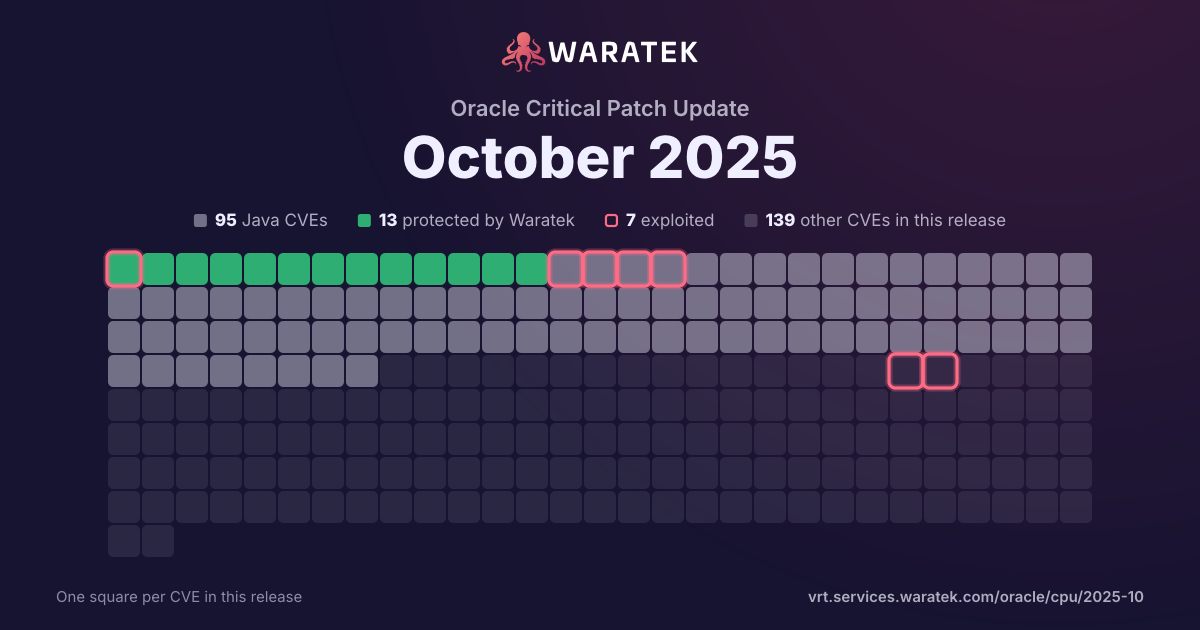
By status
13Protected by Waratek5Mitigation candidate77No exploit published15Outside Waratek scope124Not applicable
7Exploited, marked by the ring
No exploit published. For 36 of them, Oracle's security advisory is the source of public detail.
Protected by Waratek. Waratek RASP can block exploitation of these on systems that have not applied the patch yet.
Overview 234 matches · 95 in Waratek scope · 13 protected · 7 exploited · 3 CISA KEV · 13 public PoC · 8 EPSS ≥ 0.5
234matches
95in Waratek scope40.6%
13protected5.6%
7exploited3.0%
3CISA KEV1.3%
13public PoC5.6%
8EPSS ≥ 0.53.4%
Protected by Waratek
13
5.6%
Rule in development
0
0.0%
Mitigation candidate
5
2.1%
No exploit published
77
32.9%
Outside Waratek scope
15
6.4%
Not applicable
124
53.0%
Withdrawn CVE
0
0.0%
blocked by ARMR today
13
5.6%
partly blocked
0
0.0%
not blocked
219
93.6%
not established
2
0.9%
unrecorded
0
0.0%
split by
peak 76 / quarter
Q4 203
Protected by Waratek2
Outside Waratek scope1
Medium3
blocked by ARMR today2
not blocked1
No public exploit3
Q1 211
No exploit published1
High1
not blocked1
No public exploit1
Q2 212
No exploit published1
Not applicable1
High1
Medium1
not blocked2
Proof of concept only1
Forecast only1
Q3 212
Outside Waratek scope2
Critical1
High1
not blocked2
Forecast only1
No public exploit1
Q4 210
Q1 221
No exploit published1
Medium1
not blocked1
No public exploit1
Q2 222
Protected by Waratek1
No exploit published1
High1
Medium1
blocked by ARMR today1
not blocked1
No public exploit2
Q3 220
Q4 220
Q1 230
Q2 236
No exploit published1
Not applicable5
High1
Medium5
not blocked6
Proof of concept only1
No public exploit5
Q3 230
Q4 233
No exploit published2
Not applicable1
Critical1
High1
Medium1
not blocked3
No public exploit3
Q1 242
Outside Waratek scope1
Not applicable1
Critical1
Medium1
not blocked2
Proof of concept only1
No public exploit1
Q2 245
Not applicable5
Critical1
High2
Medium2
not blocked5
Forecast only1
No public exploit4
Q3 246
No exploit published2
Not applicable4
High2
Medium4
not blocked6
Proof of concept only1
No public exploit5
Q4 2411
Protected by Waratek3
No exploit published4
Outside Waratek scope2
Not applicable2
Critical3
High4
Medium4
blocked by ARMR today3
not blocked8
Working exploit published1
No public exploit10
Q1 2516
Protected by Waratek2
No exploit published4
Not applicable10
Critical1
High9
Medium5
Low1
blocked by ARMR today2
not blocked14
Exploited1
Proof of concept only3
No public exploit12
Q2 2543
Protected by Waratek3
Mitigation candidate2
No exploit published11
Outside Waratek scope2
Not applicable25
Critical4
High22
Medium15
Low2
blocked by ARMR today3
not blocked40
Exploited1
Working exploit published2
Proof of concept only12
No public exploit28
Q3 2555
Mitigation candidate1
No exploit published15
Outside Waratek scope2
Not applicable37
High27
Medium25
Low3
not blocked55
Exploited2
Working exploit published2
Proof of concept only7
No public exploit44
Q4 2576
Protected by Waratek2
Mitigation candidate2
No exploit published34
Outside Waratek scope5
Not applicable33
Critical4
High16
Medium50
Low6
blocked by ARMR today2
not blocked72
not established2
Exploited3
No public exploit73
Q4 20Q2 21Q4 21Q2 22Q4 22Q2 23Q4 23Q2 24Q4 24Q2 25Q4 25
| CVE | Severity | Published▾ | Status | Exploitation | Description |
|---|---|---|---|---|---|
| CVE-2025-62641 | High | 2025-10-21 | Not applicable | No public exploit | Vulnerability in the Oracle VM VirtualBox product of Oracle Virtualization (component: Core). Supported versions that are affected are 7.1.12 and 7.2.2. Easily exploitable vulnerability allows high privileged attacker with logon to the infrastructure where Oracle VM VirtualBox executes to compromise Oracle VM VirtualBox. While the vulnerability is in Oracle VM VirtualBox, attacks may significantly impact additional products (scope change). Successful attacks of this vulnerability can result in takeover of Oracle VM VirtualBox. CVSS 3.1 Base Score 8.2 (Confidentiality, Integrity and Availability impacts). CVSS Vector: (CVSS:3.1/AV:L/AC:L/PR:H/UI:N/S:C/C:H/I:H/A:H). |
| CVE-2025-62592 | Medium | 2025-10-21 | Not applicable | No public exploit | Vulnerability in the Oracle VM VirtualBox product of Oracle Virtualization (component: Core). Supported versions that are affected are 7.1.12 and 7.2.2. Easily exploitable vulnerability allows high privileged attacker with logon to the infrastructure where Oracle VM VirtualBox executes to compromise Oracle VM VirtualBox. While the vulnerability is in Oracle VM VirtualBox, attacks may significantly impact additional products (scope change). Successful attacks of this vulnerability can result in unauthorized access to critical data or complete access to all Oracle VM VirtualBox accessible data. CVSS 3.1 Base Score 6.0 (Confidentiality impacts). CVSS Vector: (CVSS:3.1/AV:L/AC:L/PR:H/UI:N/S:C/C:H/I:N/A:N). |
| CVE-2025-62591 | Medium | 2025-10-21 | Not applicable | No public exploit | Vulnerability in the Oracle VM VirtualBox product of Oracle Virtualization (component: Core). Supported versions that are affected are 7.1.12 and 7.2.2. Easily exploitable vulnerability allows high privileged attacker with logon to the infrastructure where Oracle VM VirtualBox executes to compromise Oracle VM VirtualBox. While the vulnerability is in Oracle VM VirtualBox, attacks may significantly impact additional products (scope change). Successful attacks of this vulnerability can result in unauthorized access to critical data or complete access to all Oracle VM VirtualBox accessible data. CVSS 3.1 Base Score 6.0 (Confidentiality impacts). CVSS Vector: (CVSS:3.1/AV:L/AC:L/PR:H/UI:N/S:C/C:H/I:N/A:N). |
| CVE-2025-62590 | High | 2025-10-21 | Not applicable | No public exploit | Vulnerability in the Oracle VM VirtualBox product of Oracle Virtualization (component: Core). Supported versions that are affected are 7.1.12 and 7.2.2. Easily exploitable vulnerability allows high privileged attacker with logon to the infrastructure where Oracle VM VirtualBox executes to compromise Oracle VM VirtualBox. While the vulnerability is in Oracle VM VirtualBox, attacks may significantly impact additional products (scope change). Successful attacks of this vulnerability can result in takeover of Oracle VM VirtualBox. CVSS 3.1 Base Score 8.2 (Confidentiality, Integrity and Availability impacts). CVSS Vector: (CVSS:3.1/AV:L/AC:L/PR:H/UI:N/S:C/C:H/I:H/A:H). |
| CVE-2025-62589 | High | 2025-10-21 | Not applicable | No public exploit | Vulnerability in the Oracle VM VirtualBox product of Oracle Virtualization (component: Core). Supported versions that are affected are 7.1.12 and 7.2.2. Easily exploitable vulnerability allows high privileged attacker with logon to the infrastructure where Oracle VM VirtualBox executes to compromise Oracle VM VirtualBox. While the vulnerability is in Oracle VM VirtualBox, attacks may significantly impact additional products (scope change). Successful attacks of this vulnerability can result in takeover of Oracle VM VirtualBox. CVSS 3.1 Base Score 8.2 (Confidentiality, Integrity and Availability impacts). CVSS Vector: (CVSS:3.1/AV:L/AC:L/PR:H/UI:N/S:C/C:H/I:H/A:H). |
| CVE-2025-62588 | High | 2025-10-21 | Not applicable | No public exploit | Vulnerability in the Oracle VM VirtualBox product of Oracle Virtualization (component: Core). Supported versions that are affected are 7.1.12 and 7.2.2. Easily exploitable vulnerability allows high privileged attacker with logon to the infrastructure where Oracle VM VirtualBox executes to compromise Oracle VM VirtualBox. While the vulnerability is in Oracle VM VirtualBox, attacks may significantly impact additional products (scope change). Successful attacks of this vulnerability can result in takeover of Oracle VM VirtualBox. CVSS 3.1 Base Score 8.2 (Confidentiality, Integrity and Availability impacts). CVSS Vector: (CVSS:3.1/AV:L/AC:L/PR:H/UI:N/S:C/C:H/I:H/A:H). |
| CVE-2025-62587 | High | 2025-10-21 | Not applicable | No public exploit | Vulnerability in the Oracle VM VirtualBox product of Oracle Virtualization (component: Core). Supported versions that are affected are 7.1.12 and 7.2.2. Easily exploitable vulnerability allows high privileged attacker with logon to the infrastructure where Oracle VM VirtualBox executes to compromise Oracle VM VirtualBox. While the vulnerability is in Oracle VM VirtualBox, attacks may significantly impact additional products (scope change). Successful attacks of this vulnerability can result in takeover of Oracle VM VirtualBox. CVSS 3.1 Base Score 8.2 (Confidentiality, Integrity and Availability impacts). CVSS Vector: (CVSS:3.1/AV:L/AC:L/PR:H/UI:N/S:C/C:H/I:H/A:H). |
| CVE-2025-62481 | Critical | 2025-10-21 | Mitigation candidate | Exploited | Vulnerability in the Oracle Marketing product of Oracle E-Business Suite (component: Marketing Administration). Supported versions that are affected are 12.2.3-12.2.14. Easily exploitable vulnerability allows unauthenticated attacker with network access via HTTP to compromise Oracle Marketing. Successful attacks of this vulnerability can result in takeover of Oracle Marketing. CVSS 3.1 Base Score 9.8 (Confidentiality, Integrity and Availability impacts). CVSS Vector: (CVSS:3.1/AV:N/AC:L/PR:N/UI:N/S:U/C:H/I:H/A:H). |
| CVE-2025-62480 | Low | 2025-10-21 | Not applicable | No public exploit | Vulnerability in the Oracle ZFS Storage Appliance Kit product of Oracle Systems (component: Naming Subsystem). The supported version that is affected is 8.8. Easily exploitable vulnerability allows high privileged attacker with network access via HTTP to compromise Oracle ZFS Storage Appliance Kit. Successful attacks of this vulnerability can result in unauthorized ability to cause a partial denial of service (partial DOS) of Oracle ZFS Storage Appliance Kit. CVSS 3.1 Base Score 2.7 (Availability impacts). CVSS Vector: (CVSS:3.1/AV:N/AC:L/PR:H/UI:N/S:U/C:N/I:N/A:L). |
| CVE-2025-62479 | Low | 2025-10-21 | Not applicable | No public exploit | Vulnerability in the Oracle ZFS Storage Appliance Kit product of Oracle Systems (component: Block Storage). The supported version that is affected is 8.8. Easily exploitable vulnerability allows high privileged attacker with network access via HTTP to compromise Oracle ZFS Storage Appliance Kit. Successful attacks of this vulnerability can result in unauthorized ability to cause a partial denial of service (partial DOS) of Oracle ZFS Storage Appliance Kit. CVSS 3.1 Base Score 2.7 (Availability impacts). CVSS Vector: (CVSS:3.1/AV:N/AC:L/PR:H/UI:N/S:U/C:N/I:N/A:L). |
| CVE-2025-62478 | Medium | 2025-10-21 | Not applicable | No public exploit | Vulnerability in the Oracle ZFS Storage Appliance Kit product of Oracle Systems (component: Object Store). The supported version that is affected is 8.8. Easily exploitable vulnerability allows high privileged attacker with network access via HTTP to compromise Oracle ZFS Storage Appliance Kit. Successful attacks of this vulnerability can result in unauthorized ability to cause a hang or frequently repeatable crash (complete DOS) of Oracle ZFS Storage Appliance Kit. CVSS 3.1 Base Score 4.9 (Availability impacts). CVSS Vector: (CVSS:3.1/AV:N/AC:L/PR:H/UI:N/S:U/C:N/I:N/A:H). |
| CVE-2025-62477 | Medium | 2025-10-21 | Not applicable | No public exploit | Vulnerability in the Oracle ZFS Storage Appliance Kit product of Oracle Systems (component: Remote Replication). The supported version that is affected is 8.8. Easily exploitable vulnerability allows high privileged attacker with network access via HTTP to compromise Oracle ZFS Storage Appliance Kit. Successful attacks of this vulnerability can result in unauthorized ability to cause a hang or frequently repeatable crash (complete DOS) of Oracle ZFS Storage Appliance Kit. CVSS 3.1 Base Score 4.9 (Availability impacts). CVSS Vector: (CVSS:3.1/AV:N/AC:L/PR:H/UI:N/S:U/C:N/I:N/A:H). |
| CVE-2025-62476 | Medium | 2025-10-21 | Not applicable | No public exploit | Vulnerability in the Oracle ZFS Storage Appliance Kit product of Oracle Systems (component: Remote Replication). The supported version that is affected is 8.8. Easily exploitable vulnerability allows high privileged attacker with network access via HTTP to compromise Oracle ZFS Storage Appliance Kit. Successful attacks of this vulnerability can result in unauthorized ability to cause a hang or frequently repeatable crash (complete DOS) of Oracle ZFS Storage Appliance Kit. CVSS 3.1 Base Score 4.9 (Availability impacts). CVSS Vector: (CVSS:3.1/AV:N/AC:L/PR:H/UI:N/S:U/C:N/I:N/A:H). |
| CVE-2025-62475 | Medium | 2025-10-21 | Not applicable | No public exploit | Vulnerability in the Oracle ZFS Storage Appliance Kit product of Oracle Systems (component: Core). The supported version that is affected is 8.8. Easily exploitable vulnerability allows high privileged attacker with network access via HTTP to compromise Oracle ZFS Storage Appliance Kit. Successful attacks of this vulnerability can result in unauthorized ability to cause a hang or frequently repeatable crash (complete DOS) of Oracle ZFS Storage Appliance Kit. CVSS 3.1 Base Score 4.9 (Availability impacts). CVSS Vector: (CVSS:3.1/AV:N/AC:L/PR:H/UI:N/S:U/C:N/I:N/A:H). |
| CVE-2025-62290 | High | 2025-10-21 | Not applicable | No public exploit | Vulnerability in the Oracle ZFS Storage Appliance Kit product of Oracle Systems (component: Block Storage). The supported version that is affected is 8.8. Easily exploitable vulnerability allows high privileged attacker with network access via HTTP to compromise Oracle ZFS Storage Appliance Kit. Successful attacks of this vulnerability can result in takeover of Oracle ZFS Storage Appliance Kit. CVSS 3.1 Base Score 7.2 (Confidentiality, Integrity and Availability impacts). CVSS Vector: (CVSS:3.1/AV:N/AC:L/PR:H/UI:N/S:U/C:H/I:H/A:H). |
| CVE-2025-62289 | Medium | 2025-10-21 | Not applicable | No public exploit | Vulnerability in the Oracle ZFS Storage Appliance Kit product of Oracle Systems (component: Filesystems). The supported version that is affected is 8.8. Easily exploitable vulnerability allows high privileged attacker with network access via HTTP to compromise Oracle ZFS Storage Appliance Kit. Successful attacks of this vulnerability can result in unauthorized ability to cause a hang or frequently repeatable crash (complete DOS) of Oracle ZFS Storage Appliance Kit. CVSS 3.1 Base Score 4.9 (Availability impacts). CVSS Vector: (CVSS:3.1/AV:N/AC:L/PR:H/UI:N/S:U/C:N/I:N/A:H). |
| CVE-2025-62288 | Medium | 2025-10-21 | No exploit published | No public exploit | Vulnerability in the Oracle Health Sciences Data Management Workbench product of Oracle Health Sciences Applications (component: Logger). Supported versions that are affected are 3.4.0.1.3 and 3.4.1.0.10. Easily exploitable vulnerability allows high privileged attacker with network access via HTTP to compromise Oracle Health Sciences Data Management Workbench. Successful attacks of this vulnerability can result in unauthorized access to critical data or complete access to all Oracle Health Sciences Data Management Workbench accessible data. CVSS 3.1 Base Score 4.9 (Confidentiality impacts). CVSS Vector: (CVSS:3.1/AV:N/AC:L/PR:H/UI:N/S:U/C:H/I:N/A:N). |
| CVE-2025-62287 | Medium | 2025-10-21 | No exploit published | No public exploit | Vulnerability in the Oracle Life Sciences InForm product of Oracle Health Sciences Applications (component: Web Server). The supported version that is affected is 7.0.1.0. Easily exploitable vulnerability allows unauthenticated attacker with network access via HTTP to compromise Oracle Life Sciences InForm. Successful attacks require human interaction from a person other than the attacker and while the vulnerability is in Oracle Life Sciences InForm, attacks may significantly impact additional products (scope change). Successful attacks of this vulnerability can result in unauthorized update, insert or delete access to some of Oracle Life Sciences InForm accessible data as well as unauthorized read access to a subset of Oracle Life Sciences InForm accessible data. CVSS 3.1 Base Score 6.1 (Confidentiality and Integrity impacts). CVSS Vector: (CVSS:3.1/AV:N/AC:L/PR:N/UI:R/S:C/C:L/I:L/A:N). |
| CVE-2025-61885 | Medium | 2025-10-21 | No exploit published | No public exploit | Vulnerability in the Oracle Life Sciences InForm product of Oracle Health Sciences Applications (component: Web Server). The supported version that is affected is 7.0.1.0. Easily exploitable vulnerability allows low privileged attacker with network access via HTTP to compromise Oracle Life Sciences InForm. Successful attacks of this vulnerability can result in unauthorized read access to a subset of Oracle Life Sciences InForm accessible data. CVSS 3.1 Base Score 4.3 (Confidentiality impacts). CVSS Vector: (CVSS:3.1/AV:N/AC:L/PR:L/UI:N/S:U/C:L/I:N/A:N). |
| CVE-2025-61881 | Medium | 2025-10-21 | Not applicable | No public exploit | Vulnerability in the Java VM component of Oracle Database Server. Supported versions that are affected are 19.3-19.28, 21.3-21.19 and 23.4-23.9. Difficult to exploit vulnerability allows unauthenticated attacker with network access via Oracle Net to compromise Java VM. Successful attacks of this vulnerability can result in unauthorized creation, deletion or modification access to critical data or all Java VM accessible data. CVSS 3.1 Base Score 5.9 (Integrity impacts). CVSS Vector: (CVSS:3.1/AV:N/AC:H/PR:N/UI:N/S:U/C:N/I:H/A:N). |
| CVE-2025-61764 | Medium | 2025-10-21 | Outside Waratek scope | No public exploit | Vulnerability in the Oracle WebLogic Server product of Oracle Fusion Middleware (component: Core). Supported versions that are affected are 12.2.1.4.0, 14.1.1.0.0 and 14.1.2.0.0. Easily exploitable vulnerability allows unauthenticated attacker with network access via HTTP to compromise Oracle WebLogic Server. Successful attacks of this vulnerability can result in unauthorized read access to a subset of Oracle WebLogic Server accessible data. CVSS 3.1 Base Score 5.3 (Confidentiality impacts). CVSS Vector: (CVSS:3.1/AV:N/AC:L/PR:N/UI:N/S:U/C:L/I:N/A:N). |
| CVE-2025-61763 | High | 2025-10-21 | No exploit published | No public exploit | Vulnerability in Oracle Essbase (component: Essbase Web Platform). The supported version that is affected is 21.7.3.0.0. Easily exploitable vulnerability allows low privileged attacker with network access via HTTP to compromise Oracle Essbase. Successful attacks of this vulnerability can result in unauthorized creation, deletion or modification access to critical data or all Oracle Essbase accessible data as well as unauthorized access to critical data or complete access to all Oracle Essbase accessible data. CVSS 3.1 Base Score 8.1 (Confidentiality and Integrity impacts). CVSS Vector: (CVSS:3.1/AV:N/AC:L/PR:L/UI:N/S:U/C:H/I:H/A:N). |
| CVE-2025-61762 | Medium | 2025-10-21 | No exploit published | No public exploit | Vulnerability in the PeopleSoft Enterprise FIN Payables product of Oracle PeopleSoft (component: Payables). The supported version that is affected is 9.2. Easily exploitable vulnerability allows low privileged attacker with network access via HTTP to compromise PeopleSoft Enterprise FIN Payables. Successful attacks of this vulnerability can result in unauthorized update, insert or delete access to some of PeopleSoft Enterprise FIN Payables accessible data as well as unauthorized read access to a subset of PeopleSoft Enterprise FIN Payables accessible data and unauthorized ability to cause a partial denial of service (partial DOS) of PeopleSoft Enterprise FIN Payables. CVSS 3.1 Base Score 6.3 (Confidentiality, Integrity and Availability impacts). CVSS Vector: (CVSS:3.1/AV:N/AC:L/PR:L/UI:N/S:U/C:L/I:L/A:L). |
| CVE-2025-61761 | Medium | 2025-10-21 | No exploit published | No public exploit | Vulnerability in the PeopleSoft Enterprise FIN Maintenance Management product of Oracle PeopleSoft (component: Work Order Management). The supported version that is affected is 9.2. Easily exploitable vulnerability allows low privileged attacker with network access via HTTP to compromise PeopleSoft Enterprise FIN Maintenance Management. Successful attacks of this vulnerability can result in unauthorized update, insert or delete access to some of PeopleSoft Enterprise FIN Maintenance Management accessible data as well as unauthorized read access to a subset of PeopleSoft Enterprise FIN Maintenance Management accessible data. CVSS 3.1 Base Score 5.4 (Confidentiality and Integrity impacts). CVSS Vector: (CVSS:3.1/AV:N/AC:L/PR:L/UI:N/S:U/C:L/I:L/A:N). |
| CVE-2025-61760 | High | 2025-10-21 | Not applicable | No public exploit | Vulnerability in the Oracle VM VirtualBox product of Oracle Virtualization (component: Core). Supported versions that are affected are 7.1.12 and 7.2.2. Difficult to exploit vulnerability allows low privileged attacker with logon to the infrastructure where Oracle VM VirtualBox executes to compromise Oracle VM VirtualBox. Successful attacks require human interaction from a person other than the attacker and while the vulnerability is in Oracle VM VirtualBox, attacks may significantly impact additional products (scope change). Successful attacks of this vulnerability can result in takeover of Oracle VM VirtualBox. CVSS 3.1 Base Score 7.5 (Confidentiality, Integrity and Availability impacts). CVSS Vector: (CVSS:3.1/AV:L/AC:H/PR:L/UI:R/S:C/C:H/I:H/A:H). |
| CVE-2025-61759 | Medium | 2025-10-21 | Not applicable | No public exploit | Vulnerability in the Oracle VM VirtualBox product of Oracle Virtualization (component: Core). Supported versions that are affected are 7.1.12 and 7.2.2. Easily exploitable vulnerability allows low privileged attacker with logon to the infrastructure where Oracle VM VirtualBox executes to compromise Oracle VM VirtualBox. While the vulnerability is in Oracle VM VirtualBox, attacks may significantly impact additional products (scope change). Successful attacks of this vulnerability can result in unauthorized access to critical data or complete access to all Oracle VM VirtualBox accessible data. CVSS 3.1 Base Score 6.5 (Confidentiality impacts). CVSS Vector: (CVSS:3.1/AV:L/AC:L/PR:L/UI:N/S:C/C:H/I:N/A:N). |
| CVE-2025-61758 | Medium | 2025-10-21 | No exploit published | No public exploit | Vulnerability in the PeopleSoft Enterprise FIN IT Asset Management product of Oracle PeopleSoft (component: IT Asset Management). The supported version that is affected is 9.2. Easily exploitable vulnerability allows low privileged attacker with network access via HTTP to compromise PeopleSoft Enterprise FIN IT Asset Management. Successful attacks of this vulnerability can result in unauthorized access to critical data or complete access to all PeopleSoft Enterprise FIN IT Asset Management accessible data. CVSS 3.1 Base Score 6.5 (Confidentiality impacts). CVSS Vector: (CVSS:3.1/AV:N/AC:L/PR:L/UI:N/S:U/C:H/I:N/A:N). |
| CVE-2025-61757 | Critical | 2025-10-21 | Protected by Waratek | Exploited | Vulnerability in the Identity Manager product of Oracle Fusion Middleware (component: REST WebServices). Supported versions that are affected are 12.2.1.4.0 and 14.1.2.1.0. Easily exploitable vulnerability allows unauthenticated attacker with network access via HTTP to compromise Identity Manager. Successful attacks of this vulnerability can result in takeover of Identity Manager. CVSS 3.1 Base Score 9.8 (Confidentiality, Integrity and Availability impacts). CVSS Vector: (CVSS:3.1/AV:N/AC:L/PR:N/UI:N/S:U/C:H/I:H/A:H). |
| CVE-2025-61756 | High | 2025-10-21 | No exploit published | No public exploit | Vulnerability in the Oracle Financial Services Analytical Applications Infrastructure product of Oracle Financial Services Applications (component: System Configuration). Supported versions that are affected are 8.0.7.9, 8.0.8.7 and 8.1.2.5. Easily exploitable vulnerability allows unauthenticated attacker with network access via HTTP to compromise Oracle Financial Services Analytical Applications Infrastructure. Successful attacks of this vulnerability can result in unauthorized ability to cause a hang or frequently repeatable crash (complete DOS) of Oracle Financial Services Analytical Applications Infrastructure. CVSS 3.1 Base Score 7.5 (Availability impacts). CVSS Vector: (CVSS:3.1/AV:N/AC:L/PR:N/UI:N/S:U/C:N/I:N/A:H). |
| CVE-2025-61755 | Low | 2025-10-21 | Outside Waratek scope | No public exploit | Vulnerability in the Oracle GraalVM for JDK product of Oracle Java SE (component: Compiler). Supported versions that are affected are Oracle GraalVM for JDK: 17.0.16 and 21.0.8. Difficult to exploit vulnerability allows unauthenticated attacker with network access via multiple protocols to compromise Oracle GraalVM for JDK. Successful attacks of this vulnerability can result in unauthorized read access to a subset of Oracle GraalVM for JDK accessible data. CVSS 3.1 Base Score 3.7 (Confidentiality impacts). CVSS Vector: (CVSS:3.1/AV:N/AC:H/PR:N/UI:N/S:U/C:L/I:N/A:N). |
| CVE-2025-61754 | Medium | 2025-10-21 | No exploit published | No public exploit | Vulnerability in the Oracle BI Publisher product of Oracle Analytics (component: Web Service API). Supported versions that are affected are 7.6.0.0.0 and 8.2.0.0.0. Easily exploitable vulnerability allows low privileged attacker with network access via HTTP to compromise Oracle BI Publisher. Successful attacks of this vulnerability can result in unauthorized access to critical data or complete access to all Oracle BI Publisher accessible data. CVSS 3.1 Base Score 6.5 (Confidentiality impacts). CVSS Vector: (CVSS:3.1/AV:N/AC:L/PR:L/UI:N/S:U/C:H/I:N/A:N). |
| CVE-2025-61753 | Medium | 2025-10-21 | No exploit published | No public exploit | Vulnerability in the Oracle Scripting product of Oracle E-Business Suite (component: Miscellaneous). Supported versions that are affected are 12.2.3-12.2.14. Easily exploitable vulnerability allows unauthenticated attacker with network access via HTTP to compromise Oracle Scripting. Successful attacks require human interaction from a person other than the attacker and while the vulnerability is in Oracle Scripting, attacks may significantly impact additional products (scope change). Successful attacks of this vulnerability can result in unauthorized update, insert or delete access to some of Oracle Scripting accessible data as well as unauthorized read access to a subset of Oracle Scripting accessible data. CVSS 3.1 Base Score 6.1 (Confidentiality and Integrity impacts). CVSS Vector: (CVSS:3.1/AV:N/AC:L/PR:N/UI:R/S:C/C:L/I:L/A:N). |
| CVE-2025-61752 | High | 2025-10-21 | Outside Waratek scope | No public exploit | Vulnerability in the Oracle WebLogic Server product of Oracle Fusion Middleware (component: Core). Supported versions that are affected are 14.1.1.0.0 and 14.1.2.0.0. Easily exploitable vulnerability allows unauthenticated attacker with network access via HTTP/2 to compromise Oracle WebLogic Server. Successful attacks of this vulnerability can result in unauthorized ability to cause a hang or frequently repeatable crash (complete DOS) of Oracle WebLogic Server. CVSS 3.1 Base Score 7.5 (Availability impacts). CVSS Vector: (CVSS:3.1/AV:N/AC:L/PR:N/UI:N/S:U/C:N/I:N/A:H). |
| CVE-2025-61751 | High | 2025-10-21 | No exploit published | No public exploit | Vulnerability in the Oracle Financial Services Analytical Applications Infrastructure product of Oracle Financial Services Applications (component: Platform). Supported versions that are affected are 8.0.7.9, 8.0.8.7 and 8.1.2.5. Easily exploitable vulnerability allows low privileged attacker with network access via HTTP to compromise Oracle Financial Services Analytical Applications Infrastructure. Successful attacks of this vulnerability can result in unauthorized creation, deletion or modification access to critical data or all Oracle Financial Services Analytical Applications Infrastructure accessible data as well as unauthorized access to critical data or complete access to all Oracle Financial Services Analytical Applications Infrastructure accessible data. CVSS 3.1 Base Score 8.1 (Confidentiality and Integrity impacts). CVSS Vector: (CVSS:3.1/AV:N/AC:L/PR:L/UI:N/S:U/C:H/I:H/A:N). |
| CVE-2025-61750 | Medium | 2025-10-21 | No exploit published | No public exploit | Vulnerability in the PeopleSoft Enterprise PeopleTools product of Oracle PeopleSoft (component: Query). Supported versions that are affected are 8.61 and 8.62. Easily exploitable vulnerability allows low privileged attacker with network access via HTTP to compromise PeopleSoft Enterprise PeopleTools. Successful attacks of this vulnerability can result in unauthorized read access to a subset of PeopleSoft Enterprise PeopleTools accessible data. CVSS 3.1 Base Score 4.3 (Confidentiality impacts). CVSS Vector: (CVSS:3.1/AV:N/AC:L/PR:L/UI:N/S:U/C:L/I:N/A:N). |
| CVE-2025-61749 | Low | 2025-10-21 | Not applicable | No public exploit | Vulnerability in the Unified Audit component of Oracle Database Server. Supported versions that are affected are 23.4-23.9. Easily exploitable vulnerability allows high privileged attacker having DBA privilege with network access via Oracle Net to compromise Unified Audit. Successful attacks of this vulnerability can result in unauthorized update, insert or delete access to some of Unified Audit accessible data. CVSS 3.1 Base Score 2.7 (Integrity impacts). CVSS Vector: (CVSS:3.1/AV:N/AC:L/PR:H/UI:N/S:U/C:N/I:L/A:N). |
| CVE-2025-61748 | Low | 2025-10-21 | Outside Waratek scope | No public exploit | Vulnerability in the Oracle Java SE, Oracle GraalVM for JDK, Oracle GraalVM Enterprise Edition product of Oracle Java SE (component: Libraries). Supported versions that are affected are Oracle Java SE: 21.0.8 and 25; Oracle GraalVM for JDK: 21.0.8; Oracle GraalVM Enterprise Edition: 21.3.15. Difficult to exploit vulnerability allows unauthenticated attacker with network access via multiple protocols to compromise Oracle Java SE, Oracle GraalVM for JDK, Oracle GraalVM Enterprise Edition. Successful attacks of this vulnerability can result in unauthorized update, insert or delete access to some of Oracle Java SE, Oracle GraalVM for JDK, Oracle GraalVM Enterprise Edition accessible data. Note: This vulnerability can be exploited by using APIs in the specified Component, e.g., through a web service which supplies data to the APIs. This vulnerability also applies to Java deployments, typically in clients running sandboxed Java Web Start applications or sandboxed Java applets, that load and run untrusted code (e.g., code that comes from the internet) and rely on the Java sandbox for security. CVSS 3.1 Base Score 3.7 (Integrity impacts). CVSS Vector: (CVSS:3.1/AV:N/AC:H/PR:N/UI:N/S:U/C:N/I:L/A:N). |
| CVE-2025-53072 | Critical | 2025-10-21 | Mitigation candidate | Exploited | Vulnerability in the Oracle Marketing product of Oracle E-Business Suite (component: Marketing Administration). Supported versions that are affected are 12.2.3-12.2.14. Easily exploitable vulnerability allows unauthenticated attacker with network access via HTTP to compromise Oracle Marketing. Successful attacks of this vulnerability can result in takeover of Oracle Marketing. CVSS 3.1 Base Score 9.8 (Confidentiality, Integrity and Availability impacts). CVSS Vector: (CVSS:3.1/AV:N/AC:L/PR:N/UI:N/S:U/C:H/I:H/A:H). |
| CVE-2025-53071 | Medium | 2025-10-21 | No exploit published | No public exploit | Vulnerability in the Oracle Applications Framework product of Oracle E-Business Suite (component: Upload Attachments). Supported versions that are affected are 12.2.3-12.2.14. Easily exploitable vulnerability allows low privileged attacker with network access via HTTP to compromise Oracle Applications Framework. Successful attacks of this vulnerability can result in unauthorized update, insert or delete access to some of Oracle Applications Framework accessible data. CVSS 3.1 Base Score 4.3 (Integrity impacts). CVSS Vector: (CVSS:3.1/AV:N/AC:L/PR:L/UI:N/S:U/C:N/I:L/A:N). |
| CVE-2025-53070 | Medium | 2025-10-21 | Not applicable | No public exploit | Vulnerability in the Oracle Solaris product of Oracle Systems (component: Filesystem). The supported version that is affected is 11. Easily exploitable vulnerability allows high privileged attacker with logon to the infrastructure where Oracle Solaris executes to compromise Oracle Solaris. Successful attacks require human interaction from a person other than the attacker and while the vulnerability is in Oracle Solaris, attacks may significantly impact additional products (scope change). Successful attacks of this vulnerability can result in unauthorized ability to cause a hang or frequently repeatable crash (complete DOS) of Oracle Solaris. CVSS 3.1 Base Score 5.5 (Availability impacts). CVSS Vector: (CVSS:3.1/AV:L/AC:L/PR:H/UI:R/S:C/C:N/I:N/A:H). |
| CVE-2025-53069 | Medium | 2025-10-21 | Not applicable | No public exploit | Vulnerability in the MySQL Server product of Oracle MySQL (component: Server: Components Services). Supported versions that are affected are 8.0.0-8.0.43, 8.4.0-8.4.6 and 9.0.0-9.4.0. Easily exploitable vulnerability allows high privileged attacker with network access via multiple protocols to compromise MySQL Server. Successful attacks of this vulnerability can result in unauthorized ability to cause a hang or frequently repeatable crash (complete DOS) of MySQL Server. CVSS 3.1 Base Score 4.9 (Availability impacts). CVSS Vector: (CVSS:3.1/AV:N/AC:L/PR:H/UI:N/S:U/C:N/I:N/A:H). |
| CVE-2025-53068 | Medium | 2025-10-21 | Not applicable | No public exploit | Vulnerability in the Oracle Solaris product of Oracle Systems (component: Kernel). The supported version that is affected is 11. Easily exploitable vulnerability allows low privileged attacker with logon to the infrastructure where Oracle Solaris executes to compromise Oracle Solaris. While the vulnerability is in Oracle Solaris, attacks may significantly impact additional products (scope change). Successful attacks of this vulnerability can result in unauthorized ability to cause a hang or frequently repeatable crash (complete DOS) of Oracle Solaris. CVSS 3.1 Base Score 6.5 (Availability impacts). CVSS Vector: (CVSS:3.1/AV:L/AC:L/PR:L/UI:N/S:C/C:N/I:N/A:H). |
| CVE-2025-53067 | Medium | 2025-10-21 | Not applicable | No public exploit | Vulnerability in the MySQL Server product of Oracle MySQL (component: Server: Optimizer). Supported versions that are affected are 9.0.0-9.4.0. Easily exploitable vulnerability allows high privileged attacker with network access via multiple protocols to compromise MySQL Server. Successful attacks of this vulnerability can result in unauthorized ability to cause a hang or frequently repeatable crash (complete DOS) of MySQL Server. CVSS 3.1 Base Score 4.9 (Availability impacts). CVSS Vector: (CVSS:3.1/AV:N/AC:L/PR:H/UI:N/S:U/C:N/I:N/A:H). |
| CVE-2025-53066 | High | 2025-10-21 | Protected by Waratek | No public exploit | Vulnerability in the Oracle Java SE, Oracle GraalVM for JDK, Oracle GraalVM Enterprise Edition product of Oracle Java SE (component: JAXP). Supported versions that are affected are Oracle Java SE: 8u461, 8u461-perf, 11.0.28, 17.0.16, 21.0.8, 25; Oracle GraalVM for JDK: 17.0.16 and 21.0.8; Oracle GraalVM Enterprise Edition: 21.3.15. Easily exploitable vulnerability allows unauthenticated attacker with network access via multiple protocols to compromise Oracle Java SE, Oracle GraalVM for JDK, Oracle GraalVM Enterprise Edition. Successful attacks of this vulnerability can result in unauthorized access to critical data or complete access to all Oracle Java SE, Oracle GraalVM for JDK, Oracle GraalVM Enterprise Edition accessible data. Note: This vulnerability can be exploited by using APIs in the specified Component, e.g., through a web service which supplies data to the APIs. This vulnerability also applies to Java deployments, typically in clients running sandboxed Java Web Start applications or sandboxed Java applets, that load and run untrusted code (e.g., code that comes from the internet) and rely on the Java sandbox for security. CVSS 3.1 Base Score 7.5 (Confidentiality impacts). CVSS Vector: (CVSS:3.1/AV:N/AC:L/PR:N/UI:N/S:U/C:H/I:N/A:N). |
| CVE-2025-53065 | Medium | 2025-10-21 | No exploit published | No public exploit | Vulnerability in the PeopleSoft Enterprise PeopleTools product of Oracle PeopleSoft (component: PIA Core Technology). Supported versions that are affected are 8.60, 8.61 and 8.62. Easily exploitable vulnerability allows unauthenticated attacker with network access via HTTP to compromise PeopleSoft Enterprise PeopleTools. Successful attacks require human interaction from a person other than the attacker. Successful attacks of this vulnerability can result in unauthorized update, insert or delete access to some of PeopleSoft Enterprise PeopleTools accessible data as well as unauthorized read access to a subset of PeopleSoft Enterprise PeopleTools accessible data. CVSS 3.1 Base Score 5.4 (Confidentiality and Integrity impacts). CVSS Vector: (CVSS:3.1/AV:N/AC:L/PR:N/UI:R/S:U/C:L/I:L/A:N). |
| CVE-2025-53064 | Medium | 2025-10-21 | No exploit published | No public exploit | Vulnerability in the Oracle Applications Framework product of Oracle E-Business Suite (component: Personalization). Supported versions that are affected are 12.2.3-12.2.14. Easily exploitable vulnerability allows low privileged attacker with network access via HTTP to compromise Oracle Applications Framework. Successful attacks of this vulnerability can result in unauthorized update, insert or delete access to some of Oracle Applications Framework accessible data. CVSS 3.1 Base Score 4.3 (Integrity impacts). CVSS Vector: (CVSS:3.1/AV:N/AC:L/PR:L/UI:N/S:U/C:N/I:L/A:N). |
| CVE-2025-53063 | Medium | 2025-10-21 | No exploit published | No public exploit | Vulnerability in the PeopleSoft Enterprise PeopleTools product of Oracle PeopleSoft (component: PIA Core Technology). Supported versions that are affected are 8.60, 8.61 and 8.62. Easily exploitable vulnerability allows low privileged attacker with network access via HTTP to compromise PeopleSoft Enterprise PeopleTools. Successful attacks require human interaction from a person other than the attacker and while the vulnerability is in PeopleSoft Enterprise PeopleTools, attacks may significantly impact additional products (scope change). Successful attacks of this vulnerability can result in unauthorized update, insert or delete access to some of PeopleSoft Enterprise PeopleTools accessible data as well as unauthorized read access to a subset of PeopleSoft Enterprise PeopleTools accessible data. CVSS 3.1 Base Score 5.4 (Confidentiality and Integrity impacts). CVSS Vector: (CVSS:3.1/AV:N/AC:L/PR:L/UI:R/S:C/C:L/I:L/A:N). |
| CVE-2025-53062 | Medium | 2025-10-21 | Not applicable | No public exploit | Vulnerability in the MySQL Server product of Oracle MySQL (component: InnoDB). Supported versions that are affected are 8.0.0-8.0.43, 8.4.0-8.4.6 and 9.0.0-9.4.0. Easily exploitable vulnerability allows high privileged attacker with network access via multiple protocols to compromise MySQL Server. Successful attacks of this vulnerability can result in unauthorized ability to cause a hang or frequently repeatable crash (complete DOS) of MySQL Server. CVSS 3.1 Base Score 4.9 (Availability impacts). CVSS Vector: (CVSS:3.1/AV:N/AC:L/PR:H/UI:N/S:U/C:N/I:N/A:H). |
| CVE-2025-53061 | Medium | 2025-10-21 | No exploit published | No public exploit | Vulnerability in the PeopleSoft Enterprise PeopleTools product of Oracle PeopleSoft (component: PIA Core Technology). Supported versions that are affected are 8.60, 8.61 and 8.62. Easily exploitable vulnerability allows high privileged attacker with network access via HTTP to compromise PeopleSoft Enterprise PeopleTools. While the vulnerability is in PeopleSoft Enterprise PeopleTools, attacks may significantly impact additional products (scope change). Successful attacks of this vulnerability can result in unauthorized update, insert or delete access to some of PeopleSoft Enterprise PeopleTools accessible data as well as unauthorized read access to a subset of PeopleSoft Enterprise PeopleTools accessible data. CVSS 3.1 Base Score 5.5 (Confidentiality and Integrity impacts). CVSS Vector: (CVSS:3.1/AV:N/AC:L/PR:H/UI:N/S:C/C:L/I:L/A:N). |
| CVE-2025-53060 | Medium | 2025-10-21 | No exploit published | No public exploit | Vulnerability in the JD Edwards EnterpriseOne Tools product of Oracle JD Edwards (component: Web Runtime SEC). Supported versions that are affected are 9.2.0.0-9.2.9.4. Easily exploitable vulnerability allows unauthenticated attacker with network access via HTTP to compromise JD Edwards EnterpriseOne Tools. Successful attacks require human interaction from a person other than the attacker and while the vulnerability is in JD Edwards EnterpriseOne Tools, attacks may significantly impact additional products (scope change). Successful attacks of this vulnerability can result in unauthorized update, insert or delete access to some of JD Edwards EnterpriseOne Tools accessible data as well as unauthorized read access to a subset of JD Edwards EnterpriseOne Tools accessible data. CVSS 3.1 Base Score 6.1 (Confidentiality and Integrity impacts). CVSS Vector: (CVSS:3.1/AV:N/AC:L/PR:N/UI:R/S:C/C:L/I:L/A:N). |
| CVE-2025-53059 | Medium | 2025-10-21 | No exploit published | No public exploit | Vulnerability in the PeopleSoft Enterprise PeopleTools product of Oracle PeopleSoft (component: OpenSearch Dashboards). Supported versions that are affected are 8.60, 8.61 and 8.62. Easily exploitable vulnerability allows high privileged attacker with network access via HTTP to compromise PeopleSoft Enterprise PeopleTools. Successful attacks of this vulnerability can result in unauthorized access to critical data or complete access to all PeopleSoft Enterprise PeopleTools accessible data. CVSS 3.1 Base Score 4.9 (Confidentiality impacts). CVSS Vector: (CVSS:3.1/AV:N/AC:L/PR:H/UI:N/S:U/C:H/I:N/A:N). |
| CVE-2025-53058 | Medium | 2025-10-21 | No exploit published | No public exploit | Vulnerability in the Oracle Applications Manager product of Oracle E-Business Suite (component: Application Logging Interfaces). Supported versions that are affected are 12.2.3-12.2.14. Easily exploitable vulnerability allows unauthenticated attacker with network access via HTTP to compromise Oracle Applications Manager. Successful attacks require human interaction from a person other than the attacker and while the vulnerability is in Oracle Applications Manager, attacks may significantly impact additional products (scope change). Successful attacks of this vulnerability can result in unauthorized update, insert or delete access to some of Oracle Applications Manager accessible data as well as unauthorized read access to a subset of Oracle Applications Manager accessible data. CVSS 3.1 Base Score 6.1 (Confidentiality and Integrity impacts). CVSS Vector: (CVSS:3.1/AV:N/AC:L/PR:N/UI:R/S:C/C:L/I:L/A:N). |
| CVE-2025-53057 | Medium | 2025-10-21 | Outside Waratek scope | No public exploit | Vulnerability in the Oracle Java SE, Oracle GraalVM for JDK, Oracle GraalVM Enterprise Edition product of Oracle Java SE (component: Security). Supported versions that are affected are Oracle Java SE: 8u461, 8u461-perf, 11.0.28, 17.0.16, 21.0.8, 25; Oracle GraalVM for JDK: 17.0.16 and 21.0.8; Oracle GraalVM Enterprise Edition: 21.3.15. Difficult to exploit vulnerability allows unauthenticated attacker with network access via multiple protocols to compromise Oracle Java SE, Oracle GraalVM for JDK, Oracle GraalVM Enterprise Edition. Successful attacks of this vulnerability can result in unauthorized creation, deletion or modification access to critical data or all Oracle Java SE, Oracle GraalVM for JDK, Oracle GraalVM Enterprise Edition accessible data. Note: This vulnerability can be exploited by using APIs in the specified Component, e.g., through a web service which supplies data to the APIs. This vulnerability also applies to Java deployments, typically in clients running sandboxed Java Web Start applications or sandboxed Java applets, that load and run untrusted code (e.g., code that comes from the internet) and rely on the Java sandbox for security. CVSS 3.1 Base Score 5.9 (Integrity impacts). CVSS Vector: (CVSS:3.1/AV:N/AC:H/PR:N/UI:N/S:U/C:N/I:H/A:N). |
| CVE-2025-53056 | Medium | 2025-10-21 | No exploit published | No public exploit | Vulnerability in the JD Edwards EnterpriseOne Tools product of Oracle JD Edwards (component: Object and Environment Tech). Supported versions that are affected are 9.2.0.0-9.2.9.4. Easily exploitable vulnerability allows unauthenticated attacker with network access via HTTP to compromise JD Edwards EnterpriseOne Tools. Successful attacks require human interaction from a person other than the attacker and while the vulnerability is in JD Edwards EnterpriseOne Tools, attacks may significantly impact additional products (scope change). Successful attacks of this vulnerability can result in unauthorized update, insert or delete access to some of JD Edwards EnterpriseOne Tools accessible data as well as unauthorized read access to a subset of JD Edwards EnterpriseOne Tools accessible data. CVSS 3.1 Base Score 6.1 (Confidentiality and Integrity impacts). CVSS Vector: (CVSS:3.1/AV:N/AC:L/PR:N/UI:R/S:C/C:L/I:L/A:N). |
| CVE-2025-53055 | Medium | 2025-10-21 | No exploit published | No public exploit | Vulnerability in the PeopleSoft Enterprise PeopleTools product of Oracle PeopleSoft (component: PIA Core Technology). Supported versions that are affected are 8.60, 8.61 and 8.62. Easily exploitable vulnerability allows unauthenticated attacker with network access via HTTP to compromise PeopleSoft Enterprise PeopleTools. Successful attacks require human interaction from a person other than the attacker and while the vulnerability is in PeopleSoft Enterprise PeopleTools, attacks may significantly impact additional products (scope change). Successful attacks of this vulnerability can result in unauthorized update, insert or delete access to some of PeopleSoft Enterprise PeopleTools accessible data as well as unauthorized read access to a subset of PeopleSoft Enterprise PeopleTools accessible data. CVSS 3.1 Base Score 6.1 (Confidentiality and Integrity impacts). CVSS Vector: (CVSS:3.1/AV:N/AC:L/PR:N/UI:R/S:C/C:L/I:L/A:N). |
| CVE-2025-53054 | Medium | 2025-10-21 | Not applicable | No public exploit | Vulnerability in the MySQL Server product of Oracle MySQL (component: InnoDB). Supported versions that are affected are 8.0.0-8.0.43, 8.4.0-8.4.6 and 9.0.0-9.4.0. Easily exploitable vulnerability allows high privileged attacker with network access via multiple protocols to compromise MySQL Server. Successful attacks of this vulnerability can result in unauthorized ability to cause a hang or frequently repeatable crash (complete DOS) of MySQL Server as well as unauthorized update, insert or delete access to some of MySQL Server accessible data. CVSS 3.1 Base Score 5.5 (Integrity and Availability impacts). CVSS Vector: (CVSS:3.1/AV:N/AC:L/PR:H/UI:N/S:U/C:N/I:L/A:H). |
| CVE-2025-53053 | Medium | 2025-10-21 | Not applicable | No public exploit | Vulnerability in the MySQL Server product of Oracle MySQL (component: Server: DML). Supported versions that are affected are 8.0.0-8.0.43, 8.4.0-8.4.6 and 9.0.0-9.4.0. Easily exploitable vulnerability allows high privileged attacker with network access via multiple protocols to compromise MySQL Server. Successful attacks of this vulnerability can result in unauthorized ability to cause a hang or frequently repeatable crash (complete DOS) of MySQL Server as well as unauthorized update, insert or delete access to some of MySQL Server accessible data. CVSS 3.1 Base Score 5.5 (Integrity and Availability impacts). CVSS Vector: (CVSS:3.1/AV:N/AC:L/PR:H/UI:N/S:U/C:N/I:L/A:H). |
| CVE-2025-53052 | Medium | 2025-10-21 | No exploit published | No public exploit | Vulnerability in the Oracle Workflow product of Oracle E-Business Suite (component: Workflow Notification Mailer). Supported versions that are affected are 12.2.3-12.2.14. Easily exploitable vulnerability allows unauthenticated attacker with network access via HTTP to compromise Oracle Workflow. Successful attacks require human interaction from a person other than the attacker and while the vulnerability is in Oracle Workflow, attacks may significantly impact additional products (scope change). Successful attacks of this vulnerability can result in unauthorized update, insert or delete access to some of Oracle Workflow accessible data as well as unauthorized read access to a subset of Oracle Workflow accessible data. CVSS 3.1 Base Score 6.1 (Confidentiality and Integrity impacts). CVSS Vector: (CVSS:3.1/AV:N/AC:L/PR:N/UI:R/S:C/C:L/I:L/A:N). |
| CVE-2025-53051 | Low | 2025-10-21 | Not applicable | No public exploit | Vulnerability in the RDBMS Functional Index component of Oracle Database Server. Supported versions that are affected are 23.4-23.9. Easily exploitable vulnerability allows high privileged attacker having SYSDBA privilege with network access via Oracle Net to compromise RDBMS Functional Index. Successful attacks of this vulnerability can result in unauthorized read access to a subset of RDBMS Functional Index accessible data. CVSS 3.1 Base Score 2.7 (Confidentiality impacts). CVSS Vector: (CVSS:3.1/AV:N/AC:L/PR:H/UI:N/S:U/C:L/I:N/A:N). |
| CVE-2025-53050 | High | 2025-10-21 | No exploit published | No public exploit | Vulnerability in the PeopleSoft Enterprise PeopleTools product of Oracle PeopleSoft (component: Performance Monitor). Supported versions that are affected are 8.60, 8.61 and 8.62. Easily exploitable vulnerability allows unauthenticated attacker with network access via HTTP to compromise PeopleSoft Enterprise PeopleTools. Successful attacks of this vulnerability can result in unauthorized ability to cause a hang or frequently repeatable crash (complete DOS) of PeopleSoft Enterprise PeopleTools. CVSS 3.1 Base Score 7.5 (Availability impacts). CVSS Vector: (CVSS:3.1/AV:N/AC:L/PR:N/UI:N/S:U/C:N/I:N/A:H). |
| CVE-2025-53049 | High | 2025-10-21 | No exploit published | No public exploit | Vulnerability in the Oracle Business Intelligence Enterprise Edition product of Oracle Analytics (component: Analytics Web Administration). Supported versions that are affected are 7.6.0.0.0 and 8.2.0.0.0. Easily exploitable vulnerability allows high privileged attacker with network access via HTTP to compromise Oracle Business Intelligence Enterprise Edition. Successful attacks require human interaction from a person other than the attacker and while the vulnerability is in Oracle Business Intelligence Enterprise Edition, attacks may significantly impact additional products (scope change). Successful attacks of this vulnerability can result in takeover of Oracle Business Intelligence Enterprise Edition. CVSS 3.1 Base Score 8.4 (Confidentiality, Integrity and Availability impacts). CVSS Vector: (CVSS:3.1/AV:N/AC:L/PR:H/UI:R/S:C/C:H/I:H/A:H). |
| CVE-2025-53048 | Medium | 2025-10-21 | No exploit published | No public exploit | Vulnerability in the PeopleSoft Enterprise PeopleTools product of Oracle PeopleSoft (component: Rich Text Editor). Supported versions that are affected are 8.60, 8.61 and 8.62. Easily exploitable vulnerability allows low privileged attacker with network access via HTTP to compromise PeopleSoft Enterprise PeopleTools. Successful attacks require human interaction from a person other than the attacker and while the vulnerability is in PeopleSoft Enterprise PeopleTools, attacks may significantly impact additional products (scope change). Successful attacks of this vulnerability can result in unauthorized update, insert or delete access to some of PeopleSoft Enterprise PeopleTools accessible data as well as unauthorized read access to a subset of PeopleSoft Enterprise PeopleTools accessible data. CVSS 3.1 Base Score 5.4 (Confidentiality and Integrity impacts). CVSS Vector: (CVSS:3.1/AV:N/AC:L/PR:L/UI:R/S:C/C:L/I:L/A:N). |
| CVE-2025-53047 | Medium | 2025-10-21 | Not applicable | No public exploit | Vulnerability in the Portable Clusterware component of Oracle Database Server. Supported versions that are affected are 19.3-19.28, 21.3-21.19 and 23.4-23.9. Easily exploitable vulnerability allows unauthenticated attacker with network access via Bonjour to compromise Portable Clusterware. While the vulnerability is in Portable Clusterware, attacks may significantly impact additional products (scope change). Successful attacks of this vulnerability can result in unauthorized read access to a subset of Portable Clusterware accessible data. CVSS 3.1 Base Score 5.8 (Confidentiality impacts). CVSS Vector: (CVSS:3.1/AV:N/AC:L/PR:N/UI:N/S:C/C:L/I:N/A:N). |
| CVE-2025-53046 | Medium | 2025-10-21 | Not applicable | No public exploit | Vulnerability in the Oracle ZFS Storage Appliance Kit product of Oracle Systems (component: Analytics). The supported version that is affected is 8.8. Easily exploitable vulnerability allows high privileged attacker with network access via HTTP to compromise Oracle ZFS Storage Appliance Kit. Successful attacks of this vulnerability can result in unauthorized ability to cause a hang or frequently repeatable crash (complete DOS) of Oracle ZFS Storage Appliance Kit. CVSS 3.1 Base Score 4.9 (Availability impacts). CVSS Vector: (CVSS:3.1/AV:N/AC:L/PR:H/UI:N/S:U/C:N/I:N/A:H). |
| CVE-2025-53045 | Medium | 2025-10-21 | Not applicable | No public exploit | Vulnerability in the MySQL Server product of Oracle MySQL (component: InnoDB). Supported versions that are affected are 8.0.0-8.0.43, 8.4.0-8.4.6 and 9.0.0-9.4.0. Easily exploitable vulnerability allows high privileged attacker with network access via multiple protocols to compromise MySQL Server. Successful attacks of this vulnerability can result in unauthorized ability to cause a hang or frequently repeatable crash (complete DOS) of MySQL Server. CVSS 3.1 Base Score 4.9 (Availability impacts). CVSS Vector: (CVSS:3.1/AV:N/AC:L/PR:H/UI:N/S:U/C:N/I:N/A:H). |
| CVE-2025-53044 | Medium | 2025-10-21 | Not applicable | No public exploit | Vulnerability in the MySQL Server product of Oracle MySQL (component: InnoDB). Supported versions that are affected are 8.0.0-8.0.43, 8.4.0-8.4.6 and 9.0.0-9.4.0. Easily exploitable vulnerability allows high privileged attacker with network access via multiple protocols to compromise MySQL Server. Successful attacks of this vulnerability can result in unauthorized ability to cause a hang or frequently repeatable crash (complete DOS) of MySQL Server. CVSS 3.1 Base Score 4.9 (Availability impacts). CVSS Vector: (CVSS:3.1/AV:N/AC:L/PR:H/UI:N/S:U/C:N/I:N/A:H). |
| CVE-2025-53043 | High | 2025-10-21 | No exploit published | No public exploit | Vulnerability in the Oracle Product Hub product of Oracle E-Business Suite (component: Item Catalog). Supported versions that are affected are 12.2.3-12.2.14. Easily exploitable vulnerability allows low privileged attacker with network access via HTTP to compromise Oracle Product Hub. Successful attacks of this vulnerability can result in unauthorized creation, deletion or modification access to critical data or all Oracle Product Hub accessible data as well as unauthorized access to critical data or complete access to all Oracle Product Hub accessible data. CVSS 3.1 Base Score 8.1 (Confidentiality and Integrity impacts). CVSS Vector: (CVSS:3.1/AV:N/AC:L/PR:L/UI:N/S:U/C:H/I:H/A:N). |
| CVE-2025-53042 | Medium | 2025-10-21 | Not applicable | No public exploit | Vulnerability in the MySQL Server product of Oracle MySQL (component: Server: Optimizer). Supported versions that are affected are 8.0.0-8.0.43, 8.4.0-8.4.6 and 9.0.0-9.4.0. Easily exploitable vulnerability allows high privileged attacker with network access via multiple protocols to compromise MySQL Server. Successful attacks of this vulnerability can result in unauthorized ability to cause a hang or frequently repeatable crash (complete DOS) of MySQL Server. CVSS 3.1 Base Score 4.9 (Availability impacts). CVSS Vector: (CVSS:3.1/AV:N/AC:L/PR:H/UI:N/S:U/C:N/I:N/A:H). |
| CVE-2025-53041 | Medium | 2025-10-21 | No exploit published | No public exploit | Vulnerability in the Oracle iStore product of Oracle E-Business Suite (component: Shopping Cart). Supported versions that are affected are 12.2.5-12.2.14. Easily exploitable vulnerability allows unauthenticated attacker with network access via HTTP to compromise Oracle iStore. Successful attacks require human interaction from a person other than the attacker and while the vulnerability is in Oracle iStore, attacks may significantly impact additional products (scope change). Successful attacks of this vulnerability can result in unauthorized update, insert or delete access to some of Oracle iStore accessible data as well as unauthorized read access to a subset of Oracle iStore accessible data. CVSS 3.1 Base Score 6.1 (Confidentiality and Integrity impacts). CVSS Vector: (CVSS:3.1/AV:N/AC:L/PR:N/UI:R/S:C/C:L/I:L/A:N). |
| CVE-2025-53040 | Medium | 2025-10-21 | Not applicable | No public exploit | Vulnerability in the MySQL Server product of Oracle MySQL (component: Server: Optimizer). Supported versions that are affected are 8.0.0-8.0.43, 8.4.0-8.4.6 and 9.0.0-9.4.0. Easily exploitable vulnerability allows high privileged attacker with network access via multiple protocols to compromise MySQL Server. Successful attacks of this vulnerability can result in unauthorized ability to cause a hang or frequently repeatable crash (complete DOS) of MySQL Server. CVSS 3.1 Base Score 4.9 (Availability impacts). CVSS Vector: (CVSS:3.1/AV:N/AC:L/PR:H/UI:N/S:U/C:N/I:N/A:H). |
| CVE-2025-53037 | Critical | 2025-10-21 | No exploit published | No public exploit | Vulnerability in the Oracle Financial Services Analytical Applications Infrastructure product of Oracle Financial Services Applications (component: Platform). Supported versions that are affected are 8.0.7.9, 8.0.8.7 and 8.1.2.5. Easily exploitable vulnerability allows unauthenticated attacker with network access via HTTP to compromise Oracle Financial Services Analytical Applications Infrastructure. Successful attacks of this vulnerability can result in takeover of Oracle Financial Services Analytical Applications Infrastructure. CVSS 3.1 Base Score 9.8 (Confidentiality, Integrity and Availability impacts). CVSS Vector: (CVSS:3.1/AV:N/AC:L/PR:N/UI:N/S:U/C:H/I:H/A:H). |
| CVE-2025-53036 | High | 2025-10-21 | No exploit published | No public exploit | Vulnerability in the Oracle Financial Services Analytical Applications Infrastructure product of Oracle Financial Services Applications (component: Platform). Supported versions that are affected are 8.0.7.9, 8.0.8.7 and 8.1.2.5. Easily exploitable vulnerability allows unauthenticated attacker with network access via HTTP to compromise Oracle Financial Services Analytical Applications Infrastructure. While the vulnerability is in Oracle Financial Services Analytical Applications Infrastructure, attacks may significantly impact additional products (scope change). Successful attacks of this vulnerability can result in unauthorized access to critical data or complete access to all Oracle Financial Services Analytical Applications Infrastructure accessible data. CVSS 3.1 Base Score 8.6 (Confidentiality impacts). CVSS Vector: (CVSS:3.1/AV:N/AC:L/PR:N/UI:N/S:C/C:H/I:N/A:N). |
| CVE-2025-53035 | Medium | 2025-10-21 | No exploit published | No public exploit | Vulnerability in the Oracle Financial Services Analytical Applications Infrastructure product of Oracle Financial Services Applications (component: Platform). Supported versions that are affected are 8.0.7.9, 8.0.8.7 and 8.1.2.5. Easily exploitable vulnerability allows low privileged attacker with network access via HTTP to compromise Oracle Financial Services Analytical Applications Infrastructure. Successful attacks of this vulnerability can result in unauthorized access to critical data or complete access to all Oracle Financial Services Analytical Applications Infrastructure accessible data. CVSS 3.1 Base Score 6.5 (Confidentiality impacts). CVSS Vector: (CVSS:3.1/AV:N/AC:L/PR:L/UI:N/S:U/C:H/I:N/A:N). |
| CVE-2025-53034 | Medium | 2025-10-21 | No exploit published | No public exploit | Vulnerability in the Oracle Financial Services Analytical Applications Infrastructure product of Oracle Financial Services Applications (component: Platform). Supported versions that are affected are 8.0.7.9, 8.0.8.7 and 8.1.2.5. Easily exploitable vulnerability allows unauthenticated attacker with network access via HTTP to compromise Oracle Financial Services Analytical Applications Infrastructure. Successful attacks require human interaction from a person other than the attacker. Successful attacks of this vulnerability can result in unauthorized update, insert or delete access to some of Oracle Financial Services Analytical Applications Infrastructure accessible data as well as unauthorized read access to a subset of Oracle Financial Services Analytical Applications Infrastructure accessible data. CVSS 3.1 Base Score 5.4 (Confidentiality and Integrity impacts). CVSS Vector: (CVSS:3.1/AV:N/AC:L/PR:N/UI:R/S:U/C:L/I:L/A:N). |
| CVE-2025-50075 | Medium | 2025-10-21 | No exploit published | No public exploit | Vulnerability in the Oracle Financial Services Revenue Management and Billing product of Oracle Financial Services Applications (component: Security Management System). Supported versions that are affected are 2.9.0.0.0-7.2.0.0.0. Easily exploitable vulnerability allows low privileged attacker with network access via HTTP to compromise Oracle Financial Services Revenue Management and Billing. Successful attacks of this vulnerability can result in unauthorized access to critical data or complete access to all Oracle Financial Services Revenue Management and Billing accessible data. CVSS 3.1 Base Score 6.5 (Confidentiality impacts). CVSS Vector: (CVSS:3.1/AV:N/AC:L/PR:L/UI:N/S:U/C:H/I:N/A:N). |
| CVE-2025-50074 | Medium | 2025-10-21 | No exploit published | No public exploit | Vulnerability in the Oracle Financial Services Revenue Management and Billing product of Oracle Financial Services Applications (component: Security Management System). Supported versions that are affected are 2.9.0.0.0-7.2.0.0.0. Easily exploitable vulnerability allows high privileged attacker with network access via HTTP to compromise Oracle Financial Services Revenue Management and Billing. Successful attacks of this vulnerability can result in unauthorized access to critical data or complete access to all Oracle Financial Services Revenue Management and Billing accessible data. CVSS 3.1 Base Score 4.9 (Confidentiality impacts). CVSS Vector: (CVSS:3.1/AV:N/AC:L/PR:H/UI:N/S:U/C:H/I:N/A:N). |
| CVE-2024-48014 | High | 2025-09-25 | Not applicable | No public exploit | Dell BSAFE Micro Edition Suite, versions prior to 5.0.2.3 contain an Out-of-bounds Write vulnerability. An unauthenticated attacker with remote access could potentially exploit this vulnerability, leading to denial of service. |
| CVE-2025-59476 | Medium | 2025-09-17 | No exploit published | No public exploit | Jenkins 2.527 and earlier, LTS 2.516.2 and earlier does not restrict or transform the characters that can be inserted from user-specified content in log messages, allowing attackers able to control log message contents to insert line break characters, followed by forged log messages that may mislead administrators reviewing log output. |
| CVE-2025-59475 | Medium | 2025-09-17 | No exploit published | No public exploit | Jenkins 2.527 and earlier, LTS 2.516.2 and earlier does not perform a permission check for the authenticated user profile dropdown menu, allowing attackers without Overall/Read permission to obtain limited information about the Jenkins configuration by listing available options in this menu (e.g., whether Credentials Plugin is installed). |
| CVE-2025-59474 | Medium | 2025-09-17 | Mitigation candidate | Exploited | Jenkins 2.527 and earlier, LTS 2.516.2 and earlier does not perform a permission check in the sidepanel of a page intentionally accessible to users lacking Overall/Read permission, allowing attackers without Overall/Read permission to list agent names through its sidepanel executors widget. |
| CVE-2025-41249 | High | 2025-09-16 | No exploit published | No public exploit | The Spring Framework annotation detection mechanism may not correctly resolve annotations on methods within type hierarchies with a parameterized super type with unbounded generics. This can be an issue if such annotations are used for authorization decisions. Your application may be affected by this if you are using Spring Security's @EnableMethodSecurity feature. You are not affected by this if you are not using @EnableMethodSecurity or if you do not use security annotations on methods in generic superclasses or generic interfaces. This CVE is published in conjunction with CVE-2025-41248 https://spring.io/security/cve-2025-41248 . |
| CVE-2025-59375 | High | 2025-09-15 | Not applicable | No public exploit | libexpat in Expat before 2.7.2 allows attackers to trigger large dynamic memory allocations via a small document that is submitted for parsing. |
| CVE-2025-9086 | High | 2025-09-12 | Not applicable | No public exploit | 1. A cookie is set using the `secure` keyword for `https://target` 2. curl is redirected to or otherwise made to speak with `http://target` (same hostname, but using clear text HTTP) using the same cookie set 3. The same cookie name is set - but with only a slash as path (`path="/"`). Since this site is not secure, the cookie *should* be ignored. 4. A bug in the path comparison logic makes curl read outside a heap buffer boundary The bug either causes a crash or it potentially makes the comparison come to the wrong conclusion and lets the clear-text site override the contents of the secure cookie, contrary to expectations and depending on the memory contents immediately following the single-byte allocation that holds the path. The presumed and correct behavior would be to plainly ignore the second set of the cookie since it was already set as secure on a secure host so overriding it on an insecure host should not be okay. |
| CVE-2025-10148 | Medium | 2025-09-12 | Not applicable | No public exploit | curl's WebSocket code did not update the 32-bit mask pattern for each new outgoing frame as the specification says. Instead it used a fixed mask that persisted and was used throughout the entire connection. A predictable mask pattern allows for a malicious server to induce traffic between the two communicating parties that could be interpreted by an involved proxy (configured or transparent) as genuine, real, HTTP traffic with content and thereby poison its cache. That cached poisoned content could then be served to all users of that proxy. |
| CVE-2025-58057 | Medium | 2025-09-04 | No exploit published | Proof of concept only | Netty is an asynchronous event-driven network application framework for rapid development of maintainable high performance protocol servers & clients. In netty-codec-compression versions 4.1.124.Final and below, and netty-codec versions 4.2.4.Final and below, when supplied with specially crafted input, BrotliDecoder and certain other decompression decoders will allocate a large number of reachable byte buffers, which can lead to denial of service. BrotliDecoder.decompress has no limit in how often it calls pull, decompressing data 64K bytes at a time. The buffers are saved in the output list, and remain reachable until OOM is hit. This is fixed in versions 4.1.125.Final of netty-codec and 4.2.5.Final of netty-codec-compression. |
| CVE-2025-57803 | High | 2025-08-26 | Not applicable | No public exploit | ImageMagick is free and open-source software used for editing and manipulating digital images. Prior to versions 6.9.13-28 and 7.1.2-2 for ImageMagick's 32-bit build, a 32-bit integer overflow in the BMP encoder’s scanline-stride computation collapses bytes_per_line (stride) to a tiny value while the per-row writer still emits 3 × width bytes for 24-bpp images. The row base pointer advances using the (overflowed) stride, so the first row immediately writes past its slot and into adjacent heap memory with attacker-controlled bytes. This is a classic, powerful primitive for heap corruption in common auto-convert pipelines. This issue has been patched in versions 6.9.13-28 and 7.1.2-2. |
| CVE-2025-55298 | High | 2025-08-26 | Not applicable | Proof of concept only | ImageMagick is free and open-source software used for editing and manipulating digital images. Prior to ImageMagick versions 6.9.13-28 and 7.1.2-2, a format string bug vulnerability exists in InterpretImageFilename function where user input is directly passed to FormatLocaleString without proper sanitization. An attacker can overwrite arbitrary memory regions, enabling a wide range of attacks from heap overflow to remote code execution. This issue has been patched in versions 6.9.13-28 and 7.1.2-2. |
| CVE-2025-55212 | High | 2025-08-26 | Not applicable | Proof of concept only | ImageMagick is free and open-source software used for editing and manipulating digital images. Prior to versions 6.9.13-28 and 7.1.2-2, passing a geometry string containing only a colon (":") to montage -geometry leads GetGeometry() to set width/height to 0. Later, ThumbnailImage() divides by these zero dimensions, triggering a crash (SIGFPE/abort), resulting in a denial of service. This issue has been patched in versions 6.9.13-28 and 7.1.2-2. |
| CVE-2025-5115 | High | 2025-08-20 | No exploit published | No public exploit | In Eclipse Jetty, versions <=9.4.57, <=10.0.25, <=11.0.25, <=12.0.21, <=12.1.0.alpha2, an HTTP/2 client may trigger the server to send RST_STREAM frames, for example by sending frames that are malformed or that should not be sent in a particular stream state, therefore forcing the server to consume resources such as CPU and memory. For example, a client can open a stream and then send WINDOW_UPDATE frames with window size increment of 0, which is illegal. Per specification https://www.rfc-editor.org/rfc/rfc9113.html#name-window_update , the server should send a RST_STREAM frame. The client can now open another stream and send another bad WINDOW_UPDATE, therefore causing the server to consume more resources than necessary, as this case does not exceed the max number of concurrent streams, yet the client is able to create an enormous amount of streams in a short period of time. The attack can be performed with other conditions (for example, a DATA frame for a closed stream) that cause the server to send a RST_STREAM frame. Links: * https://github.com/jetty/jetty.project/security/advisories/GHSA-mmxm-8w33-wc4h |
| CVE-2025-4877 | Medium | 2025-08-20 | Not applicable | No public exploit | There's a vulnerability in the libssh package where when a libssh consumer passes in an unexpectedly large input buffer to ssh_get_fingerprint_hash() function. In such cases the bin_to_base64() function can experience an integer overflow leading to a memory under allocation, when that happens it's possible that the program perform out of bounds write leading to a heap corruption. This issue affects only 32-bits builds of libssh. |
| CVE-2025-8916 | Medium | 2025-08-13 | No exploit published | No public exploit | Allocation of Resources Without Limits or Throttling vulnerability in Legion of the Bouncy Castle Inc. BC Java bcpkix on All (API modules), Legion of the Bouncy Castle Inc. BC Java bcprov on All (API modules), Legion of the Bouncy Castle Inc. BCPKIX FIPS bcpkix-fips on All (API modules) allows Excessive Allocation. This vulnerability is associated with program files https://github.Com/bcgit/bc-java/blob/main/pkix/src/main/java/org/bouncycastle/pkix/jcajce/PKIXCertPathReviewer.Java, https://github.Com/bcgit/bc-java/blob/main/prov/src/main/java/org/bouncycastle/x509/PKIXCertPathReviewer.Java. This issue affects BC Java: from 1.44 through 1.78; BC Java: from 1.44 through 1.78; BCPKIX FIPS: from 1.0.0 through 1.0.7, from 2.0.0 through 2.0.7. |
| CVE-2025-55163 | High | 2025-08-13 | Outside Waratek scope | No public exploit | Netty is an asynchronous, event-driven network application framework. Prior to versions 4.1.124.Final and 4.2.4.Final, Netty is vulnerable to MadeYouReset DDoS. This is a logical vulnerability in the HTTP/2 protocol, that uses malformed HTTP/2 control frames in order to break the max concurrent streams limit - which results in resource exhaustion and distributed denial of service. This issue has been patched in versions 4.1.124.Final and 4.2.4.Final. |
| CVE-2025-48989 | High | 2025-08-13 | No exploit published | No public exploit | Improper Resource Shutdown or Release vulnerability in Apache Tomcat made Tomcat vulnerable to the made you reset attack. This issue affects Apache Tomcat: from 11.0.0-M1 through 11.0.9, from 10.1.0-M1 through 10.1.43 and from 9.0.0.M1 through 9.0.107. Older, EOL versions may also be affected. Users are recommended to upgrade to one of versions 11.0.10, 10.1.44 or 9.0.108 which fix the issue. |
| CVE-2025-8885 | Medium | 2025-08-12 | No exploit published | No public exploit | Allocation of Resources Without Limits or Throttling vulnerability in Legion of the Bouncy Castle Inc. BC Java bcprov on All (API modules), Legion of the Bouncy Castle Inc. BC-FJA bc-fips on All allows Excessive Allocation. This vulnerability is associated with program files https://github.com/bcgit/bc-java/blob/main/core/src/main/java/org/bouncycastle/asn1/ASN1ObjectIdenti... https://github.com/bcgit/bc-java/blob/main/core/src/main/java/org/bouncycastle/asn1/ASN1ObjectIdentifier.Java . This issue affects BC Java: from 1.0 through 1.77; BC-FJA: from 1.0.0 through 1.0.2.5, from 2.0.0 through 2.0.1. |
| CVE-2025-43265 | Medium | 2025-07-30 | Not applicable | No public exploit | An out-of-bounds read was addressed with improved input validation. This issue is fixed in Safari 18.6, iOS 18.6 and iPadOS 18.6, macOS Sequoia 15.6, tvOS 18.6, visionOS 2.6, watchOS 11.6. Processing maliciously crafted web content may disclose internal states of the app. |
| CVE-2025-43240 | Medium | 2025-07-30 | Not applicable | No public exploit | A logic issue was addressed with improved checks. This issue is fixed in Safari 18.6, macOS Sequoia 15.6. A download's origin may be incorrectly associated. |
| CVE-2025-43228 | Medium | 2025-07-30 | Not applicable | No public exploit | The issue was addressed with improved UI. This issue is fixed in Safari 18.6, iOS 18.6 and iPadOS 18.6. Visiting a malicious website may lead to address bar spoofing. |
| CVE-2025-43227 | High | 2025-07-30 | Not applicable | No public exploit | This issue was addressed through improved state management. This issue is fixed in Safari 18.6, iOS 18.6 and iPadOS 18.6, macOS Sequoia 15.6, tvOS 18.6, visionOS 2.6, watchOS 11.6. Processing maliciously crafted web content may disclose sensitive user information. |
| CVE-2025-43216 | Medium | 2025-07-30 | Not applicable | No public exploit | A use-after-free issue was addressed with improved memory management. This issue is fixed in Safari 18.6, iOS 18.6 and iPadOS 18.6, iPadOS 17.7.9, macOS Sequoia 15.6, tvOS 18.6, visionOS 2.6, watchOS 11.6. Processing maliciously crafted web content may lead to an unexpected Safari crash. |
| CVE-2025-43212 | Medium | 2025-07-30 | Not applicable | No public exploit | The issue was addressed with improved memory handling. This issue is fixed in Safari 18.6, iOS 18.6 and iPadOS 18.6, macOS Sequoia 15.6, tvOS 18.6, visionOS 2.6, watchOS 11.6. Processing maliciously crafted web content may lead to an unexpected Safari crash. |