
Oracle Critical Patch Update October 2025
Released October 2025 · Oracle's advisory ↗ · ← Critical Patch Update, July 2025 · Critical Patch Update, January 2026 →
234 CVEs in this release, one square each
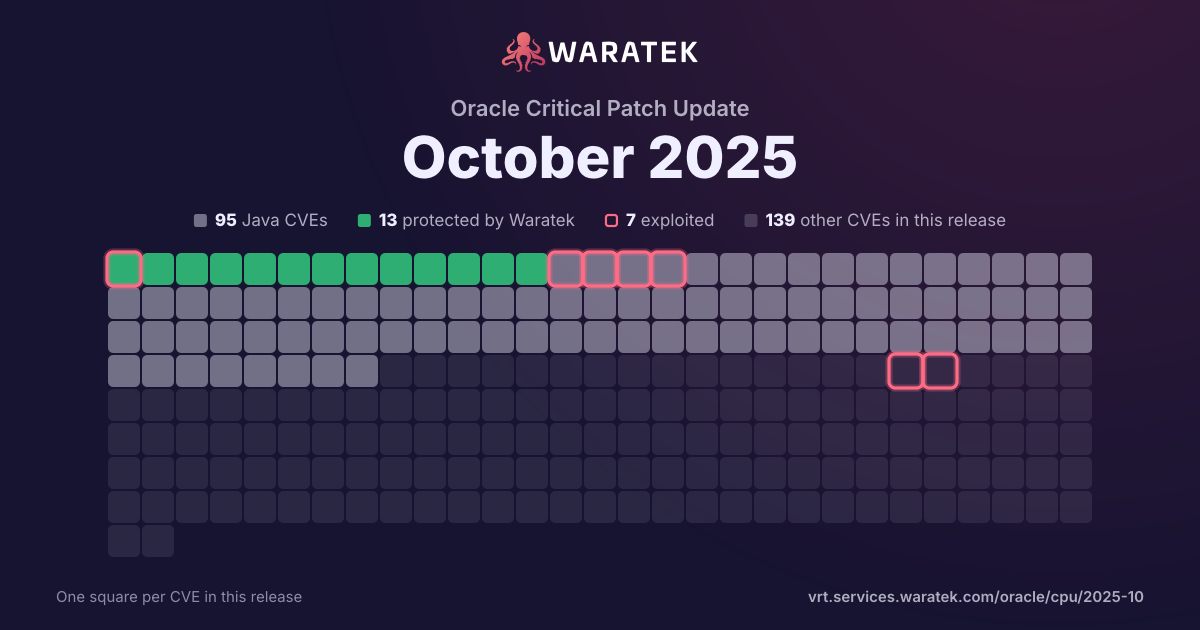
By status
11Protected by Waratek1Rule in development5Mitigation candidate87No exploit published4Outside Waratek scope126Not applicable
7Exploited, marked by the ring
No exploit published. For 37 of them, Oracle's security advisory is the source of public detail.
Protected by Waratek. Waratek RASP can block exploitation of these on systems that have not applied the patch yet.
Overview 34 matches · 3 protected · 1 exploited · 0 CISA KEV · 3 public PoC · 0 EPSS ≥ 0.5
Protected by Waratek
3
8.8%
Rule in development
1
2.9%
Mitigation candidate
1
2.9%
No exploit published
29
85.3%
blocked by ARMR today
3
8.8%
partly blocked
0
0.0%
not blocked
31
91.2%
not established
0
0.0%
unrecorded
0
0.0%
split by
peak 8 / month
Sep 241
No exploit published1
High1
not blocked1
No public exploit1
Oct 243
Protected by Waratek1
No exploit published2
High1
Medium2
blocked by ARMR today1
not blocked2
No public exploit3
Nov 240
Dec 241
Protected by Waratek1
High1
blocked by ARMR today1
Working exploit published1
Jan 251
No exploit published1
High1
not blocked1
No public exploit1
Feb 253
No exploit published3
High2
Medium1
not blocked3
Proof of concept only3
Mar 252
Protected by Waratek1
No exploit published1
High1
Medium1
blocked by ARMR today1
not blocked1
No public exploit2
Apr 251
No exploit published1
Medium1
not blocked1
No public exploit1
May 254
Mitigation candidate1
No exploit published3
High2
Medium1
Low1
not blocked4
Working exploit published1
Proof of concept only1
No public exploit2
Jun 253
Rule in development1
No exploit published2
High3
not blocked3
Exploited1
No public exploit2
Jul 252
No exploit published2
Medium2
not blocked2
No public exploit2
Aug 253
No exploit published3
High3
not blocked3
No public exploit3
Sep 252
No exploit published2
High1
Medium1
not blocked2
Proof of concept only1
No public exploit1
Oct 258
No exploit published8
Critical1
High3
Medium4
not blocked8
No public exploit8
Oct 24Dec 24Feb 25Apr 25Jun 25Aug 25Oct 25
| CVE | Severity | Published▾ | Status | Exploitation | Description |
|---|---|---|---|---|---|
| CVE-2025-61756 | High | 2025-10-21 | No exploit published | No public exploit | Vulnerability in the Oracle Financial Services Analytical Applications Infrastructure product of Oracle Financial Services Applications (component: System Configuration). Supported versions that are affected are 8.0.7.9, 8.0.8.7 and 8.1.2.5. Easily exploitable vulnerability allows unauthenticated attacker with network access via HTTP to compromise Oracle Financial Services Analytical Applications Infrastructure. Successful attacks of this vulnerability can result in unauthorized ability to cause a hang or frequently repeatable crash (complete DOS) of Oracle Financial Services Analytical Applications Infrastructure. CVSS 3.1 Base Score 7.5 (Availability impacts). CVSS Vector: (CVSS:3.1/AV:N/AC:L/PR:N/UI:N/S:U/C:N/I:N/A:H). |
| CVE-2025-61751 | High | 2025-10-21 | No exploit published | No public exploit | Vulnerability in the Oracle Financial Services Analytical Applications Infrastructure product of Oracle Financial Services Applications (component: Platform). Supported versions that are affected are 8.0.7.9, 8.0.8.7 and 8.1.2.5. Easily exploitable vulnerability allows low privileged attacker with network access via HTTP to compromise Oracle Financial Services Analytical Applications Infrastructure. Successful attacks of this vulnerability can result in unauthorized creation, deletion or modification access to critical data or all Oracle Financial Services Analytical Applications Infrastructure accessible data as well as unauthorized access to critical data or complete access to all Oracle Financial Services Analytical Applications Infrastructure accessible data. CVSS 3.1 Base Score 8.1 (Confidentiality and Integrity impacts). CVSS Vector: (CVSS:3.1/AV:N/AC:L/PR:L/UI:N/S:U/C:H/I:H/A:N). |
| CVE-2025-53037 | Critical | 2025-10-21 | No exploit published | No public exploit | Vulnerability in the Oracle Financial Services Analytical Applications Infrastructure product of Oracle Financial Services Applications (component: Platform). Supported versions that are affected are 8.0.7.9, 8.0.8.7 and 8.1.2.5. Easily exploitable vulnerability allows unauthenticated attacker with network access via HTTP to compromise Oracle Financial Services Analytical Applications Infrastructure. Successful attacks of this vulnerability can result in takeover of Oracle Financial Services Analytical Applications Infrastructure. CVSS 3.1 Base Score 9.8 (Confidentiality, Integrity and Availability impacts). CVSS Vector: (CVSS:3.1/AV:N/AC:L/PR:N/UI:N/S:U/C:H/I:H/A:H). |
| CVE-2025-53036 | High | 2025-10-21 | No exploit published | No public exploit | Vulnerability in the Oracle Financial Services Analytical Applications Infrastructure product of Oracle Financial Services Applications (component: Platform). Supported versions that are affected are 8.0.7.9, 8.0.8.7 and 8.1.2.5. Easily exploitable vulnerability allows unauthenticated attacker with network access via HTTP to compromise Oracle Financial Services Analytical Applications Infrastructure. While the vulnerability is in Oracle Financial Services Analytical Applications Infrastructure, attacks may significantly impact additional products (scope change). Successful attacks of this vulnerability can result in unauthorized access to critical data or complete access to all Oracle Financial Services Analytical Applications Infrastructure accessible data. CVSS 3.1 Base Score 8.6 (Confidentiality impacts). CVSS Vector: (CVSS:3.1/AV:N/AC:L/PR:N/UI:N/S:C/C:H/I:N/A:N). |
| CVE-2025-53035 | Medium | 2025-10-21 | No exploit published | No public exploit | Vulnerability in the Oracle Financial Services Analytical Applications Infrastructure product of Oracle Financial Services Applications (component: Platform). Supported versions that are affected are 8.0.7.9, 8.0.8.7 and 8.1.2.5. Easily exploitable vulnerability allows low privileged attacker with network access via HTTP to compromise Oracle Financial Services Analytical Applications Infrastructure. Successful attacks of this vulnerability can result in unauthorized access to critical data or complete access to all Oracle Financial Services Analytical Applications Infrastructure accessible data. CVSS 3.1 Base Score 6.5 (Confidentiality impacts). CVSS Vector: (CVSS:3.1/AV:N/AC:L/PR:L/UI:N/S:U/C:H/I:N/A:N). |
| CVE-2025-53034 | Medium | 2025-10-21 | No exploit published | No public exploit | Vulnerability in the Oracle Financial Services Analytical Applications Infrastructure product of Oracle Financial Services Applications (component: Platform). Supported versions that are affected are 8.0.7.9, 8.0.8.7 and 8.1.2.5. Easily exploitable vulnerability allows unauthenticated attacker with network access via HTTP to compromise Oracle Financial Services Analytical Applications Infrastructure. Successful attacks require human interaction from a person other than the attacker. Successful attacks of this vulnerability can result in unauthorized update, insert or delete access to some of Oracle Financial Services Analytical Applications Infrastructure accessible data as well as unauthorized read access to a subset of Oracle Financial Services Analytical Applications Infrastructure accessible data. CVSS 3.1 Base Score 5.4 (Confidentiality and Integrity impacts). CVSS Vector: (CVSS:3.1/AV:N/AC:L/PR:N/UI:R/S:U/C:L/I:L/A:N). |
| CVE-2025-50075 | Medium | 2025-10-21 | No exploit published | No public exploit | Vulnerability in the Oracle Financial Services Revenue Management and Billing product of Oracle Financial Services Applications (component: Security Management System). Supported versions that are affected are 2.9.0.0.0-7.2.0.0.0. Easily exploitable vulnerability allows low privileged attacker with network access via HTTP to compromise Oracle Financial Services Revenue Management and Billing. Successful attacks of this vulnerability can result in unauthorized access to critical data or complete access to all Oracle Financial Services Revenue Management and Billing accessible data. CVSS 3.1 Base Score 6.5 (Confidentiality impacts). CVSS Vector: (CVSS:3.1/AV:N/AC:L/PR:L/UI:N/S:U/C:H/I:N/A:N). |
| CVE-2025-50074 | Medium | 2025-10-21 | No exploit published | No public exploit | Vulnerability in the Oracle Financial Services Revenue Management and Billing product of Oracle Financial Services Applications (component: Security Management System). Supported versions that are affected are 2.9.0.0.0-7.2.0.0.0. Easily exploitable vulnerability allows high privileged attacker with network access via HTTP to compromise Oracle Financial Services Revenue Management and Billing. Successful attacks of this vulnerability can result in unauthorized access to critical data or complete access to all Oracle Financial Services Revenue Management and Billing accessible data. CVSS 3.1 Base Score 4.9 (Confidentiality impacts). CVSS Vector: (CVSS:3.1/AV:N/AC:L/PR:H/UI:N/S:U/C:H/I:N/A:N). |
| CVE-2025-41249 | High | 2025-09-16 | No exploit published | No public exploit | The Spring Framework annotation detection mechanism may not correctly resolve annotations on methods within type hierarchies with a parameterized super type with unbounded generics. This can be an issue if such annotations are used for authorization decisions. Your application may be affected by this if you are using Spring Security's @EnableMethodSecurity feature. You are not affected by this if you are not using @EnableMethodSecurity or if you do not use security annotations on methods in generic superclasses or generic interfaces. This CVE is published in conjunction with CVE-2025-41248 https://spring.io/security/cve-2025-41248 . |
| CVE-2025-58057 | Medium | 2025-09-04 | No exploit published | Proof of concept only | Netty is an asynchronous event-driven network application framework for rapid development of maintainable high performance protocol servers & clients. In netty-codec-compression versions 4.1.124.Final and below, and netty-codec versions 4.2.4.Final and below, when supplied with specially crafted input, BrotliDecoder and certain other decompression decoders will allocate a large number of reachable byte buffers, which can lead to denial of service. BrotliDecoder.decompress has no limit in how often it calls pull, decompressing data 64K bytes at a time. The buffers are saved in the output list, and remain reachable until OOM is hit. This is fixed in versions 4.1.125.Final of netty-codec and 4.2.5.Final of netty-codec-compression. |
| CVE-2025-5115 | High | 2025-08-20 | No exploit published | No public exploit | In Eclipse Jetty, versions <=9.4.57, <=10.0.25, <=11.0.25, <=12.0.21, <=12.1.0.alpha2, an HTTP/2 client may trigger the server to send RST_STREAM frames, for example by sending frames that are malformed or that should not be sent in a particular stream state, therefore forcing the server to consume resources such as CPU and memory. For example, a client can open a stream and then send WINDOW_UPDATE frames with window size increment of 0, which is illegal. Per specification https://www.rfc-editor.org/rfc/rfc9113.html#name-window_update , the server should send a RST_STREAM frame. The client can now open another stream and send another bad WINDOW_UPDATE, therefore causing the server to consume more resources than necessary, as this case does not exceed the max number of concurrent streams, yet the client is able to create an enormous amount of streams in a short period of time. The attack can be performed with other conditions (for example, a DATA frame for a closed stream) that cause the server to send a RST_STREAM frame. Links: * https://github.com/jetty/jetty.project/security/advisories/GHSA-mmxm-8w33-wc4h |
| CVE-2025-55163 | High | 2025-08-13 | No exploit published | No public exploit | Netty is an asynchronous, event-driven network application framework. Prior to versions 4.1.124.Final and 4.2.4.Final, Netty is vulnerable to MadeYouReset DDoS. This is a logical vulnerability in the HTTP/2 protocol, that uses malformed HTTP/2 control frames in order to break the max concurrent streams limit - which results in resource exhaustion and distributed denial of service. This issue has been patched in versions 4.1.124.Final and 4.2.4.Final. |
| CVE-2025-48989 | High | 2025-08-13 | No exploit published | No public exploit | Improper Resource Shutdown or Release vulnerability in Apache Tomcat made Tomcat vulnerable to the made you reset attack. This issue affects Apache Tomcat: from 11.0.0-M1 through 11.0.9, from 10.1.0-M1 through 10.1.43 and from 9.0.0.M1 through 9.0.107. Older, EOL versions may also be affected. Users are recommended to upgrade to one of versions 11.0.10, 10.1.44 or 9.0.108 which fix the issue. |
| CVE-2025-48795 | Medium | 2025-07-15 | No exploit published | No public exploit | Apache CXF stores large stream based messages as temporary files on the local filesystem. A bug was introduced which means that the entire temporary file is read into memory and then logged. An attacker might be able to exploit this to cause a denial of service attack by causing an out of memory exception. In addition, it is possible to configure CXF to encrypt temporary files to prevent sensitive credentials from being cached unencrypted on the local filesystem, however this bug means that the cached files are written out to logs unencrypted. Users are recommended to upgrade to versions 3.5.11, 3.6.6, 4.0.7 or 4.1.1, which fixes this issue. |
| CVE-2025-48924 | Medium | 2025-07-11 | No exploit published | No public exploit | Uncontrolled Recursion vulnerability in Apache Commons Lang. This issue affects Apache Commons Lang: Starting with commons-lang:commons-lang 2.0 to 2.6, and, from org.apache.commons:commons-lang3 3.0 before 3.18.0. The methods ClassUtils.getClass(...) can throw StackOverflowError on very long inputs. Because an Error is usually not handled by applications and libraries, a StackOverflowError could cause an application to stop. Users are recommended to upgrade to version 3.18.0, which fixes the issue. |
| CVE-2025-48976 | High | 2025-06-16 | No exploit published | No public exploit | Allocation of resources for multipart headers with insufficient limits enabled a DoS vulnerability in Apache Commons FileUpload. This issue affects Apache Commons FileUpload: from 1.0 before 1.6; from 2.0.0-M1 before 2.0.0-M4. Users are recommended to upgrade to versions 1.6 or 2.0.0-M4, which fix the issue. |
| CVE-2025-27818 | High | 2025-06-10 | No exploit published | No public exploit | A possible security vulnerability has been identified in Apache Kafka. This requires access to a alterConfig to the cluster resource, or Kafka Connect worker, and the ability to create/modify connectors on it with an arbitrary Kafka client SASL JAAS config and a SASL-based security protocol, which has been possible on Kafka clusters since Apache Kafka 2.0.0 (Kafka Connect 2.3.0). When configuring the broker via config file or AlterConfig command, or connector via the Kafka Kafka Connect REST API, an authenticated operator can set the `sasl.jaas.config` property for any of the connector's Kafka clients to "com.sun.security.auth.module.LdapLoginModule", which can be done via the `producer.override.sasl.jaas.config`, `consumer.override.sasl.jaas.config`, or `admin.override.sasl.jaas.config` properties. This will allow the server to connect to the attacker's LDAP server and deserialize the LDAP response, which the attacker can use to execute java deserialization gadget chains on the Kafka connect server. Attacker can cause unrestricted deserialization of untrusted data (or) RCE vulnerability when there are gadgets in the classpath. Since Apache Kafka 3.0.0, users are allowed to specify these properties in connector configurations for Kafka Connect clusters running with out-of-the-box configurations. Before Apache Kafka 3.0.0, users may not specify these properties unless the Kafka Connect cluster has been reconfigured with a connector client override policy that permits them. Since Apache Kafka 3.9.1/4.0.0, we have added a system property ("-Dorg.apache.kafka.disallowed.login.modules") to disable the problematic login modules usage in SASL JAAS configuration. Also by default "com.sun.security.auth.module.JndiLoginModule,com.sun.security.auth.module.LdapLoginModule" are disabled in Apache Kafka Connect 3.9.1/4.0.0. We advise the Kafka users to validate connector configurations and only allow trusted LDAP configurations. Also examine connector dependencies for vulnerable versions and either upgrade their connectors, upgrading that specific dependency, or removing the connectors as options for remediation. Finally, in addition to leveraging the "org.apache.kafka.disallowed.login.modules" system property, Kafka Connect users can also implement their own connector client config override policy, which can be used to control which Kafka client properties can be overridden directly in a connector config and which cannot. |
| CVE-2025-27817 | High | 2025-06-10 | Rule in development | Exploited | A possible arbitrary file read and SSRF vulnerability has been identified in Apache Kafka Client. Apache Kafka Clients accept configuration data for setting the SASL/OAUTHBEARER connection with the brokers, including "sasl.oauthbearer.token.endpoint.url" and "sasl.oauthbearer.jwks.endpoint.url". Apache Kafka allows clients to read an arbitrary file and return the content in the error log, or sending requests to an unintended location. In applications where Apache Kafka Clients configurations can be specified by an untrusted party, attackers may use the "sasl.oauthbearer.token.endpoint.url" and "sasl.oauthbearer.jwks.endpoint.url" configuratin to read arbitrary contents of the disk and environment variables or make requests to an unintended location. In particular, this flaw may be used in Apache Kafka Connect to escalate from REST API access to filesystem/environment/URL access, which may be undesirable in certain environments, including SaaS products. Since Apache Kafka 3.9.1/4.0.0, we have added a system property ("-Dorg.apache.kafka.sasl.oauthbearer.allowed.urls") to set the allowed urls in SASL JAAS configuration. In 3.9.1, it accepts all urls by default for backward compatibility. However in 4.0.0 and newer, the default value is empty list and users have to set the allowed urls explicitly. |
| CVE-2025-48734 | High | 2025-05-28 | No exploit published | Proof of concept only | Improper Access Control vulnerability in Apache Commons. A special BeanIntrospector class was added in version 1.9.2. This can be used to stop attackers from using the declared class property of Java enum objects to get access to the classloader. However this protection was not enabled by default. PropertyUtilsBean (and consequently BeanUtilsBean) now disallows declared class level property access by default. Releases 1.11.0 and 2.0.0-M2 address a potential security issue when accessing enum properties in an uncontrolled way. If an application using Commons BeanUtils passes property paths from an external source directly to the getProperty() method of PropertyUtilsBean, an attacker can access the enum’s class loader via the “declaredClass” property available on all Java “enum” objects. Accessing the enum’s “declaredClass” allows remote attackers to access the ClassLoader and execute arbitrary code. The same issue exists with PropertyUtilsBean.getNestedProperty(). Starting in versions 1.11.0 and 2.0.0-M2 a special BeanIntrospector suppresses the “declaredClass” property. Note that this new BeanIntrospector is enabled by default, but you can disable it to regain the old behavior; see section 2.5 of the user's guide and the unit tests. This issue affects Apache Commons BeanUtils 1.x before 1.11.0, and 2.x before 2.0.0-M2.Users of the artifact commons-beanutils:commons-beanutils 1.x are recommended to upgrade to version 1.11.0, which fixes the issue. Users of the artifact org.apache.commons:commons-beanutils2 2.x are recommended to upgrade to version 2.0.0-M2, which fixes the issue. |
| CVE-2025-22233 | Low | 2025-05-16 | No exploit published | No public exploit | CVE-2024-38820 ensured Locale-independent, lowercase conversion for both the configured disallowedFields patterns and for request parameter names. However, there are still cases where it is possible to bypass the disallowedFields checks. Affected Spring Products and Versions Spring Framework: * 6.2.0 - 6.2.6 * 6.1.0 - 6.1.19 * 6.0.0 - 6.0.27 * 5.3.0 - 5.3.42 * Older, unsupported versions are also affected Mitigation Users of affected versions should upgrade to the corresponding fixed version. Affected version(s)Fix Version Availability 6.2.x 6.2.7 OSS6.1.x 6.1.20 OSS6.0.x 6.0.28 Commercial https://enterprise.spring.io/ 5.3.x 5.3.43 Commercial https://enterprise.spring.io/ No further mitigation steps are necessary. Generally, we recommend using a dedicated model object with properties only for data binding, or using constructor binding since constructor arguments explicitly declare what to bind together with turning off setter binding through the declarativeBinding flag. See the Model Design section in the reference documentation. For setting binding, prefer the use of allowedFields (an explicit list) over disallowedFields. Credit This issue was responsibly reported by the TERASOLUNA Framework Development Team from NTT DATA Group Corporation. |
| CVE-2025-1948 | High | 2025-05-08 | No exploit published | No public exploit | In Eclipse Jetty versions 12.0.0 to 12.0.16 included, an HTTP/2 client can specify a very large value for the HTTP/2 settings parameter SETTINGS_MAX_HEADER_LIST_SIZE. The Jetty HTTP/2 server does not perform validation on this setting, and tries to allocate a ByteBuffer of the specified capacity to encode HTTP responses, likely resulting in OutOfMemoryError being thrown, or even the JVM process exiting. |
| CVE-2025-27533 | Medium | 2025-05-07 | Mitigation candidate | Working exploit published | Memory Allocation with Excessive Size Value vulnerability in Apache ActiveMQ. During unmarshalling of OpenWire commands the size value of buffers was not properly validated which could lead to excessive memory allocation and be exploited to cause a denial of service (DoS) by depleting process memory, thereby affecting applications and services that rely on the availability of the ActiveMQ broker when not using mutual TLS connections. This issue affects Apache ActiveMQ: from 6.0.0 before 6.1.6, from 5.18.0 before 5.18.7, from 5.17.0 before 5.17.7, before 5.16.8. ActiveMQ 5.19.0 is not affected. Users are recommended to upgrade to version 6.1.6+, 5.19.0+, 5.18.7+, 5.17.7, or 5.16.8 or which fixes the issue. Existing users may implement mutual TLS to mitigate the risk on affected brokers. |
| CVE-2025-31672 | Medium | 2025-04-09 | No exploit published | No public exploit | Improper Input Validation vulnerability in Apache POI. The issue affects the parsing of OOXML format files like xlsx, docx and pptx. These file formats are basically zip files and it is possible for malicious users to add zip entries with duplicate names (including the path) in the zip. In this case, products reading the affected file could read different data because 1 of the zip entries with the duplicate name is selected over another but different products may choose a different zip entry. This issue affects Apache POI poi-ooxml before 5.4.0. poi-ooxml 5.4.0 has a check that throws an exception if zip entries with duplicate file names are found in the input file. Users are recommended to upgrade to version poi-ooxml 5.4.0, which fixes the issue. Please read https://poi.apache.org/security.html for recommendations about how to use the POI libraries securely. |
| CVE-2025-30474 | Medium | 2025-03-23 | No exploit published | No public exploit | Exposure of Sensitive Information to an Unauthorized Actor vulnerability in Apache Commons VFS. The FtpFileObject class can throw an exception when a file is not found, revealing the original URI in its message, which may include a password. The fix is to mask the password in the exception message This issue affects Apache Commons VFS: before 2.10.0. Users are recommended to upgrade to version 2.10.0, which fixes the issue. |
| CVE-2025-27553 | High | 2025-03-23 | Protected by Waratek | No public exploit | Relative Path Traversal vulnerability in Apache Commons VFS before 2.10.0. The FileObject API in Commons VFS has a 'resolveFile' method that takes a 'scope' parameter. Specifying 'NameScope.DESCENDENT' promises that "an exception is thrown if the resolved file is not a descendent of the base file". However, when the path contains encoded ".." characters (for example, "%2E%2E/bar.txt"), it might return file objects that are not a descendent of the base file, without throwing an exception. This issue affects Apache Commons VFS: before 2.10.0. Users are recommended to upgrade to version 2.10.0, which fixes the issue. |
| CVE-2025-25193 | Medium | 2025-02-10 | No exploit published | Proof of concept only | Netty, an asynchronous, event-driven network application framework, has a vulnerability in versions up to and including 4.1.118.Final. An unsafe reading of environment file could potentially cause a denial of service in Netty. When loaded on an Windows application, Netty attempts to load a file that does not exist. If an attacker creates such a large file, the Netty application crash. A similar issue was previously reported as CVE-2024-47535. This issue was fixed, but the fix was incomplete in that null-bytes were not counted against the input limit. Commit d1fbda62d3a47835d3fb35db8bd42ecc205a5386 contains an updated fix. |
| CVE-2025-24970 | High | 2025-02-10 | No exploit published | Proof of concept only | Netty, an asynchronous, event-driven network application framework, has a vulnerability starting in version 4.1.91.Final and prior to version 4.1.118.Final. When a special crafted packet is received via SslHandler it doesn't correctly handle validation of such a packet in all cases which can lead to a native crash. Version 4.1.118.Final contains a patch. As workaround its possible to either disable the usage of the native SSLEngine or change the code manually. |
| CVE-2024-57699 | High | 2025-02-05 | No exploit published | Proof of concept only | A security issue was found in Netplex Json-smart 2.5.0 through 2.5.1. When loading a specially crafted JSON input, containing a large number of ’{’, a stack exhaustion can be trigger, which could allow an attacker to cause a Denial of Service (DoS). This issue exists because of an incomplete fix for CVE-2023-1370. |
| CVE-2025-23184 | High | 2025-01-21 | No exploit published | No public exploit | A potential denial of service vulnerability is present in versions of Apache CXF before 3.5.10, 3.6.5 and 4.0.6. In some edge cases, the CachedOutputStream instances may not be closed and, if backed by temporary files, may fill up the file system (it applies to servers and clients). |
| CVE-2024-38819 | High | 2024-12-19 | Protected by Waratek | Working exploit published | Applications serving static resources through the functional web frameworks WebMvc.fn or WebFlux.fn are vulnerable to path traversal attacks. An attacker can craft malicious HTTP requests and obtain any file on the file system that is also accessible to the process in which the Spring application is running. |
| CVE-2024-38820 | Medium | 2024-10-18 | No exploit published | No public exploit | The fix for CVE-2022-22968 made disallowedFields patterns in DataBinder case insensitive. However, String.toLowerCase() has some Locale dependent exceptions that could potentially result in fields not protected as expected. |
| CVE-2024-28168 | High | 2024-10-09 | Protected by Waratek | No public exploit | Improper Restriction of XML External Entity Reference ('XXE') vulnerability in Apache XML Graphics FOP. This issue affects Apache XML Graphics FOP: 2.9. Users are recommended to upgrade to version 2.10, which fixes the issue. |
| CVE-2024-47554 | Medium | 2024-10-03 | No exploit published | No public exploit | Uncontrolled Resource Consumption vulnerability in Apache Commons IO. The org.apache.commons.io.input.XmlStreamReader class may excessively consume CPU resources when processing maliciously crafted input. This issue affects Apache Commons IO: from 2.0 before 2.14.0. Users are recommended to upgrade to version 2.14.0 or later, which fixes the issue. |
| CVE-2024-7254 | High | 2024-09-19 | No exploit published | No public exploit | Any project that parses untrusted Protocol Buffers data containing an arbitrary number of nested groups / series of SGROUP tags can corrupted by exceeding the stack limit i.e. StackOverflow. Parsing nested groups as unknown fields with DiscardUnknownFieldsParser or Java Protobuf Lite parser, or against Protobuf map fields, creates unbounded recursions that can be abused by an attacker. |