
Oracle Critical Patch Update July 2025
Released July 2025 · Oracle's advisory ↗ · ← Critical Patch Update, April 2025 · Critical Patch Update, October 2025 →
196 CVEs in this release, one square each
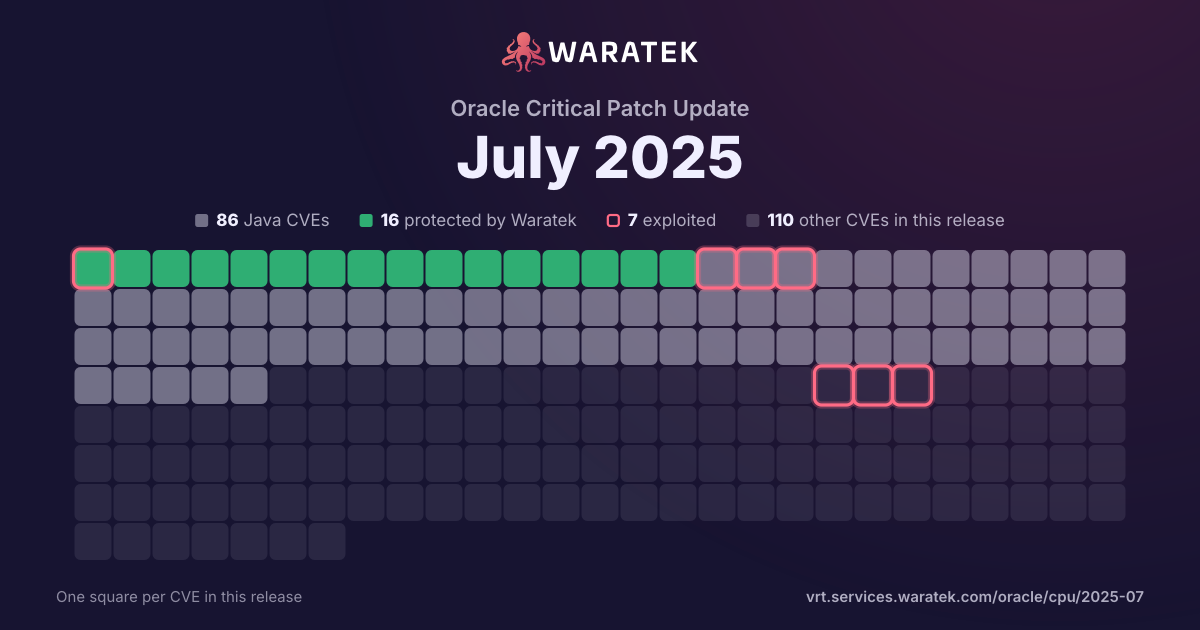
By status
16Protected by Waratek4Mitigation candidate66No exploit published14Outside Waratek scope96Not applicable
7Exploited, marked by the ring
No exploit published. For 31 of them, Oracle's security advisory is the source of public detail.
Protected by Waratek. Waratek RASP can block exploitation of these on systems that have not applied the patch yet.
Overview 161 matches · 71 in Waratek scope · 11 protected · 0 exploited · 0 CISA KEV · 0 public PoC · 0 EPSS ≥ 0.5
161matches
71in Waratek scope44.1%
11protected6.8%
0exploited0.0%
0CISA KEV0.0%
0public PoC0.0%
0EPSS ≥ 0.50.0%
Protected by Waratek
11
6.8%
Rule in development
0
0.0%
Mitigation candidate
0
0.0%
No exploit published
60
37.3%
Outside Waratek scope
13
8.1%
Not applicable
77
47.8%
Withdrawn CVE
0
0.0%
blocked by ARMR today
11
6.8%
partly blocked
0
0.0%
not blocked
150
93.2%
not established
0
0.0%
unrecorded
0
0.0%
Exploited
0
0.0%
Working exploit published
0
0.0%
Proof of concept only
0
0.0%
Forecast only
0
0.0%
No public exploit
161
100.0%
split by
peak 77 / quarter
Q1 211
No exploit published1
High1
not blocked1
No public exploit1
Q2 211
Protected by Waratek1
High1
blocked by ARMR today1
No public exploit1
Q3 210
Q4 211
Protected by Waratek1
Critical1
blocked by ARMR today1
No public exploit1
Q1 220
Q2 220
Q3 220
Q4 220
Q1 230
Q2 230
Q3 230
Q4 232
No exploit published2
Medium2
not blocked2
No public exploit2
Q1 244
No exploit published3
Not applicable1
High2
Medium2
not blocked4
No public exploit4
Q2 2412
No exploit published3
Outside Waratek scope2
Not applicable7
High4
Medium7
Low1
not blocked12
No public exploit12
Q3 2411
No exploit published4
Not applicable7
High4
Medium6
Low1
not blocked11
No public exploit11
Q4 2421
Protected by Waratek3
No exploit published9
Outside Waratek scope2
Not applicable7
Critical3
High5
Medium12
Low1
blocked by ARMR today3
not blocked18
No public exploit21
Q1 2517
Protected by Waratek2
No exploit published3
Outside Waratek scope3
Not applicable9
Critical1
High8
Medium8
blocked by ARMR today2
not blocked15
No public exploit17
Q2 2514
Protected by Waratek2
No exploit published8
Outside Waratek scope1
Not applicable3
Critical1
High10
Medium3
blocked by ARMR today2
not blocked12
No public exploit14
Q3 2577
Protected by Waratek2
No exploit published27
Outside Waratek scope5
Not applicable43
Critical1
High15
Medium52
Low9
blocked by ARMR today2
not blocked75
No public exploit77
Q1 21Q3 21Q1 22Q3 22Q1 23Q3 23Q1 24Q3 24Q1 25Q3 25
| CVE | Severity | Published▾ | Status | Exploitation | Description |
|---|---|---|---|---|---|
| CVE-2025-53032 | Medium | 2025-07-15 | Not applicable | No public exploit | Vulnerability in the MySQL Server product of Oracle MySQL (component: Server: Optimizer). Supported versions that are affected are 9.0.0-9.1.0. Easily exploitable vulnerability allows high privileged attacker with network access via multiple protocols to compromise MySQL Server. Successful attacks of this vulnerability can result in unauthorized ability to cause a hang or frequently repeatable crash (complete DOS) of MySQL Server. CVSS 3.1 Base Score 4.9 (Availability impacts). CVSS Vector: (CVSS:3.1/AV:N/AC:L/PR:H/UI:N/S:U/C:N/I:N/A:H). |
| CVE-2025-53031 | Medium | 2025-07-15 | No exploit published | No public exploit | Vulnerability in the Oracle Financial Services Analytical Applications Infrastructure product of Oracle Financial Services Applications (component: Platform). Supported versions that are affected are 8.0.7.8, 8.0.8.5, 8.0.8.6, 8.1.1.4 and 8.1.2.5. Easily exploitable vulnerability allows unauthenticated attacker with network access via HTTP to compromise Oracle Financial Services Analytical Applications Infrastructure. Successful attacks of this vulnerability can result in unauthorized read access to a subset of Oracle Financial Services Analytical Applications Infrastructure accessible data. CVSS 3.1 Base Score 5.3 (Confidentiality impacts). CVSS Vector: (CVSS:3.1/AV:N/AC:L/PR:N/UI:N/S:U/C:L/I:N/A:N). |
| CVE-2025-53030 | Medium | 2025-07-15 | Not applicable | No public exploit | Vulnerability in the Oracle VM VirtualBox product of Oracle Virtualization (component: Core). The supported version that is affected is 7.1.10. Easily exploitable vulnerability allows high privileged attacker with logon to the infrastructure where Oracle VM VirtualBox executes to compromise Oracle VM VirtualBox. While the vulnerability is in Oracle VM VirtualBox, attacks may significantly impact additional products (scope change). Successful attacks of this vulnerability can result in unauthorized access to critical data or complete access to all Oracle VM VirtualBox accessible data. CVSS 3.1 Base Score 6.0 (Confidentiality impacts). CVSS Vector: (CVSS:3.1/AV:L/AC:L/PR:H/UI:N/S:C/C:H/I:N/A:N). |
| CVE-2025-53029 | Low | 2025-07-15 | Not applicable | No public exploit | Vulnerability in the Oracle VM VirtualBox product of Oracle Virtualization (component: Core). The supported version that is affected is 7.1.10. Easily exploitable vulnerability allows high privileged attacker with logon to the infrastructure where Oracle VM VirtualBox executes to compromise Oracle VM VirtualBox. Successful attacks of this vulnerability can result in unauthorized read access to a subset of Oracle VM VirtualBox accessible data. CVSS 3.1 Base Score 2.3 (Confidentiality impacts). CVSS Vector: (CVSS:3.1/AV:L/AC:L/PR:H/UI:N/S:U/C:L/I:N/A:N). |
| CVE-2025-53028 | High | 2025-07-15 | Not applicable | No public exploit | Vulnerability in the Oracle VM VirtualBox product of Oracle Virtualization (component: Core). The supported version that is affected is 7.1.10. Easily exploitable vulnerability allows high privileged attacker with logon to the infrastructure where Oracle VM VirtualBox executes to compromise Oracle VM VirtualBox. While the vulnerability is in Oracle VM VirtualBox, attacks may significantly impact additional products (scope change). Successful attacks of this vulnerability can result in takeover of Oracle VM VirtualBox. CVSS 3.1 Base Score 8.2 (Confidentiality, Integrity and Availability impacts). CVSS Vector: (CVSS:3.1/AV:L/AC:L/PR:H/UI:N/S:C/C:H/I:H/A:H). |
| CVE-2025-53027 | High | 2025-07-15 | Not applicable | No public exploit | Vulnerability in the Oracle VM VirtualBox product of Oracle Virtualization (component: Core). The supported version that is affected is 7.1.10. Easily exploitable vulnerability allows high privileged attacker with logon to the infrastructure where Oracle VM VirtualBox executes to compromise Oracle VM VirtualBox. While the vulnerability is in Oracle VM VirtualBox, attacks may significantly impact additional products (scope change). Successful attacks of this vulnerability can result in takeover of Oracle VM VirtualBox. CVSS 3.1 Base Score 8.2 (Confidentiality, Integrity and Availability impacts). CVSS Vector: (CVSS:3.1/AV:L/AC:L/PR:H/UI:N/S:C/C:H/I:H/A:H). |
| CVE-2025-53026 | Medium | 2025-07-15 | Not applicable | No public exploit | Vulnerability in the Oracle VM VirtualBox product of Oracle Virtualization (component: Core). The supported version that is affected is 7.1.10. Easily exploitable vulnerability allows high privileged attacker with logon to the infrastructure where Oracle VM VirtualBox executes to compromise Oracle VM VirtualBox. While the vulnerability is in Oracle VM VirtualBox, attacks may significantly impact additional products (scope change). Successful attacks of this vulnerability can result in unauthorized access to critical data or complete access to all Oracle VM VirtualBox accessible data. CVSS 3.1 Base Score 6.0 (Confidentiality impacts). CVSS Vector: (CVSS:3.1/AV:L/AC:L/PR:H/UI:N/S:C/C:H/I:N/A:N). |
| CVE-2025-53025 | Medium | 2025-07-15 | Not applicable | No public exploit | Vulnerability in the Oracle VM VirtualBox product of Oracle Virtualization (component: Core). The supported version that is affected is 7.1.10. Easily exploitable vulnerability allows high privileged attacker with logon to the infrastructure where Oracle VM VirtualBox executes to compromise Oracle VM VirtualBox. While the vulnerability is in Oracle VM VirtualBox, attacks may significantly impact additional products (scope change). Successful attacks of this vulnerability can result in unauthorized access to critical data or complete access to all Oracle VM VirtualBox accessible data. CVSS 3.1 Base Score 6.0 (Confidentiality impacts). CVSS Vector: (CVSS:3.1/AV:L/AC:L/PR:H/UI:N/S:C/C:H/I:N/A:N). |
| CVE-2025-53024 | High | 2025-07-15 | Not applicable | No public exploit | Vulnerability in the Oracle VM VirtualBox product of Oracle Virtualization (component: Core). The supported version that is affected is 7.1.10. Easily exploitable vulnerability allows high privileged attacker with logon to the infrastructure where Oracle VM VirtualBox executes to compromise Oracle VM VirtualBox. While the vulnerability is in Oracle VM VirtualBox, attacks may significantly impact additional products (scope change). Successful attacks of this vulnerability can result in takeover of Oracle VM VirtualBox. CVSS 3.1 Base Score 8.2 (Confidentiality, Integrity and Availability impacts). CVSS Vector: (CVSS:3.1/AV:L/AC:L/PR:H/UI:N/S:C/C:H/I:H/A:H). |
| CVE-2025-53023 | Medium | 2025-07-15 | Not applicable | No public exploit | Vulnerability in the MySQL Server product of Oracle MySQL (component: Server: Replication). Supported versions that are affected are 8.0.0-8.0.42. Easily exploitable vulnerability allows high privileged attacker with network access via multiple protocols to compromise MySQL Server. Successful attacks of this vulnerability can result in unauthorized ability to cause a hang or frequently repeatable crash (complete DOS) of MySQL Server. CVSS 3.1 Base Score 4.9 (Availability impacts). CVSS Vector: (CVSS:3.1/AV:N/AC:L/PR:H/UI:N/S:U/C:N/I:N/A:H). |
| CVE-2025-50108 | Medium | 2025-07-15 | No exploit published | No public exploit | Vulnerability in the Oracle Hyperion Financial Reporting product of Oracle Hyperion (component: Workspace). The supported version that is affected is 11.2.20.0.000. Easily exploitable vulnerability allows low privileged attacker with network access via HTTP to compromise Oracle Hyperion Financial Reporting. Successful attacks require human interaction from a person other than the attacker and while the vulnerability is in Oracle Hyperion Financial Reporting, attacks may significantly impact additional products (scope change). Successful attacks of this vulnerability can result in unauthorized update, insert or delete access to some of Oracle Hyperion Financial Reporting accessible data as well as unauthorized read access to a subset of Oracle Hyperion Financial Reporting accessible data. CVSS 3.1 Base Score 5.4 (Confidentiality and Integrity impacts). CVSS Vector: (CVSS:3.1/AV:N/AC:L/PR:L/UI:R/S:C/C:L/I:L/A:N). |
| CVE-2025-50107 | Medium | 2025-07-15 | No exploit published | No public exploit | Vulnerability in the Oracle Universal Work Queue product of Oracle E-Business Suite (component: Request handling). Supported versions that are affected are 12.2.5-12.2.14. Easily exploitable vulnerability allows unauthenticated attacker with network access via HTTP to compromise Oracle Universal Work Queue. Successful attacks require human interaction from a person other than the attacker and while the vulnerability is in Oracle Universal Work Queue, attacks may significantly impact additional products (scope change). Successful attacks of this vulnerability can result in unauthorized update, insert or delete access to some of Oracle Universal Work Queue accessible data as well as unauthorized read access to a subset of Oracle Universal Work Queue accessible data. CVSS 3.1 Base Score 6.1 (Confidentiality and Integrity impacts). CVSS Vector: (CVSS:3.1/AV:N/AC:L/PR:N/UI:R/S:C/C:L/I:L/A:N). |
| CVE-2025-50106 | High | 2025-07-15 | No exploit published | No public exploit | Vulnerability in the Oracle Java SE, Oracle GraalVM for JDK, Oracle GraalVM Enterprise Edition product of Oracle Java SE (component: 2D). Supported versions that are affected are Oracle Java SE: 8u451, 8u451-perf, 11.0.27, 17.0.15, 21.0.7, 24.0.1; Oracle GraalVM for JDK: 17.0.15, 21.0.7 and 24.0.1; Oracle GraalVM Enterprise Edition: 21.3.14. Difficult to exploit vulnerability allows unauthenticated attacker with network access via multiple protocols to compromise Oracle Java SE, Oracle GraalVM for JDK, Oracle GraalVM Enterprise Edition. Successful attacks of this vulnerability can result in takeover of Oracle Java SE, Oracle GraalVM for JDK, Oracle GraalVM Enterprise Edition. Note: This vulnerability can be exploited by using APIs in the specified Component, e.g., through a web service which supplies data to the APIs. This vulnerability also applies to Java deployments, typically in clients running sandboxed Java Web Start applications or sandboxed Java applets, that load and run untrusted code (e.g., code that comes from the internet) and rely on the Java sandbox for security. CVSS 3.1 Base Score 8.1 (Confidentiality, Integrity and Availability impacts). CVSS Vector: (CVSS:3.1/AV:N/AC:H/PR:N/UI:N/S:U/C:H/I:H/A:H). |
| CVE-2025-50105 | High | 2025-07-15 | No exploit published | No public exploit | Vulnerability in the Oracle Universal Work Queue product of Oracle E-Business Suite (component: Work Provider Administration). Supported versions that are affected are 12.2.3-12.2.14. Easily exploitable vulnerability allows low privileged attacker with network access via HTTP to compromise Oracle Universal Work Queue. Successful attacks of this vulnerability can result in unauthorized creation, deletion or modification access to critical data or all Oracle Universal Work Queue accessible data as well as unauthorized access to critical data or complete access to all Oracle Universal Work Queue accessible data. CVSS 3.1 Base Score 8.1 (Confidentiality and Integrity impacts). CVSS Vector: (CVSS:3.1/AV:N/AC:L/PR:L/UI:N/S:U/C:H/I:H/A:N). |
| CVE-2025-50104 | Low | 2025-07-15 | Not applicable | No public exploit | Vulnerability in the MySQL Server product of Oracle MySQL (component: Server: DDL). Supported versions that are affected are 8.0.0-8.0.42, 8.4.0-8.4.5 and 9.0.0-9.3.0. Easily exploitable vulnerability allows high privileged attacker with network access via multiple protocols to compromise MySQL Server. Successful attacks of this vulnerability can result in unauthorized ability to cause a partial denial of service (partial DOS) of MySQL Server. CVSS 3.1 Base Score 2.7 (Availability impacts). CVSS Vector: (CVSS:3.1/AV:N/AC:L/PR:H/UI:N/S:U/C:N/I:N/A:L). |
| CVE-2025-50103 | Medium | 2025-07-15 | Not applicable | No public exploit | Vulnerability in the MySQL Server product of Oracle MySQL (component: Server: Security: LDAP Auth). Supported versions that are affected are 9.0.0-9.3.0. Difficult to exploit vulnerability allows high privileged attacker with network access via multiple protocols to compromise MySQL Server. Successful attacks of this vulnerability can result in unauthorized ability to cause a hang or frequently repeatable crash (complete DOS) of MySQL Server. CVSS 3.1 Base Score 4.4 (Availability impacts). CVSS Vector: (CVSS:3.1/AV:N/AC:H/PR:H/UI:N/S:U/C:N/I:N/A:H). |
| CVE-2025-50102 | Medium | 2025-07-15 | Not applicable | No public exploit | Vulnerability in the MySQL Server product of Oracle MySQL (component: Server: Optimizer). Supported versions that are affected are 8.0.0-8.0.42, 8.4.0-8.4.5 and 9.0.0-9.3.0. Easily exploitable vulnerability allows high privileged attacker with network access via multiple protocols to compromise MySQL Server. Successful attacks of this vulnerability can result in unauthorized ability to cause a hang or frequently repeatable crash (complete DOS) of MySQL Server. CVSS 3.1 Base Score 4.9 (Availability impacts). CVSS Vector: (CVSS:3.1/AV:N/AC:L/PR:H/UI:N/S:U/C:N/I:N/A:H). |
| CVE-2025-50101 | Medium | 2025-07-15 | Not applicable | No public exploit | Vulnerability in the MySQL Server product of Oracle MySQL (component: Server: Optimizer). Supported versions that are affected are 8.0.0-8.0.42, 8.4.0-8.4.5 and 9.0.0-9.3.0. Easily exploitable vulnerability allows high privileged attacker with network access via multiple protocols to compromise MySQL Server. Successful attacks of this vulnerability can result in unauthorized ability to cause a hang or frequently repeatable crash (complete DOS) of MySQL Server. CVSS 3.1 Base Score 4.9 (Availability impacts). CVSS Vector: (CVSS:3.1/AV:N/AC:L/PR:H/UI:N/S:U/C:N/I:N/A:H). |
| CVE-2025-50100 | Low | 2025-07-15 | Not applicable | No public exploit | Vulnerability in the MySQL Server product of Oracle MySQL (component: Server: Thread Pooling). Supported versions that are affected are 8.0.0-8.0.42, 8.4.0-8.4.5 and 9.0.0-9.3.0. Difficult to exploit vulnerability allows high privileged attacker with network access via multiple protocols to compromise MySQL Server. Successful attacks of this vulnerability can result in unauthorized ability to cause a partial denial of service (partial DOS) of MySQL Server. CVSS 3.1 Base Score 2.2 (Availability impacts). CVSS Vector: (CVSS:3.1/AV:N/AC:H/PR:H/UI:N/S:U/C:N/I:N/A:L). |
| CVE-2025-50099 | Medium | 2025-07-15 | Not applicable | No public exploit | Vulnerability in the MySQL Server product of Oracle MySQL (component: InnoDB). Supported versions that are affected are 8.0.0-8.0.42, 8.4.0-8.4.5 and 9.0.0-9.3.0. Easily exploitable vulnerability allows high privileged attacker with network access via multiple protocols to compromise MySQL Server. Successful attacks of this vulnerability can result in unauthorized ability to cause a hang or frequently repeatable crash (complete DOS) of MySQL Server. CVSS 3.1 Base Score 4.9 (Availability impacts). CVSS Vector: (CVSS:3.1/AV:N/AC:L/PR:H/UI:N/S:U/C:N/I:N/A:H). |
| CVE-2025-50098 | Low | 2025-07-15 | Not applicable | No public exploit | Vulnerability in the MySQL Server product of Oracle MySQL (component: Server: Optimizer). Supported versions that are affected are 8.0.0-8.0.42, 8.4.0-8.4.5 and 9.0.0-9.3.0. Easily exploitable vulnerability allows high privileged attacker with network access via multiple protocols to compromise MySQL Server. Successful attacks of this vulnerability can result in unauthorized ability to cause a partial denial of service (partial DOS) of MySQL Server. CVSS 3.1 Base Score 2.7 (Availability impacts). CVSS Vector: (CVSS:3.1/AV:N/AC:L/PR:H/UI:N/S:U/C:N/I:N/A:L). |
| CVE-2025-50097 | Medium | 2025-07-15 | Not applicable | No public exploit | Vulnerability in the MySQL Server product of Oracle MySQL (component: Server: Security: Encryption). Supported versions that are affected are 8.0.0-8.0.42, 8.4.0-8.4.5 and 9.0.0-9.3.0. Easily exploitable vulnerability allows high privileged attacker with network access via multiple protocols to compromise MySQL Server. Successful attacks of this vulnerability can result in unauthorized ability to cause a hang or frequently repeatable crash (complete DOS) of MySQL Server. CVSS 3.1 Base Score 4.9 (Availability impacts). CVSS Vector: (CVSS:3.1/AV:N/AC:L/PR:H/UI:N/S:U/C:N/I:N/A:H). |
| CVE-2025-50096 | Medium | 2025-07-15 | Not applicable | No public exploit | Vulnerability in the MySQL Server product of Oracle MySQL (component: InnoDB). Supported versions that are affected are 8.0.0-8.0.42, 8.4.0-8.4.5 and 9.0.0-9.3.0. Easily exploitable vulnerability allows high privileged attacker with logon to the infrastructure where MySQL Server executes to compromise MySQL Server. Successful attacks of this vulnerability can result in unauthorized ability to cause a hang or frequently repeatable crash (complete DOS) of MySQL Server. CVSS 3.1 Base Score 4.4 (Availability impacts). CVSS Vector: (CVSS:3.1/AV:L/AC:L/PR:H/UI:N/S:U/C:N/I:N/A:H). |
| CVE-2025-50095 | Medium | 2025-07-15 | Not applicable | No public exploit | Vulnerability in the MySQL Server product of Oracle MySQL (component: Server: Optimizer). Supported versions that are affected are 9.0.0-9.3.0. Easily exploitable vulnerability allows high privileged attacker with network access via multiple protocols to compromise MySQL Server. Successful attacks of this vulnerability can result in unauthorized ability to cause a hang or frequently repeatable crash (complete DOS) of MySQL Server. CVSS 3.1 Base Score 4.9 (Availability impacts). CVSS Vector: (CVSS:3.1/AV:N/AC:L/PR:H/UI:N/S:U/C:N/I:N/A:H). |
| CVE-2025-50094 | Medium | 2025-07-15 | Not applicable | No public exploit | Vulnerability in the MySQL Server product of Oracle MySQL (component: Server: DDL). Supported versions that are affected are 8.0.42, 8.4.5 and 9.3.0. Easily exploitable vulnerability allows high privileged attacker with network access via multiple protocols to compromise MySQL Server. Successful attacks of this vulnerability can result in unauthorized ability to cause a hang or frequently repeatable crash (complete DOS) of MySQL Server. CVSS 3.1 Base Score 4.9 (Availability impacts). CVSS Vector: (CVSS:3.1/AV:N/AC:L/PR:H/UI:N/S:U/C:N/I:N/A:H). |
| CVE-2025-50093 | Medium | 2025-07-15 | Not applicable | No public exploit | Vulnerability in the MySQL Server product of Oracle MySQL (component: Server: DDL). Supported versions that are affected are 8.0.0-8.0.42, 8.4.0-8.4.5 and 9.0.0-9.3.0. Easily exploitable vulnerability allows high privileged attacker with network access via multiple protocols to compromise MySQL Server. Successful attacks of this vulnerability can result in unauthorized ability to cause a hang or frequently repeatable crash (complete DOS) of MySQL Server. CVSS 3.1 Base Score 4.9 (Availability impacts). CVSS Vector: (CVSS:3.1/AV:N/AC:L/PR:H/UI:N/S:U/C:N/I:N/A:H). |
| CVE-2025-50092 | Medium | 2025-07-15 | Not applicable | No public exploit | Vulnerability in the MySQL Server product of Oracle MySQL (component: InnoDB). Supported versions that are affected are 8.0.0-8.0.42, 8.4.0-8.4.5 and 9.0.0-9.3.0. Easily exploitable vulnerability allows high privileged attacker with network access via multiple protocols to compromise MySQL Server. Successful attacks of this vulnerability can result in unauthorized ability to cause a hang or frequently repeatable crash (complete DOS) of MySQL Server. CVSS 3.1 Base Score 4.9 (Availability impacts). CVSS Vector: (CVSS:3.1/AV:N/AC:L/PR:H/UI:N/S:U/C:N/I:N/A:H). |
| CVE-2025-50091 | Medium | 2025-07-15 | Not applicable | No public exploit | Vulnerability in the MySQL Server product of Oracle MySQL (component: Server: Optimizer). Supported versions that are affected are 8.0.0-8.0.42, 8.4.0-8.4.5 and 9.0.0-9.3.0. Easily exploitable vulnerability allows high privileged attacker with network access via multiple protocols to compromise MySQL Server. Successful attacks of this vulnerability can result in unauthorized ability to cause a hang or frequently repeatable crash (complete DOS) of MySQL Server. CVSS 3.1 Base Score 4.9 (Availability impacts). CVSS Vector: (CVSS:3.1/AV:N/AC:L/PR:H/UI:N/S:U/C:N/I:N/A:H). |
| CVE-2025-50090 | Medium | 2025-07-15 | No exploit published | No public exploit | Vulnerability in the Oracle Applications Framework product of Oracle E-Business Suite (component: Personalization). Supported versions that are affected are 12.2.3-12.2.14. Easily exploitable vulnerability allows low privileged attacker with network access via HTTP to compromise Oracle Applications Framework. Successful attacks require human interaction from a person other than the attacker and while the vulnerability is in Oracle Applications Framework, attacks may significantly impact additional products (scope change). Successful attacks of this vulnerability can result in unauthorized update, insert or delete access to some of Oracle Applications Framework accessible data as well as unauthorized read access to a subset of Oracle Applications Framework accessible data. CVSS 3.1 Base Score 5.4 (Confidentiality and Integrity impacts). CVSS Vector: (CVSS:3.1/AV:N/AC:L/PR:L/UI:R/S:C/C:L/I:L/A:N). |
| CVE-2025-50089 | Medium | 2025-07-15 | Not applicable | No public exploit | Vulnerability in the MySQL Server product of Oracle MySQL (component: Server: Optimizer). Supported versions that are affected are 9.0.0-9.1.0. Easily exploitable vulnerability allows high privileged attacker with network access via multiple protocols to compromise MySQL Server. Successful attacks of this vulnerability can result in unauthorized ability to cause a hang or frequently repeatable crash (complete DOS) of MySQL Server. CVSS 3.1 Base Score 4.9 (Availability impacts). CVSS Vector: (CVSS:3.1/AV:N/AC:L/PR:H/UI:N/S:U/C:N/I:N/A:H). |
| CVE-2025-50088 | Medium | 2025-07-15 | Not applicable | No public exploit | Vulnerability in the MySQL Server product of Oracle MySQL (component: InnoDB). Supported versions that are affected are 8.0.0-8.0.41, 8.4.0-8.4.4 and 9.0.0-9.2.0. Easily exploitable vulnerability allows high privileged attacker with network access via multiple protocols to compromise MySQL Server. Successful attacks of this vulnerability can result in unauthorized ability to cause a hang or frequently repeatable crash (complete DOS) of MySQL Server. CVSS 3.1 Base Score 4.9 (Availability impacts). CVSS Vector: (CVSS:3.1/AV:N/AC:L/PR:H/UI:N/S:U/C:N/I:N/A:H). |
| CVE-2025-50087 | Medium | 2025-07-15 | Not applicable | No public exploit | Vulnerability in the MySQL Server product of Oracle MySQL (component: Server: Optimizer). Supported versions that are affected are 8.0.0-8.0.42, 8.4.0-8.4.5 and 9.0.0-9.3.0. Easily exploitable vulnerability allows high privileged attacker with network access via multiple protocols to compromise MySQL Server. Successful attacks of this vulnerability can result in unauthorized creation, deletion or modification access to critical data or all MySQL Server accessible data. CVSS 3.1 Base Score 4.9 (Integrity impacts). CVSS Vector: (CVSS:3.1/AV:N/AC:L/PR:H/UI:N/S:U/C:N/I:H/A:N). |
| CVE-2025-50086 | Medium | 2025-07-15 | Not applicable | No public exploit | Vulnerability in the MySQL Server product of Oracle MySQL (component: Server: Components Services). Supported versions that are affected are 8.0.0-8.0.42, 8.4.0-8.4.5 and 9.0.0-9.3.0. Easily exploitable vulnerability allows high privileged attacker with network access via multiple protocols to compromise MySQL Server. Successful attacks of this vulnerability can result in unauthorized ability to cause a hang or frequently repeatable crash (complete DOS) of MySQL Server. CVSS 3.1 Base Score 4.9 (Availability impacts). CVSS Vector: (CVSS:3.1/AV:N/AC:L/PR:H/UI:N/S:U/C:N/I:N/A:H). |
| CVE-2025-50085 | Medium | 2025-07-15 | Not applicable | No public exploit | Vulnerability in the MySQL Server product of Oracle MySQL (component: InnoDB). Supported versions that are affected are 8.0.0-8.0.42, 8.4.0-8.4.5 and 9.0.0-9.3.0. Easily exploitable vulnerability allows high privileged attacker with network access via multiple protocols to compromise MySQL Server. Successful attacks of this vulnerability can result in unauthorized ability to cause a hang or frequently repeatable crash (complete DOS) of MySQL Server as well as unauthorized update, insert or delete access to some of MySQL Server accessible data. CVSS 3.1 Base Score 5.5 (Integrity and Availability impacts). CVSS Vector: (CVSS:3.1/AV:N/AC:L/PR:H/UI:N/S:U/C:N/I:L/A:H). |
| CVE-2025-50084 | Medium | 2025-07-15 | Not applicable | No public exploit | Vulnerability in the MySQL Server product of Oracle MySQL (component: Server: Optimizer). Supported versions that are affected are 8.0.0-8.0.42, 8.4.0-8.4.5 and 9.0.0-9.3.0. Easily exploitable vulnerability allows high privileged attacker with network access via multiple protocols to compromise MySQL Server. Successful attacks of this vulnerability can result in unauthorized ability to cause a hang or frequently repeatable crash (complete DOS) of MySQL Server. CVSS 3.1 Base Score 4.9 (Availability impacts). CVSS Vector: (CVSS:3.1/AV:N/AC:L/PR:H/UI:N/S:U/C:N/I:N/A:H). |
| CVE-2025-50083 | Medium | 2025-07-15 | Not applicable | No public exploit | Vulnerability in the MySQL Server product of Oracle MySQL (component: Server: Optimizer). Supported versions that are affected are 8.0.0-8.0.42, 8.4.0-8.4.5 and 9.0.0-9.3.0. Easily exploitable vulnerability allows low privileged attacker with network access via multiple protocols to compromise MySQL Server. Successful attacks of this vulnerability can result in unauthorized ability to cause a hang or frequently repeatable crash (complete DOS) of MySQL Server. CVSS 3.1 Base Score 6.5 (Availability impacts). CVSS Vector: (CVSS:3.1/AV:N/AC:L/PR:L/UI:N/S:U/C:N/I:N/A:H). |
| CVE-2025-50082 | Medium | 2025-07-15 | Not applicable | No public exploit | Vulnerability in the MySQL Server product of Oracle MySQL (component: Server: Optimizer). Supported versions that are affected are 8.0.0-8.0.42, 8.4.0-8.4.5 and 9.0.0-9.3.0. Easily exploitable vulnerability allows low privileged attacker with network access via multiple protocols to compromise MySQL Server. Successful attacks of this vulnerability can result in unauthorized ability to cause a hang or frequently repeatable crash (complete DOS) of MySQL Server. CVSS 3.1 Base Score 6.5 (Availability impacts). CVSS Vector: (CVSS:3.1/AV:N/AC:L/PR:L/UI:N/S:U/C:N/I:N/A:H). |
| CVE-2025-50081 | Low | 2025-07-15 | Not applicable | No public exploit | Vulnerability in the MySQL Client product of Oracle MySQL (component: Client: mysqldump). Supported versions that are affected are 8.0.0-8.0.42, 8.4.0-8.4.5 and 9.0.0-9.3.0. Difficult to exploit vulnerability allows high privileged attacker with network access via multiple protocols to compromise MySQL Client. Successful attacks require human interaction from a person other than the attacker. Successful attacks of this vulnerability can result in unauthorized update, insert or delete access to some of MySQL Client accessible data as well as unauthorized read access to a subset of MySQL Client accessible data. CVSS 3.1 Base Score 3.1 (Confidentiality and Integrity impacts). CVSS Vector: (CVSS:3.1/AV:N/AC:H/PR:H/UI:R/S:U/C:L/I:L/A:N). |
| CVE-2025-50080 | Medium | 2025-07-15 | Not applicable | No public exploit | Vulnerability in the MySQL Server product of Oracle MySQL (component: Server: Stored Procedure). Supported versions that are affected are 8.0.0-8.0.42, 8.4.0-8.4.5 and 9.0.0-9.3.0. Easily exploitable vulnerability allows high privileged attacker with network access via multiple protocols to compromise MySQL Server. Successful attacks of this vulnerability can result in unauthorized ability to cause a hang or frequently repeatable crash (complete DOS) of MySQL Server. CVSS 3.1 Base Score 4.9 (Availability impacts). CVSS Vector: (CVSS:3.1/AV:N/AC:L/PR:H/UI:N/S:U/C:N/I:N/A:H). |
| CVE-2025-50079 | Medium | 2025-07-15 | Not applicable | No public exploit | Vulnerability in the MySQL Server product of Oracle MySQL (component: Server: Optimizer). Supported versions that are affected are 8.0.0-8.0.42, 8.4.0-8.4.5 and 9.0.0-9.3.0. Easily exploitable vulnerability allows high privileged attacker with network access via multiple protocols to compromise MySQL Server. Successful attacks of this vulnerability can result in unauthorized ability to cause a hang or frequently repeatable crash (complete DOS) of MySQL Server. CVSS 3.1 Base Score 4.9 (Availability impacts). CVSS Vector: (CVSS:3.1/AV:N/AC:L/PR:H/UI:N/S:U/C:N/I:N/A:H). |
| CVE-2025-50078 | Medium | 2025-07-15 | Not applicable | No public exploit | Vulnerability in the MySQL Server product of Oracle MySQL (component: Server: DML). Supported versions that are affected are 8.0.0-8.0.42, 8.4.0-8.4.5 and 9.0.0-9.3.0. Easily exploitable vulnerability allows low privileged attacker with network access via multiple protocols to compromise MySQL Server. Successful attacks of this vulnerability can result in unauthorized ability to cause a hang or frequently repeatable crash (complete DOS) of MySQL Server. CVSS 3.1 Base Score 6.5 (Availability impacts). CVSS Vector: (CVSS:3.1/AV:N/AC:L/PR:L/UI:N/S:U/C:N/I:N/A:H). |
| CVE-2025-50077 | Medium | 2025-07-15 | Not applicable | No public exploit | Vulnerability in the MySQL Server product of Oracle MySQL (component: InnoDB). Supported versions that are affected are 8.0.0-8.0.42, 8.4.0-8.4.5 and 9.0.0-9.3.0. Easily exploitable vulnerability allows high privileged attacker with network access via multiple protocols to compromise MySQL Server. Successful attacks of this vulnerability can result in unauthorized ability to cause a hang or frequently repeatable crash (complete DOS) of MySQL Server. CVSS 3.1 Base Score 4.9 (Availability impacts). CVSS Vector: (CVSS:3.1/AV:N/AC:L/PR:H/UI:N/S:U/C:N/I:N/A:H). |
| CVE-2025-50076 | Medium | 2025-07-15 | Not applicable | No public exploit | Vulnerability in the MySQL Server product of Oracle MySQL (component: Server: DML). Supported versions that are affected are 8.0.0-8.0.25. Easily exploitable vulnerability allows low privileged attacker with network access via multiple protocols to compromise MySQL Server. Successful attacks of this vulnerability can result in unauthorized ability to cause a hang or frequently repeatable crash (complete DOS) of MySQL Server. CVSS 3.1 Base Score 6.5 (Availability impacts). CVSS Vector: (CVSS:3.1/AV:N/AC:L/PR:L/UI:N/S:U/C:N/I:N/A:H). |
| CVE-2025-50073 | Medium | 2025-07-15 | No exploit published | No public exploit | Vulnerability in the Oracle WebLogic Server product of Oracle Fusion Middleware (component: Web Container). Supported versions that are affected are 12.2.1.4.0, 14.1.1.0.0 and 14.1.2.0.0. Easily exploitable vulnerability allows unauthenticated attacker with network access via HTTP to compromise Oracle WebLogic Server. Successful attacks require human interaction from a person other than the attacker and while the vulnerability is in Oracle WebLogic Server, attacks may significantly impact additional products (scope change). Successful attacks of this vulnerability can result in unauthorized update, insert or delete access to some of Oracle WebLogic Server accessible data as well as unauthorized read access to a subset of Oracle WebLogic Server accessible data. CVSS 3.1 Base Score 6.1 (Confidentiality and Integrity impacts). CVSS Vector: (CVSS:3.1/AV:N/AC:L/PR:N/UI:R/S:C/C:L/I:L/A:N). |
| CVE-2025-50072 | Medium | 2025-07-15 | No exploit published | No public exploit | Vulnerability in the Oracle WebLogic Server product of Oracle Fusion Middleware (component: Core). Supported versions that are affected are 12.2.1.4.0, 14.1.1.0.0 and 14.1.2.0.0. Easily exploitable vulnerability allows unauthenticated attacker with logon to the infrastructure where Oracle WebLogic Server executes to compromise Oracle WebLogic Server. Successful attacks of this vulnerability can result in unauthorized update, insert or delete access to some of Oracle WebLogic Server accessible data. CVSS 3.1 Base Score 4.0 (Integrity impacts). CVSS Vector: (CVSS:3.1/AV:L/AC:L/PR:N/UI:N/S:U/C:N/I:L/A:N). |
| CVE-2025-50071 | Medium | 2025-07-15 | No exploit published | No public exploit | Vulnerability in the Oracle Applications Framework product of Oracle E-Business Suite (component: Web Utilities). Supported versions that are affected are 12.2.3-12.2.14. Easily exploitable vulnerability allows low privileged attacker with network access via HTTP to compromise Oracle Applications Framework. While the vulnerability is in Oracle Applications Framework, attacks may significantly impact additional products (scope change). Successful attacks of this vulnerability can result in unauthorized update, insert or delete access to some of Oracle Applications Framework accessible data as well as unauthorized read access to a subset of Oracle Applications Framework accessible data. CVSS 3.1 Base Score 6.4 (Confidentiality and Integrity impacts). CVSS Vector: (CVSS:3.1/AV:N/AC:L/PR:L/UI:N/S:C/C:L/I:L/A:N). |
| CVE-2025-50070 | Medium | 2025-07-15 | Outside Waratek scope | No public exploit | Vulnerability in the JDBC component of Oracle Database Server. Supported versions that are affected are 23.4-23.8. Difficult to exploit vulnerability allows low privileged attacker having Authenticated OS User privilege with logon to the infrastructure where JDBC executes to compromise JDBC. Successful attacks require human interaction from a person other than the attacker and while the vulnerability is in JDBC, attacks may significantly impact additional products (scope change). Successful attacks of this vulnerability can result in unauthorized access to critical data or complete access to all JDBC accessible data. CVSS 3.1 Base Score 5.3 (Confidentiality impacts). CVSS Vector: (CVSS:3.1/AV:L/AC:H/PR:L/UI:R/S:C/C:H/I:N/A:N). |
| CVE-2025-50069 | High | 2025-07-15 | Not applicable | No public exploit | Vulnerability in the Java VM component of Oracle Database Server. Supported versions that are affected are 19.3-19.27 and 21.3-21.18. Easily exploitable vulnerability allows low privileged attacker having Create Session, Create Procedure privilege with network access via Oracle Net to compromise Java VM. While the vulnerability is in Java VM, attacks may significantly impact additional products (scope change). Successful attacks of this vulnerability can result in unauthorized access to critical data or complete access to all Java VM accessible data. CVSS 3.1 Base Score 7.7 (Confidentiality impacts). CVSS Vector: (CVSS:3.1/AV:N/AC:L/PR:L/UI:N/S:C/C:H/I:N/A:N). |
| CVE-2025-50068 | Medium | 2025-07-15 | Not applicable | No public exploit | Vulnerability in the MySQL Cluster product of Oracle MySQL (component: Cluster: General). Supported versions that are affected are 8.0.0-8.0.42, 8.4.0-8.4.5 and 9.0.0-9.3.0. Easily exploitable vulnerability allows high privileged attacker with logon to the infrastructure where MySQL Cluster executes to compromise MySQL Cluster. Successful attacks of this vulnerability can result in takeover of MySQL Cluster. CVSS 3.1 Base Score 6.7 (Confidentiality, Integrity and Availability impacts). CVSS Vector: (CVSS:3.1/AV:L/AC:L/PR:H/UI:N/S:U/C:H/I:H/A:H). |
| CVE-2025-50067 | Critical | 2025-07-15 | Not applicable | No public exploit | Vulnerability in Oracle Application Express (component: Strategic Planner Starter App). Supported versions that are affected are 24.2.4 and 24.2.5. Easily exploitable vulnerability allows low privileged attacker with network access via HTTP to compromise Oracle Application Express. Successful attacks require human interaction from a person other than the attacker and while the vulnerability is in Oracle Application Express, attacks may significantly impact additional products (scope change). Successful attacks of this vulnerability can result in takeover of Oracle Application Express. CVSS 3.1 Base Score 9.0 (Confidentiality, Integrity and Availability impacts). CVSS Vector: (CVSS:3.1/AV:N/AC:L/PR:L/UI:R/S:C/C:H/I:H/A:H). |
| CVE-2025-50066 | Low | 2025-07-15 | Not applicable | No public exploit | Vulnerability in the Oracle Database Materialized View component of Oracle Database Server. Supported versions that are affected are 19.3-19.27, 21.3-21.18 and 23.4-23.8. Easily exploitable vulnerability allows high privileged attacker having Execute on DBMS_REDEFINITION privilege with network access via Oracle Net to compromise Oracle Database Materialized View. Successful attacks of this vulnerability can result in unauthorized update, insert or delete access to some of Oracle Database Materialized View accessible data. CVSS 3.1 Base Score 2.7 (Integrity impacts). CVSS Vector: (CVSS:3.1/AV:N/AC:L/PR:H/UI:N/S:U/C:N/I:L/A:N). |
| CVE-2025-50065 | Low | 2025-07-15 | No exploit published | No public exploit | Vulnerability in the Oracle GraalVM for JDK product of Oracle Java SE (component: Native Image). The supported version that is affected is Oracle GraalVM for JDK: 24.0.1. Difficult to exploit vulnerability allows unauthenticated attacker with network access via HTTP to compromise Oracle GraalVM for JDK. Successful attacks of this vulnerability can result in unauthorized ability to cause a partial denial of service (partial DOS) of Oracle GraalVM for JDK. CVSS 3.1 Base Score 3.7 (Availability impacts). CVSS Vector: (CVSS:3.1/AV:N/AC:H/PR:N/UI:N/S:U/C:N/I:N/A:L). |
| CVE-2025-50064 | Medium | 2025-07-15 | No exploit published | No public exploit | Vulnerability in the Oracle WebLogic Server product of Oracle Fusion Middleware (component: Core). Supported versions that are affected are 12.2.1.4.0, 14.1.1.0.0 and 14.1.2.0.0. Easily exploitable vulnerability allows high privileged attacker with network access via HTTP to compromise Oracle WebLogic Server. Successful attacks require human interaction from a person other than the attacker and while the vulnerability is in Oracle WebLogic Server, attacks may significantly impact additional products (scope change). Successful attacks of this vulnerability can result in unauthorized update, insert or delete access to some of Oracle WebLogic Server accessible data as well as unauthorized read access to a subset of Oracle WebLogic Server accessible data. CVSS 3.1 Base Score 4.8 (Confidentiality and Integrity impacts). CVSS Vector: (CVSS:3.1/AV:N/AC:L/PR:H/UI:R/S:C/C:L/I:L/A:N). |
| CVE-2025-50063 | High | 2025-07-15 | Outside Waratek scope | No public exploit | Vulnerability in Oracle Java SE (component: Install). The supported version that is affected is Oracle Java SE: 8u451. Easily exploitable vulnerability allows low privileged attacker with logon to the infrastructure where Oracle Java SE executes to compromise Oracle Java SE. Successful attacks require human interaction from a person other than the attacker. Successful attacks of this vulnerability can result in takeover of Oracle Java SE. Note: Applies to installation process on client deployment of Java. CVSS 3.1 Base Score 7.3 (Confidentiality, Integrity and Availability impacts). CVSS Vector: (CVSS:3.1/AV:L/AC:L/PR:L/UI:R/S:U/C:H/I:H/A:H). |
| CVE-2025-50062 | High | 2025-07-15 | No exploit published | No public exploit | Vulnerability in the PeopleSoft Enterprise HCM Global Payroll Core product of Oracle PeopleSoft (component: Global Payroll for Core). Supported versions that are affected are 9.2.51 and 9.2.52. Easily exploitable vulnerability allows low privileged attacker with network access via HTTP to compromise PeopleSoft Enterprise HCM Global Payroll Core. Successful attacks of this vulnerability can result in unauthorized creation, deletion or modification access to critical data or all PeopleSoft Enterprise HCM Global Payroll Core accessible data as well as unauthorized access to critical data or complete access to all PeopleSoft Enterprise HCM Global Payroll Core accessible data. CVSS 3.1 Base Score 8.1 (Confidentiality and Integrity impacts). CVSS Vector: (CVSS:3.1/AV:N/AC:L/PR:L/UI:N/S:U/C:H/I:H/A:N). |
| CVE-2025-50061 | Medium | 2025-07-15 | No exploit published | No public exploit | Vulnerability in the Primavera P6 Enterprise Project Portfolio Management product of Oracle Construction and Engineering (component: Web Access). Supported versions that are affected are 20.12.0-20.12.21, 21.12.0-21.12.21, 22.12.0-22.12.19, 23.12.0-23.12.13 and 24.12.0-24.12.4. Easily exploitable vulnerability allows low privileged attacker with network access via HTTP to compromise Primavera P6 Enterprise Project Portfolio Management. Successful attacks require human interaction from a person other than the attacker and while the vulnerability is in Primavera P6 Enterprise Project Portfolio Management, attacks may significantly impact additional products (scope change). Successful attacks of this vulnerability can result in unauthorized update, insert or delete access to some of Primavera P6 Enterprise Project Portfolio Management accessible data as well as unauthorized read access to a subset of Primavera P6 Enterprise Project Portfolio Management accessible data. CVSS 3.1 Base Score 5.4 (Confidentiality and Integrity impacts). CVSS Vector: (CVSS:3.1/AV:N/AC:L/PR:L/UI:R/S:C/C:L/I:L/A:N). |
| CVE-2025-50060 | High | 2025-07-15 | No exploit published | No public exploit | Vulnerability in the Oracle BI Publisher product of Oracle Analytics (component: Web Server). Supported versions that are affected are 7.6.0.0.0, 8.2.0.0.0 and 12.2.1.4.0. Easily exploitable vulnerability allows low privileged attacker with network access via HTTP to compromise Oracle BI Publisher. Successful attacks of this vulnerability can result in unauthorized creation, deletion or modification access to critical data or all Oracle BI Publisher accessible data as well as unauthorized access to critical data or complete access to all Oracle BI Publisher accessible data. CVSS 3.1 Base Score 8.1 (Confidentiality and Integrity impacts). CVSS Vector: (CVSS:3.1/AV:N/AC:L/PR:L/UI:N/S:U/C:H/I:H/A:N). |
| CVE-2025-50059 | High | 2025-07-15 | Outside Waratek scope | No public exploit | Vulnerability in the Oracle Java SE, Oracle GraalVM for JDK, Oracle GraalVM Enterprise Edition product of Oracle Java SE (component: Networking). Supported versions that are affected are Oracle Java SE: 8u451-perf, 11.0.27, 17.0.15, 21.0.7, 24.0.1; Oracle GraalVM for JDK: 17.0.15, 21.0.7 and 24.0.1; Oracle GraalVM Enterprise Edition: 21.3.14. Easily exploitable vulnerability allows unauthenticated attacker with network access via multiple protocols to compromise Oracle Java SE, Oracle GraalVM for JDK, Oracle GraalVM Enterprise Edition. While the vulnerability is in Oracle Java SE, Oracle GraalVM for JDK, Oracle GraalVM Enterprise Edition, attacks may significantly impact additional products (scope change). Successful attacks of this vulnerability can result in unauthorized access to critical data or complete access to all Oracle Java SE, Oracle GraalVM for JDK, Oracle GraalVM Enterprise Edition accessible data. Note: This vulnerability applies to Java deployments, typically in clients running sandboxed Java Web Start applications or sandboxed Java applets, that load and run untrusted code (e.g., code that comes from the internet) and rely on the Java sandbox for security. This vulnerability does not apply to Java deployments, typically in servers, that load and run only trusted code (e.g., code installed by an administrator). CVSS 3.1 Base Score 8.6 (Confidentiality impacts). CVSS Vector: (CVSS:3.1/AV:N/AC:L/PR:N/UI:N/S:C/C:H/I:N/A:N). |
| CVE-2025-30762 | High | 2025-07-15 | No exploit published | No public exploit | Vulnerability in the Oracle WebLogic Server product of Oracle Fusion Middleware (component: Core). Supported versions that are affected are 12.2.1.4.0, 14.1.1.0.0 and 14.1.2.0.0. Easily exploitable vulnerability allows unauthenticated attacker with network access via T3, IIOP to compromise Oracle WebLogic Server. Successful attacks of this vulnerability can result in unauthorized access to critical data or complete access to all Oracle WebLogic Server accessible data. CVSS 3.1 Base Score 7.5 (Confidentiality impacts). CVSS Vector: (CVSS:3.1/AV:N/AC:L/PR:N/UI:N/S:U/C:H/I:N/A:N). |
| CVE-2025-30761 | Medium | 2025-07-15 | Protected by Waratek | No public exploit | Vulnerability in the Oracle Java SE, Oracle GraalVM Enterprise Edition product of Oracle Java SE (component: Scripting). Supported versions that are affected are Oracle Java SE: 8u451, 8u451-perf and 11.0.27; Oracle GraalVM Enterprise Edition: 21.3.14. Difficult to exploit vulnerability allows unauthenticated attacker with network access via multiple protocols to compromise Oracle Java SE, Oracle GraalVM Enterprise Edition. Successful attacks of this vulnerability can result in unauthorized creation, deletion or modification access to critical data or all Oracle Java SE, Oracle GraalVM Enterprise Edition accessible data. Note: This vulnerability can be exploited by using APIs in the specified Component, e.g., through a web service which supplies data to the APIs. This vulnerability also applies to Java deployments, typically in clients running sandboxed Java Web Start applications or sandboxed Java applets, that load and run untrusted code (e.g., code that comes from the internet) and rely on the Java sandbox for security. CVSS 3.1 Base Score 5.9 (Integrity impacts). CVSS Vector: (CVSS:3.1/AV:N/AC:H/PR:N/UI:N/S:U/C:N/I:H/A:N). |
| CVE-2025-30760 | Medium | 2025-07-15 | No exploit published | No public exploit | Vulnerability in the JD Edwards EnterpriseOne Tools product of Oracle JD Edwards (component: Web Runtime SEC). Supported versions that are affected are 9.2.0.0-9.2.9.3. Easily exploitable vulnerability allows low privileged attacker with network access via HTTP to compromise JD Edwards EnterpriseOne Tools. Successful attacks of this vulnerability can result in unauthorized update, insert or delete access to some of JD Edwards EnterpriseOne Tools accessible data as well as unauthorized read access to a subset of JD Edwards EnterpriseOne Tools accessible data. CVSS 3.1 Base Score 5.4 (Confidentiality and Integrity impacts). CVSS Vector: (CVSS:3.1/AV:N/AC:L/PR:L/UI:N/S:U/C:L/I:L/A:N). |
| CVE-2025-30759 | Medium | 2025-07-15 | No exploit published | No public exploit | Vulnerability in the Oracle Business Intelligence Enterprise Edition product of Oracle Analytics (component: Platform Security). Supported versions that are affected are 7.6.0.0.0, 8.2.0.0.0 and 12.2.1.4.0. Easily exploitable vulnerability allows unauthenticated attacker with network access via HTTP to compromise Oracle Business Intelligence Enterprise Edition. Successful attacks require human interaction from a person other than the attacker and while the vulnerability is in Oracle Business Intelligence Enterprise Edition, attacks may significantly impact additional products (scope change). Successful attacks of this vulnerability can result in unauthorized update, insert or delete access to some of Oracle Business Intelligence Enterprise Edition accessible data as well as unauthorized read access to a subset of Oracle Business Intelligence Enterprise Edition accessible data. CVSS 3.1 Base Score 6.1 (Confidentiality and Integrity impacts). CVSS Vector: (CVSS:3.1/AV:N/AC:L/PR:N/UI:R/S:C/C:L/I:L/A:N). |
| CVE-2025-30758 | Medium | 2025-07-15 | No exploit published | No public exploit | Vulnerability in the Siebel CRM End User product of Oracle Siebel CRM (component: User Interface). Supported versions that are affected are 25.0-25.5. Easily exploitable vulnerability allows unauthenticated attacker with network access via HTTP to compromise Siebel CRM End User. Successful attacks of this vulnerability can result in unauthorized read access to a subset of Siebel CRM End User accessible data. CVSS 3.1 Base Score 5.3 (Confidentiality impacts). CVSS Vector: (CVSS:3.1/AV:N/AC:L/PR:N/UI:N/S:U/C:L/I:N/A:N). |
| CVE-2025-30756 | Medium | 2025-07-15 | No exploit published | No public exploit | Vulnerability in Oracle REST Data Services (component: General). The supported version that is affected is 24.2.0. Easily exploitable vulnerability allows unauthenticated attacker with network access via HTTP to compromise Oracle REST Data Services. Successful attacks require human interaction from a person other than the attacker and while the vulnerability is in Oracle REST Data Services, attacks may significantly impact additional products (scope change). Successful attacks of this vulnerability can result in unauthorized update, insert or delete access to some of Oracle REST Data Services accessible data as well as unauthorized read access to a subset of Oracle REST Data Services accessible data. CVSS 3.1 Base Score 6.1 (Confidentiality and Integrity impacts). CVSS Vector: (CVSS:3.1/AV:N/AC:L/PR:N/UI:R/S:C/C:L/I:L/A:N). |
| CVE-2025-30754 | Medium | 2025-07-15 | Protected by Waratek | No public exploit | Vulnerability in the Oracle Java SE, Oracle GraalVM for JDK, Oracle GraalVM Enterprise Edition product of Oracle Java SE (component: JSSE). Supported versions that are affected are Oracle Java SE: 8u451, 8u451-perf, 11.0.27, 17.0.15, 21.0.7, 24.0.1; Oracle GraalVM for JDK: 17.0.15, 21.0.7 and 24.0.1; Oracle GraalVM Enterprise Edition: 21.3.14. Difficult to exploit vulnerability allows unauthenticated attacker with network access via TLS to compromise Oracle Java SE, Oracle GraalVM for JDK, Oracle GraalVM Enterprise Edition. Successful attacks of this vulnerability can result in unauthorized update, insert or delete access to some of Oracle Java SE, Oracle GraalVM for JDK, Oracle GraalVM Enterprise Edition accessible data as well as unauthorized read access to a subset of Oracle Java SE, Oracle GraalVM for JDK, Oracle GraalVM Enterprise Edition accessible data. Note: This vulnerability applies to Java deployments, typically in clients running sandboxed Java Web Start applications or sandboxed Java applets, that load and run untrusted code (e.g., code that comes from the internet) and rely on the Java sandbox for security. This vulnerability does not apply to Java deployments, typically in servers, that load and run only trusted code (e.g., code installed by an administrator). CVSS 3.1 Base Score 4.8 (Confidentiality and Integrity impacts). CVSS Vector: (CVSS:3.1/AV:N/AC:H/PR:N/UI:N/S:U/C:L/I:L/A:N). |
| CVE-2025-30753 | Medium | 2025-07-15 | No exploit published | No public exploit | Vulnerability in the Oracle WebLogic Server product of Oracle Fusion Middleware (component: Core). Supported versions that are affected are 12.2.1.4.0, 14.1.1.0.0 and 14.1.2.0.0. Easily exploitable vulnerability allows low privileged attacker with network access via HTTP to compromise Oracle WebLogic Server. Successful attacks of this vulnerability can result in unauthorized ability to cause a hang or frequently repeatable crash (complete DOS) of Oracle WebLogic Server. CVSS 3.1 Base Score 6.5 (Availability impacts). CVSS Vector: (CVSS:3.1/AV:N/AC:L/PR:L/UI:N/S:U/C:N/I:N/A:H). |
| CVE-2025-30752 | Low | 2025-07-15 | Outside Waratek scope | No public exploit | Vulnerability in the Oracle Java SE, Oracle GraalVM for JDK product of Oracle Java SE (component: Compiler). The supported version that is affected is Oracle Java SE: 24.0.1; Oracle GraalVM for JDK: 24.0.1. Difficult to exploit vulnerability allows unauthenticated attacker with network access via multiple protocols to compromise Oracle Java SE, Oracle GraalVM for JDK. Successful attacks of this vulnerability can result in unauthorized ability to cause a partial denial of service (partial DOS) of Oracle Java SE, Oracle GraalVM for JDK. Note: This vulnerability applies to Java deployments, typically in clients running sandboxed Java Web Start applications or sandboxed Java applets, that load and run untrusted code (e.g., code that comes from the internet) and rely on the Java sandbox for security. This vulnerability does not apply to Java deployments, typically in servers, that load and run only trusted code (e.g., code installed by an administrator). CVSS 3.1 Base Score 3.7 (Availability impacts). CVSS Vector: (CVSS:3.1/AV:N/AC:H/PR:N/UI:N/S:U/C:N/I:N/A:L). |
| CVE-2025-30751 | High | 2025-07-15 | Not applicable | No public exploit | Vulnerability in the Oracle Database component of Oracle Database Server. Supported versions that are affected are 19.27 and 23.4-23.8. Easily exploitable vulnerability allows low privileged attacker having Create Session, Create Procedure privilege with network access via Oracle Net to compromise Oracle Database. Successful attacks of this vulnerability can result in takeover of Oracle Database. CVSS 3.1 Base Score 8.8 (Confidentiality, Integrity and Availability impacts). CVSS Vector: (CVSS:3.1/AV:N/AC:L/PR:L/UI:N/S:U/C:H/I:H/A:H). |
| CVE-2025-30750 | Low | 2025-07-15 | Not applicable | No public exploit | Vulnerability in the Unified Audit component of Oracle Database Server. Supported versions that are affected are 19.3-19.27, 21.3-21.18 and 23.4-23.8. Easily exploitable vulnerability allows high privileged attacker having Create User privilege with network access via Oracle Net to compromise Unified Audit. Successful attacks require human interaction from a person other than the attacker. Successful attacks of this vulnerability can result in unauthorized update, insert or delete access to some of Unified Audit accessible data. CVSS 3.1 Base Score 2.4 (Integrity impacts). CVSS Vector: (CVSS:3.1/AV:N/AC:L/PR:H/UI:R/S:U/C:N/I:L/A:N). |
| CVE-2025-30749 | High | 2025-07-15 | Outside Waratek scope | No public exploit | Vulnerability in the Oracle Java SE, Oracle GraalVM for JDK, Oracle GraalVM Enterprise Edition product of Oracle Java SE (component: 2D). Supported versions that are affected are Oracle Java SE: 8u451, 8u451-perf, 11.0.27, 17.0.15, 21.0.7, 24.0.1; Oracle GraalVM for JDK: 17.0.15, 21.0.7 and 24.0.1; Oracle GraalVM Enterprise Edition: 21.3.14. Difficult to exploit vulnerability allows unauthenticated attacker with network access via multiple protocols to compromise Oracle Java SE, Oracle GraalVM for JDK, Oracle GraalVM Enterprise Edition. Successful attacks of this vulnerability can result in takeover of Oracle Java SE, Oracle GraalVM for JDK, Oracle GraalVM Enterprise Edition. Note: This vulnerability applies to Java deployments, typically in clients running sandboxed Java Web Start applications or sandboxed Java applets, that load and run untrusted code (e.g., code that comes from the internet) and rely on the Java sandbox for security. This vulnerability does not apply to Java deployments, typically in servers, that load and run only trusted code (e.g., code installed by an administrator). CVSS 3.1 Base Score 8.1 (Confidentiality, Integrity and Availability impacts). CVSS Vector: (CVSS:3.1/AV:N/AC:H/PR:N/UI:N/S:U/C:H/I:H/A:H). |
| CVE-2025-30748 | Medium | 2025-07-15 | No exploit published | No public exploit | Vulnerability in the PeopleSoft Enterprise PeopleTools product of Oracle PeopleSoft (component: PIA Core Technology). Supported versions that are affected are 8.60, 8.61 and 8.62. Easily exploitable vulnerability allows unauthenticated attacker with network access via HTTP to compromise PeopleSoft Enterprise PeopleTools. Successful attacks require human interaction from a person other than the attacker and while the vulnerability is in PeopleSoft Enterprise PeopleTools, attacks may significantly impact additional products (scope change). Successful attacks of this vulnerability can result in unauthorized update, insert or delete access to some of PeopleSoft Enterprise PeopleTools accessible data as well as unauthorized read access to a subset of PeopleSoft Enterprise PeopleTools accessible data. CVSS 3.1 Base Score 6.1 (Confidentiality and Integrity impacts). CVSS Vector: (CVSS:3.1/AV:N/AC:L/PR:N/UI:R/S:C/C:L/I:L/A:N). |
| CVE-2025-30747 | Medium | 2025-07-15 | No exploit published | No public exploit | Vulnerability in the PeopleSoft Enterprise PeopleTools product of Oracle PeopleSoft (component: PIA Core Technology). Supported versions that are affected are 8.60, 8.61 and 8.62. Easily exploitable vulnerability allows unauthenticated attacker with network access via HTTP to compromise PeopleSoft Enterprise PeopleTools. Successful attacks require human interaction from a person other than the attacker. Successful attacks of this vulnerability can result in unauthorized read access to a subset of PeopleSoft Enterprise PeopleTools accessible data. CVSS 3.1 Base Score 4.3 (Confidentiality impacts). CVSS Vector: (CVSS:3.1/AV:N/AC:L/PR:N/UI:R/S:U/C:L/I:N/A:N). |
| CVE-2025-30746 | Medium | 2025-07-15 | No exploit published | No public exploit | Vulnerability in the Oracle iStore product of Oracle E-Business Suite (component: Shopping Cart). Supported versions that are affected are 12.2.3-12.2.14. Easily exploitable vulnerability allows unauthenticated attacker with network access via HTTP to compromise Oracle iStore. Successful attacks require human interaction from a person other than the attacker and while the vulnerability is in Oracle iStore, attacks may significantly impact additional products (scope change). Successful attacks of this vulnerability can result in unauthorized update, insert or delete access to some of Oracle iStore accessible data as well as unauthorized read access to a subset of Oracle iStore accessible data. CVSS 3.1 Base Score 6.1 (Confidentiality and Integrity impacts). CVSS Vector: (CVSS:3.1/AV:N/AC:L/PR:N/UI:R/S:C/C:L/I:L/A:N). |
| CVE-2025-30745 | Medium | 2025-07-15 | No exploit published | No public exploit | Vulnerability in the Oracle MES for Process Manufacturing product of Oracle E-Business Suite (component: Device Integration). Supported versions that are affected are 12.2.12-12.2.13. Easily exploitable vulnerability allows unauthenticated attacker with network access via HTTP to compromise Oracle MES for Process Manufacturing. Successful attacks require human interaction from a person other than the attacker and while the vulnerability is in Oracle MES for Process Manufacturing, attacks may significantly impact additional products (scope change). Successful attacks of this vulnerability can result in unauthorized update, insert or delete access to some of Oracle MES for Process Manufacturing accessible data as well as unauthorized read access to a subset of Oracle MES for Process Manufacturing accessible data. CVSS 3.1 Base Score 6.1 (Confidentiality and Integrity impacts). CVSS Vector: (CVSS:3.1/AV:N/AC:L/PR:N/UI:R/S:C/C:L/I:L/A:N). |
| CVE-2025-30744 | High | 2025-07-15 | No exploit published | No public exploit | Vulnerability in the Oracle Mobile Field Service product of Oracle E-Business Suite (component: Multiplatform Sync Errors). Supported versions that are affected are 12.2.3-12.2.13. Easily exploitable vulnerability allows low privileged attacker with network access via HTTP to compromise Oracle Mobile Field Service. Successful attacks of this vulnerability can result in unauthorized creation, deletion or modification access to critical data or all Oracle Mobile Field Service accessible data as well as unauthorized access to critical data or complete access to all Oracle Mobile Field Service accessible data. CVSS 3.1 Base Score 8.1 (Confidentiality and Integrity impacts). CVSS Vector: (CVSS:3.1/AV:N/AC:L/PR:L/UI:N/S:U/C:H/I:H/A:N). |
| CVE-2025-30743 | High | 2025-07-15 | No exploit published | No public exploit | Vulnerability in the Oracle Lease and Finance Management product of Oracle E-Business Suite (component: Internal Operations). The supported version that is affected is 12.2.13. Easily exploitable vulnerability allows low privileged attacker with network access via HTTP to compromise Oracle Lease and Finance Management. Successful attacks of this vulnerability can result in unauthorized creation, deletion or modification access to critical data or all Oracle Lease and Finance Management accessible data as well as unauthorized access to critical data or complete access to all Oracle Lease and Finance Management accessible data. CVSS 3.1 Base Score 8.1 (Confidentiality and Integrity impacts). CVSS Vector: (CVSS:3.1/AV:N/AC:L/PR:L/UI:N/S:U/C:H/I:H/A:N). |
| CVE-2025-30739 | Medium | 2025-07-15 | No exploit published | No public exploit | Vulnerability in the Oracle CRM Technical Foundation product of Oracle E-Business Suite (component: Preferences). Supported versions that are affected are 12.2.11-12.2.13. Easily exploitable vulnerability allows high privileged attacker with network access via HTTP to compromise Oracle CRM Technical Foundation. While the vulnerability is in Oracle CRM Technical Foundation, attacks may significantly impact additional products (scope change). Successful attacks of this vulnerability can result in unauthorized update, insert or delete access to some of Oracle CRM Technical Foundation accessible data as well as unauthorized read access to a subset of Oracle CRM Technical Foundation accessible data. CVSS 3.1 Base Score 5.5 (Confidentiality and Integrity impacts). CVSS Vector: (CVSS:3.1/AV:N/AC:L/PR:H/UI:N/S:C/C:L/I:L/A:N). |
| CVE-2025-49125 | High | 2025-06-16 | No exploit published | No public exploit | Authentication Bypass Using an Alternate Path or Channel vulnerability in Apache Tomcat. When using PreResources or PostResources mounted other than at the root of the web application, it was possible to access those resources via an unexpected path. That path was likely not to be protected by the same security constraints as the expected path, allowing those security constraints to be bypassed. This issue affects Apache Tomcat: from 11.0.0-M1 through 11.0.7, from 10.1.0-M1 through 10.1.41, from 9.0.0.M1 through 9.0.105. The following versions were EOL at the time the CVE was created but are known to be affected: 8.5.0 through 8.5.100. Other, older, EOL versions may also be affected. Users are recommended to upgrade to version 11.0.8, 10.1.42 or 9.0.106, which fix the issue. |
| CVE-2025-49124 | High | 2025-06-16 | No exploit published | No public exploit | Untrusted Search Path vulnerability in Apache Tomcat installer for Windows. During installation, the Tomcat installer for Windows used icacls.exe without specifying a full path. This issue affects Apache Tomcat: from 11.0.0-M1 through 11.0.7, from 10.1.0 through 10.1.41, from 9.0.23 through 9.0.105. The following versions were EOL at the time the CVE was created but are known to be affected: 8.5.0 through 8.5.100 and 7.0.95 through 7.0.109. Other EOL versions may also be affected. Users are recommended to upgrade to version 11.0.8, 10.1.42 or 9.0.106, which fix the issue. |
| CVE-2025-48988 | High | 2025-06-16 | No exploit published | No public exploit | Allocation of Resources Without Limits or Throttling vulnerability in Apache Tomcat. This issue affects Apache Tomcat: from 11.0.0-M1 through 11.0.7, from 10.1.0-M1 through 10.1.41, from 9.0.0.M1 through 9.0.105. The following versions were EOL at the time the CVE was created but are known to be affected: 8.5.0 though 8.5.100. Other, older, EOL versions may also be affected. Users are recommended to upgrade to version 11.0.8, 10.1.42 or 9.0.106, which fix the issue. |
| CVE-2025-49146 | High | 2025-06-11 | No exploit published | No public exploit | pgjdbc is an open source postgresql JDBC Driver. From 42.7.4 and until 42.7.7, when the PostgreSQL JDBC driver is configured with channel binding set to required (default value is prefer), the driver would incorrectly allow connections to proceed with authentication methods that do not support channel binding (such as password, MD5, GSS, or SSPI authentication). This could allow a man-in-the-middle attacker to intercept connections that users believed were protected by channel binding requirements. This vulnerability is fixed in 42.7.7. |
| CVE-2025-27819 | High | 2025-06-10 | Protected by Waratek | No public exploit | In CVE-2023-25194, we announced the RCE/Denial of service attack via SASL JAAS JndiLoginModule configuration in Kafka Connect API. But not only Kafka Connect API is vulnerable to this attack, the Apache Kafka brokers also have this vulnerability. To exploit this vulnerability, the attacker needs to be able to connect to the Kafka cluster and have the AlterConfigs permission on the cluster resource. Since Apache Kafka 3.4.0, we have added a system property ("-Dorg.apache.kafka.disallowed.login.modules") to disable the problematic login modules usage in SASL JAAS configuration. Also by default "com.sun.security.auth.module.JndiLoginModule" is disabled in Apache Kafka 3.4.0, and "com.sun.security.auth.module.JndiLoginModule,com.sun.security.auth.module.LdapLoginModule" is disabled by default in in Apache Kafka 3.9.1/4.0.0 |
| CVE-2025-27818 | High | 2025-06-10 | Protected by Waratek | No public exploit | A possible security vulnerability has been identified in Apache Kafka. This requires access to a alterConfig to the cluster resource, or Kafka Connect worker, and the ability to create/modify connectors on it with an arbitrary Kafka client SASL JAAS config and a SASL-based security protocol, which has been possible on Kafka clusters since Apache Kafka 2.0.0 (Kafka Connect 2.3.0). When configuring the broker via config file or AlterConfig command, or connector via the Kafka Kafka Connect REST API, an authenticated operator can set the `sasl.jaas.config` property for any of the connector's Kafka clients to "com.sun.security.auth.module.LdapLoginModule", which can be done via the `producer.override.sasl.jaas.config`, `consumer.override.sasl.jaas.config`, or `admin.override.sasl.jaas.config` properties. This will allow the server to connect to the attacker's LDAP server and deserialize the LDAP response, which the attacker can use to execute java deserialization gadget chains on the Kafka connect server. Attacker can cause unrestricted deserialization of untrusted data (or) RCE vulnerability when there are gadgets in the classpath. Since Apache Kafka 3.0.0, users are allowed to specify these properties in connector configurations for Kafka Connect clusters running with out-of-the-box configurations. Before Apache Kafka 3.0.0, users may not specify these properties unless the Kafka Connect cluster has been reconfigured with a connector client override policy that permits them. Since Apache Kafka 3.9.1/4.0.0, we have added a system property ("-Dorg.apache.kafka.disallowed.login.modules") to disable the problematic login modules usage in SASL JAAS configuration. Also by default "com.sun.security.auth.module.JndiLoginModule,com.sun.security.auth.module.LdapLoginModule" are disabled in Apache Kafka Connect 3.9.1/4.0.0. We advise the Kafka users to validate connector configurations and only allow trusted LDAP configurations. Also examine connector dependencies for vulnerable versions and either upgrade their connectors, upgrading that specific dependency, or removing the connectors as options for remediation. Finally, in addition to leveraging the "org.apache.kafka.disallowed.login.modules" system property, Kafka Connect users can also implement their own connector client config override policy, which can be used to control which Kafka client properties can be overridden directly in a connector config and which cannot. |
| CVE-2025-23166 | High | 2025-05-19 | Not applicable | No public exploit | The C++ method SignTraits::DeriveBits() may incorrectly call ThrowException() based on user-supplied inputs when executing in a background thread, crashing the Node.js process. Such cryptographic operations are commonly applied to untrusted inputs. Thus, this mechanism potentially allows an adversary to remotely crash a Node.js runtime. |
| CVE-2025-4802 | High | 2025-05-16 | Not applicable | No public exploit | Untrusted LD_LIBRARY_PATH environment variable vulnerability in the GNU C Library version 2.27 to 2.38 allows attacker controlled loading of dynamically shared library in statically compiled setuid binaries that call dlopen (including internal dlopen calls after setlocale or calls to NSS functions such as getaddrinfo). |
| CVE-2025-31651 | Critical | 2025-04-28 | Outside Waratek scope | No public exploit | Improper Neutralization of Escape, Meta, or Control Sequences vulnerability in Apache Tomcat. For a subset of unlikely rewrite rule configurations, it was possible for a specially crafted request to bypass some rewrite rules. If those rewrite rules effectively enforced security constraints, those constraints could be bypassed. This issue affects Apache Tomcat: from 11.0.0-M1 through 11.0.5, from 10.1.0-M1 through 10.1.39, from 9.0.0.M1 through 9.0.102. The following versions were EOL at the time the CVE was created but are known to be affected: 8.5.0 though 8.5.100. Other, older, EOL versions may also be affected. Users are recommended to upgrade to version [FIXED_VERSION], which fixes the issue. |
| CVE-2025-27820 | High | 2025-04-24 | No exploit published | No public exploit | A bug in PSL validation logic in Apache HttpClient 5.4.x disables domain checks, affecting cookie management and host name verification. Discovered by the Apache HttpClient team. Fixed in the 5.4.3 release |
| CVE-2024-56406 | High | 2025-04-13 | Not applicable | No public exploit | A heap buffer overflow vulnerability was discovered in Perl. Release branches 5.34, 5.36, 5.38 and 5.40 are affected, including development versions from 5.33.1 through 5.41.10. When there are non-ASCII bytes in the left-hand-side of the `tr` operator, `S_do_trans_invmap` can overflow the destination pointer `d`. $ perl -e '$_ = "\x{FF}" x 1000000; tr/\xFF/\x{100}/;' Segmentation fault (core dumped) It is believed that this vulnerability can enable Denial of Service and possibly Code Execution attacks on platforms that lack sufficient defenses. |
| CVE-2025-31672 | Medium | 2025-04-09 | No exploit published | No public exploit | Improper Input Validation vulnerability in Apache POI. The issue affects the parsing of OOXML format files like xlsx, docx and pptx. These file formats are basically zip files and it is possible for malicious users to add zip entries with duplicate names (including the path) in the zip. In this case, products reading the affected file could read different data because 1 of the zip entries with the duplicate name is selected over another but different products may choose a different zip entry. This issue affects Apache POI poi-ooxml before 5.4.0. poi-ooxml 5.4.0 has a check that throws an exception if zip entries with duplicate file names are found in the input file. Users are recommended to upgrade to version poi-ooxml 5.4.0, which fixes the issue. Please read https://poi.apache.org/security.html for recommendations about how to use the POI libraries securely. |
| CVE-2025-31721 | Medium | 2025-04-02 | No exploit published | No public exploit | A missing permission check in Jenkins 2.503 and earlier, LTS 2.492.2 and earlier allows attackers with Computer/Create permission but without Computer/Configure permission to copy an agent, gaining access to encrypted secrets in its configuration. |
| CVE-2025-31720 | Medium | 2025-04-02 | No exploit published | No public exploit | A missing permission check in Jenkins 2.503 and earlier, LTS 2.492.2 and earlier allows attackers with Computer/Create permission but without Computer/Extended Read permission to copy an agent, gaining access to its configuration. |
| CVE-2025-30474 | Medium | 2025-03-23 | No exploit published | No public exploit | Exposure of Sensitive Information to an Unauthorized Actor vulnerability in Apache Commons VFS. The FtpFileObject class can throw an exception when a file is not found, revealing the original URI in its message, which may include a password. The fix is to mask the password in the exception message This issue affects Apache Commons VFS: before 2.10.0. Users are recommended to upgrade to version 2.10.0, which fixes the issue. |
| CVE-2025-27553 | High | 2025-03-23 | Protected by Waratek | No public exploit | Relative Path Traversal vulnerability in Apache Commons VFS before 2.10.0. The FileObject API in Commons VFS has a 'resolveFile' method that takes a 'scope' parameter. Specifying 'NameScope.DESCENDENT' promises that "an exception is thrown if the resolved file is not a descendent of the base file". However, when the path contains encoded ".." characters (for example, "%2E%2E/bar.txt"), it might return file objects that are not a descendent of the base file, without throwing an exception. This issue affects Apache Commons VFS: before 2.10.0. Users are recommended to upgrade to version 2.10.0, which fixes the issue. |
| CVE-2025-24855 | High | 2025-03-14 | Not applicable | No public exploit | numbers.c in libxslt before 1.1.43 has a use-after-free because, in nested XPath evaluations, an XPath context node can be modified but never restored. This is related to xsltNumberFormatGetValue, xsltEvalXPathPredicate, xsltEvalXPathStringNs, and xsltComputeSortResultInternal. |
| CVE-2025-27516 | Medium | 2025-03-05 | Not applicable | No public exploit | Jinja is an extensible templating engine. Prior to 3.1.6, an oversight in how the Jinja sandboxed environment interacts with the |attr filter allows an attacker that controls the content of a template to execute arbitrary Python code. To exploit the vulnerability, an attacker needs to control the content of a template. Whether that is the case depends on the type of application using Jinja. This vulnerability impacts users of applications which execute untrusted templates. Jinja's sandbox does catch calls to str.format and ensures they don't escape the sandbox. However, it's possible to use the |attr filter to get a reference to a string's plain format method, bypassing the sandbox. After the fix, the |attr filter no longer bypasses the environment's attribute lookup. This vulnerability is fixed in 3.1.6. |
| CVE-2025-0624 | High | 2025-02-19 | Not applicable | No public exploit | A flaw was found in grub2. During the network boot process, when trying to search for the configuration file, grub copies data from a user controlled environment variable into an internal buffer using the grub_strcpy() function. During this step, it fails to consider the environment variable length when allocating the internal buffer, resulting in an out-of-bounds write. If correctly exploited, this issue may result in remote code execution through the same network segment grub is searching for the boot information, which can be used to by-pass secure boot protections. |
| CVE-2025-27113 | High | 2025-02-18 | Not applicable | No public exploit | libxml2 before 2.12.10 and 2.13.x before 2.13.6 has a NULL pointer dereference in xmlPatMatch in pattern.c. |
| CVE-2025-24928 | High | 2025-02-18 | Outside Waratek scope | No public exploit | libxml2 before 2.12.10 and 2.13.x before 2.13.6 has a stack-based buffer overflow in xmlSnprintfElements in valid.c. To exploit this, DTD validation must occur for an untrusted document or untrusted DTD. NOTE: this is similar to CVE-2017-9047. |
| CVE-2024-56171 | Critical | 2025-02-18 | Outside Waratek scope | No public exploit | libxml2 before 2.12.10 and 2.13.x before 2.13.6 has a use-after-free in xmlSchemaIDCFillNodeTables and xmlSchemaBubbleIDCNodeTables in xmlschemas.c. To exploit this, a crafted XML document must be validated against an XML schema with certain identity constraints, or a crafted XML schema must be used. |
| CVE-2024-12797 | High | 2025-02-11 | Not applicable | No public exploit | Issue summary: Clients using RFC7250 Raw Public Keys (RPKs) to authenticate a server may fail to notice that the server was not authenticated, because handshakes don't abort as expected when the SSL_VERIFY_PEER verification mode is set. Impact summary: TLS and DTLS connections using raw public keys may be vulnerable to man-in-middle attacks when server authentication failure is not detected by clients. RPKs are disabled by default in both TLS clients and TLS servers. The issue only arises when TLS clients explicitly enable RPK use by the server, and the server, likewise, enables sending of an RPK instead of an X.509 certificate chain. The affected clients are those that then rely on the handshake to fail when the server's RPK fails to match one of the expected public keys, by setting the verification mode to SSL_VERIFY_PEER. Clients that enable server-side raw public keys can still find out that raw public key verification failed by calling SSL_get_verify_result(), and those that do, and take appropriate action, are not affected. This issue was introduced in the initial implementation of RPK support in OpenSSL 3.2. The FIPS modules in 3.4, 3.3, 3.2, 3.1 and 3.0 are not affected by this issue. |