
Oracle Critical Patch Update April 2025
Released April 2025 · Oracle's advisory ↗ · ← Critical Patch Update, January 2025 · Critical Patch Update, July 2025 →
255 CVEs in this release, one square each
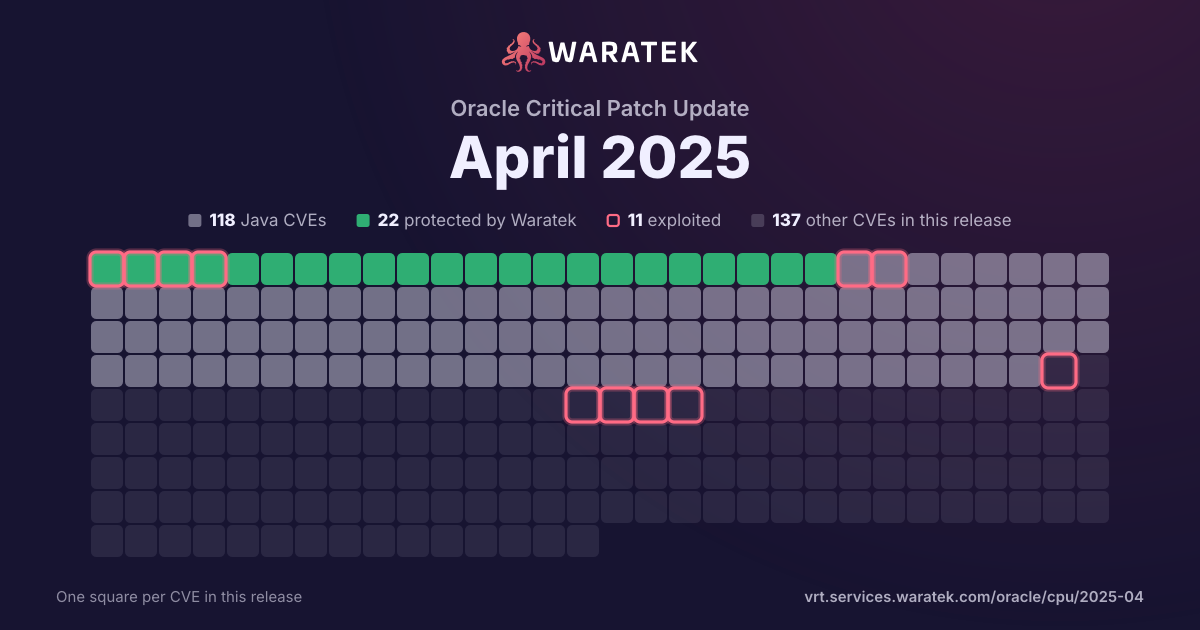
By status
22Protected by Waratek8Mitigation candidate88No exploit published16Outside Waratek scope121Not applicable
11Exploited, marked by the ring
No exploit published. For 33 of them, Oracle's security advisory is the source of public detail.
Protected by Waratek. Waratek RASP can block exploitation of these on systems that have not applied the patch yet.
Overview 142 matches · 53 in Waratek scope · 3 protected · 2 exploited · 1 CISA KEV · 5 public PoC · 3 EPSS ≥ 0.5
142matches
53in Waratek scope37.3%
3protected2.1%
2exploited1.4%
1CISA KEV0.7%
5public PoC3.5%
3EPSS ≥ 0.52.1%
Protected by Waratek
3
2.1%
Rule in development
0
0.0%
Mitigation candidate
2
1.4%
No exploit published
48
33.8%
Outside Waratek scope
9
6.3%
Not applicable
80
56.3%
Withdrawn CVE
0
0.0%
blocked by ARMR today
3
2.1%
partly blocked
0
0.0%
not blocked
139
97.9%
not established
0
0.0%
unrecorded
0
0.0%
split by
peak 56 / quarter
Q1 201
No exploit published1
Medium1
not blocked1
No public exploit1
Q2 200
Q3 200
Q4 201
No exploit published1
Medium1
not blocked1
Forecast only1
Q1 211
No exploit published1
Medium1
not blocked1
No public exploit1
Q2 211
Outside Waratek scope1
Medium1
not blocked1
No public exploit1
Q3 212
No exploit published2
Medium2
not blocked2
Forecast only1
No public exploit1
Q4 212
No exploit published1
Outside Waratek scope1
Medium2
not blocked2
Proof of concept only1
No public exploit1
Q1 220
Q2 220
Q3 221
Protected by Waratek1
Medium1
blocked by ARMR today1
Proof of concept only1
Q4 220
Q1 231
No exploit published1
Medium1
not blocked1
No public exploit1
Q2 231
No exploit published1
Medium1
not blocked1
No public exploit1
Q3 234
Protected by Waratek1
Mitigation candidate1
No exploit published1
Not applicable1
Medium4
blocked by ARMR today1
not blocked3
Proof of concept only1
No public exploit3
Q4 234
Mitigation candidate1
No exploit published2
Outside Waratek scope1
Medium4
not blocked4
Exploited1
Working exploit published1
No public exploit2
Q1 246
No exploit published3
Not applicable3
Medium6
not blocked6
Proof of concept only1
No public exploit5
Q2 246
Outside Waratek scope1
Not applicable5
Medium6
not blocked6
Proof of concept only1
No public exploit5
Q3 2411
No exploit published1
Not applicable10
Medium11
not blocked11
Proof of concept only1
No public exploit10
Q4 2433
Protected by Waratek1
No exploit published10
Outside Waratek scope2
Not applicable20
Medium33
blocked by ARMR today1
not blocked32
Exploited1
Proof of concept only11
No public exploit21
Q1 2511
No exploit published2
Outside Waratek scope1
Not applicable8
Medium11
not blocked11
Proof of concept only3
No public exploit8
Q2 2556
No exploit published21
Outside Waratek scope2
Not applicable33
Medium56
not blocked56
No public exploit56
Q2 20Q4 20Q2 21Q4 21Q2 22Q4 22Q2 23Q4 23Q2 24Q4 24Q2 25
| CVE | Severity | Published▾ | Status | Exploitation | Description |
|---|---|---|---|---|---|
| CVE-2024-45613 | Medium | 2024-09-25 | Not applicable | No public exploit | CKEditor 5 is a JavaScript rich-text editor. Starting in version 40.0.0 and prior to version 43.1.1, a Cross-Site Scripting (XSS) vulnerability is present in the CKEditor 5 clipboard package. This vulnerability could be triggered by a specific user action, leading to unauthorized JavaScript code execution, if the attacker managed to insert a malicious content into the editor, which might happen with a very specific editor configuration. This vulnerability only affects installations where the Block Toolbar plugin is enabled and either the General HTML Support (with a configuration that permits unsafe markup) or the HTML Embed plugin is also enabled. A fix for the problem is available in version 43.1.1. As a workaround, one may disable the block toolbar plugin. |
| CVE-2024-44187 | Medium | 2024-09-17 | Not applicable | No public exploit | A cross-origin issue existed with "iframe" elements. This was addressed with improved tracking of security origins. This issue is fixed in Safari 18, iOS 18 and iPadOS 18, macOS Sequoia 15, tvOS 18, visionOS 2, watchOS 11. A malicious website may exfiltrate data cross-origin. |
| CVE-2024-40866 | Medium | 2024-09-17 | Not applicable | No public exploit | The issue was addressed with improved UI. This issue is fixed in Safari 18, macOS Sequoia 15. Visiting a malicious website may lead to address bar spoofing. |
| CVE-2024-8775 | Medium | 2024-09-14 | Not applicable | No public exploit | A flaw was found in Ansible, where sensitive information stored in Ansible Vault files can be exposed in plaintext during the execution of a playbook. This occurs when using tasks such as include_vars to load vaulted variables without setting the no_log: true parameter, resulting in sensitive data being printed in the playbook output or logs. This can lead to the unintentional disclosure of secrets like passwords or API keys, compromising security and potentially allowing unauthorized access or actions. |
| CVE-2024-43796 | Medium | 2024-09-10 | Not applicable | No public exploit | Express.js minimalist web framework for node. In express < 4.20.0, passing untrusted user input - even after sanitizing it - to response.redirect() may execute untrusted code. This issue is patched in express 4.20.0. |
| CVE-2023-49582 | Medium | 2024-08-26 | Not applicable | No public exploit | Lax permissions set by the Apache Portable Runtime library on Unix platforms would allow local users read access to named shared memory segments, potentially revealing sensitive application data. This issue does not affect non-Unix platforms, or builds with APR_USE_SHMEM_SHMGET=1 (apr.h) Users are recommended to upgrade to APR version 1.7.5, which fixes this issue. |
| CVE-2024-42367 | Medium | 2024-08-12 | Not applicable | No public exploit | aiohttp is an asynchronous HTTP client/server framework for asyncio and Python. In versions on the 3.10 branch prior to version 3.10.2, static routes which contain files with compressed variants (`.gz` or `.br` extension) are vulnerable to path traversal outside the root directory if those variants are symbolic links. The server protects static routes from path traversal outside the root directory when `follow_symlinks=False` (default). It does this by resolving the requested URL to an absolute path and then checking that path relative to the root. However, these checks are not performed when looking for compressed variants in the `FileResponse` class, and symbolic links are then automatically followed when performing the `Path.stat()` and `Path.open()` to send the file. Version 3.10.2 contains a patch for the issue. |
| CVE-2024-43045 | Medium | 2024-08-07 | No exploit published | No public exploit | Jenkins 2.470 and earlier, LTS 2.452.3 and earlier does not perform a permission check in an HTTP endpoint, allowing attackers with Overall/Read permission to access other users' "My Views". |
| CVE-2024-7264 | Medium | 2024-07-31 | Not applicable | No public exploit | libcurl's ASN1 parser code has the `GTime2str()` function, used for parsing an ASN.1 Generalized Time field. If given an syntactically incorrect field, the parser might end up using -1 for the length of the *time fraction*, leading to a `strlen()` getting performed on a pointer to a heap buffer area that is not (purposely) null terminated. This flaw most likely leads to a crash, but can also lead to heap contents getting returned to the application when [CURLINFO_CERTINFO](https://curl.se/libcurl/c/CURLINFO_CERTINFO.html) is used. |
| CVE-2024-40725 | Medium | 2024-07-18 | Not applicable | Proof of concept only | A partial fix for CVE-2024-39884 in the core of Apache HTTP Server 2.4.61 ignores some use of the legacy content-type based configuration of handlers. "AddType" and similar configuration, under some circumstances where files are requested indirectly, result in source code disclosure of local content. For example, PHP scripts may be served instead of interpreted. Users are recommended to upgrade to version 2.4.62, which fixes this issue. |
| CVE-2024-39884 | Medium | 2024-07-04 | Not applicable | No public exploit | A regression in the core of Apache HTTP Server 2.4.60 ignores some use of the legacy content-type based configuration of handlers. "AddType" and similar configuration, under some circumstances where files are requested indirectly, result in source code disclosure of local content. For example, PHP scripts may be served instead of interpreted. Users are recommended to upgrade to version 2.4.61, which fixes this issue. |
| CVE-2024-38357 | Medium | 2024-06-19 | Not applicable | No public exploit | TinyMCE is an open source rich text editor. A cross-site scripting (XSS) vulnerability was discovered in TinyMCE’s content parsing code. This allowed specially crafted noscript elements containing malicious code to be executed when that content was loaded into the editor. This vulnerability has been patched in TinyMCE 7.2.0, TinyMCE 6.8.4 and TinyMCE 5.11.0 LTS by ensuring that content within noscript elements are properly parsed. Users are advised to upgrade. There are no known workarounds for this vulnerability. |
| CVE-2024-37891 | Medium | 2024-06-17 | Outside Waratek scope | No public exploit | urllib3 is a user-friendly HTTP client library for Python. When using urllib3's proxy support with `ProxyManager`, the `Proxy-Authorization` header is only sent to the configured proxy, as expected. However, when sending HTTP requests *without* using urllib3's proxy support, it's possible to accidentally configure the `Proxy-Authorization` header even though it won't have any effect as the request is not using a forwarding proxy or a tunneling proxy. In those cases, urllib3 doesn't treat the `Proxy-Authorization` HTTP header as one carrying authentication material and thus doesn't strip the header on cross-origin redirects. Because this is a highly unlikely scenario, we believe the severity of this vulnerability is low for almost all users. Out of an abundance of caution urllib3 will automatically strip the `Proxy-Authorization` header during cross-origin redirects to avoid the small chance that users are doing this on accident. Users should use urllib3's proxy support or disable automatic redirects to achieve safe processing of the `Proxy-Authorization` header, but we still decided to strip the header by default in order to further protect users who aren't using the correct approach. We believe the number of usages affected by this advisory is low. It requires all of the following to be true to be exploited: 1. Setting the `Proxy-Authorization` header without using urllib3's built-in proxy support. 2. Not disabling HTTP redirects. 3. Either not using an HTTPS origin server or for the proxy or target origin to redirect to a malicious origin. Users are advised to update to either version 1.26.19 or version 2.2.2. Users unable to upgrade may use the `Proxy-Authorization` header with urllib3's `ProxyManager`, disable HTTP redirects using `redirects=False` when sending requests, or not user the `Proxy-Authorization` header as mitigations. |
| CVE-2024-5206 | Medium | 2024-06-06 | Not applicable | Proof of concept only | A sensitive data leakage vulnerability was identified in scikit-learn's TfidfVectorizer, specifically in versions up to and including 1.4.1.post1, which was fixed in version 1.5.0. The vulnerability arises from the unexpected storage of all tokens present in the training data within the `stop_words_` attribute, rather than only storing the subset of tokens required for the TF-IDF technique to function. This behavior leads to the potential leakage of sensitive information, as the `stop_words_` attribute could contain tokens that were meant to be discarded and not stored, such as passwords or keys. The impact of this vulnerability varies based on the nature of the data being processed by the vectorizer. |
| CVE-2024-35195 | Medium | 2024-05-20 | Not applicable | No public exploit | Requests is a HTTP library. Prior to 2.32.0, when making requests through a Requests `Session`, if the first request is made with `verify=False` to disable cert verification, all subsequent requests to the same host will continue to ignore cert verification regardless of changes to the value of `verify`. This behavior will continue for the lifecycle of the connection in the connection pool. This vulnerability is fixed in 2.32.0. |
| CVE-2024-34064 | Medium | 2024-05-06 | Not applicable | No public exploit | Jinja is an extensible templating engine. The `xmlattr` filter in affected versions of Jinja accepts keys containing non-attribute characters. XML/HTML attributes cannot contain spaces, `/`, `>`, or `=`, as each would then be interpreted as starting a separate attribute. If an application accepts keys (as opposed to only values) as user input, and renders these in pages that other users see as well, an attacker could use this to inject other attributes and perform XSS. The fix for CVE-2024-22195 only addressed spaces but not other characters. Accepting keys as user input is now explicitly considered an unintended use case of the `xmlattr` filter, and code that does so without otherwise validating the input should be flagged as insecure, regardless of Jinja version. Accepting _values_ as user input continues to be safe. This vulnerability is fixed in 3.1.4. |
| CVE-2024-28219 | Medium | 2024-04-03 | Not applicable | No public exploit | In _imagingcms.c in Pillow before 10.3.0, a buffer overflow exists because strcpy is used instead of strncpy. |
| CVE-2024-29025 | Medium | 2024-03-25 | No exploit published | Proof of concept only | Netty is an asynchronous event-driven network application framework for rapid development of maintainable high performance protocol servers & clients. The `HttpPostRequestDecoder` can be tricked to accumulate data. While the decoder can store items on the disk if configured so, there are no limits to the number of fields the form can have, an attacher can send a chunked post consisting of many small fields that will be accumulated in the `bodyListHttpData` list. The decoder cumulates bytes in the `undecodedChunk` buffer until it can decode a field, this field can cumulate data without limits. This vulnerability is fixed in 4.1.108.Final. |
| CVE-2024-28835 | Medium | 2024-03-21 | Not applicable | No public exploit | A flaw has been discovered in GnuTLS where an application crash can be induced when attempting to verify a specially crafted .pem bundle using the "certtool --verify-chain" command. |
| CVE-2024-28834 | Medium | 2024-03-21 | Not applicable | No public exploit | A flaw was found in GnuTLS. The Minerva attack is a cryptographic vulnerability that exploits deterministic behavior in systems like GnuTLS, leading to side-channel leaks. In specific scenarios, such as when using the GNUTLS_PRIVKEY_FLAG_REPRODUCIBLE flag, it can result in a noticeable step in nonce size from 513 to 512 bits, exposing a potential timing side-channel. |
| CVE-2023-5388 | Medium | 2024-03-19 | Not applicable | No public exploit | NSS was susceptible to a timing side-channel attack when performing RSA decryption. This attack could potentially allow an attacker to recover the private data. This vulnerability affects Firefox < 124, Firefox ESR < 115.9, and Thunderbird < 115.9. |
| CVE-2024-23672 | Medium | 2024-03-13 | No exploit published | No public exploit | Denial of Service via incomplete cleanup vulnerability in Apache Tomcat. It was possible for WebSocket clients to keep WebSocket connections open leading to increased resource consumption.This issue affects Apache Tomcat: from 11.0.0-M1 through 11.0.0-M16, from 10.1.0-M1 through 10.1.18, from 9.0.0-M1 through 9.0.85, from 8.5.0 through 8.5.98. Older, EOL versions may also be affected. Users are recommended to upgrade to version 11.0.0-M17, 10.1.19, 9.0.86 or 8.5.99 which fix the issue. |
| CVE-2024-26308 | Medium | 2024-02-19 | No exploit published | No public exploit | Allocation of Resources Without Limits or Throttling vulnerability in Apache Commons Compress.This issue affects Apache Commons Compress: from 1.21 before 1.26. Users are recommended to upgrade to version 1.26, which fixes the issue. |
| CVE-2023-51074 | Medium | 2023-12-27 | No exploit published | No public exploit | json-path v2.8.0 was discovered to contain a stack overflow via the Criteria.parse() method. |
| CVE-2023-48795 | Medium | 2023-12-18 | Outside Waratek scope | Exploited | The SSH transport protocol with certain OpenSSH extensions, found in OpenSSH before 9.6 and other products, allows remote attackers to bypass integrity checks such that some packets are omitted (from the extension negotiation message), and a client and server may consequently end up with a connection for which some security features have been downgraded or disabled, aka a Terrapin attack. This occurs because the SSH Binary Packet Protocol (BPP), implemented by these extensions, mishandles the handshake phase and mishandles use of sequence numbers. For example, there is an effective attack against SSH's use of ChaCha20-Poly1305 (and CBC with Encrypt-then-MAC). The bypass occurs in chacha20-poly1305@openssh.com and (if CBC is used) the -etm@openssh.com MAC algorithms. This also affects Maverick Synergy Java SSH API before 3.1.0-SNAPSHOT, Dropbear through 2022.83, Ssh before 5.1.1 in Erlang/OTP, PuTTY before 0.80, AsyncSSH before 2.14.2, golang.org/x/crypto before 0.17.0, libssh before 0.10.6, libssh2 through 1.11.0, Thorn Tech SFTP Gateway before 3.4.6, Tera Term before 5.1, Paramiko before 3.4.0, jsch before 0.2.15, SFTPGo before 2.5.6, Netgate pfSense Plus through 23.09.1, Netgate pfSense CE through 2.7.2, HPN-SSH through 18.2.0, ProFTPD before 1.3.8b (and before 1.3.9rc2), ORYX CycloneSSH before 2.3.4, NetSarang XShell 7 before Build 0144, CrushFTP before 10.6.0, ConnectBot SSH library before 2.2.22, Apache MINA sshd through 2.11.0, sshj through 0.37.0, TinySSH through 20230101, trilead-ssh2 6401, LANCOM LCOS and LANconfig, FileZilla before 3.66.4, Nova before 11.8, PKIX-SSH before 14.4, SecureCRT before 9.4.3, Transmit5 before 5.10.4, Win32-OpenSSH before 9.5.0.0p1-Beta, WinSCP before 6.2.2, Bitvise SSH Server before 9.32, Bitvise SSH Client before 9.33, KiTTY through 0.76.1.13, the net-ssh gem 7.2.0 for Ruby, the mscdex ssh2 module before 1.15.0 for Node.js, the thrussh library before 0.35.1 for Rust, and the Russh crate before 0.40.2 for Rust. |
| CVE-2023-45648 | Medium | 2023-10-10 | Mitigation candidate | Working exploit published | Improper Input Validation vulnerability in Apache Tomcat.Tomcat from 11.0.0-M1 through 11.0.0-M11, from 10.1.0-M1 through 10.1.13, from 9.0.0-M1 through 9.0.81 and from 8.5.0 through 8.5.93 did not correctly parse HTTP trailer headers. A specially crafted, invalid trailer header could cause Tomcat to treat a single request as multiple requests leading to the possibility of request smuggling when behind a reverse proxy. Older, EOL versions may also be affected. Users are recommended to upgrade to version 11.0.0-M12 onwards, 10.1.14 onwards, 9.0.81 onwards or 8.5.94 onwards, which fix the issue. |
| CVE-2023-42795 | Medium | 2023-10-10 | No exploit published | No public exploit | Incomplete Cleanup vulnerability in Apache Tomcat.When recycling various internal objects in Apache Tomcat from 11.0.0-M1 through 11.0.0-M11, from 10.1.0-M1 through 10.1.13, from 9.0.0-M1 through 9.0.80 and from 8.5.0 through 8.5.93, an error could cause Tomcat to skip some parts of the recycling process leading to information leaking from the current request/response to the next. Older, EOL versions may also be affected. Users are recommended to upgrade to version 11.0.0-M12 onwards, 10.1.14 onwards, 9.0.81 onwards or 8.5.94 onwards, which fixes the issue. |
| CVE-2023-40167 | Medium | 2023-09-15 | No exploit published | No public exploit | Jetty is a Java based web server and servlet engine. Prior to versions 9.4.52, 10.0.16, 11.0.16, and 12.0.1, Jetty accepts the `+` character proceeding the content-length value in a HTTP/1 header field. This is more permissive than allowed by the RFC and other servers routinely reject such requests with 400 responses. There is no known exploit scenario, but it is conceivable that request smuggling could result if jetty is used in combination with a server that does not close the connection after sending such a 400 response. Versions 9.4.52, 10.0.16, 11.0.16, and 12.0.1 contain a patch for this issue. There is no workaround as there is no known exploit scenario. |
| CVE-2023-41080 | Medium | 2023-08-25 | Mitigation candidate | Proof of concept only | URL Redirection to Untrusted Site ('Open Redirect') vulnerability in FORM authentication feature Apache Tomcat.This issue affects Apache Tomcat: from 11.0.0-M1 through 11.0.0-M10, from 10.1.0-M1 through 10.0.12, from 9.0.0-M1 through 9.0.79 and from 8.5.0 through 8.5.92. Older, EOL versions may also be affected. The vulnerability is limited to the ROOT (default) web application. |
| CVE-2023-35887 | Medium | 2023-07-10 | Protected by Waratek | No public exploit | Exposure of Sensitive Information to an Unauthorized Actor vulnerability in Apache Software Foundation Apache MINA. In SFTP servers implemented using Apache MINA SSHD that use a RootedFileSystem, logged users may be able to discover "exists/does not exist" information about items outside the rooted tree via paths including parent navigation ("..") beyond the root, or involving symlinks. This issue affects Apache MINA: from 1.0 before 2.10. Users are recommended to upgrade to 2.10 |
| CVE-2023-25399 | Medium | 2023-07-05 | Not applicable | No public exploit | A refcounting issue which leads to potential memory leak was discovered in scipy commit 8627df31ab in Py_FindObjects() function. Note: This is disputed as a bug and not a vulnerability. SciPy is not designed to be exposed to untrusted users or data directly. |
| CVE-2023-35116 | Medium | 2023-06-14 | No exploit published | No public exploit | jackson-databind through 2.15.2 allows attackers to cause a denial of service or other unspecified impact via a crafted object that uses cyclic dependencies. NOTE: the vendor's perspective is that this is not a valid vulnerability report, because the steps of constructing a cyclic data structure and trying to serialize it cannot be achieved by an external attacker. |
| CVE-2023-28708 | Medium | 2023-03-22 | No exploit published | No public exploit | When using the RemoteIpFilter with requests received from a reverse proxy via HTTP that include the X-Forwarded-Proto header set to https, session cookies created by Apache Tomcat 11.0.0-M1 to 11.0.0.-M2, 10.1.0-M1 to 10.1.5, 9.0.0-M1 to 9.0.71 and 8.5.0 to 8.5.85 did not include the secure attribute. This could result in the user agent transmitting the session cookie over an insecure channel. Older, EOL versions may also be affected. |
| CVE-2022-36033 | Medium | 2022-08-29 | Protected by Waratek | Proof of concept only | jsoup is a Java HTML parser, built for HTML editing, cleaning, scraping, and cross-site scripting (XSS) safety. jsoup may incorrectly sanitize HTML including `javascript:` URL expressions, which could allow XSS attacks when a reader subsequently clicks that link. If the non-default `SafeList.preserveRelativeLinks` option is enabled, HTML including `javascript:` URLs that have been crafted with control characters will not be sanitized. If the site that this HTML is published on does not set a Content Security Policy, an XSS attack is then possible. This issue is patched in jsoup 1.15.3. Users should upgrade to this version. Additionally, as the unsanitized input may have been persisted, old content should be cleaned again using the updated version. To remediate this issue without immediately upgrading: - disable `SafeList.preserveRelativeLinks`, which will rewrite input URLs as absolute URLs - ensure an appropriate [Content Security Policy](https://developer.mozilla.org/en-US/docs/Web/HTTP/CSP) is defined. (This should be used regardless of upgrading, as a defence-in-depth best practice.) |
| CVE-2021-41973 | Medium | 2021-11-01 | No exploit published | No public exploit | In Apache MINA, a specifically crafted, malformed HTTP request may cause the HTTP Header decoder to loop indefinitely. The decoder assumed that the HTTP Header begins at the beginning of the buffer and loops if there is more data than expected. Please update MINA to 2.1.5 or greater. |
| CVE-2021-41184 | Medium | 2021-10-26 | Outside Waratek scope | Proof of concept only | jQuery-UI is the official jQuery user interface library. Prior to version 1.13.0, accepting the value of the `of` option of the `.position()` util from untrusted sources may execute untrusted code. The issue is fixed in jQuery UI 1.13.0. Any string value passed to the `of` option is now treated as a CSS selector. A workaround is to not accept the value of the `of` option from untrusted sources. |
| CVE-2021-33037 | Medium | 2021-07-12 | No exploit published | Forecast only | Apache Tomcat 10.0.0-M1 to 10.0.6, 9.0.0.M1 to 9.0.46 and 8.5.0 to 8.5.66 did not correctly parse the HTTP transfer-encoding request header in some circumstances leading to the possibility to request smuggling when used with a reverse proxy. Specifically: - Tomcat incorrectly ignored the transfer encoding header if the client declared it would only accept an HTTP/1.0 response; - Tomcat honoured the identify encoding; and - Tomcat did not ensure that, if present, the chunked encoding was the final encoding. |
| CVE-2021-30640 | Medium | 2021-07-12 | No exploit published | No public exploit | A vulnerability in the JNDI Realm of Apache Tomcat allows an attacker to authenticate using variations of a valid user name and/or to bypass some of the protection provided by the LockOut Realm. This issue affects Apache Tomcat 10.0.0-M1 to 10.0.5; 9.0.0.M1 to 9.0.45; 8.5.0 to 8.5.65. |
| CVE-2021-28170 | Medium | 2021-05-26 | Outside Waratek scope | No public exploit | In the Jakarta Expression Language implementation 3.0.3 and earlier, a bug in the ELParserTokenManager enables invalid EL expressions to be evaluated as if they were valid. |
| CVE-2021-24122 | Medium | 2021-01-14 | No exploit published | No public exploit | When serving resources from a network location using the NTFS file system, Apache Tomcat versions 10.0.0-M1 to 10.0.0-M9, 9.0.0.M1 to 9.0.39, 8.5.0 to 8.5.59 and 7.0.0 to 7.0.106 were susceptible to JSP source code disclosure in some configurations. The root cause was the unexpected behaviour of the JRE API File.getCanonicalPath() which in turn was caused by the inconsistent behaviour of the Windows API (FindFirstFileW) in some circumstances. |
| CVE-2020-13943 | Medium | 2020-10-12 | No exploit published | Forecast only | If an HTTP/2 client connecting to Apache Tomcat 10.0.0-M1 to 10.0.0-M7, 9.0.0.M1 to 9.0.37 or 8.5.0 to 8.5.57 exceeded the agreed maximum number of concurrent streams for a connection (in violation of the HTTP/2 protocol), it was possible that a subsequent request made on that connection could contain HTTP headers - including HTTP/2 pseudo headers - from a previous request rather than the intended headers. This could lead to users seeing responses for unexpected resources. |
| CVE-2020-1935 | Medium | 2020-02-24 | No exploit published | No public exploit | In Apache Tomcat 9.0.0.M1 to 9.0.30, 8.5.0 to 8.5.50 and 7.0.0 to 7.0.99 the HTTP header parsing code used an approach to end-of-line parsing that allowed some invalid HTTP headers to be parsed as valid. This led to a possibility of HTTP Request Smuggling if Tomcat was located behind a reverse proxy that incorrectly handled the invalid Transfer-Encoding header in a particular manner. Such a reverse proxy is considered unlikely. |