
Oracle Critical Patch Update April 2025
Released April 2025 · Oracle's advisory ↗ · ← Critical Patch Update, January 2025 · Critical Patch Update, July 2025 →
255 CVEs in this release, one square each
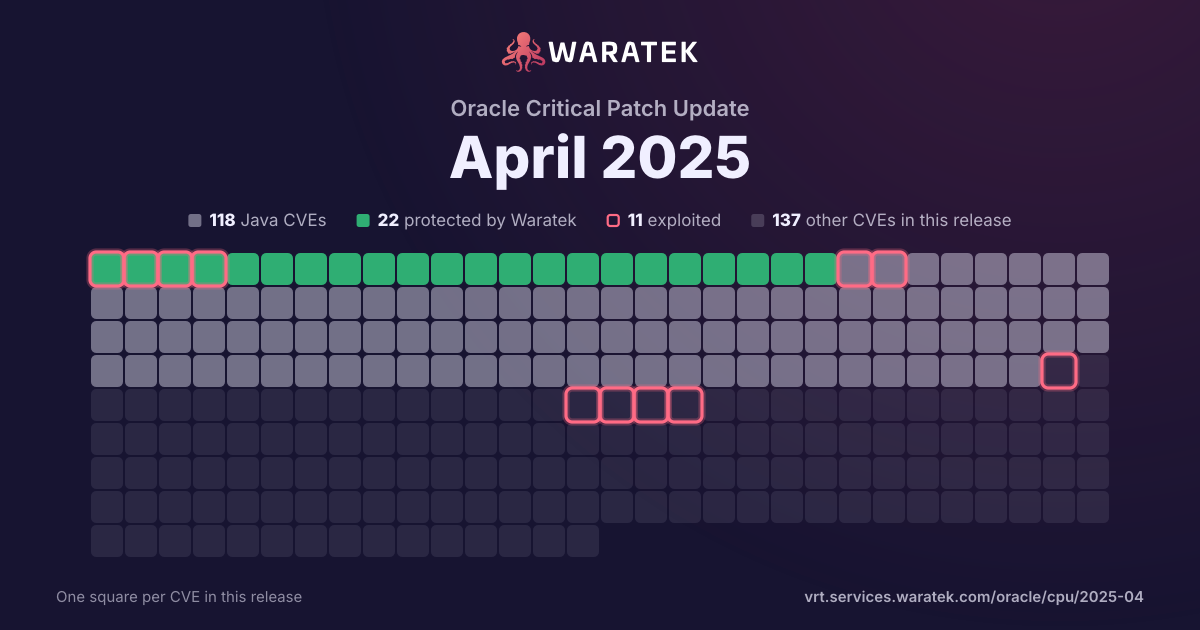
By status
22Protected by Waratek8Mitigation candidate94No exploit published3Outside Waratek scope128Not applicable
11Exploited, marked by the ring
No exploit published. For 29 of them, Oracle's security advisory is the source of public detail.
Protected by Waratek. Waratek RASP can block exploitation of these on systems that have not applied the patch yet.
Overview 5 matches · 1 protected · 1 exploited · 1 CISA KEV · 1 public PoC · 1 EPSS ≥ 0.5
Protected by Waratek
1
20.0%
Rule in development
0
0.0%
Mitigation candidate
0
0.0%
No exploit published
4
80.0%
blocked by ARMR today
1
20.0%
partly blocked
0
0.0%
not blocked
4
80.0%
not established
0
0.0%
unrecorded
0
0.0%
Exploited
1
20.0%
Working exploit published
0
0.0%
Proof of concept only
3
60.0%
Forecast only
0
0.0%
No public exploit
1
20.0%
| CVE | Severity | Published▾ | Status | Exploitation | Description |
|---|---|---|---|---|---|
| CVE-2025-30729 | Medium | 2025-04-15 | No exploit published | No public exploit | Vulnerability in the Oracle Communications Order and Service Management product of Oracle Communications Applications (component: Security). Supported versions that are affected are 7.4.0, 7.4.1 and 7.5.0. Easily exploitable vulnerability allows low privileged attacker with network access via HTTP to compromise Oracle Communications Order and Service Management. Successful attacks require human interaction from a person other than the attacker. Successful attacks of this vulnerability can result in unauthorized update, insert or delete access to some of Oracle Communications Order and Service Management accessible data as well as unauthorized read access to a subset of Oracle Communications Order and Service Management accessible data and unauthorized ability to cause a partial denial of service (partial DOS) of Oracle Communications Order and Service Management. CVSS 3.1 Base Score 5.5 (Confidentiality, Integrity and Availability impacts). CVSS Vector: (CVSS:3.1/AV:N/AC:L/PR:L/UI:R/S:U/C:L/I:L/A:L). |
| CVE-2025-24813 | Critical | 2025-03-10 | Protected by Waratek | Exploited | Path Equivalence: 'file.Name' (Internal Dot) leading to Remote Code Execution and/or Information disclosure and/or malicious content added to uploaded files via write enabled Default Servlet in Apache Tomcat. This issue affects Apache Tomcat: from 11.0.0-M1 through 11.0.2, from 10.1.0-M1 through 10.1.34, from 9.0.0.M1 through 9.0.98. The following versions were EOL at the time the CVE was created but are known to be affected: 8.5.0 though 8.5.100. Other, older, EOL versions may also be affected. If all of the following were true, a malicious user was able to view security sensitive files and/or inject content into those files: - writes enabled for the default servlet (disabled by default) - support for partial PUT (enabled by default) - a target URL for security sensitive uploads that was a sub-directory of a target URL for public uploads - attacker knowledge of the names of security sensitive files being uploaded - the security sensitive files also being uploaded via partial PUT If all of the following were true, a malicious user was able to perform remote code execution: - writes enabled for the default servlet (disabled by default) - support for partial PUT (enabled by default) - application was using Tomcat's file based session persistence with the default storage location - application included a library that may be leveraged in a deserialization attack Users are recommended to upgrade to version 11.0.3, 10.1.35 or 9.0.99, which fixes the issue. |
| CVE-2025-25193 | Medium | 2025-02-10 | No exploit published | Proof of concept only | Netty, an asynchronous, event-driven network application framework, has a vulnerability in versions up to and including 4.1.118.Final. An unsafe reading of environment file could potentially cause a denial of service in Netty. When loaded on an Windows application, Netty attempts to load a file that does not exist. If an attacker creates such a large file, the Netty application crash. A similar issue was previously reported as CVE-2024-47535. This issue was fixed, but the fix was incomplete in that null-bytes were not counted against the input limit. Commit d1fbda62d3a47835d3fb35db8bd42ecc205a5386 contains an updated fix. |
| CVE-2025-24970 | High | 2025-02-10 | No exploit published | Proof of concept only | Netty, an asynchronous, event-driven network application framework, has a vulnerability starting in version 4.1.91.Final and prior to version 4.1.118.Final. When a special crafted packet is received via SslHandler it doesn't correctly handle validation of such a packet in all cases which can lead to a native crash. Version 4.1.118.Final contains a patch. As workaround its possible to either disable the usage of the native SSLEngine or change the code manually. |
| CVE-2024-57699 | High | 2025-02-05 | No exploit published | Proof of concept only | A security issue was found in Netplex Json-smart 2.5.0 through 2.5.1. When loading a specially crafted JSON input, containing a large number of ’{’, a stack exhaustion can be trigger, which could allow an attacker to cause a Denial of Service (DoS). This issue exists because of an incomplete fix for CVE-2023-1370. |