
Oracle Critical Patch Update April 2025
Released April 2025 · Oracle's advisory ↗ · ← Critical Patch Update, January 2025 · Critical Patch Update, July 2025 →
255 CVEs in this release, one square each
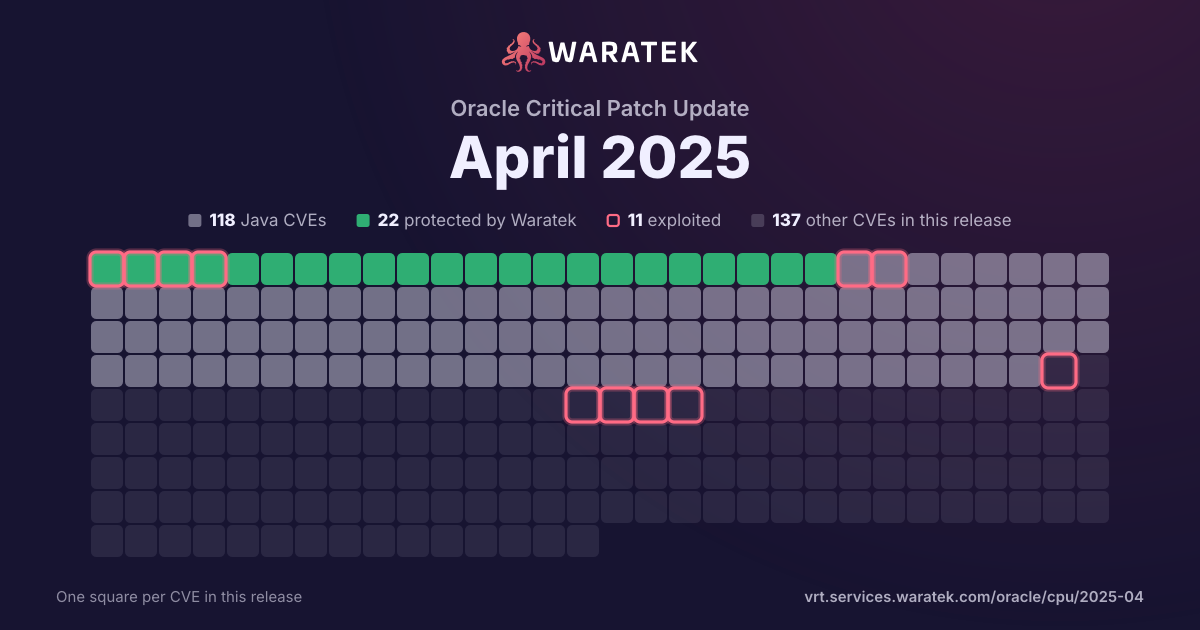
By status
22Protected by Waratek8Mitigation candidate94No exploit published3Outside Waratek scope128Not applicable
11Exploited, marked by the ring
No exploit published. For 29 of them, Oracle's security advisory is the source of public detail.
Protected by Waratek. Waratek RASP can block exploitation of these on systems that have not applied the patch yet.
Overview 21 matches · 0 protected · 0 exploited · 0 CISA KEV · 0 public PoC · 1 EPSS ≥ 0.5
Protected by Waratek
0
0.0%
Rule in development
0
0.0%
Mitigation candidate
0
0.0%
No exploit published
21
100.0%
blocked by ARMR today
0
0.0%
partly blocked
0
0.0%
not blocked
21
100.0%
not established
0
0.0%
unrecorded
0
0.0%
Exploited
0
0.0%
Working exploit published
0
0.0%
Proof of concept only
2
9.5%
Forecast only
1
4.8%
No public exploit
18
85.7%
split by
peak 5 / quarter
Q1 211
No exploit published1
High1
not blocked1
No public exploit1
Q2 211
No exploit published1
Medium1
not blocked1
No public exploit1
Q3 212
No exploit published2
Medium2
not blocked2
Forecast only1
No public exploit1
Q4 211
No exploit published1
Critical1
not blocked1
No public exploit1
Q1 221
No exploit published1
High1
not blocked1
No public exploit1
Q2 220
Q3 220
Q4 222
No exploit published2
High2
not blocked2
No public exploit2
Q1 233
No exploit published3
High2
Medium1
not blocked3
Proof of concept only1
No public exploit2
Q2 230
Q3 232
No exploit published2
Medium1
Low1
not blocked2
No public exploit2
Q4 233
No exploit published3
High1
Medium2
not blocked3
No public exploit3
Q1 245
No exploit published5
High2
Medium3
not blocked5
Proof of concept only1
No public exploit4
Q1 21Q3 21Q1 22Q3 22Q1 23Q3 23Q1 24
| CVE | Severity | Published▾ | Status | Exploitation | Description |
|---|---|---|---|---|---|
| CVE-2024-29025 | Medium | 2024-03-25 | No exploit published | Proof of concept only | Netty is an asynchronous event-driven network application framework for rapid development of maintainable high performance protocol servers & clients. The `HttpPostRequestDecoder` can be tricked to accumulate data. While the decoder can store items on the disk if configured so, there are no limits to the number of fields the form can have, an attacher can send a chunked post consisting of many small fields that will be accumulated in the `bodyListHttpData` list. The decoder cumulates bytes in the `undecodedChunk` buffer until it can decode a field, this field can cumulate data without limits. This vulnerability is fixed in 4.1.108.Final. |
| CVE-2023-5685 | High | 2024-03-22 | No exploit published | No public exploit | A flaw was found in XNIO. The XNIO NotifierState that can cause a Stack Overflow Exception when the chain of notifier states becomes problematically large can lead to uncontrolled resource management and a possible denial of service (DoS). |
| CVE-2024-23672 | Medium | 2024-03-13 | No exploit published | No public exploit | Denial of Service via incomplete cleanup vulnerability in Apache Tomcat. It was possible for WebSocket clients to keep WebSocket connections open leading to increased resource consumption.This issue affects Apache Tomcat: from 11.0.0-M1 through 11.0.0-M16, from 10.1.0-M1 through 10.1.18, from 9.0.0-M1 through 9.0.85, from 8.5.0 through 8.5.98. Older, EOL versions may also be affected. Users are recommended to upgrade to version 11.0.0-M17, 10.1.19, 9.0.86 or 8.5.99 which fix the issue. |
| CVE-2024-26308 | Medium | 2024-02-19 | No exploit published | No public exploit | Allocation of Resources Without Limits or Throttling vulnerability in Apache Commons Compress.This issue affects Apache Commons Compress: from 1.21 before 1.26. Users are recommended to upgrade to version 1.26, which fixes the issue. |
| CVE-2024-25710 | High | 2024-02-19 | No exploit published | No public exploit | Loop with Unreachable Exit Condition ('Infinite Loop') vulnerability in Apache Commons Compress.This issue affects Apache Commons Compress: from 1.3 through 1.25.0. Users are recommended to upgrade to version 1.26.0 which fixes the issue. |
| CVE-2023-51074 | Medium | 2023-12-27 | No exploit published | No public exploit | json-path v2.8.0 was discovered to contain a stack overflow via the Criteria.parse() method. |
| CVE-2023-46589 | High | 2023-11-28 | No exploit published | No public exploit | Improper Input Validation vulnerability in Apache Tomcat.Tomcat from 11.0.0-M1 through 11.0.0-M10, from 10.1.0-M1 through 10.1.15, from 9.0.0-M1 through 9.0.82 and from 8.5.0 through 8.5.95 did not correctly parse HTTP trailer headers. A trailer header that exceeded the header size limit could cause Tomcat to treat a single request as multiple requests leading to the possibility of request smuggling when behind a reverse proxy. Older, EOL versions may also be affected. Users are recommended to upgrade to version 11.0.0-M11 onwards, 10.1.16 onwards, 9.0.83 onwards or 8.5.96 onwards, which fix the issue. |
| CVE-2023-42795 | Medium | 2023-10-10 | No exploit published | No public exploit | Incomplete Cleanup vulnerability in Apache Tomcat.When recycling various internal objects in Apache Tomcat from 11.0.0-M1 through 11.0.0-M11, from 10.1.0-M1 through 10.1.13, from 9.0.0-M1 through 9.0.80 and from 8.5.0 through 8.5.93, an error could cause Tomcat to skip some parts of the recycling process leading to information leaking from the current request/response to the next. Older, EOL versions may also be affected. Users are recommended to upgrade to version 11.0.0-M12 onwards, 10.1.14 onwards, 9.0.81 onwards or 8.5.94 onwards, which fixes the issue. |
| CVE-2023-40167 | Medium | 2023-09-15 | No exploit published | No public exploit | Jetty is a Java based web server and servlet engine. Prior to versions 9.4.52, 10.0.16, 11.0.16, and 12.0.1, Jetty accepts the `+` character proceeding the content-length value in a HTTP/1 header field. This is more permissive than allowed by the RFC and other servers routinely reject such requests with 400 responses. There is no known exploit scenario, but it is conceivable that request smuggling could result if jetty is used in combination with a server that does not close the connection after sending such a 400 response. Versions 9.4.52, 10.0.16, 11.0.16, and 12.0.1 contain a patch for this issue. There is no workaround as there is no known exploit scenario. |
| CVE-2023-36479 | Low | 2023-09-15 | No exploit published | No public exploit | Eclipse Jetty Canonical Repository is the canonical repository for the Jetty project. Users of the CgiServlet with a very specific command structure may have the wrong command executed. If a user sends a request to a org.eclipse.jetty.servlets.CGI Servlet for a binary with a space in its name, the servlet will escape the command by wrapping it in quotation marks. This wrapped command, plus an optional command prefix, will then be executed through a call to Runtime.exec. If the original binary name provided by the user contains a quotation mark followed by a space, the resulting command line will contain multiple tokens instead of one. This issue was patched in version 9.4.52, 10.0.16, 11.0.16 and 12.0.0-beta2. |
| CVE-2023-28708 | Medium | 2023-03-22 | No exploit published | No public exploit | When using the RemoteIpFilter with requests received from a reverse proxy via HTTP that include the X-Forwarded-Proto header set to https, session cookies created by Apache Tomcat 11.0.0-M1 to 11.0.0.-M2, 10.1.0-M1 to 10.1.5, 9.0.0-M1 to 9.0.71 and 8.5.0 to 8.5.85 did not include the secure attribute. This could result in the user agent transmitting the session cookie over an insecure channel. Older, EOL versions may also be affected. |
| CVE-2023-1370 | High | 2023-03-22 | No exploit published | Proof of concept only | [Json-smart](https://netplex.github.io/json-smart/) is a performance focused, JSON processor lib. When reaching a ‘[‘ or ‘{‘ character in the JSON input, the code parses an array or an object respectively. It was discovered that the code does not have any limit to the nesting of such arrays or objects. Since the parsing of nested arrays and objects is done recursively, nesting too many of them can cause a stack exhaustion (stack overflow) and crash the software. |
| CVE-2023-24998 | High | 2023-02-20 | No exploit published | No public exploit | Apache Commons FileUpload before 1.5 does not limit the number of request parts to be processed resulting in the possibility of an attacker triggering a DoS with a malicious upload or series of uploads. Note that, like all of the file upload limits, the new configuration option (FileUploadBase#setFileCountMax) is not enabled by default and must be explicitly configured. |
| CVE-2022-42252 | High | 2022-11-01 | No exploit published | No public exploit | If Apache Tomcat 8.5.0 to 8.5.82, 9.0.0-M1 to 9.0.67, 10.0.0-M1 to 10.0.26 or 10.1.0-M1 to 10.1.0 was configured to ignore invalid HTTP headers via setting rejectIllegalHeader to false (the default for 8.5.x only), Tomcat did not reject a request containing an invalid Content-Length header making a request smuggling attack possible if Tomcat was located behind a reverse proxy that also failed to reject the request with the invalid header. |
| CVE-2022-42003 | High | 2022-10-02 | No exploit published | No public exploit | In FasterXML jackson-databind before versions 2.13.4.1 and 2.12.17.1, resource exhaustion can occur because of a lack of a check in primitive value deserializers to avoid deep wrapper array nesting, when the UNWRAP_SINGLE_VALUE_ARRAYS feature is enabled. |
| CVE-2020-36518 | High | 2022-03-11 | No exploit published | No public exploit | jackson-databind before 2.13.0 allows a Java StackOverflow exception and denial of service via a large depth of nested objects. |
| CVE-2021-23450 | Critical | 2021-12-17 | No exploit published | No public exploit | All versions of package dojo are vulnerable to Prototype Pollution via the setObject function. |
| CVE-2021-33037 | Medium | 2021-07-12 | No exploit published | Forecast only | Apache Tomcat 10.0.0-M1 to 10.0.6, 9.0.0.M1 to 9.0.46 and 8.5.0 to 8.5.66 did not correctly parse the HTTP transfer-encoding request header in some circumstances leading to the possibility to request smuggling when used with a reverse proxy. Specifically: - Tomcat incorrectly ignored the transfer encoding header if the client declared it would only accept an HTTP/1.0 response; - Tomcat honoured the identify encoding; and - Tomcat did not ensure that, if present, the chunked encoding was the final encoding. |
| CVE-2021-30640 | Medium | 2021-07-12 | No exploit published | No public exploit | A vulnerability in the JNDI Realm of Apache Tomcat allows an attacker to authenticate using variations of a valid user name and/or to bypass some of the protection provided by the LockOut Realm. This issue affects Apache Tomcat 10.0.0-M1 to 10.0.5; 9.0.0.M1 to 9.0.45; 8.5.0 to 8.5.65. |
| CVE-2021-28170 | Medium | 2021-05-26 | No exploit published | No public exploit | In the Jakarta Expression Language implementation 3.0.3 and earlier, a bug in the ELParserTokenManager enables invalid EL expressions to be evaluated as if they were valid. |
| CVE-2020-13936 | High | 2021-03-10 | No exploit published | No public exploit | An attacker that is able to modify Velocity templates may execute arbitrary Java code or run arbitrary system commands with the same privileges as the account running the Servlet container. This applies to applications that allow untrusted users to upload/modify velocity templates running Apache Velocity Engine versions up to 2.2. |