
Oracle Critical Patch Update April 2025
Released April 2025 · Oracle's advisory ↗ · ← Critical Patch Update, January 2025 · Critical Patch Update, July 2025 →
255 CVEs in this release, one square each
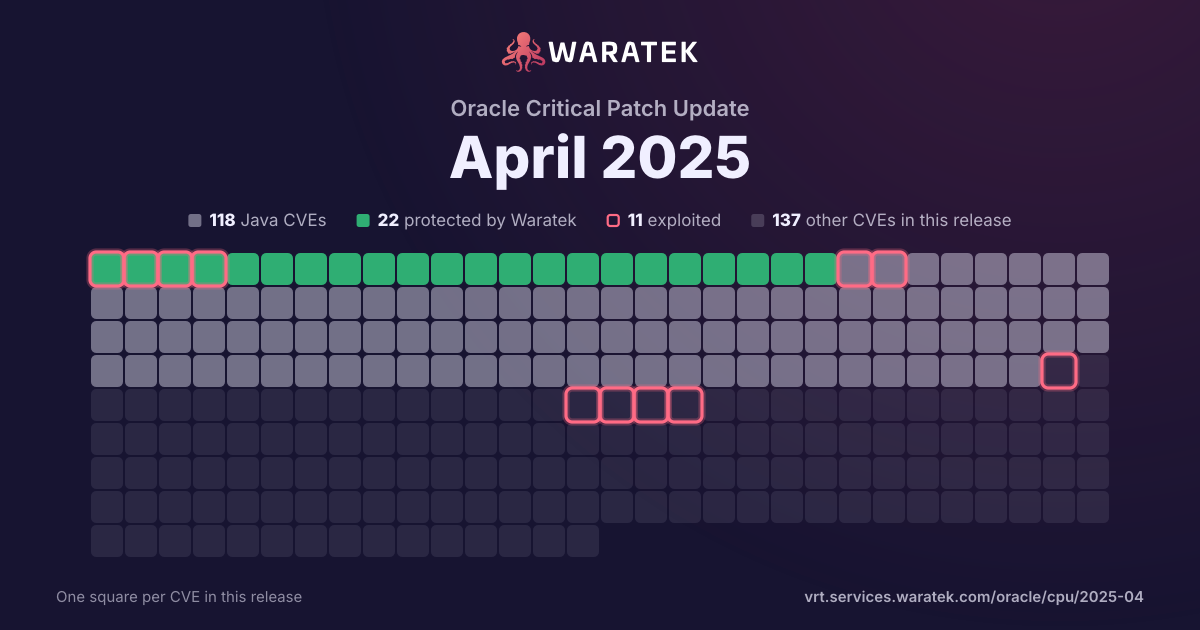
By status
22Protected by Waratek8Mitigation candidate94No exploit published3Outside Waratek scope128Not applicable
11Exploited, marked by the ring
No exploit published. For 29 of them, Oracle's security advisory is the source of public detail.
Protected by Waratek. Waratek RASP can block exploitation of these on systems that have not applied the patch yet.
Overview 52 matches · 15 protected · 4 exploited · 1 CISA KEV · 9 public PoC · 4 EPSS ≥ 0.5
Protected by Waratek
15
28.8%
Rule in development
0
0.0%
Mitigation candidate
5
9.6%
No exploit published
32
61.5%
blocked by ARMR today
15
28.8%
partly blocked
0
0.0%
not blocked
37
71.2%
not established
0
0.0%
unrecorded
0
0.0%
split by
peak 14 / quarter
Q2 201
Protected by Waratek1
High1
blocked by ARMR today1
Working exploit published1
Q3 201
Mitigation candidate1
High1
not blocked1
Working exploit published1
Q4 201
Protected by Waratek1
High1
blocked by ARMR today1
No public exploit1
Q1 212
Protected by Waratek1
No exploit published1
High2
blocked by ARMR today1
not blocked1
No public exploit2
Q2 212
No exploit published2
High1
Medium1
not blocked2
No public exploit2
Q3 212
No exploit published2
High1
Medium1
not blocked2
Forecast only1
No public exploit1
Q4 211
No exploit published1
Critical1
not blocked1
No public exploit1
Q1 221
No exploit published1
High1
not blocked1
No public exploit1
Q2 220
Q3 221
Protected by Waratek1
Medium1
blocked by ARMR today1
Proof of concept only1
Q4 223
Protected by Waratek1
No exploit published2
Critical1
High2
blocked by ARMR today1
not blocked2
Proof of concept only1
No public exploit2
Q1 235
Protected by Waratek2
No exploit published3
High4
Medium1
blocked by ARMR today2
not blocked3
Exploited1
Proof of concept only1
No public exploit3
Q2 231
No exploit published1
Medium1
not blocked1
No public exploit1
Q3 233
Protected by Waratek2
No exploit published1
High1
Medium1
Low1
blocked by ARMR today2
not blocked1
No public exploit3
Q4 233
Mitigation candidate1
No exploit published2
High2
Medium1
not blocked3
Exploited1
No public exploit2
Q1 246
Mitigation candidate2
No exploit published4
High4
Medium2
not blocked6
Proof of concept only3
No public exploit3
Q2 242
No exploit published2
High2
not blocked2
No public exploit2
Q3 242
Protected by Waratek1
No exploit published1
High2
blocked by ARMR today1
not blocked1
Exploited1
No public exploit1
Q4 2414
Protected by Waratek5
Mitigation candidate1
No exploit published8
Critical4
High3
Medium6
Low1
blocked by ARMR today5
not blocked9
Exploited1
Working exploit published1
Proof of concept only2
No public exploit10
Q1 251
No exploit published1
High1
not blocked1
No public exploit1
Q3 20Q1 21Q3 21Q1 22Q3 22Q1 23Q3 23Q1 24Q3 24Q1 25
| CVE | Severity | Published▾ | Status | Exploitation | Description |
|---|---|---|---|---|---|
| CVE-2025-23184 | High | 2025-01-21 | No exploit published | No public exploit | A potential denial of service vulnerability is present in versions of Apache CXF before 3.5.10, 3.6.5 and 4.0.6. In some edge cases, the CachedOutputStream instances may not be closed and, if backed by temporary files, may fill up the file system (it applies to servers and clients). |
| CVE-2024-52046 | Critical | 2024-12-25 | Protected by Waratek | No public exploit | The ObjectSerializationDecoder in Apache MINA uses Java’s native deserialization protocol to process incoming serialized data but lacks the necessary security checks and defenses. This vulnerability allows attackers to exploit the deserialization process by sending specially crafted malicious serialized data, potentially leading to remote code execution (RCE) attacks. This issue affects MINA core versions 2.0.X, 2.1.X and 2.2.X, and will be fixed by the releases 2.0.27, 2.1.10 and 2.2.4. It's also important to note that an application using MINA core library will only be affected if the IoBuffer#getObject() method is called, and this specific method is potentially called when adding a ProtocolCodecFilter instance using the ObjectSerializationCodecFactory class in the filter chain. If your application is specifically using those classes, you have to upgrade to the latest version of MINA core library. Upgrading will not be enough: you also need to explicitly allow the classes the decoder will accept in the ObjectSerializationDecoder instance, using one of the three new methods: /** * Accept class names where the supplied ClassNameMatcher matches for * deserialization, unless they are otherwise rejected. * * @param classNameMatcher the matcher to use */ public void accept(ClassNameMatcher classNameMatcher) /** * Accept class names that match the supplied pattern for * deserialization, unless they are otherwise rejected. * * @param pattern standard Java regexp */ public void accept(Pattern pattern) /** * Accept the wildcard specified classes for deserialization, * unless they are otherwise rejected. * * @param patterns Wildcard file name patterns as defined by * {@link org.apache.commons.io.FilenameUtils#wildcardMatch(String, String) FilenameUtils.wildcardMatch} */ public void accept(String... patterns) By default, the decoder will reject *all* classes that will be present in the incoming data. Note: The FtpServer, SSHd and Vysper sub-project are not affected by this issue. |
| CVE-2024-56337 | Critical | 2024-12-20 | Protected by Waratek | Exploited | Time-of-check Time-of-use (TOCTOU) Race Condition vulnerability in Apache Tomcat. This issue affects Apache Tomcat: from 11.0.0-M1 through 11.0.1, from 10.1.0-M1 through 10.1.33, from 9.0.0.M1 through 9.0.97. The following versions were EOL at the time the CVE was created but are known to be affected: 8.5.0 though 8.5.100. Other, older, EOL versions may also be affected. The mitigation for CVE-2024-50379 was incomplete. Users running Tomcat on a case insensitive file system with the default servlet write enabled (readonly initialisation parameter set to the non-default value of false) may need additional configuration to fully mitigate CVE-2024-50379 depending on which version of Java they are using with Tomcat: - running on Java 8 or Java 11: the system property sun.io.useCanonCaches must be explicitly set to false (it defaults to true) - running on Java 17: the system property sun.io.useCanonCaches, if set, must be set to false (it defaults to false) - running on Java 21 onwards: no further configuration is required (the system property and the problematic cache have been removed) Tomcat 11.0.3, 10.1.35 and 9.0.99 onwards will include checks that sun.io.useCanonCaches is set appropriately before allowing the default servlet to be write enabled on a case insensitive file system. Tomcat will also set sun.io.useCanonCaches to false by default where it can. |
| CVE-2024-38819 | High | 2024-12-19 | Protected by Waratek | Working exploit published | Applications serving static resources through the functional web frameworks WebMvc.fn or WebFlux.fn are vulnerable to path traversal attacks. An attacker can craft malicious HTTP requests and obtain any file on the file system that is also accessible to the process in which the Spring application is running. |
| CVE-2024-12801 | Low | 2024-12-19 | No exploit published | No public exploit | Server-Side Request Forgery (SSRF) in SaxEventRecorder by QOS.CH logback version 0.1 to 1.3.14 and 1.4.0 to 1.5.12 on the Java platform, allows an attacker to forge requests by compromising logback configuration files in XML. The attacks involves the modification of DOCTYPE declaration in XML configuration files. |
| CVE-2024-12798 | Medium | 2024-12-19 | No exploit published | No public exploit | ACE vulnerability in JaninoEventEvaluator by QOS.CH logback-core upto including version 0.1 to 1.3.14 and 1.4.0 to 1.5.12 in Java applications allows attacker to execute arbitrary code by compromising an existing logback configuration file or by injecting an environment variable before program execution. Malicious logback configuration files can allow the attacker to execute arbitrary code using the JaninoEventEvaluator extension. A successful attack requires the user to have write access to a configuration file. Alternatively, the attacker could inject a malicious environment variable pointing to a malicious configuration file. In both cases, the attack requires existing privilege. |
| CVE-2024-54677 | Medium | 2024-12-17 | No exploit published | No public exploit | Uncontrolled Resource Consumption vulnerability in the examples web application provided with Apache Tomcat leads to denial of service. This issue affects Apache Tomcat: from 11.0.0-M1 through 11.0.1, from 10.1.0-M1 through 10.1.33, from 9.0.0.M1 through 9.9.97. The following versions were EOL at the time the CVE was created but are known to be affected: 8.5.0 though 8.5.100. Other, older, EOL versions may also be affected. Users are recommended to upgrade to version 11.0.2, 10.1.34 or 9.0.98, which fixes the issue. |
| CVE-2024-50379 | Critical | 2024-12-17 | Mitigation candidate | Proof of concept only | Time-of-check Time-of-use (TOCTOU) Race Condition vulnerability during JSP compilation in Apache Tomcat permits an RCE on case insensitive file systems when the default servlet is enabled for write (non-default configuration). This issue affects Apache Tomcat: from 11.0.0-M1 through 11.0.1, from 10.1.0-M1 through 10.1.33, from 9.0.0.M1 through 9.0.97. The following versions were EOL at the time the CVE was created but are known to be affected: 8.5.0 though 8.5.100. Other, older, EOL versions may also be affected. Users are recommended to upgrade to version 11.0.2, 10.1.34 or 9.0.98, which fixes the issue. |
| CVE-2024-38828 | Medium | 2024-11-18 | No exploit published | No public exploit | Spring MVC controller methods with an @RequestBody byte[] method parameter are vulnerable to a DoS attack. |
| CVE-2024-47072 | High | 2024-11-08 | No exploit published | No public exploit | XStream is a simple library to serialize objects to XML and back again. This vulnerability may allow a remote attacker to terminate the application with a stack overflow error resulting in a denial of service only by manipulating the processed input stream when XStream is configured to use the BinaryStreamDriver. XStream 1.4.21 has been patched to detect the manipulation in the binary input stream causing the the stack overflow and raises an InputManipulationException instead. Users are advised to upgrade. Users unable to upgrade may catch the StackOverflowError in the client code calling XStream if XStream is configured to use the BinaryStreamDriver. |
| CVE-2024-38820 | Medium | 2024-10-18 | No exploit published | No public exploit | The fix for CVE-2022-22968 made disallowedFields patterns in DataBinder case insensitive. However, String.toLowerCase() has some Locale dependent exceptions that could potentially result in fields not protected as expected. |
| CVE-2024-6763 | Medium | 2024-10-14 | No exploit published | Proof of concept only | Eclipse Jetty is a lightweight, highly scalable, Java-based web server and Servlet engine . It includes a utility class, HttpURI, for URI/URL parsing. The HttpURI class does insufficient validation on the authority segment of a URI. However the behaviour of HttpURI differs from the common browsers in how it handles a URI that would be considered invalid if fully validated against the RRC. Specifically HttpURI and the browser may differ on the value of the host extracted from an invalid URI and thus a combination of Jetty and a vulnerable browser may be vulnerable to a open redirect attack or to a SSRF attack if the URI is used after passing validation checks. |
| CVE-2024-28168 | High | 2024-10-09 | Protected by Waratek | No public exploit | Improper Restriction of XML External Entity Reference ('XXE') vulnerability in Apache XML Graphics FOP. This issue affects Apache XML Graphics FOP: 2.9. Users are recommended to upgrade to version 2.10, which fixes the issue. |
| CVE-2024-47561 | Critical | 2024-10-03 | Protected by Waratek | No public exploit | Schema parsing in the Java SDK of Apache Avro 1.11.3 and previous versions allows bad actors to execute arbitrary code. Users are recommended to upgrade to version 1.11.4 or 1.12.0, which fix this issue. |
| CVE-2024-47554 | Medium | 2024-10-03 | No exploit published | No public exploit | Uncontrolled Resource Consumption vulnerability in Apache Commons IO. The org.apache.commons.io.input.XmlStreamReader class may excessively consume CPU resources when processing maliciously crafted input. This issue affects Apache Commons IO: from 2.0 before 2.14.0. Users are recommended to upgrade to version 2.14.0 or later, which fixes the issue. |
| CVE-2024-7254 | High | 2024-09-19 | No exploit published | No public exploit | Any project that parses untrusted Protocol Buffers data containing an arbitrary number of nested groups / series of SGROUP tags can corrupted by exceeding the stack limit i.e. StackOverflow. Parsing nested groups as unknown fields with DiscardUnknownFieldsParser or Java Protobuf Lite parser, or against Protobuf map fields, creates unbounded recursions that can be abused by an attacker. |
| CVE-2024-38816 | High | 2024-09-13 | Protected by Waratek | Exploited | Applications serving static resources through the functional web frameworks WebMvc.fn or WebFlux.fn are vulnerable to path traversal attacks. An attacker can craft malicious HTTP requests and obtain any file on the file system that is also accessible to the process in which the Spring application is running. Specifically, an application is vulnerable when both of the following are true: * the web application uses RouterFunctions to serve static resources * resource handling is explicitly configured with a FileSystemResource location However, malicious requests are blocked and rejected when any of the following is true: * the Spring Security HTTP Firewall https://docs.spring.io/spring-security/reference/servlet/exploits/firewall.html is in use * the application runs on Tomcat or Jetty |
| CVE-2024-30172 | High | 2024-05-14 | No exploit published | No public exploit | An issue was discovered in Bouncy Castle Java Cryptography APIs before 1.78. An Ed25519 verification code infinite loop can occur via a crafted signature and public key. |
| CVE-2024-29857 | High | 2024-05-14 | No exploit published | No public exploit | An issue was discovered in ECCurve.java and ECCurve.cs in Bouncy Castle Java (BC Java) before 1.78, BC Java LTS before 2.73.6, BC-FJA before 1.0.2.5, and BC C# .Net before 2.3.1. Importing an EC certificate with crafted F2m parameters can lead to excessive CPU consumption during the evaluation of the curve parameters. |
| CVE-2024-29025 | Medium | 2024-03-25 | No exploit published | Proof of concept only | Netty is an asynchronous event-driven network application framework for rapid development of maintainable high performance protocol servers & clients. The `HttpPostRequestDecoder` can be tricked to accumulate data. While the decoder can store items on the disk if configured so, there are no limits to the number of fields the form can have, an attacher can send a chunked post consisting of many small fields that will be accumulated in the `bodyListHttpData` list. The decoder cumulates bytes in the `undecodedChunk` buffer until it can decode a field, this field can cumulate data without limits. This vulnerability is fixed in 4.1.108.Final. |
| CVE-2024-24549 | High | 2024-03-13 | Mitigation candidate | Proof of concept only | Denial of Service due to improper input validation vulnerability for HTTP/2 requests in Apache Tomcat. When processing an HTTP/2 request, if the request exceeded any of the configured limits for headers, the associated HTTP/2 stream was not reset until after all of the headers had been processed.This issue affects Apache Tomcat: from 11.0.0-M1 through 11.0.0-M16, from 10.1.0-M1 through 10.1.18, from 9.0.0-M1 through 9.0.85, from 8.5.0 through 8.5.98. Other, older, EOL versions may also be affected. Users are recommended to upgrade to version 11.0.0-M17, 10.1.19, 9.0.86 or 8.5.99 which fix the issue. |
| CVE-2024-22243 | High | 2024-02-23 | Mitigation candidate | Proof of concept only | Applications that use UriComponentsBuilder to parse an externally provided URL (e.g. through a query parameter) AND perform validation checks on the host of the parsed URL may be vulnerable to a open redirect https://cwe.mitre.org/data/definitions/601.html attack or to a SSRF attack if the URL is used after passing validation checks. |
| CVE-2024-26308 | Medium | 2024-02-19 | No exploit published | No public exploit | Allocation of Resources Without Limits or Throttling vulnerability in Apache Commons Compress.This issue affects Apache Commons Compress: from 1.21 before 1.26. Users are recommended to upgrade to version 1.26, which fixes the issue. |
| CVE-2024-25710 | High | 2024-02-19 | No exploit published | No public exploit | Loop with Unreachable Exit Condition ('Infinite Loop') vulnerability in Apache Commons Compress.This issue affects Apache Commons Compress: from 1.3 through 1.25.0. Users are recommended to upgrade to version 1.26.0 which fixes the issue. |
| CVE-2023-52428 | High | 2024-02-11 | No exploit published | No public exploit | In Connect2id Nimbus JOSE+JWT before 9.37.2, an attacker can cause a denial of service (resource consumption) via a large JWE p2c header value (aka iteration count) for the PasswordBasedDecrypter (PBKDF2) component. |
| CVE-2023-46589 | High | 2023-11-28 | No exploit published | No public exploit | Improper Input Validation vulnerability in Apache Tomcat.Tomcat from 11.0.0-M1 through 11.0.0-M10, from 10.1.0-M1 through 10.1.15, from 9.0.0-M1 through 9.0.82 and from 8.5.0 through 8.5.95 did not correctly parse HTTP trailer headers. A trailer header that exceeded the header size limit could cause Tomcat to treat a single request as multiple requests leading to the possibility of request smuggling when behind a reverse proxy. Older, EOL versions may also be affected. Users are recommended to upgrade to version 11.0.0-M11 onwards, 10.1.16 onwards, 9.0.83 onwards or 8.5.96 onwards, which fix the issue. |
| CVE-2023-44487 | High | 2023-10-10 | Mitigation candidate | Exploited | The HTTP/2 protocol allows a denial of service (server resource consumption) because request cancellation can reset many streams quickly, as exploited in the wild in August through October 2023. |
| CVE-2023-42795 | Medium | 2023-10-10 | No exploit published | No public exploit | Incomplete Cleanup vulnerability in Apache Tomcat.When recycling various internal objects in Apache Tomcat from 11.0.0-M1 through 11.0.0-M11, from 10.1.0-M1 through 10.1.13, from 9.0.0-M1 through 9.0.80 and from 8.5.0 through 8.5.93, an error could cause Tomcat to skip some parts of the recycling process leading to information leaking from the current request/response to the next. Older, EOL versions may also be affected. Users are recommended to upgrade to version 11.0.0-M12 onwards, 10.1.14 onwards, 9.0.81 onwards or 8.5.94 onwards, which fixes the issue. |
| CVE-2023-39410 | High | 2023-09-29 | Protected by Waratek | No public exploit | When deserializing untrusted or corrupted data, it is possible for a reader to consume memory beyond the allowed constraints and thus lead to out of memory on the system. This issue affects Java applications using Apache Avro Java SDK up to and including 1.11.2. Users should update to apache-avro version 1.11.3 which addresses this issue. |
| CVE-2023-36479 | Low | 2023-09-15 | No exploit published | No public exploit | Eclipse Jetty Canonical Repository is the canonical repository for the Jetty project. Users of the CgiServlet with a very specific command structure may have the wrong command executed. If a user sends a request to a org.eclipse.jetty.servlets.CGI Servlet for a binary with a space in its name, the servlet will escape the command by wrapping it in quotation marks. This wrapped command, plus an optional command prefix, will then be executed through a call to Runtime.exec. If the original binary name provided by the user contains a quotation mark followed by a space, the resulting command line will contain multiple tokens instead of one. This issue was patched in version 9.4.52, 10.0.16, 11.0.16 and 12.0.0-beta2. |
| CVE-2023-35887 | Medium | 2023-07-10 | Protected by Waratek | No public exploit | Exposure of Sensitive Information to an Unauthorized Actor vulnerability in Apache Software Foundation Apache MINA. In SFTP servers implemented using Apache MINA SSHD that use a RootedFileSystem, logged users may be able to discover "exists/does not exist" information about items outside the rooted tree via paths including parent navigation ("..") beyond the root, or involving symlinks. This issue affects Apache MINA: from 1.0 before 2.10. Users are recommended to upgrade to 2.10 |
| CVE-2023-35116 | Medium | 2023-06-14 | No exploit published | No public exploit | jackson-databind through 2.15.2 allows attackers to cause a denial of service or other unspecified impact via a crafted object that uses cyclic dependencies. NOTE: the vendor's perspective is that this is not a valid vulnerability report, because the steps of constructing a cyclic data structure and trying to serialize it cannot be achieved by an external attacker. |
| CVE-2023-28708 | Medium | 2023-03-22 | No exploit published | No public exploit | When using the RemoteIpFilter with requests received from a reverse proxy via HTTP that include the X-Forwarded-Proto header set to https, session cookies created by Apache Tomcat 11.0.0-M1 to 11.0.0.-M2, 10.1.0-M1 to 10.1.5, 9.0.0-M1 to 9.0.71 and 8.5.0 to 8.5.85 did not include the secure attribute. This could result in the user agent transmitting the session cookie over an insecure channel. Older, EOL versions may also be affected. |
| CVE-2023-1370 | High | 2023-03-22 | No exploit published | Proof of concept only | [Json-smart](https://netplex.github.io/json-smart/) is a performance focused, JSON processor lib. When reaching a ‘[‘ or ‘{‘ character in the JSON input, the code parses an array or an object respectively. It was discovered that the code does not have any limit to the nesting of such arrays or objects. Since the parsing of nested arrays and objects is done recursively, nesting too many of them can cause a stack exhaustion (stack overflow) and crash the software. |
| CVE-2021-46877 | High | 2023-03-18 | Protected by Waratek | No public exploit | jackson-databind 2.10.x through 2.12.x before 2.12.6 and 2.13.x before 2.13.1 allows attackers to cause a denial of service (2 GB transient heap usage per read) in uncommon situations involving JsonNode JDK serialization. |
| CVE-2023-26464 | High | 2023-03-10 | Protected by Waratek | Exploited | ** UNSUPPORTED WHEN ASSIGNED ** When using the Chainsaw or SocketAppender components with Log4j 1.x on JRE less than 1.7, an attacker that manages to cause a logging entry involving a specially-crafted (ie, deeply nested) hashmap or hashtable (depending on which logging component is in use) to be processed could exhaust the available memory in the virtual machine and achieve Denial of Service when the object is deserialized. This issue affects Apache Log4j before 2. Affected users are recommended to update to Log4j 2.x. NOTE: This vulnerability only affects products that are no longer supported by the maintainer. |
| CVE-2023-24998 | High | 2023-02-20 | No exploit published | No public exploit | Apache Commons FileUpload before 1.5 does not limit the number of request parts to be processed resulting in the possibility of an attacker triggering a DoS with a malicious upload or series of uploads. Note that, like all of the file upload limits, the new configuration option (FileUploadBase#setFileCountMax) is not enabled by default and must be explicitly configured. |
| CVE-2022-45047 | Critical | 2022-11-16 | Protected by Waratek | Proof of concept only | Class org.apache.sshd.server.keyprovider.SimpleGeneratorHostKeyProvider in Apache MINA SSHD <= 2.9.1 uses Java deserialization to load a serialized java.security.PrivateKey. The class is one of several implementations that an implementor using Apache MINA SSHD can choose for loading the host keys of an SSH server. |
| CVE-2022-42004 | High | 2022-10-02 | No exploit published | No public exploit | In FasterXML jackson-databind before 2.13.4, resource exhaustion can occur because of a lack of a check in BeanDeserializer._deserializeFromArray to prevent use of deeply nested arrays. An application is vulnerable only with certain customized choices for deserialization. |
| CVE-2022-42003 | High | 2022-10-02 | No exploit published | No public exploit | In FasterXML jackson-databind before versions 2.13.4.1 and 2.12.17.1, resource exhaustion can occur because of a lack of a check in primitive value deserializers to avoid deep wrapper array nesting, when the UNWRAP_SINGLE_VALUE_ARRAYS feature is enabled. |
| CVE-2022-36033 | Medium | 2022-08-29 | Protected by Waratek | Proof of concept only | jsoup is a Java HTML parser, built for HTML editing, cleaning, scraping, and cross-site scripting (XSS) safety. jsoup may incorrectly sanitize HTML including `javascript:` URL expressions, which could allow XSS attacks when a reader subsequently clicks that link. If the non-default `SafeList.preserveRelativeLinks` option is enabled, HTML including `javascript:` URLs that have been crafted with control characters will not be sanitized. If the site that this HTML is published on does not set a Content Security Policy, an XSS attack is then possible. This issue is patched in jsoup 1.15.3. Users should upgrade to this version. Additionally, as the unsanitized input may have been persisted, old content should be cleaned again using the updated version. To remediate this issue without immediately upgrading: - disable `SafeList.preserveRelativeLinks`, which will rewrite input URLs as absolute URLs - ensure an appropriate [Content Security Policy](https://developer.mozilla.org/en-US/docs/Web/HTTP/CSP) is defined. (This should be used regardless of upgrading, as a defence-in-depth best practice.) |
| CVE-2020-36518 | High | 2022-03-11 | No exploit published | No public exploit | jackson-databind before 2.13.0 allows a Java StackOverflow exception and denial of service via a large depth of nested objects. |
| CVE-2021-23450 | Critical | 2021-12-17 | No exploit published | No public exploit | All versions of package dojo are vulnerable to Prototype Pollution via the setObject function. |
| CVE-2021-37714 | High | 2021-08-18 | No exploit published | No public exploit | jsoup is a Java library for working with HTML. Those using jsoup versions prior to 1.14.2 to parse untrusted HTML or XML may be vulnerable to DOS attacks. If the parser is run on user supplied input, an attacker may supply content that causes the parser to get stuck (loop indefinitely until cancelled), to complete more slowly than usual, or to throw an unexpected exception. This effect may support a denial of service attack. The issue is patched in version 1.14.2. There are a few available workarounds. Users may rate limit input parsing, limit the size of inputs based on system resources, and/or implement thread watchdogs to cap and timeout parse runtimes. |
| CVE-2021-33037 | Medium | 2021-07-12 | No exploit published | Forecast only | Apache Tomcat 10.0.0-M1 to 10.0.6, 9.0.0.M1 to 9.0.46 and 8.5.0 to 8.5.66 did not correctly parse the HTTP transfer-encoding request header in some circumstances leading to the possibility to request smuggling when used with a reverse proxy. Specifically: - Tomcat incorrectly ignored the transfer encoding header if the client declared it would only accept an HTTP/1.0 response; - Tomcat honoured the identify encoding; and - Tomcat did not ensure that, if present, the chunked encoding was the final encoding. |
| CVE-2021-31684 | High | 2021-06-01 | No exploit published | No public exploit | A vulnerability was discovered in the indexOf function of JSONParserByteArray in JSON Smart versions 1.3 and 2.4 which causes a denial of service (DOS) via a crafted web request. |
| CVE-2021-28170 | Medium | 2021-05-26 | No exploit published | No public exploit | In the Jakarta Expression Language implementation 3.0.3 and earlier, a bug in the ELParserTokenManager enables invalid EL expressions to be evaluated as if they were valid. |
| CVE-2020-13936 | High | 2021-03-10 | No exploit published | No public exploit | An attacker that is able to modify Velocity templates may execute arbitrary Java code or run arbitrary system commands with the same privileges as the account running the Servlet container. This applies to applications that allow untrusted users to upload/modify velocity templates running Apache Velocity Engine versions up to 2.2. |
| CVE-2021-25122 | High | 2021-03-01 | Protected by Waratek | No public exploit | When responding to new h2c connection requests, Apache Tomcat versions 10.0.0-M1 to 10.0.0, 9.0.0.M1 to 9.0.41 and 8.5.0 to 8.5.61 could duplicate request headers and a limited amount of request body from one request to another meaning user A and user B could both see the results of user A's request. |
| CVE-2020-25649 | High | 2020-12-03 | Protected by Waratek | No public exploit | A flaw was found in FasterXML Jackson Databind, where it did not have entity expansion secured properly. This flaw allows vulnerability to XML external entity (XXE) attacks. The highest threat from this vulnerability is data integrity. |
| CVE-2020-13935 | High | 2020-07-14 | Mitigation candidate | Working exploit published | The payload length in a WebSocket frame was not correctly validated in Apache Tomcat 10.0.0-M1 to 10.0.0-M6, 9.0.0.M1 to 9.0.36, 8.5.0 to 8.5.56 and 7.0.27 to 7.0.104. Invalid payload lengths could trigger an infinite loop. Multiple requests with invalid payload lengths could lead to a denial of service. |
| CVE-2020-9484 | High | 2020-05-20 | Protected by Waratek | Working exploit published | When using Apache Tomcat versions 10.0.0-M1 to 10.0.0-M4, 9.0.0.M1 to 9.0.34, 8.5.0 to 8.5.54 and 7.0.0 to 7.0.103 if a) an attacker is able to control the contents and name of a file on the server; and b) the server is configured to use the PersistenceManager with a FileStore; and c) the PersistenceManager is configured with sessionAttributeValueClassNameFilter="null" (the default unless a SecurityManager is used) or a sufficiently lax filter to allow the attacker provided object to be deserialized; and d) the attacker knows the relative file path from the storage location used by FileStore to the file the attacker has control over; then, using a specifically crafted request, the attacker will be able to trigger remote code execution via deserialization of the file under their control. Note that all of conditions a) to d) must be true for the attack to succeed. |