
Oracle Critical Patch Update October 2024
Released October 2024 · Oracle's advisory ↗ · ← Critical Patch Update, July 2024 · Critical Patch Update, January 2025 →
278 CVEs in this release, one square each
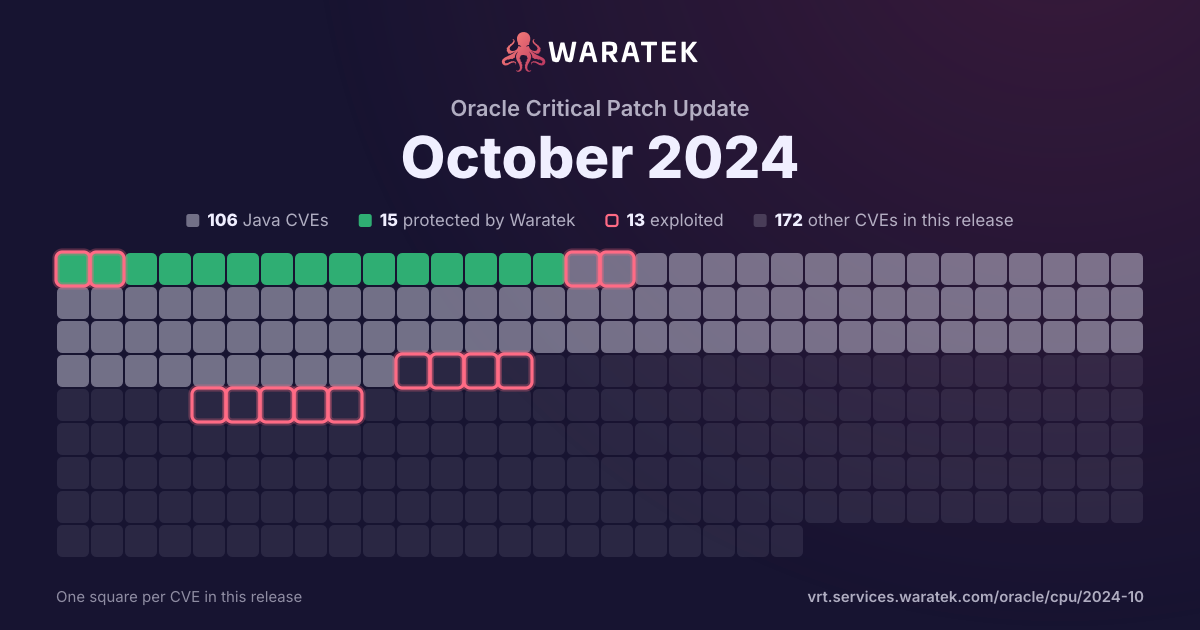
By status
15Protected by Waratek3Mitigation candidate88No exploit published26Outside Waratek scope144Not applicable2Withdrawn CVE
13Exploited, marked by the ring
No exploit published. For 51 of them, Oracle's security advisory is the source of public detail.
Protected by Waratek. Waratek RASP can block exploitation of these on systems that have not applied the patch yet.
Overview 40 matches · 6 protected · 2 exploited · 1 CISA KEV · 5 public PoC · 2 EPSS ≥ 0.5
Protected by Waratek
6
15.0%
Rule in development
0
0.0%
Mitigation candidate
2
5.0%
No exploit published
32
80.0%
blocked by ARMR today
6
15.0%
partly blocked
0
0.0%
not blocked
34
85.0%
not established
0
0.0%
unrecorded
0
0.0%
Exploited
2
5.0%
Working exploit published
0
0.0%
Proof of concept only
6
15.0%
Forecast only
0
0.0%
No public exploit
32
80.0%
split by
peak 12 / quarter
Q4 202
Protected by Waratek1
No exploit published1
Medium1
Low1
blocked by ARMR today1
not blocked1
No public exploit2
Q1 210
Q2 210
Q3 210
Q4 210
Q1 222
Protected by Waratek1
No exploit published1
Critical1
Medium1
blocked by ARMR today1
not blocked1
Proof of concept only1
No public exploit1
Q2 220
Q3 220
Q4 220
Q1 230
Q2 232
No exploit published2
High1
Medium1
not blocked2
No public exploit2
Q3 233
Protected by Waratek1
No exploit published2
High2
Medium1
blocked by ARMR today1
not blocked2
No public exploit3
Q4 236
Mitigation candidate1
No exploit published5
Critical1
High3
Medium2
not blocked6
Exploited1
No public exploit5
Q1 2410
Mitigation candidate1
No exploit published9
Critical1
High5
Medium4
not blocked10
Proof of concept only4
No public exploit6
Q2 243
Protected by Waratek1
No exploit published2
High3
blocked by ARMR today1
not blocked2
No public exploit3
Q3 2412
Protected by Waratek2
No exploit published10
Critical1
High9
Medium2
blocked by ARMR today2
not blocked10
Exploited1
Proof of concept only1
No public exploit10
Q1 21Q3 21Q1 22Q3 22Q1 23Q3 23Q1 24Q3 24
| CVE | Severity | Published▾ | Status | Exploitation | Description |
|---|---|---|---|---|---|
| CVE-2024-7254 | High | 2024-09-19 | No exploit published | No public exploit | Any project that parses untrusted Protocol Buffers data containing an arbitrary number of nested groups / series of SGROUP tags can corrupted by exceeding the stack limit i.e. StackOverflow. Parsing nested groups as unknown fields with DiscardUnknownFieldsParser or Java Protobuf Lite parser, or against Protobuf map fields, creates unbounded recursions that can be abused by an attacker. |
| CVE-2024-38816 | High | 2024-09-13 | Protected by Waratek | Exploited | Applications serving static resources through the functional web frameworks WebMvc.fn or WebFlux.fn are vulnerable to path traversal attacks. An attacker can craft malicious HTTP requests and obtain any file on the file system that is also accessible to the process in which the Spring application is running. Specifically, an application is vulnerable when both of the following are true: * the web application uses RouterFunctions to serve static resources * resource handling is explicitly configured with a FileSystemResource location However, malicious requests are blocked and rejected when any of the following is true: * the Spring Security HTTP Firewall https://docs.spring.io/spring-security/reference/servlet/exploits/firewall.html is in use * the application runs on Tomcat or Jetty |
| CVE-2024-7885 | High | 2024-08-21 | No exploit published | No public exploit | A vulnerability was found in Undertow where the ProxyProtocolReadListener reuses the same StringBuilder instance across multiple requests. This issue occurs when the parseProxyProtocolV1 method processes multiple requests on the same HTTP connection. As a result, different requests may share the same StringBuilder instance, potentially leading to information leakage between requests or responses. In some cases, a value from a previous request or response may be erroneously reused, which could lead to unintended data exposure. This issue primarily results in errors and connection termination but creates a risk of data leakage in multi-request environments. |
| CVE-2024-43045 | Medium | 2024-08-07 | No exploit published | No public exploit | Jenkins 2.470 and earlier, LTS 2.452.3 and earlier does not perform a permission check in an HTTP endpoint, allowing attackers with Overall/Read permission to access other users' "My Views". |
| CVE-2024-43044 | High | 2024-08-07 | Protected by Waratek | Proof of concept only | Jenkins 2.470 and earlier, LTS 2.452.3 and earlier allows agent processes to read arbitrary files from the Jenkins controller file system by using the `ClassLoaderProxy#fetchJar` method in the Remoting library. |
| CVE-2024-25638 | High | 2024-07-22 | No exploit published | No public exploit | dnsjava is an implementation of DNS in Java. Records in DNS replies are not checked for their relevance to the query, allowing an attacker to respond with RRs from different zones. This vulnerability is fixed in 3.6.0. |
| CVE-2024-41172 | High | 2024-07-19 | No exploit published | No public exploit | In versions of Apache CXF before 3.6.4 and 4.0.5 (3.5.x and lower versions are not impacted), a CXF HTTP client conduit may prevent HTTPClient instances from being garbage collected and it is possible that memory consumption will continue to increase, eventually causing the application to run out of memory |
| CVE-2024-32007 | High | 2024-07-19 | No exploit published | No public exploit | An improper input validation of the p2c parameter in the Apache CXF JOSE code before 4.0.5, 3.6.4 and 3.5.9 allows an attacker to perform a denial of service attack by specifying a large value for this parameter in a token. |
| CVE-2024-29736 | Critical | 2024-07-19 | No exploit published | No public exploit | A SSRF vulnerability in WADL service description in versions of Apache CXF before 4.0.5, 3.6.4 and 3.5.9 allows an attacker to perform SSRF style attacks on REST webservices. The attack only applies if a custom stylesheet parameter is configured. |
| CVE-2024-5971 | High | 2024-07-08 | No exploit published | No public exploit | A vulnerability was found in Undertow, where the chunked response hangs after the body was flushed. The response headers and body were sent but the client would continue waiting as Undertow does not send the expected 0\r\n termination of the chunked response. This results in uncontrolled resource consumption, leaving the server side to a denial of service attack. This happens only with Java 17 TLSv1.3 scenarios. |
| CVE-2024-3653 | Medium | 2024-07-08 | No exploit published | No public exploit | A vulnerability was found in Undertow. This issue requires enabling the learning-push handler in the server's config, which is disabled by default, leaving the maxAge config in the handler unconfigured. The default is -1, which makes the handler vulnerable. If someone overwrites that config, the server is not subject to the attack. The attacker needs to be able to reach the server with a normal HTTP request. |
| CVE-2024-34750 | High | 2024-07-03 | No exploit published | No public exploit | Improper Handling of Exceptional Conditions, Uncontrolled Resource Consumption vulnerability in Apache Tomcat. When processing an HTTP/2 stream, Tomcat did not handle some cases of excessive HTTP headers correctly. This led to a miscounting of active HTTP/2 streams which in turn led to the use of an incorrect infinite timeout which allowed connections to remain open which should have been closed. This issue affects Apache Tomcat: from 11.0.0-M1 through 11.0.0-M20, from 10.1.0-M1 through 10.1.24, from 9.0.0-M1 through 9.0.89. The following versions were EOL at the time the CVE was created but are known to be affected: 8.5.0 though 8.5.100. Other EOL versions may also be affected. Users are recommended to upgrade to version 11.0.0-M21, 10.1.25 or 9.0.90, which fixes the issue. |
| CVE-2024-6162 | High | 2024-06-20 | No exploit published | No public exploit | A vulnerability was found in Undertow, where URL-encoded request paths can be mishandled during concurrent requests on the AJP listener. This issue arises because the same buffer is used to decode the paths for multiple requests simultaneously, leading to incorrect path information being processed. As a result, the server may attempt to access the wrong path, causing errors such as "404 Not Found" or other application failures. This flaw can potentially lead to a denial of service, as legitimate resources become inaccessible due to the path mix-up. |
| CVE-2024-29857 | High | 2024-05-14 | No exploit published | No public exploit | An issue was discovered in ECCurve.java and ECCurve.cs in Bouncy Castle Java (BC Java) before 1.78, BC Java LTS before 2.73.6, BC-FJA before 1.0.2.5, and BC C# .Net before 2.3.1. Importing an EC certificate with crafted F2m parameters can lead to excessive CPU consumption during the evaluation of the curve parameters. |
| CVE-2024-22262 | High | 2024-04-16 | Protected by Waratek | No public exploit | Applications that use UriComponentsBuilder to parse an externally provided URL (e.g. through a query parameter) AND perform validation checks on the host of the parsed URL may be vulnerable to a open redirect https://cwe.mitre.org/data/definitions/601.html attack or to a SSRF attack if the URL is used after passing validation checks. This is the same as CVE-2024-22259 https://spring.io/security/cve-2024-22259 and CVE-2024-22243 https://spring.io/security/cve-2024-22243 , but with different input. |
| CVE-2024-29025 | Medium | 2024-03-25 | No exploit published | Proof of concept only | Netty is an asynchronous event-driven network application framework for rapid development of maintainable high performance protocol servers & clients. The `HttpPostRequestDecoder` can be tricked to accumulate data. While the decoder can store items on the disk if configured so, there are no limits to the number of fields the form can have, an attacher can send a chunked post consisting of many small fields that will be accumulated in the `bodyListHttpData` list. The decoder cumulates bytes in the `undecodedChunk` buffer until it can decode a field, this field can cumulate data without limits. This vulnerability is fixed in 4.1.108.Final. |
| CVE-2023-5685 | High | 2024-03-22 | No exploit published | No public exploit | A flaw was found in XNIO. The XNIO NotifierState that can cause a Stack Overflow Exception when the chain of notifier states becomes problematically large can lead to uncontrolled resource management and a possible denial of service (DoS). |
| CVE-2024-22257 | High | 2024-03-18 | No exploit published | No public exploit | In Spring Security, versions 5.7.x prior to 5.7.12, 5.8.x prior to 5.8.11, versions 6.0.x prior to 6.0.9, versions 6.1.x prior to 6.1.8, versions 6.2.x prior to 6.2.3, an application is possible vulnerable to broken access control when it directly uses the AuthenticatedVoter#vote passing a null Authentication parameter. |
| CVE-2024-28752 | Critical | 2024-03-15 | No exploit published | No public exploit | A SSRF vulnerability using the Aegis DataBinding in versions of Apache CXF before 4.0.4, 3.6.3 and 3.5.8 allows an attacker to perform SSRF style attacks on webservices that take at least one parameter of any type. Users of other data bindings (including the default databinding) are not impacted. |
| CVE-2024-24549 | High | 2024-03-13 | Mitigation candidate | Proof of concept only | Denial of Service due to improper input validation vulnerability for HTTP/2 requests in Apache Tomcat. When processing an HTTP/2 request, if the request exceeded any of the configured limits for headers, the associated HTTP/2 stream was not reset until after all of the headers had been processed.This issue affects Apache Tomcat: from 11.0.0-M1 through 11.0.0-M16, from 10.1.0-M1 through 10.1.18, from 9.0.0-M1 through 9.0.85, from 8.5.0 through 8.5.98. Other, older, EOL versions may also be affected. Users are recommended to upgrade to version 11.0.0-M17, 10.1.19, 9.0.86 or 8.5.99 which fix the issue. |
| CVE-2024-23672 | Medium | 2024-03-13 | No exploit published | No public exploit | Denial of Service via incomplete cleanup vulnerability in Apache Tomcat. It was possible for WebSocket clients to keep WebSocket connections open leading to increased resource consumption.This issue affects Apache Tomcat: from 11.0.0-M1 through 11.0.0-M16, from 10.1.0-M1 through 10.1.18, from 9.0.0-M1 through 9.0.85, from 8.5.0 through 8.5.98. Older, EOL versions may also be affected. Users are recommended to upgrade to version 11.0.0-M17, 10.1.19, 9.0.86 or 8.5.99 which fix the issue. |
| CVE-2023-51775 | Medium | 2024-02-29 | No exploit published | Proof of concept only | The jose4j component before 0.9.4 for Java allows attackers to cause a denial of service (CPU consumption) via a large p2c (aka PBES2 Count) value. |
| CVE-2024-22201 | High | 2024-02-26 | No exploit published | Proof of concept only | Jetty is a Java based web server and servlet engine. An HTTP/2 SSL connection that is established and TCP congested will be leaked when it times out. An attacker can cause many connections to end up in this state, and the server may run out of file descriptors, eventually causing the server to stop accepting new connections from valid clients. The vulnerability is patched in 9.4.54, 10.0.20, 11.0.20, and 12.0.6. |
| CVE-2024-26308 | Medium | 2024-02-19 | No exploit published | No public exploit | Allocation of Resources Without Limits or Throttling vulnerability in Apache Commons Compress.This issue affects Apache Commons Compress: from 1.21 before 1.26. Users are recommended to upgrade to version 1.26, which fixes the issue. |
| CVE-2024-25710 | High | 2024-02-19 | No exploit published | No public exploit | Loop with Unreachable Exit Condition ('Infinite Loop') vulnerability in Apache Commons Compress.This issue affects Apache Commons Compress: from 1.3 through 1.25.0. Users are recommended to upgrade to version 1.26.0 which fixes the issue. |
| CVE-2023-34055 | Medium | 2023-11-28 | No exploit published | No public exploit | In Spring Boot versions 2.7.0 - 2.7.17, 3.0.0-3.0.12 and 3.1.0-3.1.5, it is possible for a user to provide specially crafted HTTP requests that may cause a denial-of-service (DoS) condition. Specifically, an application is vulnerable when all of the following are true: * the application uses Spring MVC or Spring WebFlux * org.springframework.boot:spring-boot-actuator is on the classpath |
| CVE-2022-46337 | Critical | 2023-11-20 | No exploit published | No public exploit | A cleverly devised username might bypass LDAP authentication checks. In LDAP-authenticated Derby installations, this could let an attacker fill up the disk by creating junk Derby databases. In LDAP-authenticated Derby installations, this could also allow the attacker to execute malware which was visible to and executable by the account which booted the Derby server. In LDAP-protected databases which weren't also protected by SQL GRANT/REVOKE authorization, this vulnerability could also let an attacker view and corrupt sensitive data and run sensitive database functions and procedures. Mitigation: Users should upgrade to Java 21 and Derby 10.17.1.0. Alternatively, users who wish to remain on older Java versions should build their own Derby distribution from one of the release families to which the fix was backported: 10.16, 10.15, and 10.14. Those are the releases which correspond, respectively, with Java LTS versions 17, 11, and 8. |
| CVE-2023-4043 | High | 2023-11-03 | No exploit published | No public exploit | In Eclipse Parsson before versions 1.1.4 and 1.0.5, Parsing JSON from untrusted sources can lead malicious actors to exploit the fact that the built-in support for parsing numbers with large scale in Java has a number of edge cases where the input text of a number can lead to much larger processing time than one would expect. To mitigate the risk, parsson put in place a size limit for the numbers as well as their scale. |
| CVE-2023-44483 | Medium | 2023-10-20 | No exploit published | No public exploit | All versions of Apache Santuario - XML Security for Java prior to 2.2.6, 2.3.4, and 3.0.3, when using the JSR 105 API, are vulnerable to an issue where a private key may be disclosed in log files when generating an XML Signature and logging with debug level is enabled. Users are recommended to upgrade to version 2.2.6, 2.3.4, or 3.0.3, which fixes this issue. |
| CVE-2023-5072 | High | 2023-10-12 | No exploit published | No public exploit | Denial of Service in JSON-Java versions up to and including 20230618. A bug in the parser means that an input string of modest size can lead to indefinite amounts of memory being used. |
| CVE-2023-44487 | High | 2023-10-10 | Mitigation candidate | Exploited | The HTTP/2 protocol allows a denial of service (server resource consumption) because request cancellation can reset many streams quickly, as exploited in the wild in August through October 2023. |
| CVE-2023-39410 | High | 2023-09-29 | Protected by Waratek | No public exploit | When deserializing untrusted or corrupted data, it is possible for a reader to consume memory beyond the allowed constraints and thus lead to out of memory on the system. This issue affects Java applications using Apache Avro Java SDK up to and including 1.11.2. Users should update to apache-avro version 1.11.3 which addresses this issue. |
| CVE-2023-3635 | High | 2023-07-12 | No exploit published | No public exploit | GzipSource does not handle an exception that might be raised when parsing a malformed gzip buffer. This may lead to denial of service of the Okio client when handling a crafted GZIP archive, by using the GzipSource class. |
| CVE-2023-33201 | Medium | 2023-07-05 | No exploit published | No public exploit | Bouncy Castle For Java before 1.74 is affected by an LDAP injection vulnerability. The vulnerability only affects applications that use an LDAP CertStore from Bouncy Castle to validate X.509 certificates. During the certificate validation process, Bouncy Castle inserts the certificate's Subject Name into an LDAP search filter without any escaping, which leads to an LDAP injection vulnerability. |
| CVE-2023-2976 | High | 2023-06-14 | No exploit published | No public exploit | Use of Java's default temporary directory for file creation in `FileBackedOutputStream` in Google Guava versions 1.0 to 31.1 on Unix systems and Android Ice Cream Sandwich allows other users and apps on the machine with access to the default Java temporary directory to be able to access the files created by the class. Even though the security vulnerability is fixed in version 32.0.0, we recommend using version 32.0.1 as version 32.0.0 breaks some functionality under Windows. |
| CVE-2023-20863 | Medium | 2023-04-13 | No exploit published | No public exploit | In spring framework versions prior to 5.2.24 release+ ,5.3.27+ and 6.0.8+ , it is possible for a user to provide a specially crafted SpEL expression that may cause a denial-of-service (DoS) condition. |
| CVE-2022-23437 | Medium | 2022-01-24 | No exploit published | No public exploit | There's a vulnerability within the Apache Xerces Java (XercesJ) XML parser when handling specially crafted XML document payloads. This causes, the XercesJ XML parser to wait in an infinite loop, which may sometimes consume system resources for prolonged duration. This vulnerability is present within XercesJ version 2.12.1 and the previous versions. |
| CVE-2022-23305 | Critical | 2022-01-18 | Protected by Waratek | Proof of concept only | By design, the JDBCAppender in Log4j 1.2.x accepts an SQL statement as a configuration parameter where the values to be inserted are converters from PatternLayout. The message converter, %m, is likely to always be included. This allows attackers to manipulate the SQL by entering crafted strings into input fields or headers of an application that are logged allowing unintended SQL queries to be executed. Note this issue only affects Log4j 1.x when specifically configured to use the JDBCAppender, which is not the default. Beginning in version 2.0-beta8, the JDBCAppender was re-introduced with proper support for parameterized SQL queries and further customization over the columns written to in logs. Apache Log4j 1.2 reached end of life in August 2015. Users should upgrade to Log4j 2 as it addresses numerous other issues from the previous versions. |
| CVE-2020-8908 | Low | 2020-12-10 | No exploit published | No public exploit | A temp directory creation vulnerability exists in all versions of Guava, allowing an attacker with access to the machine to potentially access data in a temporary directory created by the Guava API com.google.common.io.Files.createTempDir(). By default, on unix-like systems, the created directory is world-readable (readable by an attacker with access to the system). The method in question has been marked @Deprecated in versions 30.0 and later and should not be used. For Android developers, we recommend choosing a temporary directory API provided by Android, such as context.getCacheDir(). For other Java developers, we recommend migrating to the Java 7 API java.nio.file.Files.createTempDirectory() which explicitly configures permissions of 700, or configuring the Java runtime's java.io.tmpdir system property to point to a location whose permissions are appropriately configured. |
| CVE-2020-17521 | Medium | 2020-12-07 | Protected by Waratek | No public exploit | Apache Groovy provides extension methods to aid with creating temporary directories. Prior to this fix, Groovy's implementation of those extension methods was using a now superseded Java JDK method call that is potentially not secure on some operating systems in some contexts. Users not using the extension methods mentioned in the advisory are not affected, but may wish to read the advisory for further details. Versions Affected: 2.0 to 2.4.20, 2.5.0 to 2.5.13, 3.0.0 to 3.0.6, and 4.0.0-alpha-1. Fixed in versions 2.4.21, 2.5.14, 3.0.7, 4.0.0-alpha-2. |