
Oracle Critical Patch Update April 2024
Released April 2024 · Oracle's advisory ↗ · ← Critical Patch Update, January 2024 · Critical Patch Update, July 2024 →
312 CVEs in this release, one square each
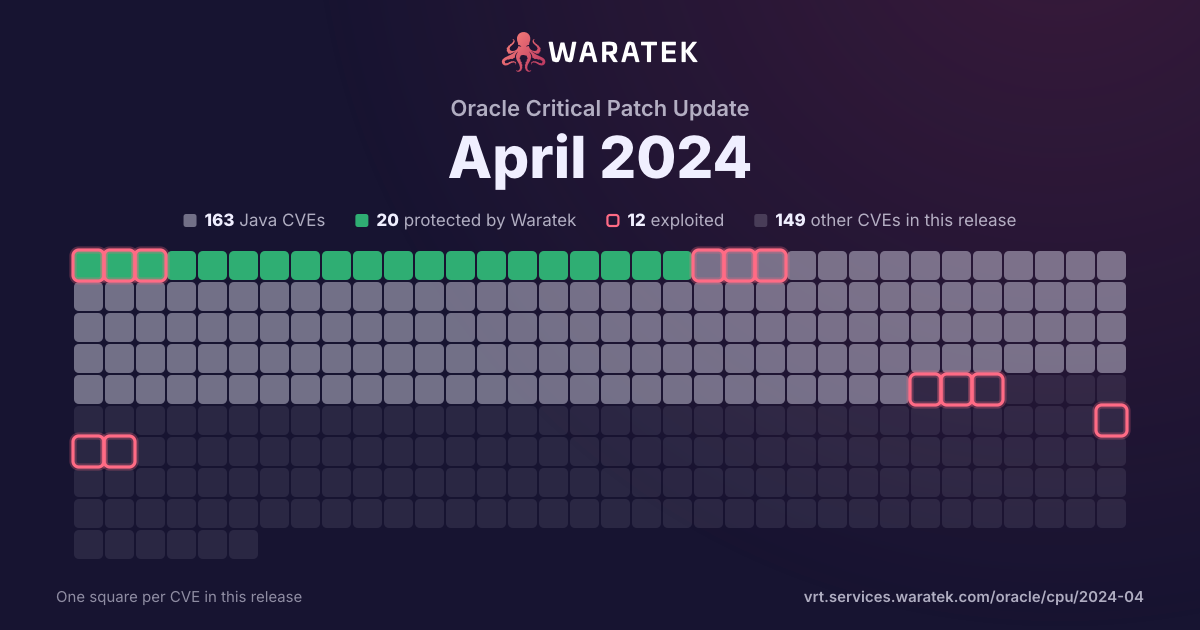
By status
20Protected by Waratek6Mitigation candidate137No exploit published40Outside Waratek scope108Not applicable1Withdrawn CVE
12Exploited, marked by the ring
No exploit published. For 82 of them, Oracle's security advisory is the source of public detail.
Protected by Waratek. Waratek RASP can block exploitation of these on systems that have not applied the patch yet.
Overview 312 matches · 163 in Waratek scope · 20 protected · 12 exploited · 6 CISA KEV · 18 public PoC · 13 EPSS ≥ 0.5
312matches
163in Waratek scope52.2%
20protected6.4%
12exploited3.8%
6CISA KEV1.9%
18public PoC5.8%
13EPSS ≥ 0.54.2%
Protected by Waratek
20
6.4%
Rule in development
0
0.0%
Mitigation candidate
6
1.9%
No exploit published
137
43.9%
Outside Waratek scope
40
12.8%
Not applicable
108
34.6%
Withdrawn CVE
1
0.3%
blocked by ARMR today
20
6.4%
partly blocked
0
0.0%
not blocked
292
93.6%
not established
0
0.0%
unrecorded
0
0.0%
split by
peak 133 / quarter
Q3 191
Outside Waratek scope1
Critical1
not blocked1
No public exploit1
Q4 192
Protected by Waratek1
Not applicable1
High2
blocked by ARMR today1
not blocked1
No public exploit2
Q1 200
Q2 200
Q3 200
Q4 202
Protected by Waratek1
No exploit published1
High1
Low1
blocked by ARMR today1
not blocked1
No public exploit2
Q1 210
Q2 212
Outside Waratek scope1
Not applicable1
Critical2
not blocked2
No public exploit2
Q3 214
Protected by Waratek1
No exploit published2
Not applicable1
Critical1
High1
Medium2
blocked by ARMR today1
not blocked3
No public exploit4
Q4 211
Protected by Waratek1
Critical1
blocked by ARMR today1
No public exploit1
Q1 223
No exploit published3
Medium3
not blocked3
No public exploit3
Q2 221
No exploit published1
High1
not blocked1
No public exploit1
Q3 2211
Protected by Waratek2
No exploit published3
Outside Waratek scope1
Not applicable5
Critical5
High4
Medium2
blocked by ARMR today2
not blocked9
Proof of concept only4
No public exploit7
Q4 2213
Protected by Waratek5
Mitigation candidate1
No exploit published6
Outside Waratek scope1
Critical6
High6
Medium1
blocked by ARMR today5
not blocked8
Exploited2
Proof of concept only2
No public exploit9
Q1 2311
No exploit published6
Not applicable5
High6
Medium5
not blocked11
Proof of concept only2
No public exploit9
Q2 2311
No exploit published5
Not applicable6
High6
Medium5
not blocked11
Proof of concept only2
Forecast only1
No public exploit8
Q3 2333
Protected by Waratek1
Mitigation candidate1
No exploit published14
Outside Waratek scope2
Not applicable15
High14
Medium17
Low2
blocked by ARMR today1
not blocked32
Exploited2
Proof of concept only3
No public exploit28
Q4 2338
Protected by Waratek2
Mitigation candidate1
No exploit published12
Outside Waratek scope2
Not applicable20
Withdrawn CVE1
Critical4
High19
Medium13
Low1
Unknown1
blocked by ARMR today2
not blocked36
Exploited5
Proof of concept only6
No public exploit27
Q1 2445
Protected by Waratek5
Mitigation candidate2
No exploit published15
Outside Waratek scope3
Not applicable20
Critical2
High24
Medium16
Low3
blocked by ARMR today5
not blocked40
Exploited3
Working exploit published1
Proof of concept only7
No public exploit34
Q2 24133
Protected by Waratek1
Mitigation candidate1
No exploit published69
Outside Waratek scope29
Not applicable33
Critical5
High27
Medium85
Low16
blocked by ARMR today1
not blocked132
Working exploit published1
Proof of concept only1
No public exploit131
Q3 241
Not applicable1
High1
not blocked1
No public exploit1
Q3 19Q1 20Q3 20Q1 21Q3 21Q1 22Q3 22Q1 23Q3 23Q1 24Q3 24
| CVE | Severity | Published▾ | Status | Exploitation | Description |
|---|---|---|---|---|---|
| CVE-2024-21022 | Medium | 2024-04-16 | No exploit published | No public exploit | Vulnerability in the Oracle Complex Maintenance, Repair, and Overhaul product of Oracle E-Business Suite (component: LOV). Supported versions that are affected are 12.2.3-12.2.13. Easily exploitable vulnerability allows unauthenticated attacker with network access via HTTP to compromise Oracle Complex Maintenance, Repair, and Overhaul. Successful attacks require human interaction from a person other than the attacker and while the vulnerability is in Oracle Complex Maintenance, Repair, and Overhaul, attacks may significantly impact additional products (scope change). Successful attacks of this vulnerability can result in unauthorized update, insert or delete access to some of Oracle Complex Maintenance, Repair, and Overhaul accessible data as well as unauthorized read access to a subset of Oracle Complex Maintenance, Repair, and Overhaul accessible data. CVSS 3.1 Base Score 6.1 (Confidentiality and Integrity impacts). CVSS Vector: (CVSS:3.1/AV:N/AC:L/PR:N/UI:R/S:C/C:L/I:L/A:N). |
| CVE-2024-21021 | Medium | 2024-04-16 | No exploit published | No public exploit | Vulnerability in the Oracle Complex Maintenance, Repair, and Overhaul product of Oracle E-Business Suite (component: LOV). Supported versions that are affected are 12.2.3-12.2.13. Easily exploitable vulnerability allows unauthenticated attacker with network access via HTTP to compromise Oracle Complex Maintenance, Repair, and Overhaul. Successful attacks require human interaction from a person other than the attacker and while the vulnerability is in Oracle Complex Maintenance, Repair, and Overhaul, attacks may significantly impact additional products (scope change). Successful attacks of this vulnerability can result in unauthorized update, insert or delete access to some of Oracle Complex Maintenance, Repair, and Overhaul accessible data as well as unauthorized read access to a subset of Oracle Complex Maintenance, Repair, and Overhaul accessible data. CVSS 3.1 Base Score 6.1 (Confidentiality and Integrity impacts). CVSS Vector: (CVSS:3.1/AV:N/AC:L/PR:N/UI:R/S:C/C:L/I:L/A:N). |
| CVE-2024-21020 | Medium | 2024-04-16 | No exploit published | No public exploit | Vulnerability in the Oracle Complex Maintenance, Repair, and Overhaul product of Oracle E-Business Suite (component: LOV). Supported versions that are affected are 12.2.3-12.2.13. Easily exploitable vulnerability allows unauthenticated attacker with network access via HTTP to compromise Oracle Complex Maintenance, Repair, and Overhaul. Successful attacks require human interaction from a person other than the attacker and while the vulnerability is in Oracle Complex Maintenance, Repair, and Overhaul, attacks may significantly impact additional products (scope change). Successful attacks of this vulnerability can result in unauthorized update, insert or delete access to some of Oracle Complex Maintenance, Repair, and Overhaul accessible data as well as unauthorized read access to a subset of Oracle Complex Maintenance, Repair, and Overhaul accessible data. CVSS 3.1 Base Score 6.1 (Confidentiality and Integrity impacts). CVSS Vector: (CVSS:3.1/AV:N/AC:L/PR:N/UI:R/S:C/C:L/I:L/A:N). |
| CVE-2024-21019 | Medium | 2024-04-16 | No exploit published | No public exploit | Vulnerability in the Oracle Complex Maintenance, Repair, and Overhaul product of Oracle E-Business Suite (component: LOV). Supported versions that are affected are 12.2.3-12.2.13. Easily exploitable vulnerability allows unauthenticated attacker with network access via HTTP to compromise Oracle Complex Maintenance, Repair, and Overhaul. Successful attacks require human interaction from a person other than the attacker and while the vulnerability is in Oracle Complex Maintenance, Repair, and Overhaul, attacks may significantly impact additional products (scope change). Successful attacks of this vulnerability can result in unauthorized update, insert or delete access to some of Oracle Complex Maintenance, Repair, and Overhaul accessible data as well as unauthorized read access to a subset of Oracle Complex Maintenance, Repair, and Overhaul accessible data. CVSS 3.1 Base Score 6.1 (Confidentiality and Integrity impacts). CVSS Vector: (CVSS:3.1/AV:N/AC:L/PR:N/UI:R/S:C/C:L/I:L/A:N). |
| CVE-2024-21018 | Medium | 2024-04-16 | No exploit published | No public exploit | Vulnerability in the Oracle Complex Maintenance, Repair, and Overhaul product of Oracle E-Business Suite (component: LOV). Supported versions that are affected are 12.2.3-12.2.13. Easily exploitable vulnerability allows unauthenticated attacker with network access via HTTP to compromise Oracle Complex Maintenance, Repair, and Overhaul. Successful attacks require human interaction from a person other than the attacker and while the vulnerability is in Oracle Complex Maintenance, Repair, and Overhaul, attacks may significantly impact additional products (scope change). Successful attacks of this vulnerability can result in unauthorized update, insert or delete access to some of Oracle Complex Maintenance, Repair, and Overhaul accessible data as well as unauthorized read access to a subset of Oracle Complex Maintenance, Repair, and Overhaul accessible data. CVSS 3.1 Base Score 6.1 (Confidentiality and Integrity impacts). CVSS Vector: (CVSS:3.1/AV:N/AC:L/PR:N/UI:R/S:C/C:L/I:L/A:N). |
| CVE-2024-21017 | Medium | 2024-04-16 | No exploit published | No public exploit | Vulnerability in the Oracle Complex Maintenance, Repair, and Overhaul product of Oracle E-Business Suite (component: LOV). Supported versions that are affected are 12.2.3-12.2.13. Easily exploitable vulnerability allows unauthenticated attacker with network access via HTTP to compromise Oracle Complex Maintenance, Repair, and Overhaul. Successful attacks require human interaction from a person other than the attacker and while the vulnerability is in Oracle Complex Maintenance, Repair, and Overhaul, attacks may significantly impact additional products (scope change). Successful attacks of this vulnerability can result in unauthorized update, insert or delete access to some of Oracle Complex Maintenance, Repair, and Overhaul accessible data as well as unauthorized read access to a subset of Oracle Complex Maintenance, Repair, and Overhaul accessible data. CVSS 3.1 Base Score 6.1 (Confidentiality and Integrity impacts). CVSS Vector: (CVSS:3.1/AV:N/AC:L/PR:N/UI:R/S:C/C:L/I:L/A:N). |
| CVE-2024-21016 | Medium | 2024-04-16 | No exploit published | No public exploit | Vulnerability in the Oracle Complex Maintenance, Repair, and Overhaul product of Oracle E-Business Suite (component: LOV). Supported versions that are affected are 12.2.3-12.2.13. Easily exploitable vulnerability allows unauthenticated attacker with network access via HTTP to compromise Oracle Complex Maintenance, Repair, and Overhaul. Successful attacks require human interaction from a person other than the attacker and while the vulnerability is in Oracle Complex Maintenance, Repair, and Overhaul, attacks may significantly impact additional products (scope change). Successful attacks of this vulnerability can result in unauthorized update, insert or delete access to some of Oracle Complex Maintenance, Repair, and Overhaul accessible data as well as unauthorized read access to a subset of Oracle Complex Maintenance, Repair, and Overhaul accessible data. CVSS 3.1 Base Score 6.1 (Confidentiality and Integrity impacts). CVSS Vector: (CVSS:3.1/AV:N/AC:L/PR:N/UI:R/S:C/C:L/I:L/A:N). |
| CVE-2024-21015 | Medium | 2024-04-16 | Outside Waratek scope | No public exploit | Vulnerability in the MySQL Server product of Oracle MySQL (component: Server: DML). Supported versions that are affected are 8.0.34 and prior and 8.3.0 and prior. Easily exploitable vulnerability allows high privileged attacker with network access via multiple protocols to compromise MySQL Server. Successful attacks of this vulnerability can result in unauthorized ability to cause a hang or frequently repeatable crash (complete DOS) of MySQL Server as well as unauthorized update, insert or delete access to some of MySQL Server accessible data. CVSS 3.1 Base Score 5.5 (Integrity and Availability impacts). CVSS Vector: (CVSS:3.1/AV:N/AC:L/PR:H/UI:N/S:U/C:N/I:L/A:H). |
| CVE-2024-21014 | Critical | 2024-04-16 | Not applicable | No public exploit | Vulnerability in the Oracle Hospitality Simphony product of Oracle Food and Beverage Applications (component: Simphony Enterprise Server). Supported versions that are affected are 19.1.0-19.5.4. Easily exploitable vulnerability allows unauthenticated attacker with network access via HTTP to compromise Oracle Hospitality Simphony. Successful attacks of this vulnerability can result in takeover of Oracle Hospitality Simphony. CVSS 3.1 Base Score 9.8 (Confidentiality, Integrity and Availability impacts). CVSS Vector: (CVSS:3.1/AV:N/AC:L/PR:N/UI:N/S:U/C:H/I:H/A:H). |
| CVE-2024-21013 | Medium | 2024-04-16 | Outside Waratek scope | No public exploit | Vulnerability in the MySQL Server product of Oracle MySQL (component: Server: Optimizer). Supported versions that are affected are 8.0.36 and prior and 8.3.0 and prior. Difficult to exploit vulnerability allows high privileged attacker with network access via multiple protocols to compromise MySQL Server. Successful attacks of this vulnerability can result in unauthorized ability to cause a hang or frequently repeatable crash (complete DOS) of MySQL Server. CVSS 3.1 Base Score 4.4 (Availability impacts). CVSS Vector: (CVSS:3.1/AV:N/AC:H/PR:H/UI:N/S:U/C:N/I:N/A:H). |
| CVE-2024-21012 | Low | 2024-04-16 | Outside Waratek scope | No public exploit | Vulnerability in the Oracle Java SE, Oracle GraalVM for JDK, Oracle GraalVM Enterprise Edition product of Oracle Java SE (component: Networking). Supported versions that are affected are Oracle Java SE: 11.0.22, 17.0.10, 21.0.2, 22; Oracle GraalVM for JDK: 17.0.10, 21.0.2, 22; Oracle GraalVM Enterprise Edition: 20.3.13 and 21.3.9. Difficult to exploit vulnerability allows unauthenticated attacker with network access via multiple protocols to compromise Oracle Java SE, Oracle GraalVM for JDK, Oracle GraalVM Enterprise Edition. Successful attacks of this vulnerability can result in unauthorized update, insert or delete access to some of Oracle Java SE, Oracle GraalVM for JDK, Oracle GraalVM Enterprise Edition accessible data. Note: This vulnerability applies to Java deployments, typically in clients running sandboxed Java Web Start applications or sandboxed Java applets, that load and run untrusted code (e.g., code that comes from the internet) and rely on the Java sandbox for security. This vulnerability does not apply to Java deployments, typically in servers, that load and run only trusted code (e.g., code installed by an administrator). CVSS 3.1 Base Score 3.7 (Integrity impacts). CVSS Vector: (CVSS:3.1/AV:N/AC:H/PR:N/UI:N/S:U/C:N/I:L/A:N). |
| CVE-2024-21011 | Low | 2024-04-16 | No exploit published | No public exploit | Vulnerability in the Oracle Java SE, Oracle GraalVM for JDK, Oracle GraalVM Enterprise Edition product of Oracle Java SE (component: Hotspot). Supported versions that are affected are Oracle Java SE: 8u401, 8u401-perf, 11.0.22, 17.0.10, 21.0.2, 22; Oracle GraalVM for JDK: 17.0.10, 21.0.2, 22; Oracle GraalVM Enterprise Edition: 20.3.13 and 21.3.9. Difficult to exploit vulnerability allows unauthenticated attacker with network access via multiple protocols to compromise Oracle Java SE, Oracle GraalVM for JDK, Oracle GraalVM Enterprise Edition. Successful attacks of this vulnerability can result in unauthorized ability to cause a partial denial of service (partial DOS) of Oracle Java SE, Oracle GraalVM for JDK, Oracle GraalVM Enterprise Edition. Note: This vulnerability can be exploited by using APIs in the specified Component, e.g., through a web service which supplies data to the APIs. This vulnerability also applies to Java deployments, typically in clients running sandboxed Java Web Start applications or sandboxed Java applets, that load and run untrusted code (e.g., code that comes from the internet) and rely on the Java sandbox for security. CVSS 3.1 Base Score 3.7 (Availability impacts). CVSS Vector: (CVSS:3.1/AV:N/AC:H/PR:N/UI:N/S:U/C:N/I:N/A:L). |
| CVE-2024-21010 | Critical | 2024-04-16 | Not applicable | No public exploit | Vulnerability in the Oracle Hospitality Simphony product of Oracle Food and Beverage Applications (component: Simphony Enterprise Server). Supported versions that are affected are 19.1.0-19.5.4. Easily exploitable vulnerability allows low privileged attacker with network access via HTTP to compromise Oracle Hospitality Simphony. While the vulnerability is in Oracle Hospitality Simphony, attacks may significantly impact additional products (scope change). Successful attacks of this vulnerability can result in takeover of Oracle Hospitality Simphony. CVSS 3.1 Base Score 9.9 (Confidentiality, Integrity and Availability impacts). CVSS Vector: (CVSS:3.1/AV:N/AC:L/PR:L/UI:N/S:C/C:H/I:H/A:H). |
| CVE-2024-21009 | Medium | 2024-04-16 | Outside Waratek scope | No public exploit | Vulnerability in the MySQL Server product of Oracle MySQL (component: Server: Optimizer). Supported versions that are affected are 8.0.36 and prior and 8.3.0 and prior. Easily exploitable vulnerability allows high privileged attacker with network access via multiple protocols to compromise MySQL Server. Successful attacks of this vulnerability can result in unauthorized ability to cause a hang or frequently repeatable crash (complete DOS) of MySQL Server. CVSS 3.1 Base Score 4.9 (Availability impacts). CVSS Vector: (CVSS:3.1/AV:N/AC:L/PR:H/UI:N/S:U/C:N/I:N/A:H). |
| CVE-2024-21008 | Medium | 2024-04-16 | Outside Waratek scope | No public exploit | Vulnerability in the MySQL Server product of Oracle MySQL (component: Server: Optimizer). Supported versions that are affected are 8.0.36 and prior and 8.3.0 and prior. Difficult to exploit vulnerability allows high privileged attacker with network access via multiple protocols to compromise MySQL Server. Successful attacks of this vulnerability can result in unauthorized ability to cause a hang or frequently repeatable crash (complete DOS) of MySQL Server. CVSS 3.1 Base Score 4.4 (Availability impacts). CVSS Vector: (CVSS:3.1/AV:N/AC:H/PR:H/UI:N/S:U/C:N/I:N/A:H). |
| CVE-2024-21007 | High | 2024-04-16 | No exploit published | No public exploit | Vulnerability in the Oracle WebLogic Server product of Oracle Fusion Middleware (component: Core). Supported versions that are affected are 12.2.1.4.0 and 14.1.1.0.0. Easily exploitable vulnerability allows unauthenticated attacker with network access via T3, IIOP to compromise Oracle WebLogic Server. Successful attacks of this vulnerability can result in unauthorized access to critical data or complete access to all Oracle WebLogic Server accessible data. CVSS 3.1 Base Score 7.5 (Confidentiality impacts). CVSS Vector: (CVSS:3.1/AV:N/AC:L/PR:N/UI:N/S:U/C:H/I:N/A:N). |
| CVE-2024-21006 | High | 2024-04-16 | Mitigation candidate | Proof of concept only | Vulnerability in the Oracle WebLogic Server product of Oracle Fusion Middleware (component: Core). Supported versions that are affected are 12.2.1.4.0 and 14.1.1.0.0. Easily exploitable vulnerability allows unauthenticated attacker with network access via T3, IIOP to compromise Oracle WebLogic Server. Successful attacks of this vulnerability can result in unauthorized access to critical data or complete access to all Oracle WebLogic Server accessible data. CVSS 3.1 Base Score 7.5 (Confidentiality impacts). CVSS Vector: (CVSS:3.1/AV:N/AC:L/PR:N/UI:N/S:U/C:H/I:N/A:N). |
| CVE-2024-21005 | Low | 2024-04-16 | Outside Waratek scope | No public exploit | Vulnerability in the Oracle Java SE, Oracle GraalVM Enterprise Edition product of Oracle Java SE (component: JavaFX). Supported versions that are affected are Oracle Java SE: 8u401; Oracle GraalVM Enterprise Edition: 20.3.13 and 21.3.9. Difficult to exploit vulnerability allows unauthenticated attacker with network access via multiple protocols to compromise Oracle Java SE, Oracle GraalVM Enterprise Edition. Successful attacks require human interaction from a person other than the attacker. Successful attacks of this vulnerability can result in unauthorized update, insert or delete access to some of Oracle Java SE, Oracle GraalVM Enterprise Edition accessible data. Note: This vulnerability applies to Java deployments, typically in clients running sandboxed Java Web Start applications or sandboxed Java applets, that load and run untrusted code (e.g., code that comes from the internet) and rely on the Java sandbox for security. This vulnerability does not apply to Java deployments, typically in servers, that load and run only trusted code (e.g., code installed by an administrator). CVSS 3.1 Base Score 3.1 (Integrity impacts). CVSS Vector: (CVSS:3.1/AV:N/AC:H/PR:N/UI:R/S:U/C:N/I:L/A:N). |
| CVE-2024-21004 | Low | 2024-04-16 | Outside Waratek scope | No public exploit | Vulnerability in the Oracle Java SE, Oracle GraalVM Enterprise Edition product of Oracle Java SE (component: JavaFX). Supported versions that are affected are Oracle Java SE: 8u401; Oracle GraalVM Enterprise Edition: 20.3.13 and 21.3.9. Difficult to exploit vulnerability allows unauthenticated attacker with logon to the infrastructure where Oracle Java SE, Oracle GraalVM Enterprise Edition executes to compromise Oracle Java SE, Oracle GraalVM Enterprise Edition. Successful attacks require human interaction from a person other than the attacker. Successful attacks of this vulnerability can result in unauthorized update, insert or delete access to some of Oracle Java SE, Oracle GraalVM Enterprise Edition accessible data. Note: This vulnerability applies to Java deployments, typically in clients running sandboxed Java Web Start applications or sandboxed Java applets, that load and run untrusted code (e.g., code that comes from the internet) and rely on the Java sandbox for security. This vulnerability does not apply to Java deployments, typically in servers, that load and run only trusted code (e.g., code installed by an administrator). CVSS 3.1 Base Score 2.5 (Integrity impacts). CVSS Vector: (CVSS:3.1/AV:L/AC:H/PR:N/UI:R/S:U/C:N/I:L/A:N). |
| CVE-2024-21003 | Low | 2024-04-16 | Outside Waratek scope | No public exploit | Vulnerability in the Oracle Java SE, Oracle GraalVM Enterprise Edition product of Oracle Java SE (component: JavaFX). Supported versions that are affected are Oracle Java SE: 8u401; Oracle GraalVM Enterprise Edition: 20.3.13 and 21.3.9. Difficult to exploit vulnerability allows unauthenticated attacker with network access via multiple protocols to compromise Oracle Java SE, Oracle GraalVM Enterprise Edition. Successful attacks require human interaction from a person other than the attacker. Successful attacks of this vulnerability can result in unauthorized update, insert or delete access to some of Oracle Java SE, Oracle GraalVM Enterprise Edition accessible data. Note: This vulnerability applies to Java deployments, typically in clients running sandboxed Java Web Start applications or sandboxed Java applets, that load and run untrusted code (e.g., code that comes from the internet) and rely on the Java sandbox for security. This vulnerability does not apply to Java deployments, typically in servers, that load and run only trusted code (e.g., code installed by an administrator). CVSS 3.1 Base Score 3.1 (Integrity impacts). CVSS Vector: (CVSS:3.1/AV:N/AC:H/PR:N/UI:R/S:U/C:N/I:L/A:N). |
| CVE-2024-21002 | Low | 2024-04-16 | Outside Waratek scope | No public exploit | Vulnerability in the Oracle Java SE, Oracle GraalVM Enterprise Edition product of Oracle Java SE (component: JavaFX). Supported versions that are affected are Oracle Java SE: 8u401; Oracle GraalVM Enterprise Edition: 20.3.13 and 21.3.9. Difficult to exploit vulnerability allows unauthenticated attacker with logon to the infrastructure where Oracle Java SE, Oracle GraalVM Enterprise Edition executes to compromise Oracle Java SE, Oracle GraalVM Enterprise Edition. Successful attacks require human interaction from a person other than the attacker. Successful attacks of this vulnerability can result in unauthorized update, insert or delete access to some of Oracle Java SE, Oracle GraalVM Enterprise Edition accessible data. Note: This vulnerability applies to Java deployments, typically in clients running sandboxed Java Web Start applications or sandboxed Java applets, that load and run untrusted code (e.g., code that comes from the internet) and rely on the Java sandbox for security. This vulnerability does not apply to Java deployments, typically in servers, that load and run only trusted code (e.g., code installed by an administrator). CVSS 3.1 Base Score 2.5 (Integrity impacts). CVSS Vector: (CVSS:3.1/AV:L/AC:H/PR:N/UI:R/S:U/C:N/I:L/A:N). |
| CVE-2024-21001 | Medium | 2024-04-16 | No exploit published | No public exploit | Vulnerability in the Oracle Business Intelligence Enterprise Edition product of Oracle Analytics (component: BI Platform Security). The supported version that is affected is 7.0.0.0.0. Easily exploitable vulnerability allows low privileged attacker with network access via HTTP to compromise Oracle Business Intelligence Enterprise Edition. Successful attacks require human interaction from a person other than the attacker and while the vulnerability is in Oracle Business Intelligence Enterprise Edition, attacks may significantly impact additional products (scope change). Successful attacks of this vulnerability can result in unauthorized update, insert or delete access to some of Oracle Business Intelligence Enterprise Edition accessible data as well as unauthorized read access to a subset of Oracle Business Intelligence Enterprise Edition accessible data. CVSS 3.1 Base Score 5.4 (Confidentiality and Integrity impacts). CVSS Vector: (CVSS:3.1/AV:N/AC:L/PR:L/UI:R/S:C/C:L/I:L/A:N). |
| CVE-2024-21000 | Low | 2024-04-16 | Outside Waratek scope | No public exploit | Vulnerability in the MySQL Server product of Oracle MySQL (component: Server: Security: Privileges). Supported versions that are affected are 8.0.36 and prior and 8.3.0 and prior. Easily exploitable vulnerability allows high privileged attacker with network access via multiple protocols to compromise MySQL Server. Successful attacks of this vulnerability can result in unauthorized update, insert or delete access to some of MySQL Server accessible data as well as unauthorized read access to a subset of MySQL Server accessible data. CVSS 3.1 Base Score 3.8 (Confidentiality and Integrity impacts). CVSS Vector: (CVSS:3.1/AV:N/AC:L/PR:H/UI:N/S:U/C:L/I:L/A:N). |
| CVE-2024-20999 | High | 2024-04-16 | Not applicable | No public exploit | Vulnerability in the Oracle Solaris product of Oracle Systems (component: Zones). The supported version that is affected is 11. Easily exploitable vulnerability allows high privileged attacker with logon to the infrastructure where Oracle Solaris executes to compromise Oracle Solaris. While the vulnerability is in Oracle Solaris, attacks may significantly impact additional products (scope change). Successful attacks of this vulnerability can result in takeover of Oracle Solaris. CVSS 3.1 Base Score 8.2 (Confidentiality, Integrity and Availability impacts). CVSS Vector: (CVSS:3.1/AV:L/AC:L/PR:H/UI:N/S:C/C:H/I:H/A:H). |
| CVE-2024-20998 | Medium | 2024-04-16 | Outside Waratek scope | No public exploit | Vulnerability in the MySQL Server product of Oracle MySQL (component: Server: Optimizer). Supported versions that are affected are 8.0.36 and prior and 8.3.0 and prior. Easily exploitable vulnerability allows high privileged attacker with network access via multiple protocols to compromise MySQL Server. Successful attacks of this vulnerability can result in unauthorized ability to cause a hang or frequently repeatable crash (complete DOS) of MySQL Server. CVSS 3.1 Base Score 4.9 (Availability impacts). CVSS Vector: (CVSS:3.1/AV:N/AC:L/PR:H/UI:N/S:U/C:N/I:N/A:H). |
| CVE-2024-20997 | Critical | 2024-04-16 | Not applicable | No public exploit | Vulnerability in the Oracle Hospitality Simphony product of Oracle Food and Beverage Applications (component: Simphony Enterprise Server). Supported versions that are affected are 19.1.0-19.5.4. Easily exploitable vulnerability allows low privileged attacker with network access via HTTP to compromise Oracle Hospitality Simphony. While the vulnerability is in Oracle Hospitality Simphony, attacks may significantly impact additional products (scope change). Successful attacks of this vulnerability can result in takeover of Oracle Hospitality Simphony. CVSS 3.1 Base Score 9.9 (Confidentiality, Integrity and Availability impacts). CVSS Vector: (CVSS:3.1/AV:N/AC:L/PR:L/UI:N/S:C/C:H/I:H/A:H). |
| CVE-2024-20995 | Low | 2024-04-16 | Not applicable | No public exploit | Vulnerability in the Oracle Database Sharding component of Oracle Database Server. Supported versions that are affected are 19.3-19.22 and 21.3-21.13. Easily exploitable vulnerability allows high privileged attacker having DBA privilege with network access via Oracle Net to compromise Oracle Database Sharding. Successful attacks require human interaction from a person other than the attacker. Successful attacks of this vulnerability can result in unauthorized ability to cause a partial denial of service (partial DOS) of Oracle Database Sharding. CVSS 3.1 Base Score 2.4 (Availability impacts). CVSS Vector: (CVSS:3.1/AV:N/AC:L/PR:H/UI:R/S:U/C:N/I:N/A:L). |
| CVE-2024-20994 | Medium | 2024-04-16 | Outside Waratek scope | No public exploit | Vulnerability in the MySQL Server product of Oracle MySQL (component: Server: Information Schema). Supported versions that are affected are 8.0.36 and prior and 8.3.0 and prior. Difficult to exploit vulnerability allows low privileged attacker with network access via multiple protocols to compromise MySQL Server. Successful attacks of this vulnerability can result in unauthorized ability to cause a hang or frequently repeatable crash (complete DOS) of MySQL Server. CVSS 3.1 Base Score 5.3 (Availability impacts). CVSS Vector: (CVSS:3.1/AV:N/AC:H/PR:L/UI:N/S:U/C:N/I:N/A:H). |
| CVE-2024-20993 | Medium | 2024-04-16 | Outside Waratek scope | No public exploit | Vulnerability in the MySQL Server product of Oracle MySQL (component: Server: Optimizer). Supported versions that are affected are 8.0.35 and prior and 8.2.0 and prior. Easily exploitable vulnerability allows high privileged attacker with network access via multiple protocols to compromise MySQL Server. Successful attacks of this vulnerability can result in unauthorized ability to cause a hang or frequently repeatable crash (complete DOS) of MySQL Server. CVSS 3.1 Base Score 4.9 (Availability impacts). CVSS Vector: (CVSS:3.1/AV:N/AC:L/PR:H/UI:N/S:U/C:N/I:N/A:H). |
| CVE-2024-20992 | Medium | 2024-04-16 | No exploit published | No public exploit | Vulnerability in the Oracle WebCenter Portal product of Oracle Fusion Middleware (component: Content integration). The supported version that is affected is 12.2.1.4.0. Difficult to exploit vulnerability allows low privileged attacker with network access via HTTP to compromise Oracle WebCenter Portal. Successful attacks require human interaction from a person other than the attacker and while the vulnerability is in Oracle WebCenter Portal, attacks may significantly impact additional products (scope change). Successful attacks of this vulnerability can result in unauthorized update, insert or delete access to some of Oracle WebCenter Portal accessible data as well as unauthorized read access to a subset of Oracle WebCenter Portal accessible data. CVSS 3.1 Base Score 4.4 (Confidentiality and Integrity impacts). CVSS Vector: (CVSS:3.1/AV:N/AC:H/PR:L/UI:R/S:C/C:L/I:L/A:N). |
| CVE-2024-20991 | Medium | 2024-04-16 | Not applicable | No public exploit | Vulnerability in the Oracle HTTP Server product of Oracle Fusion Middleware (component: Web Listener). The supported version that is affected is 12.2.1.4.0. Easily exploitable vulnerability allows unauthenticated attacker with network access via HTTP to compromise Oracle HTTP Server. Successful attacks of this vulnerability can result in unauthorized read access to a subset of Oracle HTTP Server accessible data. CVSS 3.1 Base Score 5.3 (Confidentiality impacts). CVSS Vector: (CVSS:3.1/AV:N/AC:L/PR:N/UI:N/S:U/C:L/I:N/A:N). |
| CVE-2024-20990 | Medium | 2024-04-16 | No exploit published | No public exploit | Vulnerability in the Oracle Applications Technology product of Oracle E-Business Suite (component: Templates). Supported versions that are affected are 12.2.3-12.2.13. Easily exploitable vulnerability allows unauthenticated attacker with network access via HTTP to compromise Oracle Applications Technology. Successful attacks of this vulnerability can result in unauthorized read access to a subset of Oracle Applications Technology accessible data. CVSS 3.1 Base Score 5.3 (Confidentiality impacts). CVSS Vector: (CVSS:3.1/AV:N/AC:L/PR:N/UI:N/S:U/C:L/I:N/A:N). |
| CVE-2024-20989 | High | 2024-04-16 | Not applicable | No public exploit | Vulnerability in the Oracle Hospitality Simphony product of Oracle Food and Beverage Applications (component: Simphony POS). Supported versions that are affected are 19.1.0-19.5.4. Difficult to exploit vulnerability allows unauthenticated attacker with network access via HTTP to compromise Oracle Hospitality Simphony. Successful attacks of this vulnerability can result in unauthorized access to critical data or complete access to all Oracle Hospitality Simphony accessible data as well as unauthorized update, insert or delete access to some of Oracle Hospitality Simphony accessible data and unauthorized ability to cause a partial denial of service (partial DOS) of Oracle Hospitality Simphony. CVSS 3.1 Base Score 7.0 (Confidentiality, Integrity and Availability impacts). CVSS Vector: (CVSS:3.1/AV:N/AC:H/PR:N/UI:N/S:U/C:H/I:L/A:L). |
| CVE-2024-20954 | Low | 2024-04-16 | No exploit published | No public exploit | Vulnerability in the Oracle GraalVM for JDK, Oracle GraalVM Enterprise Edition product of Oracle Java SE (component: Compiler). Supported versions that are affected are Oracle GraalVM for JDK: 17.0.10, 21.0.2, 22; Oracle GraalVM Enterprise Edition: 20.3.13 and 21.3.9. Difficult to exploit vulnerability allows unauthenticated attacker with network access via multiple protocols to compromise Oracle GraalVM for JDK, Oracle GraalVM Enterprise Edition. Successful attacks of this vulnerability can result in unauthorized read access to a subset of Oracle GraalVM for JDK, Oracle GraalVM Enterprise Edition accessible data. CVSS 3.1 Base Score 3.7 (Confidentiality impacts). CVSS Vector: (CVSS:3.1/AV:N/AC:H/PR:N/UI:N/S:U/C:L/I:N/A:N). |
| CVE-2024-22257 | High | 2024-03-18 | No exploit published | No public exploit | In Spring Security, versions 5.7.x prior to 5.7.12, 5.8.x prior to 5.8.11, versions 6.0.x prior to 6.0.9, versions 6.1.x prior to 6.1.8, versions 6.2.x prior to 6.2.3, an application is possible vulnerable to broken access control when it directly uses the AuthenticatedVoter#vote passing a null Authentication parameter. |
| CVE-2024-22259 | High | 2024-03-16 | Protected by Waratek | No public exploit | Applications that use UriComponentsBuilder in Spring Framework to parse an externally provided URL (e.g. through a query parameter) AND perform validation checks on the host of the parsed URL may be vulnerable to a open redirect https://cwe.mitre.org/data/definitions/601.html attack or to a SSRF attack if the URL is used after passing validation checks. This is the same as CVE-2024-22243 https://spring.io/security/cve-2024-22243 , but with different input. |
| CVE-2023-51775 | Medium | 2024-02-29 | No exploit published | Proof of concept only | The jose4j component before 0.9.4 for Java allows attackers to cause a denial of service (CPU consumption) via a large p2c (aka PBES2 Count) value. |
| CVE-2024-22201 | High | 2024-02-26 | No exploit published | Proof of concept only | Jetty is a Java based web server and servlet engine. An HTTP/2 SSL connection that is established and TCP congested will be leaked when it times out. An attacker can cause many connections to end up in this state, and the server may run out of file descriptors, eventually causing the server to stop accepting new connections from valid clients. The vulnerability is patched in 9.4.54, 10.0.20, 11.0.20, and 12.0.6. |
| CVE-2024-22243 | High | 2024-02-23 | Not applicable | Proof of concept only | Applications that use UriComponentsBuilder to parse an externally provided URL (e.g. through a query parameter) AND perform validation checks on the host of the parsed URL may be vulnerable to a open redirect https://cwe.mitre.org/data/definitions/601.html attack or to a SSRF attack if the URL is used after passing validation checks. |
| CVE-2024-26130 | High | 2024-02-21 | Not applicable | No public exploit | cryptography is a package designed to expose cryptographic primitives and recipes to Python developers. Starting in version 38.0.0 and prior to version 42.0.4, if `pkcs12.serialize_key_and_certificates` is called with both a certificate whose public key did not match the provided private key and an `encryption_algorithm` with `hmac_hash` set (via `PrivateFormat.PKCS12.encryption_builder().hmac_hash(...)`, then a NULL pointer dereference would occur, crashing the Python process. This has been resolved in version 42.0.4, the first version in which a `ValueError` is properly raised. |
| CVE-2024-22019 | High | 2024-02-20 | Not applicable | No public exploit | A vulnerability in Node.js HTTP servers allows an attacker to send a specially crafted HTTP request with chunked encoding, leading to resource exhaustion and denial of service (DoS). The server reads an unbounded number of bytes from a single connection, exploiting the lack of limitations on chunk extension bytes. The issue can cause CPU and network bandwidth exhaustion, bypassing standard safeguards like timeouts and body size limits. |
| CVE-2024-21892 | High | 2024-02-20 | Not applicable | No public exploit | On Linux, Node.js ignores certain environment variables if those may have been set by an unprivileged user while the process is running with elevated privileges with the only exception of CAP_NET_BIND_SERVICE. Due to a bug in the implementation of this exception, Node.js incorrectly applies this exception even when certain other capabilities have been set. This allows unprivileged users to inject code that inherits the process's elevated privileges. |
| CVE-2024-26308 | Medium | 2024-02-19 | No exploit published | No public exploit | Allocation of Resources Without Limits or Throttling vulnerability in Apache Commons Compress.This issue affects Apache Commons Compress: from 1.21 before 1.26. Users are recommended to upgrade to version 1.26, which fixes the issue. |
| CVE-2024-25710 | High | 2024-02-19 | No exploit published | No public exploit | Loop with Unreachable Exit Condition ('Infinite Loop') vulnerability in Apache Commons Compress.This issue affects Apache Commons Compress: from 1.3 through 1.25.0. Users are recommended to upgrade to version 1.26.0 which fixes the issue. |
| CVE-2024-1635 | High | 2024-02-19 | No exploit published | No public exploit | A vulnerability was found in Undertow. This vulnerability impacts a server that supports the wildfly-http-client protocol. Whenever a malicious user opens and closes a connection with the HTTP port of the server and then closes the connection immediately, the server will end with both memory and open file limits exhausted at some point, depending on the amount of memory available. At HTTP upgrade to remoting, the WriteTimeoutStreamSinkConduit leaks connections if RemotingConnection is closed by Remoting ServerConnectionOpenListener. Because the remoting connection originates in Undertow as part of the HTTP upgrade, there is an external layer to the remoting connection. This connection is unaware of the outermost layer when closing the connection during the connection opening procedure. Hence, the Undertow WriteTimeoutStreamSinkConduit is not notified of the closed connection in this scenario. Because WriteTimeoutStreamSinkConduit creates a timeout task, the whole dependency tree leaks via that task, which is added to XNIO WorkerThread. So, the workerThread points to the Undertow conduit, which contains the connections and causes the leak. |
| CVE-2024-1597 | Critical | 2024-02-19 | Mitigation candidate | Exploited | pgjdbc, the PostgreSQL JDBC Driver, allows attacker to inject SQL if using PreferQueryMode=SIMPLE. Note this is not the default. In the default mode there is no vulnerability. A placeholder for a numeric value must be immediately preceded by a minus. There must be a second placeholder for a string value after the first placeholder; both must be on the same line. By constructing a matching string payload, the attacker can inject SQL to alter the query,bypassing the protections that parameterized queries bring against SQL Injection attacks. Versions before 42.7.2, 42.6.1, 42.5.5, 42.4.4, 42.3.9, and 42.2.28 are affected. |
| CVE-2024-20945 | Medium | 2024-02-17 | Protected by Waratek | No public exploit | Vulnerability in the Oracle Java SE, Oracle GraalVM for JDK, Oracle GraalVM Enterprise Edition product of Oracle Java SE (component: Security). Supported versions that are affected are Oracle Java SE: 8u391, 8u391-perf, 11.0.21, 17.0.9, 21.0.1; Oracle GraalVM for JDK: 17.0.9, 21.0.1; Oracle GraalVM Enterprise Edition: 20.3.12, 21.3.8 and 22.3.4. Difficult to exploit vulnerability allows low privileged attacker with logon to the infrastructure where Oracle Java SE, Oracle GraalVM for JDK, Oracle GraalVM Enterprise Edition executes to compromise Oracle Java SE, Oracle GraalVM for JDK, Oracle GraalVM Enterprise Edition. Successful attacks of this vulnerability can result in unauthorized access to critical data or complete access to all Oracle Java SE, Oracle GraalVM for JDK, Oracle GraalVM Enterprise Edition accessible data. Note: This vulnerability can be exploited by using APIs in the specified Component, e.g., through a web service which supplies data to the APIs. This vulnerability also applies to Java deployments, typically in clients running sandboxed Java Web Start applications or sandboxed Java applets, that load and run untrusted code (e.g., code that comes from the internet) and rely on the Java sandbox for security. CVSS 3.1 Base Score 4.7 (Confidentiality impacts). CVSS Vector: (CVSS:3.1/AV:L/AC:H/PR:L/UI:N/S:U/C:H/I:N/A:N). |
| CVE-2024-20925 | Low | 2024-02-17 | No exploit published | No public exploit | Vulnerability in the Oracle Java SE, Oracle GraalVM Enterprise Edition product of Oracle Java SE (component: JavaFX). Supported versions that are affected are Oracle Java SE: 8u391; Oracle GraalVM Enterprise Edition: 20.3.12 and 21.3.8. Difficult to exploit vulnerability allows unauthenticated attacker with network access via multiple protocols to compromise Oracle Java SE, Oracle GraalVM Enterprise Edition. Successful attacks require human interaction from a person other than the attacker. Successful attacks of this vulnerability can result in unauthorized update, insert or delete access to some of Oracle Java SE, Oracle GraalVM Enterprise Edition accessible data. Note: This vulnerability applies to Java deployments, typically in clients running sandboxed Java Web Start applications or sandboxed Java applets, that load and run untrusted code (e.g., code that comes from the internet) and rely on the Java sandbox for security. This vulnerability does not apply to Java deployments, typically in servers, that load and run only trusted code (e.g., code installed by an administrator). CVSS 3.1 Base Score 3.1 (Integrity impacts). CVSS Vector: (CVSS:3.1/AV:N/AC:H/PR:N/UI:R/S:U/C:N/I:L/A:N). |
| CVE-2024-20923 | Low | 2024-02-17 | Outside Waratek scope | No public exploit | Vulnerability in the Oracle Java SE, Oracle GraalVM Enterprise Edition product of Oracle Java SE (component: JavaFX). Supported versions that are affected are Oracle Java SE: 8u391; Oracle GraalVM Enterprise Edition: 20.3.12 and 21.3.8. Difficult to exploit vulnerability allows unauthenticated attacker with network access via multiple protocols to compromise Oracle Java SE, Oracle GraalVM Enterprise Edition. Successful attacks require human interaction from a person other than the attacker. Successful attacks of this vulnerability can result in unauthorized read access to a subset of Oracle Java SE, Oracle GraalVM Enterprise Edition accessible data. Note: This vulnerability applies to Java deployments, typically in clients running sandboxed Java Web Start applications or sandboxed Java applets, that load and run untrusted code (e.g., code that comes from the internet) and rely on the Java sandbox for security. This vulnerability does not apply to Java deployments, typically in servers, that load and run only trusted code (e.g., code installed by an administrator). CVSS 3.1 Base Score 3.1 (Confidentiality impacts). CVSS Vector: (CVSS:3.1/AV:N/AC:H/PR:N/UI:R/S:U/C:L/I:N/A:N). |
| CVE-2024-20921 | Medium | 2024-02-17 | No exploit published | No public exploit | Vulnerability in the Oracle Java SE, Oracle GraalVM for JDK, Oracle GraalVM Enterprise Edition product of Oracle Java SE (component: Hotspot). Supported versions that are affected are Oracle Java SE: 8u391, 8u391-perf, 11.0.21, 17.0.9, 21.0.1; Oracle GraalVM for JDK: 17.0.9, 21.0.1; Oracle GraalVM Enterprise Edition: 20.3.12, 21.3.8 and 22.3.4. Difficult to exploit vulnerability allows unauthenticated attacker with network access via multiple protocols to compromise Oracle Java SE, Oracle GraalVM for JDK, Oracle GraalVM Enterprise Edition. Successful attacks of this vulnerability can result in unauthorized access to critical data or complete access to all Oracle Java SE, Oracle GraalVM for JDK, Oracle GraalVM Enterprise Edition accessible data. Note: This vulnerability can be exploited by using APIs in the specified Component, e.g., through a web service which supplies data to the APIs. This vulnerability also applies to Java deployments, typically in clients running sandboxed Java Web Start applications or sandboxed Java applets, that load and run untrusted code (e.g., code that comes from the internet) and rely on the Java sandbox for security. CVSS 3.1 Base Score 5.9 (Confidentiality impacts). CVSS Vector: (CVSS:3.1/AV:N/AC:H/PR:N/UI:N/S:U/C:H/I:N/A:N). |
| CVE-2024-20919 | Medium | 2024-02-17 | No exploit published | No public exploit | Vulnerability in the Oracle Java SE, Oracle GraalVM for JDK, Oracle GraalVM Enterprise Edition product of Oracle Java SE (component: Hotspot). Supported versions that are affected are Oracle Java SE: 8u391, 8u391-perf, 11.0.21, 17.0.9, 21.0.1; Oracle GraalVM for JDK: 17.0.9, 21.0.1; Oracle GraalVM Enterprise Edition: 20.3.12, 21.3.8 and 22.3.4. Difficult to exploit vulnerability allows unauthenticated attacker with network access via multiple protocols to compromise Oracle Java SE, Oracle GraalVM for JDK, Oracle GraalVM Enterprise Edition. Successful attacks of this vulnerability can result in unauthorized creation, deletion or modification access to critical data or all Oracle Java SE, Oracle GraalVM for JDK, Oracle GraalVM Enterprise Edition accessible data. Note: This vulnerability can only be exploited by supplying data to APIs in the specified Component without using Untrusted Java Web Start applications or Untrusted Java applets, such as through a web service. CVSS 3.1 Base Score 5.9 (Integrity impacts). CVSS Vector: (CVSS:3.1/AV:N/AC:H/PR:N/UI:N/S:U/C:N/I:H/A:N). |
| CVE-2024-1459 | Medium | 2024-02-12 | Protected by Waratek | No public exploit | A path traversal vulnerability was found in Undertow. This issue may allow a remote attacker to append a specially-crafted sequence to an HTTP request for an application deployed to JBoss EAP, which may permit access to privileged or restricted files and directories. |
| CVE-2023-52428 | High | 2024-02-11 | No exploit published | No public exploit | In Connect2id Nimbus JOSE+JWT before 9.37.2, an attacker can cause a denial of service (resource consumption) via a large JWE p2c header value (aka iteration count) for the PasswordBasedDecrypter (PBKDF2) component. |
| CVE-2023-50386 | High | 2024-02-09 | Mitigation candidate | Exploited | Improper Control of Dynamically-Managed Code Resources, Unrestricted Upload of File with Dangerous Type, Inclusion of Functionality from Untrusted Control Sphere vulnerability in Apache Solr.This issue affects Apache Solr: from 6.0.0 through 8.11.2, from 9.0.0 before 9.4.1. In the affected versions, Solr ConfigSets accepted Java jar and class files to be uploaded through the ConfigSets API. When backing up Solr Collections, these configSet files would be saved to disk when using the LocalFileSystemRepository (the default for backups). If the backup was saved to a directory that Solr uses in its ClassPath/ClassLoaders, then the jar and class files would be available to use with any ConfigSet, trusted or untrusted. When Solr is run in a secure way (Authorization enabled), as is strongly suggested, this vulnerability is limited to extending the Backup permissions with the ability to add libraries. Users are recommended to upgrade to version 8.11.3 or 9.4.1, which fix the issue. In these versions, the following protections have been added: * Users are no longer able to upload files to a configSet that could be executed via a Java ClassLoader. * The Backup API restricts saving backups to directories that are used in the ClassLoader. |
| CVE-2023-50298 | High | 2024-02-09 | No exploit published | No public exploit | Exposure of Sensitive Information to an Unauthorized Actor vulnerability in Apache Solr.This issue affects Apache Solr: from 6.0.0 through 8.11.2, from 9.0.0 before 9.4.1. Solr Streaming Expressions allows users to extract data from other Solr Clouds, using a "zkHost" parameter. When original SolrCloud is setup to use ZooKeeper credentials and ACLs, they will be sent to whatever "zkHost" the user provides. An attacker could setup a server to mock ZooKeeper, that accepts ZooKeeper requests with credentials and ACLs and extracts the sensitive information, then send a streaming expression using the mock server's address in "zkHost". Streaming Expressions are exposed via the "/streaming" handler, with "read" permissions. Users are recommended to upgrade to version 8.11.3 or 9.4.1, which fix the issue. From these versions on, only zkHost values that have the same server address (regardless of chroot), will use the given ZooKeeper credentials and ACLs when connecting. |
| CVE-2024-24816 | Medium | 2024-02-07 | Not applicable | No public exploit | CKEditor4 is an open source what-you-see-is-what-you-get HTML editor. A cross-site scripting vulnerability vulnerability has been discovered in versions prior to 4.24.0-lts in samples that use the `preview` feature. All integrators that use these samples in the production code can be affected. The vulnerability allows an attacker to execute JavaScript code by abusing the misconfigured preview feature. It affects all users using the CKEditor 4 at version < 4.24.0-lts with affected samples used in a production environment. A fix is available in version 4.24.0-lts. |
| CVE-2024-24815 | Medium | 2024-02-07 | Not applicable | No public exploit | CKEditor4 is an open source what-you-see-is-what-you-get HTML editor. A cross-site scripting vulnerability has been discovered in the core HTML parsing module in versions of CKEditor4 prior to 4.24.0-lts. It may affect all editor instances that enabled full-page editing mode or enabled CDATA elements in Advanced Content Filtering configuration (defaults to `script` and `style` elements). The vulnerability allows attackers to inject malformed HTML content bypassing Advanced Content Filtering mechanism, which could result in executing JavaScript code. An attacker could abuse faulty CDATA content detection and use it to prepare an intentional attack on the editor. A fix is available in version 4.24.0-lts. |
| CVE-2023-50782 | High | 2024-02-05 | Not applicable | Proof of concept only | A flaw was found in the python-cryptography package. This issue may allow a remote attacker to decrypt captured messages in TLS servers that use RSA key exchanges, which may lead to exposure of confidential or sensitive data. |
| CVE-2024-25062 | High | 2024-02-04 | Not applicable | No public exploit | An issue was discovered in libxml2 before 2.11.7 and 2.12.x before 2.12.5. When using the XML Reader interface with DTD validation and XInclude expansion enabled, processing crafted XML documents can lead to an xmlValidatePopElement use-after-free. |
| CVE-2024-0853 | Medium | 2024-02-03 | Not applicable | Proof of concept only | curl inadvertently kept the SSL session ID for connections in its cache even when the verify status (*OCSP stapling*) test failed. A subsequent transfer to the same hostname could then succeed if the session ID cache was still fresh, which then skipped the verify status check. |
| CVE-2024-23635 | Medium | 2024-02-02 | No exploit published | No public exploit | AntiSamy is a library for performing fast, configurable cleansing of HTML coming from untrusted sources. Prior to 1.7.5, there is a potential for a mutation XSS (mXSS) vulnerability in AntiSamy caused by flawed parsing of the HTML being sanitized. To be subject to this vulnerability the `preserveComments` directive must be enabled in your policy file. As a result, certain crafty inputs can result in elements in comment tags being interpreted as executable when using AntiSamy's sanitized output. Patched in AntiSamy 1.7.5 and later. |
| CVE-2022-34381 | Critical | 2024-02-02 | Not applicable | No public exploit | Dell BSAFE SSL-J version 7.0 and all versions prior to 6.5, and Dell BSAFE Crypto-J versions prior to 6.2.6.1 contain an unmaintained third-party component vulnerability. An unauthenticated remote attacker could potentially exploit this vulnerability, leading to the compromise of the impacted system. This is a Critical vulnerability and Dell recommends customers to upgrade at the earliest opportunity. |
| CVE-2024-21626 | High | 2024-01-31 | Not applicable | Exploited | runc is a CLI tool for spawning and running containers on Linux according to the OCI specification. In runc 1.1.11 and earlier, due to an internal file descriptor leak, an attacker could cause a newly-spawned container process (from runc exec) to have a working directory in the host filesystem namespace, allowing for a container escape by giving access to the host filesystem ("attack 2"). The same attack could be used by a malicious image to allow a container process to gain access to the host filesystem through runc run ("attack 1"). Variants of attacks 1 and 2 could be also be used to overwrite semi-arbitrary host binaries, allowing for complete container escapes ("attack 3a" and "attack 3b"). runc 1.1.12 includes patches for this issue. |
| CVE-2023-6780 | Medium | 2024-01-31 | Not applicable | Proof of concept only | An integer overflow was found in the __vsyslog_internal function of the glibc library. This function is called by the syslog and vsyslog functions. This issue occurs when these functions are called with a very long message, leading to an incorrect calculation of the buffer size to store the message, resulting in undefined behavior. This issue affects glibc 2.37 and newer. |
| CVE-2023-6779 | High | 2024-01-31 | Not applicable | No public exploit | An off-by-one heap-based buffer overflow was found in the __vsyslog_internal function of the glibc library. This function is called by the syslog and vsyslog functions. This issue occurs when these functions are called with a message bigger than INT_MAX bytes, leading to an incorrect calculation of the buffer size to store the message, resulting in an application crash. This issue affects glibc 2.37 and newer. |
| CVE-2023-6246 | High | 2024-01-31 | Not applicable | Working exploit published | A heap-based buffer overflow was found in the __vsyslog_internal function of the glibc library. This function is called by the syslog and vsyslog functions. This issue occurs when the openlog function was not called, or called with the ident argument set to NULL, and the program name (the basename of argv[0]) is bigger than 1024 bytes, resulting in an application crash or local privilege escalation. This issue affects glibc 2.36 and newer. |
| CVE-2024-0727 | Medium | 2024-01-26 | Not applicable | No public exploit | Issue summary: Processing a maliciously formatted PKCS12 file may lead OpenSSL to crash leading to a potential Denial of Service attack Impact summary: Applications loading files in the PKCS12 format from untrusted sources might terminate abruptly. A file in PKCS12 format can contain certificates and keys and may come from an untrusted source. The PKCS12 specification allows certain fields to be NULL, but OpenSSL does not correctly check for this case. This can lead to a NULL pointer dereference that results in OpenSSL crashing. If an application processes PKCS12 files from an untrusted source using the OpenSSL APIs then that application will be vulnerable to this issue. OpenSSL APIs that are vulnerable to this are: PKCS12_parse(), PKCS12_unpack_p7data(), PKCS12_unpack_p7encdata(), PKCS12_unpack_authsafes() and PKCS12_newpass(). We have also fixed a similar issue in SMIME_write_PKCS7(). However since this function is related to writing data we do not consider it security significant. The FIPS modules in 3.2, 3.1 and 3.0 are not affected by this issue. |
| CVE-2023-29081 | Medium | 2024-01-26 | Not applicable | No public exploit | A vulnerability has been reported in Suite Setups built with versions prior to InstallShield 2023 R2. This vulnerability may allow locally authenticated users to cause a Denial of Service (DoS) condition when handling move operations on local, temporary folders. |
| CVE-2024-22233 | High | 2024-01-22 | No exploit published | No public exploit | In Spring Framework versions 6.0.15 and 6.1.2, it is possible for a user to provide specially crafted HTTP requests that may cause a denial-of-service (DoS) condition. Specifically, an application is vulnerable when all of the following are true: * the application uses Spring MVC * Spring Security 6.1.6+ or 6.2.1+ is on the classpath Typically, Spring Boot applications need the org.springframework.boot:spring-boot-starter-web and org.springframework.boot:spring-boot-starter-security dependencies to meet all conditions. |
| CVE-2024-20952 | High | 2024-01-16 | No exploit published | No public exploit | Vulnerability in the Oracle Java SE, Oracle GraalVM for JDK, Oracle GraalVM Enterprise Edition product of Oracle Java SE (component: Security). Supported versions that are affected are Oracle Java SE: 8u391, 8u391-perf, 11.0.21, 17.0.9, 21.0.1; Oracle GraalVM for JDK: 17.0.9, 21.0.1; Oracle GraalVM Enterprise Edition: 20.3.12, 21.3.8 and 22.3.4. Difficult to exploit vulnerability allows unauthenticated attacker with network access via multiple protocols to compromise Oracle Java SE, Oracle GraalVM for JDK, Oracle GraalVM Enterprise Edition. Successful attacks of this vulnerability can result in unauthorized creation, deletion or modification access to critical data or all Oracle Java SE, Oracle GraalVM for JDK, Oracle GraalVM Enterprise Edition accessible data as well as unauthorized access to critical data or complete access to all Oracle Java SE, Oracle GraalVM for JDK, Oracle GraalVM Enterprise Edition accessible data. Note: This vulnerability applies to Java deployments, typically in clients running sandboxed Java Web Start applications or sandboxed Java applets, that load and run untrusted code (e.g., code that comes from the internet) and rely on the Java sandbox for security. This vulnerability does not apply to Java deployments, typically in servers, that load and run only trusted code (e.g., code installed by an administrator). CVSS 3.1 Base Score 7.4 (Confidentiality and Integrity impacts). CVSS Vector: (CVSS:3.1/AV:N/AC:H/PR:N/UI:N/S:U/C:H/I:H/A:N). |
| CVE-2024-20932 | High | 2024-01-16 | Outside Waratek scope | No public exploit | Vulnerability in the Oracle Java SE, Oracle GraalVM for JDK, Oracle GraalVM Enterprise Edition product of Oracle Java SE (component: Security). Supported versions that are affected are Oracle Java SE: 17.0.9; Oracle GraalVM for JDK: 17.0.9; Oracle GraalVM Enterprise Edition: 21.3.8 and 22.3.4. Easily exploitable vulnerability allows unauthenticated attacker with network access via multiple protocols to compromise Oracle Java SE, Oracle GraalVM for JDK, Oracle GraalVM Enterprise Edition. Successful attacks of this vulnerability can result in unauthorized creation, deletion or modification access to critical data or all Oracle Java SE, Oracle GraalVM for JDK, Oracle GraalVM Enterprise Edition accessible data. Note: This vulnerability applies to Java deployments, typically in clients running sandboxed Java Web Start applications or sandboxed Java applets, that load and run untrusted code (e.g., code that comes from the internet) and rely on the Java sandbox for security. This vulnerability does not apply to Java deployments, typically in servers, that load and run only trusted code (e.g., code installed by an administrator). CVSS 3.1 Base Score 7.5 (Integrity impacts). CVSS Vector: (CVSS:3.1/AV:N/AC:L/PR:N/UI:N/S:U/C:N/I:H/A:N). |
| CVE-2024-20926 | Medium | 2024-01-16 | Protected by Waratek | No public exploit | Vulnerability in the Oracle Java SE, Oracle GraalVM for JDK, Oracle GraalVM Enterprise Edition product of Oracle Java SE (component: Scripting). Supported versions that are affected are Oracle Java SE: 8u391, 8u391-perf, 11.0.21; Oracle GraalVM for JDK: 17.0.9; Oracle GraalVM Enterprise Edition: 20.3.12, 21.3.8 and 22.3.4. Difficult to exploit vulnerability allows unauthenticated attacker with network access via multiple protocols to compromise Oracle Java SE, Oracle GraalVM for JDK, Oracle GraalVM Enterprise Edition. Successful attacks of this vulnerability can result in unauthorized access to critical data or complete access to all Oracle Java SE, Oracle GraalVM for JDK, Oracle GraalVM Enterprise Edition accessible data. Note: This vulnerability can be exploited by using APIs in the specified Component, e.g., through a web service which supplies data to the APIs. This vulnerability also applies to Java deployments, typically in clients running sandboxed Java Web Start applications or sandboxed Java applets, that load and run untrusted code (e.g., code that comes from the internet) and rely on the Java sandbox for security. CVSS 3.1 Base Score 5.9 (Confidentiality impacts). CVSS Vector: (CVSS:3.1/AV:N/AC:H/PR:N/UI:N/S:U/C:H/I:N/A:N). |
| CVE-2024-20922 | Low | 2024-01-16 | Outside Waratek scope | No public exploit | Vulnerability in the Oracle Java SE, Oracle GraalVM Enterprise Edition product of Oracle Java SE (component: JavaFX). Supported versions that are affected are Oracle Java SE: 8u391; Oracle GraalVM Enterprise Edition: 20.3.12 and 21.3.8. Difficult to exploit vulnerability allows unauthenticated attacker with logon to the infrastructure where Oracle Java SE, Oracle GraalVM Enterprise Edition executes to compromise Oracle Java SE, Oracle GraalVM Enterprise Edition. Successful attacks require human interaction from a person other than the attacker. Successful attacks of this vulnerability can result in unauthorized update, insert or delete access to some of Oracle Java SE, Oracle GraalVM Enterprise Edition accessible data. Note: This vulnerability applies to Java deployments, typically in clients running sandboxed Java Web Start applications or sandboxed Java applets, that load and run untrusted code (e.g., code that comes from the internet) and rely on the Java sandbox for security. This vulnerability does not apply to Java deployments, typically in servers, that load and run only trusted code (e.g., code installed by an administrator). CVSS 3.1 Base Score 2.5 (Integrity impacts). CVSS Vector: (CVSS:3.1/AV:L/AC:H/PR:N/UI:R/S:U/C:N/I:L/A:N). |
| CVE-2024-20918 | High | 2024-01-16 | No exploit published | No public exploit | Vulnerability in the Oracle Java SE, Oracle GraalVM for JDK, Oracle GraalVM Enterprise Edition product of Oracle Java SE (component: Hotspot). Supported versions that are affected are Oracle Java SE: 8u391, 8u391-perf, 11.0.21, 17.0.9, 21.0.1; Oracle GraalVM for JDK: 17.0.9, 21.0.1; Oracle GraalVM Enterprise Edition: 20.3.12, 21.3.8 and 22.3.4. Difficult to exploit vulnerability allows unauthenticated attacker with network access via multiple protocols to compromise Oracle Java SE, Oracle GraalVM for JDK, Oracle GraalVM Enterprise Edition. Successful attacks of this vulnerability can result in unauthorized creation, deletion or modification access to critical data or all Oracle Java SE, Oracle GraalVM for JDK, Oracle GraalVM Enterprise Edition accessible data as well as unauthorized access to critical data or complete access to all Oracle Java SE, Oracle GraalVM for JDK, Oracle GraalVM Enterprise Edition accessible data. Note: This vulnerability can be exploited by using APIs in the specified Component, e.g., through a web service which supplies data to the APIs. This vulnerability also applies to Java deployments, typically in clients running sandboxed Java Web Start applications or sandboxed Java applets, that load and run untrusted code (e.g., code that comes from the internet) and rely on the Java sandbox for security. CVSS 3.1 Base Score 7.4 (Confidentiality and Integrity impacts). CVSS Vector: (CVSS:3.1/AV:N/AC:H/PR:N/UI:N/S:U/C:H/I:H/A:N). |
| CVE-2023-51257 | High | 2024-01-16 | Not applicable | Proof of concept only | An invalid memory write issue in Jasper-Software Jasper v.4.1.1 and before allows a local attacker to execute arbitrary code. |
| CVE-2023-41056 | High | 2024-01-10 | Not applicable | No public exploit | Redis is an in-memory database that persists on disk. Redis incorrectly handles resizing of memory buffers which can result in integer overflow that leads to heap overflow and potential remote code execution. This issue has been patched in version 7.0.15 and 7.2.4. |
| CVE-2023-6129 | Medium | 2024-01-09 | Not applicable | No public exploit | Issue summary: The POLY1305 MAC (message authentication code) implementation contains a bug that might corrupt the internal state of applications running on PowerPC CPU based platforms if the CPU provides vector instructions. Impact summary: If an attacker can influence whether the POLY1305 MAC algorithm is used, the application state might be corrupted with various application dependent consequences. The POLY1305 MAC (message authentication code) implementation in OpenSSL for PowerPC CPUs restores the contents of vector registers in a different order than they are saved. Thus the contents of some of these vector registers are corrupted when returning to the caller. The vulnerable code is used only on newer PowerPC processors supporting the PowerISA 2.07 instructions. The consequences of this kind of internal application state corruption can be various - from no consequences, if the calling application does not depend on the contents of non-volatile XMM registers at all, to the worst consequences, where the attacker could get complete control of the application process. However unless the compiler uses the vector registers for storing pointers, the most likely consequence, if any, would be an incorrect result of some application dependent calculations or a crash leading to a denial of service. The POLY1305 MAC algorithm is most frequently used as part of the CHACHA20-POLY1305 AEAD (authenticated encryption with associated data) algorithm. The most common usage of this AEAD cipher is with TLS protocol versions 1.2 and 1.3. If this cipher is enabled on the server a malicious client can influence whether this AEAD cipher is used. This implies that TLS server applications using OpenSSL can be potentially impacted. However we are currently not aware of any concrete application that would be affected by this issue therefore we consider this a Low severity security issue. |
| CVE-2024-21634 | High | 2024-01-03 | Protected by Waratek | No public exploit | Amazon Ion is a Java implementation of the Ion data notation. Prior to version 1.10.5, a potential denial-of-service issue exists in `ion-java` for applications that use `ion-java` to deserialize Ion text encoded data, or deserialize Ion text or binary encoded data into the `IonValue` model and then invoke certain `IonValue` methods on that in-memory representation. An actor could craft Ion data that, when loaded by the affected application and/or processed using the `IonValue` model, results in a `StackOverflowError` originating from the `ion-java` library. The patch is included in `ion-java` 1.10.5. As a workaround, do not load data which originated from an untrusted source or that could have been tampered with. |
| CVE-2023-6004 | Medium | 2024-01-03 | Not applicable | No public exploit | A flaw was found in libssh. By utilizing the ProxyCommand or ProxyJump feature, users can exploit unchecked hostname syntax on the client. This issue may allow an attacker to inject malicious code into the command of the features mentioned through the hostname parameter. |
| CVE-2023-51074 | Medium | 2023-12-27 | No exploit published | No public exploit | json-path v2.8.0 was discovered to contain a stack overflow via the Criteria.parse() method. |
| CVE-2023-4641 | Medium | 2023-12-27 | Not applicable | No public exploit | A flaw was found in shadow-utils. When asking for a new password, shadow-utils asks the password twice. If the password fails on the second attempt, shadow-utils fails in cleaning the buffer used to store the first entry. This may allow an attacker with enough access to retrieve the password from the memory. |
| CVE-2023-6918 | Medium | 2023-12-19 | Not applicable | No public exploit | A flaw was found in the libssh implements abstract layer for message digest (MD) operations implemented by different supported crypto backends. The return values from these were not properly checked, which could cause low-memory situations failures, NULL dereferences, crashes, or usage of the uninitialized memory as an input for the KDF. In this case, non-matching keys will result in decryption/integrity failures, terminating the connection. |
| CVE-2023-48795 | Medium | 2023-12-18 | Outside Waratek scope | Exploited | The SSH transport protocol with certain OpenSSH extensions, found in OpenSSH before 9.6 and other products, allows remote attackers to bypass integrity checks such that some packets are omitted (from the extension negotiation message), and a client and server may consequently end up with a connection for which some security features have been downgraded or disabled, aka a Terrapin attack. This occurs because the SSH Binary Packet Protocol (BPP), implemented by these extensions, mishandles the handshake phase and mishandles use of sequence numbers. For example, there is an effective attack against SSH's use of ChaCha20-Poly1305 (and CBC with Encrypt-then-MAC). The bypass occurs in chacha20-poly1305@openssh.com and (if CBC is used) the -etm@openssh.com MAC algorithms. This also affects Maverick Synergy Java SSH API before 3.1.0-SNAPSHOT, Dropbear through 2022.83, Ssh before 5.1.1 in Erlang/OTP, PuTTY before 0.80, AsyncSSH before 2.14.2, golang.org/x/crypto before 0.17.0, libssh before 0.10.6, libssh2 through 1.11.0, Thorn Tech SFTP Gateway before 3.4.6, Tera Term before 5.1, Paramiko before 3.4.0, jsch before 0.2.15, SFTPGo before 2.5.6, Netgate pfSense Plus through 23.09.1, Netgate pfSense CE through 2.7.2, HPN-SSH through 18.2.0, ProFTPD before 1.3.8b (and before 1.3.9rc2), ORYX CycloneSSH before 2.3.4, NetSarang XShell 7 before Build 0144, CrushFTP before 10.6.0, ConnectBot SSH library before 2.2.22, Apache MINA sshd through 2.11.0, sshj through 0.37.0, TinySSH through 20230101, trilead-ssh2 6401, LANCOM LCOS and LANconfig, FileZilla before 3.66.4, Nova before 11.8, PKIX-SSH before 14.4, SecureCRT before 9.4.3, Transmit5 before 5.10.4, Win32-OpenSSH before 9.5.0.0p1-Beta, WinSCP before 6.2.2, Bitvise SSH Server before 9.32, Bitvise SSH Client before 9.33, KiTTY through 0.76.1.13, the net-ssh gem 7.2.0 for Ruby, the mscdex ssh2 module before 1.15.0 for Node.js, the thrussh library before 0.35.1 for Rust, and the Russh crate before 0.40.2 for Rust. |
| CVE-2023-47038 | High | 2023-12-18 | Not applicable | No public exploit | A vulnerability was found in perl 5.30.0 through 5.38.0. This issue occurs when a crafted regular expression is compiled by perl, which can allow an attacker controlled byte buffer overflow in a heap allocated buffer. |
| CVE-2023-5379 | High | 2023-12-12 | No exploit published | No public exploit | A flaw was found in Undertow. When an AJP request is sent that exceeds the max-header-size attribute in ajp-listener, JBoss EAP is marked in an error state by mod_cluster in httpd, causing JBoss EAP to close the TCP connection without returning an AJP response. This happens because mod_proxy_cluster marks the JBoss EAP instance as an error worker when the TCP connection is closed from the backend after sending the AJP request without receiving an AJP response, and stops forwarding. This issue could allow a malicious user could to repeatedly send requests that exceed the max-header-size, causing a Denial of Service (DoS). |
| CVE-2023-46219 | Medium | 2023-12-12 | Not applicable | Proof of concept only | When saving HSTS data to an excessively long file name, curl could end up removing all contents, making subsequent requests using that file unaware of the HSTS status they should otherwise use. |
| CVE-2023-6507 | Medium | 2023-12-08 | Not applicable | No public exploit | An issue was found in CPython 3.12.0 `subprocess` module on POSIX platforms. The issue was fixed in CPython 3.12.1 and does not affect other stable releases. When using the `extra_groups=` parameter with an empty list as a value (ie `extra_groups=[]`) the logic regressed to not call `setgroups(0, NULL)` before calling `exec()`, thus not dropping the original processes' groups before starting the new process. There is no issue when the parameter isn't used or when any value is used besides an empty list. This issue only impacts CPython processes run with sufficient privilege to make the `setgroups` system call (typically `root`). |
| CVE-2023-46218 | Medium | 2023-12-07 | Not applicable | Proof of concept only | This flaw allows a malicious HTTP server to set "super cookies" in curl that are then passed back to more origins than what is otherwise allowed or possible. This allows a site to set cookies that then would get sent to different and unrelated sites and domains. It could do this by exploiting a mixed case flaw in curl's function that verifies a given cookie domain against the Public Suffix List (PSL). For example a cookie could be set with `domain=co.UK` when the URL used a lower case hostname `curl.co.uk`, even though `co.uk` is listed as a PSL domain. |
| CVE-2023-47100 | Unknown | 2023-12-02 | Withdrawn CVE | No public exploit | Rejected reason: DO NOT USE THIS CVE RECORD. ConsultIDs: CVE-2023-47038. Reason: This record is a duplicate of CVE-2023-47038. Notes: All CVE users should reference CVE-2023-47038 instead of this record. All references and descriptions in this record have been removed to prevent accidental usage. |
| CVE-2023-42917 | High | 2023-11-30 | Not applicable | Exploited | A memory corruption vulnerability was addressed with improved locking. This issue is fixed in iOS 17.1.2 and iPadOS 17.1.2, macOS Sonoma 14.1.2, Safari 17.1.2. Processing web content may lead to arbitrary code execution. Apple is aware of a report that this issue may have been exploited against versions of iOS before iOS 16.7.1. |
| CVE-2023-6378 | High | 2023-11-29 | Protected by Waratek | No public exploit | A serialization vulnerability in logback receiver component part of logback version 1.4.11 allows an attacker to mount a Denial-Of-Service attack by sending poisoned data. |
| CVE-2023-49083 | High | 2023-11-29 | Not applicable | Proof of concept only | cryptography is a package designed to expose cryptographic primitives and recipes to Python developers. Calling `load_pem_pkcs7_certificates` or `load_der_pkcs7_certificates` could lead to a NULL-pointer dereference and segfault. Exploitation of this vulnerability poses a serious risk of Denial of Service (DoS) for any application attempting to deserialize a PKCS7 blob/certificate. The consequences extend to potential disruptions in system availability and stability. This vulnerability has been patched in version 41.0.6. |
| CVE-2023-46589 | High | 2023-11-28 | No exploit published | No public exploit | Improper Input Validation vulnerability in Apache Tomcat.Tomcat from 11.0.0-M1 through 11.0.0-M10, from 10.1.0-M1 through 10.1.15, from 9.0.0-M1 through 9.0.82 and from 8.5.0 through 8.5.95 did not correctly parse HTTP trailer headers. A trailer header that exceeded the header size limit could cause Tomcat to treat a single request as multiple requests leading to the possibility of request smuggling when behind a reverse proxy. Older, EOL versions may also be affected. Users are recommended to upgrade to version 11.0.0-M11 onwards, 10.1.16 onwards, 9.0.83 onwards or 8.5.96 onwards, which fix the issue. |
| CVE-2023-34055 | Medium | 2023-11-28 | No exploit published | No public exploit | In Spring Boot versions 2.7.0 - 2.7.17, 3.0.0-3.0.12 and 3.1.0-3.1.5, it is possible for a user to provide specially crafted HTTP requests that may cause a denial-of-service (DoS) condition. Specifically, an application is vulnerable when all of the following are true: * the application uses Spring MVC or Spring WebFlux * org.springframework.boot:spring-boot-actuator is on the classpath |
| CVE-2023-34053 | High | 2023-11-28 | No exploit published | No public exploit | In Spring Framework versions 6.0.0 - 6.0.13, it is possible for a user to provide specially crafted HTTP requests that may cause a denial-of-service (DoS) condition. Specifically, an application is vulnerable when all of the following are true: * the application uses Spring MVC or Spring WebFlux * io.micrometer:micrometer-core is on the classpath * an ObservationRegistry is configured in the application to record observations Typically, Spring Boot applications need the org.springframework.boot:spring-boot-actuator dependency to meet all conditions. |
| CVE-2023-33202 | Medium | 2023-11-23 | No exploit published | No public exploit | Bouncy Castle for Java before 1.73 contains a potential Denial of Service (DoS) issue within the Bouncy Castle org.bouncycastle.openssl.PEMParser class. This class parses OpenSSL PEM encoded streams containing X.509 certificates, PKCS8 encoded keys, and PKCS7 objects. Parsing a file that has crafted ASN.1 data through the PEMParser causes an OutOfMemoryError, which can enable a denial of service attack. (For users of the FIPS Java API: BC-FJA 1.0.2.3 and earlier are affected; BC-FJA 1.0.2.4 is fixed.) |
| CVE-2022-46337 | Critical | 2023-11-20 | No exploit published | No public exploit | A cleverly devised username might bypass LDAP authentication checks. In LDAP-authenticated Derby installations, this could let an attacker fill up the disk by creating junk Derby databases. In LDAP-authenticated Derby installations, this could also allow the attacker to execute malware which was visible to and executable by the account which booted the Derby server. In LDAP-protected databases which weren't also protected by SQL GRANT/REVOKE authorization, this vulnerability could also let an attacker view and corrupt sensitive data and run sensitive database functions and procedures. Mitigation: Users should upgrade to Java 21 and Derby 10.17.1.0. Alternatively, users who wish to remain on older Java versions should build their own Derby distribution from one of the release families to which the fix was backported: 10.16, 10.15, and 10.14. Those are the releases which correspond, respectively, with Java LTS versions 17, 11, and 8. |
| CVE-2023-5341 | Medium | 2023-11-19 | Not applicable | Proof of concept only | A heap use-after-free flaw was found in coders/bmp.c in ImageMagick. |
| CVE-2023-5678 | Medium | 2023-11-06 | Not applicable | No public exploit | Issue summary: Generating excessively long X9.42 DH keys or checking excessively long X9.42 DH keys or parameters may be very slow. Impact summary: Applications that use the functions DH_generate_key() to generate an X9.42 DH key may experience long delays. Likewise, applications that use DH_check_pub_key(), DH_check_pub_key_ex() or EVP_PKEY_public_check() to check an X9.42 DH key or X9.42 DH parameters may experience long delays. Where the key or parameters that are being checked have been obtained from an untrusted source this may lead to a Denial of Service. While DH_check() performs all the necessary checks (as of CVE-2023-3817), DH_check_pub_key() doesn't make any of these checks, and is therefore vulnerable for excessively large P and Q parameters. Likewise, while DH_generate_key() performs a check for an excessively large P, it doesn't check for an excessively large Q. An application that calls DH_generate_key() or DH_check_pub_key() and supplies a key or parameters obtained from an untrusted source could be vulnerable to a Denial of Service attack. DH_generate_key() and DH_check_pub_key() are also called by a number of other OpenSSL functions. An application calling any of those other functions may similarly be affected. The other functions affected by this are DH_check_pub_key_ex(), EVP_PKEY_public_check(), and EVP_PKEY_generate(). Also vulnerable are the OpenSSL pkey command line application when using the "-pubcheck" option, as well as the OpenSSL genpkey command line application. The OpenSSL SSL/TLS implementation is not affected by this issue. The OpenSSL 3.0 and 3.1 FIPS providers are not affected by this issue. |
| CVE-2023-44271 | High | 2023-11-03 | Not applicable | No public exploit | An issue was discovered in Pillow before 10.0.0. It is a Denial of Service that uncontrollably allocates memory to process a given task, potentially causing a service to crash by having it run out of memory. This occurs for truetype in ImageFont when textlength in an ImageDraw instance operates on a long text argument. |