
Oracle Critical Patch Update January 2024
Released January 2024 · Oracle's advisory ↗ · ← Critical Patch Update, October 2023 · Critical Patch Update, April 2024 →
236 CVEs in this release, one square each
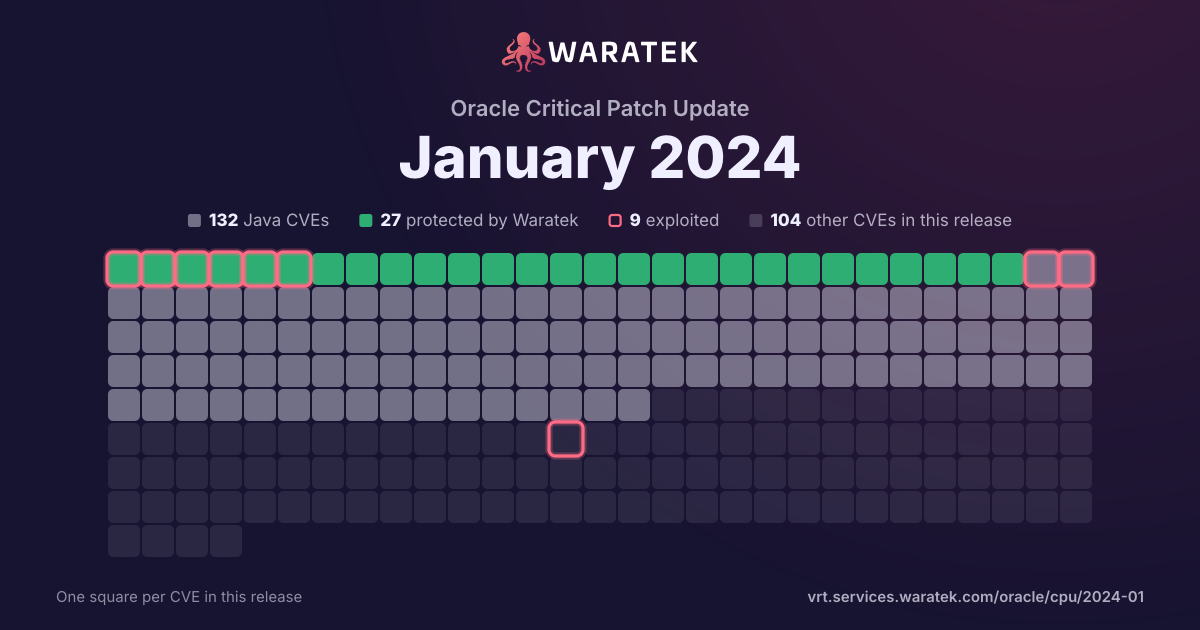
By status
27Protected by Waratek4Mitigation candidate101No exploit published26Outside Waratek scope78Not applicable
9Exploited, marked by the ring
No exploit published. For 47 of them, Oracle's security advisory is the source of public detail.
Protected by Waratek. Waratek RASP can block exploitation of these on systems that have not applied the patch yet.
Overview 209 matches · 105 in Waratek scope · 0 protected · 3 exploited · 2 CISA KEV · 9 public PoC · 10 EPSS ≥ 0.5
209matches
105in Waratek scope50.2%
0protected0.0%
3exploited1.4%
2CISA KEV1.0%
9public PoC4.3%
10EPSS ≥ 0.54.8%
Protected by Waratek
0
0.0%
Rule in development
0
0.0%
Mitigation candidate
4
1.9%
No exploit published
101
48.3%
Outside Waratek scope
26
12.4%
Not applicable
78
37.3%
Withdrawn CVE
0
0.0%
blocked by ARMR today
0
0.0%
partly blocked
0
0.0%
not blocked
209
100.0%
not established
0
0.0%
unrecorded
0
0.0%
split by
peak 82 / quarter
Q3 201
No exploit published1
Medium1
not blocked1
No public exploit1
Q4 202
No exploit published1
Not applicable1
High1
Medium1
not blocked2
No public exploit2
Q1 211
No exploit published1
High1
not blocked1
No public exploit1
Q2 210
Q3 214
No exploit published4
High4
not blocked4
No public exploit4
Q4 214
Outside Waratek scope4
Critical1
Medium3
not blocked4
Proof of concept only1
No public exploit3
Q1 220
Q2 225
No exploit published3
Not applicable2
Critical1
High2
Medium1
Low1
not blocked5
Forecast only1
No public exploit4
Q3 225
No exploit published1
Outside Waratek scope3
Not applicable1
Critical1
High2
Medium1
Low1
not blocked5
Proof of concept only3
No public exploit2
Q4 2213
Mitigation candidate1
No exploit published7
Not applicable5
Critical2
High10
Medium1
not blocked13
Proof of concept only5
No public exploit8
Q1 2313
No exploit published3
Not applicable10
High5
Medium8
not blocked13
Proof of concept only3
No public exploit10
Q2 2320
No exploit published10
Not applicable10
Critical1
High14
Medium5
not blocked20
Proof of concept only6
Forecast only1
No public exploit13
Q3 2335
No exploit published18
Outside Waratek scope2
Not applicable15
Critical3
High15
Medium14
Low3
not blocked35
Proof of concept only3
No public exploit32
Q4 2324
Mitigation candidate3
No exploit published11
Outside Waratek scope1
Not applicable9
Critical3
High12
Medium6
Low3
not blocked24
Exploited3
Working exploit published1
Proof of concept only2
No public exploit18
Q1 2482
No exploit published41
Outside Waratek scope16
Not applicable25
High10
Medium61
Low11
not blocked82
No public exploit82
Q3 20Q1 21Q3 21Q1 22Q3 22Q1 23Q3 23Q1 24
| CVE | Severity | Published▾ | Status | Exploitation | Description |
|---|---|---|---|---|---|
| CVE-2023-45648 | Medium | 2023-10-10 | Mitigation candidate | Working exploit published | Improper Input Validation vulnerability in Apache Tomcat.Tomcat from 11.0.0-M1 through 11.0.0-M11, from 10.1.0-M1 through 10.1.13, from 9.0.0-M1 through 9.0.81 and from 8.5.0 through 8.5.93 did not correctly parse HTTP trailer headers. A specially crafted, invalid trailer header could cause Tomcat to treat a single request as multiple requests leading to the possibility of request smuggling when behind a reverse proxy. Older, EOL versions may also be affected. Users are recommended to upgrade to version 11.0.0-M12 onwards, 10.1.14 onwards, 9.0.81 onwards or 8.5.94 onwards, which fix the issue. |
| CVE-2023-44487 | High | 2023-10-10 | Mitigation candidate | Exploited | The HTTP/2 protocol allows a denial of service (server resource consumption) because request cancellation can reset many streams quickly, as exploited in the wild in August through October 2023. |
| CVE-2023-42795 | Medium | 2023-10-10 | No exploit published | No public exploit | Incomplete Cleanup vulnerability in Apache Tomcat.When recycling various internal objects in Apache Tomcat from 11.0.0-M1 through 11.0.0-M11, from 10.1.0-M1 through 10.1.13, from 9.0.0-M1 through 9.0.80 and from 8.5.0 through 8.5.93, an error could cause Tomcat to skip some parts of the recycling process leading to information leaking from the current request/response to the next. Older, EOL versions may also be affected. Users are recommended to upgrade to version 11.0.0-M12 onwards, 10.1.14 onwards, 9.0.81 onwards or 8.5.94 onwards, which fixes the issue. |
| CVE-2023-42794 | Medium | 2023-10-10 | No exploit published | No public exploit | Incomplete Cleanup vulnerability in Apache Tomcat. The internal fork of Commons FileUpload packaged with Apache Tomcat 9.0.70 through 9.0.80 and 8.5.85 through 8.5.93 included an unreleased, in progress refactoring that exposed a potential denial of service on Windows if a web application opened a stream for an uploaded file but failed to close the stream. The file would never be deleted from disk creating the possibility of an eventual denial of service due to the disk being full. Other, EOL versions may also be affected. Users are recommended to upgrade to version 9.0.81 onwards or 8.5.94 onwards, which fixes the issue. |
| CVE-2023-36478 | High | 2023-10-10 | No exploit published | No public exploit | Eclipse Jetty provides a web server and servlet container. In versions 11.0.0 through 11.0.15, 10.0.0 through 10.0.15, and 9.0.0 through 9.4.52, an integer overflow in `MetaDataBuilder.checkSize` allows for HTTP/2 HPACK header values to exceed their size limit. `MetaDataBuilder.java` determines if a header name or value exceeds the size limit, and throws an exception if the limit is exceeded. However, when length is very large and huffman is true, the multiplication by 4 in line 295 will overflow, and length will become negative. `(_size+length)` will now be negative, and the check on line 296 will not be triggered. Furthermore, `MetaDataBuilder.checkSize` allows for user-entered HPACK header value sizes to be negative, potentially leading to a very large buffer allocation later on when the user-entered size is multiplied by 2. This means that if a user provides a negative length value (or, more precisely, a length value which, when multiplied by the 4/3 fudge factor, is negative), and this length value is a very large positive number when multiplied by 2, then the user can cause a very large buffer to be allocated on the server. Users of HTTP/2 can be impacted by a remote denial of service attack. The issue has been fixed in versions 11.0.16, 10.0.16, and 9.4.53. There are no known workarounds. |
| CVE-2023-4911 | High | 2023-10-03 | Not applicable | Exploited | A buffer overflow was discovered in the GNU C Library's dynamic loader ld.so while processing the GLIBC_TUNABLES environment variable. This issue could allow a local attacker to use maliciously crafted GLIBC_TUNABLES environment variables when launching binaries with SUID permission to execute code with elevated privileges. |
| CVE-2023-43642 | High | 2023-09-25 | No exploit published | Proof of concept only | snappy-java is a Java port of the snappy, a fast C++ compresser/decompresser developed by Google. The SnappyInputStream was found to be vulnerable to Denial of Service (DoS) attacks when decompressing data with a too large chunk size. Due to missing upper bound check on chunk length, an unrecoverable fatal error can occur. All versions of snappy-java including the latest released version 1.1.10.3 are vulnerable to this issue. A fix has been introduced in commit `9f8c3cf74` which will be included in the 1.1.10.4 release. Users are advised to upgrade. Users unable to upgrade should only accept compressed data from trusted sources. |
| CVE-2023-43498 | High | 2023-09-20 | No exploit published | No public exploit | In Jenkins 2.423 and earlier, LTS 2.414.1 and earlier, processing file uploads using MultipartFormDataParser creates temporary files in the default system temporary directory with the default permissions for newly created files, potentially allowing attackers with access to the Jenkins controller file system to read and write the files before they are used. |
| CVE-2023-43497 | High | 2023-09-20 | No exploit published | No public exploit | In Jenkins 2.423 and earlier, LTS 2.414.1 and earlier, processing file uploads using the Stapler web framework creates temporary files in the default system temporary directory with the default permissions for newly created files, potentially allowing attackers with access to the Jenkins controller file system to read and write the files before they are used. |
| CVE-2023-43496 | High | 2023-09-20 | No exploit published | No public exploit | Jenkins 2.423 and earlier, LTS 2.414.1 and earlier creates a temporary file in the system temporary directory with the default permissions for newly created files when installing a plugin from a URL, potentially allowing attackers with access to the system temporary directory to replace the file before it is installed in Jenkins, potentially resulting in arbitrary code execution. |
| CVE-2023-43495 | Medium | 2023-09-20 | No exploit published | No public exploit | Jenkins 2.423 and earlier, LTS 2.414.1 and earlier does not escape the value of the 'caption' constructor parameter of 'ExpandableDetailsNote', resulting in a stored cross-site scripting (XSS) vulnerability exploitable by attackers able to control this parameter. |
| CVE-2023-43494 | Medium | 2023-09-20 | No exploit published | No public exploit | Jenkins 2.50 through 2.423 (both inclusive), LTS 2.60.1 through 2.414.1 (both inclusive) does not exclude sensitive build variables (e.g., password parameter values) from the search in the build history widget, allowing attackers with Item/Read permission to obtain values of sensitive variables used in builds by iteratively testing different characters until the correct sequence is discovered. |
| CVE-2023-41900 | Medium | 2023-09-15 | No exploit published | No public exploit | Jetty is a Java based web server and servlet engine. Versions 9.4.21 through 9.4.51, 10.0.15, and 11.0.15 are vulnerable to weak authentication. If a Jetty `OpenIdAuthenticator` uses the optional nested `LoginService`, and that `LoginService` decides to revoke an already authenticated user, then the current request will still treat the user as authenticated. The authentication is then cleared from the session and subsequent requests will not be treated as authenticated. So a request on a previously authenticated session could be allowed to bypass authentication after it had been rejected by the `LoginService`. This impacts usages of the jetty-openid which have configured a nested `LoginService` and where that `LoginService` will is capable of rejecting previously authenticated users. Versions 9.4.52, 10.0.16, and 11.0.16 have a patch for this issue. |
| CVE-2023-40167 | Medium | 2023-09-15 | No exploit published | No public exploit | Jetty is a Java based web server and servlet engine. Prior to versions 9.4.52, 10.0.16, 11.0.16, and 12.0.1, Jetty accepts the `+` character proceeding the content-length value in a HTTP/1 header field. This is more permissive than allowed by the RFC and other servers routinely reject such requests with 400 responses. There is no known exploit scenario, but it is conceivable that request smuggling could result if jetty is used in combination with a server that does not close the connection after sending such a 400 response. Versions 9.4.52, 10.0.16, 11.0.16, and 12.0.1 contain a patch for this issue. There is no workaround as there is no known exploit scenario. |
| CVE-2023-38039 | High | 2023-09-15 | Not applicable | Proof of concept only | When curl retrieves an HTTP response, it stores the incoming headers so that they can be accessed later via the libcurl headers API. However, curl did not have a limit in how many or how large headers it would accept in a response, allowing a malicious server to stream an endless series of headers and eventually cause curl to run out of heap memory. |
| CVE-2023-36479 | Low | 2023-09-15 | No exploit published | No public exploit | Eclipse Jetty Canonical Repository is the canonical repository for the Jetty project. Users of the CgiServlet with a very specific command structure may have the wrong command executed. If a user sends a request to a org.eclipse.jetty.servlets.CGI Servlet for a binary with a space in its name, the servlet will escape the command by wrapping it in quotation marks. This wrapped command, plus an optional command prefix, will then be executed through a call to Runtime.exec. If the original binary name provided by the user contains a quotation mark followed by a space, the resulting command line will contain multiple tokens instead of one. This issue was patched in version 9.4.52, 10.0.16, 11.0.16 and 12.0.0-beta2. |
| CVE-2023-42503 | Medium | 2023-09-14 | No exploit published | No public exploit | Improper Input Validation, Uncontrolled Resource Consumption vulnerability in Apache Commons Compress in TAR parsing.This issue affects Apache Commons Compress: from 1.22 before 1.24.0. Users are recommended to upgrade to version 1.24.0, which fixes the issue. A third party can create a malformed TAR file by manipulating file modification times headers, which when parsed with Apache Commons Compress, will cause a denial of service issue via CPU consumption. In version 1.22 of Apache Commons Compress, support was added for file modification times with higher precision (issue # COMPRESS-612 [1]). The format for the PAX extended headers carrying this data consists of two numbers separated by a period [2], indicating seconds and subsecond precision (for example “1647221103.5998539”). The impacted fields are “atime”, “ctime”, “mtime” and “LIBARCHIVE.creationtime”. No input validation is performed prior to the parsing of header values. Parsing of these numbers uses the BigDecimal [3] class from the JDK which has a publicly known algorithmic complexity issue when doing operations on large numbers, causing denial of service (see issue # JDK-6560193 [4]). A third party can manipulate file time headers in a TAR file by placing a number with a very long fraction (300,000 digits) or a number with exponent notation (such as “9e9999999”) within a file modification time header, and the parsing of files with these headers will take hours instead of seconds, leading to a denial of service via exhaustion of CPU resources. This issue is similar to CVE-2012-2098 [5]. [1]: https://issues.apache.org/jira/browse/COMPRESS-612 [2]: https://pubs.opengroup.org/onlinepubs/9699919799/utilities/pax.html#tag_20_92_13_05 [3]: https://docs.oracle.com/javase/8/docs/api/java/math/BigDecimal.html [4]: https://bugs.openjdk.org/browse/JDK-6560193 [5]: https://cve.mitre.org/cgi-bin/cvename.cgi?name=CVE-2012-2098 Only applications using CompressorStreamFactory class (with auto-detection of file types), TarArchiveInputStream and TarFile classes to parse TAR files are impacted. Since this code was introduced in v1.22, only that version and later versions are impacted. |
| CVE-2023-1108 | High | 2023-09-14 | No exploit published | No public exploit | A flaw was found in undertow. This issue makes achieving a denial of service possible due to an unexpected handshake status updated in SslConduit, where the loop never terminates. |
| CVE-2023-41053 | Low | 2023-09-06 | Not applicable | No public exploit | Redis is an in-memory database that persists on disk. Redis does not correctly identify keys accessed by `SORT_RO` and as a result may grant users executing this command access to keys that are not explicitly authorized by the ACL configuration. The problem exists in Redis 7.0 or newer and has been fixed in Redis 7.0.13 and 7.2.1. Users are advised to upgrade. There are no known workarounds for this vulnerability. |
| CVE-2023-32559 | High | 2023-08-24 | Not applicable | No public exploit | A privilege escalation vulnerability exists in the experimental policy mechanism in all active release lines: 16.x, 18.x and, 20.x. The use of the deprecated API `process.binding()` can bypass the policy mechanism by requiring internal modules and eventually take advantage of `process.binding('spawn_sync')` run arbitrary code, outside of the limits defined in a `policy.json` file. Please note that at the time this CVE was issued, the policy is an experimental feature of Node.js. |
| CVE-2023-41105 | High | 2023-08-23 | Not applicable | No public exploit | An issue was discovered in Python 3.11 through 3.11.4. If a path containing '\0' bytes is passed to os.path.normpath(), the path will be truncated unexpectedly at the first '\0' byte. There are plausible cases in which an application would have rejected a filename for security reasons in Python 3.10.x or earlier, but that filename is no longer rejected in Python 3.11.x. |
| CVE-2022-48174 | Critical | 2023-08-22 | Not applicable | No public exploit | There is a stack overflow vulnerability in ash.c:6030 in busybox before 1.35. In the environment of Internet of Vehicles, this vulnerability can be executed from command to arbitrary code execution. |
| CVE-2022-44730 | Medium | 2023-08-22 | No exploit published | No public exploit | Server-Side Request Forgery (SSRF) vulnerability in Apache Software Foundation Apache XML Graphics Batik.This issue affects Apache XML Graphics Batik: 1.16. A malicious SVG can probe user profile / data and send it directly as parameter to a URL. |
| CVE-2022-44729 | High | 2023-08-22 | No exploit published | No public exploit | Server-Side Request Forgery (SSRF) vulnerability in Apache Software Foundation Apache XML Graphics Batik.This issue affects Apache XML Graphics Batik: 1.16. On version 1.16, a malicious SVG could trigger loading external resources by default, causing resource consumption or in some cases even information disclosure. Users are recommended to upgrade to version 1.17 or later. |
| CVE-2023-32002 | Critical | 2023-08-21 | Not applicable | No public exploit | The use of `Module._load()` can bypass the policy mechanism and require modules outside of the policy.json definition for a given module. This vulnerability affects all users using the experimental policy mechanism in all active release lines: 16.x, 18.x and, 20.x. Please note that at the time this CVE was issued, the policy is an experimental feature of Node.js. |
| CVE-2023-39975 | High | 2023-08-16 | Not applicable | No public exploit | kdc/do_tgs_req.c in MIT Kerberos 5 (aka krb5) 1.21 before 1.21.2 has a double free that is reachable if an authenticated user can trigger an authorization-data handling failure. Incorrect data is copied from one ticket to another. |
| CVE-2023-32006 | High | 2023-08-15 | Not applicable | No public exploit | The use of `module.constructor.createRequire()` can bypass the policy mechanism and require modules outside of the policy.json definition for a given module. This vulnerability affects all users using the experimental policy mechanism in all active release lines: 16.x, 18.x, and, 20.x. Please note that at the time this CVE was issued, the policy is an experimental feature of Node.js. |
| CVE-2023-28823 | High | 2023-08-11 | Not applicable | No public exploit | Uncontrolled search path in some Intel(R) oneAPI Toolkit and component software installers before version 4.3.1.493 may allow an authenticated user to potentially enable escalation of privilege via local access. |
| CVE-2023-27391 | Medium | 2023-08-11 | Not applicable | No public exploit | Improper access control in some Intel(R) oneAPI Toolkit and component software installers before version 4.3.1.493 may allow a privileged user to potentially enable escalation of privilege via local access. |
| CVE-2023-36054 | Medium | 2023-08-07 | Outside Waratek scope | No public exploit | lib/kadm5/kadm_rpc_xdr.c in MIT Kerberos 5 (aka krb5) before 1.20.2 and 1.21.x before 1.21.1 frees an uninitialized pointer. A remote authenticated user can trigger a kadmind crash. This occurs because _xdr_kadm5_principal_ent_rec does not validate the relationship between n_key_data and the key_data array count. |
| CVE-2023-3817 | Medium | 2023-07-31 | Not applicable | No public exploit | Issue summary: Checking excessively long DH keys or parameters may be very slow. Impact summary: Applications that use the functions DH_check(), DH_check_ex() or EVP_PKEY_param_check() to check a DH key or DH parameters may experience long delays. Where the key or parameters that are being checked have been obtained from an untrusted source this may lead to a Denial of Service. The function DH_check() performs various checks on DH parameters. After fixing CVE-2023-3446 it was discovered that a large q parameter value can also trigger an overly long computation during some of these checks. A correct q value, if present, cannot be larger than the modulus p parameter, thus it is unnecessary to perform these checks if q is larger than p. An application that calls DH_check() and supplies a key or parameters obtained from an untrusted source could be vulnerable to a Denial of Service attack. The function DH_check() is itself called by a number of other OpenSSL functions. An application calling any of those other functions may similarly be affected. The other functions affected by this are DH_check_ex() and EVP_PKEY_param_check(). Also vulnerable are the OpenSSL dhparam and pkeyparam command line applications when using the "-check" option. The OpenSSL SSL/TLS implementation is not affected by this issue. The OpenSSL 3.0 and 3.1 FIPS providers are not affected by this issue. |
| CVE-2023-39151 | Medium | 2023-07-26 | No exploit published | No public exploit | Jenkins 2.415 and earlier, LTS 2.401.2 and earlier does not sanitize or properly encode URLs in build logs when transforming them into hyperlinks, resulting in a stored cross-site scripting (XSS) vulnerability exploitable by attackers able to control build log contents. |
| CVE-2023-3446 | Medium | 2023-07-19 | Not applicable | No public exploit | Issue summary: Checking excessively long DH keys or parameters may be very slow. Impact summary: Applications that use the functions DH_check(), DH_check_ex() or EVP_PKEY_param_check() to check a DH key or DH parameters may experience long delays. Where the key or parameters that are being checked have been obtained from an untrusted source this may lead to a Denial of Service. The function DH_check() performs various checks on DH parameters. One of those checks confirms that the modulus ('p' parameter) is not too large. Trying to use a very large modulus is slow and OpenSSL will not normally use a modulus which is over 10,000 bits in length. However the DH_check() function checks numerous aspects of the key or parameters that have been supplied. Some of those checks use the supplied modulus value even if it has already been found to be too large. An application that calls DH_check() and supplies a key or parameters obtained from an untrusted source could be vulernable to a Denial of Service attack. The function DH_check() is itself called by a number of other OpenSSL functions. An application calling any of those other functions may similarly be affected. The other functions affected by this are DH_check_ex() and EVP_PKEY_param_check(). Also vulnerable are the OpenSSL dhparam and pkeyparam command line applications when using the '-check' option. The OpenSSL SSL/TLS implementation is not affected by this issue. The OpenSSL 3.0 and 3.1 FIPS providers are not affected by this issue. |
| CVE-2023-34034 | Critical | 2023-07-19 | No exploit published | No public exploit | Using "**" as a pattern in Spring Security configuration for WebFlux creates a mismatch in pattern matching between Spring Security and Spring WebFlux, and the potential for a security bypass. |
| CVE-2022-40896 | Medium | 2023-07-19 | Not applicable | No public exploit | A ReDoS issue was discovered in pygments/lexers/smithy.py in pygments through 2.15.0 via SmithyLexer. |
| CVE-2023-34035 | High | 2023-07-18 | No exploit published | No public exploit | Spring Security versions 5.8 prior to 5.8.5, 6.0 prior to 6.0.5, and 6.1 prior to 6.1.2 could be susceptible to authorization rule misconfiguration if the application uses requestMatchers(String) and multiple servlets, one of them being Spring MVC’s DispatcherServlet. (DispatcherServlet is a Spring MVC component that maps HTTP endpoints to methods on @Controller-annotated classes.) Specifically, an application is vulnerable when all of the following are true: * Spring MVC is on the classpath * Spring Security is securing more than one servlet in a single application (one of them being Spring MVC’s DispatcherServlet) * The application uses requestMatchers(String) to refer to endpoints that are not Spring MVC endpoints An application is not vulnerable if any of the following is true: * The application does not have Spring MVC on the classpath * The application secures no servlets other than Spring MVC’s DispatcherServlet * The application uses requestMatchers(String) only for Spring MVC endpoints |
| CVE-2023-21949 | Low | 2023-07-18 | Outside Waratek scope | No public exploit | Vulnerability in the Advanced Networking Option component of Oracle Database Server. Supported versions that are affected are 19.3-19.19 and 21.3-21.10. Difficult to exploit vulnerability allows unauthenticated attacker with network access via Oracle Net to compromise Advanced Networking Option. Successful attacks of this vulnerability can result in unauthorized update, insert or delete access to some of Advanced Networking Option accessible data. CVSS 3.1 Base Score 3.7 (Integrity impacts). CVSS Vector: (CVSS:3.1/AV:N/AC:H/PR:N/UI:N/S:U/C:N/I:L/A:N). |
| CVE-2023-38325 | High | 2023-07-14 | Not applicable | Proof of concept only | The cryptography package before 41.0.2 for Python mishandles SSH certificates that have critical options. |
| CVE-2023-2975 | Medium | 2023-07-14 | Not applicable | No public exploit | Issue summary: The AES-SIV cipher implementation contains a bug that causes it to ignore empty associated data entries which are unauthenticated as a consequence. Impact summary: Applications that use the AES-SIV algorithm and want to authenticate empty data entries as associated data can be misled by removing, adding or reordering such empty entries as these are ignored by the OpenSSL implementation. We are currently unaware of any such applications. The AES-SIV algorithm allows for authentication of multiple associated data entries along with the encryption. To authenticate empty data the application has to call EVP_EncryptUpdate() (or EVP_CipherUpdate()) with NULL pointer as the output buffer and 0 as the input buffer length. The AES-SIV implementation in OpenSSL just returns success for such a call instead of performing the associated data authentication operation. The empty data thus will not be authenticated. As this issue does not affect non-empty associated data authentication and we expect it to be rare for an application to use empty associated data entries this is qualified as Low severity issue. |
| CVE-2023-3635 | High | 2023-07-12 | No exploit published | No public exploit | GzipSource does not handle an exception that might be raised when parsing a malformed gzip buffer. This may lead to denial of service of the Okio client when handling a crafted GZIP archive, by using the GzipSource class. |
| CVE-2023-33201 | Medium | 2023-07-05 | No exploit published | No public exploit | Bouncy Castle For Java before 1.74 is affected by an LDAP injection vulnerability. The vulnerability only affects applications that use an LDAP CertStore from Bouncy Castle to validate X.509 certificates. During the certificate validation process, Bouncy Castle inserts the certificate's Subject Name into an LDAP search filter without any escaping, which leads to an LDAP injection vulnerability. |
| CVE-2023-36632 | High | 2023-06-25 | Not applicable | Proof of concept only | The legacy email.utils.parseaddr function in Python through 3.11.4 allows attackers to trigger "RecursionError: maximum recursion depth exceeded while calling a Python object" via a crafted argument. This argument is plausibly an untrusted value from an application's input data that was supposed to contain a name and an e-mail address. NOTE: email.utils.parseaddr is categorized as a Legacy API in the documentation of the Python email package. Applications should instead use the email.parser.BytesParser or email.parser.Parser class. NOTE: the vendor's perspective is that this is neither a vulnerability nor a bug. The email package is intended to have size limits and to throw an exception when limits are exceeded; they were exceeded by the example demonstration code. |
| CVE-2023-34462 | Medium | 2023-06-22 | No exploit published | No public exploit | Netty is an asynchronous event-driven network application framework for rapid development of maintainable high performance protocol servers & clients. The `SniHandler` can allocate up to 16MB of heap for each channel during the TLS handshake. When the handler or the channel does not have an idle timeout, it can be used to make a TCP server using the `SniHandler` to allocate 16MB of heap. The `SniHandler` class is a handler that waits for the TLS handshake to configure a `SslHandler` according to the indicated server name by the `ClientHello` record. For this matter it allocates a `ByteBuf` using the value defined in the `ClientHello` record. Normally the value of the packet should be smaller than the handshake packet but there are not checks done here and the way the code is written, it is possible to craft a packet that makes the `SslClientHelloHandler`. This vulnerability has been fixed in version 4.1.94.Final. |
| CVE-2023-34981 | High | 2023-06-21 | No exploit published | No public exploit | A regression in the fix for bug 66512 in Apache Tomcat 11.0.0-M5, 10.1.8, 9.0.74 and 8.5.88 meant that, if a response did not include any HTTP headers no AJP SEND_HEADERS messare woudl be sent for the response which in turn meant that at least one AJP proxy (mod_proxy_ajp) would use the response headers from the previous request leading to an information leak. |
| CVE-2023-34455 | High | 2023-06-15 | No exploit published | Proof of concept only | snappy-java is a fast compressor/decompressor for Java. Due to use of an unchecked chunk length, an unrecoverable fatal error can occur in versions prior to 1.1.10.1. The code in the function hasNextChunk in the fileSnappyInputStream.java checks if a given stream has more chunks to read. It does that by attempting to read 4 bytes. If it wasn’t possible to read the 4 bytes, the function returns false. Otherwise, if 4 bytes were available, the code treats them as the length of the next chunk. In the case that the `compressed` variable is null, a byte array is allocated with the size given by the input data. Since the code doesn’t test the legality of the `chunkSize` variable, it is possible to pass a negative number (such as 0xFFFFFFFF which is -1), which will cause the code to raise a `java.lang.NegativeArraySizeException` exception. A worse case would happen when passing a huge positive value (such as 0x7FFFFFFF), which would raise the fatal `java.lang.OutOfMemoryError` error. Version 1.1.10.1 contains a patch for this issue. |
| CVE-2023-34454 | High | 2023-06-15 | No exploit published | Proof of concept only | snappy-java is a fast compressor/decompressor for Java. Due to unchecked multiplications, an integer overflow may occur in versions prior to 1.1.10.1, causing an unrecoverable fatal error. The function `compress(char[] input)` in the file `Snappy.java` receives an array of characters and compresses it. It does so by multiplying the length by 2 and passing it to the rawCompress` function. Since the length is not tested, the multiplication by two can cause an integer overflow and become negative. The rawCompress function then uses the received length and passes it to the natively compiled maxCompressedLength function, using the returned value to allocate a byte array. Since the maxCompressedLength function treats the length as an unsigned integer, it doesn’t care that it is negative, and it returns a valid value, which is casted to a signed integer by the Java engine. If the result is negative, a `java.lang.NegativeArraySizeException` exception will be raised while trying to allocate the array `buf`. On the other side, if the result is positive, the `buf` array will successfully be allocated, but its size might be too small to use for the compression, causing a fatal Access Violation error. The same issue exists also when using the `compress` functions that receive double, float, int, long and short, each using a different multiplier that may cause the same issue. The issue most likely won’t occur when using a byte array, since creating a byte array of size 0x80000000 (or any other negative value) is impossible in the first place. Version 1.1.10.1 contains a patch for this issue. |
| CVE-2023-34453 | High | 2023-06-15 | No exploit published | Proof of concept only | snappy-java is a fast compressor/decompressor for Java. Due to unchecked multiplications, an integer overflow may occur in versions prior to 1.1.10.1, causing a fatal error. The function `shuffle(int[] input)` in the file `BitShuffle.java` receives an array of integers and applies a bit shuffle on it. It does so by multiplying the length by 4 and passing it to the natively compiled shuffle function. Since the length is not tested, the multiplication by four can cause an integer overflow and become a smaller value than the true size, or even zero or negative. In the case of a negative value, a `java.lang.NegativeArraySizeException` exception will raise, which can crash the program. In a case of a value that is zero or too small, the code that afterwards references the shuffled array will assume a bigger size of the array, which might cause exceptions such as `java.lang.ArrayIndexOutOfBoundsException`. The same issue exists also when using the `shuffle` functions that receive a double, float, long and short, each using a different multiplier that may cause the same issue. Version 1.1.10.1 contains a patch for this vulnerability. |
| CVE-2023-35141 | High | 2023-06-14 | No exploit published | No public exploit | In Jenkins 2.399 and earlier, LTS 2.387.3 and earlier, POST requests are sent in order to load the list of context actions. If part of the URL includes insufficiently escaped user-provided values, a victim may be tricked into sending a POST request to an unexpected endpoint by opening a context menu. |
| CVE-2023-34624 | High | 2023-06-14 | No exploit published | Proof of concept only | An issue was discovered htmlcleaner thru = 2.28 allows attackers to cause a denial of service or other unspecified impacts via crafted object that uses cyclic dependencies. |
| CVE-2023-2976 | High | 2023-06-14 | No exploit published | No public exploit | Use of Java's default temporary directory for file creation in `FileBackedOutputStream` in Google Guava versions 1.0 to 31.1 on Unix systems and Android Ice Cream Sandwich allows other users and apps on the machine with access to the default Java temporary directory to be able to access the files created by the class. Even though the security vulnerability is fixed in version 32.0.0, we recommend using version 32.0.1 as version 32.0.0 breaks some functionality under Windows. |
| CVE-2023-2650 | Medium | 2023-05-30 | Not applicable | Forecast only | Issue summary: Processing some specially crafted ASN.1 object identifiers or data containing them may be very slow. Impact summary: Applications that use OBJ_obj2txt() directly, or use any of the OpenSSL subsystems OCSP, PKCS7/SMIME, CMS, CMP/CRMF or TS with no message size limit may experience notable to very long delays when processing those messages, which may lead to a Denial of Service. An OBJECT IDENTIFIER is composed of a series of numbers - sub-identifiers - most of which have no size limit. OBJ_obj2txt() may be used to translate an ASN.1 OBJECT IDENTIFIER given in DER encoding form (using the OpenSSL type ASN1_OBJECT) to its canonical numeric text form, which are the sub-identifiers of the OBJECT IDENTIFIER in decimal form, separated by periods. When one of the sub-identifiers in the OBJECT IDENTIFIER is very large (these are sizes that are seen as absurdly large, taking up tens or hundreds of KiBs), the translation to a decimal number in text may take a very long time. The time complexity is O(n^2) with 'n' being the size of the sub-identifiers in bytes (*). With OpenSSL 3.0, support to fetch cryptographic algorithms using names / identifiers in string form was introduced. This includes using OBJECT IDENTIFIERs in canonical numeric text form as identifiers for fetching algorithms. Such OBJECT IDENTIFIERs may be received through the ASN.1 structure AlgorithmIdentifier, which is commonly used in multiple protocols to specify what cryptographic algorithm should be used to sign or verify, encrypt or decrypt, or digest passed data. Applications that call OBJ_obj2txt() directly with untrusted data are affected, with any version of OpenSSL. If the use is for the mere purpose of display, the severity is considered low. In OpenSSL 3.0 and newer, this affects the subsystems OCSP, PKCS7/SMIME, CMS, CMP/CRMF or TS. It also impacts anything that processes X.509 certificates, including simple things like verifying its signature. The impact on TLS is relatively low, because all versions of OpenSSL have a 100KiB limit on the peer's certificate chain. Additionally, this only impacts clients, or servers that have explicitly enabled client authentication. In OpenSSL 1.1.1 and 1.0.2, this only affects displaying diverse objects, such as X.509 certificates. This is assumed to not happen in such a way that it would cause a Denial of Service, so these versions are considered not affected by this issue in such a way that it would be cause for concern, and the severity is therefore considered low. |
| CVE-2023-2283 | Medium | 2023-05-26 | Not applicable | No public exploit | A vulnerability was found in libssh, where the authentication check of the connecting client can be bypassed in the`pki_verify_data_signature` function in memory allocation problems. This issue may happen if there is insufficient memory or the memory usage is limited. The problem is caused by the return value `rc,` which is initialized to SSH_ERROR and later rewritten to save the return value of the function call `pki_key_check_hash_compatible.` The value of the variable is not changed between this point and the cryptographic verification. Therefore any error between them calls `goto error` returning SSH_OK. |
| CVE-2023-20883 | High | 2023-05-26 | No exploit published | No public exploit | In Spring Boot versions 3.0.0 - 3.0.6, 2.7.0 - 2.7.11, 2.6.0 - 2.6.14, 2.5.0 - 2.5.14 and older unsupported versions, there is potential for a denial-of-service (DoS) attack if Spring MVC is used together with a reverse proxy cache. |
| CVE-2023-32697 | Critical | 2023-05-23 | No exploit published | No public exploit | SQLite JDBC is a library for accessing and creating SQLite database files in Java. Sqlite-jdbc addresses a remote code execution vulnerability via JDBC URL. This issue impacting versions 3.6.14.1 through 3.41.2.1 and has been fixed in version 3.41.2.2. |
| CVE-2023-2618 | High | 2023-05-10 | Not applicable | No public exploit | A vulnerability, which was classified as problematic, has been found in OpenCV wechat_qrcode Module up to 4.7.0. Affected by this issue is the function DecodedBitStreamParser::decodeHanziSegment of the file qrcode/decoder/decoded_bit_stream_parser.cpp. The manipulation leads to memory leak. The attack may be launched remotely. The name of the patch is 2b62ff6181163eea029ed1cab11363b4996e9cd6. It is recommended to apply a patch to fix this issue. The identifier of this vulnerability is VDB-228548. |
| CVE-2023-2617 | High | 2023-05-10 | Not applicable | Proof of concept only | A vulnerability classified as problematic was found in OpenCV wechat_qrcode Module up to 4.7.0. Affected by this vulnerability is the function DecodedBitStreamParser::decodeByteSegment of the file qrcode/decoder/decoded_bit_stream_parser.cpp. The manipulation leads to null pointer dereference. The attack can be launched remotely. The exploit has been disclosed to the public and may be used. It is recommended to apply a patch to fix this issue. The associated identifier of this vulnerability is VDB-228547. |
| CVE-2023-30861 | High | 2023-05-02 | Not applicable | No public exploit | Flask is a lightweight WSGI web application framework. When all of the following conditions are met, a response containing data intended for one client may be cached and subsequently sent by the proxy to other clients. If the proxy also caches `Set-Cookie` headers, it may send one client's `session` cookie to other clients. The severity depends on the application's use of the session and the proxy's behavior regarding cookies. The risk depends on all these conditions being met. 1. The application must be hosted behind a caching proxy that does not strip cookies or ignore responses with cookies. 2. The application sets `session.permanent = True` 3. The application does not access or modify the session at any point during a request. 4. `SESSION_REFRESH_EACH_REQUEST` enabled (the default). 5. The application does not set a `Cache-Control` header to indicate that a page is private or should not be cached. This happens because vulnerable versions of Flask only set the `Vary: Cookie` header when the session is accessed or modified, not when it is refreshed (re-sent to update the expiration) without being accessed or modified. This issue has been fixed in versions 2.3.2 and 2.2.5. |
| CVE-2023-31486 | High | 2023-04-29 | Not applicable | No public exploit | HTTP::Tiny before 0.083, a Perl core module since 5.13.9 and available standalone on CPAN, has an insecure default TLS configuration where users must opt in to verify certificates. |
| CVE-2023-31484 | High | 2023-04-29 | Not applicable | No public exploit | CPAN.pm before 2.35 does not verify TLS certificates when downloading distributions over HTTPS. |
| CVE-2023-29469 | Medium | 2023-04-24 | Not applicable | No public exploit | An issue was discovered in libxml2 before 2.10.4. When hashing empty dict strings in a crafted XML document, xmlDictComputeFastKey in dict.c can produce non-deterministic values, leading to various logic and memory errors, such as a double free. This behavior occurs because there is an attempt to use the first byte of an empty string, and any value is possible (not solely the '\0' value). |
| CVE-2023-28484 | Medium | 2023-04-24 | Not applicable | No public exploit | In libxml2 before 2.10.4, parsing of certain invalid XSD schemas can lead to a NULL pointer dereference and subsequently a segfault. This occurs in xmlSchemaFixupComplexType in xmlschemas.c. |
| CVE-2023-28756 | Medium | 2023-03-31 | Not applicable | No public exploit | A ReDoS issue was discovered in the Time component through 0.2.1 in Ruby through 3.2.1. The Time parser mishandles invalid URLs that have specific characters. It causes an increase in execution time for parsing strings to Time objects. The fixed versions are 0.1.1 and 0.2.2. |
| CVE-2023-28755 | Medium | 2023-03-31 | Not applicable | No public exploit | A ReDoS issue was discovered in the URI component through 0.12.0 in Ruby through 3.2.1. The URI parser mishandles invalid URLs that have specific characters. It causes an increase in execution time for parsing strings to URI objects. The fixed versions are 0.12.1, 0.11.1, 0.10.2 and 0.10.0.1. |
| CVE-2023-0466 | Medium | 2023-03-28 | Not applicable | No public exploit | The function X509_VERIFY_PARAM_add0_policy() is documented to implicitly enable the certificate policy check when doing certificate verification. However the implementation of the function does not enable the check which allows certificates with invalid or incorrect policies to pass the certificate verification. As suddenly enabling the policy check could break existing deployments it was decided to keep the existing behavior of the X509_VERIFY_PARAM_add0_policy() function. Instead the applications that require OpenSSL to perform certificate policy check need to use X509_VERIFY_PARAM_set1_policies() or explicitly enable the policy check by calling X509_VERIFY_PARAM_set_flags() with the X509_V_FLAG_POLICY_CHECK flag argument. Certificate policy checks are disabled by default in OpenSSL and are not commonly used by applications. |
| CVE-2023-0465 | Medium | 2023-03-28 | Not applicable | No public exploit | Applications that use a non-default option when verifying certificates may be vulnerable to an attack from a malicious CA to circumvent certain checks. Invalid certificate policies in leaf certificates are silently ignored by OpenSSL and other certificate policy checks are skipped for that certificate. A malicious CA could use this to deliberately assert invalid certificate policies in order to circumvent policy checking on the certificate altogether. Policy processing is disabled by default but can be enabled by passing the `-policy' argument to the command line utilities or by calling the `X509_VERIFY_PARAM_set1_policies()' function. |
| CVE-2023-28439 | Medium | 2023-03-22 | Not applicable | No public exploit | CKEditor4 is an open source what-you-see-is-what-you-get HTML editor. A cross-site scripting vulnerability has been discovered affecting Iframe Dialog and Media Embed packages. The vulnerability may trigger a JavaScript code after fulfilling special conditions: using one of the affected packages on a web page with missing proper Content Security Policy configuration; initializing the editor on an element and using an element other than `<textarea>` as a base; and destroying the editor instance. This vulnerability might affect a small percentage of integrators that depend on dynamic editor initialization/destroy mechanism. A fix is available in CKEditor4 version 4.21.0. In some rare cases, a security fix may be considered a breaking change. Starting from version 4.21.0, the Iframe Dialog plugin applies the `sandbox` attribute by default, which restricts JavaScript code execution in the iframe element. To change this behavior, configure the `config.iframe_attributes` option. Also starting from version 4.21.0, the Media Embed plugin regenerates the entire content of the embed widget by default. To change this behavior, configure the `config.embed_keepOriginalContent` option. Those who choose to enable either of the more permissive options or who cannot upgrade to a patched version should properly configure Content Security Policy to avoid any potential security issues that may arise from embedding iframe elements on their web page. |
| CVE-2023-1436 | High | 2023-03-22 | No exploit published | Proof of concept only | An infinite recursion is triggered in Jettison when constructing a JSONArray from a Collection that contains a self-reference in one of its elements. This leads to a StackOverflowError exception being thrown. |
| CVE-2023-1370 | High | 2023-03-22 | No exploit published | Proof of concept only | [Json-smart](https://netplex.github.io/json-smart/) is a performance focused, JSON processor lib. When reaching a ‘[‘ or ‘{‘ character in the JSON input, the code parses an array or an object respectively. It was discovered that the code does not have any limit to the nesting of such arrays or objects. Since the parsing of nested arrays and objects is done recursively, nesting too many of them can cause a stack exhaustion (stack overflow) and crash the software. |
| CVE-2023-0464 | High | 2023-03-22 | Not applicable | No public exploit | A security vulnerability has been identified in all supported versions of OpenSSL related to the verification of X.509 certificate chains that include policy constraints. Attackers may be able to exploit this vulnerability by creating a malicious certificate chain that triggers exponential use of computational resources, leading to a denial-of-service (DoS) attack on affected systems. Policy processing is disabled by default but can be enabled by passing the `-policy' argument to the command line utilities or by calling the `X509_VERIFY_PARAM_set1_policies()' function. |
| CVE-2023-24998 | High | 2023-02-20 | No exploit published | No public exploit | Apache Commons FileUpload before 1.5 does not limit the number of request parts to be processed resulting in the possibility of an attacker triggering a DoS with a malicious upload or series of uploads. Note that, like all of the file upload limits, the new configuration option (FileUploadBase#setFileCountMax) is not enabled by default and must be explicitly configured. |
| CVE-2022-4450 | High | 2023-02-08 | Not applicable | No public exploit | The function PEM_read_bio_ex() reads a PEM file from a BIO and parses and decodes the "name" (e.g. "CERTIFICATE"), any header data and the payload data. If the function succeeds then the "name_out", "header" and "data" arguments are populated with pointers to buffers containing the relevant decoded data. The caller is responsible for freeing those buffers. It is possible to construct a PEM file that results in 0 bytes of payload data. In this case PEM_read_bio_ex() will return a failure code but will populate the header argument with a pointer to a buffer that has already been freed. If the caller also frees this buffer then a double free will occur. This will most likely lead to a crash. This could be exploited by an attacker who has the ability to supply malicious PEM files for parsing to achieve a denial of service attack. The functions PEM_read_bio() and PEM_read() are simple wrappers around PEM_read_bio_ex() and therefore these functions are also directly affected. These functions are also called indirectly by a number of other OpenSSL functions including PEM_X509_INFO_read_bio_ex() and SSL_CTX_use_serverinfo_file() which are also vulnerable. Some OpenSSL internal uses of these functions are not vulnerable because the caller does not free the header argument if PEM_read_bio_ex() returns a failure code. These locations include the PEM_read_bio_TYPE() functions as well as the decoders introduced in OpenSSL 3.0. The OpenSSL asn1parse command line application is also impacted by this issue. |
| CVE-2022-4304 | Medium | 2023-02-08 | Not applicable | No public exploit | A timing based side channel exists in the OpenSSL RSA Decryption implementation which could be sufficient to recover a plaintext across a network in a Bleichenbacher style attack. To achieve a successful decryption an attacker would have to be able to send a very large number of trial messages for decryption. The vulnerability affects all RSA padding modes: PKCS#1 v1.5, RSA-OEAP and RSASVE. For example, in a TLS connection, RSA is commonly used by a client to send an encrypted pre-master secret to the server. An attacker that had observed a genuine connection between a client and a server could use this flaw to send trial messages to the server and record the time taken to process them. After a sufficiently large number of messages the attacker could recover the pre-master secret used for the original connection and thus be able to decrypt the application data sent over that connection. |
| CVE-2023-23931 | Medium | 2023-02-07 | Not applicable | Proof of concept only | cryptography is a package designed to expose cryptographic primitives and recipes to Python developers. In affected versions `Cipher.update_into` would accept Python objects which implement the buffer protocol, but provide only immutable buffers. This would allow immutable objects (such as `bytes`) to be mutated, thus violating fundamental rules of Python and resulting in corrupted output. This now correctly raises an exception. This issue has been present since `update_into` was originally introduced in cryptography 1.8. |
| CVE-2022-25147 | Medium | 2023-01-31 | Not applicable | No public exploit | Integer Overflow or Wraparound vulnerability in apr_base64 functions of Apache Portable Runtime Utility (APR-util) allows an attacker to write beyond bounds of a buffer. This issue affects Apache Portable Runtime Utility (APR-util) 1.6.1 and prior versions. |
| CVE-2022-46908 | High | 2022-12-12 | Not applicable | Proof of concept only | SQLite through 3.40.0, when relying on --safe for execution of an untrusted CLI script, does not properly implement the azProhibitedFunctions protection mechanism, and instead allows UDF functions such as WRITEFILE. |
| CVE-2022-3510 | High | 2022-12-12 | No exploit published | No public exploit | A parsing issue similar to CVE-2022-3171, but with Message-Type Extensions in protobuf-java core and lite versions prior to 3.21.7, 3.20.3, 3.19.6 and 3.16.3 can lead to a denial of service attack. Inputs containing multiple instances of non-repeated embedded messages with repeated or unknown fields causes objects to be converted back-n-forth between mutable and immutable forms, resulting in potentially long garbage collection pauses. We recommend updating to the versions mentioned above. |
| CVE-2021-37533 | Medium | 2022-12-03 | No exploit published | No public exploit | Prior to Apache Commons Net 3.9.0, Net's FTP client trusts the host from PASV response by default. A malicious server can redirect the Commons Net code to use a different host, but the user has to connect to the malicious server in the first place. This may lead to leakage of information about services running on the private network of the client. The default in version 3.9.0 is now false to ignore such hosts, as cURL does. See https://issues.apache.org/jira/browse/NET-711. |
| CVE-2022-45868 | High | 2022-11-23 | No exploit published | Proof of concept only | The web-based admin console in H2 Database Engine before 2.2.220 can be started via the CLI with the argument -webAdminPassword, which allows the user to specify the password in cleartext for the web admin console. Consequently, a local user (or an attacker that has obtained local access through some means) would be able to discover the password by listing processes and their arguments. NOTE: the vendor states "This is not a vulnerability of H2 Console ... Passwords should never be passed on the command line and every qualified DBA or system administrator is expected to know that." Nonetheless, the issue was fixed in 2.2.220. |
| CVE-2022-3786 | High | 2022-11-01 | Not applicable | Proof of concept only | A buffer overrun can be triggered in X.509 certificate verification, specifically in name constraint checking. Note that this occurs after certificate chain signature verification and requires either a CA to have signed a malicious certificate or for an application to continue certificate verification despite failure to construct a path to a trusted issuer. An attacker can craft a malicious email address in a certificate to overflow an arbitrary number of bytes containing the `.' character (decimal 46) on the stack. This buffer overflow could result in a crash (causing a denial of service). In a TLS client, this can be triggered by connecting to a malicious server. In a TLS server, this can be triggered if the server requests client authentication and a malicious client connects. |
| CVE-2022-3602 | High | 2022-11-01 | Not applicable | Proof of concept only | A buffer overrun can be triggered in X.509 certificate verification, specifically in name constraint checking. Note that this occurs after certificate chain signature verification and requires either a CA to have signed the malicious certificate or for the application to continue certificate verification despite failure to construct a path to a trusted issuer. An attacker can craft a malicious email address to overflow four attacker-controlled bytes on the stack. This buffer overflow could result in a crash (causing a denial of service) or potentially remote code execution. Many platforms implement stack overflow protections which would mitigate against the risk of remote code execution. The risk may be further mitigated based on stack layout for any given platform/compiler. Pre-announcements of CVE-2022-3602 described this issue as CRITICAL. Further analysis based on some of the mitigating factors described above have led this to be downgraded to HIGH. Users are still encouraged to upgrade to a new version as soon as possible. In a TLS client, this can be triggered by connecting to a malicious server. In a TLS server, this can be triggered if the server requests client authentication and a malicious client connects. Fixed in OpenSSL 3.0.7 (Affected 3.0.0,3.0.1,3.0.2,3.0.3,3.0.4,3.0.5,3.0.6). |
| CVE-2022-31692 | Critical | 2022-10-31 | Mitigation candidate | Proof of concept only | Spring Security, versions 5.7 prior to 5.7.5 and 5.6 prior to 5.6.9 could be susceptible to authorization rules bypass via forward or include dispatcher types. Specifically, an application is vulnerable when all of the following are true: The application expects that Spring Security applies security to forward and include dispatcher types. The application uses the AuthorizationFilter either manually or via the authorizeHttpRequests() method. The application configures the FilterChainProxy to apply to forward and/or include requests (e.g. spring.security.filter.dispatcher-types = request, error, async, forward, include). The application may forward or include the request to a higher privilege-secured endpoint.The application configures Spring Security to apply to every dispatcher type via authorizeHttpRequests().shouldFilterAllDispatcherTypes(true) |
| CVE-2022-31690 | High | 2022-10-31 | No exploit published | No public exploit | Spring Security, versions 5.7 prior to 5.7.5, and 5.6 prior to 5.6.9, and older unsupported versions could be susceptible to a privilege escalation under certain conditions. A malicious user or attacker can modify a request initiated by the Client (via the browser) to the Authorization Server which can lead to a privilege escalation on the subsequent approval. This scenario can happen if the Authorization Server responds with an OAuth2 Access Token Response containing an empty scope list (per RFC 6749, Section 5.1) on the subsequent request to the token endpoint to obtain the access token. |
| CVE-2022-42890 | High | 2022-10-25 | No exploit published | No public exploit | A vulnerability in Batik of Apache XML Graphics allows an attacker to run Java code from untrusted SVG via JavaScript. This issue affects Apache XML Graphics prior to 1.16. Users are recommended to upgrade to version 1.16. |
| CVE-2022-41704 | High | 2022-10-25 | No exploit published | No public exploit | A vulnerability in Batik of Apache XML Graphics allows an attacker to run untrusted Java code from an SVG. This issue affects Apache XML Graphics prior to 1.16. It is recommended to update to version 1.16. |
| CVE-2021-46848 | Critical | 2022-10-24 | Not applicable | No public exploit | GNU Libtasn1 before 4.19.0 has an ETYPE_OK off-by-one array size check that affects asn1_encode_simple_der. |
| CVE-2022-3479 | High | 2022-10-14 | Not applicable | No public exploit | A vulnerability found in nss. By this security vulnerability, nss client auth crash without a user certificate in the database and this can lead us to a segmentation fault or crash. |
| CVE-2022-42003 | High | 2022-10-02 | No exploit published | No public exploit | In FasterXML jackson-databind before versions 2.13.4.1 and 2.12.17.1, resource exhaustion can occur because of a lack of a check in primitive value deserializers to avoid deep wrapper array nesting, when the UNWRAP_SINGLE_VALUE_ARRAYS feature is enabled. |
| CVE-2022-40152 | High | 2022-09-16 | No exploit published | Proof of concept only | Those using Woodstox to parse XML data may be vulnerable to Denial of Service attacks (DOS) if DTD support is enabled. If the parser is running on user supplied input, an attacker may supply content that causes the parser to crash by stackoverflow. This effect may support a denial of service attack. |
| CVE-2022-37434 | Critical | 2022-08-05 | Outside Waratek scope | Proof of concept only | zlib through 1.2.12 has a heap-based buffer over-read or buffer overflow in inflate in inflate.c via a large gzip header extra field. NOTE: only applications that call inflateGetHeader are affected. Some common applications bundle the affected zlib source code but may be unable to call inflateGetHeader (e.g., see the nodejs/node reference). |
| CVE-2022-31160 | Medium | 2022-07-20 | Outside Waratek scope | Proof of concept only | jQuery UI is a curated set of user interface interactions, effects, widgets, and themes built on top of jQuery. Versions prior to 1.13.2 are potentially vulnerable to cross-site scripting. Initializing a checkboxradio widget on an input enclosed within a label makes that parent label contents considered as the input label. Calling `.checkboxradio( "refresh" )` on such a widget and the initial HTML contained encoded HTML entities will make them erroneously get decoded. This can lead to potentially executing JavaScript code. The bug has been patched in jQuery UI 1.13.2. To remediate the issue, someone who can change the initial HTML can wrap all the non-input contents of the `label` in a `span`. |
| CVE-2022-21432 | Low | 2022-07-19 | Outside Waratek scope | No public exploit | Vulnerability in the Oracle Database - Enterprise Edition RDBMS Security component of Oracle Database Server. Supported versions that are affected are 12.1.0.2, 19c and 21c. Easily exploitable vulnerability allows high privileged attacker having DBA role privilege with network access via Oracle Net to compromise Oracle Database - Enterprise Edition RDBMS Security. Successful attacks of this vulnerability can result in unauthorized ability to cause a partial denial of service (partial DOS) of Oracle Database - Enterprise Edition RDBMS Security. CVSS 3.1 Base Score 2.7 (Availability impacts). CVSS Vector: (CVSS:3.1/AV:N/AC:L/PR:H/UI:N/S:U/C:N/I:N/A:L). |
| CVE-2022-31147 | High | 2022-07-14 | Not applicable | No public exploit | The jQuery Validation Plugin (jquery-validation) provides drop-in validation for forms. Versions of jquery-validation prior to 1.19.5 are vulnerable to regular expression denial of service (ReDoS) when an attacker is able to supply arbitrary input to the url2 method. This is due to an incomplete fix for CVE-2021-43306. Users should upgrade to version 1.19.5 to receive a patch. |
| CVE-2022-33879 | Low | 2022-06-27 | No exploit published | No public exploit | The initial fixes in CVE-2022-30126 and CVE-2022-30973 for regexes in the StandardsExtractingContentHandler were insufficient, and we found a separate, new regex DoS in a different regex in the StandardsExtractingContentHandler. These are now fixed in 1.28.4 and 2.4.1. |
| CVE-2022-22979 | High | 2022-06-21 | No exploit published | No public exploit | In Spring Cloud Function versions prior to 3.2.6, it is possible for a user who directly interacts with framework provided lookup functionality to cause a denial-of-service condition due to the caching issue in the Function Catalog component of the framework. |
| CVE-2021-43306 | High | 2022-06-02 | Not applicable | No public exploit | An exponential ReDoS (Regular Expression Denial of Service) can be triggered in the jquery-validation npm package, when an attacker is able to supply arbitrary input to the url2 method |
| CVE-2022-29155 | Critical | 2022-05-04 | Not applicable | Forecast only | In OpenLDAP 2.x before 2.5.12 and 2.6.x before 2.6.2, a SQL injection vulnerability exists in the experimental back-sql backend to slapd, via a SQL statement within an LDAP query. This can occur during an LDAP search operation when the search filter is processed, due to a lack of proper escaping. |
| CVE-2022-22969 | Medium | 2022-04-21 | No exploit published | No public exploit | <Issue Description> Spring Security OAuth versions 2.5.x prior to 2.5.2 and older unsupported versions are susceptible to a Denial-of-Service (DoS) attack via the initiation of the Authorization Request in an OAuth 2.0 Client application. A malicious user or attacker can send multiple requests initiating the Authorization Request for the Authorization Code Grant, which has the potential of exhausting system resources using a single session. This vulnerability exposes OAuth 2.0 Client applications only. |
| CVE-2021-43527 | Critical | 2021-12-08 | Outside Waratek scope | No public exploit | NSS (Network Security Services) versions prior to 3.73 or 3.68.1 ESR are vulnerable to a heap overflow when handling DER-encoded DSA or RSA-PSS signatures. Applications using NSS for handling signatures encoded within CMS, S/MIME, PKCS \#7, or PKCS \#12 are likely to be impacted. Applications using NSS for certificate validation or other TLS, X.509, OCSP or CRL functionality may be impacted, depending on how they configure NSS. *Note: This vulnerability does NOT impact Mozilla Firefox.* However, email clients and PDF viewers that use NSS for signature verification, such as Thunderbird, LibreOffice, Evolution and Evince are believed to be impacted. This vulnerability affects NSS < 3.73 and NSS < 3.68.1. |
| CVE-2021-41184 | Medium | 2021-10-26 | Outside Waratek scope | Proof of concept only | jQuery-UI is the official jQuery user interface library. Prior to version 1.13.0, accepting the value of the `of` option of the `.position()` util from untrusted sources may execute untrusted code. The issue is fixed in jQuery UI 1.13.0. Any string value passed to the `of` option is now treated as a CSS selector. A workaround is to not accept the value of the `of` option from untrusted sources. |
| CVE-2021-41183 | Medium | 2021-10-26 | Outside Waratek scope | No public exploit | jQuery-UI is the official jQuery user interface library. Prior to version 1.13.0, accepting the value of various `*Text` options of the Datepicker widget from untrusted sources may execute untrusted code. The issue is fixed in jQuery UI 1.13.0. The values passed to various `*Text` options are now always treated as pure text, not HTML. A workaround is to not accept the value of the `*Text` options from untrusted sources. |