
Oracle Critical Patch Update October 2023
Released October 2023 · Oracle's advisory ↗ · ← Critical Patch Update, July 2023 · Critical Patch Update, January 2024 →
245 CVEs in this release, one square each
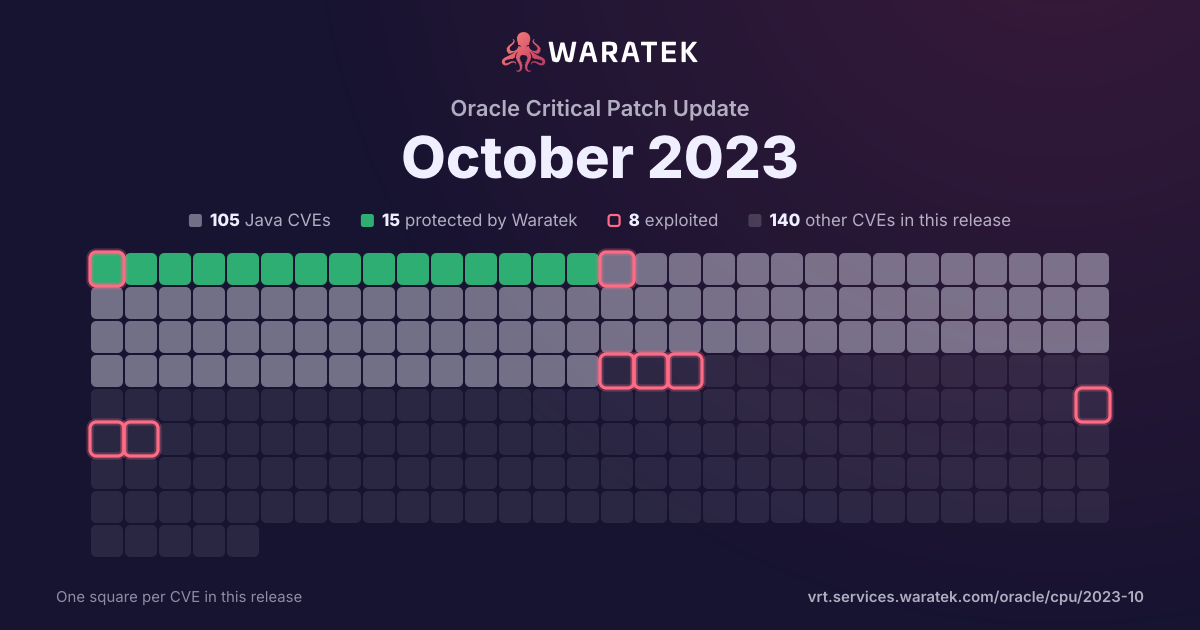
By status
15Protected by Waratek3Mitigation candidate87No exploit published44Outside Waratek scope96Not applicable
8Exploited, marked by the ring
No exploit published. For 35 of them, Oracle's security advisory is the source of public detail.
Protected by Waratek. Waratek RASP can block exploitation of these on systems that have not applied the patch yet.
Overview 245 matches · 105 in Waratek scope · 15 protected · 8 exploited · 1 CISA KEV · 16 public PoC · 12 EPSS ≥ 0.5
245matches
105in Waratek scope42.9%
15protected6.1%
8exploited3.3%
1CISA KEV0.4%
16public PoC6.5%
12EPSS ≥ 0.54.9%
Protected by Waratek
15
6.1%
Rule in development
0
0.0%
Mitigation candidate
3
1.2%
No exploit published
87
35.5%
Outside Waratek scope
44
18.0%
Not applicable
96
39.2%
Withdrawn CVE
0
0.0%
blocked by ARMR today
15
6.1%
partly blocked
0
0.0%
not blocked
229
93.5%
not established
1
0.4%
unrecorded
0
0.0%
Exploited
8
3.3%
Working exploit published
0
0.0%
Proof of concept only
47
19.2%
Forecast only
4
1.6%
No public exploit
186
75.9%
split by
peak 78 / quarter
Q2 191
Outside Waratek scope1
Medium1
not blocked1
Exploited1
Q3 191
Protected by Waratek1
High1
blocked by ARMR today1
No public exploit1
Q4 191
Outside Waratek scope1
High1
not blocked1
No public exploit1
Q1 201
No exploit published1
Critical1
not blocked1
No public exploit1
Q2 202
Outside Waratek scope2
Medium2
not blocked2
Exploited2
Q3 202
Outside Waratek scope2
High2
not blocked2
No public exploit2
Q4 202
No exploit published1
Outside Waratek scope1
High1
Medium1
not blocked2
No public exploit2
Q1 214
No exploit published3
Not applicable1
High2
Medium2
not blocked4
No public exploit4
Q2 211
No exploit published1
High1
not blocked1
Forecast only1
Q3 214
No exploit published4
High2
Medium2
not blocked4
No public exploit4
Q4 216
Protected by Waratek1
Outside Waratek scope3
Not applicable2
High3
Medium3
blocked by ARMR today1
not blocked5
Proof of concept only1
No public exploit5
Q1 224
No exploit published2
Outside Waratek scope1
Not applicable1
High3
Medium1
not blocked4
No public exploit4
Q2 2215
Protected by Waratek5
No exploit published3
Outside Waratek scope1
Not applicable6
Critical4
High8
Medium3
blocked by ARMR today5
not blocked10
Proof of concept only3
No public exploit12
Q3 228
Protected by Waratek2
Mitigation candidate1
No exploit published2
Outside Waratek scope1
Not applicable2
Critical3
High3
Medium2
blocked by ARMR today2
not blocked6
Proof of concept only7
No public exploit1
Q4 2221
Protected by Waratek3
No exploit published9
Outside Waratek scope2
Not applicable7
Critical3
High14
Medium3
Low1
blocked by ARMR today3
not blocked18
Exploited1
Proof of concept only8
No public exploit12
Q1 2329
No exploit published7
Not applicable22
Critical3
High15
Medium11
not blocked29
Exploited1
Proof of concept only9
Forecast only1
No public exploit18
Q2 2331
Protected by Waratek1
No exploit published14
Not applicable16
Critical2
High13
Medium16
blocked by ARMR today1
not blocked30
Proof of concept only7
Forecast only1
No public exploit23
Q3 2334
Protected by Waratek1
Mitigation candidate1
No exploit published10
Outside Waratek scope1
Not applicable21
Critical5
High13
Medium15
Low1
blocked by ARMR today1
not blocked33
Exploited2
Proof of concept only10
Forecast only1
No public exploit21
Q4 2378
Protected by Waratek1
Mitigation candidate1
No exploit published30
Outside Waratek scope28
Not applicable18
Critical4
High13
Medium55
Low6
blocked by ARMR today1
not blocked76
not established1
Exploited1
Proof of concept only2
No public exploit75
Q2 19Q4 19Q2 20Q4 20Q2 21Q4 21Q2 22Q4 22Q2 23Q4 23
| CVE | Severity | Published▾ | Status | Exploitation | Description |
|---|---|---|---|---|---|
| CVE-2023-34035 | High | 2023-07-18 | No exploit published | No public exploit | Spring Security versions 5.8 prior to 5.8.5, 6.0 prior to 6.0.5, and 6.1 prior to 6.1.2 could be susceptible to authorization rule misconfiguration if the application uses requestMatchers(String) and multiple servlets, one of them being Spring MVC’s DispatcherServlet. (DispatcherServlet is a Spring MVC component that maps HTTP endpoints to methods on @Controller-annotated classes.) Specifically, an application is vulnerable when all of the following are true: * Spring MVC is on the classpath * Spring Security is securing more than one servlet in a single application (one of them being Spring MVC’s DispatcherServlet) * The application uses requestMatchers(String) to refer to endpoints that are not Spring MVC endpoints An application is not vulnerable if any of the following is true: * The application does not have Spring MVC on the classpath * The application secures no servlets other than Spring MVC’s DispatcherServlet * The application uses requestMatchers(String) only for Spring MVC endpoints |
| CVE-2023-22043 | Medium | 2023-07-18 | Outside Waratek scope | No public exploit | Vulnerability in Oracle Java SE (component: JavaFX). The supported version that is affected is Oracle Java SE: 8u371. Difficult to exploit vulnerability allows unauthenticated attacker with network access via multiple protocols to compromise Oracle Java SE. Successful attacks of this vulnerability can result in unauthorized creation, deletion or modification access to critical data or all Oracle Java SE accessible data. Note: This vulnerability applies to Java deployments, typically in clients running sandboxed Java Web Start applications or sandboxed Java applets, that load and run untrusted code (e.g., code that comes from the internet) and rely on the Java sandbox for security. This vulnerability does not apply to Java deployments, typically in servers, that load and run only trusted code (e.g., code installed by an administrator). CVSS 3.1 Base Score 5.9 (Integrity impacts). CVSS Vector: (CVSS:3.1/AV:N/AC:H/PR:N/UI:N/S:U/C:N/I:H/A:N). |
| CVE-2022-41409 | High | 2023-07-18 | Not applicable | Proof of concept only | Integer overflow vulnerability in pcre2test before 10.41 allows attackers to cause a denial of service or other unspecified impacts via negative input. |
| CVE-2023-38325 | High | 2023-07-14 | Not applicable | Proof of concept only | The cryptography package before 41.0.2 for Python mishandles SSH certificates that have critical options. |
| CVE-2023-2975 | Medium | 2023-07-14 | Not applicable | No public exploit | Issue summary: The AES-SIV cipher implementation contains a bug that causes it to ignore empty associated data entries which are unauthenticated as a consequence. Impact summary: Applications that use the AES-SIV algorithm and want to authenticate empty data entries as associated data can be misled by removing, adding or reordering such empty entries as these are ignored by the OpenSSL implementation. We are currently unaware of any such applications. The AES-SIV algorithm allows for authentication of multiple associated data entries along with the encryption. To authenticate empty data the application has to call EVP_EncryptUpdate() (or EVP_CipherUpdate()) with NULL pointer as the output buffer and 0 as the input buffer length. The AES-SIV implementation in OpenSSL just returns success for such a call instead of performing the associated data authentication operation. The empty data thus will not be authenticated. As this issue does not affect non-empty associated data authentication and we expect it to be rare for an application to use empty associated data entries this is qualified as Low severity issue. |
| CVE-2022-24834 | High | 2023-07-13 | Not applicable | Proof of concept only | Redis is an in-memory database that persists on disk. A specially crafted Lua script executing in Redis can trigger a heap overflow in the cjson library, and result with heap corruption and potentially remote code execution. The problem exists in all versions of Redis with Lua scripting support, starting from 2.6, and affects only authenticated and authorized users. The problem is fixed in versions 7.0.12, 6.2.13, and 6.0.20. |
| CVE-2023-3635 | High | 2023-07-12 | No exploit published | No public exploit | GzipSource does not handle an exception that might be raised when parsing a malformed gzip buffer. This may lead to denial of service of the Okio client when handling a crafted GZIP archive, by using the GzipSource class. |
| CVE-2023-36824 | High | 2023-07-11 | Not applicable | Forecast only | Redis is an in-memory database that persists on disk. In Redit 7.0 prior to 7.0.12, extracting key names from a command and a list of arguments may, in some cases, trigger a heap overflow and result in reading random heap memory, heap corruption and potentially remote code execution. Several scenarios that may lead to authenticated users executing a specially crafted `COMMAND GETKEYS` or `COMMAND GETKEYSANDFLAGS`and authenticated users who were set with ACL rules that match key names, executing a specially crafted command that refers to a variadic list of key names. The vulnerability is patched in Redis 7.0.12. |
| CVE-2023-35887 | Medium | 2023-07-10 | Protected by Waratek | No public exploit | Exposure of Sensitive Information to an Unauthorized Actor vulnerability in Apache Software Foundation Apache MINA. In SFTP servers implemented using Apache MINA SSHD that use a RootedFileSystem, logged users may be able to discover "exists/does not exist" information about items outside the rooted tree via paths including parent navigation ("..") beyond the root, or involving symlinks. This issue affects Apache MINA: from 1.0 before 2.10. Users are recommended to upgrade to 2.10 |
| CVE-2023-35001 | High | 2023-07-05 | Not applicable | Proof of concept only | Linux Kernel nftables Out-Of-Bounds Read/Write Vulnerability; nft_byteorder poorly handled vm register contents when CAP_NET_ADMIN is in any user or network namespace |
| CVE-2023-33201 | Medium | 2023-07-05 | No exploit published | No public exploit | Bouncy Castle For Java before 1.74 is affected by an LDAP injection vulnerability. The vulnerability only affects applications that use an LDAP CertStore from Bouncy Castle to validate X.509 certificates. During the certificate validation process, Bouncy Castle inserts the certificate's Subject Name into an LDAP search filter without any escaping, which leads to an LDAP injection vulnerability. |
| CVE-2023-30589 | High | 2023-07-01 | Not applicable | No public exploit | The llhttp parser in the http module in Node v20.2.0 does not strictly use the CRLF sequence to delimit HTTP requests. This can lead to HTTP Request Smuggling (HRS). The CR character (without LF) is sufficient to delimit HTTP header fields in the llhttp parser. According to RFC7230 section 3, only the CRLF sequence should delimit each header-field. This impacts all Node.js active versions: v16, v18, and, v20 |
| CVE-2023-3390 | High | 2023-06-28 | Not applicable | No public exploit | A use-after-free vulnerability was found in the Linux kernel's netfilter subsystem in net/netfilter/nf_tables_api.c. Mishandled error handling with NFT_MSG_NEWRULE makes it possible to use a dangling pointer in the same transaction causing a use-after-free vulnerability. This flaw allows a local attacker with user access to cause a privilege escalation issue. We recommend upgrading past commit 1240eb93f0616b21c675416516ff3d74798fdc97 |
| CVE-2023-3090 | High | 2023-06-28 | Not applicable | Proof of concept only | A heap out-of-bounds write vulnerability in the Linux Kernel ipvlan network driver can be exploited to achieve local privilege escalation. The out-of-bounds write is caused by missing skb->cb initialization in the ipvlan network driver. The vulnerability is reachable if CONFIG_IPVLAN is enabled. We recommend upgrading past commit 90cbed5247439a966b645b34eb0a2e037836ea8e. |
| CVE-2023-34462 | Medium | 2023-06-22 | No exploit published | No public exploit | Netty is an asynchronous event-driven network application framework for rapid development of maintainable high performance protocol servers & clients. The `SniHandler` can allocate up to 16MB of heap for each channel during the TLS handshake. When the handler or the channel does not have an idle timeout, it can be used to make a TCP server using the `SniHandler` to allocate 16MB of heap. The `SniHandler` class is a handler that waits for the TLS handshake to configure a `SslHandler` according to the indicated server name by the `ClientHello` record. For this matter it allocates a `ByteBuf` using the value defined in the `ClientHello` record. Normally the value of the packet should be smaller than the handshake packet but there are not checks done here and the way the code is written, it is possible to craft a packet that makes the `SslClientHelloHandler`. This vulnerability has been fixed in version 4.1.94.Final. |
| CVE-2023-34981 | High | 2023-06-21 | No exploit published | No public exploit | A regression in the fix for bug 66512 in Apache Tomcat 11.0.0-M5, 10.1.8, 9.0.74 and 8.5.88 meant that, if a response did not include any HTTP headers no AJP SEND_HEADERS messare woudl be sent for the response which in turn meant that at least one AJP proxy (mod_proxy_ajp) would use the response headers from the previous request leading to an information leak. |
| CVE-2023-35788 | High | 2023-06-16 | Not applicable | Proof of concept only | An issue was discovered in fl_set_geneve_opt in net/sched/cls_flower.c in the Linux kernel before 6.3.7. It allows an out-of-bounds write in the flower classifier code via TCA_FLOWER_KEY_ENC_OPTS_GENEVE packets. This may result in denial of service or privilege escalation. |
| CVE-2023-35116 | Medium | 2023-06-14 | No exploit published | No public exploit | jackson-databind through 2.15.2 allows attackers to cause a denial of service or other unspecified impact via a crafted object that uses cyclic dependencies. NOTE: the vendor's perspective is that this is not a valid vulnerability report, because the steps of constructing a cyclic data structure and trying to serialize it cannot be achieved by an external attacker. |
| CVE-2023-34396 | High | 2023-06-14 | No exploit published | No public exploit | Allocation of Resources Without Limits or Throttling vulnerability in Apache Software Foundation Apache Struts.This issue affects Apache Struts: through 2.5.30, through 6.1.2. Upgrade to Struts 2.5.31 or 6.1.2.1 or greater |
| CVE-2023-34149 | Medium | 2023-06-14 | No exploit published | No public exploit | Allocation of Resources Without Limits or Throttling vulnerability in Apache Software Foundation Apache Struts.This issue affects Apache Struts: through 2.5.30, through 6.1.2. Upgrade to Struts 2.5.31 or 6.1.2.1 or greater. |
| CVE-2023-2976 | High | 2023-06-14 | No exploit published | No public exploit | Use of Java's default temporary directory for file creation in `FileBackedOutputStream` in Google Guava versions 1.0 to 31.1 on Unix systems and Android Ice Cream Sandwich allows other users and apps on the machine with access to the default Java temporary directory to be able to access the files created by the class. Even though the security vulnerability is fixed in version 32.0.0, we recommend using version 32.0.1 as version 32.0.0 breaks some functionality under Windows. |
| CVE-2023-2603 | High | 2023-06-06 | Not applicable | No public exploit | A vulnerability was found in libcap. This issue occurs in the _libcap_strdup() function and can lead to an integer overflow if the input string is close to 4GiB. |
| CVE-2023-2650 | Medium | 2023-05-30 | Not applicable | Forecast only | Issue summary: Processing some specially crafted ASN.1 object identifiers or data containing them may be very slow. Impact summary: Applications that use OBJ_obj2txt() directly, or use any of the OpenSSL subsystems OCSP, PKCS7/SMIME, CMS, CMP/CRMF or TS with no message size limit may experience notable to very long delays when processing those messages, which may lead to a Denial of Service. An OBJECT IDENTIFIER is composed of a series of numbers - sub-identifiers - most of which have no size limit. OBJ_obj2txt() may be used to translate an ASN.1 OBJECT IDENTIFIER given in DER encoding form (using the OpenSSL type ASN1_OBJECT) to its canonical numeric text form, which are the sub-identifiers of the OBJECT IDENTIFIER in decimal form, separated by periods. When one of the sub-identifiers in the OBJECT IDENTIFIER is very large (these are sizes that are seen as absurdly large, taking up tens or hundreds of KiBs), the translation to a decimal number in text may take a very long time. The time complexity is O(n^2) with 'n' being the size of the sub-identifiers in bytes (*). With OpenSSL 3.0, support to fetch cryptographic algorithms using names / identifiers in string form was introduced. This includes using OBJECT IDENTIFIERs in canonical numeric text form as identifiers for fetching algorithms. Such OBJECT IDENTIFIERs may be received through the ASN.1 structure AlgorithmIdentifier, which is commonly used in multiple protocols to specify what cryptographic algorithm should be used to sign or verify, encrypt or decrypt, or digest passed data. Applications that call OBJ_obj2txt() directly with untrusted data are affected, with any version of OpenSSL. If the use is for the mere purpose of display, the severity is considered low. In OpenSSL 3.0 and newer, this affects the subsystems OCSP, PKCS7/SMIME, CMS, CMP/CRMF or TS. It also impacts anything that processes X.509 certificates, including simple things like verifying its signature. The impact on TLS is relatively low, because all versions of OpenSSL have a 100KiB limit on the peer's certificate chain. Additionally, this only impacts clients, or servers that have explicitly enabled client authentication. In OpenSSL 1.1.1 and 1.0.2, this only affects displaying diverse objects, such as X.509 certificates. This is assumed to not happen in such a way that it would cause a Denial of Service, so these versions are considered not affected by this issue in such a way that it would be cause for concern, and the severity is therefore considered low. |
| CVE-2023-28322 | Medium | 2023-05-26 | Not applicable | Proof of concept only | An information disclosure vulnerability exists in curl <v8.1.0 when doing HTTP(S) transfers, libcurl might erroneously use the read callback (`CURLOPT_READFUNCTION`) to ask for data to send, even when the `CURLOPT_POSTFIELDS` option has been set, if the same handle previously wasused to issue a `PUT` request which used that callback. This flaw may surprise the application and cause it to misbehave and either send off the wrong data or use memory after free or similar in the second transfer. The problem exists in the logic for a reused handle when it is (expected to be) changed from a PUT to a POST. |
| CVE-2023-28321 | Medium | 2023-05-26 | Not applicable | Proof of concept only | An improper certificate validation vulnerability exists in curl <v8.1.0 in the way it supports matching of wildcard patterns when listed as "Subject Alternative Name" in TLS server certificates. curl can be built to use its own name matching function for TLS rather than one provided by a TLS library. This private wildcard matching function would match IDN (International Domain Name) hosts incorrectly and could as a result accept patterns that otherwise should mismatch. IDN hostnames are converted to puny code before used for certificate checks. Puny coded names always start with `xn--` and should not be allowed to pattern match, but the wildcard check in curl could still check for `x*`, which would match even though the IDN name most likely contained nothing even resembling an `x`. |
| CVE-2023-28320 | Medium | 2023-05-26 | Not applicable | Proof of concept only | A denial of service vulnerability exists in curl <v8.1.0 in the way libcurl provides several different backends for resolving host names, selected at build time. If it is built to use the synchronous resolver, it allows name resolves to time-out slow operations using `alarm()` and `siglongjmp()`. When doing this, libcurl used a global buffer that was not mutex protected and a multi-threaded application might therefore crash or otherwise misbehave. |
| CVE-2023-28319 | High | 2023-05-26 | Not applicable | Proof of concept only | A use after free vulnerability exists in curl <v8.1.0 in the way libcurl offers a feature to verify an SSH server's public key using a SHA 256 hash. When this check fails, libcurl would free the memory for the fingerprint before it returns an error message containing the (now freed) hash. This flaw risks inserting sensitive heap-based data into the error message that might be shown to users or otherwise get leaked and revealed. |
| CVE-2023-2283 | Medium | 2023-05-26 | Not applicable | No public exploit | A vulnerability was found in libssh, where the authentication check of the connecting client can be bypassed in the`pki_verify_data_signature` function in memory allocation problems. This issue may happen if there is insufficient memory or the memory usage is limited. The problem is caused by the return value `rc,` which is initialized to SSH_ERROR and later rewritten to save the return value of the function call `pki_key_check_hash_compatible.` The value of the variable is not changed between this point and the cryptographic verification. Therefore any error between them calls `goto error` returning SSH_OK. |
| CVE-2023-20883 | High | 2023-05-26 | No exploit published | No public exploit | In Spring Boot versions 3.0.0 - 3.0.6, 2.7.0 - 2.7.11, 2.6.0 - 2.6.14, 2.5.0 - 2.5.14 and older unsupported versions, there is potential for a denial-of-service (DoS) attack if Spring MVC is used together with a reverse proxy cache. |
| CVE-2023-2002 | Medium | 2023-05-26 | Not applicable | Proof of concept only | A vulnerability was found in the HCI sockets implementation due to a missing capability check in net/bluetooth/hci_sock.c in the Linux Kernel. This flaw allows an attacker to unauthorized execution of management commands, compromising the confidentiality, integrity, and availability of Bluetooth communication. |
| CVE-2023-28709 | High | 2023-05-22 | No exploit published | No public exploit | The fix for CVE-2023-24998 was incomplete for Apache Tomcat 11.0.0-M2 to 11.0.0-M4, 10.1.5 to 10.1.7, 9.0.71 to 9.0.73 and 8.5.85 to 8.5.87. If non-default HTTP connector settings were used such that the maxParameterCount could be reached using query string parameters and a request was submitted that supplied exactly maxParameterCount parameters in the query string, the limit for uploaded request parts could be bypassed with the potential for a denial of service to occur. |
| CVE-2023-30861 | High | 2023-05-02 | Not applicable | No public exploit | Flask is a lightweight WSGI web application framework. When all of the following conditions are met, a response containing data intended for one client may be cached and subsequently sent by the proxy to other clients. If the proxy also caches `Set-Cookie` headers, it may send one client's `session` cookie to other clients. The severity depends on the application's use of the session and the proxy's behavior regarding cookies. The risk depends on all these conditions being met. 1. The application must be hosted behind a caching proxy that does not strip cookies or ignore responses with cookies. 2. The application sets `session.permanent = True` 3. The application does not access or modify the session at any point during a request. 4. `SESSION_REFRESH_EACH_REQUEST` enabled (the default). 5. The application does not set a `Cache-Control` header to indicate that a page is private or should not be cached. This happens because vulnerable versions of Flask only set the `Vary: Cookie` header when the session is accessed or modified, not when it is refreshed (re-sent to update the expiration) without being accessed or modified. This issue has been fixed in versions 2.3.2 and 2.2.5. |
| CVE-2023-29469 | Medium | 2023-04-24 | Not applicable | No public exploit | An issue was discovered in libxml2 before 2.10.4. When hashing empty dict strings in a crafted XML document, xmlDictComputeFastKey in dict.c can produce non-deterministic values, leading to various logic and memory errors, such as a double free. This behavior occurs because there is an attempt to use the first byte of an empty string, and any value is possible (not solely the '\0' value). |
| CVE-2023-28484 | Medium | 2023-04-24 | Not applicable | No public exploit | In libxml2 before 2.10.4, parsing of certain invalid XSD schemas can lead to a NULL pointer dereference and subsequently a segfault. This occurs in xmlSchemaFixupComplexType in xmlschemas.c. |
| CVE-2023-20873 | Critical | 2023-04-20 | No exploit published | No public exploit | In Spring Boot versions 3.0.0 - 3.0.5, 2.7.0 - 2.7.10, and older unsupported versions, an application that is deployed to Cloud Foundry could be susceptible to a security bypass. Users of affected versions should apply the following mitigation: 3.0.x users should upgrade to 3.0.6+. 2.7.x users should upgrade to 2.7.11+. Users of older, unsupported versions should upgrade to 3.0.6+ or 2.7.11+. |
| CVE-2023-1255 | Medium | 2023-04-20 | Not applicable | No public exploit | Issue summary: The AES-XTS cipher decryption implementation for 64 bit ARM platform contains a bug that could cause it to read past the input buffer, leading to a crash. Impact summary: Applications that use the AES-XTS algorithm on the 64 bit ARM platform can crash in rare circumstances. The AES-XTS algorithm is usually used for disk encryption. The AES-XTS cipher decryption implementation for 64 bit ARM platform will read past the end of the ciphertext buffer if the ciphertext size is 4 mod 5 in 16 byte blocks, e.g. 144 bytes or 1024 bytes. If the memory after the ciphertext buffer is unmapped, this will trigger a crash which results in a denial of service. If an attacker can control the size and location of the ciphertext buffer being decrypted by an application using AES-XTS on 64 bit ARM, the application is affected. This is fairly unlikely making this issue a Low severity one. |
| CVE-2023-20862 | Medium | 2023-04-19 | No exploit published | No public exploit | In Spring Security, versions 5.7.x prior to 5.7.8, versions 5.8.x prior to 5.8.3, and versions 6.0.x prior to 6.0.3, the logout support does not properly clean the security context if using serialized versions. Additionally, it is not possible to explicitly save an empty security context to the HttpSessionSecurityContextRepository. This vulnerability can keep users authenticated even after they performed logout. Users of affected versions should apply the following mitigation. 5.7.x users should upgrade to 5.7.8. 5.8.x users should upgrade to 5.8.3. 6.0.x users should upgrade to 6.0.3. |
| CVE-2023-26049 | Medium | 2023-04-18 | No exploit published | No public exploit | Jetty is a java based web server and servlet engine. Nonstandard cookie parsing in Jetty may allow an attacker to smuggle cookies within other cookies, or otherwise perform unintended behavior by tampering with the cookie parsing mechanism. If Jetty sees a cookie VALUE that starts with `"` (double quote), it will continue to read the cookie string until it sees a closing quote -- even if a semicolon is encountered. So, a cookie header such as: `DISPLAY_LANGUAGE="b; JSESSIONID=1337; c=d"` will be parsed as one cookie, with the name DISPLAY_LANGUAGE and a value of b; JSESSIONID=1337; c=d instead of 3 separate cookies. This has security implications because if, say, JSESSIONID is an HttpOnly cookie, and the DISPLAY_LANGUAGE cookie value is rendered on the page, an attacker can smuggle the JSESSIONID cookie into the DISPLAY_LANGUAGE cookie and thereby exfiltrate it. This is significant when an intermediary is enacting some policy based on cookies, so a smuggled cookie can bypass that policy yet still be seen by the Jetty server or its logging system. This issue has been addressed in versions 9.4.51, 10.0.14, 11.0.14, and 12.0.0.beta0 and users are advised to upgrade. There are no known workarounds for this issue. |
| CVE-2023-26048 | Medium | 2023-04-18 | No exploit published | No public exploit | Jetty is a java based web server and servlet engine. In affected versions servlets with multipart support (e.g. annotated with `@MultipartConfig`) that call `HttpServletRequest.getParameter()` or `HttpServletRequest.getParts()` may cause `OutOfMemoryError` when the client sends a multipart request with a part that has a name but no filename and very large content. This happens even with the default settings of `fileSizeThreshold=0` which should stream the whole part content to disk. An attacker client may send a large multipart request and cause the server to throw `OutOfMemoryError`. However, the server may be able to recover after the `OutOfMemoryError` and continue its service -- although it may take some time. This issue has been patched in versions 9.4.51, 10.0.14, and 11.0.14. Users are advised to upgrade. Users unable to upgrade may set the multipart parameter `maxRequestSize` which must be set to a non-negative value, so the whole multipart content is limited (although still read into memory). |
| CVE-2023-22946 | Critical | 2023-04-17 | No exploit published | No public exploit | In Apache Spark versions prior to 3.4.0, applications using spark-submit can specify a 'proxy-user' to run as, limiting privileges. The application can execute code with the privileges of the submitting user, however, by providing malicious configuration-related classes on the classpath. This affects architectures relying on proxy-user, for example those using Apache Livy to manage submitted applications. Update to Apache Spark 3.4.0 or later, and ensure that spark.submit.proxyUser.allowCustomClasspathInClusterMode is set to its default of "false", and is not overridden by submitted applications. |
| CVE-2023-30535 | High | 2023-04-14 | Protected by Waratek | No public exploit | Snowflake JDBC provides a JDBC type 4 driver that supports core functionality, allowing Java program to connect to Snowflake. Users of the Snowflake JDBC driver were vulnerable to a command injection vulnerability. An attacker could set up a malicious, publicly accessible server which responds to the SSO URL with an attack payload. If the attacker then tricked a user into visiting the maliciously crafted connection URL, the user’s local machine would render the malicious payload, leading to a remote code execution. The vulnerability was patched on March 17, 2023 as part of Snowflake JDBC driver Version 3.13.29. All users should immediately upgrade the Snowflake JDBC driver to the latest version: 3.13.29. |
| CVE-2023-29491 | High | 2023-04-14 | Not applicable | No public exploit | ncurses before 6.4 20230408, when used by a setuid application, allows local users to trigger security-relevant memory corruption via malformed data in a terminfo database file that is found in $HOME/.terminfo or reached via the TERMINFO or TERM environment variable. |
| CVE-2023-20863 | Medium | 2023-04-13 | No exploit published | No public exploit | In spring framework versions prior to 5.2.24 release+ ,5.3.27+ and 6.0.8+ , it is possible for a user to provide a specially crafted SpEL expression that may cause a denial-of-service (DoS) condition. |
| CVE-2022-4899 | High | 2023-03-31 | Not applicable | No public exploit | A vulnerability was found in zstd v1.4.10, where an attacker can supply empty string as an argument to the command line tool to cause buffer overrun. |
| CVE-2023-27534 | High | 2023-03-30 | Not applicable | Proof of concept only | A path traversal vulnerability exists in curl <8.0.0 SFTP implementation causes the tilde (~) character to be wrongly replaced when used as a prefix in the first path element, in addition to its intended use as the first element to indicate a path relative to the user's home directory. Attackers can exploit this flaw to bypass filtering or execute arbitrary code by crafting a path like /~2/foo while accessing a server with a specific user. |
| CVE-2023-27533 | Critical | 2023-03-30 | Not applicable | Proof of concept only | A vulnerability in input validation exists in curl <8.0 during communication using the TELNET protocol may allow an attacker to pass on maliciously crafted user name and "telnet options" during server negotiation. The lack of proper input scrubbing allows an attacker to send content or perform option negotiation without the application's intent. This vulnerability could be exploited if an application allows user input, thereby enabling attackers to execute arbitrary code on the system. |
| CVE-2023-0466 | Medium | 2023-03-28 | Not applicable | No public exploit | The function X509_VERIFY_PARAM_add0_policy() is documented to implicitly enable the certificate policy check when doing certificate verification. However the implementation of the function does not enable the check which allows certificates with invalid or incorrect policies to pass the certificate verification. As suddenly enabling the policy check could break existing deployments it was decided to keep the existing behavior of the X509_VERIFY_PARAM_add0_policy() function. Instead the applications that require OpenSSL to perform certificate policy check need to use X509_VERIFY_PARAM_set1_policies() or explicitly enable the policy check by calling X509_VERIFY_PARAM_set_flags() with the X509_V_FLAG_POLICY_CHECK flag argument. Certificate policy checks are disabled by default in OpenSSL and are not commonly used by applications. |
| CVE-2023-0465 | Medium | 2023-03-28 | Not applicable | No public exploit | Applications that use a non-default option when verifying certificates may be vulnerable to an attack from a malicious CA to circumvent certain checks. Invalid certificate policies in leaf certificates are silently ignored by OpenSSL and other certificate policy checks are skipped for that certificate. A malicious CA could use this to deliberately assert invalid certificate policies in order to circumvent policy checking on the certificate altogether. Policy processing is disabled by default but can be enabled by passing the `-policy' argument to the command line utilities or by calling the `X509_VERIFY_PARAM_set1_policies()' function. |
| CVE-2023-20860 | High | 2023-03-27 | No exploit published | No public exploit | Spring Framework running version 6.0.0 - 6.0.6 or 5.3.0 - 5.3.25 using "**" as a pattern in Spring Security configuration with the mvcRequestMatcher creates a mismatch in pattern matching between Spring Security and Spring MVC, and the potential for a security bypass. |
| CVE-2023-20861 | Medium | 2023-03-23 | No exploit published | No public exploit | In Spring Framework versions 6.0.0 - 6.0.6, 5.3.0 - 5.3.25, 5.2.0.RELEASE - 5.2.22.RELEASE, and older unsupported versions, it is possible for a user to provide a specially crafted SpEL expression that may cause a denial-of-service (DoS) condition. |
| CVE-2023-28708 | Medium | 2023-03-22 | No exploit published | No public exploit | When using the RemoteIpFilter with requests received from a reverse proxy via HTTP that include the X-Forwarded-Proto header set to https, session cookies created by Apache Tomcat 11.0.0-M1 to 11.0.0.-M2, 10.1.0-M1 to 10.1.5, 9.0.0-M1 to 9.0.71 and 8.5.0 to 8.5.85 did not include the secure attribute. This could result in the user agent transmitting the session cookie over an insecure channel. Older, EOL versions may also be affected. |
| CVE-2023-28439 | Medium | 2023-03-22 | Not applicable | No public exploit | CKEditor4 is an open source what-you-see-is-what-you-get HTML editor. A cross-site scripting vulnerability has been discovered affecting Iframe Dialog and Media Embed packages. The vulnerability may trigger a JavaScript code after fulfilling special conditions: using one of the affected packages on a web page with missing proper Content Security Policy configuration; initializing the editor on an element and using an element other than `<textarea>` as a base; and destroying the editor instance. This vulnerability might affect a small percentage of integrators that depend on dynamic editor initialization/destroy mechanism. A fix is available in CKEditor4 version 4.21.0. In some rare cases, a security fix may be considered a breaking change. Starting from version 4.21.0, the Iframe Dialog plugin applies the `sandbox` attribute by default, which restricts JavaScript code execution in the iframe element. To change this behavior, configure the `config.iframe_attributes` option. Also starting from version 4.21.0, the Media Embed plugin regenerates the entire content of the embed widget by default. To change this behavior, configure the `config.embed_keepOriginalContent` option. Those who choose to enable either of the more permissive options or who cannot upgrade to a patched version should properly configure Content Security Policy to avoid any potential security issues that may arise from embedding iframe elements on their web page. |
| CVE-2023-1436 | High | 2023-03-22 | No exploit published | Proof of concept only | An infinite recursion is triggered in Jettison when constructing a JSONArray from a Collection that contains a self-reference in one of its elements. This leads to a StackOverflowError exception being thrown. |
| CVE-2023-1370 | High | 2023-03-22 | No exploit published | Proof of concept only | [Json-smart](https://netplex.github.io/json-smart/) is a performance focused, JSON processor lib. When reaching a ‘[‘ or ‘{‘ character in the JSON input, the code parses an array or an object respectively. It was discovered that the code does not have any limit to the nesting of such arrays or objects. Since the parsing of nested arrays and objects is done recursively, nesting too many of them can cause a stack exhaustion (stack overflow) and crash the software. |
| CVE-2023-0464 | High | 2023-03-22 | Not applicable | No public exploit | A security vulnerability has been identified in all supported versions of OpenSSL related to the verification of X.509 certificate chains that include policy constraints. Attackers may be able to exploit this vulnerability by creating a malicious certificate chain that triggers exponential use of computational resources, leading to a denial-of-service (DoS) attack on affected systems. Policy processing is disabled by default but can be enabled by passing the `-policy' argument to the command line utilities or by calling the `X509_VERIFY_PARAM_set1_policies()' function. |
| CVE-2023-27522 | High | 2023-03-07 | Not applicable | No public exploit | HTTP Response Smuggling vulnerability in Apache HTTP Server via mod_proxy_uwsgi. This issue affects Apache HTTP Server: from 2.4.30 through 2.4.55. Special characters in the origin response header can truncate/split the response forwarded to the client. |
| CVE-2023-25690 | Critical | 2023-03-07 | Not applicable | Exploited | Some mod_proxy configurations on Apache HTTP Server versions 2.4.0 through 2.4.55 allow a HTTP Request Smuggling attack. Configurations are affected when mod_proxy is enabled along with some form of RewriteRule or ProxyPassMatch in which a non-specific pattern matches some portion of the user-supplied request-target (URL) data and is then re-inserted into the proxied request-target using variable substitution. For example, something like: RewriteEngine on RewriteRule "^/here/(.*)" "http://example.com:8080/elsewhere?$1"; [P] ProxyPassReverse /here/ http://example.com:8080/ Request splitting/smuggling could result in bypass of access controls in the proxy server, proxying unintended URLs to existing origin servers, and cache poisoning. Users are recommended to update to at least version 2.4.56 of Apache HTTP Server. |
| CVE-2023-26604 | High | 2023-03-03 | Not applicable | Proof of concept only | systemd before 247 does not adequately block local privilege escalation for some Sudo configurations, e.g., plausible sudoers files in which the "systemctl status" command may be executed. Specifically, systemd does not set LESSSECURE to 1, and thus other programs may be launched from the less program. This presents a substantial security risk when running systemctl from Sudo, because less executes as root when the terminal size is too small to show the complete systemctl output. |
| CVE-2023-0567 | High | 2023-03-01 | Not applicable | No public exploit | In PHP 8.0.X before 8.0.28, 8.1.X before 8.1.16 and 8.2.X before 8.2.3, password_verify() function may accept some invalid Blowfish hashes as valid. If such invalid hash ever ends up in the password database, it may lead to an application allowing any password for this entry as valid. |
| CVE-2023-23916 | Medium | 2023-02-23 | Not applicable | Proof of concept only | An allocation of resources without limits or throttling vulnerability exists in curl <v7.88.0 based on the "chained" HTTP compression algorithms, meaning that a server response can be compressed multiple times and potentially with differentalgorithms. The number of acceptable "links" in this "decompression chain" wascapped, but the cap was implemented on a per-header basis allowing a maliciousserver to insert a virtually unlimited number of compression steps simply byusing many headers. The use of such a decompression chain could result in a "malloc bomb", making curl end up spending enormous amounts of allocated heap memory, or trying to and returning out of memory errors. |
| CVE-2023-23915 | Medium | 2023-02-23 | Not applicable | No public exploit | A cleartext transmission of sensitive information vulnerability exists in curl <v7.88.0 that could cause HSTS functionality to behave incorrectly when multiple URLs are requested in parallel. Using its HSTS support, curl can be instructed to use HTTPS instead of using an insecure clear-text HTTP step even when HTTP is provided in the URL. This HSTS mechanism would however surprisingly fail when multiple transfers are done in parallel as the HSTS cache file gets overwritten by the most recentlycompleted transfer. A later HTTP-only transfer to the earlier host name would then *not* get upgraded properly to HSTS. |
| CVE-2023-23914 | Critical | 2023-02-23 | Not applicable | Proof of concept only | A cleartext transmission of sensitive information vulnerability exists in curl <v7.88.0 that could cause HSTS functionality fail when multiple URLs are requested serially. Using its HSTS support, curl can be instructed to use HTTPS instead of usingan insecure clear-text HTTP step even when HTTP is provided in the URL. ThisHSTS mechanism would however surprisingly be ignored by subsequent transferswhen done on the same command line because the state would not be properlycarried on. |
| CVE-2022-4492 | High | 2023-02-23 | No exploit published | No public exploit | The undertow client is not checking the server identity presented by the server certificate in https connections. This is a compulsory step (at least it should be performed by default) in https and in http/2. I would add it to any TLS client protocol. |
| CVE-2023-24998 | High | 2023-02-20 | No exploit published | No public exploit | Apache Commons FileUpload before 1.5 does not limit the number of request parts to be processed resulting in the possibility of an attacker triggering a DoS with a malicious upload or series of uploads. Note that, like all of the file upload limits, the new configuration option (FileUploadBase#setFileCountMax) is not enabled by default and must be explicitly configured. |
| CVE-2023-0662 | High | 2023-02-16 | Not applicable | No public exploit | In PHP 8.0.X before 8.0.28, 8.1.X before 8.1.16 and 8.2.X before 8.2.3, excessive number of parts in HTTP form upload can cause high resource consumption and excessive number of log entries. This can cause denial of service on the affected server by exhausting CPU resources or disk space. |
| CVE-2023-0568 | High | 2023-02-16 | Not applicable | No public exploit | In PHP 8.0.X before 8.0.28, 8.1.X before 8.1.16 and 8.2.X before 8.2.3, core path resolution function allocate buffer one byte too small. When resolving paths with lengths close to system MAXPATHLEN setting, this may lead to the byte after the allocated buffer being overwritten with NUL value, which might lead to unauthorized data access or modification. |
| CVE-2023-0361 | High | 2023-02-15 | Not applicable | Proof of concept only | A timing side-channel in the handling of RSA ClientKeyExchange messages was discovered in GnuTLS. This side-channel can be sufficient to recover the key encrypted in the RSA ciphertext across a network in a Bleichenbacher style attack. To achieve a successful decryption the attacker would need to send a large amount of specially crafted messages to the vulnerable server. By recovering the secret from the ClientKeyExchange message, the attacker would be able to decrypt the application data exchanged over that connection. |
| CVE-2023-23931 | Medium | 2023-02-07 | Not applicable | Proof of concept only | cryptography is a package designed to expose cryptographic primitives and recipes to Python developers. In affected versions `Cipher.update_into` would accept Python objects which implement the buffer protocol, but provide only immutable buffers. This would allow immutable objects (such as `bytes`) to be mutated, thus violating fundamental rules of Python and resulting in corrupted output. This now correctly raises an exception. This issue has been present since `update_into` was originally introduced in cryptography 1.8. |
| CVE-2022-25147 | Medium | 2023-01-31 | Not applicable | No public exploit | Integer Overflow or Wraparound vulnerability in apr_base64 functions of Apache Portable Runtime Utility (APR-util) allows an attacker to write beyond bounds of a buffer. This issue affects Apache Portable Runtime Utility (APR-util) 1.6.1 and prior versions. |
| CVE-2022-48285 | High | 2023-01-29 | Not applicable | No public exploit | loadAsync in JSZip before 3.8.0 allows Directory Traversal via a crafted ZIP archive. |
| CVE-2023-21829 | Medium | 2023-01-18 | Not applicable | No public exploit | Vulnerability in the Oracle Database RDBMS Security component of Oracle Database Server. Supported versions that are affected are 19c and 21c. Easily exploitable vulnerability allows low privileged attacker having Create Session privilege with network access via Oracle Net to compromise Oracle Database RDBMS Security. Successful attacks require human interaction from a person other than the attacker. Successful attacks of this vulnerability can result in unauthorized creation, deletion or modification access to critical data or all Oracle Database RDBMS Security accessible data as well as unauthorized read access to a subset of Oracle Database RDBMS Security accessible data. CVSS 3.1 Base Score 6.3 (Confidentiality and Integrity impacts). CVSS Vector: (CVSS:3.1/AV:N/AC:L/PR:L/UI:R/S:U/C:L/I:H/A:N). |
| CVE-2022-37436 | Medium | 2023-01-17 | Not applicable | Forecast only | Prior to Apache HTTP Server 2.4.55, a malicious backend can cause the response headers to be truncated early, resulting in some headers being incorporated into the response body. If the later headers have any security purpose, they will not be interpreted by the client. |
| CVE-2022-41966 | High | 2022-12-28 | No exploit published | Proof of concept only | XStream serializes Java objects to XML and back again. Versions prior to 1.4.20 may allow a remote attacker to terminate the application with a stack overflow error, resulting in a denial of service only via manipulation the processed input stream. The attack uses the hash code implementation for collections and maps to force recursive hash calculation causing a stack overflow. This issue is patched in version 1.4.20 which handles the stack overflow and raises an InputManipulationException instead. A potential workaround for users who only use HashMap or HashSet and whose XML refers these only as default map or set, is to change the default implementation of java.util.Map and java.util per the code example in the referenced advisory. However, this implies that your application does not care about the implementation of the map and all elements are comparable. |
| CVE-2022-42898 | High | 2022-12-25 | Not applicable | No public exploit | PAC parsing in MIT Kerberos 5 (aka krb5) before 1.19.4 and 1.20.x before 1.20.1 has integer overflows that may lead to remote code execution (in KDC, kadmind, or a GSS or Kerberos application server) on 32-bit platforms (which have a resultant heap-based buffer overflow), and cause a denial of service on other platforms. This occurs in krb5_pac_parse in lib/krb5/krb/pac.c. Heimdal before 7.7.1 has "a similar bug." |
| CVE-2022-43551 | High | 2022-12-23 | Outside Waratek scope | Proof of concept only | A vulnerability exists in curl <7.87.0 HSTS check that could be bypassed to trick it to keep using HTTP. Using its HSTS support, curl can be instructed to use HTTPS instead of using an insecure clear-text HTTP step even when HTTP is provided in the URL. However, the HSTS mechanism could be bypassed if the host name in the given URL first uses IDN characters that get replaced to ASCII counterparts as part of the IDN conversion. Like using the character UTF-8 U+3002 (IDEOGRAPHIC FULL STOP) instead of the common ASCII full stop (U+002E) `.`. Then in a subsequent request, it does not detect the HSTS state and makes a clear text transfer. Because it would store the info IDN encoded but look for it IDN decoded. |
| CVE-2022-40897 | Medium | 2022-12-23 | Not applicable | No public exploit | Python Packaging Authority (PyPA) setuptools before 65.5.1 allows remote attackers to cause a denial of service via HTML in a crafted package or custom PackageIndex page. There is a Regular Expression Denial of Service (ReDoS) in package_index.py. |
| CVE-2022-45690 | High | 2022-12-13 | No exploit published | Proof of concept only | A stack overflow in the org.json.JSONTokener.nextValue::JSONTokener.java component of hutool-json v5.8.10 allows attackers to cause a Denial of Service (DoS) via crafted JSON or XML data. |
| CVE-2022-45688 | High | 2022-12-13 | No exploit published | Proof of concept only | A stack overflow in the XML.toJSONObject component of hutool-json v5.8.10 allows attackers to cause a Denial of Service (DoS) via crafted JSON or XML data. |
| CVE-2022-41915 | Medium | 2022-12-13 | No exploit published | Proof of concept only | Netty project is an event-driven asynchronous network application framework. Starting in version 4.1.83.Final and prior to 4.1.86.Final, when calling `DefaultHttpHeadesr.set` with an _iterator_ of values, header value validation was not performed, allowing malicious header values in the iterator to perform HTTP Response Splitting. This issue has been patched in version 4.1.86.Final. Integrators can work around the issue by changing the `DefaultHttpHeaders.set(CharSequence, Iterator<?>)` call, into a `remove()` call, and call `add()` in a loop over the iterator of values. |
| CVE-2022-41881 | High | 2022-12-12 | No exploit published | Proof of concept only | Netty project is an event-driven asynchronous network application framework. In versions prior to 4.1.86.Final, a StackOverflowError can be raised when parsing a malformed crafted message due to an infinite recursion. This issue is patched in version 4.1.86.Final. There is no workaround, except using a custom HaProxyMessageDecoder. |
| CVE-2022-23491 | High | 2022-12-07 | Outside Waratek scope | No public exploit | Certifi is a curated collection of Root Certificates for validating the trustworthiness of SSL certificates while verifying the identity of TLS hosts. Certifi 2022.12.07 removes root certificates from "TrustCor" from the root store. These are in the process of being removed from Mozilla's trust store. TrustCor's root certificates are being removed pursuant to an investigation prompted by media reporting that TrustCor's ownership also operated a business that produced spyware. Conclusions of Mozilla's investigation can be found in the linked google group discussion. |
| CVE-2021-37533 | Medium | 2022-12-03 | No exploit published | No public exploit | Prior to Apache Commons Net 3.9.0, Net's FTP client trusts the host from PASV response by default. A malicious server can redirect the Commons Net code to use a different host, but the user has to connect to the malicious server in the first place. This may lead to leakage of information about services running on the private network of the client. The default in version 3.9.0 is now false to ignore such hosts, as cURL does. See https://issues.apache.org/jira/browse/NET-711. |
| CVE-2022-1471 | Critical | 2022-12-01 | Protected by Waratek | Exploited | SnakeYaml's Constructor() class does not restrict types which can be instantiated during deserialization. Deserializing yaml content provided by an attacker can lead to remote code execution. We recommend using SnakeYaml's SafeConsturctor when parsing untrusted content to restrict deserialization. We recommend upgrading to version 2.0 and beyond. |
| CVE-2022-41954 | Low | 2022-11-25 | No exploit published | No public exploit | MPXJ is an open source library to read and write project plans from a variety of file formats and databases. On Unix-like operating systems (not Windows or macos), MPXJ's use of `File.createTempFile(..)` results in temporary files being created with the permissions `-rw-r--r--`. This means that any other user on the system can read the contents of this file. When MPXJ is reading a schedule file which requires the creation of a temporary file or directory, a knowledgeable local user could locate these transient files while they are in use and would then be able to read the schedule being processed by MPXJ. The problem has been patched, MPXJ version 10.14.1 and later includes the necessary changes. Users unable to upgrade may set `java.io.tmpdir` to a directory to which only the user running the application has access will prevent other users from accessing these temporary files. |
| CVE-2022-45061 | High | 2022-11-09 | Not applicable | Proof of concept only | An issue was discovered in Python before 3.11.1. An unnecessary quadratic algorithm exists in one path when processing some inputs to the IDNA (RFC 3490) decoder, such that a crafted, unreasonably long name being presented to the decoder could lead to a CPU denial of service. Hostnames are often supplied by remote servers that could be controlled by a malicious actor; in such a scenario, they could trigger excessive CPU consumption on the client attempting to make use of an attacker-supplied supposed hostname. For example, the attack payload could be placed in the Location header of an HTTP response with status code 302. A fix is planned in 3.11.1, 3.10.9, 3.9.16, 3.8.16, and 3.7.16. |
| CVE-2022-42920 | Critical | 2022-11-07 | Protected by Waratek | No public exploit | Apache Commons BCEL has a number of APIs that would normally only allow changing specific class characteristics. However, due to an out-of-bounds writing issue, these APIs can be used to produce arbitrary bytecode. This could be abused in applications that pass attacker-controllable data to those APIs, giving the attacker more control over the resulting bytecode than otherwise expected. Update to Apache Commons BCEL 6.6.0. |
| CVE-2022-42919 | High | 2022-11-07 | Not applicable | No public exploit | Python 3.9.x before 3.9.16 and 3.10.x before 3.10.9 on Linux allows local privilege escalation in a non-default configuration. The Python multiprocessing library, when used with the forkserver start method on Linux, allows pickles to be deserialized from any user in the same machine local network namespace, which in many system configurations means any user on the same machine. Pickles can execute arbitrary code. Thus, this allows for local user privilege escalation to the user that any forkserver process is running as. Setting multiprocessing.util.abstract_sockets_supported to False is a workaround. The forkserver start method for multiprocessing is not the default start method. This issue is Linux specific because only Linux supports abstract namespace sockets. CPython before 3.9 does not make use of Linux abstract namespace sockets by default. Support for users manually specifying an abstract namespace socket was added as a bugfix in 3.7.8 and 3.8.3, but users would need to make specific uncommon API calls in order to do that in CPython before 3.9. |
| CVE-2022-42915 | High | 2022-10-29 | Not applicable | No public exploit | curl before 7.86.0 has a double free. If curl is told to use an HTTP proxy for a transfer with a non-HTTP(S) URL, it sets up the connection to the remote server by issuing a CONNECT request to the proxy, and then tunnels the rest of the protocol through. An HTTP proxy might refuse this request (HTTP proxies often only allow outgoing connections to specific port numbers, like 443 for HTTPS) and instead return a non-200 status code to the client. Due to flaws in the error/cleanup handling, this could trigger a double free in curl if one of the following schemes were used in the URL for the transfer: dict, gopher, gophers, ldap, ldaps, rtmp, rtmps, or telnet. The earliest affected version is 7.77.0. |
| CVE-2022-43680 | High | 2022-10-24 | Not applicable | No public exploit | In libexpat through 2.4.9, there is a use-after free caused by overeager destruction of a shared DTD in XML_ExternalEntityParserCreate in out-of-memory situations. |
| CVE-2022-37454 | Critical | 2022-10-21 | Not applicable | Proof of concept only | The Keccak XKCP SHA-3 reference implementation before fdc6fef has an integer overflow and resultant buffer overflow that allows attackers to execute arbitrary code or eliminate expected cryptographic properties. This occurs in the sponge function interface. |
| CVE-2022-3171 | High | 2022-10-12 | No exploit published | No public exploit | A parsing issue with binary data in protobuf-java core and lite versions prior to 3.21.7, 3.20.3, 3.19.6 and 3.16.3 can lead to a denial of service attack. Inputs containing multiple instances of non-repeated embedded messages with repeated or unknown fields causes objects to be converted back-n-forth between mutable and immutable forms, resulting in potentially long garbage collection pauses. We recommend updating to the versions mentioned above. |
| CVE-2022-42004 | High | 2022-10-02 | Protected by Waratek | No public exploit | In FasterXML jackson-databind before 2.13.4, resource exhaustion can occur because of a lack of a check in BeanDeserializer._deserializeFromArray to prevent use of deeply nested arrays. An application is vulnerable only with certain customized choices for deserialization. |
| CVE-2022-42003 | High | 2022-10-02 | No exploit published | No public exploit | In FasterXML jackson-databind before versions 2.13.4.1 and 2.12.17.1, resource exhaustion can occur because of a lack of a check in primitive value deserializers to avoid deep wrapper array nesting, when the UNWRAP_SINGLE_VALUE_ARRAYS feature is enabled. |
| CVE-2022-36944 | Critical | 2022-09-23 | Protected by Waratek | Proof of concept only | Scala 2.13.x before 2.13.9 has a Java deserialization chain in its JAR file. On its own, it cannot be exploited. There is only a risk in conjunction with Java object deserialization within an application. In such situations, it allows attackers to erase contents of arbitrary files, make network connections, or possibly run arbitrary code (specifically, Function0 functions) via a gadget chain. |
| CVE-2022-40152 | High | 2022-09-16 | No exploit published | Proof of concept only | Those using Woodstox to parse XML data may be vulnerable to Denial of Service attacks (DOS) if DTD support is enabled. If the parser is running on user supplied input, an attacker may supply content that causes the parser to crash by stackoverflow. This effect may support a denial of service attack. |
| CVE-2022-40151 | High | 2022-09-16 | No exploit published | Proof of concept only | Those using Xstream to seralize XML data may be vulnerable to Denial of Service attacks (DOS). If the parser is running on user supplied input, an attacker may supply content that causes the parser to crash by stackoverflow. This effect may support a denial of service attack. |
| CVE-2022-36033 | Medium | 2022-08-29 | Protected by Waratek | Proof of concept only | jsoup is a Java HTML parser, built for HTML editing, cleaning, scraping, and cross-site scripting (XSS) safety. jsoup may incorrectly sanitize HTML including `javascript:` URL expressions, which could allow XSS attacks when a reader subsequently clicks that link. If the non-default `SafeList.preserveRelativeLinks` option is enabled, HTML including `javascript:` URLs that have been crafted with control characters will not be sanitized. If the site that this HTML is published on does not set a Content Security Policy, an XSS attack is then possible. This issue is patched in jsoup 1.15.3. Users should upgrade to this version. Additionally, as the unsanitized input may have been persisted, old content should be cleaned again using the updated version. To remediate this issue without immediately upgrading: - disable `SafeList.preserveRelativeLinks`, which will rewrite input URLs as absolute URLs - ensure an appropriate [Content Security Policy](https://developer.mozilla.org/en-US/docs/Web/HTTP/CSP) is defined. (This should be used regardless of upgrading, as a defence-in-depth best practice.) |
| CVE-2022-25168 | Critical | 2022-08-04 | Not applicable | No public exploit | Apache Hadoop's FileUtil.unTar(File, File) API does not escape the input file name before being passed to the shell. An attacker can inject arbitrary commands. This is only used in Hadoop 3.3 InMemoryAliasMap.completeBootstrapTransfer, which is only ever run by a local user. It has been used in Hadoop 2.x for yarn localization, which does enable remote code execution. It is used in Apache Spark, from the SQL command ADD ARCHIVE. As the ADD ARCHIVE command adds new binaries to the classpath, being able to execute shell scripts does not confer new permissions to the caller. SPARK-38305. "Check existence of file before untarring/zipping", which is included in 3.3.0, 3.1.4, 3.2.2, prevents shell commands being executed, regardless of which version of the hadoop libraries are in use. Users should upgrade to Apache Hadoop 2.10.2, 3.2.4, 3.3.3 or upper (including HADOOP-18136). |
| CVE-2022-31160 | Medium | 2022-07-20 | Outside Waratek scope | Proof of concept only | jQuery UI is a curated set of user interface interactions, effects, widgets, and themes built on top of jQuery. Versions prior to 1.13.2 are potentially vulnerable to cross-site scripting. Initializing a checkboxradio widget on an input enclosed within a label makes that parent label contents considered as the input label. Calling `.checkboxradio( "refresh" )` on such a widget and the initial HTML contained encoded HTML entities will make them erroneously get decoded. This can lead to potentially executing JavaScript code. The bug has been patched in jQuery UI 1.13.2. To remediate the issue, someone who can change the initial HTML can wrap all the non-input contents of the `label` in a `span`. |
| CVE-2022-33980 | Critical | 2022-07-06 | Mitigation candidate | Proof of concept only | Apache Commons Configuration performs variable interpolation, allowing properties to be dynamically evaluated and expanded. The standard format for interpolation is "${prefix:name}", where "prefix" is used to locate an instance of org.apache.commons.configuration2.interpol.Lookup that performs the interpolation. Starting with version 2.4 and continuing through 2.7, the set of default Lookup instances included interpolators that could result in arbitrary code execution or contact with remote servers. These lookups are: - "script" - execute expressions using the JVM script execution engine (javax.script) - "dns" - resolve dns records - "url" - load values from urls, including from remote servers Applications using the interpolation defaults in the affected versions may be vulnerable to remote code execution or unintentional contact with remote servers if untrusted configuration values are used. Users are recommended to upgrade to Apache Commons Configuration 2.8.0, which disables the problematic interpolators by default. |