
Oracle Critical Patch Update July 2023
Released July 2023 · Oracle's advisory ↗ · ← Critical Patch Update, April 2023 · Critical Patch Update, October 2023 →
269 CVEs in this release, one square each
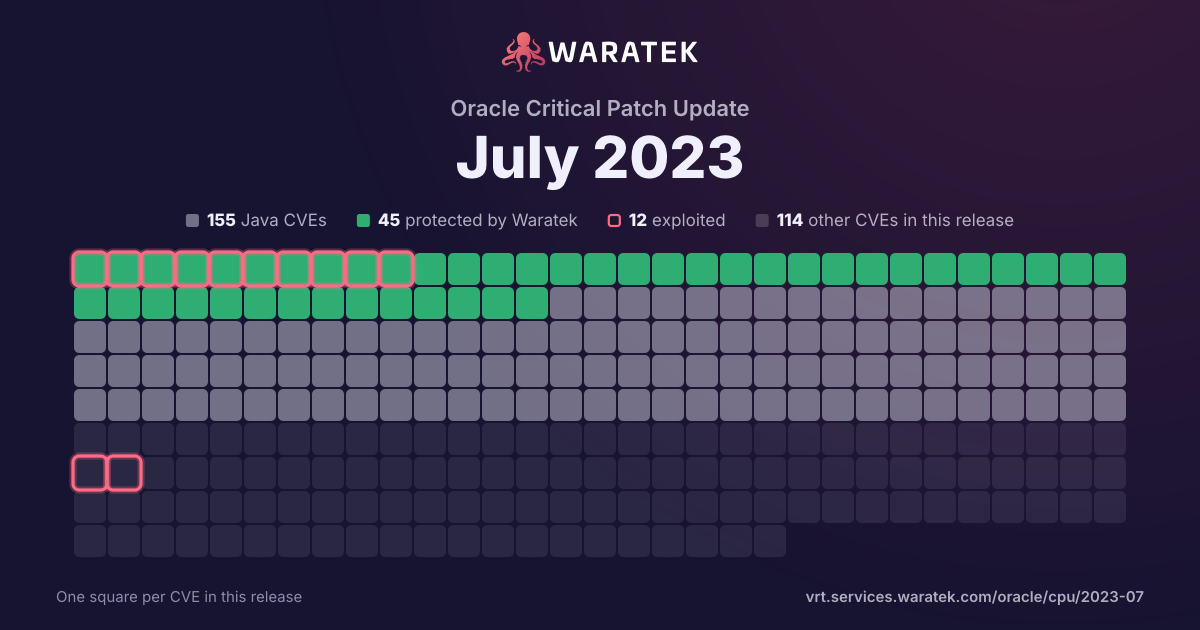
By status
43Protected by Waratek1Rule in development6Mitigation candidate112No exploit published5Outside Waratek scope102Not applicable
12Exploited, marked by the ring
No exploit published. For 28 of them, Oracle's security advisory is the source of public detail.
Protected by Waratek. Waratek RASP can block exploitation of these on systems that have not applied the patch yet.
Overview 34 matches · 14 protected · 3 exploited · 0 CISA KEV · 5 public PoC · 6 EPSS ≥ 0.5
Protected by Waratek
14
41.2%
Rule in development
0
0.0%
Mitigation candidate
2
5.9%
No exploit published
18
52.9%
blocked by ARMR today
14
41.2%
partly blocked
0
0.0%
not blocked
20
58.8%
not established
0
0.0%
unrecorded
0
0.0%
split by
peak 7 / quarter
Q2 191
Mitigation candidate1
High1
not blocked1
Working exploit published1
Q3 193
Protected by Waratek2
No exploit published1
Critical1
High2
blocked by ARMR today2
not blocked1
No public exploit3
Q4 190
Q1 200
Q2 200
Q3 201
Protected by Waratek1
Critical1
blocked by ARMR today1
Forecast only1
Q4 201
Protected by Waratek1
Medium1
blocked by ARMR today1
No public exploit1
Q1 213
No exploit published3
High3
not blocked3
No public exploit3
Q2 212
Protected by Waratek1
No exploit published1
Medium2
blocked by ARMR today1
not blocked1
No public exploit2
Q3 217
Protected by Waratek1
No exploit published6
High5
Medium2
blocked by ARMR today1
not blocked6
Exploited1
No public exploit6
Q4 212
Protected by Waratek2
Medium2
blocked by ARMR today2
Exploited2
Q1 224
Protected by Waratek2
No exploit published2
Critical1
High2
Medium1
blocked by ARMR today2
not blocked2
Proof of concept only2
No public exploit2
Q2 225
Protected by Waratek3
No exploit published2
Critical1
High1
Medium2
Low1
blocked by ARMR today3
not blocked2
Proof of concept only1
No public exploit4
Q3 225
Protected by Waratek1
Mitigation candidate1
No exploit published3
Critical1
High2
Medium1
Low1
blocked by ARMR today1
not blocked4
Proof of concept only2
No public exploit3
Q3 19Q1 20Q3 20Q1 21Q3 21Q1 22Q3 22
| CVE | Severity | Published▾ | Status | Exploitation | Description |
|---|---|---|---|---|---|
| CVE-2022-36033 | Medium | 2022-08-29 | Protected by Waratek | Proof of concept only | jsoup is a Java HTML parser, built for HTML editing, cleaning, scraping, and cross-site scripting (XSS) safety. jsoup may incorrectly sanitize HTML including `javascript:` URL expressions, which could allow XSS attacks when a reader subsequently clicks that link. If the non-default `SafeList.preserveRelativeLinks` option is enabled, HTML including `javascript:` URLs that have been crafted with control characters will not be sanitized. If the site that this HTML is published on does not set a Content Security Policy, an XSS attack is then possible. This issue is patched in jsoup 1.15.3. Users should upgrade to this version. Additionally, as the unsanitized input may have been persisted, old content should be cleaned again using the updated version. To remediate this issue without immediately upgrading: - disable `SafeList.preserveRelativeLinks`, which will rewrite input URLs as absolute URLs - ensure an appropriate [Content Security Policy](https://developer.mozilla.org/en-US/docs/Web/HTTP/CSP) is defined. (This should be used regardless of upgrading, as a defence-in-depth best practice.) |
| CVE-2022-2191 | High | 2022-07-07 | No exploit published | No public exploit | In Eclipse Jetty versions 10.0.0 thru 10.0.9, and 11.0.0 thru 11.0.9 versions, SslConnection does not release ByteBuffers from configured ByteBufferPool in case of error code paths. |
| CVE-2022-2048 | High | 2022-07-07 | No exploit published | No public exploit | In Eclipse Jetty HTTP/2 server implementation, when encountering an invalid HTTP/2 request, the error handling has a bug that can wind up not properly cleaning up the active connections and associated resources. This can lead to a Denial of Service scenario where there are no enough resources left to process good requests. |
| CVE-2022-2047 | Low | 2022-07-07 | No exploit published | No public exploit | In Eclipse Jetty versions 9.4.0 thru 9.4.46, and 10.0.0 thru 10.0.9, and 11.0.0 thru 11.0.9 versions, the parsing of the authority segment of an http scheme URI, the Jetty HttpURI class improperly detects an invalid input as a hostname. This can lead to failures in a Proxy scenario. |
| CVE-2022-33980 | Critical | 2022-07-06 | Mitigation candidate | Proof of concept only | Apache Commons Configuration performs variable interpolation, allowing properties to be dynamically evaluated and expanded. The standard format for interpolation is "${prefix:name}", where "prefix" is used to locate an instance of org.apache.commons.configuration2.interpol.Lookup that performs the interpolation. Starting with version 2.4 and continuing through 2.7, the set of default Lookup instances included interpolators that could result in arbitrary code execution or contact with remote servers. These lookups are: - "script" - execute expressions using the JVM script execution engine (javax.script) - "dns" - resolve dns records - "url" - load values from urls, including from remote servers Applications using the interpolation defaults in the affected versions may be vulnerable to remote code execution or unintentional contact with remote servers if untrusted configuration values are used. Users are recommended to upgrade to Apache Commons Configuration 2.8.0, which disables the problematic interpolators by default. |
| CVE-2022-33879 | Low | 2022-06-27 | No exploit published | No public exploit | The initial fixes in CVE-2022-30126 and CVE-2022-30973 for regexes in the StandardsExtractingContentHandler were insufficient, and we found a separate, new regex DoS in a different regex in the StandardsExtractingContentHandler. These are now fixed in 1.28.4 and 2.4.1. |
| CVE-2022-22971 | Medium | 2022-05-12 | Protected by Waratek | No public exploit | In spring framework versions prior to 5.3.20+ , 5.2.22+ and old unsupported versions, application with a STOMP over WebSocket endpoint is vulnerable to a denial of service attack by an authenticated user. |
| CVE-2022-22970 | Medium | 2022-05-12 | No exploit published | No public exploit | In spring framework versions prior to 5.3.20+ , 5.2.22+ and old unsupported versions, applications that handle file uploads are vulnerable to DoS attack if they rely on data binding to set a MultipartFile or javax.servlet.Part to a field in a model object. |
| CVE-2022-25647 | High | 2022-05-01 | Protected by Waratek | No public exploit | The package com.google.code.gson:gson before 2.8.9 are vulnerable to Deserialization of Untrusted Data via the writeReplace() method in internal classes, which may lead to DoS attacks. |
| CVE-2022-23457 | Critical | 2022-04-25 | Protected by Waratek | Proof of concept only | ESAPI (The OWASP Enterprise Security API) is a free, open source, web application security control library. Prior to version 2.3.0.0, the default implementation of `Validator.getValidDirectoryPath(String, String, File, boolean)` may incorrectly treat the tested input string as a child of the specified parent directory. This potentially could allow control-flow bypass checks to be defeated if an attack can specify the entire string representing the 'input' path. This vulnerability is patched in release 2.3.0.0 of ESAPI. As a workaround, it is possible to write one's own implementation of the Validator interface. However, maintainers do not recommend this. |
| CVE-2020-36518 | High | 2022-03-11 | No exploit published | No public exploit | jackson-databind before 2.13.0 allows a Java StackOverflow exception and denial of service via a large depth of nested objects. |
| CVE-2021-43859 | High | 2022-02-01 | No exploit published | Proof of concept only | XStream is an open source java library to serialize objects to XML and back again. Versions prior to 1.4.19 may allow a remote attacker to allocate 100% CPU time on the target system depending on CPU type or parallel execution of such a payload resulting in a denial of service only by manipulating the processed input stream. XStream 1.4.19 monitors and accumulates the time it takes to add elements to collections and throws an exception if a set threshold is exceeded. Users are advised to upgrade as soon as possible. Users unable to upgrade may set the NO_REFERENCE mode to prevent recursion. See GHSA-rmr5-cpv2-vgjf for further details on a workaround if an upgrade is not possible. |
| CVE-2022-23437 | Medium | 2022-01-24 | Protected by Waratek | No public exploit | There's a vulnerability within the Apache Xerces Java (XercesJ) XML parser when handling specially crafted XML document payloads. This causes, the XercesJ XML parser to wait in an infinite loop, which may sometimes consume system resources for prolonged duration. This vulnerability is present within XercesJ version 2.12.1 and the previous versions. |
| CVE-2022-23305 | Critical | 2022-01-18 | Protected by Waratek | Proof of concept only | By design, the JDBCAppender in Log4j 1.2.x accepts an SQL statement as a configuration parameter where the values to be inserted are converters from PatternLayout. The message converter, %m, is likely to always be included. This allows attackers to manipulate the SQL by entering crafted strings into input fields or headers of an application that are logged allowing unintended SQL queries to be executed. Note this issue only affects Log4j 1.x when specifically configured to use the JDBCAppender, which is not the default. Beginning in version 2.0-beta8, the JDBCAppender was re-introduced with proper support for parameterized SQL queries and further customization over the columns written to in logs. Apache Log4j 1.2 reached end of life in August 2015. Users should upgrade to Log4j 2 as it addresses numerous other issues from the previous versions. |
| CVE-2021-44832 | Medium | 2021-12-28 | Protected by Waratek | Exploited | Apache Log4j2 versions 2.0-beta7 through 2.17.0 (excluding security fix releases 2.3.2 and 2.12.4) are vulnerable to a remote code execution (RCE) attack when a configuration uses a JDBC Appender with a JNDI LDAP data source URI when an attacker has control of the target LDAP server. This issue is fixed by limiting JNDI data source names to the java protocol in Log4j2 versions 2.17.1, 2.12.4, and 2.3.2. |
| CVE-2021-45105 | Medium | 2021-12-18 | Protected by Waratek | Exploited | Apache Log4j2 versions 2.0-alpha1 through 2.16.0 (excluding 2.12.3 and 2.3.1) did not protect from uncontrolled recursion from self-referential lookups. This allows an attacker with control over Thread Context Map data to cause a denial of service when a crafted string is interpreted. This issue was fixed in Log4j 2.17.0, 2.12.3, and 2.3.1. |
| CVE-2021-40690 | High | 2021-09-19 | No exploit published | No public exploit | All versions of Apache Santuario - XML Security for Java prior to 2.2.3 and 2.1.7 are vulnerable to an issue where the "secureValidation" property is not passed correctly when creating a KeyInfo from a KeyInfoReference element. This allows an attacker to abuse an XPath Transform to extract any local .xml files in a RetrievalMethod element. |
| CVE-2021-34429 | Medium | 2021-07-15 | Protected by Waratek | Exploited | For Eclipse Jetty versions 9.4.37-9.4.42, 10.0.1-10.0.5 & 11.0.1-11.0.5, URIs can be crafted using some encoded characters to access the content of the WEB-INF directory and/or bypass some security constraints. This is a variation of the vulnerability reported in CVE-2021-28164/GHSA-v7ff-8wcx-gmc5. |
| CVE-2021-36374 | Medium | 2021-07-14 | No exploit published | No public exploit | When reading a specially crafted ZIP archive, or a derived formats, an Apache Ant build can be made to allocate large amounts of memory that leads to an out of memory error, even for small inputs. This can be used to disrupt builds using Apache Ant. Commonly used derived formats from ZIP archives are for instance JAR files and many office files. Apache Ant prior to 1.9.16 and 1.10.11 were affected. |
| CVE-2021-36090 | High | 2021-07-13 | No exploit published | No public exploit | When reading a specially crafted ZIP archive, Compress can be made to allocate large amounts of memory that finally leads to an out of memory error even for very small inputs. This could be used to mount a denial of service attack against services that use Compress' zip package. |
| CVE-2021-35517 | High | 2021-07-13 | No exploit published | No public exploit | When reading a specially crafted TAR archive, Compress can be made to allocate large amounts of memory that finally leads to an out of memory error even for very small inputs. This could be used to mount a denial of service attack against services that use Compress' tar package. |
| CVE-2021-35516 | High | 2021-07-13 | No exploit published | No public exploit | When reading a specially crafted 7Z archive, Compress can be made to allocate large amounts of memory that finally leads to an out of memory error even for very small inputs. This could be used to mount a denial of service attack against services that use Compress' sevenz package. |
| CVE-2021-35515 | High | 2021-07-13 | No exploit published | No public exploit | When reading a specially crafted 7Z archive, the construction of the list of codecs that decompress an entry can result in an infinite loop. This could be used to mount a denial of service attack against services that use Compress' sevenz package. |
| CVE-2021-28168 | Medium | 2021-04-22 | No exploit published | No public exploit | Eclipse Jersey 2.28 to 2.33 and Eclipse Jersey 3.0.0 to 3.0.1 contains a local information disclosure vulnerability. This is due to the use of the File.createTempFile which creates a file inside of the system temporary directory with the permissions: -rw-r--r--. Thus the contents of this file are viewable by all other users locally on the system. As such, if the contents written is security sensitive, it can be disclosed to other local users. |
| CVE-2021-29425 | Medium | 2021-04-13 | Protected by Waratek | No public exploit | In Apache Commons IO before 2.7, When invoking the method FileNameUtils.normalize with an improper input string, like "//../foo", or "\\..\foo", the result would be the same value, thus possibly providing access to files in the parent directory, but not further above (thus "limited" path traversal), if the calling code would use the result to construct a path value. |
| CVE-2020-13936 | High | 2021-03-10 | No exploit published | No public exploit | An attacker that is able to modify Velocity templates may execute arbitrary Java code or run arbitrary system commands with the same privileges as the account running the Servlet container. This applies to applications that allow untrusted users to upload/modify velocity templates running Apache Velocity Engine versions up to 2.2. |
| CVE-2020-11988 | High | 2021-02-24 | No exploit published | No public exploit | Apache XmlGraphics Commons 2.4 and earlier is vulnerable to server-side request forgery, caused by improper input validation by the XMPParser. By using a specially-crafted argument, an attacker could exploit this vulnerability to cause the underlying server to make arbitrary GET requests. Users should upgrade to 2.6 or later. |
| CVE-2021-26117 | High | 2021-01-27 | No exploit published | No public exploit | The optional ActiveMQ LDAP login module can be configured to use anonymous access to the LDAP server. In this case, for Apache ActiveMQ Artemis prior to version 2.16.0 and Apache ActiveMQ prior to versions 5.16.1 and 5.15.14, the anonymous context is used to verify a valid users password in error, resulting in no check on the password. |
| CVE-2020-15250 | Medium | 2020-10-12 | Protected by Waratek | No public exploit | In JUnit4 from version 4.7 and before 4.13.1, the test rule TemporaryFolder contains a local information disclosure vulnerability. On Unix like systems, the system's temporary directory is shared between all users on that system. Because of this, when files and directories are written into this directory they are, by default, readable by other users on that same system. This vulnerability does not allow other users to overwrite the contents of these directories or files. This is purely an information disclosure vulnerability. This vulnerability impacts you if the JUnit tests write sensitive information, like API keys or passwords, into the temporary folder, and the JUnit tests execute in an environment where the OS has other untrusted users. Because certain JDK file system APIs were only added in JDK 1.7, this this fix is dependent upon the version of the JDK you are using. For Java 1.7 and higher users: this vulnerability is fixed in 4.13.1. For Java 1.6 and lower users: no patch is available, you must use the workaround below. If you are unable to patch, or are stuck running on Java 1.6, specifying the `java.io.tmpdir` system environment variable to a directory that is exclusively owned by the executing user will fix this vulnerability. For more information, including an example of vulnerable code, see the referenced GitHub Security Advisory. |
| CVE-2020-11998 | Critical | 2020-09-10 | Protected by Waratek | Forecast only | A regression has been introduced in the commit preventing JMX re-bind. By passing an empty environment map to RMIConnectorServer, instead of the map that contains the authentication credentials, it leaves ActiveMQ open to the following attack: https://docs.oracle.com/javase/8/docs/technotes/guides/management/agent.html "A remote client could create a javax.management.loading.MLet MBean and use it to create new MBeans from arbitrary URLs, at least if there is no security manager. In other words, a rogue remote client could make your Java application execute arbitrary code." Mitigation: Upgrade to Apache ActiveMQ 5.15.13 |
| CVE-2019-12402 | High | 2019-08-30 | No exploit published | No public exploit | The file name encoding algorithm used internally in Apache Commons Compress 1.15 to 1.18 can get into an infinite loop when faced with specially crafted inputs. This can lead to a denial of service attack if an attacker can choose the file names inside of an archive created by Compress. |
| CVE-2019-10086 | High | 2019-08-20 | Protected by Waratek | No public exploit | In Apache Commons Beanutils 1.9.2, a special BeanIntrospector class was added which allows suppressing the ability for an attacker to access the classloader via the class property available on all Java objects. We, however were not using this by default characteristic of the PropertyUtilsBean. |
| CVE-2019-13990 | Critical | 2019-07-26 | Protected by Waratek | No public exploit | initDocumentParser in xml/XMLSchedulingDataProcessor.java in Terracotta Quartz Scheduler through 2.3.0 allows XXE attacks via a job description. |
| CVE-2019-0227 | High | 2019-05-01 | Mitigation candidate | Working exploit published | A Server Side Request Forgery (SSRF) vulnerability affected the Apache Axis 1.4 distribution that was last released in 2006. Security and bug commits commits continue in the projects Axis 1.x Subversion repository, legacy users are encouraged to build from source. The successor to Axis 1.x is Axis2, the latest version is 1.7.9 and is not vulnerable to this issue. |