
Oracle Critical Patch Update July 2023
Released July 2023 · Oracle's advisory ↗ · ← Critical Patch Update, April 2023 · Critical Patch Update, October 2023 →
269 CVEs in this release, one square each
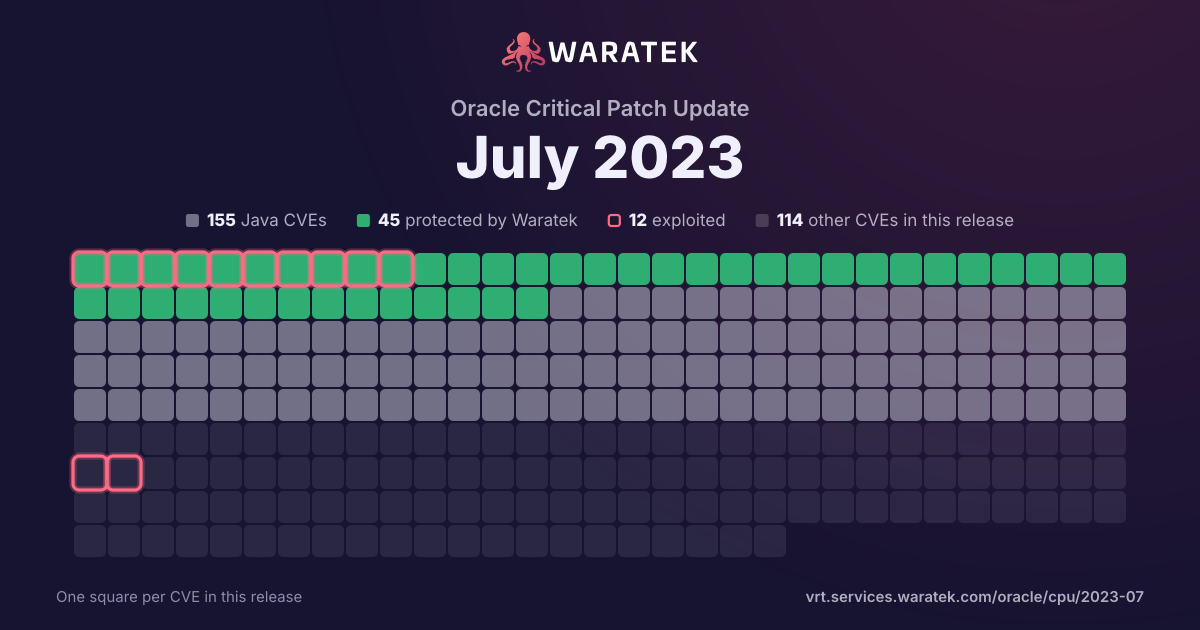
By status
43Protected by Waratek1Rule in development6Mitigation candidate112No exploit published5Outside Waratek scope102Not applicable
12Exploited, marked by the ring
No exploit published. For 28 of them, Oracle's security advisory is the source of public detail.
Protected by Waratek. Waratek RASP can block exploitation of these on systems that have not applied the patch yet.
Overview 37 matches · 5 protected · 0 exploited · 0 CISA KEV · 0 public PoC · 0 EPSS ≥ 0.5
Protected by Waratek
5
13.5%
Rule in development
0
0.0%
Mitigation candidate
0
0.0%
No exploit published
32
86.5%
blocked by ARMR today
5
13.5%
partly blocked
0
0.0%
not blocked
32
86.5%
not established
0
0.0%
unrecorded
0
0.0%
Exploited
0
0.0%
Working exploit published
0
0.0%
Proof of concept only
0
0.0%
Forecast only
0
0.0%
No public exploit
37
100.0%
split by
peak 9 / month
May 223
Protected by Waratek2
No exploit published1
High1
Medium2
blocked by ARMR today2
not blocked1
No public exploit3
Jun 220
Jul 223
No exploit published3
High2
Low1
not blocked3
No public exploit3
Aug 220
Sep 222
No exploit published2
Medium2
not blocked2
No public exploit2
Oct 225
No exploit published5
High5
not blocked5
No public exploit5
Nov 224
Protected by Waratek3
No exploit published1
Critical2
High2
blocked by ARMR today3
not blocked1
No public exploit4
Dec 222
No exploit published2
High1
Medium1
not blocked2
No public exploit2
Jan 232
No exploit published2
High1
Medium1
not blocked2
No public exploit2
Feb 231
No exploit published1
High1
not blocked1
No public exploit1
Mar 239
No exploit published9
Critical1
High3
Medium5
not blocked9
No public exploit9
Apr 236
No exploit published6
Critical1
Medium5
not blocked6
No public exploit6
May 22Jun 22Jul 22Aug 22Sep 22Oct 22Nov 22Dec 22Jan 23Feb 23Mar 23Apr 23
| CVE | Severity | Published▾ | Status | Exploitation | Description |
|---|---|---|---|---|---|
| CVE-2023-20873 | Critical | 2023-04-20 | No exploit published | No public exploit | In Spring Boot versions 3.0.0 - 3.0.5, 2.7.0 - 2.7.10, and older unsupported versions, an application that is deployed to Cloud Foundry could be susceptible to a security bypass. Users of affected versions should apply the following mitigation: 3.0.x users should upgrade to 3.0.6+. 2.7.x users should upgrade to 2.7.11+. Users of older, unsupported versions should upgrade to 3.0.6+ or 2.7.11+. |
| CVE-2023-20862 | Medium | 2023-04-19 | No exploit published | No public exploit | In Spring Security, versions 5.7.x prior to 5.7.8, versions 5.8.x prior to 5.8.3, and versions 6.0.x prior to 6.0.3, the logout support does not properly clean the security context if using serialized versions. Additionally, it is not possible to explicitly save an empty security context to the HttpSessionSecurityContextRepository. This vulnerability can keep users authenticated even after they performed logout. Users of affected versions should apply the following mitigation. 5.7.x users should upgrade to 5.7.8. 5.8.x users should upgrade to 5.8.3. 6.0.x users should upgrade to 6.0.3. |
| CVE-2023-26049 | Medium | 2023-04-18 | No exploit published | No public exploit | Jetty is a java based web server and servlet engine. Nonstandard cookie parsing in Jetty may allow an attacker to smuggle cookies within other cookies, or otherwise perform unintended behavior by tampering with the cookie parsing mechanism. If Jetty sees a cookie VALUE that starts with `"` (double quote), it will continue to read the cookie string until it sees a closing quote -- even if a semicolon is encountered. So, a cookie header such as: `DISPLAY_LANGUAGE="b; JSESSIONID=1337; c=d"` will be parsed as one cookie, with the name DISPLAY_LANGUAGE and a value of b; JSESSIONID=1337; c=d instead of 3 separate cookies. This has security implications because if, say, JSESSIONID is an HttpOnly cookie, and the DISPLAY_LANGUAGE cookie value is rendered on the page, an attacker can smuggle the JSESSIONID cookie into the DISPLAY_LANGUAGE cookie and thereby exfiltrate it. This is significant when an intermediary is enacting some policy based on cookies, so a smuggled cookie can bypass that policy yet still be seen by the Jetty server or its logging system. This issue has been addressed in versions 9.4.51, 10.0.14, 11.0.14, and 12.0.0.beta0 and users are advised to upgrade. There are no known workarounds for this issue. |
| CVE-2023-26048 | Medium | 2023-04-18 | No exploit published | No public exploit | Jetty is a java based web server and servlet engine. In affected versions servlets with multipart support (e.g. annotated with `@MultipartConfig`) that call `HttpServletRequest.getParameter()` or `HttpServletRequest.getParts()` may cause `OutOfMemoryError` when the client sends a multipart request with a part that has a name but no filename and very large content. This happens even with the default settings of `fileSizeThreshold=0` which should stream the whole part content to disk. An attacker client may send a large multipart request and cause the server to throw `OutOfMemoryError`. However, the server may be able to recover after the `OutOfMemoryError` and continue its service -- although it may take some time. This issue has been patched in versions 9.4.51, 10.0.14, and 11.0.14. Users are advised to upgrade. Users unable to upgrade may set the multipart parameter `maxRequestSize` which must be set to a non-negative value, so the whole multipart content is limited (although still read into memory). |
| CVE-2023-21971 | Medium | 2023-04-18 | No exploit published | No public exploit | Vulnerability in the MySQL Connectors product of Oracle MySQL (component: Connector/J). Supported versions that are affected are 8.0.32 and prior. Difficult to exploit vulnerability allows high privileged attacker with network access via multiple protocols to compromise MySQL Connectors. Successful attacks require human interaction from a person other than the attacker. Successful attacks of this vulnerability can result in unauthorized ability to cause a hang or frequently repeatable crash (complete DOS) of MySQL Connectors as well as unauthorized update, insert or delete access to some of MySQL Connectors accessible data and unauthorized read access to a subset of MySQL Connectors accessible data. CVSS 3.1 Base Score 5.3 (Confidentiality, Integrity and Availability impacts). CVSS Vector: (CVSS:3.1/AV:N/AC:H/PR:H/UI:R/S:U/C:L/I:L/A:H). |
| CVE-2023-20863 | Medium | 2023-04-13 | No exploit published | No public exploit | In spring framework versions prior to 5.2.24 release+ ,5.3.27+ and 6.0.8+ , it is possible for a user to provide a specially crafted SpEL expression that may cause a denial-of-service (DoS) condition. |
| CVE-2023-20861 | Medium | 2023-03-23 | No exploit published | No public exploit | In Spring Framework versions 6.0.0 - 6.0.6, 5.3.0 - 5.3.25, 5.2.0.RELEASE - 5.2.22.RELEASE, and older unsupported versions, it is possible for a user to provide a specially crafted SpEL expression that may cause a denial-of-service (DoS) condition. |
| CVE-2023-28708 | Medium | 2023-03-22 | No exploit published | No public exploit | When using the RemoteIpFilter with requests received from a reverse proxy via HTTP that include the X-Forwarded-Proto header set to https, session cookies created by Apache Tomcat 11.0.0-M1 to 11.0.0.-M2, 10.1.0-M1 to 10.1.5, 9.0.0-M1 to 9.0.71 and 8.5.0 to 8.5.85 did not include the secure attribute. This could result in the user agent transmitting the session cookie over an insecure channel. Older, EOL versions may also be affected. |
| CVE-2023-27904 | Medium | 2023-03-10 | No exploit published | No public exploit | Jenkins 2.393 and earlier, LTS 2.375.3 and earlier prints an error stack trace on agent-related pages when agent connections are broken, potentially revealing information about Jenkins configuration that is otherwise inaccessible to attackers. |
| CVE-2023-27903 | Medium | 2023-03-10 | No exploit published | No public exploit | Jenkins 2.393 and earlier, LTS 2.375.3 and earlier creates a temporary file in the default temporary directory with the default permissions for newly created files when uploading a file parameter through the CLI, potentially allowing attackers with access to the Jenkins controller file system to read and write the file before it is used. |
| CVE-2023-27902 | Medium | 2023-03-10 | No exploit published | No public exploit | Jenkins 2.393 and earlier, LTS 2.375.3 and earlier shows temporary directories related to job workspaces, which allows attackers with Item/Workspace permission to access their contents. |
| CVE-2023-27901 | High | 2023-03-10 | No exploit published | No public exploit | Jenkins 2.393 and earlier, LTS 2.375.3 and earlier uses the Apache Commons FileUpload library without specifying limits for the number of request parts introduced in version 1.5 for CVE-2023-24998 in org.kohsuke.stapler.RequestImpl, allowing attackers to trigger a denial of service. |
| CVE-2023-27900 | High | 2023-03-10 | No exploit published | No public exploit | Jenkins 2.393 and earlier, LTS 2.375.3 and earlier uses the Apache Commons FileUpload library without specifying limits for the number of request parts introduced in version 1.5 for CVE-2023-24998 in hudson.util.MultipartFormDataParser, allowing attackers to trigger a denial of service. |
| CVE-2023-27899 | High | 2023-03-10 | No exploit published | No public exploit | Jenkins 2.393 and earlier, LTS 2.375.3 and earlier creates a temporary file in the default temporary directory with the default permissions for newly created files when uploading a plugin for installation, potentially allowing attackers with access to the Jenkins controller file system to read and write the file before it is used, potentially resulting in arbitrary code execution. |
| CVE-2023-27898 | Critical | 2023-03-10 | No exploit published | No public exploit | Jenkins 2.270 through 2.393 (both inclusive), LTS 2.277.1 through 2.375.3 (both inclusive) does not escape the Jenkins version a plugin depends on when rendering the error message stating its incompatibility with the current version of Jenkins, resulting in a stored cross-site scripting (XSS) vulnerability exploitable by attackers able to provide plugins to the configured update sites and have this message shown by Jenkins instances. |
| CVE-2023-24998 | High | 2023-02-20 | No exploit published | No public exploit | Apache Commons FileUpload before 1.5 does not limit the number of request parts to be processed resulting in the possibility of an attacker triggering a DoS with a malicious upload or series of uploads. Note that, like all of the file upload limits, the new configuration option (FileUploadBase#setFileCountMax) is not enabled by default and must be explicitly configured. |
| CVE-2022-45787 | Medium | 2023-01-06 | No exploit published | No public exploit | Unproper laxist permissions on the temporary files used by MIME4J TempFileStorageProvider may lead to information disclosure to other local users. This issue affects Apache James MIME4J version 0.8.8 and prior versions. We recommend users to upgrade to MIME4j version 0.8.9 or later. |
| CVE-2022-45143 | High | 2023-01-03 | No exploit published | No public exploit | The JsonErrorReportValve in Apache Tomcat 8.5.83, 9.0.40 to 9.0.68 and 10.1.0-M1 to 10.1.1 did not escape the type, message or description values. In some circumstances these are constructed from user provided data and it was therefore possible for users to supply values that invalidated or manipulated the JSON output. |
| CVE-2022-46363 | High | 2022-12-13 | No exploit published | No public exploit | A vulnerability in Apache CXF before versions 3.5.5 and 3.4.10 allows an attacker to perform a remote directory listing or code exfiltration. The vulnerability only applies when the CXFServlet is configured with both the static-resources-list and redirect-query-check attributes. These attributes are not supposed to be used together, and so the vulnerability can only arise if the CXF service is misconfigured. |
| CVE-2021-37533 | Medium | 2022-12-03 | No exploit published | No public exploit | Prior to Apache Commons Net 3.9.0, Net's FTP client trusts the host from PASV response by default. A malicious server can redirect the Commons Net code to use a different host, but the user has to connect to the malicious server in the first place. This may lead to leakage of information about services running on the private network of the client. The default in version 3.9.0 is now false to ignore such hosts, as cURL does. See https://issues.apache.org/jira/browse/NET-711. |
| CVE-2022-42920 | Critical | 2022-11-07 | Protected by Waratek | No public exploit | Apache Commons BCEL has a number of APIs that would normally only allow changing specific class characteristics. However, due to an out-of-bounds writing issue, these APIs can be used to produce arbitrary bytecode. This could be abused in applications that pass attacker-controllable data to those APIs, giving the attacker more control over the resulting bytecode than otherwise expected. Update to Apache Commons BCEL 6.6.0. |
| CVE-2022-37866 | High | 2022-11-07 | Protected by Waratek | No public exploit | When Apache Ivy downloads artifacts from a repository it stores them in the local file system based on a user-supplied "pattern" that may include placeholders for artifacts coordinates like the organisation, module or version. If said coordinates contain "../" sequences - which are valid characters for Ivy coordinates in general - it is possible the artifacts are stored outside of Ivy's local cache or repository or can overwrite different artifacts inside of the local cache. In order to exploit this vulnerability an attacker needs collaboration by the remote repository as Ivy will issue http requests containing ".." sequences and a "normal" repository will not interpret them as part of the artifact coordinates. Users of Apache Ivy 2.0.0 to 2.5.1 should upgrade to Ivy 2.5.1. |
| CVE-2022-37865 | Critical | 2022-11-07 | Protected by Waratek | No public exploit | With Apache Ivy 2.4.0 an optional packaging attribute has been introduced that allows artifacts to be unpacked on the fly if they used pack200 or zip packaging. For artifacts using the "zip", "jar" or "war" packaging Ivy prior to 2.5.1 doesn't verify the target path when extracting the archive. An archive containing absolute paths or paths that try to traverse "upwards" using ".." sequences can then write files to any location on the local fie system that the user executing Ivy has write access to. Ivy users of version 2.4.0 to 2.5.0 should upgrade to Ivy 2.5.1. |
| CVE-2022-42252 | High | 2022-11-01 | No exploit published | No public exploit | If Apache Tomcat 8.5.0 to 8.5.82, 9.0.0-M1 to 9.0.67, 10.0.0-M1 to 10.0.26 or 10.1.0-M1 to 10.1.0 was configured to ignore invalid HTTP headers via setting rejectIllegalHeader to false (the default for 8.5.x only), Tomcat did not reject a request containing an invalid Content-Length header making a request smuggling attack possible if Tomcat was located behind a reverse proxy that also failed to reject the request with the invalid header. |
| CVE-2022-31690 | High | 2022-10-31 | No exploit published | No public exploit | Spring Security, versions 5.7 prior to 5.7.5, and 5.6 prior to 5.6.9, and older unsupported versions could be susceptible to a privilege escalation under certain conditions. A malicious user or attacker can modify a request initiated by the Client (via the browser) to the Authorization Server which can lead to a privilege escalation on the subsequent approval. This scenario can happen if the Authorization Server responds with an OAuth2 Access Token Response containing an empty scope list (per RFC 6749, Section 5.1) on the subsequent request to the token endpoint to obtain the access token. |
| CVE-2022-42890 | High | 2022-10-25 | No exploit published | No public exploit | A vulnerability in Batik of Apache XML Graphics allows an attacker to run Java code from untrusted SVG via JavaScript. This issue affects Apache XML Graphics prior to 1.16. Users are recommended to upgrade to version 1.16. |
| CVE-2022-41704 | High | 2022-10-25 | No exploit published | No public exploit | A vulnerability in Batik of Apache XML Graphics allows an attacker to run untrusted Java code from an SVG. This issue affects Apache XML Graphics prior to 1.16. It is recommended to update to version 1.16. |
| CVE-2022-3171 | High | 2022-10-12 | No exploit published | No public exploit | A parsing issue with binary data in protobuf-java core and lite versions prior to 3.21.7, 3.20.3, 3.19.6 and 3.16.3 can lead to a denial of service attack. Inputs containing multiple instances of non-repeated embedded messages with repeated or unknown fields causes objects to be converted back-n-forth between mutable and immutable forms, resulting in potentially long garbage collection pauses. We recommend updating to the versions mentioned above. |
| CVE-2022-42003 | High | 2022-10-02 | No exploit published | No public exploit | In FasterXML jackson-databind before versions 2.13.4.1 and 2.12.17.1, resource exhaustion can occur because of a lack of a check in primitive value deserializers to avoid deep wrapper array nesting, when the UNWRAP_SINGLE_VALUE_ARRAYS feature is enabled. |
| CVE-2022-38648 | Medium | 2022-09-22 | No exploit published | No public exploit | Server-Side Request Forgery (SSRF) vulnerability in Batik of Apache XML Graphics allows an attacker to fetch external resources. This issue affects Apache XML Graphics Batik 1.14. |
| CVE-2022-38398 | Medium | 2022-09-22 | No exploit published | No public exploit | Server-Side Request Forgery (SSRF) vulnerability in Batik of Apache XML Graphics allows an attacker to load a url thru the jar protocol. This issue affects Apache XML Graphics Batik 1.14. |
| CVE-2022-2191 | High | 2022-07-07 | No exploit published | No public exploit | In Eclipse Jetty versions 10.0.0 thru 10.0.9, and 11.0.0 thru 11.0.9 versions, SslConnection does not release ByteBuffers from configured ByteBufferPool in case of error code paths. |
| CVE-2022-2048 | High | 2022-07-07 | No exploit published | No public exploit | In Eclipse Jetty HTTP/2 server implementation, when encountering an invalid HTTP/2 request, the error handling has a bug that can wind up not properly cleaning up the active connections and associated resources. This can lead to a Denial of Service scenario where there are no enough resources left to process good requests. |
| CVE-2022-2047 | Low | 2022-07-07 | No exploit published | No public exploit | In Eclipse Jetty versions 9.4.0 thru 9.4.46, and 10.0.0 thru 10.0.9, and 11.0.0 thru 11.0.9 versions, the parsing of the authority segment of an http scheme URI, the Jetty HttpURI class improperly detects an invalid input as a hostname. This can lead to failures in a Proxy scenario. |
| CVE-2022-22971 | Medium | 2022-05-12 | Protected by Waratek | No public exploit | In spring framework versions prior to 5.3.20+ , 5.2.22+ and old unsupported versions, application with a STOMP over WebSocket endpoint is vulnerable to a denial of service attack by an authenticated user. |
| CVE-2022-22970 | Medium | 2022-05-12 | No exploit published | No public exploit | In spring framework versions prior to 5.3.20+ , 5.2.22+ and old unsupported versions, applications that handle file uploads are vulnerable to DoS attack if they rely on data binding to set a MultipartFile or javax.servlet.Part to a field in a model object. |
| CVE-2022-25647 | High | 2022-05-01 | Protected by Waratek | No public exploit | The package com.google.code.gson:gson before 2.8.9 are vulnerable to Deserialization of Untrusted Data via the writeReplace() method in internal classes, which may lead to DoS attacks. |