
Oracle Critical Patch Update April 2023
Released April 2023 · Oracle's advisory ↗ · ← Critical Patch Update, January 2023 · Critical Patch Update, July 2023 →
328 CVEs in this release, one square each
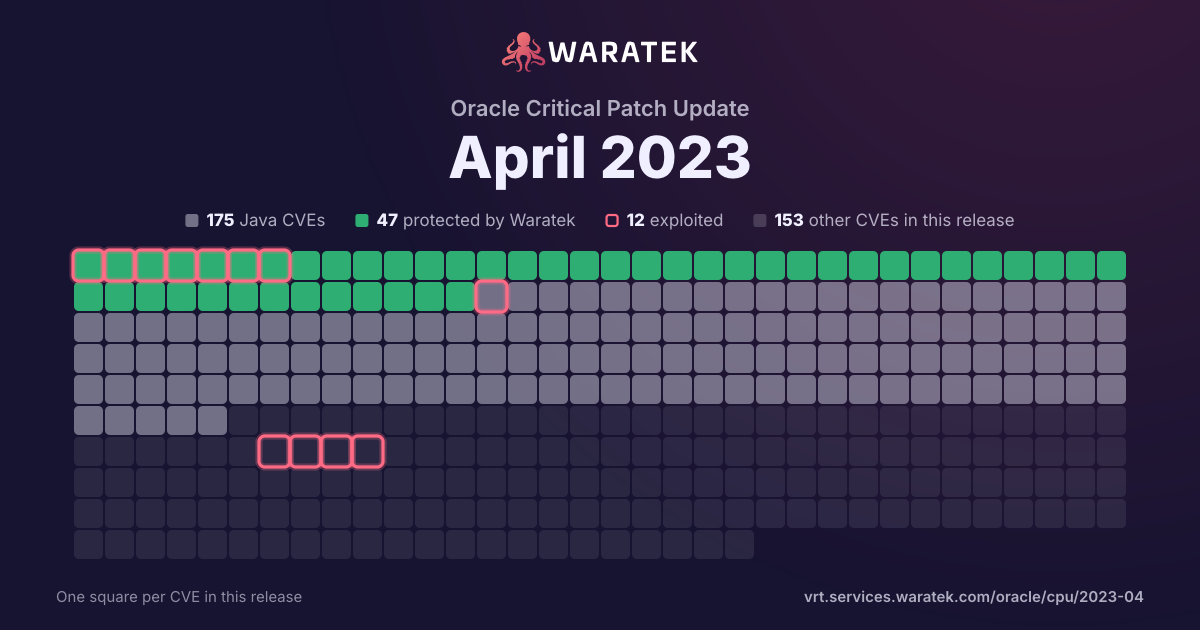
By status
47Protected by Waratek9Mitigation candidate119No exploit published35Outside Waratek scope118Not applicable
12Exploited, marked by the ring
No exploit published. For 56 of them, Oracle's security advisory is the source of public detail.
Protected by Waratek. Waratek RASP can block exploitation of these on systems that have not applied the patch yet.
Overview 328 matches · 175 in Waratek scope · 47 protected · 12 exploited · 2 CISA KEV · 29 public PoC · 23 EPSS ≥ 0.5
328matches
175in Waratek scope53.4%
47protected14.3%
12exploited3.7%
2CISA KEV0.6%
29public PoC8.8%
23EPSS ≥ 0.57.0%
Protected by Waratek
47
14.3%
Rule in development
0
0.0%
Mitigation candidate
9
2.7%
No exploit published
119
36.3%
Outside Waratek scope
35
10.7%
Not applicable
118
36.0%
Withdrawn CVE
0
0.0%
blocked by ARMR today
47
14.3%
partly blocked
0
0.0%
not blocked
280
85.4%
not established
1
0.3%
unrecorded
0
0.0%
split by
peak 91 / quarter
Q3 182
Protected by Waratek1
Not applicable1
High2
blocked by ARMR today1
not blocked1
No public exploit2
Q4 182
Not applicable2
Critical1
High1
not blocked2
No public exploit2
Q1 190
Q2 190
Q3 192
Protected by Waratek1
No exploit published1
High2
blocked by ARMR today1
not blocked1
No public exploit2
Q4 195
Protected by Waratek2
Not applicable3
Critical1
High2
Medium2
blocked by ARMR today2
not blocked3
Exploited1
No public exploit4
Q1 201
No exploit published1
High1
not blocked1
No public exploit1
Q2 203
No exploit published1
Outside Waratek scope1
Not applicable1
High1
Medium2
not blocked3
No public exploit3
Q3 203
Protected by Waratek1
Outside Waratek scope2
High3
blocked by ARMR today1
not blocked2
No public exploit3
Q4 2011
Protected by Waratek4
Mitigation candidate1
No exploit published6
High7
Medium3
Low1
blocked by ARMR today4
not blocked7
Proof of concept only1
No public exploit10
Q1 2117
Protected by Waratek3
Mitigation candidate2
No exploit published11
Outside Waratek scope1
Critical2
High14
Medium1
blocked by ARMR today3
not blocked14
Proof of concept only3
No public exploit14
Q2 215
Protected by Waratek2
No exploit published2
Not applicable1
High2
Medium3
blocked by ARMR today2
not blocked3
Working exploit published2
No public exploit3
Q3 2116
No exploit published10
Outside Waratek scope2
Not applicable4
High10
Medium6
not blocked16
Forecast only1
No public exploit15
Q4 2110
Protected by Waratek4
No exploit published1
Outside Waratek scope4
Not applicable1
Critical2
High3
Medium5
blocked by ARMR today4
not blocked6
Exploited2
Proof of concept only1
No public exploit7
Q1 2217
Protected by Waratek4
No exploit published4
Outside Waratek scope1
Not applicable8
Critical4
High9
Medium4
blocked by ARMR today4
not blocked13
Proof of concept only4
Forecast only2
No public exploit11
Q2 2227
Protected by Waratek8
Mitigation candidate1
No exploit published5
Outside Waratek scope4
Not applicable9
Critical10
High9
Medium8
blocked by ARMR today8
not blocked19
Exploited2
Proof of concept only6
No public exploit19
Q3 2236
Protected by Waratek4
Mitigation candidate2
No exploit published13
Outside Waratek scope4
Not applicable13
Critical11
High14
Medium10
Low1
blocked by ARMR today4
not blocked32
Proof of concept only12
Forecast only1
No public exploit23
Q4 2249
Protected by Waratek6
Mitigation candidate2
No exploit published15
Outside Waratek scope3
Not applicable23
Critical11
High34
Medium4
blocked by ARMR today6
not blocked43
Exploited4
Proof of concept only13
No public exploit32
Q1 2328
Protected by Waratek1
No exploit published6
Not applicable21
Critical4
High13
Medium10
Low1
blocked by ARMR today1
not blocked27
Exploited2
Proof of concept only9
Forecast only2
No public exploit15
Q2 2391
Protected by Waratek6
Mitigation candidate1
No exploit published43
Outside Waratek scope13
Not applicable28
High14
Medium68
Low9
blocked by ARMR today6
not blocked84
not established1
Exploited1
Proof of concept only1
Forecast only1
No public exploit88
Q3 230
Q4 230
Q1 242
Not applicable2
Critical2
not blocked2
No public exploit2
Q2 241
Not applicable1
Medium1
not blocked1
No public exploit1
Q4 18Q2 19Q4 19Q2 20Q4 20Q2 21Q4 21Q2 22Q4 22Q2 23Q4 23Q2 24
| CVE | Severity | Published▾ | Status | Exploitation | Description |
|---|---|---|---|---|---|
| CVE-2022-2191 | High | 2022-07-07 | No exploit published | No public exploit | In Eclipse Jetty versions 10.0.0 thru 10.0.9, and 11.0.0 thru 11.0.9 versions, SslConnection does not release ByteBuffers from configured ByteBufferPool in case of error code paths. |
| CVE-2022-2048 | High | 2022-07-07 | No exploit published | No public exploit | In Eclipse Jetty HTTP/2 server implementation, when encountering an invalid HTTP/2 request, the error handling has a bug that can wind up not properly cleaning up the active connections and associated resources. This can lead to a Denial of Service scenario where there are no enough resources left to process good requests. |
| CVE-2022-2047 | Low | 2022-07-07 | No exploit published | No public exploit | In Eclipse Jetty versions 9.4.0 thru 9.4.46, and 10.0.0 thru 10.0.9, and 11.0.0 thru 11.0.9 versions, the parsing of the authority segment of an http scheme URI, the Jetty HttpURI class improperly detects an invalid input as a hostname. This can lead to failures in a Proxy scenario. |
| CVE-2022-33980 | Critical | 2022-07-06 | Mitigation candidate | Proof of concept only | Apache Commons Configuration performs variable interpolation, allowing properties to be dynamically evaluated and expanded. The standard format for interpolation is "${prefix:name}", where "prefix" is used to locate an instance of org.apache.commons.configuration2.interpol.Lookup that performs the interpolation. Starting with version 2.4 and continuing through 2.7, the set of default Lookup instances included interpolators that could result in arbitrary code execution or contact with remote servers. These lookups are: - "script" - execute expressions using the JVM script execution engine (javax.script) - "dns" - resolve dns records - "url" - load values from urls, including from remote servers Applications using the interpolation defaults in the affected versions may be vulnerable to remote code execution or unintentional contact with remote servers if untrusted configuration values are used. Users are recommended to upgrade to Apache Commons Configuration 2.8.0, which disables the problematic interpolators by default. |
| CVE-2022-31129 | High | 2022-07-06 | Not applicable | Proof of concept only | moment is a JavaScript date library for parsing, validating, manipulating, and formatting dates. Affected versions of moment were found to use an inefficient parsing algorithm. Specifically using string-to-date parsing in moment (more specifically rfc2822 parsing, which is tried by default) has quadratic (N^2) complexity on specific inputs. Users may notice a noticeable slowdown is observed with inputs above 10k characters. Users who pass user-provided strings without sanity length checks to moment constructor are vulnerable to (Re)DoS attacks. The problem is patched in 2.29.4, the patch can be applied to all affected versions with minimal tweaking. Users are advised to upgrade. Users unable to upgrade should consider limiting date lengths accepted from user input. |
| CVE-2022-2097 | Medium | 2022-07-05 | Outside Waratek scope | No public exploit | AES OCB mode for 32-bit x86 platforms using the AES-NI assembly optimised implementation will not encrypt the entirety of the data under some circumstances. This could reveal sixteen bytes of data that was preexisting in the memory that wasn't written. In the special case of "in place" encryption, sixteen bytes of the plaintext would be revealed. Since OpenSSL does not support OCB based cipher suites for TLS and DTLS, they are both unaffected. Fixed in OpenSSL 3.0.5 (Affected 3.0.0-3.0.4). Fixed in OpenSSL 1.1.1q (Affected 1.1.1-1.1.1p). |
| CVE-2022-2274 | Critical | 2022-07-01 | Outside Waratek scope | Proof of concept only | The OpenSSL 3.0.4 release introduced a serious bug in the RSA implementation for X86_64 CPUs supporting the AVX512IFMA instructions. This issue makes the RSA implementation with 2048 bit private keys incorrect on such machines and memory corruption will happen during the computation. As a consequence of the memory corruption an attacker may be able to trigger a remote code execution on the machine performing the computation. SSL/TLS servers or other servers using 2048 bit RSA private keys running on machines supporting AVX512IFMA instructions of the X86_64 architecture are affected by this issue. |
| CVE-2022-31081 | High | 2022-06-27 | Not applicable | Proof of concept only | HTTP::Daemon is a simple http server class written in perl. Versions prior to 6.15 are subject to a vulnerability which could potentially be exploited to gain privileged access to APIs or poison intermediate caches. It is uncertain how large the risks are, most Perl based applications are served on top of Nginx or Apache, not on the `HTTP::Daemon`. This library is commonly used for local development and tests. Users are advised to update to resolve this issue. Users unable to upgrade may add additional request handling logic as a mitigation. After calling `my $rqst = $conn->get_request()` one could inspect the returned `HTTP::Request` object. Querying the 'Content-Length' (`my $cl = $rqst->header('Content-Length')`) will show any abnormalities that should be dealt with by a `400` response. Expected strings of 'Content-Length' SHOULD consist of either a single non-negative integer, or, a comma separated repetition of that number. (that is `42` or `42, 42, 42`). Anything else MUST be rejected. |
| CVE-2022-34305 | Medium | 2022-06-23 | Protected by Waratek | Exploited | In Apache Tomcat 10.1.0-M1 to 10.1.0-M16, 10.0.0-M1 to 10.0.22, 9.0.30 to 9.0.64 and 8.5.50 to 8.5.81 the Form authentication example in the examples web application displayed user provided data without filtering, exposing a XSS vulnerability. |
| CVE-2022-22979 | High | 2022-06-21 | No exploit published | No public exploit | In Spring Cloud Function versions prior to 3.2.6, it is possible for a user who directly interacts with framework provided lookup functionality to cause a denial-of-service condition due to the caching issue in the Function Catalog component of the framework. |
| CVE-2022-2068 | Critical | 2022-06-21 | Outside Waratek scope | Proof of concept only | In addition to the c_rehash shell command injection identified in CVE-2022-1292, further circumstances where the c_rehash script does not properly sanitise shell metacharacters to prevent command injection were found by code review. When the CVE-2022-1292 was fixed it was not discovered that there are other places in the script where the file names of certificates being hashed were possibly passed to a command executed through the shell. This script is distributed by some operating systems in a manner where it is automatically executed. On such operating systems, an attacker could execute arbitrary commands with the privileges of the script. Use of the c_rehash script is considered obsolete and should be replaced by the OpenSSL rehash command line tool. Fixed in OpenSSL 3.0.4 (Affected 3.0.0,3.0.1,3.0.2,3.0.3). Fixed in OpenSSL 1.1.1p (Affected 1.1.1-1.1.1o). Fixed in OpenSSL 1.0.2zf (Affected 1.0.2-1.0.2ze). |
| CVE-2022-28614 | Medium | 2022-06-09 | Not applicable | No public exploit | The ap_rwrite() function in Apache HTTP Server 2.4.53 and earlier may read unintended memory if an attacker can cause the server to reflect very large input using ap_rwrite() or ap_rputs(), such as with mod_luas r:puts() function. Modules compiled and distributed separately from Apache HTTP Server that use the 'ap_rputs' function and may pass it a very large (INT_MAX or larger) string must be compiled against current headers to resolve the issue. |
| CVE-2022-29599 | Critical | 2022-05-23 | Protected by Waratek | No public exploit | In Apache Maven maven-shared-utils prior to version 3.3.3, the Commandline class can emit double-quoted strings without proper escaping, allowing shell injection attacks. |
| CVE-2022-22978 | Critical | 2022-05-19 | Mitigation candidate | Proof of concept only | In spring security versions prior to 5.4.11+, 5.5.7+ , 5.6.4+ and older unsupported versions, RegexRequestMatcher can easily be misconfigured to be bypassed on some servlet containers. Applications using RegexRequestMatcher with `.` in the regular expression are possibly vulnerable to an authorization bypass. |
| CVE-2022-22976 | Medium | 2022-05-19 | No exploit published | No public exploit | Spring Security versions 5.5.x prior to 5.5.7, 5.6.x prior to 5.6.4, and earlier unsupported versions contain an integer overflow vulnerability. When using the BCrypt class with the maximum work factor (31), the encoder does not perform any salt rounds, due to an integer overflow error. The default settings are not affected by this CVE. |
| CVE-2022-1587 | Critical | 2022-05-16 | Outside Waratek scope | No public exploit | An out-of-bounds read vulnerability was discovered in the PCRE2 library in the get_recurse_data_length() function of the pcre2_jit_compile.c file. This issue affects recursions in JIT-compiled regular expressions caused by duplicate data transfers. |
| CVE-2022-1586 | Critical | 2022-05-16 | Outside Waratek scope | No public exploit | An out-of-bounds read vulnerability was discovered in the PCRE2 library in the compile_xclass_matchingpath() function of the pcre2_jit_compile.c file. This involves a unicode property matching issue in JIT-compiled regular expressions. The issue occurs because the character was not fully read in case-less matching within JIT. |
| CVE-2022-22971 | Medium | 2022-05-12 | Protected by Waratek | No public exploit | In spring framework versions prior to 5.3.20+ , 5.2.22+ and old unsupported versions, application with a STOMP over WebSocket endpoint is vulnerable to a denial of service attack by an authenticated user. |
| CVE-2022-22970 | Medium | 2022-05-12 | No exploit published | No public exploit | In spring framework versions prior to 5.3.20+ , 5.2.22+ and old unsupported versions, applications that handle file uploads are vulnerable to DoS attack if they rely on data binding to set a MultipartFile or javax.servlet.Part to a field in a model object. |
| CVE-2022-28739 | High | 2022-05-09 | Not applicable | No public exploit | There is a buffer over-read in Ruby before 2.6.10, 2.7.x before 2.7.6, 3.x before 3.0.4, and 3.1.x before 3.1.2. It occurs in String-to-Float conversion, including Kernel#Float and String#to_f. |
| CVE-2022-28738 | Critical | 2022-05-09 | Not applicable | No public exploit | A double free was found in the Regexp compiler in Ruby 3.x before 3.0.4 and 3.1.x before 3.1.2. If a victim attempts to create a Regexp from untrusted user input, an attacker may be able to write to unexpected memory locations. |
| CVE-2022-1292 | Critical | 2022-05-03 | Outside Waratek scope | Proof of concept only | The c_rehash script does not properly sanitise shell metacharacters to prevent command injection. This script is distributed by some operating systems in a manner where it is automatically executed. On such operating systems, an attacker could execute arbitrary commands with the privileges of the script. Use of the c_rehash script is considered obsolete and should be replaced by the OpenSSL rehash command line tool. Fixed in OpenSSL 3.0.3 (Affected 3.0.0,3.0.1,3.0.2). Fixed in OpenSSL 1.1.1o (Affected 1.1.1-1.1.1n). Fixed in OpenSSL 1.0.2ze (Affected 1.0.2-1.0.2zd). |
| CVE-2022-25647 | High | 2022-05-01 | Protected by Waratek | No public exploit | The package com.google.code.gson:gson before 2.8.9 are vulnerable to Deserialization of Untrusted Data via the writeReplace() method in internal classes, which may lead to DoS attacks. |
| CVE-2022-24891 | Medium | 2022-04-27 | No exploit published | Proof of concept only | ESAPI (The OWASP Enterprise Security API) is a free, open source, web application security control library. Prior to version 2.3.0.0, there is a potential for a cross-site scripting vulnerability in ESAPI caused by a incorrect regular expression for "onsiteURL" in the **antisamy-esapi.xml** configuration file that can cause "javascript:" URLs to fail to be correctly sanitized. This issue is patched in ESAPI 2.3.0.0. As a workaround, manually edit the **antisamy-esapi.xml** configuration files to change the "onsiteURL" regular expression. More information about remediation of the vulnerability, including the workaround, is available in the maintainers' release notes and security bulletin. |
| CVE-2022-23457 | Critical | 2022-04-25 | Protected by Waratek | Proof of concept only | ESAPI (The OWASP Enterprise Security API) is a free, open source, web application security control library. Prior to version 2.3.0.0, the default implementation of `Validator.getValidDirectoryPath(String, String, File, boolean)` may incorrectly treat the tested input string as a child of the specified parent directory. This potentially could allow control-flow bypass checks to be defeated if an attack can specify the entire string representing the 'input' path. This vulnerability is patched in release 2.3.0.0 of ESAPI. As a workaround, it is possible to write one's own implementation of the Validator interface. However, maintainers do not recommend this. |
| CVE-2022-27406 | High | 2022-04-22 | Not applicable | No public exploit | FreeType commit 22a0cccb4d9d002f33c1ba7a4b36812c7d4f46b5 was discovered to contain a segmentation violation via the function FT_Request_Size. |
| CVE-2022-27405 | High | 2022-04-22 | Not applicable | No public exploit | FreeType commit 53dfdcd8198d2b3201a23c4bad9190519ba918db was discovered to contain a segmentation violation via the function FNT_Size_Request. |
| CVE-2022-27404 | Critical | 2022-04-22 | Not applicable | No public exploit | FreeType commit 1e2eb65048f75c64b68708efed6ce904c31f3b2f was discovered to contain a heap buffer overflow via the function sfnt_init_face. |
| CVE-2022-29577 | Medium | 2022-04-21 | Protected by Waratek | No public exploit | OWASP AntiSamy before 1.6.7 allows XSS via HTML tag smuggling on STYLE content with crafted input. The output serializer does not properly encode the supposed Cascading Style Sheets (CSS) content. NOTE: this issue exists because of an incomplete fix for CVE-2022-28367. |
| CVE-2022-28327 | High | 2022-04-20 | Not applicable | No public exploit | The generic P-256 feature in crypto/elliptic in Go before 1.17.9 and 1.18.x before 1.18.1 allows a panic via long scalar input. |
| CVE-2022-24675 | High | 2022-04-20 | Not applicable | No public exploit | encoding/pem in Go before 1.17.9 and 1.18.x before 1.18.1 has a Decode stack overflow via a large amount of PEM data. |
| CVE-2022-24839 | High | 2022-04-11 | No exploit published | No public exploit | org.cyberneko.html is an html parser written in Java. The fork of `org.cyberneko.html` used by Nokogiri (Rubygem) raises a `java.lang.OutOfMemoryError` exception when parsing ill-formed HTML markup. Users are advised to upgrade to `>= 1.9.22.noko2`. Note: The upstream library `org.cyberneko.html` is no longer maintained. Nokogiri uses its own fork of this library located at https://github.com/sparklemotion/nekohtml and this CVE applies only to that fork. Other forks of nekohtml may have a similar vulnerability. |
| CVE-2022-22965 | Critical | 2022-04-01 | Protected by Waratek | Exploited | A Spring MVC or Spring WebFlux application running on JDK 9+ may be vulnerable to remote code execution (RCE) via data binding. The specific exploit requires the application to run on Tomcat as a WAR deployment. If the application is deployed as a Spring Boot executable jar, i.e. the default, it is not vulnerable to the exploit. However, the nature of the vulnerability is more general, and there may be other ways to exploit it. |
| CVE-2022-22950 | Medium | 2022-04-01 | Protected by Waratek | No public exploit | n Spring Framework versions 5.3.0 - 5.3.16 and older unsupported versions, it is possible for a user to provide a specially crafted SpEL expression that may cause a denial of service condition. |
| CVE-2022-24729 | High | 2022-03-16 | Outside Waratek scope | No public exploit | CKEditor4 is an open source what-you-see-is-what-you-get HTML editor. CKEditor4 prior to version 4.18.0 contains a vulnerability in the `dialog` plugin. The vulnerability allows abuse of a dialog input validator regular expression, which can cause a significant performance drop resulting in a browser tab freeze. A patch is available in version 4.18.0. There are currently no known workarounds. |
| CVE-2022-24728 | Medium | 2022-03-16 | Not applicable | No public exploit | CKEditor4 is an open source what-you-see-is-what-you-get HTML editor. A vulnerability has been discovered in the core HTML processing module and may affect all plugins used by CKEditor 4 prior to version 4.18.0. The vulnerability allows someone to inject malformed HTML bypassing content sanitization, which could result in executing JavaScript code. This problem has been patched in version 4.18.0. There are currently no known workarounds. |
| CVE-2020-36518 | High | 2022-03-11 | No exploit published | No public exploit | jackson-databind before 2.13.0 allows a Java StackOverflow exception and denial of service via a large depth of nested objects. |
| CVE-2022-21824 | High | 2022-02-24 | Not applicable | No public exploit | Due to the formatting logic of the "console.table()" function it was not safe to allow user controlled input to be passed to the "properties" parameter while simultaneously passing a plain object with at least one property as the first parameter, which could be "__proto__". The prototype pollution has very limited control, in that it only allows an empty string to be assigned to numerical keys of the object prototype.Node.js >= 12.22.9, >= 14.18.3, >= 16.13.2, and >= 17.3.1 use a null protoype for the object these properties are being assigned to. |
| CVE-2021-44533 | Medium | 2022-02-24 | Not applicable | No public exploit | Node.js < 12.22.9, < 14.18.3, < 16.13.2, and < 17.3.1 did not handle multi-value Relative Distinguished Names correctly. Attackers could craft certificate subjects containing a single-value Relative Distinguished Name that would be interpreted as a multi-value Relative Distinguished Name, for example, in order to inject a Common Name that would allow bypassing the certificate subject verification.Affected versions of Node.js that do not accept multi-value Relative Distinguished Names and are thus not vulnerable to such attacks themselves. However, third-party code that uses node's ambiguous presentation of certificate subjects may be vulnerable. |
| CVE-2021-44532 | Medium | 2022-02-24 | Not applicable | No public exploit | Node.js < 12.22.9, < 14.18.3, < 16.13.2, and < 17.3.1 converts SANs (Subject Alternative Names) to a string format. It uses this string to check peer certificates against hostnames when validating connections. The string format was subject to an injection vulnerability when name constraints were used within a certificate chain, allowing the bypass of these name constraints.Versions of Node.js with the fix for this escape SANs containing the problematic characters in order to prevent the injection. This behavior can be reverted through the --security-revert command-line option. |
| CVE-2021-44531 | High | 2022-02-24 | Not applicable | No public exploit | Accepting arbitrary Subject Alternative Name (SAN) types, unless a PKI is specifically defined to use a particular SAN type, can result in bypassing name-constrained intermediates. Node.js < 12.22.9, < 14.18.3, < 16.13.2, and < 17.3.1 was accepting URI SAN types, which PKIs are often not defined to use. Additionally, when a protocol allows URI SANs, Node.js did not match the URI correctly.Versions of Node.js with the fix for this disable the URI SAN type when checking a certificate against a hostname. This behavior can be reverted through the --security-revert command-line option. |
| CVE-2022-25315 | Critical | 2022-02-18 | Not applicable | Proof of concept only | In Expat (aka libexpat) before 2.4.5, there is an integer overflow in storeRawNames. |
| CVE-2022-25236 | Critical | 2022-02-16 | Not applicable | No public exploit | xmlparse.c in Expat (aka libexpat) before 2.4.5 allows attackers to insert namespace-separator characters into namespace URIs. |
| CVE-2022-25235 | Critical | 2022-02-16 | Not applicable | No public exploit | xmltok_impl.c in Expat (aka libexpat) before 2.4.5 lacks certain validation of encoding, such as checks for whether a UTF-8 character is valid in a certain context. |
| CVE-2021-43859 | High | 2022-02-01 | No exploit published | Proof of concept only | XStream is an open source java library to serialize objects to XML and back again. Versions prior to 1.4.19 may allow a remote attacker to allocate 100% CPU time on the target system depending on CPU type or parallel execution of such a payload resulting in a denial of service only by manipulating the processed input stream. XStream 1.4.19 monitors and accumulates the time it takes to add elements to collections and throws an exception if a set threshold is exceeded. Users are advised to upgrade as soon as possible. Users unable to upgrade may set the NO_REFERENCE mode to prevent recursion. See GHSA-rmr5-cpv2-vgjf for further details on a workaround if an upgrade is not possible. |
| CVE-2022-23181 | High | 2022-01-27 | Protected by Waratek | No public exploit | The fix for bug CVE-2020-9484 introduced a time of check, time of use vulnerability into Apache Tomcat 10.1.0-M1 to 10.1.0-M8, 10.0.0-M5 to 10.0.14, 9.0.35 to 9.0.56 and 8.5.55 to 8.5.73 that allowed a local attacker to perform actions with the privileges of the user that the Tomcat process is using. This issue is only exploitable when Tomcat is configured to persist sessions using the FileStore. |
| CVE-2022-23437 | Medium | 2022-01-24 | No exploit published | No public exploit | There's a vulnerability within the Apache Xerces Java (XercesJ) XML parser when handling specially crafted XML document payloads. This causes, the XercesJ XML parser to wait in an infinite loop, which may sometimes consume system resources for prolonged duration. This vulnerability is present within XercesJ version 2.12.1 and the previous versions. |
| CVE-2022-23307 | High | 2022-01-18 | Protected by Waratek | Forecast only | CVE-2020-9493 identified a deserialization issue that was present in Apache Chainsaw. Prior to Chainsaw V2.0 Chainsaw was a component of Apache Log4j 1.2.x where the same issue exists. |
| CVE-2022-23305 | Critical | 2022-01-18 | Protected by Waratek | Proof of concept only | By design, the JDBCAppender in Log4j 1.2.x accepts an SQL statement as a configuration parameter where the values to be inserted are converters from PatternLayout. The message converter, %m, is likely to always be included. This allows attackers to manipulate the SQL by entering crafted strings into input fields or headers of an application that are logged allowing unintended SQL queries to be executed. Note this issue only affects Log4j 1.x when specifically configured to use the JDBCAppender, which is not the default. Beginning in version 2.0-beta8, the JDBCAppender was re-introduced with proper support for parameterized SQL queries and further customization over the columns written to in logs. Apache Log4j 1.2 reached end of life in August 2015. Users should upgrade to Log4j 2 as it addresses numerous other issues from the previous versions. |
| CVE-2022-23302 | High | 2022-01-18 | Protected by Waratek | Forecast only | JMSSink in all versions of Log4j 1.x is vulnerable to deserialization of untrusted data when the attacker has write access to the Log4j configuration or if the configuration references an LDAP service the attacker has access to. The attacker can provide a TopicConnectionFactoryBindingName configuration causing JMSSink to perform JNDI requests that result in remote code execution in a similar fashion to CVE-2021-4104. Note this issue only affects Log4j 1.x when specifically configured to use JMSSink, which is not the default. Apache Log4j 1.2 reached end of life in August 2015. Users should upgrade to Log4j 2 as it addresses numerous other issues from the previous versions. |
| CVE-2021-22569 | High | 2022-01-10 | No exploit published | Proof of concept only | An issue in protobuf-java allowed the interleaving of com.google.protobuf.UnknownFieldSet fields in such a way that would be processed out of order. A small malicious payload can occupy the parser for several minutes by creating large numbers of short-lived objects that cause frequent, repeated pauses. We recommend upgrading libraries beyond the vulnerable versions. |
| CVE-2021-44832 | Medium | 2021-12-28 | Protected by Waratek | Exploited | Apache Log4j2 versions 2.0-beta7 through 2.17.0 (excluding security fix releases 2.3.2 and 2.12.4) are vulnerable to a remote code execution (RCE) attack when a configuration uses a JDBC Appender with a JNDI LDAP data source URI when an attacker has control of the target LDAP server. This issue is fixed by limiting JNDI data source names to the java protocol in Log4j2 versions 2.17.1, 2.12.4, and 2.3.2. |
| CVE-2021-4104 | High | 2021-12-14 | Protected by Waratek | Exploited | JMSAppender in Log4j 1.2 is vulnerable to deserialization of untrusted data when the attacker has write access to the Log4j configuration. The attacker can provide TopicBindingName and TopicConnectionFactoryBindingName configurations causing JMSAppender to perform JNDI requests that result in remote code execution in a similar fashion to CVE-2021-44228. Note this issue only affects Log4j 1.2 when specifically configured to use JMSAppender, which is not the default. Apache Log4j 1.2 reached end of life in August 2015. Users should upgrade to Log4j 2 as it addresses numerous other issues from the previous versions. |
| CVE-2021-4048 | Critical | 2021-12-08 | Not applicable | No public exploit | An out-of-bounds read flaw was found in the CLARRV, DLARRV, SLARRV, and ZLARRV functions in lapack through version 3.10.0, as also used in OpenBLAS before version 0.3.18. Specially crafted inputs passed to these functions could cause an application using lapack to crash or possibly disclose portions of its memory. |
| CVE-2021-41973 | Medium | 2021-11-01 | No exploit published | No public exploit | In Apache MINA, a specifically crafted, malformed HTTP request may cause the HTTP Header decoder to loop indefinitely. The decoder assumed that the HTTP Header begins at the beginning of the buffer and loops if there is more data than expected. Please update MINA to 2.1.5 or greater. |
| CVE-2021-41184 | Medium | 2021-10-26 | Outside Waratek scope | Proof of concept only | jQuery-UI is the official jQuery user interface library. Prior to version 1.13.0, accepting the value of the `of` option of the `.position()` util from untrusted sources may execute untrusted code. The issue is fixed in jQuery UI 1.13.0. Any string value passed to the `of` option is now treated as a CSS selector. A workaround is to not accept the value of the `of` option from untrusted sources. |
| CVE-2021-41183 | Medium | 2021-10-26 | Outside Waratek scope | No public exploit | jQuery-UI is the official jQuery user interface library. Prior to version 1.13.0, accepting the value of various `*Text` options of the Datepicker widget from untrusted sources may execute untrusted code. The issue is fixed in jQuery UI 1.13.0. The values passed to various `*Text` options are now always treated as pure text, not HTML. A workaround is to not accept the value of the `*Text` options from untrusted sources. |
| CVE-2021-41182 | Medium | 2021-10-26 | Outside Waratek scope | No public exploit | jQuery-UI is the official jQuery user interface library. Prior to version 1.13.0, accepting the value of the `altField` option of the Datepicker widget from untrusted sources may execute untrusted code. The issue is fixed in jQuery UI 1.13.0. Any string value passed to the `altField` option is now treated as a CSS selector. A workaround is to not accept the value of the `altField` option from untrusted sources. |
| CVE-2021-37137 | High | 2021-10-19 | Outside Waratek scope | No public exploit | The Snappy frame decoder function doesn't restrict the chunk length which may lead to excessive memory usage. Beside this it also may buffer reserved skippable chunks until the whole chunk was received which may lead to excessive memory usage as well. This vulnerability can be triggered by supplying malicious input that decompresses to a very big size (via a network stream or a file) or by sending a huge skippable chunk. |
| CVE-2021-37136 | High | 2021-10-19 | Protected by Waratek | No public exploit | The Bzip2 decompression decoder function doesn't allow setting size restrictions on the decompressed output data (which affects the allocation size used during decompression). All users of Bzip2Decoder are affected. The malicious input can trigger an OOME and so a DoS attack |
| CVE-2021-42575 | Critical | 2021-10-18 | Protected by Waratek | No public exploit | The OWASP Java HTML Sanitizer before 20211018.1 does not properly enforce policies associated with the SELECT, STYLE, and OPTION elements. |
| CVE-2021-40690 | High | 2021-09-19 | No exploit published | No public exploit | All versions of Apache Santuario - XML Security for Java prior to 2.2.3 and 2.1.7 are vulnerable to an issue where the "secureValidation" property is not passed correctly when creating a KeyInfo from a KeyInfoReference element. This allows an attacker to abuse an XPath Transform to extract any local .xml files in a RetrievalMethod element. |
| CVE-2021-34798 | High | 2021-09-16 | Outside Waratek scope | Forecast only | Malformed requests may cause the server to dereference a NULL pointer. This issue affects Apache HTTP Server 2.4.48 and earlier. |
| CVE-2021-3712 | High | 2021-08-24 | Outside Waratek scope | No public exploit | ASN.1 strings are represented internally within OpenSSL as an ASN1_STRING structure which contains a buffer holding the string data and a field holding the buffer length. This contrasts with normal C strings which are repesented as a buffer for the string data which is terminated with a NUL (0) byte. Although not a strict requirement, ASN.1 strings that are parsed using OpenSSL's own "d2i" functions (and other similar parsing functions) as well as any string whose value has been set with the ASN1_STRING_set() function will additionally NUL terminate the byte array in the ASN1_STRING structure. However, it is possible for applications to directly construct valid ASN1_STRING structures which do not NUL terminate the byte array by directly setting the "data" and "length" fields in the ASN1_STRING array. This can also happen by using the ASN1_STRING_set0() function. Numerous OpenSSL functions that print ASN.1 data have been found to assume that the ASN1_STRING byte array will be NUL terminated, even though this is not guaranteed for strings that have been directly constructed. Where an application requests an ASN.1 structure to be printed, and where that ASN.1 structure contains ASN1_STRINGs that have been directly constructed by the application without NUL terminating the "data" field, then a read buffer overrun can occur. The same thing can also occur during name constraints processing of certificates (for example if a certificate has been directly constructed by the application instead of loading it via the OpenSSL parsing functions, and the certificate contains non NUL terminated ASN1_STRING structures). It can also occur in the X509_get1_email(), X509_REQ_get1_email() and X509_get1_ocsp() functions. If a malicious actor can cause an application to directly construct an ASN1_STRING and then process it through one of the affected OpenSSL functions then this issue could be hit. This might result in a crash (causing a Denial of Service attack). It could also result in the disclosure of private memory contents (such as private keys, or sensitive plaintext). Fixed in OpenSSL 1.1.1l (Affected 1.1.1-1.1.1k). Fixed in OpenSSL 1.0.2za (Affected 1.0.2-1.0.2y). |
| CVE-2021-37695 | High | 2021-08-13 | Not applicable | No public exploit | ckeditor is an open source WYSIWYG HTML editor with rich content support. A potential vulnerability has been discovered in CKEditor 4 [Fake Objects](https://ckeditor.com/cke4/addon/fakeobjects) package. The vulnerability allowed to inject malformed Fake Objects HTML, which could result in executing JavaScript code. It affects all users using the CKEditor 4 plugins listed above at version < 4.16.2. The problem has been recognized and patched. The fix will be available in version 4.16.2. |
| CVE-2021-32809 | Medium | 2021-08-12 | Not applicable | No public exploit | ckeditor is an open source WYSIWYG HTML editor with rich content support. A potential vulnerability has been discovered in CKEditor 4 [Clipboard](https://ckeditor.com/cke4/addon/clipboard) package. The vulnerability allowed to abuse paste functionality using malformed HTML, which could result in injecting arbitrary HTML into the editor. It affects all users using the CKEditor 4 plugins listed above at version >= 4.5.2. The problem has been recognized and patched. The fix will be available in version 4.16.2. |
| CVE-2021-32808 | High | 2021-08-12 | Not applicable | No public exploit | ckeditor is an open source WYSIWYG HTML editor with rich content support. A vulnerability has been discovered in the clipboard Widget plugin if used alongside the undo feature. The vulnerability allows a user to abuse undo functionality using malformed widget HTML, which could result in executing JavaScript code. It affects all users using the CKEditor 4 plugins listed above at version >= 4.13.0. The problem has been recognized and patched. The fix will be available in version 4.16.2. |
| CVE-2021-23413 | Medium | 2021-07-25 | Not applicable | No public exploit | This affects the package jszip before 3.7.0. Crafting a new zip file with filenames set to Object prototype values (e.g __proto__, toString, etc) results in a returned object with a modified prototype instance. |
| CVE-2021-2351 | High | 2021-07-21 | No exploit published | No public exploit | Vulnerability in the Advanced Networking Option component of Oracle Database Server. Supported versions that are affected are 12.1.0.2, 12.2.0.1 and 19c. Difficult to exploit vulnerability allows unauthenticated attacker with network access via Oracle Net to compromise Advanced Networking Option. Successful attacks require human interaction from a person other than the attacker and while the vulnerability is in Advanced Networking Option, attacks may significantly impact additional products. Successful attacks of this vulnerability can result in takeover of Advanced Networking Option. Note: The July 2021 Critical Patch Update introduces a number of Native Network Encryption changes to deal with vulnerability CVE-2021-2351 and prevent the use of weaker ciphers. Customers should review: "Changes in Native Network Encryption with the July 2021 Critical Patch Update" (Doc ID 2791571.1). CVSS 3.1 Base Score 8.3 (Confidentiality, Integrity and Availability impacts). CVSS Vector: (CVSS:3.1/AV:N/AC:H/PR:N/UI:R/S:C/C:H/I:H/A:H). |
| CVE-2021-35043 | Medium | 2021-07-19 | No exploit published | No public exploit | OWASP AntiSamy before 1.6.4 allows XSS via HTML attributes when using the HTML output serializer (XHTML is not affected). This was demonstrated by a javascript: URL with : as the replacement for the : character. |
| CVE-2021-36374 | Medium | 2021-07-14 | No exploit published | No public exploit | When reading a specially crafted ZIP archive, or a derived formats, an Apache Ant build can be made to allocate large amounts of memory that leads to an out of memory error, even for small inputs. This can be used to disrupt builds using Apache Ant. Commonly used derived formats from ZIP archives are for instance JAR files and many office files. Apache Ant prior to 1.9.16 and 1.10.11 were affected. |
| CVE-2021-36373 | Medium | 2021-07-14 | No exploit published | No public exploit | When reading a specially crafted TAR archive an Apache Ant build can be made to allocate large amounts of memory that finally leads to an out of memory error, even for small inputs. This can be used to disrupt builds using Apache Ant. Apache Ant prior to 1.9.16 and 1.10.11 were affected. |
| CVE-2021-36090 | High | 2021-07-13 | No exploit published | No public exploit | When reading a specially crafted ZIP archive, Compress can be made to allocate large amounts of memory that finally leads to an out of memory error even for very small inputs. This could be used to mount a denial of service attack against services that use Compress' zip package. |
| CVE-2021-35517 | High | 2021-07-13 | No exploit published | No public exploit | When reading a specially crafted TAR archive, Compress can be made to allocate large amounts of memory that finally leads to an out of memory error even for very small inputs. This could be used to mount a denial of service attack against services that use Compress' tar package. |
| CVE-2021-35516 | High | 2021-07-13 | No exploit published | No public exploit | When reading a specially crafted 7Z archive, Compress can be made to allocate large amounts of memory that finally leads to an out of memory error even for very small inputs. This could be used to mount a denial of service attack against services that use Compress' sevenz package. |
| CVE-2021-35515 | High | 2021-07-13 | No exploit published | No public exploit | When reading a specially crafted 7Z archive, the construction of the list of codecs that decompress an entry can result in an infinite loop. This could be used to mount a denial of service attack against services that use Compress' sevenz package. |
| CVE-2021-30129 | Medium | 2021-07-12 | No exploit published | No public exploit | A vulnerability in sshd-core of Apache Mina SSHD allows an attacker to overflow the server causing an OutOfMemory error. This issue affects the SFTP and port forwarding features of Apache Mina SSHD version 2.0.0 and later versions. It was addressed in Apache Mina SSHD 2.7.0 |
| CVE-2020-6950 | Medium | 2021-06-02 | Protected by Waratek | Working exploit published | Directory traversal in Eclipse Mojarra before 2.3.14 allows attackers to read arbitrary files via the loc parameter or con parameter. |
| CVE-2021-31684 | High | 2021-06-01 | No exploit published | No public exploit | A vulnerability was discovered in the indexOf function of JSONParserByteArray in JSON Smart versions 1.3 and 2.4 which causes a denial of service (DOS) via a crafted web request. |
| CVE-2021-23017 | High | 2021-06-01 | Not applicable | Working exploit published | A security issue in nginx resolver was identified, which might allow an attacker who is able to forge UDP packets from the DNS server to cause 1-byte memory overwrite, resulting in worker process crash or potential other impact. |
| CVE-2020-15522 | Medium | 2021-05-20 | No exploit published | No public exploit | Bouncy Castle BC Java before 1.66, BC C# .NET before 1.8.7, BC-FJA before 1.0.1.2, 1.0.2.1, and BC-FNA before 1.0.1.1 have a timing issue within the EC math library that can expose information about the private key when an attacker is able to observe timing information for the generation of multiple deterministic ECDSA signatures. |
| CVE-2021-29425 | Medium | 2021-04-13 | Protected by Waratek | No public exploit | In Apache Commons IO before 2.7, When invoking the method FileNameUtils.normalize with an improper input string, like "//../foo", or "\\..\foo", the result would be the same value, thus possibly providing access to files in the parent directory, but not further above (thus "limited" path traversal), if the calling code would use the result to construct a path value. |
| CVE-2020-13936 | High | 2021-03-10 | No exploit published | No public exploit | An attacker that is able to modify Velocity templates may execute arbitrary Java code or run arbitrary system commands with the same privileges as the account running the Servlet container. This applies to applications that allow untrusted users to upload/modify velocity templates running Apache Velocity Engine versions up to 2.2. |
| CVE-2020-11988 | High | 2021-02-24 | No exploit published | No public exploit | Apache XmlGraphics Commons 2.4 and earlier is vulnerable to server-side request forgery, caused by improper input validation by the XMPParser. By using a specially-crafted argument, an attacker could exploit this vulnerability to cause the underlying server to make arbitrary GET requests. Users should upgrade to 2.6 or later. |
| CVE-2020-11987 | High | 2021-02-24 | No exploit published | No public exploit | Apache Batik 1.13 is vulnerable to server-side request forgery, caused by improper input validation by the NodePickerPanel. By using a specially-crafted argument, an attacker could exploit this vulnerability to cause the underlying server to make arbitrary GET requests. |
| CVE-2021-27568 | Medium | 2021-02-23 | Protected by Waratek | No public exploit | An issue was discovered in netplex json-smart-v1 through 2015-10-23 and json-smart-v2 through 2.4. An exception is thrown from a function, but it is not caught, as demonstrated by NumberFormatException. When it is not caught, it may cause programs using the library to crash or expose sensitive information. |
| CVE-2020-14343 | Critical | 2021-02-09 | Outside Waratek scope | No public exploit | A vulnerability was discovered in the PyYAML library in versions before 5.4, where it is susceptible to arbitrary code execution when it processes untrusted YAML files through the full_load method or with the FullLoader loader. Applications that use the library to process untrusted input may be vulnerable to this flaw. This flaw allows an attacker to execute arbitrary code on the system by abusing the python/object/new constructor. This flaw is due to an incomplete fix for CVE-2020-1747. |
| CVE-2021-23926 | Critical | 2021-01-14 | Protected by Waratek | No public exploit | The XML parsers used by XMLBeans up to version 2.6.0 did not set the properties needed to protect the user from malicious XML input. Vulnerabilities include possibilities for XML Entity Expansion attacks. Affects XMLBeans up to and including v2.6.0. |
| CVE-2020-36183 | High | 2021-01-07 | No exploit published | No public exploit | FasterXML jackson-databind 2.x before 2.9.10.8 mishandles the interaction between serialization gadgets and typing, related to org.docx4j.org.apache.xalan.lib.sql.JNDIConnectionPool. |
| CVE-2020-36182 | High | 2021-01-07 | No exploit published | No public exploit | FasterXML jackson-databind 2.x before 2.9.10.8 mishandles the interaction between serialization gadgets and typing, related to org.apache.tomcat.dbcp.dbcp2.cpdsadapter.DriverAdapterCPDS. |
| CVE-2020-36180 | High | 2021-01-07 | No exploit published | No public exploit | FasterXML jackson-databind 2.x before 2.9.10.8 mishandles the interaction between serialization gadgets and typing, related to org.apache.commons.dbcp2.cpdsadapter.DriverAdapterCPDS. |
| CVE-2020-36179 | High | 2021-01-07 | Mitigation candidate | Proof of concept only | FasterXML jackson-databind 2.x before 2.9.10.8 mishandles the interaction between serialization gadgets and typing, related to oadd.org.apache.commons.dbcp.cpdsadapter.DriverAdapterCPDS. |
| CVE-2020-36189 | High | 2021-01-06 | No exploit published | No public exploit | FasterXML jackson-databind 2.x before 2.9.10.8 mishandles the interaction between serialization gadgets and typing, related to com.newrelic.agent.deps.ch.qos.logback.core.db.DriverManagerConnectionSource. |
| CVE-2020-36188 | High | 2021-01-06 | Protected by Waratek | Proof of concept only | FasterXML jackson-databind 2.x before 2.9.10.8 mishandles the interaction between serialization gadgets and typing, related to com.newrelic.agent.deps.ch.qos.logback.core.db.JNDIConnectionSource. |
| CVE-2020-36187 | High | 2021-01-06 | No exploit published | No public exploit | FasterXML jackson-databind 2.x before 2.9.10.8 mishandles the interaction between serialization gadgets and typing, related to org.apache.tomcat.dbcp.dbcp.datasources.SharedPoolDataSource. |
| CVE-2020-36186 | High | 2021-01-06 | No exploit published | No public exploit | FasterXML jackson-databind 2.x before 2.9.10.8 mishandles the interaction between serialization gadgets and typing, related to org.apache.tomcat.dbcp.dbcp.datasources.PerUserPoolDataSource. |
| CVE-2020-36185 | High | 2021-01-06 | No exploit published | No public exploit | FasterXML jackson-databind 2.x before 2.9.10.8 mishandles the interaction between serialization gadgets and typing, related to org.apache.tomcat.dbcp.dbcp2.datasources.SharedPoolDataSource. |
| CVE-2020-36184 | High | 2021-01-06 | Mitigation candidate | Proof of concept only | FasterXML jackson-databind 2.x before 2.9.10.8 mishandles the interaction between serialization gadgets and typing, related to org.apache.tomcat.dbcp.dbcp2.datasources.PerUserPoolDataSource. |
| CVE-2020-36181 | High | 2021-01-06 | No exploit published | No public exploit | FasterXML jackson-databind 2.x before 2.9.10.8 mishandles the interaction between serialization gadgets and typing, related to org.apache.tomcat.dbcp.dbcp.cpdsadapter.DriverAdapterCPDS. |
| CVE-2020-35728 | High | 2020-12-27 | Mitigation candidate | Proof of concept only | FasterXML jackson-databind 2.x before 2.9.10.8 mishandles the interaction between serialization gadgets and typing, related to com.oracle.wls.shaded.org.apache.xalan.lib.sql.JNDIConnectionPool (aka embedded Xalan in org.glassfish.web/javax.servlet.jsp.jstl). |