
Oracle Critical Patch Update April 2023
Released April 2023 · Oracle's advisory ↗ · ← Critical Patch Update, January 2023 · Critical Patch Update, July 2023 →
328 CVEs in this release, one square each
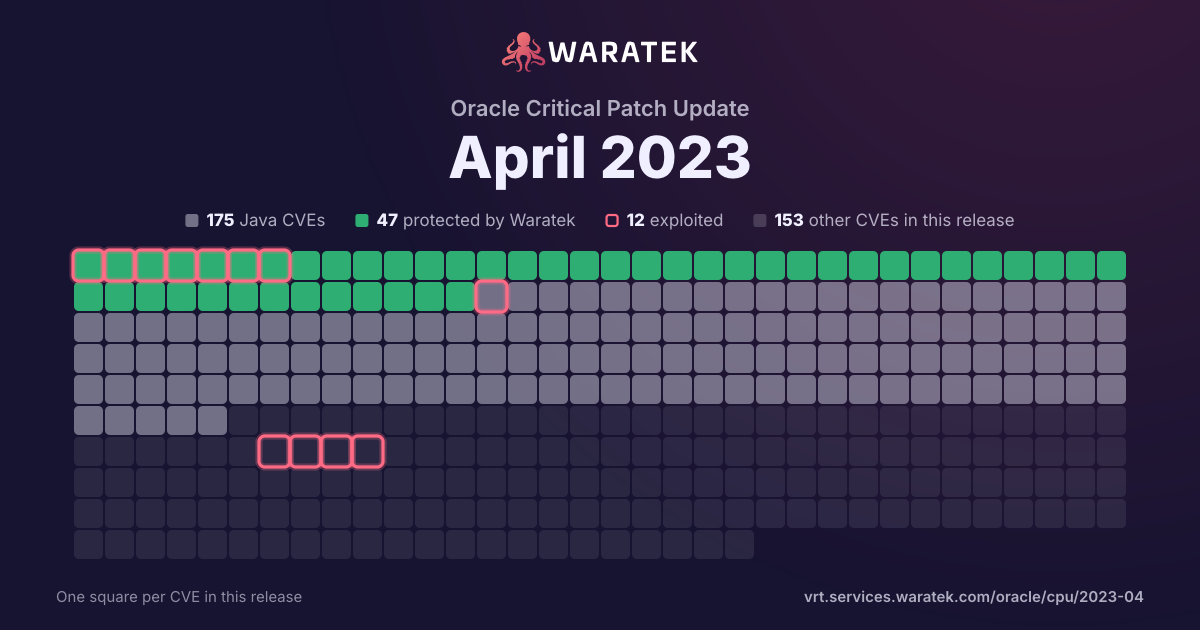
By status
47Protected by Waratek9Mitigation candidate119No exploit published35Outside Waratek scope118Not applicable
12Exploited, marked by the ring
No exploit published. For 56 of them, Oracle's security advisory is the source of public detail.
Protected by Waratek. Waratek RASP can block exploitation of these on systems that have not applied the patch yet.
Overview 27 matches · 8 protected · 0 exploited · 0 CISA KEV · 12 public PoC · 2 EPSS ≥ 0.5
Protected by Waratek
8
29.6%
Rule in development
0
0.0%
Mitigation candidate
8
29.6%
No exploit published
11
40.7%
blocked by ARMR today
8
29.6%
partly blocked
0
0.0%
not blocked
19
70.4%
not established
0
0.0%
unrecorded
0
0.0%
Exploited
0
0.0%
Working exploit published
0
0.0%
Proof of concept only
27
100.0%
Forecast only
0
0.0%
No public exploit
0
0.0%
split by
peak 7 / quarter
Q4 201
Mitigation candidate1
High1
not blocked1
Proof of concept only1
Q1 213
Protected by Waratek1
Mitigation candidate2
High3
blocked by ARMR today1
not blocked2
Proof of concept only3
Q2 210
Q3 210
Q4 210
Q1 223
Protected by Waratek1
No exploit published2
Critical1
High2
blocked by ARMR today1
not blocked2
Proof of concept only3
Q2 223
Protected by Waratek1
Mitigation candidate1
No exploit published1
Critical2
Medium1
blocked by ARMR today1
not blocked2
Proof of concept only3
Q3 227
Protected by Waratek3
Mitigation candidate2
No exploit published2
Critical1
High4
Medium2
blocked by ARMR today3
not blocked4
Proof of concept only7
Q4 227
Protected by Waratek1
Mitigation candidate2
No exploit published4
Critical3
High3
Medium1
blocked by ARMR today1
not blocked6
Proof of concept only7
Q1 232
No exploit published2
High1
Medium1
not blocked2
Proof of concept only2
Q2 231
Protected by Waratek1
Medium1
blocked by ARMR today1
Proof of concept only1
Q4 20Q1 21Q2 21Q3 21Q4 21Q1 22Q2 22Q3 22Q4 22Q1 23Q2 23
| CVE | Severity | Published▾ | Status | Exploitation | Description |
|---|---|---|---|---|---|
| CVE-2023-21939 | Medium | 2023-04-18 | Protected by Waratek | Proof of concept only | Vulnerability in the Oracle Java SE, Oracle GraalVM Enterprise Edition product of Oracle Java SE (component: Swing). Supported versions that are affected are Oracle Java SE: 8u361, 8u361-perf, 11.0.18, 17.0.6, 20; Oracle GraalVM Enterprise Edition: 20.3.9, 21.3.5 and 22.3.1. Easily exploitable vulnerability allows unauthenticated attacker with network access via HTTP to compromise Oracle Java SE, Oracle GraalVM Enterprise Edition. Successful attacks of this vulnerability can result in unauthorized update, insert or delete access to some of Oracle Java SE, Oracle GraalVM Enterprise Edition accessible data. Note: This vulnerability applies to Java deployments, typically in clients running sandboxed Java Web Start applications or sandboxed Java applets, that load and run untrusted code (e.g., code that comes from the internet) and rely on the Java sandbox for security. This vulnerability can also be exploited by using APIs in the specified Component, e.g., through a web service which supplies data to the APIs. CVSS 3.1 Base Score 5.3 (Integrity impacts). CVSS Vector: (CVSS:3.1/AV:N/AC:L/PR:N/UI:N/S:U/C:N/I:L/A:N). |
| CVE-2023-1370 | High | 2023-03-22 | No exploit published | Proof of concept only | [Json-smart](https://netplex.github.io/json-smart/) is a performance focused, JSON processor lib. When reaching a ‘[‘ or ‘{‘ character in the JSON input, the code parses an array or an object respectively. It was discovered that the code does not have any limit to the nesting of such arrays or objects. Since the parsing of nested arrays and objects is done recursively, nesting too many of them can cause a stack exhaustion (stack overflow) and crash the software. |
| CVE-2023-22899 | Medium | 2023-01-10 | No exploit published | Proof of concept only | Zip4j through 2.11.2, as used in Threema and other products, does not always check the MAC when decrypting a ZIP archive. |
| CVE-2022-41966 | High | 2022-12-28 | No exploit published | Proof of concept only | XStream serializes Java objects to XML and back again. Versions prior to 1.4.20 may allow a remote attacker to terminate the application with a stack overflow error, resulting in a denial of service only via manipulation the processed input stream. The attack uses the hash code implementation for collections and maps to force recursive hash calculation causing a stack overflow. This issue is patched in version 1.4.20 which handles the stack overflow and raises an InputManipulationException instead. A potential workaround for users who only use HashMap or HashSet and whose XML refers these only as default map or set, is to change the default implementation of java.util.Map and java.util per the code example in the referenced advisory. However, this implies that your application does not care about the implementation of the map and all elements are comparable. |
| CVE-2022-46364 | Critical | 2022-12-13 | Mitigation candidate | Proof of concept only | A SSRF vulnerability in parsing the href attribute of XOP:Include in MTOM requests in versions of Apache CXF before 3.5.5 and 3.4.10 allows an attacker to perform SSRF style attacks on webservices that take at least one parameter of any type. |
| CVE-2022-45693 | High | 2022-12-13 | No exploit published | Proof of concept only | Jettison before v1.5.2 was discovered to contain a stack overflow via the map parameter. This vulnerability allows attackers to cause a Denial of Service (DoS) via a crafted string. |
| CVE-2022-41915 | Medium | 2022-12-13 | No exploit published | Proof of concept only | Netty project is an event-driven asynchronous network application framework. Starting in version 4.1.83.Final and prior to 4.1.86.Final, when calling `DefaultHttpHeadesr.set` with an _iterator_ of values, header value validation was not performed, allowing malicious header values in the iterator to perform HTTP Response Splitting. This issue has been patched in version 4.1.86.Final. Integrators can work around the issue by changing the `DefaultHttpHeaders.set(CharSequence, Iterator<?>)` call, into a `remove()` call, and call `add()` in a loop over the iterator of values. |
| CVE-2022-41881 | High | 2022-12-12 | No exploit published | Proof of concept only | Netty project is an event-driven asynchronous network application framework. In versions prior to 4.1.86.Final, a StackOverflowError can be raised when parsing a malformed crafted message due to an infinite recursion. This issue is patched in version 4.1.86.Final. There is no workaround, except using a custom HaProxyMessageDecoder. |
| CVE-2022-45047 | Critical | 2022-11-16 | Protected by Waratek | Proof of concept only | Class org.apache.sshd.server.keyprovider.SimpleGeneratorHostKeyProvider in Apache MINA SSHD <= 2.9.1 uses Java deserialization to load a serialized java.security.PrivateKey. The class is one of several implementations that an implementor using Apache MINA SSHD can choose for loading the host keys of an SSH server. |
| CVE-2022-31692 | Critical | 2022-10-31 | Mitigation candidate | Proof of concept only | Spring Security, versions 5.7 prior to 5.7.5 and 5.6 prior to 5.6.9 could be susceptible to authorization rules bypass via forward or include dispatcher types. Specifically, an application is vulnerable when all of the following are true: The application expects that Spring Security applies security to forward and include dispatcher types. The application uses the AuthorizationFilter either manually or via the authorizeHttpRequests() method. The application configures the FilterChainProxy to apply to forward and/or include requests (e.g. spring.security.filter.dispatcher-types = request, error, async, forward, include). The application may forward or include the request to a higher privilege-secured endpoint.The application configures Spring Security to apply to every dispatcher type via authorizeHttpRequests().shouldFilterAllDispatcherTypes(true) |
| CVE-2022-40146 | High | 2022-09-22 | Mitigation candidate | Proof of concept only | Server-Side Request Forgery (SSRF) vulnerability in Batik of Apache XML Graphics allows an attacker to access files using a Jar url. This issue affects Apache XML Graphics Batik 1.14. |
| CVE-2022-40152 | High | 2022-09-16 | No exploit published | Proof of concept only | Those using Woodstox to parse XML data may be vulnerable to Denial of Service attacks (DOS) if DTD support is enabled. If the parser is running on user supplied input, an attacker may supply content that causes the parser to crash by stackoverflow. This effect may support a denial of service attack. |
| CVE-2022-40151 | High | 2022-09-16 | No exploit published | Proof of concept only | Those using Xstream to seralize XML data may be vulnerable to Denial of Service attacks (DOS). If the parser is running on user supplied input, an attacker may supply content that causes the parser to crash by stackoverflow. This effect may support a denial of service attack. |
| CVE-2022-38752 | Medium | 2022-09-05 | Protected by Waratek | Proof of concept only | Using snakeYAML to parse untrusted YAML files may be vulnerable to Denial of Service attacks (DOS). If the parser is running on user supplied input, an attacker may supply content that causes the parser to crash by stack-overflow. |
| CVE-2022-36033 | Medium | 2022-08-29 | Protected by Waratek | Proof of concept only | jsoup is a Java HTML parser, built for HTML editing, cleaning, scraping, and cross-site scripting (XSS) safety. jsoup may incorrectly sanitize HTML including `javascript:` URL expressions, which could allow XSS attacks when a reader subsequently clicks that link. If the non-default `SafeList.preserveRelativeLinks` option is enabled, HTML including `javascript:` URLs that have been crafted with control characters will not be sanitized. If the site that this HTML is published on does not set a Content Security Policy, an XSS attack is then possible. This issue is patched in jsoup 1.15.3. Users should upgrade to this version. Additionally, as the unsanitized input may have been persisted, old content should be cleaned again using the updated version. To remediate this issue without immediately upgrading: - disable `SafeList.preserveRelativeLinks`, which will rewrite input URLs as absolute URLs - ensure an appropriate [Content Security Policy](https://developer.mozilla.org/en-US/docs/Web/HTTP/CSP) is defined. (This should be used regardless of upgrading, as a defence-in-depth best practice.) |
| CVE-2022-34169 | High | 2022-07-19 | Protected by Waratek | Proof of concept only | The Apache Xalan Java XSLT library is vulnerable to an integer truncation issue when processing malicious XSLT stylesheets. This can be used to corrupt Java class files generated by the internal XSLTC compiler and execute arbitrary Java bytecode. Users are recommended to update to version 2.7.3 or later. Note: Java runtimes (such as OpenJDK) include repackaged copies of Xalan. |
| CVE-2022-33980 | Critical | 2022-07-06 | Mitigation candidate | Proof of concept only | Apache Commons Configuration performs variable interpolation, allowing properties to be dynamically evaluated and expanded. The standard format for interpolation is "${prefix:name}", where "prefix" is used to locate an instance of org.apache.commons.configuration2.interpol.Lookup that performs the interpolation. Starting with version 2.4 and continuing through 2.7, the set of default Lookup instances included interpolators that could result in arbitrary code execution or contact with remote servers. These lookups are: - "script" - execute expressions using the JVM script execution engine (javax.script) - "dns" - resolve dns records - "url" - load values from urls, including from remote servers Applications using the interpolation defaults in the affected versions may be vulnerable to remote code execution or unintentional contact with remote servers if untrusted configuration values are used. Users are recommended to upgrade to Apache Commons Configuration 2.8.0, which disables the problematic interpolators by default. |
| CVE-2022-22978 | Critical | 2022-05-19 | Mitigation candidate | Proof of concept only | In spring security versions prior to 5.4.11+, 5.5.7+ , 5.6.4+ and older unsupported versions, RegexRequestMatcher can easily be misconfigured to be bypassed on some servlet containers. Applications using RegexRequestMatcher with `.` in the regular expression are possibly vulnerable to an authorization bypass. |
| CVE-2022-24891 | Medium | 2022-04-27 | No exploit published | Proof of concept only | ESAPI (The OWASP Enterprise Security API) is a free, open source, web application security control library. Prior to version 2.3.0.0, there is a potential for a cross-site scripting vulnerability in ESAPI caused by a incorrect regular expression for "onsiteURL" in the **antisamy-esapi.xml** configuration file that can cause "javascript:" URLs to fail to be correctly sanitized. This issue is patched in ESAPI 2.3.0.0. As a workaround, manually edit the **antisamy-esapi.xml** configuration files to change the "onsiteURL" regular expression. More information about remediation of the vulnerability, including the workaround, is available in the maintainers' release notes and security bulletin. |
| CVE-2022-23457 | Critical | 2022-04-25 | Protected by Waratek | Proof of concept only | ESAPI (The OWASP Enterprise Security API) is a free, open source, web application security control library. Prior to version 2.3.0.0, the default implementation of `Validator.getValidDirectoryPath(String, String, File, boolean)` may incorrectly treat the tested input string as a child of the specified parent directory. This potentially could allow control-flow bypass checks to be defeated if an attack can specify the entire string representing the 'input' path. This vulnerability is patched in release 2.3.0.0 of ESAPI. As a workaround, it is possible to write one's own implementation of the Validator interface. However, maintainers do not recommend this. |
| CVE-2021-43859 | High | 2022-02-01 | No exploit published | Proof of concept only | XStream is an open source java library to serialize objects to XML and back again. Versions prior to 1.4.19 may allow a remote attacker to allocate 100% CPU time on the target system depending on CPU type or parallel execution of such a payload resulting in a denial of service only by manipulating the processed input stream. XStream 1.4.19 monitors and accumulates the time it takes to add elements to collections and throws an exception if a set threshold is exceeded. Users are advised to upgrade as soon as possible. Users unable to upgrade may set the NO_REFERENCE mode to prevent recursion. See GHSA-rmr5-cpv2-vgjf for further details on a workaround if an upgrade is not possible. |
| CVE-2022-23305 | Critical | 2022-01-18 | Protected by Waratek | Proof of concept only | By design, the JDBCAppender in Log4j 1.2.x accepts an SQL statement as a configuration parameter where the values to be inserted are converters from PatternLayout. The message converter, %m, is likely to always be included. This allows attackers to manipulate the SQL by entering crafted strings into input fields or headers of an application that are logged allowing unintended SQL queries to be executed. Note this issue only affects Log4j 1.x when specifically configured to use the JDBCAppender, which is not the default. Beginning in version 2.0-beta8, the JDBCAppender was re-introduced with proper support for parameterized SQL queries and further customization over the columns written to in logs. Apache Log4j 1.2 reached end of life in August 2015. Users should upgrade to Log4j 2 as it addresses numerous other issues from the previous versions. |
| CVE-2021-22569 | High | 2022-01-10 | No exploit published | Proof of concept only | An issue in protobuf-java allowed the interleaving of com.google.protobuf.UnknownFieldSet fields in such a way that would be processed out of order. A small malicious payload can occupy the parser for several minutes by creating large numbers of short-lived objects that cause frequent, repeated pauses. We recommend upgrading libraries beyond the vulnerable versions. |
| CVE-2020-36179 | High | 2021-01-07 | Mitigation candidate | Proof of concept only | FasterXML jackson-databind 2.x before 2.9.10.8 mishandles the interaction between serialization gadgets and typing, related to oadd.org.apache.commons.dbcp.cpdsadapter.DriverAdapterCPDS. |
| CVE-2020-36188 | High | 2021-01-06 | Protected by Waratek | Proof of concept only | FasterXML jackson-databind 2.x before 2.9.10.8 mishandles the interaction between serialization gadgets and typing, related to com.newrelic.agent.deps.ch.qos.logback.core.db.JNDIConnectionSource. |
| CVE-2020-36184 | High | 2021-01-06 | Mitigation candidate | Proof of concept only | FasterXML jackson-databind 2.x before 2.9.10.8 mishandles the interaction between serialization gadgets and typing, related to org.apache.tomcat.dbcp.dbcp2.datasources.PerUserPoolDataSource. |
| CVE-2020-35728 | High | 2020-12-27 | Mitigation candidate | Proof of concept only | FasterXML jackson-databind 2.x before 2.9.10.8 mishandles the interaction between serialization gadgets and typing, related to com.oracle.wls.shaded.org.apache.xalan.lib.sql.JNDIConnectionPool (aka embedded Xalan in org.glassfish.web/javax.servlet.jsp.jstl). |