
Oracle Critical Patch Update January 2023
Released January 2023 · Oracle's advisory ↗ · ← Critical Patch Update, October 2022 · Critical Patch Update, April 2023 →
183 CVEs in this release, one square each
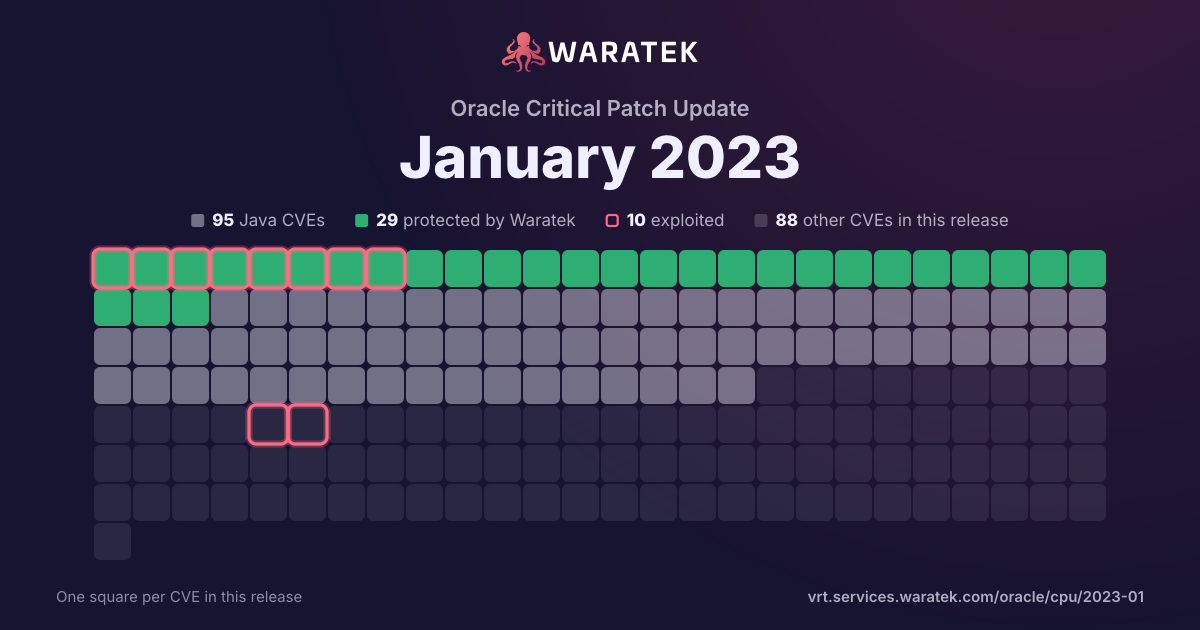
By status
29Protected by Waratek4Mitigation candidate62No exploit published13Outside Waratek scope74Not applicable1Withdrawn CVE
10Exploited, marked by the ring
No exploit published. For 39 of them, Oracle's security advisory is the source of public detail.
Protected by Waratek. Waratek RASP can block exploitation of these on systems that have not applied the patch yet.
Overview 31 matches · 19 in Waratek scope · 13 protected · 4 exploited · 2 CISA KEV · 10 public PoC · 7 EPSS ≥ 0.5
31matches
19in Waratek scope61.3%
13protected41.9%
4exploited12.9%
2CISA KEV6.5%
10public PoC32.3%
7EPSS ≥ 0.522.6%
Protected by Waratek
13
41.9%
Rule in development
0
0.0%
Mitigation candidate
3
9.7%
No exploit published
3
9.7%
Outside Waratek scope
5
16.1%
Not applicable
7
22.6%
Withdrawn CVE
0
0.0%
blocked by ARMR today
13
41.9%
partly blocked
0
0.0%
not blocked
18
58.1%
not established
0
0.0%
unrecorded
0
0.0%
Exploited
4
12.9%
Working exploit published
0
0.0%
Proof of concept only
14
45.2%
Forecast only
0
0.0%
No public exploit
13
41.9%
split by
peak 8 / quarter
Q1 181
Protected by Waratek1
Critical1
blocked by ARMR today1
No public exploit1
Q2 181
Protected by Waratek1
Critical1
blocked by ARMR today1
Exploited1
Q3 180
Q4 180
Q1 190
Q2 190
Q3 190
Q4 191
Protected by Waratek1
Critical1
blocked by ARMR today1
Proof of concept only1
Q1 200
Q2 201
Protected by Waratek1
Critical1
blocked by ARMR today1
No public exploit1
Q3 200
Q4 200
Q1 211
Outside Waratek scope1
Critical1
not blocked1
No public exploit1
Q2 210
Q3 210
Q4 211
Not applicable1
Critical1
not blocked1
No public exploit1
Q1 225
Protected by Waratek2
Outside Waratek scope1
Not applicable2
Critical5
blocked by ARMR today2
not blocked3
Proof of concept only4
No public exploit1
Q2 227
Protected by Waratek4
Mitigation candidate1
Not applicable2
Critical7
blocked by ARMR today4
not blocked3
Exploited2
Proof of concept only2
No public exploit3
Q3 224
Mitigation candidate1
Outside Waratek scope3
Critical4
not blocked4
Proof of concept only3
No public exploit1
Q4 228
Protected by Waratek3
Mitigation candidate1
No exploit published2
Not applicable2
Critical8
blocked by ARMR today3
not blocked5
Exploited1
Proof of concept only4
No public exploit3
Q1 231
No exploit published1
Critical1
not blocked1
No public exploit1
Q1 18Q3 18Q1 19Q3 19Q1 20Q3 20Q1 21Q3 21Q1 22Q3 22Q1 23
| CVE | Severity | Published▾ | Status | Exploitation | Description |
|---|---|---|---|---|---|
| CVE-2023-21890 | Critical | 2023-01-18 | No exploit published | No public exploit | Vulnerability in the Oracle Communications Converged Application Server product of Oracle Communications (component: Core). Supported versions that are affected are 7.1.0 and 8.0.0. Easily exploitable vulnerability allows unauthenticated attacker with network access via UDP to compromise Oracle Communications Converged Application Server. Successful attacks of this vulnerability can result in takeover of Oracle Communications Converged Application Server. CVSS 3.1 Base Score 9.8 (Confidentiality, Integrity and Availability impacts). CVSS Vector: (CVSS:3.1/AV:N/AC:L/PR:N/UI:N/S:U/C:H/I:H/A:H). |
| CVE-2022-32221 | Critical | 2022-12-05 | Not applicable | Proof of concept only | When doing HTTP(S) transfers, libcurl might erroneously use the read callback (`CURLOPT_READFUNCTION`) to ask for data to send, even when the `CURLOPT_POSTFIELDS` option has been set, if the same handle previously was used to issue a `PUT` request which used that callback. This flaw may surprise the application and cause it to misbehave and either send off the wrong data or use memory after free or similar in the subsequent `POST` request. The problem exists in the logic for a reused handle when it is changed from a PUT to a POST. |
| CVE-2022-45047 | Critical | 2022-11-16 | Protected by Waratek | Proof of concept only | Class org.apache.sshd.server.keyprovider.SimpleGeneratorHostKeyProvider in Apache MINA SSHD <= 2.9.1 uses Java deserialization to load a serialized java.security.PrivateKey. The class is one of several implementations that an implementor using Apache MINA SSHD can choose for loading the host keys of an SSH server. |
| CVE-2022-42920 | Critical | 2022-11-07 | Protected by Waratek | No public exploit | Apache Commons BCEL has a number of APIs that would normally only allow changing specific class characteristics. However, due to an out-of-bounds writing issue, these APIs can be used to produce arbitrary bytecode. This could be abused in applications that pass attacker-controllable data to those APIs, giving the attacker more control over the resulting bytecode than otherwise expected. Update to Apache Commons BCEL 6.6.0. |
| CVE-2022-31692 | Critical | 2022-10-31 | Mitigation candidate | Proof of concept only | Spring Security, versions 5.7 prior to 5.7.5 and 5.6 prior to 5.6.9 could be susceptible to authorization rules bypass via forward or include dispatcher types. Specifically, an application is vulnerable when all of the following are true: The application expects that Spring Security applies security to forward and include dispatcher types. The application uses the AuthorizationFilter either manually or via the authorizeHttpRequests() method. The application configures the FilterChainProxy to apply to forward and/or include requests (e.g. spring.security.filter.dispatcher-types = request, error, async, forward, include). The application may forward or include the request to a higher privilege-secured endpoint.The application configures Spring Security to apply to every dispatcher type via authorizeHttpRequests().shouldFilterAllDispatcherTypes(true) |
| CVE-2022-37454 | Critical | 2022-10-21 | Not applicable | Proof of concept only | The Keccak XKCP SHA-3 reference implementation before fdc6fef has an integer overflow and resultant buffer overflow that allows attackers to execute arbitrary code or eliminate expected cryptographic properties. This occurs in the sponge function interface. |
| CVE-2022-43403 | Critical | 2022-10-19 | No exploit published | No public exploit | A sandbox bypass vulnerability involving casting an array-like value to an array type in Jenkins Script Security Plugin 1183.v774b_0b_0a_a_451 and earlier allows attackers with permission to define and run sandboxed scripts, including Pipelines, to bypass the sandbox protection and execute arbitrary code in the context of the Jenkins controller JVM. |
| CVE-2022-42889 | Critical | 2022-10-13 | Protected by Waratek | Exploited | Apache Commons Text performs variable interpolation, allowing properties to be dynamically evaluated and expanded. The standard format for interpolation is "${prefix:name}", where "prefix" is used to locate an instance of org.apache.commons.text.lookup.StringLookup that performs the interpolation. Starting with version 1.5 and continuing through 1.9, the set of default Lookup instances included interpolators that could result in arbitrary code execution or contact with remote servers. These lookups are: - "script" - execute expressions using the JVM script execution engine (javax.script) - "dns" - resolve dns records - "url" - load values from urls, including from remote servers Applications using the interpolation defaults in the affected versions may be vulnerable to remote code execution or unintentional contact with remote servers if untrusted configuration values are used. Users are recommended to upgrade to Apache Commons Text 1.10.0, which disables the problematic interpolators by default. |
| CVE-2022-40664 | Critical | 2022-10-12 | No exploit published | No public exploit | Apache Shiro before 1.10.0, Authentication Bypass Vulnerability in Shiro when forwarding or including via RequestDispatcher. |
| CVE-2022-2526 | Critical | 2022-09-09 | Outside Waratek scope | No public exploit | A use-after-free vulnerability was found in systemd. This issue occurs due to the on_stream_io() function and dns_stream_complete() function in 'resolved-dns-stream.c' not incrementing the reference counting for the DnsStream object. Therefore, other functions and callbacks called can dereference the DNSStream object, causing the use-after-free when the reference is still used later. |
| CVE-2022-37434 | Critical | 2022-08-05 | Outside Waratek scope | Proof of concept only | zlib through 1.2.12 has a heap-based buffer over-read or buffer overflow in inflate in inflate.c via a large gzip header extra field. NOTE: only applications that call inflateGetHeader are affected. Some common applications bundle the affected zlib source code but may be unable to call inflateGetHeader (e.g., see the nodejs/node reference). |
| CVE-2022-33980 | Critical | 2022-07-06 | Mitigation candidate | Proof of concept only | Apache Commons Configuration performs variable interpolation, allowing properties to be dynamically evaluated and expanded. The standard format for interpolation is "${prefix:name}", where "prefix" is used to locate an instance of org.apache.commons.configuration2.interpol.Lookup that performs the interpolation. Starting with version 2.4 and continuing through 2.7, the set of default Lookup instances included interpolators that could result in arbitrary code execution or contact with remote servers. These lookups are: - "script" - execute expressions using the JVM script execution engine (javax.script) - "dns" - resolve dns records - "url" - load values from urls, including from remote servers Applications using the interpolation defaults in the affected versions may be vulnerable to remote code execution or unintentional contact with remote servers if untrusted configuration values are used. Users are recommended to upgrade to Apache Commons Configuration 2.8.0, which disables the problematic interpolators by default. |
| CVE-2022-2274 | Critical | 2022-07-01 | Outside Waratek scope | Proof of concept only | The OpenSSL 3.0.4 release introduced a serious bug in the RSA implementation for X86_64 CPUs supporting the AVX512IFMA instructions. This issue makes the RSA implementation with 2048 bit private keys incorrect on such machines and memory corruption will happen during the computation. As a consequence of the memory corruption an attacker may be able to trigger a remote code execution on the machine performing the computation. SSL/TLS servers or other servers using 2048 bit RSA private keys running on machines supporting AVX512IFMA instructions of the X86_64 architecture are affected by this issue. |
| CVE-2021-41411 | Critical | 2022-06-16 | Protected by Waratek | No public exploit | drools <=7.59.x is affected by an XML External Entity (XXE) vulnerability in KieModuleMarshaller.java. The Validator class is not used correctly, resulting in the XXE injection vulnerability. |
| CVE-2022-31813 | Critical | 2022-06-09 | Not applicable | No public exploit | Apache HTTP Server 2.4.53 and earlier may not send the X-Forwarded-* headers to the origin server based on client side Connection header hop-by-hop mechanism. This may be used to bypass IP based authentication on the origin server/application. |
| CVE-2022-22978 | Critical | 2022-05-19 | Mitigation candidate | Proof of concept only | In spring security versions prior to 5.4.11+, 5.5.7+ , 5.6.4+ and older unsupported versions, RegexRequestMatcher can easily be misconfigured to be bypassed on some servlet containers. Applications using RegexRequestMatcher with `.` in the regular expression are possibly vulnerable to an authorization bypass. |
| CVE-2022-23457 | Critical | 2022-04-25 | Protected by Waratek | Proof of concept only | ESAPI (The OWASP Enterprise Security API) is a free, open source, web application security control library. Prior to version 2.3.0.0, the default implementation of `Validator.getValidDirectoryPath(String, String, File, boolean)` may incorrectly treat the tested input string as a child of the specified parent directory. This potentially could allow control-flow bypass checks to be defeated if an attack can specify the entire string representing the 'input' path. This vulnerability is patched in release 2.3.0.0 of ESAPI. As a workaround, it is possible to write one's own implementation of the Validator interface. However, maintainers do not recommend this. |
| CVE-2022-27404 | Critical | 2022-04-22 | Not applicable | No public exploit | FreeType commit 1e2eb65048f75c64b68708efed6ce904c31f3b2f was discovered to contain a heap buffer overflow via the function sfnt_init_face. |
| CVE-2021-31805 | Critical | 2022-04-12 | Protected by Waratek | Exploited | The fix issued for CVE-2020-17530 was incomplete. So from Apache Struts 2.0.0 to 2.5.29, still some of the tag’s attributes could perform a double evaluation if a developer applied forced OGNL evaluation by using the %{...} syntax. Using forced OGNL evaluation on untrusted user input can lead to a Remote Code Execution and security degradation. |
| CVE-2022-22965 | Critical | 2022-04-01 | Protected by Waratek | Exploited | A Spring MVC or Spring WebFlux application running on JDK 9+ may be vulnerable to remote code execution (RCE) via data binding. The specific exploit requires the application to run on Tomcat as a WAR deployment. If the application is deployed as a Spring Boot executable jar, i.e. the default, it is not vulnerable to the exploit. However, the nature of the vulnerability is more general, and there may be other ways to exploit it. |
| CVE-2022-25315 | Critical | 2022-02-18 | Not applicable | Proof of concept only | In Expat (aka libexpat) before 2.4.5, there is an integer overflow in storeRawNames. |
| CVE-2022-25236 | Critical | 2022-02-16 | Not applicable | No public exploit | xmlparse.c in Expat (aka libexpat) before 2.4.5 allows attackers to insert namespace-separator characters into namespace URIs. |
| CVE-2022-23221 | Critical | 2022-01-19 | Protected by Waratek | Proof of concept only | H2 Console before 2.1.210 allows remote attackers to execute arbitrary code via a jdbc:h2:mem JDBC URL containing the IGNORE_UNKNOWN_SETTINGS=TRUE;FORBID_CREATION=FALSE;INIT=RUNSCRIPT substring, a different vulnerability than CVE-2021-42392. |
| CVE-2022-23305 | Critical | 2022-01-18 | Protected by Waratek | Proof of concept only | By design, the JDBCAppender in Log4j 1.2.x accepts an SQL statement as a configuration parameter where the values to be inserted are converters from PatternLayout. The message converter, %m, is likely to always be included. This allows attackers to manipulate the SQL by entering crafted strings into input fields or headers of an application that are logged allowing unintended SQL queries to be executed. Note this issue only affects Log4j 1.x when specifically configured to use the JDBCAppender, which is not the default. Beginning in version 2.0-beta8, the JDBCAppender was re-introduced with proper support for parameterized SQL queries and further customization over the columns written to in logs. Apache Log4j 1.2 reached end of life in August 2015. Users should upgrade to Log4j 2 as it addresses numerous other issues from the previous versions. |
| CVE-2022-23219 | Critical | 2022-01-14 | Outside Waratek scope | Proof of concept only | The deprecated compatibility function clnt_create in the sunrpc module of the GNU C Library (aka glibc) through 2.34 copies its hostname argument on the stack without validating its length, which may result in a buffer overflow, potentially resulting in a denial of service or (if an application is not built with a stack protector enabled) arbitrary code execution. |
| CVE-2021-3918 | Critical | 2021-11-13 | Not applicable | No public exploit | json-schema is vulnerable to Improperly Controlled Modification of Object Prototype Attributes ('Prototype Pollution') |
| CVE-2020-36242 | Critical | 2021-02-07 | Outside Waratek scope | No public exploit | In the cryptography package before 3.3.2 for Python, certain sequences of update calls to symmetrically encrypt multi-GB values could result in an integer overflow and buffer overflow, as demonstrated by the Fernet class. |
| CVE-2020-10683 | Critical | 2020-05-01 | Protected by Waratek | No public exploit | dom4j before 2.0.3 and 2.1.x before 2.1.3 allows external DTDs and External Entities by default, which might enable XXE attacks. However, there is popular external documentation from OWASP showing how to enable the safe, non-default behavior in any application that uses dom4j. |
| CVE-2019-17571 | Critical | 2019-12-20 | Protected by Waratek | Proof of concept only | Included in Log4j 1.2 is a SocketServer class that is vulnerable to deserialization of untrusted data which can be exploited to remotely execute arbitrary code when combined with a deserialization gadget when listening to untrusted network traffic for log data. This affects Log4j versions up to 1.2 up to 1.2.17. |
| CVE-2018-1273 | Critical | 2018-04-11 | Protected by Waratek | Exploited | Spring Data Commons, versions prior to 1.13 to 1.13.10, 2.0 to 2.0.5, and older unsupported versions, contain a property binder vulnerability caused by improper neutralization of special elements. An unauthenticated remote malicious user (or attacker) can supply specially crafted request parameters against Spring Data REST backed HTTP resources or using Spring Data's projection-based request payload binding hat can lead to a remote code execution attack. |
| CVE-2018-7489 | Critical | 2018-02-26 | Protected by Waratek | No public exploit | FasterXML jackson-databind before 2.7.9.3, 2.8.x before 2.8.11.1 and 2.9.x before 2.9.5 allows unauthenticated remote code execution because of an incomplete fix for the CVE-2017-7525 deserialization flaw. This is exploitable by sending maliciously crafted JSON input to the readValue method of the ObjectMapper, bypassing a blacklist that is ineffective if the c3p0 libraries are available in the classpath. |