
Oracle Critical Patch Update April 2020
Released April 2020 · Oracle's advisory ↗ · ← Critical Patch Update, January 2020 · Critical Patch Update, July 2020 →
300 CVEs in this release, one square each
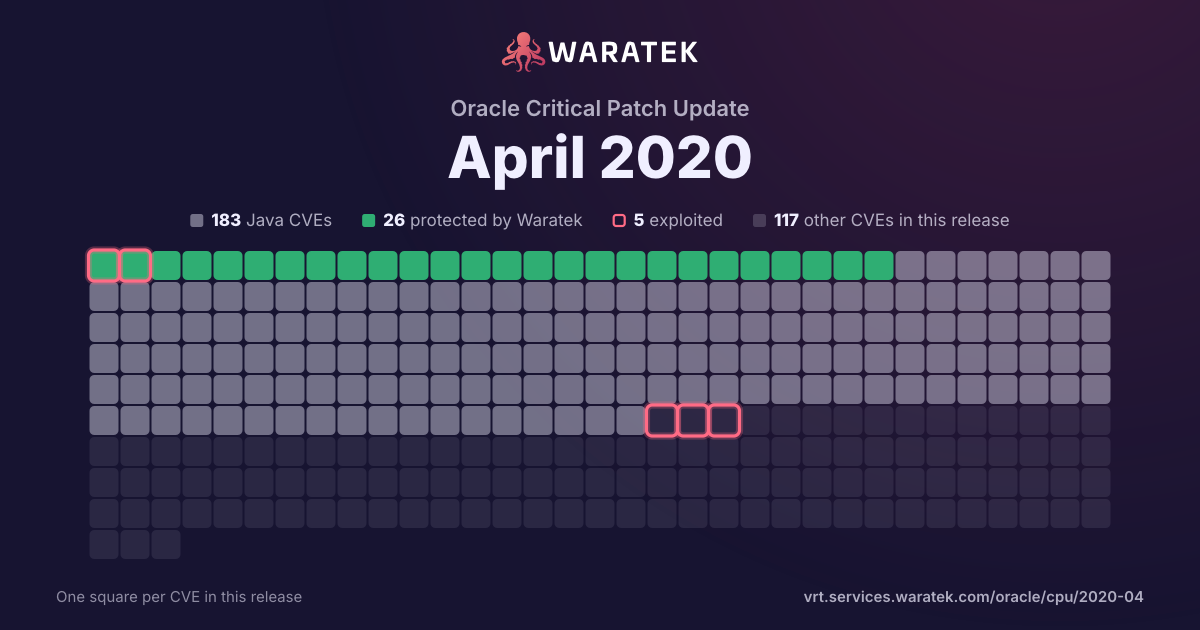
By status
26Protected by Waratek1Mitigation candidate156No exploit published60Outside Waratek scope56Not applicable1Withdrawn CVE
5Exploited, marked by the ring
No exploit published. For 141 of them, Oracle's security advisory is the source of public detail.
Protected by Waratek. Waratek RASP can block exploitation of these on systems that have not applied the patch yet.
Overview 15 matches · 10 in Waratek scope · 5 protected · 4 exploited · 2 CISA KEV · 8 public PoC
Protected by Waratek
5
33.3%
Rule in development
0
0.0%
Mitigation candidate
0
0.0%
No exploit published
5
33.3%
Outside Waratek scope
4
26.7%
Not applicable
1
6.7%
Withdrawn CVE
0
0.0%
blocked by ARMR today
5
33.3%
partly blocked
0
0.0%
not blocked
10
66.7%
not established
0
0.0%
unrecorded
0
0.0%
Exploited
4
26.7%
Working exploit published
2
13.3%
Proof of concept only
2
13.3%
Forecast only
7
46.7%
No public exploit
0
0.0%
split by
peak 5 / quarter
Q2 171
Protected by Waratek1
Critical1
blocked by ARMR today1
Working exploit published1
Q3 170
Q4 170
Q1 181
Not applicable1
Medium1
not blocked1
Forecast only1
Q2 180
Q3 180
Q4 180
Q1 190
Q2 195
Protected by Waratek1
No exploit published1
Outside Waratek scope3
Critical1
High3
Medium1
blocked by ARMR today1
not blocked4
Exploited3
Working exploit published1
Forecast only1
Q3 191
Protected by Waratek1
Critical1
blocked by ARMR today1
Forecast only1
Q4 191
Protected by Waratek1
Critical1
blocked by ARMR today1
Proof of concept only1
Q1 201
Outside Waratek scope1
High1
not blocked1
Proof of concept only1
Q2 205
Protected by Waratek1
No exploit published4
Critical2
High3
blocked by ARMR today1
not blocked4
Exploited1
Forecast only4
Q2 17Q4 17Q2 18Q4 18Q2 19Q4 19Q2 20
| CVE | Severity | Published▾ | Status | Exploitation | Description |
|---|---|---|---|---|---|
| CVE-2020-2950 | Critical | 2020-04-15 | No exploit published | Forecast only | Vulnerability in the Oracle Business Intelligence Enterprise Edition product of Oracle Fusion Middleware (component: Analytics Web General). Supported versions that are affected are 5.5.0.0.0, 11.1.1.9.0, 12.2.1.3.0 and 12.2.1.4.0. Easily exploitable vulnerability allows unauthenticated attacker with network access via HTTP to compromise Oracle Business Intelligence Enterprise Edition. Successful attacks of this vulnerability can result in takeover of Oracle Business Intelligence Enterprise Edition. CVSS 3.0 Base Score 9.8 (Confidentiality, Integrity and Availability impacts). CVSS Vector: (CVSS:3.0/AV:N/AC:L/PR:N/UI:N/S:U/C:H/I:H/A:H). |
| CVE-2020-2883 | Critical | 2020-04-15 | Protected by Waratek | Exploited | Vulnerability in the Oracle WebLogic Server product of Oracle Fusion Middleware (component: Core). Supported versions that are affected are 10.3.6.0.0, 12.1.3.0.0, 12.2.1.3.0 and 12.2.1.4.0. Easily exploitable vulnerability allows unauthenticated attacker with network access via IIOP, T3 to compromise Oracle WebLogic Server. Successful attacks of this vulnerability can result in takeover of Oracle WebLogic Server. CVSS 3.0 Base Score 9.8 (Confidentiality, Integrity and Availability impacts). CVSS Vector: (CVSS:3.0/AV:N/AC:L/PR:N/UI:N/S:U/C:H/I:H/A:H). |
| CVE-2020-2871 | High | 2020-04-15 | No exploit published | Forecast only | Vulnerability in the Oracle Advanced Outbound Telephony product of Oracle E-Business Suite (component: User Interface). Supported versions that are affected are 12.1.1-12.1.3 and 12.2.3-12.2.9. Easily exploitable vulnerability allows unauthenticated attacker with network access via HTTP to compromise Oracle Advanced Outbound Telephony. Successful attacks require human interaction from a person other than the attacker and while the vulnerability is in Oracle Advanced Outbound Telephony, attacks may significantly impact additional products. Successful attacks of this vulnerability can result in unauthorized access to critical data or complete access to all Oracle Advanced Outbound Telephony accessible data as well as unauthorized update, insert or delete access to some of Oracle Advanced Outbound Telephony accessible data. CVSS 3.0 Base Score 8.2 (Confidentiality and Integrity impacts). CVSS Vector: (CVSS:3.0/AV:N/AC:L/PR:N/UI:R/S:C/C:H/I:L/A:N). |
| CVE-2020-2854 | High | 2020-04-15 | No exploit published | Forecast only | Vulnerability in the Oracle Advanced Outbound Telephony product of Oracle E-Business Suite (component: User Interface). Supported versions that are affected are 12.1.1-12.1.3. Easily exploitable vulnerability allows unauthenticated attacker with network access via HTTP to compromise Oracle Advanced Outbound Telephony. Successful attacks require human interaction from a person other than the attacker and while the vulnerability is in Oracle Advanced Outbound Telephony, attacks may significantly impact additional products. Successful attacks of this vulnerability can result in unauthorized access to critical data or complete access to all Oracle Advanced Outbound Telephony accessible data as well as unauthorized update, insert or delete access to some of Oracle Advanced Outbound Telephony accessible data. CVSS 3.0 Base Score 8.2 (Confidentiality and Integrity impacts). CVSS Vector: (CVSS:3.0/AV:N/AC:L/PR:N/UI:R/S:C/C:H/I:L/A:N). |
| CVE-2020-2852 | High | 2020-04-15 | No exploit published | Forecast only | Vulnerability in the Oracle Advanced Outbound Telephony product of Oracle E-Business Suite (component: Calendar). Supported versions that are affected are 12.1.1-12.1.3. Easily exploitable vulnerability allows unauthenticated attacker with network access via HTTP to compromise Oracle Advanced Outbound Telephony. Successful attacks require human interaction from a person other than the attacker and while the vulnerability is in Oracle Advanced Outbound Telephony, attacks may significantly impact additional products. Successful attacks of this vulnerability can result in unauthorized access to critical data or complete access to all Oracle Advanced Outbound Telephony accessible data as well as unauthorized update, insert or delete access to some of Oracle Advanced Outbound Telephony accessible data. CVSS 3.0 Base Score 8.2 (Confidentiality and Integrity impacts). CVSS Vector: (CVSS:3.0/AV:N/AC:L/PR:N/UI:R/S:C/C:H/I:L/A:N). |
| CVE-2020-5398 | High | 2020-01-17 | Outside Waratek scope | Proof of concept only | In Spring Framework, versions 5.2.x prior to 5.2.3, versions 5.1.x prior to 5.1.13, and versions 5.0.x prior to 5.0.16, an application is vulnerable to a reflected file download (RFD) attack when it sets a "Content-Disposition" header in the response where the filename attribute is derived from user supplied input. |
| CVE-2019-17571 | Critical | 2019-12-20 | Protected by Waratek | Proof of concept only | Included in Log4j 1.2 is a SocketServer class that is vulnerable to deserialization of untrusted data which can be exploited to remotely execute arbitrary code when combined with a deserialization gadget when listening to untrusted network traffic for log data. This affects Log4j versions up to 1.2 up to 1.2.17. |
| CVE-2019-10173 | Critical | 2019-07-23 | Protected by Waratek | Forecast only | It was found that xstream API version 1.4.10 before 1.4.11 introduced a regression for a previous deserialization flaw. If the security framework has not been initialized, it may allow a remote attacker to run arbitrary shell commands when unmarshalling XML or any supported format. e.g. JSON. (regression of CVE-2013-7285) |
| CVE-2019-10072 | High | 2019-06-21 | No exploit published | Forecast only | The fix for CVE-2019-0199 was incomplete and did not address HTTP/2 connection window exhaustion on write in Apache Tomcat versions 9.0.0.M1 to 9.0.19 and 8.5.0 to 8.5.40 . By not sending WINDOW_UPDATE messages for the connection window (stream 0) clients were able to cause server-side threads to block eventually leading to thread exhaustion and a DoS. |
| CVE-2019-2729 | Critical | 2019-06-19 | Protected by Waratek | Exploited | Vulnerability in the Oracle WebLogic Server component of Oracle Fusion Middleware (subcomponent: Web Services). Supported versions that are affected are 10.3.6.0.0, 12.1.3.0.0 and 12.2.1.3.0. Easily exploitable vulnerability allows unauthenticated attacker with network access via HTTP to compromise Oracle WebLogic Server. Successful attacks of this vulnerability can result in takeover of Oracle WebLogic Server. CVSS 3.0 Base Score 9.8 (Confidentiality, Integrity and Availability impacts). CVSS Vector: (CVSS:3.0/AV:N/AC:L/PR:N/UI:N/S:U/C:H/I:H/A:H). |
| CVE-2019-0227 | High | 2019-05-01 | Outside Waratek scope | Working exploit published | A Server Side Request Forgery (SSRF) vulnerability affected the Apache Axis 1.4 distribution that was last released in 2006. Security and bug commits commits continue in the projects Axis 1.x Subversion repository, legacy users are encouraged to build from source. The successor to Axis 1.x is Axis2, the latest version is 1.7.9 and is not vulnerable to this issue. |
| CVE-2019-11358 | Medium | 2019-04-20 | Outside Waratek scope | Exploited | jQuery before 3.4.0, as used in Drupal, Backdrop CMS, and other products, mishandles jQuery.extend(true, {}, ...) because of Object.prototype pollution. If an unsanitized source object contained an enumerable __proto__ property, it could extend the native Object.prototype. |
| CVE-2019-0211 | High | 2019-04-08 | Outside Waratek scope | Exploited | In Apache HTTP Server 2.4 releases 2.4.17 to 2.4.38, with MPM event, worker or prefork, code executing in less-privileged child processes or threads (including scripts executed by an in-process scripting interpreter) could execute arbitrary code with the privileges of the parent process (usually root) by manipulating the scoreboard. Non-Unix systems are not affected. |
| CVE-2018-5712 | Medium | 2018-01-16 | Not applicable | Forecast only | An issue was discovered in PHP before 5.6.33, 7.0.x before 7.0.27, 7.1.x before 7.1.13, and 7.2.x before 7.2.1. There is Reflected XSS on the PHAR 404 error page via the URI of a request for a .phar file. |
| CVE-2017-5645 | Critical | 2017-04-17 | Protected by Waratek | Working exploit published | In Apache Log4j 2.x before 2.8.2, when using the TCP socket server or UDP socket server to receive serialized log events from another application, a specially crafted binary payload can be sent that, when deserialized, can execute arbitrary code. |