
Oracle Critical Patch Update April 2020
Released April 2020 · Oracle's advisory ↗ · ← Critical Patch Update, January 2020 · Critical Patch Update, July 2020 →
300 CVEs in this release, one square each
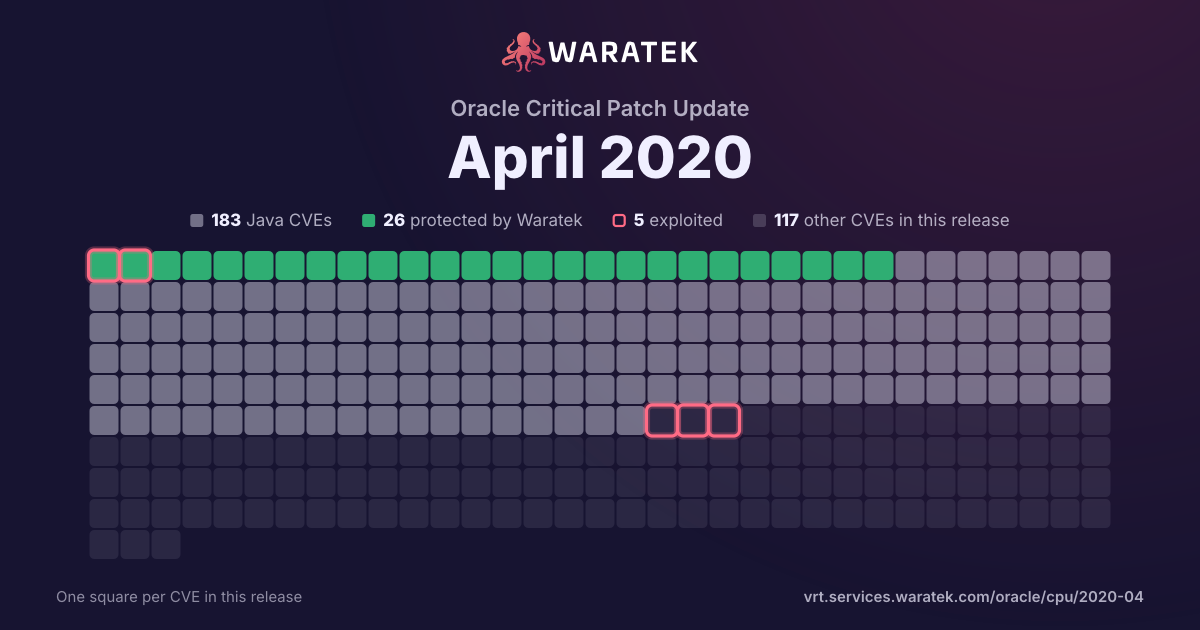
By status
26Protected by Waratek5Mitigation candidate166No exploit published6Outside Waratek scope96Not applicable1Withdrawn CVE
5Exploited, marked by the ring
No exploit published. For 144 of them, Oracle's security advisory is the source of public detail.
Protected by Waratek. Waratek RASP can block exploitation of these on systems that have not applied the patch yet.
Overview 25 matches · 11 protected · 0 exploited · 0 CISA KEV · 2 public PoC · 3 EPSS ≥ 0.5
Protected by Waratek
11
44.0%
Rule in development
0
0.0%
Mitigation candidate
1
4.0%
No exploit published
13
52.0%
blocked by ARMR today
11
44.0%
partly blocked
0
0.0%
not blocked
14
56.0%
not established
0
0.0%
unrecorded
0
0.0%
Exploited
0
0.0%
Working exploit published
2
8.0%
Proof of concept only
0
0.0%
Forecast only
1
4.0%
No public exploit
22
88.0%
split by
peak 6 / quarter
Q4 151
No exploit published1
Medium1
not blocked1
No public exploit1
Q1 160
Q2 160
Q3 161
No exploit published1
High1
not blocked1
No public exploit1
Q4 161
Protected by Waratek1
Critical1
blocked by ARMR today1
No public exploit1
Q1 170
Q2 171
Protected by Waratek1
Critical1
blocked by ARMR today1
Working exploit published1
Q3 172
Protected by Waratek2
Critical1
Medium1
blocked by ARMR today2
No public exploit2
Q4 170
Q1 181
No exploit published1
High1
not blocked1
No public exploit1
Q2 181
No exploit published1
High1
not blocked1
No public exploit1
Q3 182
Protected by Waratek1
No exploit published1
High2
blocked by ARMR today1
not blocked1
No public exploit2
Q4 182
No exploit published2
High1
Medium1
not blocked2
No public exploit2
Q1 190
Q2 192
Mitigation candidate1
No exploit published1
High1
Medium1
not blocked2
Working exploit published1
No public exploit1
Q3 196
Protected by Waratek4
No exploit published2
Critical3
High3
blocked by ARMR today4
not blocked2
Forecast only1
No public exploit5
Q4 195
Protected by Waratek2
No exploit published3
Critical2
High1
Medium2
blocked by ARMR today2
not blocked3
No public exploit5
Q4 15Q2 16Q4 16Q2 17Q4 17Q2 18Q4 18Q2 19Q4 19
| CVE | Severity | Published▾ | Status | Exploitation | Description |
|---|---|---|---|---|---|
| CVE-2019-12415 | Medium | 2019-10-23 | Protected by Waratek | No public exploit | In Apache POI up to 4.1.0, when using the tool XSSFExportToXml to convert user-provided Microsoft Excel documents, a specially crafted document can allow an attacker to read files from the local filesystem or from internal network resources via XML External Entity (XXE) Processing. |
| CVE-2019-2904 | Critical | 2019-10-16 | No exploit published | No public exploit | Vulnerability in the Oracle JDeveloper and ADF product of Oracle Fusion Middleware (component: ADF Faces). Supported versions that are affected are 11.1.1.9.0, 12.1.3.0.0 and 12.2.1.3.0. Easily exploitable vulnerability allows unauthenticated attacker with network access via HTTP to compromise Oracle JDeveloper and ADF. Successful attacks of this vulnerability can result in takeover of Oracle JDeveloper and ADF. CVSS 3.0 Base Score 9.8 (Confidentiality, Integrity and Availability impacts). CVSS Vector: (CVSS:3.0/AV:N/AC:L/PR:N/UI:N/S:U/C:H/I:H/A:H). |
| CVE-2019-17359 | High | 2019-10-08 | No exploit published | No public exploit | The ASN.1 parser in Bouncy Castle Crypto (aka BC Java) 1.63 can trigger a large attempted memory allocation, and resultant OutOfMemoryError error, via crafted ASN.1 data. This is fixed in 1.64. |
| CVE-2019-17091 | Medium | 2019-10-02 | Protected by Waratek | No public exploit | faces/context/PartialViewContextImpl.java in Eclipse Mojarra, as used in Mojarra for Eclipse EE4J before 2.3.10 and Mojarra JavaServer Faces before 2.2.20, allows Reflected XSS because a client window field is mishandled. |
| CVE-2019-16943 | Critical | 2019-10-01 | No exploit published | No public exploit | A Polymorphic Typing issue was discovered in FasterXML jackson-databind 2.0.0 through 2.9.10. When Default Typing is enabled (either globally or for a specific property) for an externally exposed JSON endpoint and the service has the p6spy (3.8.6) jar in the classpath, and an attacker can find an RMI service endpoint to access, it is possible to make the service execute a malicious payload. This issue exists because of com.p6spy.engine.spy.P6DataSource mishandling. |
| CVE-2019-12402 | High | 2019-08-30 | No exploit published | No public exploit | The file name encoding algorithm used internally in Apache Commons Compress 1.15 to 1.18 can get into an infinite loop when faced with specially crafted inputs. This can lead to a denial of service attack if an attacker can choose the file names inside of an archive created by Compress. |
| CVE-2019-10086 | High | 2019-08-20 | Protected by Waratek | No public exploit | In Apache Commons Beanutils 1.9.2, a special BeanIntrospector class was added which allows suppressing the ability for an attacker to access the classloader via the class property available on all Java objects. We, however were not using this by default characteristic of the PropertyUtilsBean. |
| CVE-2019-10088 | High | 2019-08-02 | No exploit published | No public exploit | A carefully crafted or corrupt zip file can cause an OOM in Apache Tika's RecursiveParserWrapper in versions 1.7-1.21. Users should upgrade to 1.22 or later. |
| CVE-2019-14379 | Critical | 2019-07-29 | Protected by Waratek | No public exploit | SubTypeValidator.java in FasterXML jackson-databind before 2.9.9.2 mishandles default typing when ehcache is used (because of net.sf.ehcache.transaction.manager.DefaultTransactionManagerLookup), leading to remote code execution. |
| CVE-2019-13990 | Critical | 2019-07-26 | Protected by Waratek | No public exploit | initDocumentParser in xml/XMLSchedulingDataProcessor.java in Terracotta Quartz Scheduler through 2.3.0 allows XXE attacks via a job description. |
| CVE-2019-10173 | Critical | 2019-07-23 | Protected by Waratek | Forecast only | It was found that xstream API version 1.4.10 before 1.4.11 introduced a regression for a previous deserialization flaw. If the security framework has not been initialized, it may allow a remote attacker to run arbitrary shell commands when unmarshalling XML or any supported format. e.g. JSON. (regression of CVE-2013-7285) |
| CVE-2019-0227 | High | 2019-05-01 | Mitigation candidate | Working exploit published | A Server Side Request Forgery (SSRF) vulnerability affected the Apache Axis 1.4 distribution that was last released in 2006. Security and bug commits commits continue in the projects Axis 1.x Subversion repository, legacy users are encouraged to build from source. The successor to Axis 1.x is Axis2, the latest version is 1.7.9 and is not vulnerable to this issue. |
| CVE-2019-10247 | Medium | 2019-04-22 | No exploit published | No public exploit | In Eclipse Jetty version 7.x, 8.x, 9.2.27 and older, 9.3.26 and older, and 9.4.16 and older, the server running on any OS and Jetty version combination will reveal the configured fully qualified directory base resource location on the output of the 404 error for not finding a Context that matches the requested path. The default server behavior on jetty-distribution and jetty-home will include at the end of the Handler tree a DefaultHandler, which is responsible for reporting this 404 error, it presents the various configured contexts as HTML for users to click through to. This produced HTML includes output that contains the configured fully qualified directory base resource location for each context. |
| CVE-2018-17197 | Medium | 2018-12-24 | No exploit published | No public exploit | A carefully crafted or corrupt sqlite file can cause an infinite loop in Apache Tika's SQLite3Parser in versions 1.8-1.19.1 of Apache Tika. |
| CVE-2018-15756 | High | 2018-10-18 | No exploit published | No public exploit | Spring Framework, version 5.1, versions 5.0.x prior to 5.0.10, versions 4.3.x prior to 4.3.20, and older unsupported versions on the 4.2.x branch provide support for range requests when serving static resources through the ResourceHttpRequestHandler, or starting in 5.0 when an annotated controller returns an org.springframework.core.io.Resource. A malicious user (or attacker) can add a range header with a high number of ranges, or with wide ranges that overlap, or both, for a denial of service attack. This vulnerability affects applications that depend on either spring-webmvc or spring-webflux. Such applications must also have a registration for serving static resources (e.g. JS, CSS, images, and others), or have an annotated controller that returns an org.springframework.core.io.Resource. Spring Boot applications that depend on spring-boot-starter-web or spring-boot-starter-webflux are ready to serve static resources out of the box and are therefore vulnerable. |
| CVE-2018-1000632 | High | 2018-08-20 | Protected by Waratek | No public exploit | dom4j version prior to version 2.1.1 contains a CWE-91: XML Injection vulnerability in Class: Element. Methods: addElement, addAttribute that can result in an attacker tampering with XML documents through XML injection. This attack appear to be exploitable via an attacker specifying attributes or elements in the XML document. This vulnerability appears to have been fixed in 2.1.1 or later. |
| CVE-2018-8039 | High | 2018-07-02 | No exploit published | No public exploit | It is possible to configure Apache CXF to use the com.sun.net.ssl implementation via 'System.setProperty("java.protocol.handler.pkgs", "com.sun.net.ssl.internal.www.protocol");'. When this system property is set, CXF uses some reflection to try to make the HostnameVerifier work with the old com.sun.net.ssl.HostnameVerifier interface. However, the default HostnameVerifier implementation in CXF does not implement the method in this interface, and an exception is thrown. However, in Apache CXF prior to 3.2.5 and 3.1.16 the exception is caught in the reflection code and not properly propagated. What this means is that if you are using the com.sun.net.ssl stack with CXF, an error with TLS hostname verification will not be thrown, leaving a CXF client subject to man-in-the-middle attacks. |
| CVE-2018-1258 | High | 2018-05-11 | No exploit published | No public exploit | Spring Framework version 5.0.5 when used in combination with any versions of Spring Security contains an authorization bypass when using method security. An unauthorized malicious user can gain unauthorized access to methods that should be restricted. |
| CVE-2017-12626 | High | 2018-01-29 | No exploit published | No public exploit | Apache POI in versions prior to release 3.17 are vulnerable to Denial of Service Attacks: 1) Infinite Loops while parsing crafted WMF, EMF, MSG and macros (POI bugs 61338 and 61294), and 2) Out of Memory Exceptions while parsing crafted DOC, PPT and XLS (POI bugs 52372 and 61295). |
| CVE-2017-14735 | Medium | 2017-09-25 | Protected by Waratek | No public exploit | OWASP AntiSamy before 1.5.7 allows XSS via HTML5 entities, as demonstrated by use of : to construct a javascript: URL. |
| CVE-2016-4000 | Critical | 2017-07-06 | Protected by Waratek | No public exploit | Jython before 2.7.1rc1 allows attackers to execute arbitrary code via a crafted serialized PyFunction object. |
| CVE-2017-5645 | Critical | 2017-04-17 | Protected by Waratek | Working exploit published | In Apache Log4j 2.x before 2.8.2, when using the TCP socket server or UDP socket server to receive serialized log events from another application, a specially crafted binary payload can be sent that, when deserialized, can execute arbitrary code. |
| CVE-2016-1000031 | Critical | 2016-10-25 | Protected by Waratek | No public exploit | Apache Commons FileUpload before 1.3.3 DiskFileItem File Manipulation Remote Code Execution |
| CVE-2016-3092 | High | 2016-07-04 | No exploit published | No public exploit | The MultipartStream class in Apache Commons Fileupload before 1.3.2, as used in Apache Tomcat 7.x before 7.0.70, 8.x before 8.0.36, 8.5.x before 8.5.3, and 9.x before 9.0.0.M7 and other products, allows remote attackers to cause a denial of service (CPU consumption) via a long boundary string. |
| CVE-2015-7940 | Medium | 2015-11-09 | No exploit published | No public exploit | The Bouncy Castle Java library before 1.51 does not validate a point is withing the elliptic curve, which makes it easier for remote attackers to obtain private keys via a series of crafted elliptic curve Diffie Hellman (ECDH) key exchanges, aka an "invalid curve attack." |