
Oracle Critical Patch Update July 2018
Released July 2018 · Oracle's advisory ↗ · ← Critical Patch Update, April 2018 · Critical Patch Update, October 2018 →
247 CVEs in this release, one square each
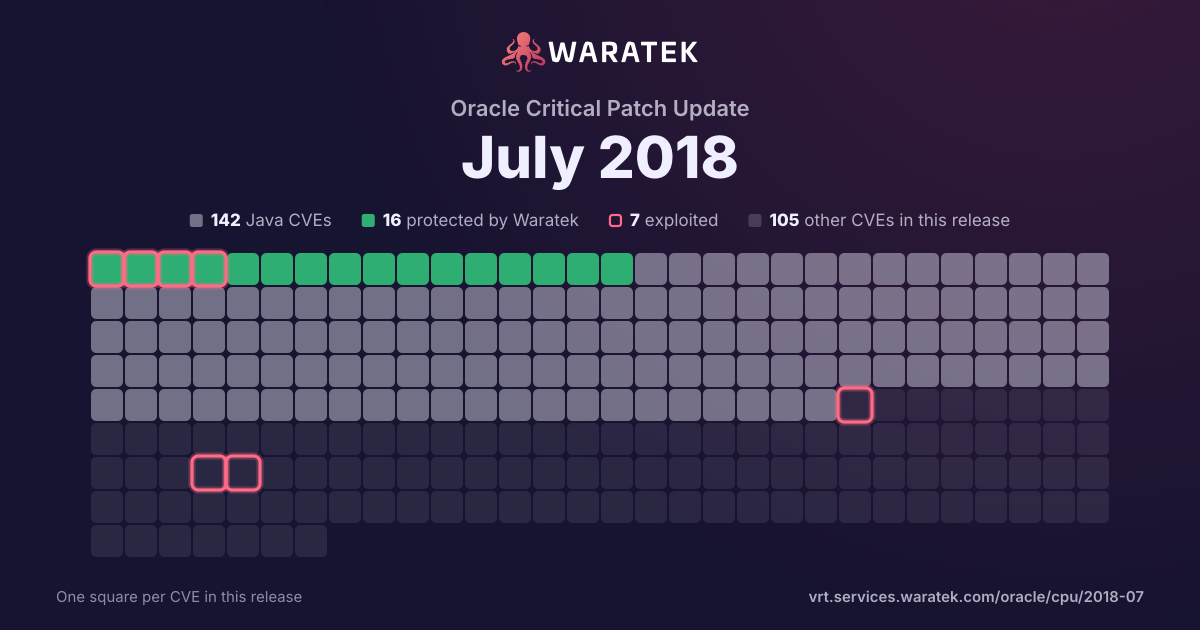
By status
18Protected by Waratek2Mitigation candidate132No exploit published7Outside Waratek scope88Not applicable
7Exploited, marked by the ring
No exploit published. For 127 of them, Oracle's security advisory is the source of public detail.
Protected by Waratek. Waratek RASP can block exploitation of these on systems that have not applied the patch yet.
Overview 31 matches · 12 protected · 4 exploited · 1 CISA KEV · 7 public PoC · 6 EPSS ≥ 0.5
Protected by Waratek
14
45.2%
Rule in development
0
0.0%
Mitigation candidate
1
3.2%
No exploit published
16
51.6%
blocked by ARMR today
12
38.7%
partly blocked
2
6.5%
not blocked
17
54.8%
not established
0
0.0%
unrecorded
0
0.0%
split by
peak 15 / quarter
Q4 151
No exploit published1
Medium1
not blocked1
No public exploit1
Q1 161
No exploit published1
High1
not blocked1
No public exploit1
Q2 160
Q3 161
Protected by Waratek1
High1
blocked by ARMR today1
No public exploit1
Q4 161
Protected by Waratek1
Critical1
blocked by ARMR today1
No public exploit1
Q1 171
No exploit published1
Medium1
not blocked1
No public exploit1
Q2 172
Protected by Waratek2
Critical1
High1
blocked by ARMR today2
Working exploit published1
No public exploit1
Q3 170
Q4 172
Protected by Waratek2
Critical1
High1
blocked by ARMR today1
partly blocked1
Exploited2
Q1 185
Protected by Waratek4
Mitigation candidate1
Critical4
Medium1
blocked by ARMR today4
not blocked1
Proof of concept only2
No public exploit3
Q2 182
Protected by Waratek2
Critical2
blocked by ARMR today2
Forecast only1
No public exploit1
Q3 1815
Protected by Waratek2
No exploit published13
Critical4
High3
Medium8
blocked by ARMR today1
partly blocked1
not blocked13
Exploited2
No public exploit13
Q4 15Q1 16Q2 16Q3 16Q4 16Q1 17Q2 17Q3 17Q4 17Q1 18Q2 18Q3 18
| CVE | Severity | Published▾ | Status | Exploitation | Description |
|---|---|---|---|---|---|
| CVE-2018-3109 | Medium | 2018-08-02 | No exploit published | No public exploit | Vulnerability in the Oracle Fusion Middleware MapViewer component of Oracle Fusion Middleware (subcomponent: Map Builder). Supported versions that are affected are 12.2.1.2 and 12.2.1.3. Easily exploitable vulnerability allows low privileged attacker with network access via HTTP to compromise Oracle Fusion Middleware MapViewer. Successful attacks of this vulnerability can result in unauthorized access to critical data or complete access to all Oracle Fusion Middleware MapViewer accessible data. CVSS 3.0 Base Score 6.5 (Confidentiality impacts). CVSS Vector: (CVSS:3.0/AV:N/AC:L/PR:L/UI:N/S:U/C:H/I:N/A:N). |
| CVE-2018-3108 | Medium | 2018-08-02 | No exploit published | No public exploit | Vulnerability in the Oracle Fusion Middleware component of Oracle Fusion Middleware (subcomponent: Oracle Notification Service). Supported versions that are affected are 12.2.1.2 and 12.2.1.3. Difficult to exploit vulnerability allows low privileged attacker with network access via HTTPS to compromise Oracle Fusion Middleware. Successful attacks of this vulnerability can result in unauthorized access to critical data or complete access to all Oracle Fusion Middleware accessible data. CVSS 3.0 Base Score 5.3 (Confidentiality impacts). CVSS Vector: (CVSS:3.0/AV:N/AC:H/PR:L/UI:N/S:U/C:H/I:N/A:N). |
| CVE-2018-2933 | Medium | 2018-08-02 | No exploit published | No public exploit | Vulnerability in the Oracle WebLogic Server component of Oracle Fusion Middleware (subcomponent: WLS Core Components). Supported versions that are affected are 10.3.6.0, 12.1.3.0, 12.2.1.2 and 12.2.1.3. Difficult to exploit vulnerability allows low privileged attacker with network access via HTTP to compromise Oracle WebLogic Server. While the vulnerability is in Oracle WebLogic Server, attacks may significantly impact additional products. Successful attacks of this vulnerability can result in unauthorized update, insert or delete access to some of Oracle WebLogic Server accessible data as well as unauthorized read access to a subset of Oracle WebLogic Server accessible data. Note: Please refer to MOS document |
| CVE-2018-3105 | Medium | 2018-07-18 | No exploit published | No public exploit | Vulnerability in the Oracle SOA Suite component of Oracle Fusion Middleware (subcomponent: Health Care FastPath). Supported versions that are affected are 11.1.1.7.0, 11.1.1.9.0, 12.1.3.0.0, 12.2.1.2.0 and 12.2.1.3.0. Easily exploitable vulnerability allows low privileged attacker with network access via HTTP to compromise Oracle SOA Suite. Successful attacks of this vulnerability can result in unauthorized read access to a subset of Oracle SOA Suite accessible data. CVSS 3.0 Base Score 4.3 (Confidentiality impacts). CVSS Vector: (CVSS:3.0/AV:N/AC:L/PR:L/UI:N/S:U/C:L/I:N/A:N). |
| CVE-2018-3101 | Medium | 2018-07-18 | No exploit published | No public exploit | Vulnerability in the Oracle WebCenter Portal component of Oracle Fusion Middleware (subcomponent: Portlet Services). Supported versions that are affected are 11.1.1.9.0, 12.2.1.2.0 and 12.2.1.3.0. Easily exploitable vulnerability allows unauthenticated attacker with network access via HTTP to compromise Oracle WebCenter Portal. Successful attacks of this vulnerability can result in unauthorized read access to a subset of Oracle WebCenter Portal accessible data. CVSS 3.0 Base Score 5.3 (Confidentiality impacts). CVSS Vector: (CVSS:3.0/AV:N/AC:L/PR:N/UI:N/S:U/C:L/I:N/A:N). |
| CVE-2018-3100 | Critical | 2018-07-18 | No exploit published | No public exploit | Vulnerability in the Oracle Business Process Management Suite component of Oracle Fusion Middleware (subcomponent: Process Analysis & Discovery). Supported versions that are affected are 11.1.1.7.0, 11.1.1.9.0, 12.1.3.0.0, 12.2.1.2.0 and 12.2.1.3.0. Easily exploitable vulnerability allows unauthenticated attacker with network access via HTTP to compromise Oracle Business Process Management Suite. Successful attacks of this vulnerability can result in unauthorized creation, deletion or modification access to critical data or all Oracle Business Process Management Suite accessible data as well as unauthorized access to critical data or complete access to all Oracle Business Process Management Suite accessible data. CVSS 3.0 Base Score 9.1 (Confidentiality and Integrity impacts). CVSS Vector: (CVSS:3.0/AV:N/AC:L/PR:N/UI:N/S:U/C:H/I:H/A:N). |
| CVE-2018-2998 | Medium | 2018-07-18 | No exploit published | No public exploit | Vulnerability in the Oracle WebLogic Server component of Oracle Fusion Middleware (subcomponent: SAML). Supported versions that are affected are 10.3.6.0, 12.1.3.0, 12.2.1.2 and 12.2.1.3. Easily exploitable vulnerability allows low privileged attacker with network access via HTTP to compromise Oracle WebLogic Server. Successful attacks of this vulnerability can result in unauthorized update, insert or delete access to some of Oracle WebLogic Server accessible data as well as unauthorized read access to a subset of Oracle WebLogic Server accessible data. CVSS 3.0 Base Score 5.4 (Confidentiality and Integrity impacts). CVSS Vector: (CVSS:3.0/AV:N/AC:L/PR:L/UI:N/S:U/C:L/I:L/A:N). |
| CVE-2018-2987 | Medium | 2018-07-18 | No exploit published | No public exploit | Vulnerability in the Oracle WebLogic Server component of Oracle Fusion Middleware (subcomponent: Console). Supported versions that are affected are 10.3.6.0, 12.1.3.0, 12.2.1.2 and 12.2.1.3. Easily exploitable vulnerability allows unauthenticated attacker with network access via HTTP to compromise Oracle WebLogic Server. Successful attacks require human interaction from a person other than the attacker and while the vulnerability is in Oracle WebLogic Server, attacks may significantly impact additional products. Successful attacks of this vulnerability can result in unauthorized update, insert or delete access to some of Oracle WebLogic Server accessible data as well as unauthorized read access to a subset of Oracle WebLogic Server accessible data. CVSS 3.0 Base Score 6.1 (Confidentiality and Integrity impacts). CVSS Vector: (CVSS:3.0/AV:N/AC:L/PR:N/UI:R/S:C/C:L/I:L/A:N). |
| CVE-2018-2958 | High | 2018-07-18 | No exploit published | No public exploit | Vulnerability in the BI Publisher component of Oracle Fusion Middleware (subcomponent: BI Publisher Security). Supported versions that are affected are 11.1.1.7.0, 11.1.1.9.0, 12.2.1.2.0 and 12.2.1.3.0. Easily exploitable vulnerability allows unauthenticated attacker with network access via HTTP to compromise BI Publisher. Successful attacks of this vulnerability can result in unauthorized creation, deletion or modification access to critical data or all BI Publisher accessible data as well as unauthorized read access to a subset of BI Publisher accessible data. CVSS 3.0 Base Score 8.2 (Confidentiality and Integrity impacts). CVSS Vector: (CVSS:3.0/AV:N/AC:L/PR:N/UI:N/S:U/C:L/I:H/A:N). |
| CVE-2018-2943 | Critical | 2018-07-18 | No exploit published | No public exploit | Vulnerability in the Oracle Fusion Middleware MapViewer component of Oracle Fusion Middleware (subcomponent: Map Builder). Supported versions that are affected are 12.2.1.2.0 and 12.2.1.3.0. Easily exploitable vulnerability allows unauthenticated attacker with network access via HTTP to compromise Oracle Fusion Middleware MapViewer. Successful attacks of this vulnerability can result in takeover of Oracle Fusion Middleware MapViewer. CVSS 3.0 Base Score 7.2 (Confidentiality, Integrity and Availability impacts). CVSS Vector: (CVSS:3.0/AV:N/AC:L/PR:H/UI:N/S:U/C:H/I:H/A:H). |
| CVE-2018-2935 | High | 2018-07-18 | No exploit published | No public exploit | Vulnerability in the Oracle WebLogic Server component of Oracle Fusion Middleware (subcomponent: JSF). Supported versions that are affected are 10.3.6.0, 12.1.3.0, 12.2.1.2 and 12.2.1.3. Easily exploitable vulnerability allows unauthenticated attacker with network access via HTTP to compromise Oracle WebLogic Server. Successful attacks require human interaction from a person other than the attacker. Successful attacks of this vulnerability can result in unauthorized creation, deletion or modification access to critical data or all Oracle WebLogic Server accessible data as well as unauthorized access to critical data or complete access to all Oracle WebLogic Server accessible data and unauthorized ability to cause a partial denial of service (partial DOS) of Oracle WebLogic Server. CVSS 3.0 Base Score 8.3 (Confidentiality, Integrity and Availability impacts). CVSS Vector: (CVSS:3.0/AV:N/AC:L/PR:N/UI:R/S:U/C:H/I:H/A:L). |
| CVE-2018-2925 | Medium | 2018-07-18 | No exploit published | No public exploit | Vulnerability in the BI Publisher component of Oracle Fusion Middleware (subcomponent: Web Server). Supported versions that are affected are 11.1.1.7.0, 11.1.1.9.0, 12.2.1.2.0 and 12.2.1.3.0. Easily exploitable vulnerability allows low privileged attacker with network access via HTTP to compromise BI Publisher. Successful attacks of this vulnerability can result in unauthorized access to critical data or complete access to all BI Publisher accessible data. CVSS 3.0 Base Score 6.5 (Confidentiality impacts). CVSS Vector: (CVSS:3.0/AV:N/AC:L/PR:L/UI:N/S:U/C:H/I:N/A:N). |
| CVE-2018-2900 | High | 2018-07-18 | No exploit published | No public exploit | Vulnerability in the BI Publisher component of Oracle Fusion Middleware (subcomponent: Layout Tools). The supported version that is affected is 11.1.1.7.0. Easily exploitable vulnerability allows unauthenticated attacker with network access via HTTP to compromise BI Publisher. Successful attacks of this vulnerability can result in unauthorized creation, deletion or modification access to critical data or all BI Publisher accessible data as well as unauthorized read access to a subset of BI Publisher accessible data. CVSS 3.0 Base Score 8.2 (Confidentiality and Integrity impacts). CVSS Vector: (CVSS:3.0/AV:N/AC:L/PR:N/UI:N/S:U/C:L/I:H/A:N). |
| CVE-2018-2894 | Critical | 2018-07-18 | Protected by Waratek | Exploited | Vulnerability in the Oracle WebLogic Server component of Oracle Fusion Middleware (subcomponent: WLS - Web Services). Supported versions that are affected are 12.1.3.0, 12.2.1.2 and 12.2.1.3. Easily exploitable vulnerability allows unauthenticated attacker with network access via HTTP to compromise Oracle WebLogic Server. Successful attacks of this vulnerability can result in takeover of Oracle WebLogic Server. CVSS 3.0 Base Score 9.8 (Confidentiality, Integrity and Availability impacts). CVSS Vector: (CVSS:3.0/AV:N/AC:L/PR:N/UI:N/S:U/C:H/I:H/A:H). |
| CVE-2018-2893 | Critical | 2018-07-18 | Protected by Waratek | Exploited | Vulnerability in the Oracle WebLogic Server component of Oracle Fusion Middleware (subcomponent: WLS Core Components). Supported versions that are affected are 10.3.6.0, 12.1.3.0, 12.2.1.2 and 12.2.1.3. Easily exploitable vulnerability allows unauthenticated attacker with network access via T3 to compromise Oracle WebLogic Server. Successful attacks of this vulnerability can result in takeover of Oracle WebLogic Server. CVSS 3.0 Base Score 9.8 (Confidentiality, Integrity and Availability impacts). CVSS Vector: (CVSS:3.0/AV:N/AC:L/PR:N/UI:N/S:U/C:H/I:H/A:H). |
| CVE-2018-8013 | Critical | 2018-05-24 | Protected by Waratek | No public exploit | In Apache Batik 1.x before 1.10, when deserializing subclass of `AbstractDocument`, the class takes a string from the inputStream as the class name which then use it to call the no-arg constructor of the class. Fix was to check the class type before calling newInstance in deserialization. |
| CVE-2018-1275 | Critical | 2018-04-11 | Protected by Waratek | Forecast only | Spring Framework, versions 5.0 prior to 5.0.5 and versions 4.3 prior to 4.3.16 and older unsupported versions, allow applications to expose STOMP over WebSocket endpoints with a simple, in-memory STOMP broker through the spring-messaging module. A malicious user (or attacker) can craft a message to the broker that can lead to a remote code execution attack. This CVE addresses the partial fix for CVE-2018-1270 in the 4.3.x branch of the Spring Framework. |
| CVE-2018-7489 | Critical | 2018-02-26 | Protected by Waratek | No public exploit | FasterXML jackson-databind before 2.7.9.3, 2.8.x before 2.8.11.1 and 2.9.x before 2.9.5 allows unauthenticated remote code execution because of an incomplete fix for the CVE-2017-7525 deserialization flaw. This is exploitable by sending maliciously crafted JSON input to the readValue method of the ObjectMapper, bypassing a blacklist that is ineffective if the c3p0 libraries are available in the classpath. |
| CVE-2018-1305 | Medium | 2018-02-23 | Mitigation candidate | Proof of concept only | Security constraints defined by annotations of Servlets in Apache Tomcat 9.0.0.M1 to 9.0.4, 8.5.0 to 8.5.27, 8.0.0.RC1 to 8.0.49 and 7.0.0 to 7.0.84 were only applied once a Servlet had been loaded. Because security constraints defined in this way apply to the URL pattern and any URLs below that point, it was possible - depending on the order Servlets were loaded - for some security constraints not to be applied. This could have exposed resources to users who were not authorised to access them. |
| CVE-2017-7525 | Critical | 2018-02-06 | Protected by Waratek | Proof of concept only | A deserialization flaw was discovered in the jackson-databind, versions before 2.6.7.1, 2.7.9.1 and 2.8.9, which could allow an unauthenticated user to perform code execution by sending the maliciously crafted input to the readValue method of the ObjectMapper. |
| CVE-2017-15095 | Critical | 2018-02-06 | Protected by Waratek | No public exploit | A deserialization flaw was discovered in the jackson-databind in versions before 2.8.10 and 2.9.1, which could allow an unauthenticated user to perform code execution by sending the maliciously crafted input to the readValue method of the ObjectMapper. This issue extends the previous flaw CVE-2017-7525 by blacklisting more classes that could be used maliciously. |
| CVE-2016-6814 | Critical | 2018-01-18 | Protected by Waratek | No public exploit | When an application with unsupported Codehaus versions of Groovy from 1.7.0 to 2.4.3, Apache Groovy 2.4.4 to 2.4.7 on classpath uses standard Java serialization mechanisms, e.g. to communicate between servers or to store local data, it was possible for an attacker to bake a special serialized object that will execute code directly when deserialized. All applications which rely on serialization and do not isolate the code which deserializes objects were subject to this vulnerability. |
| CVE-2015-7501 | Critical | 2017-11-09 | Protected by Waratek | Exploited | Red Hat JBoss A-MQ 6.x; BPM Suite (BPMS) 6.x; BRMS 6.x and 5.x; Data Grid (JDG) 6.x; Data Virtualization (JDV) 6.x and 5.x; Enterprise Application Platform 6.x, 5.x, and 4.3.x; Fuse 6.x; Fuse Service Works (FSW) 6.x; Operations Network (JBoss ON) 3.x; Portal 6.x; SOA Platform (SOA-P) 5.x; Web Server (JWS) 3.x; Red Hat OpenShift/xPAAS 3.x; and Red Hat Subscription Asset Manager 1.3 allow remote attackers to execute arbitrary commands via a crafted serialized Java object, related to the Apache Commons Collections (ACC) library. |
| CVE-2017-12617 | High | 2017-10-04 | Protected by Waratek | Exploited | When running Apache Tomcat versions 9.0.0.M1 to 9.0.0, 8.5.0 to 8.5.22, 8.0.0.RC1 to 8.0.46 and 7.0.0 to 7.0.81 with HTTP PUTs enabled (e.g. via setting the readonly initialisation parameter of the Default servlet to false) it was possible to upload a JSP file to the server via a specially crafted request. This JSP could then be requested and any code it contained would be executed by the server. |
| CVE-2017-5662 | High | 2017-04-18 | Protected by Waratek | No public exploit | In Apache Batik before 1.9, files lying on the filesystem of the server which uses batik can be revealed to arbitrary users who send maliciously formed SVG files. The file types that can be shown depend on the user context in which the exploitable application is running. If the user is root a full compromise of the server - including confidential or sensitive files - would be possible. XXE can also be used to attack the availability of the server via denial of service as the references within a xml document can trivially trigger an amplification attack. |
| CVE-2017-5645 | Critical | 2017-04-17 | Protected by Waratek | Working exploit published | In Apache Log4j 2.x before 2.8.2, when using the TCP socket server or UDP socket server to receive serialized log events from another application, a specially crafted binary payload can be sent that, when deserialized, can execute arbitrary code. |
| CVE-2016-7103 | Medium | 2017-03-15 | No exploit published | No public exploit | Cross-site scripting (XSS) vulnerability in jQuery UI before 1.12.0 might allow remote attackers to inject arbitrary web script or HTML via the closeText parameter of the dialog function. |
| CVE-2016-5019 | Critical | 2016-10-03 | Protected by Waratek | No public exploit | CoreResponseStateManager in Apache MyFaces Trinidad 1.0.0 through 1.0.13, 1.2.x before 1.2.15, 2.0.x before 2.0.2, and 2.1.x before 2.1.2 might allow attackers to conduct deserialization attacks via a crafted serialized view state string. |
| CVE-2016-1181 | High | 2016-07-04 | Protected by Waratek | No public exploit | ActionServlet.java in Apache Struts 1 1.x through 1.3.10 mishandles multithreaded access to an ActionForm instance, which allows remote attackers to execute arbitrary code or cause a denial of service (unexpected memory access) via a multipart request, a related issue to CVE-2015-0899. |
| CVE-2016-0714 | High | 2016-02-25 | No exploit published | No public exploit | The session-persistence implementation in Apache Tomcat 6.x before 6.0.45, 7.x before 7.0.68, 8.x before 8.0.31, and 9.x before 9.0.0.M2 mishandles session attributes, which allows remote authenticated users to bypass intended SecurityManager restrictions and execute arbitrary code in a privileged context via a web application that places a crafted object in a session. |
| CVE-2015-7940 | Medium | 2015-11-09 | No exploit published | No public exploit | The Bouncy Castle Java library before 1.51 does not validate a point is withing the elliptic curve, which makes it easier for remote attackers to obtain private keys via a series of crafted elliptic curve Diffie Hellman (ECDH) key exchanges, aka an "invalid curve attack." |