
Oracle Critical Patch Update April 2018
Released April 2018 · Oracle's advisory ↗ · ← Critical Patch Update, January 2018 · Critical Patch Update, July 2018 →
165 CVEs in this release, one square each
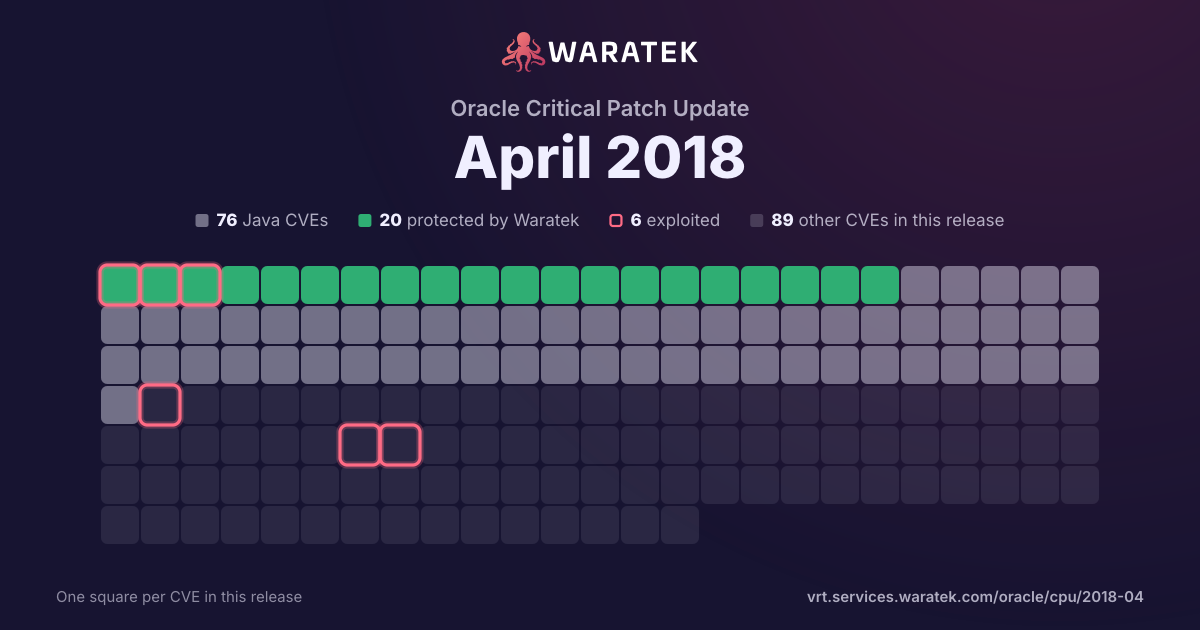
By status
20Protected by Waratek2Mitigation candidate54No exploit published30Outside Waratek scope59Not applicable
6Exploited, marked by the ring
No exploit published. For 52 of them, Oracle's security advisory is the source of public detail.
Protected by Waratek. Waratek RASP can block exploitation of these on systems that have not applied the patch yet.
Overview 19 matches · 10 protected · 3 exploited · 2 CISA KEV · 7 public PoC · 4 EPSS ≥ 0.5
Protected by Waratek
11
57.9%
Rule in development
0
0.0%
Mitigation candidate
2
10.5%
No exploit published
6
31.6%
blocked by ARMR today
10
52.6%
partly blocked
1
5.3%
not blocked
8
42.1%
not established
0
0.0%
unrecorded
0
0.0%
split by
peak 10 / quarter
Q3 131
Mitigation candidate1
High1
not blocked1
No public exploit1
Q4 130
Q1 140
Q2 140
Q3 140
Q4 140
Q1 150
Q2 150
Q3 150
Q4 150
Q1 160
Q2 160
Q3 161
No exploit published1
High1
not blocked1
No public exploit1
Q4 161
Protected by Waratek1
Critical1
blocked by ARMR today1
No public exploit1
Q1 170
Q2 171
Protected by Waratek1
Critical1
blocked by ARMR today1
Working exploit published1
Q3 170
Q4 172
Protected by Waratek2
Critical1
High1
blocked by ARMR today1
partly blocked1
Exploited2
Q1 183
Protected by Waratek3
Critical3
blocked by ARMR today3
Proof of concept only1
No public exploit2
Q2 1810
Protected by Waratek4
Mitigation candidate1
No exploit published5
Critical3
High5
Medium2
blocked by ARMR today4
not blocked6
Exploited1
Working exploit published1
Proof of concept only1
No public exploit7
Q4 13Q2 14Q4 14Q2 15Q4 15Q2 16Q4 16Q2 17Q4 17Q2 18
| CVE | Severity | Published▾ | Status | Exploitation | Description |
|---|---|---|---|---|---|
| CVE-2018-2879 | Critical | 2018-04-19 | Protected by Waratek | Proof of concept only | Vulnerability in the Oracle Access Manager component of Oracle Fusion Middleware (subcomponent: Authentication Engine). Supported versions that are affected are 11.1.2.3.0 and 12.2.1.3.0. Difficult to exploit vulnerability allows unauthenticated attacker with network access via HTTP to compromise Oracle Access Manager. While the vulnerability is in Oracle Access Manager, attacks may significantly impact additional products. Successful attacks of this vulnerability can result in takeover of Oracle Access Manager. Note: Please refer to Doc ID <a href="http://support.oracle.com/CSP/main/article?cmd=show&type=NOT&id=2386496.1">My Oracle Support Note 2386496.1 for instructions on how to address this issue. CVSS 3.0 Base Score 9.0 (Confidentiality, Integrity and Availability impacts). CVSS Vector: (CVSS:3.0/AV:N/AC:H/PR:N/UI:N/S:C/C:H/I:H/A:H). |
| CVE-2018-2834 | High | 2018-04-19 | No exploit published | No public exploit | Vulnerability in the Oracle Data Visualization Desktop component of Oracle Fusion Middleware (subcomponent: Security). The supported version that is affected is 12.2.4.1.1. Easily exploitable vulnerability allows unauthenticated attacker with logon to the infrastructure where Oracle Data Visualization Desktop executes to compromise Oracle Data Visualization Desktop. Successful attacks require human interaction from a person other than the attacker and while the vulnerability is in Oracle Data Visualization Desktop, attacks may significantly impact additional products. Successful attacks of this vulnerability can result in unauthorized creation, deletion or modification access to critical data or all Oracle Data Visualization Desktop accessible data as well as unauthorized read access to a subset of Oracle Data Visualization Desktop accessible data and unauthorized ability to cause a hang or frequently repeatable crash (complete DOS) of Oracle Data Visualization Desktop. Note: Please refer to Doc ID <a href="http://support.oracle.com/CSP/main/article?cmd=show&type=NOT&id=2384640.1">My Oracle Support Note 2384640.1 for instructions on how to address this issue. CVSS 3.0 Base Score 8.5 (Confidentiality, Integrity and Availability impacts). CVSS Vector: (CVSS:3.0/AV:L/AC:L/PR:N/UI:R/S:C/C:L/I:H/A:H). |
| CVE-2018-2828 | High | 2018-04-19 | No exploit published | No public exploit | Vulnerability in the Oracle WebCenter Content component of Oracle Fusion Middleware (subcomponent: Content Server). Supported versions that are affected are 11.1.1.9.0, 12.2.1.2.0 and 12.2.1.3.0. Easily exploitable vulnerability allows low privileged attacker with network access via HTTP to compromise Oracle WebCenter Content. Successful attacks require human interaction from a person other than the attacker and while the vulnerability is in Oracle WebCenter Content, attacks may significantly impact additional products. Successful attacks of this vulnerability can result in unauthorized access to critical data or complete access to all Oracle WebCenter Content accessible data as well as unauthorized update, insert or delete access to some of Oracle WebCenter Content accessible data and unauthorized ability to cause a partial denial of service (partial DOS) of Oracle WebCenter Content. CVSS 3.0 Base Score 8.2 (Confidentiality, Integrity and Availability impacts). CVSS Vector: (CVSS:3.0/AV:N/AC:L/PR:L/UI:R/S:C/C:H/I:L/A:L). |
| CVE-2018-2791 | High | 2018-04-19 | Mitigation candidate | Working exploit published | Vulnerability in the Oracle WebCenter Sites component of Oracle Fusion Middleware (subcomponent: Advanced UI). Supported versions that are affected are 11.1.1.8.0, 12.2.1.2.0 and 12.2.1.3.0. Easily exploitable vulnerability allows unauthenticated attacker with network access via HTTP to compromise Oracle WebCenter Sites. Successful attacks require human interaction from a person other than the attacker and while the vulnerability is in Oracle WebCenter Sites, attacks may significantly impact additional products. Successful attacks of this vulnerability can result in unauthorized access to critical data or complete access to all Oracle WebCenter Sites accessible data as well as unauthorized update, insert or delete access to some of Oracle WebCenter Sites accessible data. CVSS 3.0 Base Score 8.2 (Confidentiality and Integrity impacts). CVSS Vector: (CVSS:3.0/AV:N/AC:L/PR:N/UI:R/S:C/C:H/I:L/A:N). |
| CVE-2018-2770 | High | 2018-04-19 | No exploit published | No public exploit | Vulnerability in the Oracle Adaptive Access Manager component of Oracle Fusion Middleware (subcomponent: OAAM Admin). The supported version that is affected is 11.1.2.3.0. Easily exploitable vulnerability allows low privileged attacker with network access via HTTP to compromise Oracle Adaptive Access Manager. Successful attacks require human interaction from a person other than the attacker and while the vulnerability is in Oracle Adaptive Access Manager, attacks may significantly impact additional products. Successful attacks of this vulnerability can result in unauthorized access to critical data or complete access to all Oracle Adaptive Access Manager accessible data as well as unauthorized update, insert or delete access to some of Oracle Adaptive Access Manager accessible data. CVSS 3.0 Base Score 7.6 (Confidentiality and Integrity impacts). CVSS Vector: (CVSS:3.0/AV:N/AC:L/PR:L/UI:R/S:C/C:H/I:L/A:N). |
| CVE-2018-2765 | High | 2018-04-19 | No exploit published | No public exploit | Vulnerability in the Oracle Security Service component of Oracle Fusion Middleware (subcomponent: Oracle SSL API). Supported versions that are affected are 11.1.1.9.0, 12.1.3.0.0, 12.2.1.2.0 and 12.2.1.3.0. Easily exploitable vulnerability allows unauthenticated attacker with network access via HTTPS to compromise Oracle Security Service. Successful attacks of this vulnerability can result in unauthorized access to critical data or complete access to all Oracle Security Service accessible data. CVSS 3.0 Base Score 7.5 (Confidentiality impacts). CVSS Vector: (CVSS:3.0/AV:N/AC:L/PR:N/UI:N/S:U/C:H/I:N/A:N). |
| CVE-2018-2760 | Medium | 2018-04-19 | No exploit published | No public exploit | Vulnerability in the Oracle HTTP Server component of Oracle Fusion Middleware (subcomponent: OSSL Module). Supported versions that are affected are 12.1.3 and 12.2.1.2. Difficult to exploit vulnerability allows unauthenticated attacker with network access via HTTPS to compromise Oracle HTTP Server. Successful attacks of this vulnerability can result in unauthorized access to critical data or complete access to all Oracle HTTP Server accessible data. CVSS 3.0 Base Score 5.9 (Confidentiality impacts). CVSS Vector: (CVSS:3.0/AV:N/AC:H/PR:N/UI:N/S:U/C:H/I:N/A:N). |
| CVE-2018-2739 | Critical | 2018-04-19 | Protected by Waratek | No public exploit | Vulnerability in the Oracle Access Manager component of Oracle Fusion Middleware (subcomponent: Web Server Plugin). Supported versions that are affected are 10.1.4.3.0, 11.1.2.3.0 and 12.2.1.3.0. Easily exploitable vulnerability allows unauthenticated attacker with network access via HTTP to compromise Oracle Access Manager. Successful attacks require human interaction from a person other than the attacker and while the vulnerability is in Oracle Access Manager, attacks may significantly impact additional products. Successful attacks of this vulnerability can result in unauthorized creation, deletion or modification access to critical data or all Oracle Access Manager accessible data as well as unauthorized access to critical data or complete access to all Oracle Access Manager accessible data. CVSS 3.0 Base Score 9.3 (Confidentiality and Integrity impacts). CVSS Vector: (CVSS:3.0/AV:N/AC:L/PR:N/UI:R/S:C/C:H/I:H/A:N). |
| CVE-2018-2628 | Critical | 2018-04-19 | Protected by Waratek | Exploited | Vulnerability in the Oracle WebLogic Server component of Oracle Fusion Middleware (subcomponent: WLS Core Components). Supported versions that are affected are 10.3.6.0, 12.1.3.0, 12.2.1.2 and 12.2.1.3. Easily exploitable vulnerability allows unauthenticated attacker with network access via T3 to compromise Oracle WebLogic Server. Successful attacks of this vulnerability can result in takeover of Oracle WebLogic Server. CVSS 3.0 Base Score 9.8 (Confidentiality, Integrity and Availability impacts). CVSS Vector: (CVSS:3.0/AV:N/AC:L/PR:N/UI:N/S:U/C:H/I:H/A:H). |
| CVE-2018-2587 | Medium | 2018-04-19 | Protected by Waratek | No public exploit | Vulnerability in the Oracle Access Manager component of Oracle Fusion Middleware (subcomponent: Web Server Plugin). Supported versions that are affected are 10.1.4.3.0, 11.1.2.3.0 and 12.2.1.3.0. Difficult to exploit vulnerability allows unauthenticated attacker with network access via HTTP to compromise Oracle Access Manager. Successful attacks of this vulnerability can result in unauthorized creation, deletion or modification access to critical data or all Oracle Access Manager accessible data as well as unauthorized read access to a subset of Oracle Access Manager accessible data. CVSS 3.0 Base Score 6.5 (Confidentiality and Integrity impacts). CVSS Vector: (CVSS:3.0/AV:N/AC:H/PR:N/UI:N/S:U/C:L/I:H/A:N). |
| CVE-2018-7489 | Critical | 2018-02-26 | Protected by Waratek | No public exploit | FasterXML jackson-databind before 2.7.9.3, 2.8.x before 2.8.11.1 and 2.9.x before 2.9.5 allows unauthenticated remote code execution because of an incomplete fix for the CVE-2017-7525 deserialization flaw. This is exploitable by sending maliciously crafted JSON input to the readValue method of the ObjectMapper, bypassing a blacklist that is ineffective if the c3p0 libraries are available in the classpath. |
| CVE-2017-7525 | Critical | 2018-02-06 | Protected by Waratek | Proof of concept only | A deserialization flaw was discovered in the jackson-databind, versions before 2.6.7.1, 2.7.9.1 and 2.8.9, which could allow an unauthenticated user to perform code execution by sending the maliciously crafted input to the readValue method of the ObjectMapper. |
| CVE-2017-15095 | Critical | 2018-02-06 | Protected by Waratek | No public exploit | A deserialization flaw was discovered in the jackson-databind in versions before 2.8.10 and 2.9.1, which could allow an unauthenticated user to perform code execution by sending the maliciously crafted input to the readValue method of the ObjectMapper. This issue extends the previous flaw CVE-2017-7525 by blacklisting more classes that could be used maliciously. |
| CVE-2015-7501 | Critical | 2017-11-09 | Protected by Waratek | Exploited | Red Hat JBoss A-MQ 6.x; BPM Suite (BPMS) 6.x; BRMS 6.x and 5.x; Data Grid (JDG) 6.x; Data Virtualization (JDV) 6.x and 5.x; Enterprise Application Platform 6.x, 5.x, and 4.3.x; Fuse 6.x; Fuse Service Works (FSW) 6.x; Operations Network (JBoss ON) 3.x; Portal 6.x; SOA Platform (SOA-P) 5.x; Web Server (JWS) 3.x; Red Hat OpenShift/xPAAS 3.x; and Red Hat Subscription Asset Manager 1.3 allow remote attackers to execute arbitrary commands via a crafted serialized Java object, related to the Apache Commons Collections (ACC) library. |
| CVE-2017-12617 | High | 2017-10-04 | Protected by Waratek | Exploited | When running Apache Tomcat versions 9.0.0.M1 to 9.0.0, 8.5.0 to 8.5.22, 8.0.0.RC1 to 8.0.46 and 7.0.0 to 7.0.81 with HTTP PUTs enabled (e.g. via setting the readonly initialisation parameter of the Default servlet to false) it was possible to upload a JSP file to the server via a specially crafted request. This JSP could then be requested and any code it contained would be executed by the server. |
| CVE-2017-5645 | Critical | 2017-04-17 | Protected by Waratek | Working exploit published | In Apache Log4j 2.x before 2.8.2, when using the TCP socket server or UDP socket server to receive serialized log events from another application, a specially crafted binary payload can be sent that, when deserialized, can execute arbitrary code. |
| CVE-2016-5019 | Critical | 2016-10-03 | Protected by Waratek | No public exploit | CoreResponseStateManager in Apache MyFaces Trinidad 1.0.0 through 1.0.13, 1.2.x before 1.2.15, 2.0.x before 2.0.2, and 2.1.x before 2.1.2 might allow attackers to conduct deserialization attacks via a crafted serialized view state string. |
| CVE-2016-3092 | High | 2016-07-04 | No exploit published | No public exploit | The MultipartStream class in Apache Commons Fileupload before 1.3.2, as used in Apache Tomcat 7.x before 7.0.70, 8.x before 8.0.36, 8.5.x before 8.5.3, and 9.x before 9.0.0.M7 and other products, allows remote attackers to cause a denial of service (CPU consumption) via a long boundary string. |
| CVE-2013-1768 | High | 2013-07-11 | Mitigation candidate | No public exploit | The BrokerFactory functionality in Apache OpenJPA 1.x before 1.2.3 and 2.x before 2.2.2 creates local executable JSP files containing logging trace data produced during deserialization of certain crafted OpenJPA objects, which makes it easier for remote attackers to execute arbitrary code by creating a serialized object and leveraging improperly secured server programs. |