
Java SE CPU Feb 2011
Released February 2011 · Oracle's advisory ↗ · ← Critical Patch Update, January 2011 · Critical Patch Update, April 2011 →
21 CVEs in this release, one square each
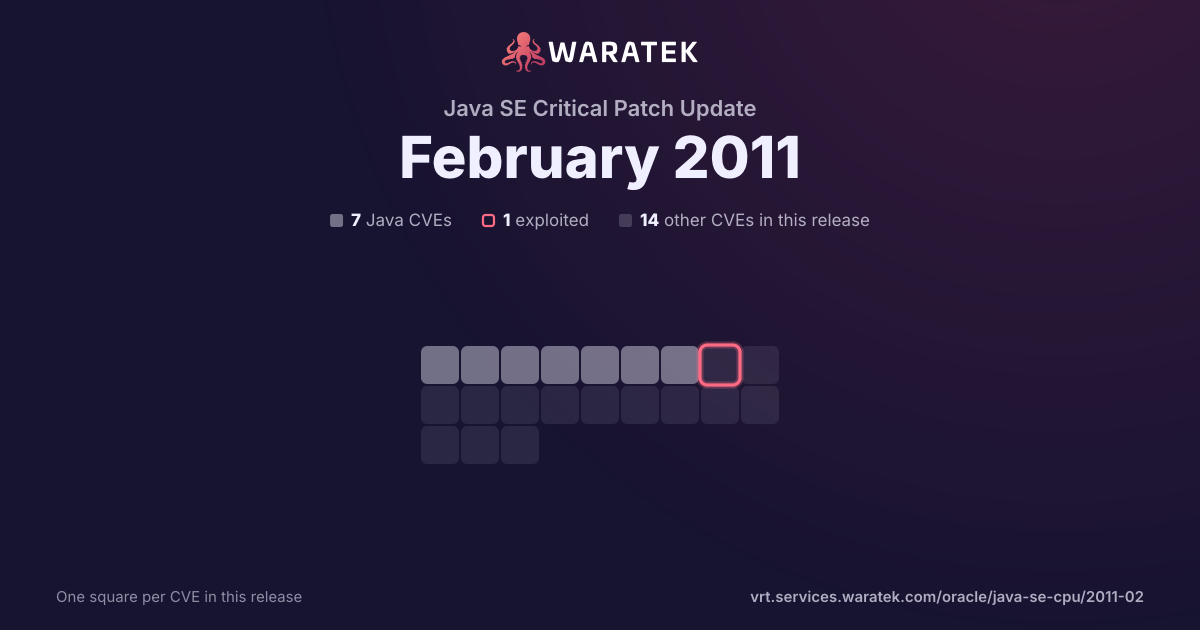
By status
No exploit published. For 4 of them, Oracle's security advisory is the source of public detail.
Overview 6 matches · 0 protected · 0 exploited · 0 CISA KEV · 0 public PoC · 0 EPSS ≥ 0.5
6matches
0protected0.0%
0exploited0.0%
0CISA KEV0.0%
0public PoC0.0%
0EPSS ≥ 0.50.0%
Protected by Waratek
0
0.0%
Rule in development
0
0.0%
Mitigation candidate
0
0.0%
No exploit published
6
100.0%
blocked by ARMR today
0
0.0%
partly blocked
0
0.0%
not blocked
6
100.0%
not established
0
0.0%
unrecorded
0
0.0%
Exploited
0
0.0%
Working exploit published
0
0.0%
Proof of concept only
0
0.0%
Forecast only
0
0.0%
No public exploit
6
100.0%
split by
peak 6 / month
Feb 11
| CVE | Severity | Published▾ | Status | Exploitation | Description |
|---|---|---|---|---|---|
| CVE-2010-4474 | Low | 2011-02-17 | No exploit published | No public exploit | Unspecified vulnerability in the Java DB component in Oracle Java SE and Java for Business 6 Update 23, and, and earlier allows local users to affect confidentiality via unknown vectors related to Security, a similar vulnerability to CVE-2009-4269. |
| CVE-2010-4473 | High | 2011-02-17 | No exploit published | No public exploit | Unspecified vulnerability in the Java Runtime Environment (JRE) in Oracle Java SE and Java for Business 6 Update 23 and earlier, 5.0 Update 27 and earlier, and 1.4.2_29 and earlier allows remote attackers to affect confidentiality, integrity, and availability via unknown vectors related to Sound and unspecified APIs, a different vulnerability than CVE-2010-4454 and CVE-2010-4462. |
| CVE-2010-4472 | Low | 2011-02-17 | No exploit published | No public exploit | Unspecified vulnerability in the Java Runtime Environment (JRE) in Oracle Java SE and Java for Business 6 Update 23 and earlier allows remote attackers to affect availability, related to XML Digital Signature and unspecified APIs. NOTE: the previous information was obtained from the February 2011 CPU. Oracle has not commented on claims from a downstream vendor that this issue involves the replacement of the "XML DSig Transform or C14N algorithm implementations." |
| CVE-2010-4470 | Medium | 2011-02-17 | No exploit published | No public exploit | Unspecified vulnerability in the Java Runtime Environment (JRE) in Oracle Java SE and Java for Business 6 Update 23, and, and earlier allows remote attackers to affect availability via unknown vectors related to JAXP and unspecified APIs. NOTE: the previous information was obtained from the February 2011 CPU. Oracle has not commented on claims from a downstream vendor that this issue is related to "Features set on SchemaFactory not inherited by Validator." |
| CVE-2010-4462 | High | 2011-02-17 | No exploit published | No public exploit | Unspecified vulnerability in the Java Runtime Environment (JRE) in Oracle Java SE and Java for Business 6 Update 23 and earlier, 5.0 Update 27 and earlier, and 1.4.2_29 and earlier allows remote attackers to affect confidentiality, integrity, and availability via unknown vectors related to Sound and unspecified APIs, a different vulnerability than CVE-2010-4454 and CVE-2010-4473. |
| CVE-2010-4454 | High | 2011-02-17 | No exploit published | No public exploit | Unspecified vulnerability in the Java Runtime Environment (JRE) in Oracle Java SE and Java for Business 6 Update 23 and earlier, 5.0 Update 27 and earlier, and 1.4.2_29 and earlier allows remote attackers to affect confidentiality, integrity, and availability via unknown vectors related to Sound and unspecified APIs, a different vulnerability than CVE-2010-4462 and CVE-2010-4473. |