
Oracle Critical Patch Update January 2011
Released January 2011 · Oracle's advisory ↗ · ← Java SE Critical Patch Update, October 2010 · Java SE Critical Patch Update, February 2011 →
66 CVEs in this release, one square each
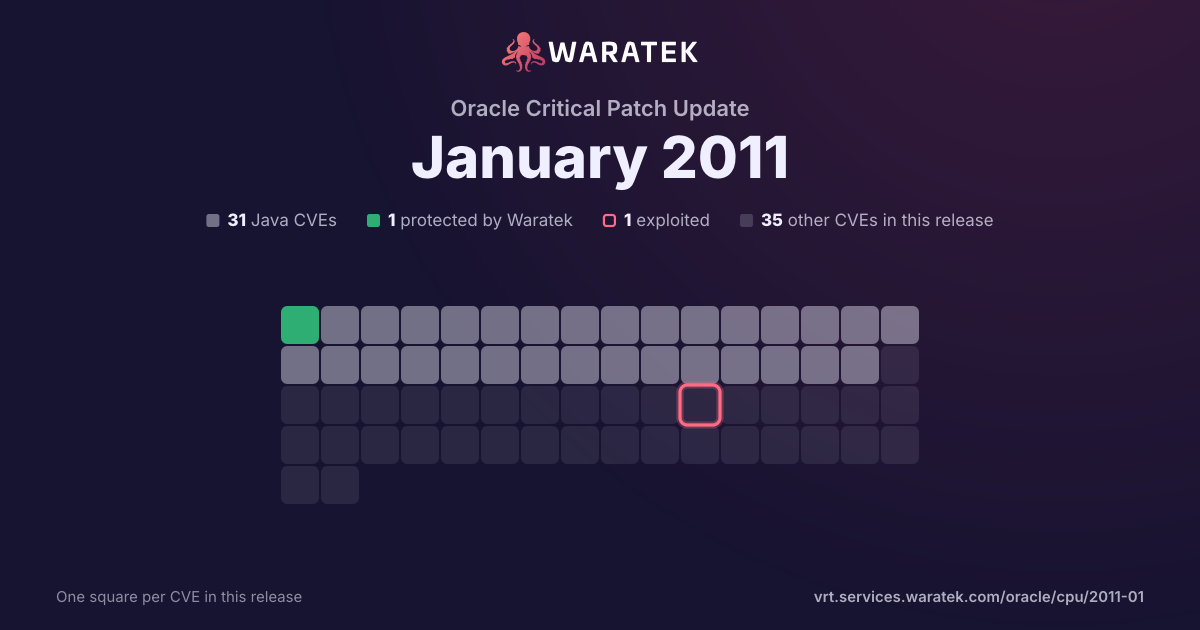
By status
1Protected by Waratek3Mitigation candidate27No exploit published11Outside Waratek scope24Not applicable
1Exploited, marked by the ring
No exploit published. For 26 of them, Oracle's security advisory is the source of public detail.
Protected by Waratek. Waratek RASP can block exploitation of these on systems that have not applied the patch yet.
Overview 31 matches · 1 protected · 0 exploited · 0 CISA KEV · 3 public PoC · 1 EPSS ≥ 0.5
Protected by Waratek
1
3.2%
Rule in development
0
0.0%
Mitigation candidate
3
9.7%
No exploit published
27
87.1%
blocked by ARMR today
1
3.2%
partly blocked
0
0.0%
not blocked
30
96.8%
not established
0
0.0%
unrecorded
0
0.0%
Exploited
0
0.0%
Working exploit published
3
9.7%
Proof of concept only
0
0.0%
Forecast only
0
0.0%
No public exploit
28
90.3%
split by
peak 30 / month
Aug 10Sep 10Oct 10Nov 10Dec 10Jan 11
| CVE | Severity | Published▾ | Status | Exploitation | Description |
|---|---|---|---|---|---|
| CVE-2010-4461 | Medium | 2011-01-19 | No exploit published | No public exploit | Unspecified vulnerability in the PeopleSoft Enterprise HRMS component in Oracle PeopleSoft and JDEdwards Suite 8.9 Bundle #23, 9.0 Bundle #14, and 9.1 Bundle #4 allows remote authenticated users to affect confidentiality and integrity via unknown vectors related to ePerformance. |
| CVE-2010-4455 | Medium | 2011-01-19 | No exploit published | No public exploit | Unspecified vulnerability in the Oracle HTTP Server component in Oracle Fusion Middleware 11.1.1.2 and 11.1.1.3 allows remote attackers to affect confidentiality and integrity via unknown vectors related to Apache Plugin. |
| CVE-2010-4453 | Medium | 2011-01-19 | No exploit published | No public exploit | Unspecified vulnerability in the Oracle WebLogic Server component in Oracle Fusion Middleware 7.0.7, 8.1.6, 9.0, 9.1, 9.2.4, 10.0.2, 10.3.2, and 10.3.3 allows remote attackers to affect integrity via unknown vectors related to Servlet Container. |
| CVE-2010-4445 | Medium | 2011-01-19 | No exploit published | No public exploit | Unspecified vulnerability in the PeopleSoft Enterprise HRMS component in Oracle PeopleSoft and JDEdwards Suite 9.0 Bundle #14 and 9.1 Bundle #4 allows remote authenticated users to affect confidentiality via unknown vectors related to Talent Acquisition Manager. |
| CVE-2010-4441 | Medium | 2011-01-19 | No exploit published | No public exploit | Unspecified vulnerability in the PeopleSoft Enterprise HRMS component in Oracle PeopleSoft and JDEdwards Suite 9.1 Bundle #4 allows remote authenticated users to affect confidentiality and integrity via unknown vectors related to Talent Acquisition Manager. |
| CVE-2010-4439 | Medium | 2011-01-19 | No exploit published | No public exploit | Unspecified vulnerability in the PeopleSoft Enterprise HRMS component in Oracle PeopleSoft and JDEdwards Suite 9.0 Bundle #14 and 9.1 Bundle #4 allows remote authenticated users to affect confidentiality via unknown vectors related to eProfile - Manager Desktop. |
| CVE-2010-4438 | Medium | 2011-01-19 | No exploit published | No public exploit | Unspecified vulnerability in Oracle GlassFish 2.1, 2.1.1, and 3.0.1, and Java System Message Queue 4.1 allows local users to affect confidentiality, integrity, and availability, related to Java Message Service (JMS). |
| CVE-2010-4437 | Medium | 2011-01-19 | Mitigation candidate | Working exploit published | Unspecified vulnerability in the Oracle WebLogic Server component in Oracle Fusion Middleware 9.0, 9.1, 9.2.4, 10.0.2, 10.3.2, and 10.3.3 allows remote attackers to affect confidentiality and integrity via unknown vectors related to Servlet Container. |
| CVE-2010-4434 | Medium | 2011-01-19 | No exploit published | No public exploit | Unspecified vulnerability in the PeopleSoft Enterprise PeopleTools component in Oracle PeopleSoft and JDEdwards Suite 8.50.0 through 8.50.14 and 8.51.0 through 8.51.04 allows remote authenticated users to affect confidentiality via unknown vectors related to Portal. |
| CVE-2010-4432 | Low | 2011-01-19 | No exploit published | No public exploit | Unspecified vulnerability in the Oracle Transportation Manager component in Oracle Supply Chain Products Suite 5.5.06, 6.0, 6.1, and 6.2 allows remote authenticated users to affect confidentiality via unknown vectors related to UI Infrastructure. |
| CVE-2010-4430 | Medium | 2011-01-19 | No exploit published | No public exploit | Unspecified vulnerability in the PeopleSoft Enterprise HRMS component in Oracle PeopleSoft and JDEdwards Suite 9.1 Update 2010-F allows remote authenticated users to affect confidentiality via unknown vectors related to Absence Management. |
| CVE-2010-4429 | Low | 2011-01-19 | No exploit published | No public exploit | Unspecified vulnerability in the Agile Core component in Oracle Supply Chain Products Suite 9.3.0.2 and 9.3.1 allows remote authenticated users to affect integrity via unknown vectors related to Web Client, a different vulnerability than CVE-2010-3505. |
| CVE-2010-4428 | Medium | 2011-01-19 | No exploit published | No public exploit | Unspecified vulnerability in the PeopleSoft Enterprise HRMS component in Oracle PeopleSoft and JDEdwards Suite 9.0 Update 2010-F allows remote authenticated users to affect confidentiality via unknown vectors related to Absence Management. |
| CVE-2010-4427 | Low | 2011-01-19 | No exploit published | No public exploit | Unspecified vulnerability in the Oracle BI Publisher component in Oracle Fusion Middleware 10.1.3.4.0, 10.1.3.4.1, and 11.1.1.3 allows remote authenticated users to affect integrity via unknown vectors related to Web Server. |
| CVE-2010-4426 | Medium | 2011-01-19 | No exploit published | No public exploit | Unspecified vulnerability in the PeopleSoft Enterprise PeopleTools component in Oracle PeopleSoft and JDEdwards Suite 8.49.0 through 8.49.29, 8.50.0 through 8.50.14, and 8.51.0 through 8.51.04 allows remote attackers to affect integrity, related to PIA Core Technology. |
| CVE-2010-4425 | Low | 2011-01-19 | No exploit published | No public exploit | Unspecified vulnerability in the Oracle BI Publisher component in Oracle Fusion Middleware 10.1.3.3.2, 10.1.3.4.0, and 10.1.3.4.1 allows remote authenticated users to affect integrity via unknown vectors related to Web Server. |
| CVE-2010-4424 | Medium | 2011-01-19 | No exploit published | No public exploit | Unspecified vulnerability in the PeopleSoft Enterprise PeopleTools component in Oracle PeopleSoft and JDEdwards Suite 8.49.0 through 8.49.29, 8.50.0 through 8.50.14, and 8.51.0 through 8.51.04 allows remote attackers to affect availability via unknown vectors related to the Security sub-component. |
| CVE-2010-4419 | Medium | 2011-01-19 | No exploit published | No public exploit | Unspecified vulnerability in the PeopleSoft Enterprise CRM component in Oracle PeopleSoft and JDEdwards Suite 9.0 Bundle #31 and 9.1 Bundle #6 allows remote authenticated users to affect confidentiality and integrity via unknown vectors related to Order Capture. |
| CVE-2010-4418 | High | 2011-01-19 | No exploit published | No public exploit | Unspecified vulnerability in the PeopleSoft Enterprise PeopleTools component in Oracle PeopleSoft and JDEdwards Suite 8.50.11 through 8.50.15 and 8.51GA through 8.51.05 allows remote attackers to affect confidentiality, integrity, and availability, related to PIA Core Technology. |
| CVE-2010-4417 | High | 2011-01-19 | Mitigation candidate | Working exploit published | Unspecified vulnerability in the Services for Beehive component in Oracle Fusion Middleware 2.0.1.0, 2.0.1.1, 2.0.1.2, 2.0.1.2.1, and 2.0.1.3 allows remote attackers to affect confidentiality, integrity, and availability via unknown vectors. NOTE: the previous information was obtained from the January 2011 CPU. Oracle has not commented on claims from a reliable third party coordinator that voice-servlet/prompt-qa/Index.jspf does not properly handle null (%00) bytes in the evaluation parameter that is used in a filename, which allows attackers to create a file with an executable extension and execute arbitrary JSP code. |
| CVE-2010-4416 | Medium | 2011-01-19 | No exploit published | No public exploit | Unspecified vulnerability in the Oracle GoldenGate Veridata component in Oracle Fusion Middleware 3.0.0.4 allows remote attackers to affect availability via unknown vectors related to Server. NOTE: the previous information was obtained from the January 2011 CPU. Oracle has not commented on claims from a reliable third party researcher that this is a buffer overflow via a crafted XML soap request and a value that does not contain the expected 0x20 terminator character. |
| CVE-2010-3597 | Low | 2011-01-19 | No exploit published | No public exploit | Unspecified vulnerability in the Oracle Outside In Technology component in Oracle Fusion Middleware 8.3.0 allows local users to affect availability, related to Outside In Viewer SDK. |
| CVE-2010-3595 | High | 2011-01-19 | Mitigation candidate | Working exploit published | Unspecified vulnerability in the Oracle Document Capture component in Oracle Fusion Middleware 10.1.3.4 and 10.1.3.5 allows remote attackers to affect confidentiality via unknown vectors related to Import Server. NOTE: the previous information was obtained from the January 2011 CPU. Oracle has not commented on claims from the original researcher that remote attackers can read arbitrary files via a full pathname in the first argument to the ImportBodyText method in the EasyMail ActiveX control (emsmtp.dll). |
| CVE-2010-3594 | Medium | 2011-01-19 | Protected by Waratek | No public exploit | Unspecified vulnerability in the Real User Experience Insight component in Oracle Enterprise Manager Grid Control 6.0 allows remote attackers to affect confidentiality and integrity via unknown vectors related to Processing. NOTE: the previous information was obtained from the January 2011 CPU. Oracle has not commented on claims from a reliable third party coordinator that this is SQL injection in rsynclogdird involving improper escaping of UTF-8 characters while processing log files. |
| CVE-2010-3593 | High | 2011-01-19 | No exploit published | No public exploit | Unspecified vulnerability in the Health Sciences - Oracle Argus Safety component in Oracle Industry Applications 5.0, 5.0.1, 5.0.2, and 5.0.3 allows remote attackers to affect confidentiality, integrity, and availability via unknown vectors related to Login and LDAP. |
| CVE-2010-3589 | Medium | 2011-01-19 | No exploit published | No public exploit | Unspecified vulnerability in the Oracle Application Object Library component in Oracle Applications 11.5.10.2, 12.0.4, 12.0.5, 12.0.6, 12.1.1, 12.1.2, and 12.1.3 allows remote attackers to affect confidentiality and integrity via unknown vectors related to Logout. |
| CVE-2010-3588 | Medium | 2011-01-19 | No exploit published | No public exploit | Unspecified vulnerability in the Oracle Discoverer component in Oracle Fusion Middleware 10.1.2.3, 11.1.1.2.0, and 11.1.1.3.0 allows remote authenticated users to affect confidentiality and integrity, related to EUL Code & Schema. |
| CVE-2010-3587 | Medium | 2011-01-19 | No exploit published | No public exploit | Unspecified vulnerability in the Oracle Common Applications component in Oracle Applications 11.5.10.2, 12.0.4, 12.0.5, 12.0.6, 12.1.1, 12.1.2, and 12.1.3 allows remote attackers to affect integrity via unknown vectors related to User Management. |
| CVE-2010-3510 | High | 2011-01-19 | No exploit published | No public exploit | Unspecified vulnerability in the Oracle WebLogic Server component in Oracle Fusion Middleware 9.0, 9.1, 9.2.3, 10.0.2, 10.3.2, and 10.3.3 allows remote attackers to affect confidentiality, integrity, and availability via unknown vectors related to Node Manager. |
| CVE-2010-3505 | Low | 2011-01-19 | No exploit published | No public exploit | Unspecified vulnerability in the Agile Core component in Oracle Supply Chain Products Suite 9.3.0.2 and 9.3.1 allows remote authenticated users to affect confidentiality via unknown vectors related to Folders, Files & Attachments, a different vulnerability than CVE-2010-4429. |
| CVE-2009-4269 | Low | 2010-08-16 | No exploit published | No public exploit | The password hash generation algorithm in the BUILTIN authentication functionality for Apache Derby before 10.6.1.0 performs a transformation that reduces the size of the set of inputs to SHA-1, which produces a small search space that makes it easier for local and possibly remote attackers to crack passwords by generating hash collisions, related to password substitution. |