
Oracle Critical Security Patch Update August 2026
Released August 2026 · Oracle's advisory ↗ · ← Critical Patch Update, July 2026 · Security Patch Update, September 2026 →
1,021 CVEs in this release, one square each
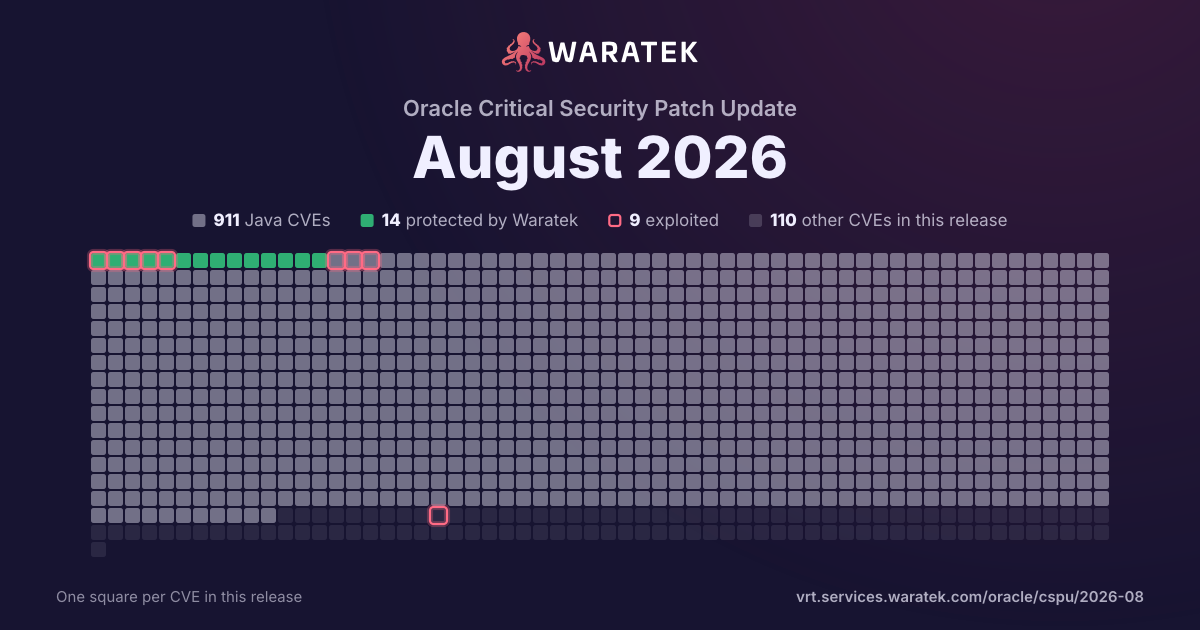
By status
14Protected by Waratek3Mitigation candidate894No exploit published9Outside Waratek scope101Not applicable
9Exploited, marked by the ring
No exploit published. For 848 of them, Oracle's security advisory is the source of public detail.
Protected by Waratek. Waratek RASP can block exploitation of these on systems that have not applied the patch yet.
Overview 14 matches · 5 exploited · 2 CISA KEV · 9 public PoC · 7 EPSS ≥ 0.5
Protected by Waratek
14
100.0%
Rule in development
0
0.0%
Mitigation candidate
0
0.0%
No exploit published
0
0.0%
blocked by ARMR today
14
100.0%
partly blocked
0
0.0%
not blocked
0
0.0%
not established
0
0.0%
unrecorded
0
0.0%
split by
peak 6 / quarter
Q4 211
Protected by Waratek1
High1
blocked by ARMR today1
Exploited1
Q1 221
Protected by Waratek1
Critical1
blocked by ARMR today1
Proof of concept only1
Q2 221
Protected by Waratek1
Critical1
blocked by ARMR today1
Exploited1
Q3 221
Protected by Waratek1
High1
blocked by ARMR today1
Proof of concept only1
Q4 220
Q1 232
Protected by Waratek2
High2
blocked by ARMR today2
Exploited2
Q2 230
Q3 230
Q4 230
Q1 241
Protected by Waratek1
High1
blocked by ARMR today1
Proof of concept only1
Q2 240
Q3 240
Q4 240
Q1 250
Q2 250
Q3 250
Q4 251
Protected by Waratek1
Critical1
blocked by ARMR today1
Exploited1
Q1 260
Q2 266
Protected by Waratek6
Critical2
High1
Medium3
blocked by ARMR today6
Working exploit published1
Proof of concept only1
No public exploit4
Q4 21Q2 22Q4 22Q2 23Q4 23Q2 24Q4 24Q2 25Q4 25Q2 26
| CVE | Severity | Published▾ | Status | Exploitation | Description |
|---|---|---|---|---|---|
| CVE-2026-50229 | Medium | 2026-06-29 | Protected by Waratek | Working exploit published | Improper Neutralization of Script-Related HTML Tags in a Web Page (Basic XSS) vulnerability in the number guess example for Apache Tomcat. This issue affects Apache Tomcat: from 11.0.0-M1 through 11.0.22, from 10.1.0-M1 through 10.1.55, from 9.0.0.M1 through 9.0.118, from 8.5.0 through 8.5.100, from 7.0.0 through 7.0.109. Other versions that have reached end of support may also be affected. Users are recommended to upgrade to version 11.0.23, 10.1.56 or 9.0.119, which fix the issue. |
| CVE-2026-41843 | Medium | 2026-06-09 | Protected by Waratek | No public exploit | Spring MVC and WebFlux applications are vulnerable to Path Traversal attacks when resolving static resources. Affected versions: Spring Framework 7.0.0 through 7.0.7; 6.2.0 through 6.2.18; 6.1.0 through 6.1.27; 5.3.0 through 5.3.48. |
| CVE-2026-42779 | Critical | 2026-05-01 | Protected by Waratek | Proof of concept only | The fix for CVE-2026-41635 was not applied to the 2.1.X and 2.2.X branches. Here was the original issue description: Apache MINA's AbstractIoBuffer.resolveClass() contains two branches, one of them (for static classes or primitive types) does not check the class at all, bypassing the classname allowlist and allowing arbitrary code to be executed. The fix checks if the class is present in the accepted class filter before calling Class.forName(). Affected versions are Apache MINA 2.1.0 <= 2.1.11, and 2.2.0 <= 2.2.6. The problem is resolved in Apache MINA 2.1.12, and 2.2.7 by applying the classname allowlist earlier. Affected are applications using Apache MINA that call IoBuffer.getObject(). Applications using Apache MINA are advised to upgrade. |
| CVE-2026-42778 | Critical | 2026-05-01 | Protected by Waratek | No public exploit | The fix for CVE-2026-41409 was not applied to the 2.1.X and 2.2.X branches. Here was the original issue description: The fix for CVE-2024-52046 in Apache MINA AbstractIoBuffer.getObject() was incomplete. The classname allowlist of classes allowed to be deserialized was applied too late after a static initializer in a class to be read might already have been executed. Affected versions are Apache MINA 2.1.0 <= 2.1.11, and 2.2.0 <= 2.2.6. The problem is resolved in Apache MINA 2.1.12, and 2.2.7 by applying the classname allowlist earlier. Affected are applications using Apache MINA that call IoBuffer.getObject(). Applications using Apache MINA are advised to upgrade The fix for CVE-2024-52046 in Apache MINA AbstractIoBuffer.getObject() was incomplete. The classname allowlist of classes allowed to be deserialized was applied too late after a static initializer in a class to be read might already have been executed. Affected versions are Apache MINA 2.1.0 <= 2.1.110, and 2.2.0 <= 2.2.6. The problem is resolved in Apache MINA 2.1.12, and 2.2.7 by applying the classname allowlist earlier. Affected are applications using Apache MINA that call IoBuffer.getObject(). Applications using Apache MINA are advised to upgrade |
| CVE-2026-33929 | Medium | 2026-04-14 | Protected by Waratek | No public exploit | Improper Limitation of a Pathname to a Restricted Directory ('Path Traversal') vulnerability in Apache PDFBox Examples. This issue affects the ExtractEmbeddedFiles example in Apache PDFBox: from 2.0.24 through 2.0.36, from 3.0.0 through 3.0.7. Users are recommended to update to version 2.0.37 or 3.0.8 once available. Until then, they should apply the fix provided in GitHub PR 427. The ExtractEmbeddedFiles example contained a path traversal vulnerability (CWE-22) mentioned in CVE-2026-23907. However the change in the releases 2.0.36 and 3.0.7 is flawed because it doesn't consider the file path separator. Because of that, a user having writing rights on /home/ABC could be victim to a malicious PDF resulting in a write attempt to any path starting with /home/ABC, e.g. "/home/ABCDEF". Users who have copied this example into their production code should apply the mentioned change. The example has been changed accordingly and is available in the project repository. |
| CVE-2026-35554 | High | 2026-04-07 | Protected by Waratek | No public exploit | A race condition in the Apache Kafka Java producer client’s buffer pool management can cause messages to be silently delivered to incorrect topics. When a produce batch expires due to delivery.timeout.ms while a network request containing that batch is still in flight, the batch’s ByteBuffer is prematurely deallocated and returned to the buffer pool. If a subsequent producer batch—potentially destined for a different topic—reuses this freed buffer before the original network request completes, the buffer contents may become corrupted. This can result in messages being delivered to unintended topics without any error being reported to the producer. Data Confidentiality: Messages intended for one topic may be delivered to a different topic, potentially exposing sensitive data to consumers who have access to the destination topic but not the intended source topic. Data Integrity: Consumers on the receiving topic may encounter unexpected or incompatible messages, leading to deserialization failures, processing errors, and corrupted downstream data. This issue affects Apache Kafka versions ≤ 3.9.1, ≤ 4.0.1, and ≤ 4.1.1. Kafka users are advised to upgrade to 3.9.2, 4.0.2, 4.1.2, 4.2.0, or later to address this vulnerability. |
| CVE-2025-61757 | Critical | 2025-10-21 | Protected by Waratek | Exploited | Vulnerability in the Identity Manager product of Oracle Fusion Middleware (component: REST WebServices). Supported versions that are affected are 12.2.1.4.0 and 14.1.2.1.0. Easily exploitable vulnerability allows unauthenticated attacker with network access via HTTP to compromise Identity Manager. Successful attacks of this vulnerability can result in takeover of Identity Manager. CVSS 3.1 Base Score 9.8 (Confidentiality, Integrity and Availability impacts). CVSS Vector: (CVSS:3.1/AV:N/AC:L/PR:N/UI:N/S:U/C:H/I:H/A:H). |
| CVE-2024-20931 | High | 2024-02-17 | Protected by Waratek | Proof of concept only | Vulnerability in the Oracle WebLogic Server product of Oracle Fusion Middleware (component: Core). Supported versions that are affected are 12.2.1.4.0 and 14.1.1.0.0. Easily exploitable vulnerability allows unauthenticated attacker with network access via T3, IIOP to compromise Oracle WebLogic Server. Successful attacks of this vulnerability can result in unauthorized access to critical data or complete access to all Oracle WebLogic Server accessible data. CVSS 3.1 Base Score 7.5 (Confidentiality impacts). CVSS Vector: (CVSS:3.1/AV:N/AC:L/PR:N/UI:N/S:U/C:H/I:N/A:N). |
| CVE-2023-26464 | High | 2023-03-10 | Protected by Waratek | Exploited | ** UNSUPPORTED WHEN ASSIGNED ** When using the Chainsaw or SocketAppender components with Log4j 1.x on JRE less than 1.7, an attacker that manages to cause a logging entry involving a specially-crafted (ie, deeply nested) hashmap or hashtable (depending on which logging component is in use) to be processed could exhaust the available memory in the virtual machine and achieve Denial of Service when the object is deserialized. This issue affects Apache Log4j before 2. Affected users are recommended to update to Log4j 2.x. NOTE: This vulnerability only affects products that are no longer supported by the maintainer. |
| CVE-2023-21839 | High | 2023-01-18 | Protected by Waratek | Exploited | Vulnerability in the Oracle WebLogic Server product of Oracle Fusion Middleware (component: Core). Supported versions that are affected are 12.2.1.3.0, 12.2.1.4.0 and 14.1.1.0.0. Easily exploitable vulnerability allows unauthenticated attacker with network access via T3, IIOP to compromise Oracle WebLogic Server. Successful attacks of this vulnerability can result in unauthorized access to critical data or complete access to all Oracle WebLogic Server accessible data. CVSS 3.1 Base Score 7.5 (Confidentiality impacts). CVSS Vector: (CVSS:3.1/AV:N/AC:L/PR:N/UI:N/S:U/C:H/I:N/A:N). |
| CVE-2022-34169 | High | 2022-07-19 | Protected by Waratek | Proof of concept only | The Apache Xalan Java XSLT library is vulnerable to an integer truncation issue when processing malicious XSLT stylesheets. This can be used to corrupt Java class files generated by the internal XSLTC compiler and execute arbitrary Java bytecode. Users are recommended to update to version 2.7.3 or later. Note: Java runtimes (such as OpenJDK) include repackaged copies of Xalan. |
| CVE-2021-31805 | Critical | 2022-04-12 | Protected by Waratek | Exploited | The fix issued for CVE-2020-17530 was incomplete. So from Apache Struts 2.0.0 to 2.5.29, still some of the tag’s attributes could perform a double evaluation if a developer applied forced OGNL evaluation by using the %{...} syntax. Using forced OGNL evaluation on untrusted user input can lead to a Remote Code Execution and security degradation. |
| CVE-2022-23305 | Critical | 2022-01-18 | Protected by Waratek | Proof of concept only | By design, the JDBCAppender in Log4j 1.2.x accepts an SQL statement as a configuration parameter where the values to be inserted are converters from PatternLayout. The message converter, %m, is likely to always be included. This allows attackers to manipulate the SQL by entering crafted strings into input fields or headers of an application that are logged allowing unintended SQL queries to be executed. Note this issue only affects Log4j 1.x when specifically configured to use the JDBCAppender, which is not the default. Beginning in version 2.0-beta8, the JDBCAppender was re-introduced with proper support for parameterized SQL queries and further customization over the columns written to in logs. Apache Log4j 1.2 reached end of life in August 2015. Users should upgrade to Log4j 2 as it addresses numerous other issues from the previous versions. |
| CVE-2021-4104 | High | 2021-12-14 | Protected by Waratek | Exploited | JMSAppender in Log4j 1.2 is vulnerable to deserialization of untrusted data when the attacker has write access to the Log4j configuration. The attacker can provide TopicBindingName and TopicConnectionFactoryBindingName configurations causing JMSAppender to perform JNDI requests that result in remote code execution in a similar fashion to CVE-2021-44228. Note this issue only affects Log4j 1.2 when specifically configured to use JMSAppender, which is not the default. Apache Log4j 1.2 reached end of life in August 2015. Users should upgrade to Log4j 2 as it addresses numerous other issues from the previous versions. |