
Oracle Critical Security Patch Update August 2026
Released August 2026 · Oracle's advisory ↗ · ← Critical Patch Update, July 2026 · Security Patch Update, September 2026 →
1,021 CVEs in this release, one square each
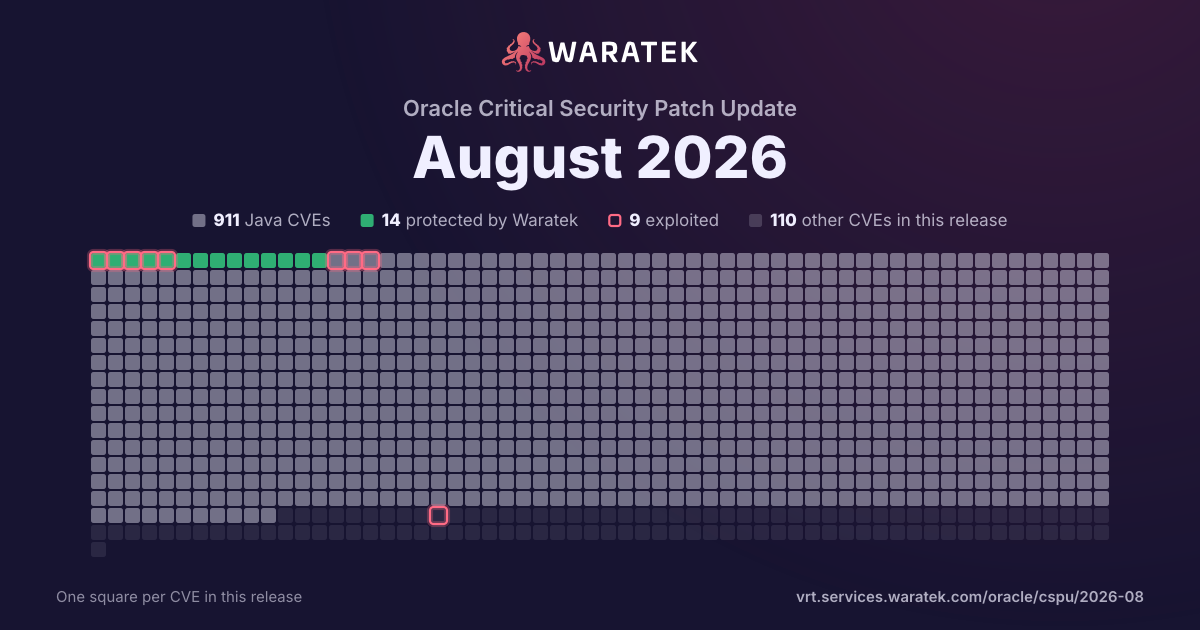
By status
14Protected by Waratek1Rule in development3Mitigation candidate893No exploit published2Outside Waratek scope108Not applicable
9Exploited, marked by the ring
No exploit published. For 847 of them, Oracle's security advisory is the source of public detail.
Protected by Waratek. Waratek RASP can block exploitation of these on systems that have not applied the patch yet.
Overview 282 matches · 3 protected · 0 exploited · 0 CISA KEV · 1 public PoC · 0 EPSS ≥ 0.5
Protected by Waratek
3
1.1%
Rule in development
0
0.0%
Mitigation candidate
0
0.0%
No exploit published
279
98.9%
blocked by ARMR today
3
1.1%
partly blocked
0
0.0%
not blocked
279
98.9%
not established
0
0.0%
unrecorded
0
0.0%
Exploited
0
0.0%
Working exploit published
0
0.0%
Proof of concept only
10
3.5%
Forecast only
0
0.0%
No public exploit
272
96.5%
split by
peak 253 / month
May 2613
Protected by Waratek2
No exploit published11
Critical5
High5
Medium2
Low1
blocked by ARMR today2
not blocked11
Proof of concept only10
No public exploit3
Jun 2615
Protected by Waratek1
No exploit published14
Critical1
High6
Medium8
blocked by ARMR today1
not blocked14
No public exploit15
Jul 261
No exploit published1
Medium1
not blocked1
No public exploit1
Aug 26253
No exploit published253
Critical75
High131
Medium45
Low2
not blocked253
No public exploit253
May 26Jun 26Jul 26Aug 26
| CVE | Severity | Published▾ | Status | Exploitation | Description |
|---|---|---|---|---|---|
| CVE-2026-60969 | High | 2026-08-18 | No exploit published | No public exploit | Vulnerability in the Oracle Unified Directory product of Oracle Fusion Middleware (component: OUD Core). Supported versions that are affected are 12.2.1.4.0 and 14.1.2.1.0. Easily exploitable vulnerability allows low privileged attacker with network access via LDAP to compromise Oracle Unified Directory. While the vulnerability is in Oracle Unified Directory, attacks may significantly impact additional products (scope change). Successful attacks of this vulnerability can result in unauthorized access to critical data or complete access to all Oracle Unified Directory accessible data. CVSS 3.1 Base Score 7.7 (Confidentiality impacts). CVSS Vector: (CVSS:3.1/AV:N/AC:L/PR:L/UI:N/S:C/C:H/I:N/A:N). |
| CVE-2026-60961 | High | 2026-08-18 | No exploit published | No public exploit | Vulnerability in the Oracle WebCenter Content product of Oracle Fusion Middleware (component: Content Server). Supported versions that are affected are 12.2.1.4.0 and 14.1.2.0.0. Difficult to exploit vulnerability allows unauthenticated attacker with access to the physical communication segment attached to the hardware where the Oracle WebCenter Content executes to compromise Oracle WebCenter Content. While the vulnerability is in Oracle WebCenter Content, attacks may significantly impact additional products (scope change). Successful attacks of this vulnerability can result in unauthorized creation, deletion or modification access to critical data or all Oracle WebCenter Content accessible data as well as unauthorized access to critical data or complete access to all Oracle WebCenter Content accessible data. CVSS 3.1 Base Score 8.0 (Confidentiality and Integrity impacts). CVSS Vector: (CVSS:3.1/AV:A/AC:H/PR:N/UI:N/S:C/C:H/I:H/A:N). |
| CVE-2026-60958 | Critical | 2026-08-18 | No exploit published | No public exploit | Vulnerability in the Oracle WebCenter Enterprise Capture product of Oracle Fusion Middleware (component: Client Bundle). Supported versions that are affected are 12.2.1.4.0 and 14.1.2.0.0. Easily exploitable vulnerability allows unauthenticated attacker with network access via HTTP to compromise Oracle WebCenter Enterprise Capture. Successful attacks of this vulnerability can result in takeover of Oracle WebCenter Enterprise Capture. CVSS 3.1 Base Score 9.8 (Confidentiality, Integrity and Availability impacts). CVSS Vector: (CVSS:3.1/AV:N/AC:L/PR:N/UI:N/S:U/C:H/I:H/A:H). |
| CVE-2026-60955 | High | 2026-08-18 | No exploit published | No public exploit | Vulnerability in the Oracle WebCenter Content product of Oracle Fusion Middleware (component: Content Server). Supported versions that are affected are 12.2.1.4.0 and 14.1.2.0.0. Easily exploitable vulnerability allows high privileged attacker with network access via HTTP to compromise Oracle WebCenter Content. While the vulnerability is in Oracle WebCenter Content, attacks may significantly impact additional products (scope change). Successful attacks of this vulnerability can result in unauthorized creation, deletion or modification access to critical data or all Oracle WebCenter Content accessible data as well as unauthorized read access to a subset of Oracle WebCenter Content accessible data and unauthorized ability to cause a partial denial of service (partial DOS) of Oracle WebCenter Content. CVSS 3.1 Base Score 8.2 (Confidentiality, Integrity and Availability impacts). CVSS Vector: (CVSS:3.1/AV:N/AC:L/PR:H/UI:N/S:C/C:L/I:H/A:L). |
| CVE-2026-60954 | High | 2026-08-18 | No exploit published | No public exploit | Vulnerability in the Oracle WebCenter Content product of Oracle Fusion Middleware (component: Content Server). Supported versions that are affected are 12.2.1.4.0 and 14.1.2.0.0. Difficult to exploit vulnerability allows unauthenticated attacker with network access via HTTP to compromise Oracle WebCenter Content. While the vulnerability is in Oracle WebCenter Content, attacks may significantly impact additional products (scope change). Successful attacks of this vulnerability can result in unauthorized creation, deletion or modification access to critical data or all Oracle WebCenter Content accessible data as well as unauthorized access to critical data or complete access to all Oracle WebCenter Content accessible data. CVSS 3.1 Base Score 8.7 (Confidentiality and Integrity impacts). CVSS Vector: (CVSS:3.1/AV:N/AC:H/PR:N/UI:N/S:C/C:H/I:H/A:N). |
| CVE-2026-60949 | High | 2026-08-18 | No exploit published | No public exploit | Vulnerability in the Oracle WebCenter Content product of Oracle Fusion Middleware (component: Content Server). Supported versions that are affected are 12.2.1.4.0 and 14.1.2.0.0. Difficult to exploit vulnerability allows low privileged attacker with network access via HTTP to compromise Oracle WebCenter Content. While the vulnerability is in Oracle WebCenter Content, attacks may significantly impact additional products (scope change). Successful attacks of this vulnerability can result in unauthorized access to critical data or complete access to all Oracle WebCenter Content accessible data as well as unauthorized update, insert or delete access to some of Oracle WebCenter Content accessible data. CVSS 3.1 Base Score 7.1 (Confidentiality and Integrity impacts). CVSS Vector: (CVSS:3.1/AV:N/AC:H/PR:L/UI:N/S:C/C:H/I:L/A:N). |
| CVE-2026-60947 | Critical | 2026-08-18 | No exploit published | No public exploit | Vulnerability in the Oracle WebCenter Enterprise Capture product of Oracle Fusion Middleware (component: Client Bundle). Supported versions that are affected are 12.2.1.4.0 and 14.1.2.0.0. Easily exploitable vulnerability allows unauthenticated attacker with network access via RMI to compromise Oracle WebCenter Enterprise Capture. Successful attacks of this vulnerability can result in takeover of Oracle WebCenter Enterprise Capture. CVSS 3.1 Base Score 9.8 (Confidentiality, Integrity and Availability impacts). CVSS Vector: (CVSS:3.1/AV:N/AC:L/PR:N/UI:N/S:U/C:H/I:H/A:H). |
| CVE-2026-60946 | Critical | 2026-08-18 | No exploit published | No public exploit | Vulnerability in the Oracle WebCenter Enterprise Capture product of Oracle Fusion Middleware (component: Client Bundle). Supported versions that are affected are 12.2.1.4.0 and 14.1.2.0.0. Easily exploitable vulnerability allows unauthenticated attacker with network access via RMI to compromise Oracle WebCenter Enterprise Capture. Successful attacks of this vulnerability can result in takeover of Oracle WebCenter Enterprise Capture. CVSS 3.1 Base Score 9.8 (Confidentiality, Integrity and Availability impacts). CVSS Vector: (CVSS:3.1/AV:N/AC:L/PR:N/UI:N/S:U/C:H/I:H/A:H). |
| CVE-2026-60944 | High | 2026-08-18 | No exploit published | No public exploit | Vulnerability in the Oracle WebCenter Content product of Oracle Fusion Middleware (component: Content Server). Supported versions that are affected are 12.2.1.4.0 and 14.1.2.0.0. Easily exploitable vulnerability allows unauthenticated attacker with network access via HTTP to compromise Oracle WebCenter Content. Successful attacks require human interaction from a person other than the attacker and while the vulnerability is in Oracle WebCenter Content, attacks may significantly impact additional products (scope change). Successful attacks of this vulnerability can result in unauthorized access to critical data or complete access to all Oracle WebCenter Content accessible data as well as unauthorized update, insert or delete access to some of Oracle WebCenter Content accessible data. CVSS 3.1 Base Score 8.2 (Confidentiality and Integrity impacts). CVSS Vector: (CVSS:3.1/AV:N/AC:L/PR:N/UI:R/S:C/C:H/I:L/A:N). |
| CVE-2026-60935 | High | 2026-08-18 | No exploit published | No public exploit | Vulnerability in the Oracle WebCenter Content product of Oracle Fusion Middleware (component: Content Server). Supported versions that are affected are 12.2.1.4.0 and 14.1.2.0.0. Difficult to exploit vulnerability allows unauthenticated attacker with network access via HTTP to compromise Oracle WebCenter Content. While the vulnerability is in Oracle WebCenter Content, attacks may significantly impact additional products (scope change). Successful attacks of this vulnerability can result in unauthorized creation, deletion or modification access to critical data or all Oracle WebCenter Content accessible data as well as unauthorized access to critical data or complete access to all Oracle WebCenter Content accessible data. CVSS 3.1 Base Score 8.7 (Confidentiality and Integrity impacts). CVSS Vector: (CVSS:3.1/AV:N/AC:H/PR:N/UI:N/S:C/C:H/I:H/A:N). |
| CVE-2026-60934 | High | 2026-08-18 | No exploit published | No public exploit | Vulnerability in the Oracle WebCenter Content product of Oracle Fusion Middleware (component: Content Server). Supported versions that are affected are 12.2.1.4.0 and 14.1.2.0.0. Difficult to exploit vulnerability allows unauthenticated attacker with network access via HTTP to compromise Oracle WebCenter Content. While the vulnerability is in Oracle WebCenter Content, attacks may significantly impact additional products (scope change). Successful attacks of this vulnerability can result in unauthorized creation, deletion or modification access to critical data or all Oracle WebCenter Content accessible data as well as unauthorized access to critical data or complete access to all Oracle WebCenter Content accessible data. CVSS 3.1 Base Score 8.7 (Confidentiality and Integrity impacts). CVSS Vector: (CVSS:3.1/AV:N/AC:H/PR:N/UI:N/S:C/C:H/I:H/A:N). |
| CVE-2026-60933 | High | 2026-08-18 | No exploit published | No public exploit | Vulnerability in the Oracle WebCenter Content product of Oracle Fusion Middleware (component: Content Server). Supported versions that are affected are 12.2.1.4.0 and 14.1.2.0.0. Difficult to exploit vulnerability allows unauthenticated attacker with network access via HTTP to compromise Oracle WebCenter Content. Successful attacks of this vulnerability can result in unauthorized creation, deletion or modification access to critical data or all Oracle WebCenter Content accessible data as well as unauthorized access to critical data or complete access to all Oracle WebCenter Content accessible data. CVSS 3.1 Base Score 7.4 (Confidentiality and Integrity impacts). CVSS Vector: (CVSS:3.1/AV:N/AC:H/PR:N/UI:N/S:U/C:H/I:H/A:N). |
| CVE-2026-60928 | High | 2026-08-18 | No exploit published | No public exploit | Vulnerability in the Oracle WebCenter Content product of Oracle Fusion Middleware (component: Content Server). The supported version that is affected is 14.1.2.0.0. Easily exploitable vulnerability allows low privileged attacker with logon to the infrastructure where Oracle WebCenter Content executes to compromise Oracle WebCenter Content. While the vulnerability is in Oracle WebCenter Content, attacks may significantly impact additional products (scope change). Successful attacks of this vulnerability can result in unauthorized creation, deletion or modification access to critical data or all Oracle WebCenter Content accessible data as well as unauthorized access to critical data or complete access to all Oracle WebCenter Content accessible data. CVSS 3.1 Base Score 8.4 (Confidentiality and Integrity impacts). CVSS Vector: (CVSS:3.1/AV:L/AC:L/PR:L/UI:N/S:C/C:H/I:H/A:N). |
| CVE-2026-60921 | Critical | 2026-08-18 | No exploit published | No public exploit | Vulnerability in the Oracle WebCenter Enterprise Capture product of Oracle Fusion Middleware (component: Client Bundle). Supported versions that are affected are 12.2.1.4.0 and 14.1.2.0.0. Easily exploitable vulnerability allows unauthenticated attacker with network access via T3, IIOP to compromise Oracle WebCenter Enterprise Capture. Successful attacks of this vulnerability can result in takeover of Oracle WebCenter Enterprise Capture. CVSS 3.1 Base Score 9.8 (Confidentiality, Integrity and Availability impacts). CVSS Vector: (CVSS:3.1/AV:N/AC:L/PR:N/UI:N/S:U/C:H/I:H/A:H). |
| CVE-2026-60916 | Critical | 2026-08-18 | No exploit published | No public exploit | Vulnerability in the Oracle WebCenter Enterprise Capture product of Oracle Fusion Middleware (component: Client Bundle). Supported versions that are affected are 12.2.1.4.0 and 14.1.2.0.0. Easily exploitable vulnerability allows unauthenticated attacker with network access via HTTP to compromise Oracle WebCenter Enterprise Capture. While the vulnerability is in Oracle WebCenter Enterprise Capture, attacks may significantly impact additional products (scope change). Successful attacks of this vulnerability can result in unauthorized creation, deletion or modification access to critical data or all Oracle WebCenter Enterprise Capture accessible data as well as unauthorized read access to a subset of Oracle WebCenter Enterprise Capture accessible data and unauthorized ability to cause a partial denial of service (partial DOS) of Oracle WebCenter Enterprise Capture. CVSS 3.1 Base Score 9.9 (Confidentiality, Integrity and Availability impacts). CVSS Vector: (CVSS:3.1/AV:N/AC:L/PR:N/UI:N/S:C/C:L/I:H/A:L). |
| CVE-2026-60915 | High | 2026-08-18 | No exploit published | No public exploit | Vulnerability in the Helidon product of Oracle Fusion Middleware (component: Imperative Web Server). Supported versions that are affected are 3.0.0-3.2.17 and 4.0.0-4.4.1. Difficult to exploit vulnerability allows unauthenticated attacker with network access via HTTP to compromise Helidon. Successful attacks of this vulnerability can result in unauthorized creation, deletion or modification access to critical data or all Helidon accessible data as well as unauthorized access to critical data or complete access to all Helidon accessible data. CVSS 3.1 Base Score 7.4 (Confidentiality and Integrity impacts). CVSS Vector: (CVSS:3.1/AV:N/AC:H/PR:N/UI:N/S:U/C:H/I:H/A:N). |
| CVE-2026-60914 | High | 2026-08-18 | No exploit published | No public exploit | Vulnerability in the Oracle Unified Directory product of Oracle Fusion Middleware (component: OUD Core). Supported versions that are affected are 12.2.1.4.0 and 14.1.2.1.0. Easily exploitable vulnerability allows unauthenticated attacker with network access via LDAP to compromise Oracle Unified Directory. Successful attacks of this vulnerability can result in unauthorized access to critical data or complete access to all Oracle Unified Directory accessible data. CVSS 3.1 Base Score 7.5 (Confidentiality impacts). CVSS Vector: (CVSS:3.1/AV:N/AC:L/PR:N/UI:N/S:U/C:H/I:N/A:N). |
| CVE-2026-60909 | High | 2026-08-18 | No exploit published | No public exploit | Vulnerability in the Oracle WebCenter Content product of Oracle Fusion Middleware (component: Content Server). Supported versions that are affected are 12.2.1.4.0 and 14.1.2.0.0. Easily exploitable vulnerability allows low privileged attacker with network access via HTTP to compromise Oracle WebCenter Content. Successful attacks require human interaction from a person other than the attacker and while the vulnerability is in Oracle WebCenter Content, attacks may significantly impact additional products (scope change). Successful attacks of this vulnerability can result in unauthorized access to critical data or complete access to all Oracle WebCenter Content accessible data as well as unauthorized update, insert or delete access to some of Oracle WebCenter Content accessible data. CVSS 3.1 Base Score 7.6 (Confidentiality and Integrity impacts). CVSS Vector: (CVSS:3.1/AV:N/AC:L/PR:L/UI:R/S:C/C:H/I:L/A:N). |
| CVE-2026-60906 | High | 2026-08-18 | No exploit published | No public exploit | Vulnerability in the Oracle WebCenter Content product of Oracle Fusion Middleware (component: Content Server). Supported versions that are affected are 12.2.1.4.0 and 14.1.2.0.0. Easily exploitable vulnerability allows unauthenticated attacker with network access via HTTP to compromise Oracle WebCenter Content. Successful attacks of this vulnerability can result in unauthorized access to critical data or complete access to all Oracle WebCenter Content accessible data. CVSS 3.1 Base Score 7.5 (Confidentiality impacts). CVSS Vector: (CVSS:3.1/AV:N/AC:L/PR:N/UI:N/S:U/C:H/I:N/A:N). |
| CVE-2026-60905 | Critical | 2026-08-18 | No exploit published | No public exploit | Vulnerability in the Oracle WebCenter Content product of Oracle Fusion Middleware (component: Content Server). Supported versions that are affected are 12.2.1.4.0 and 14.1.2.0.0. Easily exploitable vulnerability allows unauthenticated attacker with network access via HTTP to compromise Oracle WebCenter Content. Successful attacks require human interaction from a person other than the attacker and while the vulnerability is in Oracle WebCenter Content, attacks may significantly impact additional products (scope change). Successful attacks of this vulnerability can result in unauthorized creation, deletion or modification access to critical data or all Oracle WebCenter Content accessible data as well as unauthorized access to critical data or complete access to all Oracle WebCenter Content accessible data and unauthorized ability to cause a partial denial of service (partial DOS) of Oracle WebCenter Content. CVSS 3.1 Base Score 9.6 (Confidentiality, Integrity and Availability impacts). CVSS Vector: (CVSS:3.1/AV:N/AC:L/PR:N/UI:R/S:C/C:H/I:H/A:L). |
| CVE-2026-60903 | High | 2026-08-18 | No exploit published | No public exploit | Vulnerability in the Oracle WebCenter Content product of Oracle Fusion Middleware (component: Content Server). Supported versions that are affected are 12.2.1.4.0 and 14.1.2.0.0. Difficult to exploit vulnerability allows unauthenticated attacker with network access via HTTP to compromise Oracle WebCenter Content. While the vulnerability is in Oracle WebCenter Content, attacks may significantly impact additional products (scope change). Successful attacks of this vulnerability can result in unauthorized creation, deletion or modification access to critical data or all Oracle WebCenter Content accessible data as well as unauthorized access to critical data or complete access to all Oracle WebCenter Content accessible data. CVSS 3.1 Base Score 8.7 (Confidentiality and Integrity impacts). CVSS Vector: (CVSS:3.1/AV:N/AC:H/PR:N/UI:N/S:C/C:H/I:H/A:N). |
| CVE-2026-60895 | Medium | 2026-08-18 | No exploit published | No public exploit | Vulnerability in the Oracle Unified Directory product of Oracle Fusion Middleware (component: OUD Core). Supported versions that are affected are 12.2.1.4.0 and 14.1.2.1.0. Difficult to exploit vulnerability allows low privileged attacker with network access via LDAP to compromise Oracle Unified Directory. Successful attacks of this vulnerability can result in unauthorized creation, deletion or modification access to critical data or all Oracle Unified Directory accessible data as well as unauthorized access to critical data or complete access to all Oracle Unified Directory accessible data. CVSS 3.1 Base Score 6.8 (Confidentiality and Integrity impacts). CVSS Vector: (CVSS:3.1/AV:N/AC:H/PR:L/UI:N/S:U/C:H/I:H/A:N). |
| CVE-2026-60889 | High | 2026-08-18 | No exploit published | No public exploit | Vulnerability in the Oracle Unified Directory product of Oracle Fusion Middleware (component: OUD Core). Supported versions that are affected are 12.2.1.4.0 and 14.1.2.1.0. Easily exploitable vulnerability allows unauthenticated attacker with network access via LDAP to compromise Oracle Unified Directory. Successful attacks of this vulnerability can result in unauthorized access to critical data or complete access to all Oracle Unified Directory accessible data. CVSS 3.1 Base Score 7.5 (Confidentiality impacts). CVSS Vector: (CVSS:3.1/AV:N/AC:L/PR:N/UI:N/S:U/C:H/I:N/A:N). |
| CVE-2026-60866 | Medium | 2026-08-18 | No exploit published | No public exploit | Vulnerability in the Service Delivery Platform product of Oracle Fusion Middleware (component: Messaging Enabler). The supported version that is affected is 14.1.2.0.0. Easily exploitable vulnerability allows unauthenticated attacker with network access via HTTP to compromise Service Delivery Platform. Successful attacks of this vulnerability can result in unauthorized update, insert or delete access to some of Service Delivery Platform accessible data as well as unauthorized read access to a subset of Service Delivery Platform accessible data. CVSS 3.1 Base Score 6.5 (Confidentiality and Integrity impacts). CVSS Vector: (CVSS:3.1/AV:N/AC:L/PR:N/UI:N/S:U/C:L/I:L/A:N). |
| CVE-2026-60865 | Medium | 2026-08-18 | No exploit published | No public exploit | Vulnerability in the Service Delivery Platform product of Oracle Fusion Middleware (component: Messaging Enabler). Supported versions that are affected are 14.1.2.0.0 and 12.2.1.4.0. Easily exploitable vulnerability allows high privileged attacker with network access via HTTP to compromise Service Delivery Platform. While the vulnerability is in Service Delivery Platform, attacks may significantly impact additional products (scope change). Successful attacks of this vulnerability can result in unauthorized access to critical data or complete access to all Service Delivery Platform accessible data. CVSS 3.1 Base Score 6.8 (Confidentiality impacts). CVSS Vector: (CVSS:3.1/AV:N/AC:L/PR:H/UI:N/S:C/C:H/I:N/A:N). |
| CVE-2026-60861 | Critical | 2026-08-18 | No exploit published | No public exploit | Vulnerability in the Service Delivery Platform product of Oracle Fusion Middleware (component: Messaging Enabler). Supported versions that are affected are 14.1.2.0.0 and 12.2.1.4.0. Easily exploitable vulnerability allows low privileged attacker with network access via Oracle Net to compromise Service Delivery Platform. While the vulnerability is in Service Delivery Platform, attacks may significantly impact additional products (scope change). Successful attacks of this vulnerability can result in unauthorized creation, deletion or modification access to critical data or all Service Delivery Platform accessible data as well as unauthorized access to critical data or complete access to all Service Delivery Platform accessible data. CVSS 3.1 Base Score 9.6 (Confidentiality and Integrity impacts). CVSS Vector: (CVSS:3.1/AV:N/AC:L/PR:L/UI:N/S:C/C:H/I:H/A:N). |
| CVE-2026-60860 | High | 2026-08-18 | No exploit published | No public exploit | Vulnerability in the Service Delivery Platform product of Oracle Fusion Middleware (component: Messaging Enabler). Supported versions that are affected are 14.1.2.0.0 and 12.2.1.4.0. Difficult to exploit vulnerability allows unauthenticated attacker with network access via TCP to compromise Service Delivery Platform. While the vulnerability is in Service Delivery Platform, attacks may significantly impact additional products (scope change). Successful attacks of this vulnerability can result in unauthorized creation, deletion or modification access to critical data or all Service Delivery Platform accessible data and unauthorized ability to cause a hang or frequently repeatable crash (complete DOS) of Service Delivery Platform. CVSS 3.1 Base Score 8.7 (Integrity and Availability impacts). CVSS Vector: (CVSS:3.1/AV:N/AC:H/PR:N/UI:N/S:C/C:N/I:H/A:H). |
| CVE-2026-60853 | Low | 2026-08-18 | No exploit published | No public exploit | Vulnerability in the Helidon product of Oracle Fusion Middleware (component: Imperative Web Server). Supported versions that are affected are 3.0.0-3.2.19. Difficult to exploit vulnerability allows unauthenticated attacker with network access via HTTP to compromise Helidon. Successful attacks of this vulnerability can result in unauthorized read access to a subset of Helidon accessible data. CVSS 3.1 Base Score 3.7 (Confidentiality impacts). CVSS Vector: (CVSS:3.1/AV:N/AC:H/PR:N/UI:N/S:U/C:L/I:N/A:N). |
| CVE-2026-60850 | High | 2026-08-18 | No exploit published | No public exploit | Vulnerability in the Oracle Unified Directory product of Oracle Fusion Middleware (component: OUD Core). Supported versions that are affected are 12.2.1.4.0 and 14.1.2.1.0. Easily exploitable vulnerability allows unauthenticated attacker with network access via LDAP to compromise Oracle Unified Directory. Successful attacks of this vulnerability can result in unauthorized access to critical data or complete access to all Oracle Unified Directory accessible data. CVSS 3.1 Base Score 7.5 (Confidentiality impacts). CVSS Vector: (CVSS:3.1/AV:N/AC:L/PR:N/UI:N/S:U/C:H/I:N/A:N). |
| CVE-2026-60849 | High | 2026-08-18 | No exploit published | No public exploit | Vulnerability in the Oracle Unified Directory product of Oracle Fusion Middleware (component: OUD Core). Supported versions that are affected are 12.2.1.4.0 and 14.1.2.1.0. Difficult to exploit vulnerability allows low privileged attacker with network access via LDAP to compromise Oracle Unified Directory. While the vulnerability is in Oracle Unified Directory, attacks may significantly impact additional products (scope change). Successful attacks of this vulnerability can result in takeover of Oracle Unified Directory. CVSS 3.1 Base Score 8.5 (Confidentiality, Integrity and Availability impacts). CVSS Vector: (CVSS:3.1/AV:N/AC:H/PR:L/UI:N/S:C/C:H/I:H/A:H). |
| CVE-2026-60841 | High | 2026-08-18 | No exploit published | No public exploit | Vulnerability in the Oracle Unified Directory product of Oracle Fusion Middleware (component: OUD Core). Supported versions that are affected are 12.2.1.4.0 and 14.1.2.1.0. Difficult to exploit vulnerability allows low privileged attacker with network access via LDAP to compromise Oracle Unified Directory. While the vulnerability is in Oracle Unified Directory, attacks may significantly impact additional products (scope change). Successful attacks of this vulnerability can result in takeover of Oracle Unified Directory. CVSS 3.1 Base Score 8.5 (Confidentiality, Integrity and Availability impacts). CVSS Vector: (CVSS:3.1/AV:N/AC:H/PR:L/UI:N/S:C/C:H/I:H/A:H). |
| CVE-2026-60737 | Critical | 2026-08-18 | No exploit published | No public exploit | Vulnerability in the Oracle Web Services Manager product of Oracle Fusion Middleware (component: Web Services Security). Supported versions that are affected are 12.2.1.4.0 and 14.1.2.0.0. Easily exploitable vulnerability allows unauthenticated attacker with network access via HTTP to compromise Oracle Web Services Manager. Successful attacks of this vulnerability can result in unauthorized creation, deletion or modification access to critical data or all Oracle Web Services Manager accessible data as well as unauthorized access to critical data or complete access to all Oracle Web Services Manager accessible data. CVSS 3.1 Base Score 9.1 (Confidentiality and Integrity impacts). CVSS Vector: (CVSS:3.1/AV:N/AC:L/PR:N/UI:N/S:U/C:H/I:H/A:N). |
| CVE-2026-60733 | High | 2026-08-18 | No exploit published | No public exploit | Vulnerability in the Oracle WebCenter Portal product of Oracle Fusion Middleware (component: Composer). Supported versions that are affected are 12.2.1.4.0 and 14.1.2.0.0. Difficult to exploit vulnerability allows low privileged attacker with network access via HTTP to compromise Oracle WebCenter Portal. While the vulnerability is in Oracle WebCenter Portal, attacks may significantly impact additional products (scope change). Successful attacks of this vulnerability can result in unauthorized creation, deletion or modification access to critical data or all Oracle WebCenter Portal accessible data as well as unauthorized read access to a subset of Oracle WebCenter Portal accessible data and unauthorized ability to cause a partial denial of service (partial DOS) of Oracle WebCenter Portal. CVSS 3.1 Base Score 7.7 (Confidentiality, Integrity and Availability impacts). CVSS Vector: (CVSS:3.1/AV:N/AC:H/PR:L/UI:N/S:C/C:L/I:H/A:L). |
| CVE-2026-60731 | High | 2026-08-18 | No exploit published | No public exploit | Vulnerability in the Oracle WebCenter Portal product of Oracle Fusion Middleware (component: Composer). Supported versions that are affected are 12.2.1.4.0 and 14.1.2.0.0. Easily exploitable vulnerability allows low privileged attacker with network access via RMI to compromise Oracle WebCenter Portal. Successful attacks of this vulnerability can result in takeover of Oracle WebCenter Portal. CVSS 3.1 Base Score 8.8 (Confidentiality, Integrity and Availability impacts). CVSS Vector: (CVSS:3.1/AV:N/AC:L/PR:L/UI:N/S:U/C:H/I:H/A:H). |
| CVE-2026-60730 | Critical | 2026-08-18 | No exploit published | No public exploit | Vulnerability in the Oracle WebCenter Portal product of Oracle Fusion Middleware (component: Composer). Supported versions that are affected are 12.2.1.4.0 and 14.1.2.0.0. Easily exploitable vulnerability allows low privileged attacker with network access via HTTP to compromise Oracle WebCenter Portal. While the vulnerability is in Oracle WebCenter Portal, attacks may significantly impact additional products (scope change). Successful attacks of this vulnerability can result in takeover of Oracle WebCenter Portal. CVSS 3.1 Base Score 9.9 (Confidentiality, Integrity and Availability impacts). CVSS Vector: (CVSS:3.1/AV:N/AC:L/PR:L/UI:N/S:C/C:H/I:H/A:H). |
| CVE-2026-60729 | High | 2026-08-18 | No exploit published | No public exploit | Vulnerability in the Oracle WebCenter Portal product of Oracle Fusion Middleware (component: Composer). Supported versions that are affected are 12.2.1.4.0 and 14.1.2.0.0. Easily exploitable vulnerability allows low privileged attacker with network access via HTTP to compromise Oracle WebCenter Portal. Successful attacks of this vulnerability can result in takeover of Oracle WebCenter Portal. CVSS 3.1 Base Score 8.8 (Confidentiality, Integrity and Availability impacts). CVSS Vector: (CVSS:3.1/AV:N/AC:L/PR:L/UI:N/S:U/C:H/I:H/A:H). |
| CVE-2026-60728 | Critical | 2026-08-18 | No exploit published | No public exploit | Vulnerability in the Oracle WebCenter Portal product of Oracle Fusion Middleware (component: Portlet Services). Supported versions that are affected are 12.2.1.4.0 and 14.1.2.0.0. Easily exploitable vulnerability allows unauthenticated attacker with network access via HTTP to compromise Oracle WebCenter Portal. Successful attacks of this vulnerability can result in unauthorized access to critical data or complete access to all Oracle WebCenter Portal accessible data and unauthorized ability to cause a hang or frequently repeatable crash (complete DOS) of Oracle WebCenter Portal. CVSS 3.1 Base Score 9.1 (Confidentiality and Availability impacts). CVSS Vector: (CVSS:3.1/AV:N/AC:L/PR:N/UI:N/S:U/C:H/I:N/A:H). |
| CVE-2026-60727 | Critical | 2026-08-18 | No exploit published | No public exploit | Vulnerability in the Oracle Identity Manager product of Oracle Fusion Middleware (component: OIM Legacy UI). Supported versions that are affected are 12.2.1.4.0 and 14.1.2.1.0. Easily exploitable vulnerability allows unauthenticated attacker with network access via HTTP to compromise Oracle Identity Manager. Successful attacks of this vulnerability can result in takeover of Oracle Identity Manager. CVSS 3.1 Base Score 9.8 (Confidentiality, Integrity and Availability impacts). CVSS Vector: (CVSS:3.1/AV:N/AC:L/PR:N/UI:N/S:U/C:H/I:H/A:H). |
| CVE-2026-60726 | High | 2026-08-18 | No exploit published | No public exploit | Vulnerability in the Oracle Access Manager product of Oracle Fusion Middleware (component: Authentication Engine). Supported versions that are affected are 12.2.1.4.0 and 14.1.2.1.0. Easily exploitable vulnerability allows low privileged attacker with network access via HTTP to compromise Oracle Access Manager. Successful attacks of this vulnerability can result in takeover of Oracle Access Manager. CVSS 3.1 Base Score 8.8 (Confidentiality, Integrity and Availability impacts). CVSS Vector: (CVSS:3.1/AV:N/AC:L/PR:L/UI:N/S:U/C:H/I:H/A:H). |
| CVE-2026-60722 | High | 2026-08-18 | No exploit published | No public exploit | Vulnerability in the Oracle Identity Manager product of Oracle Fusion Middleware (component: OIM Legacy UI). Supported versions that are affected are 12.2.1.4.0 and 14.1.2.1.0. Easily exploitable vulnerability allows low privileged attacker with network access via T3, IIOP to compromise Oracle Identity Manager. Successful attacks of this vulnerability can result in takeover of Oracle Identity Manager. CVSS 3.1 Base Score 8.8 (Confidentiality, Integrity and Availability impacts). CVSS Vector: (CVSS:3.1/AV:N/AC:L/PR:L/UI:N/S:U/C:H/I:H/A:H). |
| CVE-2026-60721 | Critical | 2026-08-18 | No exploit published | No public exploit | Vulnerability in the Oracle Identity Manager product of Oracle Fusion Middleware (component: OIM Legacy UI). Supported versions that are affected are 12.2.1.4.0 and 14.1.2.1.0. Easily exploitable vulnerability allows unauthenticated attacker with network access via HTTP to compromise Oracle Identity Manager. Successful attacks of this vulnerability can result in takeover of Oracle Identity Manager. CVSS 3.1 Base Score 9.8 (Confidentiality, Integrity and Availability impacts). CVSS Vector: (CVSS:3.1/AV:N/AC:L/PR:N/UI:N/S:U/C:H/I:H/A:H). |
| CVE-2026-60720 | Critical | 2026-08-18 | No exploit published | No public exploit | Vulnerability in the Oracle Identity Manager product of Oracle Fusion Middleware (component: OIM Legacy UI). Supported versions that are affected are 12.2.1.4.0 and 14.1.2.1.0. Easily exploitable vulnerability allows low privileged attacker with network access via HTTP to compromise Oracle Identity Manager. While the vulnerability is in Oracle Identity Manager, attacks may significantly impact additional products (scope change). Successful attacks of this vulnerability can result in takeover of Oracle Identity Manager. CVSS 3.1 Base Score 9.9 (Confidentiality, Integrity and Availability impacts). CVSS Vector: (CVSS:3.1/AV:N/AC:L/PR:L/UI:N/S:C/C:H/I:H/A:H). |
| CVE-2026-60716 | High | 2026-08-18 | No exploit published | No public exploit | Vulnerability in the Oracle Identity Manager product of Oracle Fusion Middleware (component: OIM Legacy UI). Supported versions that are affected are 12.2.1.4.0 and 14.1.2.1.0. Easily exploitable vulnerability allows low privileged attacker with network access via T3, IIOP to compromise Oracle Identity Manager. Successful attacks of this vulnerability can result in takeover of Oracle Identity Manager. CVSS 3.1 Base Score 8.8 (Confidentiality, Integrity and Availability impacts). CVSS Vector: (CVSS:3.1/AV:N/AC:L/PR:L/UI:N/S:U/C:H/I:H/A:H). |
| CVE-2026-60715 | High | 2026-08-18 | No exploit published | No public exploit | Vulnerability in the Oracle Identity Manager product of Oracle Fusion Middleware (component: OIM Legacy UI). Supported versions that are affected are 12.2.1.4.0 and 14.1.2.1.0. Easily exploitable vulnerability allows low privileged attacker with network access via HTTP to compromise Oracle Identity Manager. Successful attacks of this vulnerability can result in takeover of Oracle Identity Manager. CVSS 3.1 Base Score 8.8 (Confidentiality, Integrity and Availability impacts). CVSS Vector: (CVSS:3.1/AV:N/AC:L/PR:L/UI:N/S:U/C:H/I:H/A:H). |
| CVE-2026-60707 | High | 2026-08-18 | No exploit published | No public exploit | Vulnerability in the Oracle Identity Manager product of Oracle Fusion Middleware (component: Security). Supported versions that are affected are 12.2.1.4.0 and 14.1.2.1.0. Easily exploitable vulnerability allows high privileged attacker with network access via HTTP to compromise Oracle Identity Manager. While the vulnerability is in Oracle Identity Manager, attacks may significantly impact additional products (scope change). Successful attacks of this vulnerability can result in unauthorized creation, deletion or modification access to critical data or all Oracle Identity Manager accessible data as well as unauthorized access to critical data or complete access to all Oracle Identity Manager accessible data. CVSS 3.1 Base Score 8.7 (Confidentiality and Integrity impacts). CVSS Vector: (CVSS:3.1/AV:N/AC:L/PR:H/UI:N/S:C/C:H/I:H/A:N). |
| CVE-2026-60702 | Critical | 2026-08-18 | No exploit published | No public exploit | Vulnerability in the Oracle WebLogic Server product of Oracle Fusion Middleware (component: Core). Supported versions that are affected are 12.2.1.4.0, 14.1.1.0.0, 14.1.2.0.0 and 15.1.1.0.0. Easily exploitable vulnerability allows low privileged attacker with network access via T3, IIOP to compromise Oracle WebLogic Server. While the vulnerability is in Oracle WebLogic Server, attacks may significantly impact additional products (scope change). Successful attacks of this vulnerability can result in takeover of Oracle WebLogic Server. CVSS 3.1 Base Score 9.9 (Confidentiality, Integrity and Availability impacts). CVSS Vector: (CVSS:3.1/AV:N/AC:L/PR:L/UI:N/S:C/C:H/I:H/A:H). |
| CVE-2026-60699 | High | 2026-08-18 | No exploit published | No public exploit | Vulnerability in the Oracle WebLogic Server product of Oracle Fusion Middleware (component: Core). Supported versions that are affected are 12.2.1.4.0, 14.1.1.0.0, 14.1.2.0.0 and 15.1.1.0.0. Easily exploitable vulnerability allows unauthenticated attacker with network access via T3, IIOP to compromise Oracle WebLogic Server. While the vulnerability is in Oracle WebLogic Server, attacks may significantly impact additional products (scope change). Successful attacks of this vulnerability can result in unauthorized access to critical data or complete access to all Oracle WebLogic Server accessible data. CVSS 3.1 Base Score 8.6 (Confidentiality impacts). CVSS Vector: (CVSS:3.1/AV:N/AC:L/PR:N/UI:N/S:C/C:H/I:N/A:N). |
| CVE-2026-60698 | Critical | 2026-08-18 | No exploit published | No public exploit | Vulnerability in the Oracle WebLogic Server product of Oracle Fusion Middleware (component: Core). Supported versions that are affected are 12.2.1.4.0, 14.1.1.0.0, 14.1.2.0.0 and 15.1.1.0.0. Easily exploitable vulnerability allows unauthenticated attacker with network access via IIOP to compromise Oracle WebLogic Server. Successful attacks of this vulnerability can result in takeover of Oracle WebLogic Server. CVSS 3.1 Base Score 9.8 (Confidentiality, Integrity and Availability impacts). CVSS Vector: (CVSS:3.1/AV:N/AC:L/PR:N/UI:N/S:U/C:H/I:H/A:H). |
| CVE-2026-60696 | Critical | 2026-08-18 | No exploit published | No public exploit | Vulnerability in the Oracle WebLogic Server product of Oracle Fusion Middleware (component: Core). Supported versions that are affected are 12.2.1.4.0, 14.1.1.0.0, 14.1.2.0.0 and 15.1.1.0.0. Easily exploitable vulnerability allows unauthenticated attacker with network access via T3, IIOP to compromise Oracle WebLogic Server. Successful attacks of this vulnerability can result in takeover of Oracle WebLogic Server. CVSS 3.1 Base Score 9.8 (Confidentiality, Integrity and Availability impacts). CVSS Vector: (CVSS:3.1/AV:N/AC:L/PR:N/UI:N/S:U/C:H/I:H/A:H). |
| CVE-2026-60680 | High | 2026-08-18 | No exploit published | No public exploit | Vulnerability in the Oracle WebLogic Server product of Oracle Fusion Middleware (component: Core). Supported versions that are affected are 12.2.1.4.0, 14.1.1.0.0, 14.1.2.0.0 and 15.1.1.0.0. Easily exploitable vulnerability allows low privileged attacker with network access via HTTP to compromise Oracle WebLogic Server. Successful attacks of this vulnerability can result in unauthorized creation, deletion or modification access to critical data or all Oracle WebLogic Server accessible data and unauthorized ability to cause a hang or frequently repeatable crash (complete DOS) of Oracle WebLogic Server. CVSS 3.1 Base Score 8.1 (Integrity and Availability impacts). CVSS Vector: (CVSS:3.1/AV:N/AC:L/PR:L/UI:N/S:U/C:N/I:H/A:H). |
| CVE-2026-60679 | High | 2026-08-18 | No exploit published | No public exploit | Vulnerability in the Oracle WebLogic Server product of Oracle Fusion Middleware (component: Core). Supported versions that are affected are 12.2.1.4.0, 14.1.1.0.0, 14.1.2.0.0 and 15.1.1.0.0. Difficult to exploit vulnerability allows low privileged attacker with network access via T3, IIOP to compromise Oracle WebLogic Server. Successful attacks of this vulnerability can result in takeover of Oracle WebLogic Server. CVSS 3.1 Base Score 7.5 (Confidentiality, Integrity and Availability impacts). CVSS Vector: (CVSS:3.1/AV:N/AC:H/PR:L/UI:N/S:U/C:H/I:H/A:H). |
| CVE-2026-60672 | Critical | 2026-08-18 | No exploit published | No public exploit | Vulnerability in the Oracle WebLogic Server product of Oracle Fusion Middleware (component: Core). Supported versions that are affected are 12.2.1.4.0, 14.1.1.0.0, 14.1.2.0.0 and 15.1.1.0.0. Easily exploitable vulnerability allows unauthenticated attacker with network access via T3, IIOP to compromise Oracle WebLogic Server. Successful attacks of this vulnerability can result in takeover of Oracle WebLogic Server. CVSS 3.1 Base Score 9.8 (Confidentiality, Integrity and Availability impacts). CVSS Vector: (CVSS:3.1/AV:N/AC:L/PR:N/UI:N/S:U/C:H/I:H/A:H). |
| CVE-2026-60415 | High | 2026-08-18 | No exploit published | No public exploit | Vulnerability in the Oracle WebLogic Server product of Oracle Fusion Middleware (component: Core). Supported versions that are affected are 12.2.1.4.0, 14.1.1.0.0, 14.1.2.0.0 and 15.1.1.0.0. Difficult to exploit vulnerability allows unauthenticated attacker with network access via T3, IIOP to compromise Oracle WebLogic Server. Successful attacks of this vulnerability can result in takeover of Oracle WebLogic Server. CVSS 3.1 Base Score 8.1 (Confidentiality, Integrity and Availability impacts). CVSS Vector: (CVSS:3.1/AV:N/AC:H/PR:N/UI:N/S:U/C:H/I:H/A:H). |
| CVE-2026-59889 | Medium | 2026-07-14 | No exploit published | No public exploit | jackson-databind contains the general-purpose data-binding functionality and tree-model for Jackson Data Processor. From 2.18.0 until 2.18.9, 2.21.5, 2.22.1, 3.1.5, and 3.2.1, UnwrappedPropertyHandler.processUnwrapped() replays buffered JSON for a @JsonUnwrapped property and calls prop.deserializeAndSet() without a prop.visibleInView(ctxt.getActiveView()) guard, allowing a property annotated with both @JsonView and @JsonUnwrapped to be written from attacker JSON under a less-privileged active view. This issue is fixed in versions 2.18.9, 2.21.5, 2.22.1, 3.1.5, and 3.2.1. |
| CVE-2026-41855 | Critical | 2026-06-09 | No exploit published | No public exploit | In an untrusted JMS environment, org.springframework.jms.support.converter.MappingJackson2MessageConverter and org.springframework.jms.support.converter.JacksonJsonMessageConverter allow arbitrary class instantiation, which can lead to unauthorized actions via gadget class deserialization. Affected versions: Spring Framework 7.0.0 through 7.0.7; 6.2.0 through 6.2.18; 6.1.0 through 6.1.27; 5.3.0 through 5.3.48. |
| CVE-2026-41854 | Medium | 2026-06-09 | No exploit published | No public exploit | Due to incorrect host parsing, applications that rely on UriComponentsBuilder to parse and validate an externally provided URL string may be exposed to a server-side request forgery (SSRF) attack. Affected versions: Spring Framework 7.0.0 through 7.0.7; 6.2.0 through 6.2.18. |
| CVE-2026-41852 | Medium | 2026-06-09 | No exploit published | No public exploit | A vulnerability in Spring Expression Language (SpEL) evaluation logic allows for arbitrary zero-argument method invocation, even within restricted or read-only contexts, which may allow an attacker to invoke unintended application logic. Affected versions: Spring Framework 7.0.0 through 7.0.7; 6.2.0 through 6.2.18; 6.1.0 through 6.1.27; 5.3.0 through 5.3.48. |
| CVE-2026-41851 | High | 2026-06-09 | No exploit published | No public exploit | Applications which accept user-supplied Spring Expression Language (SpEL) expressions may be vulnerable to a Denial of Service (DoS) attack if the evaluation of a SpEL expression triggers unbounded cache growth. Affected versions: Spring Framework 7.0.0 through 7.0.7; 6.2.0 through 6.2.18; 6.1.0 through 6.1.27; 5.3.0 through 5.3.48. |
| CVE-2026-41850 | High | 2026-06-09 | No exploit published | No public exploit | Applications that evaluate user-supplied Spring Expression Language (SpEL) expressions are vulnerable to an Algorithmic Denial of Service (DoS). By providing a specially crafted expression, an attacker can trigger excessive resource consumption during evaluation, leading to application degradation or unavailability. Affected versions: Spring Framework 7.0.0 through 7.0.7; 6.2.0 through 6.2.18; 6.1.0 through 6.1.27; 5.3.0 through 5.3.48. |
| CVE-2026-41848 | High | 2026-06-09 | No exploit published | No public exploit | Applications may be vulnerable to a Regular Expression Denial of Service (ReDoS) attack if an attacker is able to provide a pattern which is then directly or indirectly supplied to one of the following methods in AntPathMatcher: match(String pattern, String path), matchStart(String pattern, String path), extractUriTemplateVariables(String pattern, String path). Affected versions: Spring Framework 7.0.0 through 7.0.7; 6.2.0 through 6.2.18; 6.1.0 through 6.1.27; 5.3.0 through 5.3.48. |
| CVE-2026-41846 | Medium | 2026-06-09 | No exploit published | No public exploit | Spring MVC applications which accept user-supplied values in the cssClass, cssErrorClass, or cssStyle attributes of JSP form tags allow arbitrary HTML/JavaScript code injection, potentially resulting in a cross-site scripting (XSS) vulnerability. Affected versions: Spring Framework 7.0.0 through 7.0.7; 6.2.0 through 6.2.18; 6.1.0 through 6.1.27; 5.3.0 through 5.3.48. |
| CVE-2026-41845 | High | 2026-06-09 | No exploit published | No public exploit | Due to incorrect escaping, the use of JavaScriptUtils.javaScriptEscape() may lead to JavaScript code injection in the browser, potentially resulting in a cross-site scripting (XSS) vulnerability. Affected versions: Spring Framework 7.0.0 through 7.0.7; 6.2.0 through 6.2.18; 6.1.0 through 6.1.27; 5.3.0 through 5.3.48. |
| CVE-2026-41844 | Medium | 2026-06-09 | No exploit published | No public exploit | A Spring MVC or Spring WebFlux application which configures a mapping for "/**" where the view name is not explicitly specified allows an attacker to craft a link resulting in a 302 redirect to an arbitrary external host via the redirect: prefix. Affected versions: Spring Framework 7.0.0 through 7.0.7; 6.2.0 through 6.2.18; 6.1.0 through 6.1.27; 5.3.0 through 5.3.48. |
| CVE-2026-41843 | Medium | 2026-06-09 | Protected by Waratek | No public exploit | Spring MVC and WebFlux applications are vulnerable to Path Traversal attacks when resolving static resources. Affected versions: Spring Framework 7.0.0 through 7.0.7; 6.2.0 through 6.2.18; 6.1.0 through 6.1.27; 5.3.0 through 5.3.48. |
| CVE-2026-41842 | High | 2026-06-09 | No exploit published | No public exploit | Spring MVC and WebFlux applications are vulnerable to Denial of Service (DoS) attacks when resolving static resources. Affected versions: Spring Framework 7.0.0 through 7.0.7; 6.2.0 through 6.2.18; 6.1.0 through 6.1.27; 5.3.0 through 5.3.48. |
| CVE-2026-41841 | Medium | 2026-06-09 | No exploit published | No public exploit | Spring MVC and WebFlux applications are vulnerable to Information Disclosure attacks when resolving static resources. Affected versions: Spring Framework 7.0.0 through 7.0.7; 6.2.0 through 6.2.18; 6.1.0 through 6.1.27; 5.3.0 through 5.3.48. |
| CVE-2026-41840 | Medium | 2026-06-09 | No exploit published | No public exploit | Spring WebFlux applications are vulnerable to Denial of Service (DoS) attacks when processing multipart requests. Affected versions: Spring Framework 7.0.0 through 7.0.7, 6.2.0 through 6.2.18, 6.1.0 through 6.1.27, 5.3.0 through 5.3.48. |
| CVE-2026-41839 | Medium | 2026-06-09 | No exploit published | No public exploit | A WebFlux application with a compromised subdomain (for example, compromised via cross-site scripting (XSS)) is vulnerable to an escalation attack exchanging a known session ID for that of an authenticated user. Affected versions: Spring Framework 7.0.0 through 7.0.7; 6.2.0 through 6.2.18; 6.1.0 through 6.1.27; 5.3.0 through 5.3.48. |
| CVE-2026-41838 | High | 2026-06-09 | No exploit published | No public exploit | IDs for WebSocket sessions in the spring-websocket module are not cryptographically unpredictable, which may be possible to exploit in combination with inadequate authorization rules. Affected versions: Spring Framework 7.0.0 through 7.0.7; 6.2.0 through 6.2.18; 6.1.0 through 6.1.27; 5.3.0 through 5.3.48. |
| CVE-2026-44248 | High | 2026-05-13 | No exploit published | No public exploit | Netty is an asynchronous, event-driven network application framework. Prior to 4.2.13.Final and 4.1.133.Final, the MQTT 5 header Properties section is parsed and buffered before any message size limit is applied. Specifically, in MqttDecoder, the decodeVariableHeader() method is called before the bytesRemainingBeforeVariableHeader > maxBytesInMessage check. The decodeVariableHeader() can call other methods which will call decodeProperties(). Effectively, Netty does not apply any limits to the size of the properties being decoded. Additionally, because MqttDecoder extends ReplayingDecoder, Netty will repeatedly re-parse the enormous Properties sections and buffer the bytes in memory, until the entire thing parses to completion. This can cause high resource usage in both CPU and memory. This vulnerability is fixed in 4.2.13.Final and 4.1.133.Final. |
| CVE-2026-42587 | High | 2026-05-13 | No exploit published | Proof of concept only | Netty is an asynchronous, event-driven network application framework. Prior to 4.2.13.Final and 4.1.133.Final, HttpContentDecompressor accepts a maxAllocation parameter to limit decompression buffer size and prevent decompression bomb attacks. This limit is correctly enforced for gzip and deflate encodings via ZlibDecoder, but is silently ignored when the content encoding is br (Brotli), zstd, or snappy. An attacker can bypass the configured decompression limit by sending a compressed payload with Content-Encoding: br instead of Content-Encoding: gzip, causing unbounded memory allocation and out-of-memory denial of service. The same vulnerability exists in DelegatingDecompressorFrameListener for HTTP/2 connections. This vulnerability is fixed in 4.2.13.Final and 4.1.133.Final. |
| CVE-2026-42586 | High | 2026-05-13 | No exploit published | No public exploit | Netty is an asynchronous, event-driven network application framework. Prior to 4.2.13.Final and 4.1.133.Final, the Netty Redis codec encoder (RedisEncoder) writes user-controlled string content directly to the network output buffer without validating or sanitizing CRLF (\r\n) characters. Since the Redis Serialization Protocol (RESP) uses CRLF as the command/response delimiter, an attacker who can control the content of a Redis message can inject arbitrary Redis commands or forge fake responses. This vulnerability is fixed in 4.2.13.Final and 4.1.133.Final. |
| CVE-2026-42585 | High | 2026-05-13 | No exploit published | Proof of concept only | Netty is an asynchronous, event-driven network application framework. Prior to 4.2.13.Final and 4.1.133.Final, Netty incorrectly parses malformed Transfer-Encoding, enabling request smuggling attacks. This vulnerability is fixed in 4.2.13.Final and 4.1.133.Final. |
| CVE-2026-42584 | Critical | 2026-05-13 | No exploit published | Proof of concept only | Netty is an asynchronous, event-driven network application framework. Prior to 4.2.13.Final and 4.1.133.Final, HttpClientCodec pairs each inbound response with an outbound request by queue.poll() once per response, including for 1xx. If the client pipelines GET then HEAD and the server sends 103, then 200 with GET body, then 200 for HEAD, the queue pairs HEAD with the first 200. The HEAD rule then skips reading that message’s body, so the GET entity bytes stay on the stream and the following 200 is parsed from the wrong offset. This vulnerability is fixed in 4.2.13.Final and 4.1.133.Final. |
| CVE-2026-42583 | High | 2026-05-13 | No exploit published | Proof of concept only | Netty is an asynchronous, event-driven network application framework. Prior to 4.2.13.Final and 4.1.133.Final, Lz4FrameDecoder allocates a ByteBuf of size decompressedLength (up to 32 MB per block) before LZ4 runs. A peer only needs a 21-byte header plus compressedLength payload bytes - 22 bytes if compressedLength == 1 - to force that allocation. This vulnerability is fixed in 4.2.13.Final and 4.1.133.Final. |
| CVE-2026-42581 | Critical | 2026-05-13 | No exploit published | Proof of concept only | Netty is an asynchronous, event-driven network application framework. Prior to 4.2.13.Final and 4.1.133.Final, HttpObjectDecoder strips a conflicting Content-Length header when a request carries both Transfer-Encoding: chunked and Content-Length, but only for HTTP/1.1 messages. The guard is absent for HTTP/1.0. An attacker that sends an HTTP/1.0 request with both headers causes Netty to decode the body as chunked while leaving Content-Length intact in the forwarded HttpMessage. Any downstream proxy or handler that trusts Content-Length over Transfer-Encoding will disagree on message boundaries, enabling request smuggling. This vulnerability is fixed in 4.2.13.Final and 4.1.133.Final. |
| CVE-2026-42580 | Medium | 2026-05-13 | No exploit published | Proof of concept only | Netty is an asynchronous, event-driven network application framework. Prior to 4.2.13.Final and 4.1.133.Final, Netty's chunk size parser silently overflows int, enabling request smuggling attacks. This vulnerability is fixed in 4.2.13.Final and 4.1.133.Final. |
| CVE-2026-42579 | Critical | 2026-05-13 | No exploit published | Proof of concept only | Netty is an asynchronous, event-driven network application framework. Prior to 4.2.13.Final and 4.1.133.Final, Netty's DNS codec does not enforce RFC 1035 domain name constraints during either encoding or decoding. This creates a bidirectional attack surface: malicious DNS responses can exploit the decoder, and user-influenced hostnames can exploit the encoder. This vulnerability is fixed in 4.2.13.Final and 4.1.133.Final. |
| CVE-2026-42578 | Low | 2026-05-13 | No exploit published | Proof of concept only | Netty is an asynchronous, event-driven network application framework. Prior to 4.2.13.Final and 4.1.133.Final, Netty's HttpProxyHandler constructs HTTP CONNECT requests with header validation explicitly disabled. The newInitialMessage() method creates headers using DefaultHttpHeadersFactory.headersFactory().withValidation(false), then adds user-provided outboundHeaders without any CRLF validation. This allows an attacker who can influence the outbound headers to inject arbitrary HTTP headers into the CONNECT request sent to the proxy server. This vulnerability is fixed in 4.2.13.Final and 4.1.133.Final. |
| CVE-2026-41417 | Medium | 2026-05-06 | No exploit published | Proof of concept only | Netty allows request-line validation to be bypassed when a `DefaultHttpRequest` or `DefaultFullHttpRequest` is created first and its URI is later changed via `setUri()`. The constructors reject CRLF and whitespace characters that would break the start-line, but `setUri()` does not apply the same validation. `HttpRequestEncoder` and `RtspEncoder` then write the URI into the request line verbatim. If attacker-controlled input reaches `setUri()`, this enables CRLF injection and insertion of additional HTTP or RTSP requests, leading to HTTP request smuggling or desynchronization on the HTTP side and request injection on the RTSP side. This issue is fixed in versions 4.2.13.Final and 4.1.133.Final. |
| CVE-2026-42779 | Critical | 2026-05-01 | Protected by Waratek | Proof of concept only | The fix for CVE-2026-41635 was not applied to the 2.1.X and 2.2.X branches. Here was the original issue description: Apache MINA's AbstractIoBuffer.resolveClass() contains two branches, one of them (for static classes or primitive types) does not check the class at all, bypassing the classname allowlist and allowing arbitrary code to be executed. The fix checks if the class is present in the accepted class filter before calling Class.forName(). Affected versions are Apache MINA 2.1.0 <= 2.1.11, and 2.2.0 <= 2.2.6. The problem is resolved in Apache MINA 2.1.12, and 2.2.7 by applying the classname allowlist earlier. Affected are applications using Apache MINA that call IoBuffer.getObject(). Applications using Apache MINA are advised to upgrade. |
| CVE-2026-42778 | Critical | 2026-05-01 | Protected by Waratek | No public exploit | The fix for CVE-2026-41409 was not applied to the 2.1.X and 2.2.X branches. Here was the original issue description: The fix for CVE-2024-52046 in Apache MINA AbstractIoBuffer.getObject() was incomplete. The classname allowlist of classes allowed to be deserialized was applied too late after a static initializer in a class to be read might already have been executed. Affected versions are Apache MINA 2.1.0 <= 2.1.11, and 2.2.0 <= 2.2.6. The problem is resolved in Apache MINA 2.1.12, and 2.2.7 by applying the classname allowlist earlier. Affected are applications using Apache MINA that call IoBuffer.getObject(). Applications using Apache MINA are advised to upgrade The fix for CVE-2024-52046 in Apache MINA AbstractIoBuffer.getObject() was incomplete. The classname allowlist of classes allowed to be deserialized was applied too late after a static initializer in a class to be read might already have been executed. Affected versions are Apache MINA 2.1.0 <= 2.1.110, and 2.2.0 <= 2.2.6. The problem is resolved in Apache MINA 2.1.12, and 2.2.7 by applying the classname allowlist earlier. Affected are applications using Apache MINA that call IoBuffer.getObject(). Applications using Apache MINA are advised to upgrade |