
Oracle Critical Patch Update October 2026
Released October 2026 · Oracle's advisory ↗ · ← Security Patch Update, September 2026 · Security Patch Update, November 2026 →
1,693 CVEs in this release, one square each
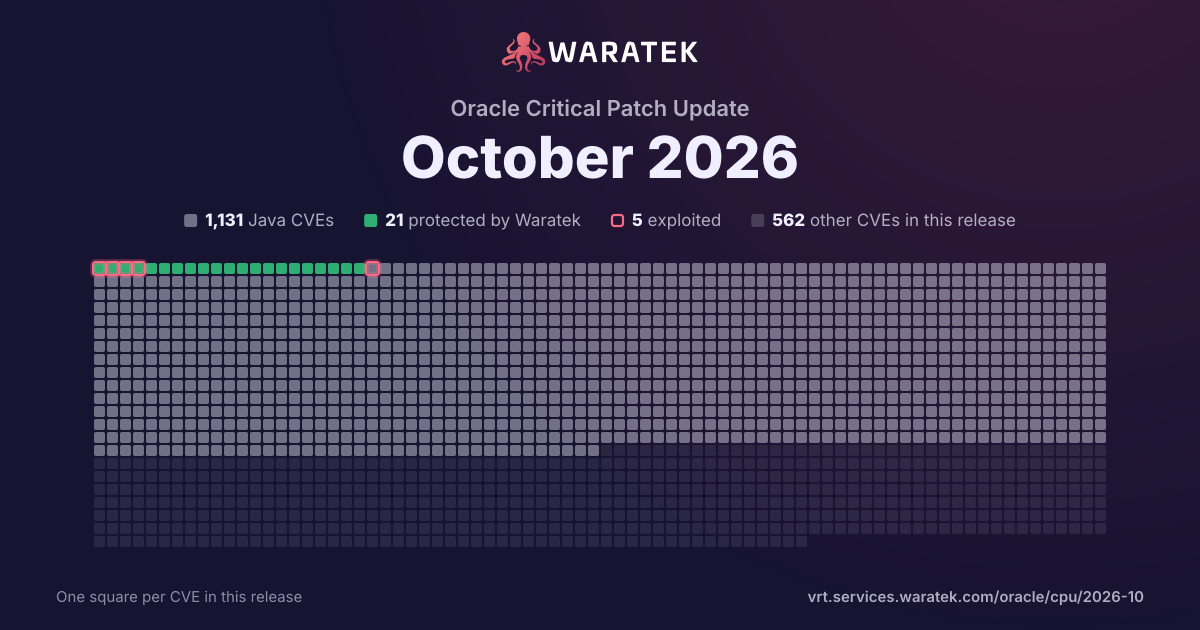
By status
20Protected by Waratek1Mitigation candidate1,112No exploit published11Outside Waratek scope549Not applicable
5Exploited, marked by the ring
No exploit published. For 858 of them, Oracle's security advisory is the source of public detail.
Protected by Waratek. Waratek RASP can block exploitation of these on systems that have not applied the patch yet.
Overview 15 matches · 5 protected · 0 exploited · 0 CISA KEV · 1 public PoC · 0 EPSS ≥ 0.5
Protected by Waratek
5
33.3%
Rule in development
0
0.0%
Mitigation candidate
0
0.0%
No exploit published
10
66.7%
blocked by ARMR today
5
33.3%
partly blocked
0
0.0%
not blocked
10
66.7%
not established
0
0.0%
unrecorded
0
0.0%
Exploited
0
0.0%
Working exploit published
0
0.0%
Proof of concept only
5
33.3%
Forecast only
0
0.0%
No public exploit
10
66.7%
split by
peak 7 / month
Apr 264
Protected by Waratek2
No exploit published2
Critical4
blocked by ARMR today2
not blocked2
Proof of concept only1
No public exploit3
May 267
Protected by Waratek2
No exploit published5
Critical7
blocked by ARMR today2
not blocked5
Proof of concept only4
No public exploit3
Jun 264
Protected by Waratek1
No exploit published3
Critical4
blocked by ARMR today1
not blocked3
No public exploit4
Apr 26May 26Jun 26
| CVE | Severity | Published▾ | Status | Exploitation | Description |
|---|---|---|---|---|---|
| CVE-2026-55276 | Critical | 2026-06-29 | No exploit published | No public exploit | Always-Incorrect Control Flow Implementation vulnerability in Apache Tomcat meant that special roles and empty authorisation constraints were not included when the effective web.xml was logged. This issue affects Apache Tomcat: from 11.0.0-M1 through 11.0.22, from 10.1.0-M1 through 10.1.55, from 9.0.0.M1 through 9.0.118, from 8.5.0 through 8.5.100. Other versions that have reached end of support may also be affected. Users are recommended to upgrade to version 11.0.23, 10.1.56 or 9.0.119 which fixes the issue. |
| CVE-2026-53434 | Critical | 2026-06-29 | No exploit published | No public exploit | Detection of Error Condition Without Action vulnerability in Apache Tomcat when configuring CRLs for a FFM based connector. This issue affects Apache Tomcat: from 11.0.0-M1 through 11.0.22, from 10.1.0-M7 through 10.1.55, from 9.0.83 through 9.0.118. Users are recommended to upgrade to version 11.0.23, 10.1.56 or 9.0.119, which fixes the issue. |
| CVE-2026-41855 | Critical | 2026-06-09 | No exploit published | No public exploit | In an untrusted JMS environment, org.springframework.jms.support.converter.MappingJackson2MessageConverter and org.springframework.jms.support.converter.JacksonJsonMessageConverter allow arbitrary class instantiation, which can lead to unauthorized actions via gadget class deserialization. Affected versions: Spring Framework 7.0.0 through 7.0.7; 6.2.0 through 6.2.18; 6.1.0 through 6.1.27; 5.3.0 through 5.3.48. |
| CVE-2026-47065 | Critical | 2026-06-03 | Protected by Waratek | No public exploit | ZDRES-232: resolveProxyClass Not Overridden - acceptMatchers Filter Bypass via java.lang.reflect.Proxy Assessment: Fully addressed. When the serialised stream contains a TC_PROXYCLASSDESC (the marker for a java.lang.reflect.Proxy ), JDK’s ObjectInputStream.readProxyDesc() is dispatched. JDK then calls the default ObjectInputStream.resolveProxyClass(interfaces) implementation, which performs Class.forName(intf, false, latestUserDefinedLoader()) for EACH interface name and constructs the proxy class — bypassing the accepted classes list . ZDRES-233: Class.forName(name, initialize=true, classLoader) in readClassDescriptor Triggers Static Initialiser of Allow-Listed Classes Assessment: Fully addressed. For ANY class on the allow-list, deserialising a stream that names it triggers the class’s (static initialiser) BEFORE any instance is constructed. This means an attacker who supplies a class name on the allow-list (e.g., the developer wrote accept(“com.myapp.*") , attacker supplies com.myapp.SomeClass ) causes <clinit> of SomeClass — and many real-world classes have side-effecting static initialisers Both issues have been fixed. |
| CVE-2026-42584 | Critical | 2026-05-13 | No exploit published | Proof of concept only | Netty is an asynchronous, event-driven network application framework. Prior to 4.2.13.Final and 4.1.133.Final, HttpClientCodec pairs each inbound response with an outbound request by queue.poll() once per response, including for 1xx. If the client pipelines GET then HEAD and the server sends 103, then 200 with GET body, then 200 for HEAD, the queue pairs HEAD with the first 200. The HEAD rule then skips reading that message’s body, so the GET entity bytes stay on the stream and the following 200 is parsed from the wrong offset. This vulnerability is fixed in 4.2.13.Final and 4.1.133.Final. |
| CVE-2026-42581 | Critical | 2026-05-13 | No exploit published | Proof of concept only | Netty is an asynchronous, event-driven network application framework. Prior to 4.2.13.Final and 4.1.133.Final, HttpObjectDecoder strips a conflicting Content-Length header when a request carries both Transfer-Encoding: chunked and Content-Length, but only for HTTP/1.1 messages. The guard is absent for HTTP/1.0. An attacker that sends an HTTP/1.0 request with both headers causes Netty to decode the body as chunked while leaving Content-Length intact in the forwarded HttpMessage. Any downstream proxy or handler that trusts Content-Length over Transfer-Encoding will disagree on message boundaries, enabling request smuggling. This vulnerability is fixed in 4.2.13.Final and 4.1.133.Final. |
| CVE-2026-42579 | Critical | 2026-05-13 | No exploit published | Proof of concept only | Netty is an asynchronous, event-driven network application framework. Prior to 4.2.13.Final and 4.1.133.Final, Netty's DNS codec does not enforce RFC 1035 domain name constraints during either encoding or decoding. This creates a bidirectional attack surface: malicious DNS responses can exploit the decoder, and user-influenced hostnames can exploit the encoder. This vulnerability is fixed in 4.2.13.Final and 4.1.133.Final. |
| CVE-2026-43515 | Critical | 2026-05-12 | No exploit published | No public exploit | Improper Authorization vulnerability when multiple method constraints define an HTTP method for the same extension in Apache Tomcat. This issue affects Apache Tomcat: from 11.0.0-M1 through 11.0.21, from 10.1.0-M1 through 10.1.54, from 9.0.0.M1 through 9.0.117, from 8.5.0 through 8.5.100, from 7.0.0 through 7.0.109. Users are recommended to upgrade to version 11.0.22, 10.1.55 or 9.0.118 which fix the issue. |
| CVE-2026-43512 | Critical | 2026-05-12 | No exploit published | No public exploit | DEPRECATED: Authentication Bypass Issues vulnerability in digest authentication in Apache Tomcat. This issue affects Apache Tomcat: from 11.0.0-M1 through 11.0.21, from 10.1.0-M1 through 10.1.54, from 9.0.0.M1 through 9.0.117, from 8.5.0 through 8.5.100, from before 7.0.0. Older unsupported versions any also be affect Users are recommended to upgrade to version 11.0.22, 10.1.55 or 9.0.118 which fix the issue. |
| CVE-2026-42779 | Critical | 2026-05-01 | Protected by Waratek | Proof of concept only | The fix for CVE-2026-41635 was not applied to the 2.1.X and 2.2.X branches. Here was the original issue description: Apache MINA's AbstractIoBuffer.resolveClass() contains two branches, one of them (for static classes or primitive types) does not check the class at all, bypassing the classname allowlist and allowing arbitrary code to be executed. The fix checks if the class is present in the accepted class filter before calling Class.forName(). Affected versions are Apache MINA 2.1.0 <= 2.1.11, and 2.2.0 <= 2.2.6. The problem is resolved in Apache MINA 2.1.12, and 2.2.7 by applying the classname allowlist earlier. Affected are applications using Apache MINA that call IoBuffer.getObject(). Applications using Apache MINA are advised to upgrade. |
| CVE-2026-42778 | Critical | 2026-05-01 | Protected by Waratek | No public exploit | The fix for CVE-2026-41409 was not applied to the 2.1.X and 2.2.X branches. Here was the original issue description: The fix for CVE-2024-52046 in Apache MINA AbstractIoBuffer.getObject() was incomplete. The classname allowlist of classes allowed to be deserialized was applied too late after a static initializer in a class to be read might already have been executed. Affected versions are Apache MINA 2.1.0 <= 2.1.11, and 2.2.0 <= 2.2.6. The problem is resolved in Apache MINA 2.1.12, and 2.2.7 by applying the classname allowlist earlier. Affected are applications using Apache MINA that call IoBuffer.getObject(). Applications using Apache MINA are advised to upgrade The fix for CVE-2024-52046 in Apache MINA AbstractIoBuffer.getObject() was incomplete. The classname allowlist of classes allowed to be deserialized was applied too late after a static initializer in a class to be read might already have been executed. Affected versions are Apache MINA 2.1.0 <= 2.1.110, and 2.2.0 <= 2.2.6. The problem is resolved in Apache MINA 2.1.12, and 2.2.7 by applying the classname allowlist earlier. Affected are applications using Apache MINA that call IoBuffer.getObject(). Applications using Apache MINA are advised to upgrade |
| CVE-2026-41635 | Critical | 2026-04-27 | Protected by Waratek | No public exploit | Apache MINA's AbstractIoBuffer.resolveClass() contains two branches, one of them (for static classes or primitive types) does not check the class at all, bypassing the classname allowlist and allowing arbitrary code to be executed. The fix checks if the class is present in the accepted class filter before calling Class.forName(). Affected versions are Apache MINA 2.0.0 <= 2.0.27, 2.1.0 <= 2.1.10, and 2.2.0 <= 2.2.5. The problem is resolved in Apache MINA 2.0.28, 2.1.11, and 2.2.6 by applying the classname allowlist earlier. Affected are applications using Apache MINA that call IoBuffer.getObject(). Applications using Apache MINA are advised to upgrade. |
| CVE-2026-41409 | Critical | 2026-04-27 | Protected by Waratek | No public exploit | The fix for CVE-2024-52046 in Apache MINA AbstractIoBuffer.getObject() was incomplete. The classname allowlist of classes allowed to be deserialized was applied too late after a static initializer in a class to be read might already have been executed. Affected versions are Apache MINA 2.0.0 <= 2.0.27, 2.1.0 <= 2.1.10, and 2.2.0 <= 2.2.5. The problem is resolved in Apache MINA 2.0.28, 2.1.11, and 2.2.6 by applying the classname allowlist earlier. Affected are applications using Apache MINA that call IoBuffer.getObject(). Applications using Apache MINA are advised to upgrade |
| CVE-2025-14813 | Critical | 2026-04-15 | No exploit published | No public exploit | : Use of a Broken or Risky Cryptographic Algorithm vulnerability in Legion of the Bouncy Castle Inc. BC-JAVA bcprov on all (core modules). This vulnerability is associated with program files G3413CTRBlockCipher. This issue affects BC-JAVA: from 1.59 before 1.80.2, from 1.81 before 1.81.1, from 1.82 before 1.84. |
| CVE-2026-2332 | Critical | 2026-04-14 | No exploit published | Proof of concept only | In Eclipse Jetty, the HTTP/1.1 parser is vulnerable to request smuggling when chunk extensions are used, similar to the "funky chunks" techniques outlined here: * https://w4ke.info/2025/06/18/funky-chunks.html * https://w4ke.info/2025/10/29/funky-chunks-2.html Jetty terminates chunk extension parsing at \r\n inside quoted strings instead of treating this as an error. POST / HTTP/1.1 Host: localhost Transfer-Encoding: chunked 1;ext="val X 0 GET /smuggled HTTP/1.1 ... Note how the chunk extension does not close the double quotes, and it is able to inject a smuggled request. |