
Oracle Critical Patch Update October 2026
Released October 2026 · Oracle's advisory ↗ · ← Security Patch Update, September 2026 · Security Patch Update, November 2026 →
1,693 CVEs in this release, one square each
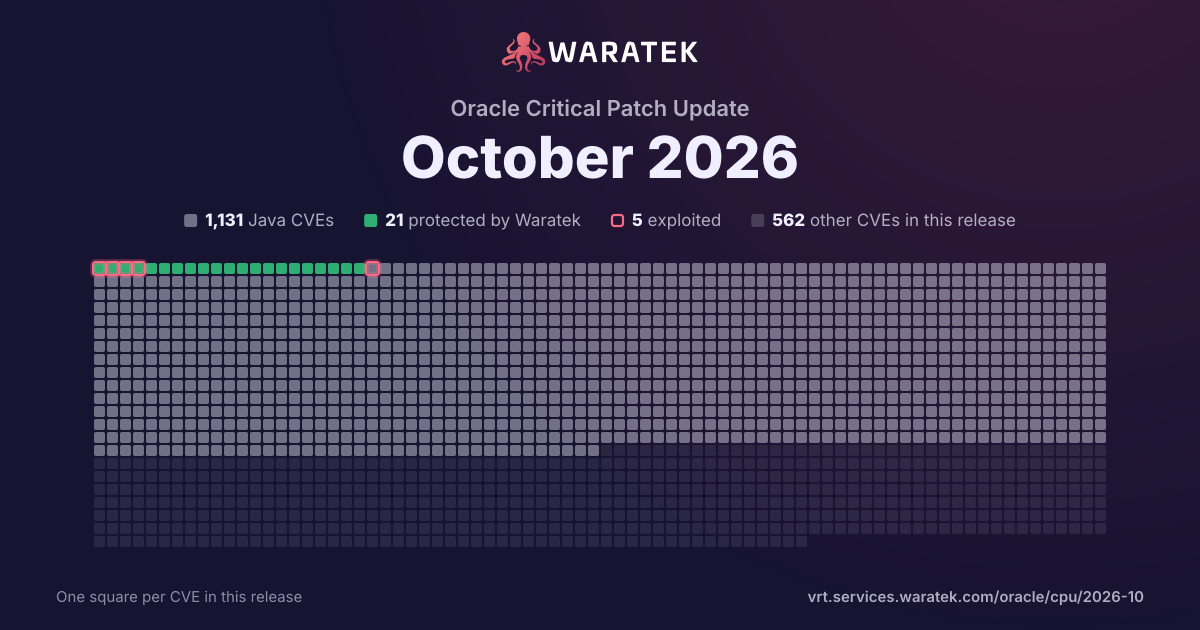
By status
20Protected by Waratek3Mitigation candidate1,109No exploit published12Outside Waratek scope549Not applicable
7Exploited, marked by the ring
No exploit published. For 855 of them, Oracle's security advisory is the source of public detail.
Protected by Waratek. Waratek RASP can block exploitation of these on systems that have not applied the patch yet.
Overview 45 matches · 5 protected · 0 exploited · 0 CISA KEV · 1 public PoC · 0 EPSS ≥ 0.5
Protected by Waratek
5
11.1%
Rule in development
0
0.0%
Mitigation candidate
0
0.0%
No exploit published
40
88.9%
blocked by ARMR today
5
11.1%
partly blocked
0
0.0%
not blocked
40
88.9%
not established
0
0.0%
unrecorded
0
0.0%
Exploited
0
0.0%
Working exploit published
0
0.0%
Proof of concept only
4
8.9%
Forecast only
0
0.0%
No public exploit
41
91.1%
split by
peak 31 / month
Apr 263
Protected by Waratek2
No exploit published1
Critical3
blocked by ARMR today2
not blocked1
No public exploit3
May 265
Protected by Waratek2
No exploit published3
Critical5
blocked by ARMR today2
not blocked3
Proof of concept only4
No public exploit1
Jun 262
Protected by Waratek1
No exploit published1
Critical2
blocked by ARMR today1
not blocked1
No public exploit2
Jul 260
Aug 264
No exploit published4
Critical4
not blocked4
No public exploit4
Sep 260
Oct 2631
No exploit published31
Critical31
not blocked31
No public exploit31
Apr 26May 26Jun 26Jul 26Aug 26Sep 26Oct 26
| CVE | Severity | Published▾ | Status | Exploitation | Description |
|---|---|---|---|---|---|
| CVE-2026-91495 | Critical | 2026-10-20 | No exploit published | No public exploit | Vulnerability in the Oracle WebCenter Content product of Oracle Fusion Middleware (component: Content Server). Supported versions that are affected are 12.2.1.4.0 and 14.1.2.0.0. Easily exploitable vulnerability allows unauthenticated attacker with network access via HTTP to compromise Oracle WebCenter Content. Successful attacks of this vulnerability can result in takeover of Oracle WebCenter Content. CVSS 3.1 Base Score 9.8 (Confidentiality, Integrity and Availability impacts). CVSS Vector: (CVSS:3.1/AV:N/AC:L/PR:N/UI:N/S:U/C:H/I:H/A:H). |
| CVE-2026-91491 | Critical | 2026-10-20 | No exploit published | No public exploit | Vulnerability in the Oracle Identity Manager Connector product of Oracle Fusion Middleware (component: LDAP Gateway). Supported versions that are affected are 12.2.1.4.0 and 14.1.2.1.0. Easily exploitable vulnerability allows unauthenticated attacker with network access via LDAP to compromise Oracle Identity Manager Connector. Successful attacks of this vulnerability can result in takeover of Oracle Identity Manager Connector. CVSS 3.1 Base Score 9.8 (Confidentiality, Integrity and Availability impacts). CVSS Vector: (CVSS:3.1/AV:N/AC:L/PR:N/UI:N/S:U/C:H/I:H/A:H). |
| CVE-2026-91490 | Critical | 2026-10-20 | No exploit published | No public exploit | Vulnerability in the Oracle Identity Manager Connector product of Oracle Fusion Middleware (component: LDAP Gateway). Supported versions that are affected are 12.2.1.4.0 and 14.1.2.1.0. Easily exploitable vulnerability allows unauthenticated attacker with network access via LDAP to compromise Oracle Identity Manager Connector. Successful attacks of this vulnerability can result in unauthorized creation, deletion or modification access to critical data or all Oracle Identity Manager Connector accessible data as well as unauthorized access to critical data or complete access to all Oracle Identity Manager Connector accessible data. CVSS 3.1 Base Score 9.1 (Confidentiality and Integrity impacts). CVSS Vector: (CVSS:3.1/AV:N/AC:L/PR:N/UI:N/S:U/C:H/I:H/A:N). |
| CVE-2026-91408 | Critical | 2026-10-20 | No exploit published | No public exploit | Vulnerability in the Oracle Identity Manager product of Oracle Fusion Middleware (component: End User Self Service). Supported versions that are affected are 12.2.1.4.0 and 14.1.2.1.0. Easily exploitable vulnerability allows unauthenticated attacker with network access via T3, IIOP to compromise Oracle Identity Manager. Successful attacks of this vulnerability can result in takeover of Oracle Identity Manager. CVSS 3.1 Base Score 9.8 (Confidentiality, Integrity and Availability impacts). CVSS Vector: (CVSS:3.1/AV:N/AC:L/PR:N/UI:N/S:U/C:H/I:H/A:H). |
| CVE-2026-91323 | Critical | 2026-10-20 | No exploit published | No public exploit | Vulnerability in the Oracle WebLogic Server product of Oracle Fusion Middleware (component: Core). Supported versions that are affected are 12.2.1.4.0, 14.1.1.0.0, 14.1.2.0.0 and 15.1.1.0.0. Easily exploitable vulnerability allows unauthenticated attacker with network access via HTTP to compromise Oracle WebLogic Server. Successful attacks of this vulnerability can result in takeover of Oracle WebLogic Server. CVSS 3.1 Base Score 9.8 (Confidentiality, Integrity and Availability impacts). CVSS Vector: (CVSS:3.1/AV:N/AC:L/PR:N/UI:N/S:U/C:H/I:H/A:H). |
| CVE-2026-91251 | Critical | 2026-10-20 | No exploit published | No public exploit | Vulnerability in the Oracle SOA Suite product of Oracle Fusion Middleware (component: Adapters). Supported versions that are affected are 12.2.1.4.0 and 14.1.2.0.0. Easily exploitable vulnerability allows low privileged attacker with network access via HTTP to compromise Oracle SOA Suite. While the vulnerability is in Oracle SOA Suite, attacks may significantly impact additional products (scope change). Successful attacks of this vulnerability can result in takeover of Oracle SOA Suite. CVSS 3.1 Base Score 9.9 (Confidentiality, Integrity and Availability impacts). CVSS Vector: (CVSS:3.1/AV:N/AC:L/PR:L/UI:N/S:C/C:H/I:H/A:H). |
| CVE-2026-91250 | Critical | 2026-10-20 | No exploit published | No public exploit | Vulnerability in the Oracle SOA Suite product of Oracle Fusion Middleware (component: Adapters). Supported versions that are affected are 12.2.1.4.0 and 14.1.2.0.0. Easily exploitable vulnerability allows low privileged attacker with network access via multiple protocols to compromise Oracle SOA Suite. While the vulnerability is in Oracle SOA Suite, attacks may significantly impact additional products (scope change). Successful attacks of this vulnerability can result in takeover of Oracle SOA Suite. CVSS 3.1 Base Score 9.9 (Confidentiality, Integrity and Availability impacts). CVSS Vector: (CVSS:3.1/AV:N/AC:L/PR:L/UI:N/S:C/C:H/I:H/A:H). |
| CVE-2026-91243 | Critical | 2026-10-20 | No exploit published | No public exploit | Vulnerability in the Oracle Business Process Management Suite product of Oracle Fusion Middleware (component: Fabric Layer). Supported versions that are affected are 12.2.1.4.0 and 14.1.2.0.0. Easily exploitable vulnerability allows low privileged attacker with network access via HTTP to compromise Oracle Business Process Management Suite. While the vulnerability is in Oracle Business Process Management Suite, attacks may significantly impact additional products (scope change). Successful attacks of this vulnerability can result in unauthorized creation, deletion or modification access to critical data or all Oracle Business Process Management Suite accessible data as well as unauthorized access to critical data or complete access to all Oracle Business Process Management Suite accessible data. CVSS 3.1 Base Score 9.6 (Confidentiality and Integrity impacts). CVSS Vector: (CVSS:3.1/AV:N/AC:L/PR:L/UI:N/S:C/C:H/I:H/A:N). |
| CVE-2026-91236 | Critical | 2026-10-20 | No exploit published | No public exploit | Vulnerability in the Oracle SOA Suite product of Oracle Fusion Middleware (component: Fabric Layer). Supported versions that are affected are 12.2.1.4.0 and 14.1.2.0.0. Easily exploitable vulnerability allows unauthenticated attacker with network access via HTTP to compromise Oracle SOA Suite. Successful attacks of this vulnerability can result in takeover of Oracle SOA Suite. CVSS 3.1 Base Score 9.8 (Confidentiality, Integrity and Availability impacts). CVSS Vector: (CVSS:3.1/AV:N/AC:L/PR:N/UI:N/S:U/C:H/I:H/A:H). |
| CVE-2026-91235 | Critical | 2026-10-20 | No exploit published | No public exploit | Vulnerability in the Oracle SOA Suite product of Oracle Fusion Middleware (component: Fabric Layer). Supported versions that are affected are 12.2.1.4.0 and 14.1.2.0.0. Easily exploitable vulnerability allows unauthenticated attacker with network access via HTTP to compromise Oracle SOA Suite. Successful attacks of this vulnerability can result in takeover of Oracle SOA Suite. CVSS 3.1 Base Score 9.8 (Confidentiality, Integrity and Availability impacts). CVSS Vector: (CVSS:3.1/AV:N/AC:L/PR:N/UI:N/S:U/C:H/I:H/A:H). |
| CVE-2026-91234 | Critical | 2026-10-20 | No exploit published | No public exploit | Vulnerability in the Oracle SOA Suite product of Oracle Fusion Middleware (component: Fabric Layer). Supported versions that are affected are 12.2.1.4.0 and 14.1.2.0.0. Easily exploitable vulnerability allows unauthenticated attacker with network access via HTTP to compromise Oracle SOA Suite. Successful attacks of this vulnerability can result in takeover of Oracle SOA Suite. CVSS 3.1 Base Score 9.8 (Confidentiality, Integrity and Availability impacts). CVSS Vector: (CVSS:3.1/AV:N/AC:L/PR:N/UI:N/S:U/C:H/I:H/A:H). |
| CVE-2026-91233 | Critical | 2026-10-20 | No exploit published | No public exploit | Vulnerability in the Oracle SOA Suite product of Oracle Fusion Middleware (component: Enterprise Scheduling System). Supported versions that are affected are 12.2.1.4.0 and 14.1.2.0.0. Easily exploitable vulnerability allows unauthenticated attacker with network access via SOAP to compromise Oracle SOA Suite. Successful attacks of this vulnerability can result in takeover of Oracle SOA Suite. CVSS 3.1 Base Score 9.8 (Confidentiality, Integrity and Availability impacts). CVSS Vector: (CVSS:3.1/AV:N/AC:L/PR:N/UI:N/S:U/C:H/I:H/A:H). |
| CVE-2026-91232 | Critical | 2026-10-20 | No exploit published | No public exploit | Vulnerability in the Oracle SOA Suite product of Oracle Fusion Middleware (component: Fabric Layer). Supported versions that are affected are 12.2.1.4.0 and 14.1.2.0.0. Easily exploitable vulnerability allows low privileged attacker with network access via HTTP to compromise Oracle SOA Suite. While the vulnerability is in Oracle SOA Suite, attacks may significantly impact additional products (scope change). Successful attacks of this vulnerability can result in takeover of Oracle SOA Suite. CVSS 3.1 Base Score 9.9 (Confidentiality, Integrity and Availability impacts). CVSS Vector: (CVSS:3.1/AV:N/AC:L/PR:L/UI:N/S:C/C:H/I:H/A:H). |
| CVE-2026-91231 | Critical | 2026-10-20 | No exploit published | No public exploit | Vulnerability in the Oracle SOA Suite product of Oracle Fusion Middleware (component: Adapters). Supported versions that are affected are 12.2.1.4.0 and 14.1.2.0.0. Easily exploitable vulnerability allows unauthenticated attacker with network access via HTTP to compromise Oracle SOA Suite. While the vulnerability is in Oracle SOA Suite, attacks may significantly impact additional products (scope change). Successful attacks of this vulnerability can result in takeover of Oracle SOA Suite. CVSS 3.1 Base Score 10.0 (Confidentiality, Integrity and Availability impacts). CVSS Vector: (CVSS:3.1/AV:N/AC:L/PR:N/UI:N/S:C/C:H/I:H/A:H). |
| CVE-2026-91230 | Critical | 2026-10-20 | No exploit published | No public exploit | Vulnerability in the Oracle SOA Suite product of Oracle Fusion Middleware (component: Fabric Layer). Supported versions that are affected are 12.2.1.4.0 and 14.1.2.0.0. Easily exploitable vulnerability allows unauthenticated attacker with network access via HTTP to compromise Oracle SOA Suite. While the vulnerability is in Oracle SOA Suite, attacks may significantly impact additional products (scope change). Successful attacks of this vulnerability can result in unauthorized access to critical data or complete access to all Oracle SOA Suite accessible data as well as unauthorized update, insert or delete access to some of Oracle SOA Suite accessible data. CVSS 3.1 Base Score 9.3 (Confidentiality and Integrity impacts). CVSS Vector: (CVSS:3.1/AV:N/AC:L/PR:N/UI:N/S:C/C:H/I:L/A:N). |
| CVE-2026-91225 | Critical | 2026-10-20 | No exploit published | No public exploit | Vulnerability in the Oracle SOA Suite product of Oracle Fusion Middleware (component: Adapters). Supported versions that are affected are 12.2.1.4.0 and 14.1.2.0.0. Easily exploitable vulnerability allows unauthenticated attacker with network access via HTTP to compromise Oracle SOA Suite. Successful attacks of this vulnerability can result in unauthorized creation, deletion or modification access to critical data or all Oracle SOA Suite accessible data and unauthorized ability to cause a hang or frequently repeatable crash (complete DOS) of Oracle SOA Suite. CVSS 3.1 Base Score 9.1 (Integrity and Availability impacts). CVSS Vector: (CVSS:3.1/AV:N/AC:L/PR:N/UI:N/S:U/C:N/I:H/A:H). |
| CVE-2026-91224 | Critical | 2026-10-20 | No exploit published | No public exploit | Vulnerability in the Oracle SOA Suite product of Oracle Fusion Middleware (component: Fabric Layer). Supported versions that are affected are 12.2.1.4.0 and 14.1.2.0.0. Easily exploitable vulnerability allows low privileged attacker with network access via HTTP to compromise Oracle SOA Suite. While the vulnerability is in Oracle SOA Suite, attacks may significantly impact additional products (scope change). Successful attacks of this vulnerability can result in takeover of Oracle SOA Suite. CVSS 3.1 Base Score 9.9 (Confidentiality, Integrity and Availability impacts). CVSS Vector: (CVSS:3.1/AV:N/AC:L/PR:L/UI:N/S:C/C:H/I:H/A:H). |
| CVE-2026-91222 | Critical | 2026-10-20 | No exploit published | No public exploit | Vulnerability in the Oracle Business Process Management Suite product of Oracle Fusion Middleware (component: Human Workflow (11g+)). Supported versions that are affected are 12.2.1.4.0 and 14.1.2.0.0. Easily exploitable vulnerability allows low privileged attacker with network access via SOAP to compromise Oracle Business Process Management Suite. While the vulnerability is in Oracle Business Process Management Suite, attacks may significantly impact additional products (scope change). Successful attacks of this vulnerability can result in takeover of Oracle Business Process Management Suite. CVSS 3.1 Base Score 9.9 (Confidentiality, Integrity and Availability impacts). CVSS Vector: (CVSS:3.1/AV:N/AC:L/PR:L/UI:N/S:C/C:H/I:H/A:H). |
| CVE-2026-91221 | Critical | 2026-10-20 | No exploit published | No public exploit | Vulnerability in the Oracle SOA Suite product of Oracle Fusion Middleware (component: Fabric Layer). Supported versions that are affected are 12.2.1.4.0 and 14.1.2.0.0. Easily exploitable vulnerability allows unauthenticated attacker with network access via T3, IIOP to compromise Oracle SOA Suite. While the vulnerability is in Oracle SOA Suite, attacks may significantly impact additional products (scope change). Successful attacks of this vulnerability can result in takeover of Oracle SOA Suite. CVSS 3.1 Base Score 10.0 (Confidentiality, Integrity and Availability impacts). CVSS Vector: (CVSS:3.1/AV:N/AC:L/PR:N/UI:N/S:C/C:H/I:H/A:H). |
| CVE-2026-91220 | Critical | 2026-10-20 | No exploit published | No public exploit | Vulnerability in the Oracle Business Process Management Suite product of Oracle Fusion Middleware (component: Human Workflow). Supported versions that are affected are 12.2.1.4.0 and 14.1.2.0.0. Easily exploitable vulnerability allows unauthenticated attacker with network access via HTTP to compromise Oracle Business Process Management Suite. Successful attacks of this vulnerability can result in takeover of Oracle Business Process Management Suite. CVSS 3.1 Base Score 9.8 (Confidentiality, Integrity and Availability impacts). CVSS Vector: (CVSS:3.1/AV:N/AC:L/PR:N/UI:N/S:U/C:H/I:H/A:H). |
| CVE-2026-91218 | Critical | 2026-10-20 | No exploit published | No public exploit | Vulnerability in the Oracle SOA Suite product of Oracle Fusion Middleware (component: Fabric Layer). Supported versions that are affected are 12.2.1.4.0 and 14.1.2.0.0. Easily exploitable vulnerability allows low privileged attacker with network access via HTTP to compromise Oracle SOA Suite. While the vulnerability is in Oracle SOA Suite, attacks may significantly impact additional products (scope change). Successful attacks of this vulnerability can result in unauthorized creation, deletion or modification access to critical data or all Oracle SOA Suite accessible data as well as unauthorized access to critical data or complete access to all Oracle SOA Suite accessible data. CVSS 3.1 Base Score 9.6 (Confidentiality and Integrity impacts). CVSS Vector: (CVSS:3.1/AV:N/AC:L/PR:L/UI:N/S:C/C:H/I:H/A:N). |
| CVE-2026-91216 | Critical | 2026-10-20 | No exploit published | No public exploit | Vulnerability in the Oracle SOA Suite product of Oracle Fusion Middleware (component: Fabric Layer). Supported versions that are affected are 12.2.1.4.0 and 14.1.2.0.0. Easily exploitable vulnerability allows unauthenticated attacker with network access via T3, IIOP to compromise Oracle SOA Suite. While the vulnerability is in Oracle SOA Suite, attacks may significantly impact additional products (scope change). Successful attacks of this vulnerability can result in takeover of Oracle SOA Suite. CVSS 3.1 Base Score 10.0 (Confidentiality, Integrity and Availability impacts). CVSS Vector: (CVSS:3.1/AV:N/AC:L/PR:N/UI:N/S:C/C:H/I:H/A:H). |
| CVE-2026-91214 | Critical | 2026-10-20 | No exploit published | No public exploit | Vulnerability in the Oracle SOA Suite product of Oracle Fusion Middleware (component: Fabric Layer). Supported versions that are affected are 12.2.1.4.0 and 14.1.2.0.0. Easily exploitable vulnerability allows unauthenticated attacker with network access via HTTP to compromise Oracle SOA Suite. Successful attacks of this vulnerability can result in takeover of Oracle SOA Suite. CVSS 3.1 Base Score 9.8 (Confidentiality, Integrity and Availability impacts). CVSS Vector: (CVSS:3.1/AV:N/AC:L/PR:N/UI:N/S:U/C:H/I:H/A:H). |
| CVE-2026-87337 | Critical | 2026-10-20 | No exploit published | No public exploit | Vulnerability in the Oracle Access Manager product of Oracle Fusion Middleware (component: Authentication Engine). Supported versions that are affected are 12.2.1.4.0 and 14.1.2.1.0. Easily exploitable vulnerability allows unauthenticated attacker with network access via HTTP to compromise Oracle Access Manager. While the vulnerability is in Oracle Access Manager, attacks may significantly impact additional products (scope change). Successful attacks of this vulnerability can result in unauthorized creation, deletion or modification access to critical data or all Oracle Access Manager accessible data as well as unauthorized access to critical data or complete access to all Oracle Access Manager accessible data. CVSS 3.1 Base Score 10.0 (Confidentiality and Integrity impacts). CVSS Vector: (CVSS:3.1/AV:N/AC:L/PR:N/UI:N/S:C/C:H/I:H/A:N). |
| CVE-2026-87302 | Critical | 2026-10-20 | No exploit published | No public exploit | Vulnerability in the Oracle WebLogic Server product of Oracle Fusion Middleware (component: Core). Supported versions that are affected are 12.2.1.4.0, 14.1.1.0.0, 14.1.2.0.0 and 15.1.1.0.0. Easily exploitable vulnerability allows unauthenticated attacker with network access via HTTP to compromise Oracle WebLogic Server. Successful attacks of this vulnerability can result in unauthorized creation, deletion or modification access to critical data or all Oracle WebLogic Server accessible data as well as unauthorized access to critical data or complete access to all Oracle WebLogic Server accessible data. CVSS 3.1 Base Score 9.1 (Confidentiality and Integrity impacts). CVSS Vector: (CVSS:3.1/AV:N/AC:L/PR:N/UI:N/S:U/C:H/I:H/A:N). |
| CVE-2026-87251 | Critical | 2026-10-20 | No exploit published | No public exploit | Vulnerability in the Oracle Access Manager product of Oracle Fusion Middleware (component: Authentication Engine). Supported versions that are affected are 12.2.1.4.0 and 14.1.2.1.0. Easily exploitable vulnerability allows unauthenticated attacker with network access via SAML to compromise Oracle Access Manager. Successful attacks of this vulnerability can result in takeover of Oracle Access Manager. CVSS 3.1 Base Score 9.8 (Confidentiality, Integrity and Availability impacts). CVSS Vector: (CVSS:3.1/AV:N/AC:L/PR:N/UI:N/S:U/C:H/I:H/A:H). |
| CVE-2026-83399 | Critical | 2026-10-20 | No exploit published | No public exploit | Vulnerability in the Oracle WebLogic Server product of Oracle Fusion Middleware (component: Core). Supported versions that are affected are 12.2.1.4.0, 14.1.1.0.0, 14.1.2.0.0 and 15.1.1.0.0. Easily exploitable vulnerability allows unauthenticated attacker with network access via T3, IIOP to compromise Oracle WebLogic Server. Successful attacks of this vulnerability can result in takeover of Oracle WebLogic Server. CVSS 3.1 Base Score 9.8 (Confidentiality, Integrity and Availability impacts). CVSS Vector: (CVSS:3.1/AV:N/AC:L/PR:N/UI:N/S:U/C:H/I:H/A:H). |
| CVE-2026-83397 | Critical | 2026-10-20 | No exploit published | No public exploit | Vulnerability in the Oracle Data Integrator product of Oracle Fusion Middleware (component: Console / Repository Explorer). Supported versions that are affected are 12.2.1.4.0 and 14.1.2.0.0. Easily exploitable vulnerability allows unauthenticated attacker with network access via HTTP to compromise Oracle Data Integrator. Successful attacks of this vulnerability can result in takeover of Oracle Data Integrator. CVSS 3.1 Base Score 9.8 (Confidentiality, Integrity and Availability impacts). CVSS Vector: (CVSS:3.1/AV:N/AC:L/PR:N/UI:N/S:U/C:H/I:H/A:H). |
| CVE-2026-83396 | Critical | 2026-10-20 | No exploit published | No public exploit | Vulnerability in the Oracle Data Integrator product of Oracle Fusion Middleware (component: Console / Repository Explorer). Supported versions that are affected are 12.2.1.4.0 and 14.1.2.0.0. Easily exploitable vulnerability allows unauthenticated attacker with network access via RMI to compromise Oracle Data Integrator. Successful attacks of this vulnerability can result in takeover of Oracle Data Integrator. CVSS 3.1 Base Score 9.8 (Confidentiality, Integrity and Availability impacts). CVSS Vector: (CVSS:3.1/AV:N/AC:L/PR:N/UI:N/S:U/C:H/I:H/A:H). |
| CVE-2026-101590 | Critical | 2026-10-20 | No exploit published | No public exploit | Vulnerability in the Helidon product of Oracle Fusion Middleware (component: helidon-microprofile-security). Supported versions that are affected are 4.0.0-4.5.5. Easily exploitable vulnerability allows unauthenticated attacker with network access via HTTP to compromise Helidon. Successful attacks of this vulnerability can result in unauthorized creation, deletion or modification access to critical data or all Helidon accessible data as well as unauthorized access to critical data or complete access to all Helidon accessible data. CVSS 3.1 Base Score 9.1 (Confidentiality and Integrity impacts). CVSS Vector: (CVSS:3.1/AV:N/AC:L/PR:N/UI:N/S:U/C:H/I:H/A:N). |
| CVE-2026-101499 | Critical | 2026-10-20 | No exploit published | No public exploit | Vulnerability in the Oracle WebCenter Sites product of Oracle Fusion Middleware (component: WebCenter Sites). Supported versions that are affected are 12.2.1.4.0 and 14.1.2.0.0. Easily exploitable vulnerability allows unauthenticated attacker with network access via HTTP to compromise Oracle WebCenter Sites. Successful attacks of this vulnerability can result in takeover of Oracle WebCenter Sites. CVSS 3.1 Base Score 9.8 (Confidentiality, Integrity and Availability impacts). CVSS Vector: (CVSS:3.1/AV:N/AC:L/PR:N/UI:N/S:U/C:H/I:H/A:H). |
| CVE-2026-75595 | Critical | 2026-08-19 | No exploit published | No public exploit | Netty is an asynchronous, event-driven network application framework. Prior to 4.1.137.Fina and 4.2.17.Final, io.netty.handler.ssl.SslClientHelloHandler#decode checks the wrong offset before reading the four-byte TLS handshake header, so a ClientHello whose handshake header spans records can cause an IndexOutOfBoundsException and invoke select(ctx, null). This selects the default SslContext instead of the SNI-specific context. In deployments where per-SNI clientAuth=REQUIRE is the sole mutual TLS gate, the default SslContext uses clientAuth=NONE or clientAuth=OPTIONAL, and no application-layer certificate verification exists, an unauthenticated remote attacker can bypass the protected route's mutual TLS requirement. This issue is fixed in versions 4.1.137.Final and 4.2.17.Final. |
| CVE-2026-8763 | Critical | 2026-08-03 | No exploit published | No public exploit | In Bouncy Castle for Java before 1.85, Name Constraints bypass via trailing dot in rfc822Name and URI. This issue also affects Bouncy Castle for Java LTS before 2.73.12, and Bouncy Castle for Java FIPS (BC-FJA) before bc-fips 1.0.2.7 (1.0.X series), 2.0.2 (2.0.X series) and 2.1.3 (2.1.X series). |
| CVE-2026-59650 | Critical | 2026-08-03 | No exploit published | No public exploit | In Bouncy Castle for Java before 1.85, MTI/A0 DH agreement exponentiates unvalidated peer value. This issue also affects Bouncy Castle for Java LTS before 2.73.12. |
| CVE-2026-58062 | Critical | 2026-08-03 | No exploit published | No public exploit | In Bouncy Castle for Java before 1.85, Stapled OCSP response accepted without binding to the checked certificate. This issue also affects Bouncy Castle for Java LTS before 2.73.12, and Bouncy Castle for Java FIPS (BC-FJA) before bc-fips 2.0.2 (2.0.X series) and 2.1.3 (2.1.X series). |
| CVE-2026-41855 | Critical | 2026-06-09 | No exploit published | No public exploit | In an untrusted JMS environment, org.springframework.jms.support.converter.MappingJackson2MessageConverter and org.springframework.jms.support.converter.JacksonJsonMessageConverter allow arbitrary class instantiation, which can lead to unauthorized actions via gadget class deserialization. Affected versions: Spring Framework 7.0.0 through 7.0.7; 6.2.0 through 6.2.18; 6.1.0 through 6.1.27; 5.3.0 through 5.3.48. |
| CVE-2026-47065 | Critical | 2026-06-03 | Protected by Waratek | No public exploit | ZDRES-232: resolveProxyClass Not Overridden - acceptMatchers Filter Bypass via java.lang.reflect.Proxy Assessment: Fully addressed. When the serialised stream contains a TC_PROXYCLASSDESC (the marker for a java.lang.reflect.Proxy ), JDK’s ObjectInputStream.readProxyDesc() is dispatched. JDK then calls the default ObjectInputStream.resolveProxyClass(interfaces) implementation, which performs Class.forName(intf, false, latestUserDefinedLoader()) for EACH interface name and constructs the proxy class — bypassing the accepted classes list . ZDRES-233: Class.forName(name, initialize=true, classLoader) in readClassDescriptor Triggers Static Initialiser of Allow-Listed Classes Assessment: Fully addressed. For ANY class on the allow-list, deserialising a stream that names it triggers the class’s (static initialiser) BEFORE any instance is constructed. This means an attacker who supplies a class name on the allow-list (e.g., the developer wrote accept(“com.myapp.*") , attacker supplies com.myapp.SomeClass ) causes <clinit> of SomeClass — and many real-world classes have side-effecting static initialisers Both issues have been fixed. |
| CVE-2026-42584 | Critical | 2026-05-13 | No exploit published | Proof of concept only | Netty is an asynchronous, event-driven network application framework. Prior to 4.2.13.Final and 4.1.133.Final, HttpClientCodec pairs each inbound response with an outbound request by queue.poll() once per response, including for 1xx. If the client pipelines GET then HEAD and the server sends 103, then 200 with GET body, then 200 for HEAD, the queue pairs HEAD with the first 200. The HEAD rule then skips reading that message’s body, so the GET entity bytes stay on the stream and the following 200 is parsed from the wrong offset. This vulnerability is fixed in 4.2.13.Final and 4.1.133.Final. |
| CVE-2026-42581 | Critical | 2026-05-13 | No exploit published | Proof of concept only | Netty is an asynchronous, event-driven network application framework. Prior to 4.2.13.Final and 4.1.133.Final, HttpObjectDecoder strips a conflicting Content-Length header when a request carries both Transfer-Encoding: chunked and Content-Length, but only for HTTP/1.1 messages. The guard is absent for HTTP/1.0. An attacker that sends an HTTP/1.0 request with both headers causes Netty to decode the body as chunked while leaving Content-Length intact in the forwarded HttpMessage. Any downstream proxy or handler that trusts Content-Length over Transfer-Encoding will disagree on message boundaries, enabling request smuggling. This vulnerability is fixed in 4.2.13.Final and 4.1.133.Final. |
| CVE-2026-42579 | Critical | 2026-05-13 | No exploit published | Proof of concept only | Netty is an asynchronous, event-driven network application framework. Prior to 4.2.13.Final and 4.1.133.Final, Netty's DNS codec does not enforce RFC 1035 domain name constraints during either encoding or decoding. This creates a bidirectional attack surface: malicious DNS responses can exploit the decoder, and user-influenced hostnames can exploit the encoder. This vulnerability is fixed in 4.2.13.Final and 4.1.133.Final. |
| CVE-2026-42779 | Critical | 2026-05-01 | Protected by Waratek | Proof of concept only | The fix for CVE-2026-41635 was not applied to the 2.1.X and 2.2.X branches. Here was the original issue description: Apache MINA's AbstractIoBuffer.resolveClass() contains two branches, one of them (for static classes or primitive types) does not check the class at all, bypassing the classname allowlist and allowing arbitrary code to be executed. The fix checks if the class is present in the accepted class filter before calling Class.forName(). Affected versions are Apache MINA 2.1.0 <= 2.1.11, and 2.2.0 <= 2.2.6. The problem is resolved in Apache MINA 2.1.12, and 2.2.7 by applying the classname allowlist earlier. Affected are applications using Apache MINA that call IoBuffer.getObject(). Applications using Apache MINA are advised to upgrade. |
| CVE-2026-42778 | Critical | 2026-05-01 | Protected by Waratek | No public exploit | The fix for CVE-2026-41409 was not applied to the 2.1.X and 2.2.X branches. Here was the original issue description: The fix for CVE-2024-52046 in Apache MINA AbstractIoBuffer.getObject() was incomplete. The classname allowlist of classes allowed to be deserialized was applied too late after a static initializer in a class to be read might already have been executed. Affected versions are Apache MINA 2.1.0 <= 2.1.11, and 2.2.0 <= 2.2.6. The problem is resolved in Apache MINA 2.1.12, and 2.2.7 by applying the classname allowlist earlier. Affected are applications using Apache MINA that call IoBuffer.getObject(). Applications using Apache MINA are advised to upgrade The fix for CVE-2024-52046 in Apache MINA AbstractIoBuffer.getObject() was incomplete. The classname allowlist of classes allowed to be deserialized was applied too late after a static initializer in a class to be read might already have been executed. Affected versions are Apache MINA 2.1.0 <= 2.1.110, and 2.2.0 <= 2.2.6. The problem is resolved in Apache MINA 2.1.12, and 2.2.7 by applying the classname allowlist earlier. Affected are applications using Apache MINA that call IoBuffer.getObject(). Applications using Apache MINA are advised to upgrade |
| CVE-2026-41635 | Critical | 2026-04-27 | Protected by Waratek | No public exploit | Apache MINA's AbstractIoBuffer.resolveClass() contains two branches, one of them (for static classes or primitive types) does not check the class at all, bypassing the classname allowlist and allowing arbitrary code to be executed. The fix checks if the class is present in the accepted class filter before calling Class.forName(). Affected versions are Apache MINA 2.0.0 <= 2.0.27, 2.1.0 <= 2.1.10, and 2.2.0 <= 2.2.5. The problem is resolved in Apache MINA 2.0.28, 2.1.11, and 2.2.6 by applying the classname allowlist earlier. Affected are applications using Apache MINA that call IoBuffer.getObject(). Applications using Apache MINA are advised to upgrade. |
| CVE-2026-41409 | Critical | 2026-04-27 | Protected by Waratek | No public exploit | The fix for CVE-2024-52046 in Apache MINA AbstractIoBuffer.getObject() was incomplete. The classname allowlist of classes allowed to be deserialized was applied too late after a static initializer in a class to be read might already have been executed. Affected versions are Apache MINA 2.0.0 <= 2.0.27, 2.1.0 <= 2.1.10, and 2.2.0 <= 2.2.5. The problem is resolved in Apache MINA 2.0.28, 2.1.11, and 2.2.6 by applying the classname allowlist earlier. Affected are applications using Apache MINA that call IoBuffer.getObject(). Applications using Apache MINA are advised to upgrade |
| CVE-2025-14813 | Critical | 2026-04-15 | No exploit published | No public exploit | : Use of a Broken or Risky Cryptographic Algorithm vulnerability in Legion of the Bouncy Castle Inc. BC-JAVA bcprov on all (core modules). This vulnerability is associated with program files G3413CTRBlockCipher. This issue affects BC-JAVA: from 1.59 before 1.80.2, from 1.81 before 1.81.1, from 1.82 before 1.84. |