
Oracle Critical Patch Update July 2026
Released July 2026 · Oracle's advisory ↗ · ← Security Patch Update, June 2026 · Security Patch Update, August 2026 →
1,433 CVEs in this release, one square each
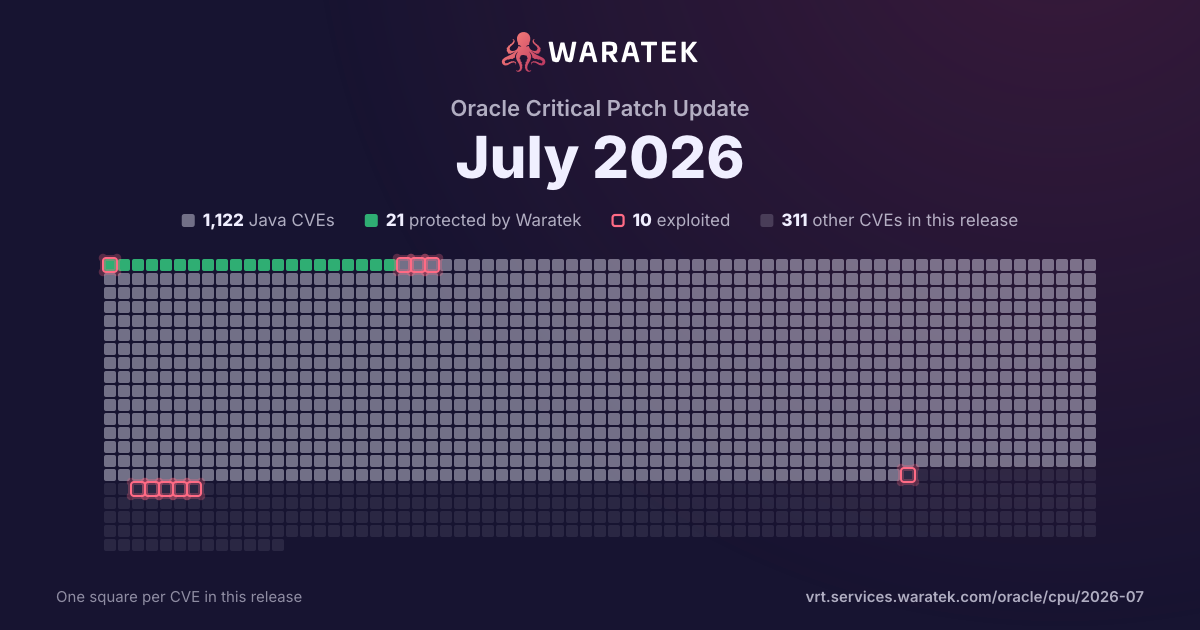
By status
21Protected by Waratek8Mitigation candidate1,093No exploit published16Outside Waratek scope295Not applicable
10Exploited, marked by the ring
No exploit published. For 971 of them, Oracle's security advisory is the source of public detail.
Protected by Waratek. Waratek RASP can block exploitation of these on systems that have not applied the patch yet.
Overview 122 matches · 0 in Waratek scope · 0 protected · 3 exploited · 1 CISA KEV · 7 public PoC · 4 EPSS ≥ 0.5
122matches
0in Waratek scope0.0%
0protected0.0%
3exploited2.5%
1CISA KEV0.8%
7public PoC5.7%
4EPSS ≥ 0.53.3%
Protected by Waratek
0
0.0%
Rule in development
0
0.0%
Mitigation candidate
0
0.0%
No exploit published
0
0.0%
Outside Waratek scope
0
0.0%
Not applicable
122
100.0%
Withdrawn CVE
0
0.0%
blocked by ARMR today
0
0.0%
partly blocked
0
0.0%
not blocked
122
100.0%
not established
0
0.0%
unrecorded
0
0.0%
split by
peak 38 / quarter
Q1 211
Not applicable1
High1
not blocked1
No public exploit1
Q2 210
Q3 210
Q4 210
Q1 220
Q2 221
Not applicable1
High1
not blocked1
No public exploit1
Q3 221
Not applicable1
High1
not blocked1
No public exploit1
Q4 220
Q1 230
Q2 230
Q3 231
Not applicable1
High1
not blocked1
No public exploit1
Q4 230
Q1 243
Not applicable3
High3
not blocked3
No public exploit3
Q2 242
Not applicable2
High2
not blocked2
Proof of concept only2
Q3 241
Not applicable1
High1
not blocked1
No public exploit1
Q4 242
Not applicable2
High2
not blocked2
Proof of concept only1
No public exploit1
Q1 253
Not applicable3
High3
not blocked3
Proof of concept only1
No public exploit2
Q2 253
Not applicable3
High3
not blocked3
No public exploit3
Q3 257
Not applicable7
High7
not blocked7
Working exploit published1
Proof of concept only1
No public exploit5
Q4 257
Not applicable7
High7
not blocked7
Proof of concept only3
No public exploit4
Q1 2625
Not applicable25
High25
not blocked25
Proof of concept only5
No public exploit20
Q2 2627
Not applicable27
High27
not blocked27
Exploited3
Proof of concept only2
No public exploit22
Q3 2638
Not applicable38
High38
not blocked38
No public exploit38
Q1 21Q3 21Q1 22Q3 22Q1 23Q3 23Q1 24Q3 24Q1 25Q3 25Q1 26Q3 26
| CVE | Severity | Published▾ | Status | Exploitation | Description |
|---|---|---|---|---|---|
| CVE-2026-61202 | High | 2026-07-21 | Not applicable | No public exploit | Vulnerability in the Oracle Solaris product of Oracle Systems (component: Utility). Supported versions that are affected are 11.3 and 11.4. Difficult to exploit vulnerability allows low privileged attacker with logon to the infrastructure where Oracle Solaris executes to compromise Oracle Solaris. While the vulnerability is in Oracle Solaris, attacks may significantly impact additional products (scope change). Successful attacks of this vulnerability can result in unauthorized creation, deletion or modification access to critical data or all Oracle Solaris accessible data as well as unauthorized access to critical data or complete access to all Oracle Solaris accessible data. CVSS 3.1 Base Score 7.5 (Confidentiality and Integrity impacts). CVSS Vector: (CVSS:3.1/AV:L/AC:H/PR:L/UI:N/S:C/C:H/I:H/A:N). |
| CVE-2026-61106 | High | 2026-07-21 | Not applicable | No public exploit | Vulnerability in Oracle GoldenGate (component: Config Service Executable). Supported versions that are affected are 23.4-23.26.2. Difficult to exploit vulnerability allows unauthenticated attacker with network access via HTTP to compromise Oracle GoldenGate. Successful attacks of this vulnerability can result in takeover of Oracle GoldenGate. CVSS 3.1 Base Score 8.1 (Confidentiality, Integrity and Availability impacts). CVSS Vector: (CVSS:3.1/AV:N/AC:H/PR:N/UI:N/S:U/C:H/I:H/A:H). |
| CVE-2026-61094 | High | 2026-07-21 | Not applicable | No public exploit | Vulnerability in the MySQL Server, MySQL Cluster product of Oracle MySQL (component: Server: Replication). Supported versions that are affected are MySQL Server: 8.4.0-8.4.10, 9.7.0-9.7.1; MySQL Cluster: 8.0.0-8.0.47, 8.4.0-8.4.10 and 9.7.0-9.7.1. Easily exploitable vulnerability allows high privileged attacker with network access via multiple protocols to compromise MySQL Server, MySQL Cluster. Successful attacks of this vulnerability can result in takeover of MySQL Server, MySQL Cluster. CVSS 3.1 Base Score 7.2 (Confidentiality, Integrity and Availability impacts). CVSS Vector: (CVSS:3.1/AV:N/AC:L/PR:H/UI:N/S:U/C:H/I:H/A:H). |
| CVE-2026-60834 | High | 2026-07-21 | Not applicable | No public exploit | Vulnerability in the Oracle Solaris product of Oracle Systems (component: Utility). The supported version that is affected is 11.4. Difficult to exploit vulnerability allows low privileged attacker with network access via RAD to compromise Oracle Solaris. While the vulnerability is in Oracle Solaris, attacks may significantly impact additional products (scope change). Successful attacks of this vulnerability can result in unauthorized access to critical data or complete access to all Oracle Solaris accessible data as well as unauthorized update, insert or delete access to some of Oracle Solaris accessible data. CVSS 3.1 Base Score 7.1 (Confidentiality and Integrity impacts). CVSS Vector: (CVSS:3.1/AV:N/AC:H/PR:L/UI:N/S:C/C:H/I:L/A:N). |
| CVE-2026-60833 | High | 2026-07-21 | Not applicable | No public exploit | Vulnerability in the Oracle Solaris product of Oracle Systems (component: Utility). The supported version that is affected is 11.4. Difficult to exploit vulnerability allows low privileged attacker with logon to the infrastructure where Oracle Solaris executes to compromise Oracle Solaris. Successful attacks of this vulnerability can result in takeover of Oracle Solaris. CVSS 3.1 Base Score 7.0 (Confidentiality, Integrity and Availability impacts). CVSS Vector: (CVSS:3.1/AV:L/AC:H/PR:L/UI:N/S:U/C:H/I:H/A:H). |
| CVE-2026-60725 | High | 2026-07-21 | Not applicable | No public exploit | Vulnerability in the MySQL Router product of Oracle MySQL (component: Router: General). Supported versions that are affected are 8.4.0-8.4.10 and 9.7.0-9.7.1. Difficult to exploit vulnerability allows unauthenticated attacker with network access via HTTP to compromise MySQL Router. Successful attacks of this vulnerability can result in unauthorized creation, deletion or modification access to critical data or all MySQL Router accessible data as well as unauthorized access to critical data or complete access to all MySQL Router accessible data. CVSS 3.1 Base Score 7.4 (Confidentiality and Integrity impacts). CVSS Vector: (CVSS:3.1/AV:N/AC:H/PR:N/UI:N/S:U/C:H/I:H/A:N). |
| CVE-2026-60661 | High | 2026-07-21 | Not applicable | No public exploit | Vulnerability in the Oracle Solaris product of Oracle Systems (component: Filesystems). The supported version that is affected is 11.4. Difficult to exploit vulnerability allows low privileged attacker with logon to the infrastructure where Oracle Solaris executes to compromise Oracle Solaris. While the vulnerability is in Oracle Solaris, attacks may significantly impact additional products (scope change). Successful attacks of this vulnerability can result in takeover of Oracle Solaris. CVSS 3.1 Base Score 7.8 (Confidentiality, Integrity and Availability impacts). CVSS Vector: (CVSS:3.1/AV:L/AC:H/PR:L/UI:N/S:C/C:H/I:H/A:H). |
| CVE-2026-60659 | High | 2026-07-21 | Not applicable | No public exploit | Vulnerability in the Oracle Solaris product of Oracle Systems (component: Filesystems). The supported version that is affected is 11.4. Easily exploitable vulnerability allows low privileged attacker with logon to the infrastructure where Oracle Solaris executes to compromise Oracle Solaris. Successful attacks of this vulnerability can result in unauthorized creation, deletion or modification access to critical data or all Oracle Solaris accessible data and unauthorized ability to cause a hang or frequently repeatable crash (complete DOS) of Oracle Solaris. CVSS 3.1 Base Score 7.1 (Integrity and Availability impacts). CVSS Vector: (CVSS:3.1/AV:L/AC:L/PR:L/UI:N/S:U/C:N/I:H/A:H). |
| CVE-2026-60623 | High | 2026-07-21 | Not applicable | No public exploit | Vulnerability in the MySQL Connectors product of Oracle MySQL (component: Connector/J). Supported versions that are affected are 9.7.0-9.7.1. Difficult to exploit vulnerability allows low privileged attacker with network access via multiple protocols to compromise MySQL Connectors. Successful attacks of this vulnerability can result in unauthorized creation, deletion or modification access to critical data or all MySQL Connectors accessible data as well as unauthorized access to critical data or complete access to all MySQL Connectors accessible data and unauthorized ability to cause a partial denial of service (partial DOS) of MySQL Connectors. CVSS 3.1 Base Score 7.1 (Confidentiality, Integrity and Availability impacts). CVSS Vector: (CVSS:3.1/AV:N/AC:H/PR:L/UI:N/S:U/C:H/I:H/A:L). |
| CVE-2026-60586 | High | 2026-07-21 | Not applicable | No public exploit | Vulnerability in the MySQL Connectors product of Oracle MySQL (component: Connector/J). Supported versions that are affected are 9.7.0-9.7.1. Easily exploitable vulnerability allows low privileged attacker with network access via multiple protocols to compromise MySQL Connectors. While the vulnerability is in MySQL Connectors, attacks may significantly impact additional products (scope change). Successful attacks of this vulnerability can result in unauthorized access to critical data or complete access to all MySQL Connectors accessible data. CVSS 3.1 Base Score 7.7 (Confidentiality impacts). CVSS Vector: (CVSS:3.1/AV:N/AC:L/PR:L/UI:N/S:C/C:H/I:N/A:N). |
| CVE-2026-60570 | High | 2026-07-21 | Not applicable | No public exploit | Vulnerability in Oracle GoldenGate (component: Libraries). Supported versions that are affected are 23.4-23.26.1. Easily exploitable vulnerability allows low privileged attacker with logon to the infrastructure where Oracle GoldenGate executes to compromise Oracle GoldenGate. Successful attacks of this vulnerability can result in takeover of Oracle GoldenGate. CVSS 3.1 Base Score 7.8 (Confidentiality, Integrity and Availability impacts). CVSS Vector: (CVSS:3.1/AV:L/AC:L/PR:L/UI:N/S:U/C:H/I:H/A:H). |
| CVE-2026-60530 | High | 2026-07-21 | Not applicable | No public exploit | Vulnerability in the Oracle HTTP Server product of Oracle Fusion Middleware (component: mod_http2.so). The supported version that is affected is 14.1.2.0.0. Easily exploitable vulnerability allows low privileged attacker with logon to the infrastructure where Oracle HTTP Server executes to compromise Oracle HTTP Server. Successful attacks of this vulnerability can result in takeover of Oracle HTTP Server. CVSS 3.1 Base Score 7.8 (Confidentiality, Integrity and Availability impacts). CVSS Vector: (CVSS:3.1/AV:L/AC:L/PR:L/UI:N/S:U/C:H/I:H/A:H). |
| CVE-2026-60454 | High | 2026-07-21 | Not applicable | No public exploit | Vulnerability in the Oracle HTTP Server product of Oracle Fusion Middleware (component: Core). Supported versions that are affected are 12.2.1.4.0 and 14.1.2.0.0. Easily exploitable vulnerability allows low privileged attacker with logon to the infrastructure where Oracle HTTP Server executes to compromise Oracle HTTP Server. Successful attacks of this vulnerability can result in takeover of Oracle HTTP Server. CVSS 3.1 Base Score 7.8 (Confidentiality, Integrity and Availability impacts). CVSS Vector: (CVSS:3.1/AV:L/AC:L/PR:L/UI:N/S:U/C:H/I:H/A:H). |
| CVE-2026-60431 | High | 2026-07-21 | Not applicable | No public exploit | Vulnerability in the Oracle HTTP Server product of Oracle Fusion Middleware (component: mod_proxy). Supported versions that are affected are 12.2.1.4.0 and 14.1.2.0.0. Easily exploitable vulnerability allows unauthenticated attacker with network access via HTTP to compromise Oracle HTTP Server. While the vulnerability is in Oracle HTTP Server, attacks may significantly impact additional products (scope change). Successful attacks of this vulnerability can result in unauthorized access to critical data or complete access to all Oracle HTTP Server accessible data. CVSS 3.1 Base Score 8.6 (Confidentiality impacts). CVSS Vector: (CVSS:3.1/AV:N/AC:L/PR:N/UI:N/S:C/C:H/I:N/A:N). |
| CVE-2026-60400 | High | 2026-07-21 | Not applicable | No public exploit | Vulnerability in Oracle GoldenGate (component: Admin Server Executable). Supported versions that are affected are 19.1.0.0.0-19.30.0.0, 21.3-21.21 and 23.4-23.26.1. Easily exploitable vulnerability allows low privileged attacker with network access via HTTPS to compromise Oracle GoldenGate. Successful attacks of this vulnerability can result in takeover of Oracle GoldenGate. CVSS 3.1 Base Score 8.8 (Confidentiality, Integrity and Availability impacts). CVSS Vector: (CVSS:3.1/AV:N/AC:L/PR:L/UI:N/S:U/C:H/I:H/A:H). |
| CVE-2026-60398 | High | 2026-07-21 | Not applicable | No public exploit | Vulnerability in Oracle GoldenGate (component: Oracle GoldenGate Microservices). Supported versions that are affected are 19.1.0.0.0-19.30.0.0, 21.3-21.21 and 23.4-23.26.1. Easily exploitable vulnerability allows low privileged attacker with network access via HTTP to compromise Oracle GoldenGate. Successful attacks of this vulnerability can result in takeover of Oracle GoldenGate. CVSS 3.1 Base Score 8.8 (Confidentiality, Integrity and Availability impacts). CVSS Vector: (CVSS:3.1/AV:N/AC:L/PR:L/UI:N/S:U/C:H/I:H/A:H). |
| CVE-2026-60396 | High | 2026-07-21 | Not applicable | No public exploit | Vulnerability in Oracle GoldenGate (component: Distribution Server executable). Supported versions that are affected are 21.3-21.21 and 23.4-23.26.1. Easily exploitable vulnerability allows high privileged attacker with network access via HTTPS to compromise Oracle GoldenGate. Successful attacks of this vulnerability can result in takeover of Oracle GoldenGate. CVSS 3.1 Base Score 7.2 (Confidentiality, Integrity and Availability impacts). CVSS Vector: (CVSS:3.1/AV:N/AC:L/PR:H/UI:N/S:U/C:H/I:H/A:H). |
| CVE-2026-60317 | High | 2026-07-21 | Not applicable | No public exploit | Vulnerability in the MySQL Connectors product of Oracle MySQL (component: Connector/Net). Supported versions that are affected are 9.7.0-9.7.1. Difficult to exploit vulnerability allows unauthenticated attacker with network access via multiple protocols to compromise MySQL Connectors. Successful attacks of this vulnerability can result in unauthorized creation, deletion or modification access to critical data or all MySQL Connectors accessible data as well as unauthorized access to critical data or complete access to all MySQL Connectors accessible data. CVSS 3.1 Base Score 7.4 (Confidentiality and Integrity impacts). CVSS Vector: (CVSS:3.1/AV:N/AC:H/PR:N/UI:N/S:U/C:H/I:H/A:N). |
| CVE-2026-60316 | High | 2026-07-21 | Not applicable | No public exploit | Vulnerability in the MySQL Server, MySQL Cluster product of Oracle MySQL (component: Server: X Plugin). Supported versions that are affected are MySQL Server: 8.4.0-8.4.10, 9.7.0-9.7.1; MySQL Cluster: 8.0.0-8.0.47, 8.4.0-8.4.10 and 9.7.0-9.7.1. Easily exploitable vulnerability allows high privileged attacker with network access via multiple protocols to compromise MySQL Server, MySQL Cluster. Successful attacks of this vulnerability can result in takeover of MySQL Server, MySQL Cluster. CVSS 3.1 Base Score 7.2 (Confidentiality, Integrity and Availability impacts). CVSS Vector: (CVSS:3.1/AV:N/AC:L/PR:H/UI:N/S:U/C:H/I:H/A:H). |
| CVE-2026-60315 | High | 2026-07-21 | Not applicable | No public exploit | Vulnerability in the MySQL Server, MySQL Cluster product of Oracle MySQL (component: Server: X Plugin). Supported versions that are affected are MySQL Server: 8.4.0-8.4.10, 9.7.0-9.7.1; MySQL Cluster: 8.0.0-8.0.47, 8.4.0-8.4.10 and 9.7.0-9.7.1. Easily exploitable vulnerability allows unauthenticated attacker with network access via multiple protocols to compromise MySQL Server, MySQL Cluster. Successful attacks of this vulnerability can result in unauthorized ability to cause a hang or frequently repeatable crash (complete DOS) of MySQL Server, MySQL Cluster and unauthorized read access to a subset of MySQL Server, MySQL Cluster accessible data. CVSS 3.1 Base Score 8.2 (Confidentiality and Availability impacts). CVSS Vector: (CVSS:3.1/AV:N/AC:L/PR:N/UI:N/S:U/C:L/I:N/A:H). |
| CVE-2026-60314 | High | 2026-07-21 | Not applicable | No public exploit | Vulnerability in the MySQL Router product of Oracle MySQL (component: Router: General). Supported versions that are affected are 8.4.0-8.4.10 and 9.7.0-9.7.1. Easily exploitable vulnerability allows unauthenticated attacker with network access via HTTP to compromise MySQL Router. Successful attacks of this vulnerability can result in unauthorized ability to cause a hang or frequently repeatable crash (complete DOS) of MySQL Router. CVSS 3.1 Base Score 7.5 (Availability impacts). CVSS Vector: (CVSS:3.1/AV:N/AC:L/PR:N/UI:N/S:U/C:N/I:N/A:H). |
| CVE-2026-60193 | High | 2026-07-21 | Not applicable | No public exploit | Vulnerability in the MySQL Connectors product of Oracle MySQL (component: Connector/Net). Supported versions that are affected are 9.7.0-9.7.1. Difficult to exploit vulnerability allows low privileged attacker with network access via multiple protocols to compromise MySQL Connectors. While the vulnerability is in MySQL Connectors, attacks may significantly impact additional products (scope change). Successful attacks of this vulnerability can result in takeover of MySQL Connectors. CVSS 3.1 Base Score 8.5 (Confidentiality, Integrity and Availability impacts). CVSS Vector: (CVSS:3.1/AV:N/AC:H/PR:L/UI:N/S:C/C:H/I:H/A:H). |
| CVE-2026-60192 | High | 2026-07-21 | Not applicable | No public exploit | Vulnerability in the MySQL Connectors product of Oracle MySQL (component: Connector/Net). Supported versions that are affected are 9.7.0-9.7.1. Difficult to exploit vulnerability allows unauthenticated attacker with network access via multiple protocols to compromise MySQL Connectors. Successful attacks of this vulnerability can result in takeover of MySQL Connectors. CVSS 3.1 Base Score 8.1 (Confidentiality, Integrity and Availability impacts). CVSS Vector: (CVSS:3.1/AV:N/AC:H/PR:N/UI:N/S:U/C:H/I:H/A:H). |
| CVE-2026-60180 | High | 2026-07-21 | Not applicable | No public exploit | Vulnerability in the MySQL Connectors product of Oracle MySQL (component: Connector/C++). Supported versions that are affected are 9.7.0-9.7.1. Easily exploitable vulnerability allows unauthenticated attacker with network access via multiple protocols to compromise MySQL Connectors. Successful attacks of this vulnerability can result in unauthorized ability to cause a hang or frequently repeatable crash (complete DOS) of MySQL Connectors. CVSS 3.1 Base Score 7.5 (Availability impacts). CVSS Vector: (CVSS:3.1/AV:N/AC:L/PR:N/UI:N/S:U/C:N/I:N/A:H). |
| CVE-2026-60179 | High | 2026-07-21 | Not applicable | No public exploit | Vulnerability in the MySQL Connectors product of Oracle MySQL (component: Connector/C++). Supported versions that are affected are 9.7.0-9.7.1. Difficult to exploit vulnerability allows unauthenticated attacker with network access via multiple protocols to compromise MySQL Connectors. Successful attacks of this vulnerability can result in unauthorized creation, deletion or modification access to critical data or all MySQL Connectors accessible data as well as unauthorized access to critical data or complete access to all MySQL Connectors accessible data. CVSS 3.1 Base Score 7.4 (Confidentiality and Integrity impacts). CVSS Vector: (CVSS:3.1/AV:N/AC:H/PR:N/UI:N/S:U/C:H/I:H/A:N). |
| CVE-2026-60175 | High | 2026-07-21 | Not applicable | No public exploit | Vulnerability in the RDBMS component of Oracle Database Server. Supported versions that are affected are 19.3-19.31, 21.3-21.22 and 23.4.0-23.26.2. Easily exploitable vulnerability allows low privileged attacker having Authenticated User privilege with network access via Oracle Net to compromise RDBMS. Successful attacks of this vulnerability can result in takeover of RDBMS. CVSS 3.1 Base Score 8.8 (Confidentiality, Integrity and Availability impacts). CVSS Vector: (CVSS:3.1/AV:N/AC:L/PR:L/UI:N/S:U/C:H/I:H/A:H). |
| CVE-2026-60170 | High | 2026-07-21 | Not applicable | No public exploit | Vulnerability in the Oracle Hospitality Simphony product of Oracle Food and Beverage Applications (component: POS). Supported versions that are affected are 19.8-19.8.5, 19.9-19.9.3 and 19.10. Easily exploitable vulnerability allows unauthenticated attacker with network access via HTTP to compromise Oracle Hospitality Simphony. Successful attacks of this vulnerability can result in unauthorized access to critical data or complete access to all Oracle Hospitality Simphony accessible data. CVSS 3.1 Base Score 7.5 (Confidentiality impacts). CVSS Vector: (CVSS:3.1/AV:N/AC:L/PR:N/UI:N/S:U/C:H/I:N/A:N). |
| CVE-2026-60169 | High | 2026-07-21 | Not applicable | No public exploit | Vulnerability in the Oracle Hospitality Simphony product of Oracle Food and Beverage Applications (component: POS). Supported versions that are affected are 19.8-19.8.5, 19.9-19.9.3 and 19.10. Difficult to exploit vulnerability allows unauthenticated attacker with network access via HTTP to compromise Oracle Hospitality Simphony. Successful attacks of this vulnerability can result in takeover of Oracle Hospitality Simphony. CVSS 3.1 Base Score 8.1 (Confidentiality, Integrity and Availability impacts). CVSS Vector: (CVSS:3.1/AV:N/AC:H/PR:N/UI:N/S:U/C:H/I:H/A:H). |
| CVE-2026-60167 | High | 2026-07-21 | Not applicable | No public exploit | Vulnerability in the Oracle Hospitality Simphony product of Oracle Food and Beverage Applications (component: POS). Supported versions that are affected are 19.8-19.8.5, 19.9-19.9.3 and 19.10. Easily exploitable vulnerability allows unauthenticated attacker with network access via HTTP to compromise Oracle Hospitality Simphony. Successful attacks of this vulnerability can result in unauthorized access to critical data or complete access to all Oracle Hospitality Simphony accessible data. CVSS 3.1 Base Score 7.5 (Confidentiality impacts). CVSS Vector: (CVSS:3.1/AV:N/AC:L/PR:N/UI:N/S:U/C:H/I:N/A:N). |
| CVE-2026-60163 | High | 2026-07-21 | Not applicable | No public exploit | Vulnerability in the MySQL Server, MySQL Cluster product of Oracle MySQL (component: Server: Group Replication Plugin). Supported versions that are affected are MySQL Server: 8.4.0-8.4.10, 9.7.0-9.7.1; MySQL Cluster: 8.0.0-8.0.47, 8.4.0-8.4.10 and 9.7.0-9.7.1. Easily exploitable vulnerability allows unauthenticated attacker with logon to the infrastructure where MySQL Server, MySQL Cluster executes to compromise MySQL Server, MySQL Cluster. Successful attacks of this vulnerability can result in takeover of MySQL Server, MySQL Cluster. CVSS 3.1 Base Score 8.4 (Confidentiality, Integrity and Availability impacts). CVSS Vector: (CVSS:3.1/AV:L/AC:L/PR:N/UI:N/S:U/C:H/I:H/A:H). |
| CVE-2026-60159 | High | 2026-07-21 | Not applicable | No public exploit | Vulnerability in the Oracle VM VirtualBox product of Oracle Virtualization (component: Core). The supported version that is affected is 7.2.12. Difficult to exploit vulnerability allows high privileged attacker with logon to the infrastructure where Oracle VM VirtualBox executes to compromise Oracle VM VirtualBox. While the vulnerability is in Oracle VM VirtualBox, attacks may significantly impact additional products (scope change). Successful attacks of this vulnerability can result in takeover of Oracle VM VirtualBox. CVSS 3.1 Base Score 7.5 (Confidentiality, Integrity and Availability impacts). CVSS Vector: (CVSS:3.1/AV:L/AC:H/PR:H/UI:N/S:C/C:H/I:H/A:H). |
| CVE-2026-60157 | High | 2026-07-21 | Not applicable | No public exploit | Vulnerability in Oracle GoldenGate (component: Service Manager). Supported versions that are affected are 19.1.0.0.0-19.29.0.0, 21.3-21.21 and 23.4-23.26.1.0.0. Easily exploitable vulnerability allows low privileged attacker with network access via HTTP to compromise Oracle GoldenGate. Successful attacks of this vulnerability can result in takeover of Oracle GoldenGate. CVSS 3.1 Base Score 8.8 (Confidentiality, Integrity and Availability impacts). CVSS Vector: (CVSS:3.1/AV:N/AC:L/PR:L/UI:N/S:U/C:H/I:H/A:H). |
| CVE-2026-60155 | High | 2026-07-21 | Not applicable | No public exploit | Vulnerability in the Oracle VM VirtualBox product of Oracle Virtualization (component: Core). The supported version that is affected is 7.2.12. Difficult to exploit vulnerability allows high privileged attacker with logon to the infrastructure where Oracle VM VirtualBox executes to compromise Oracle VM VirtualBox. While the vulnerability is in Oracle VM VirtualBox, attacks may significantly impact additional products (scope change). Successful attacks of this vulnerability can result in takeover of Oracle VM VirtualBox. CVSS 3.1 Base Score 7.5 (Confidentiality, Integrity and Availability impacts). CVSS Vector: (CVSS:3.1/AV:L/AC:H/PR:H/UI:N/S:C/C:H/I:H/A:H). |
| CVE-2026-60150 | High | 2026-07-21 | Not applicable | No public exploit | Vulnerability in the Oracle VM VirtualBox product of Oracle Virtualization (component: Core). The supported version that is affected is 7.2.12. Easily exploitable vulnerability allows low privileged attacker with logon to the infrastructure where Oracle VM VirtualBox executes to compromise Oracle VM VirtualBox. Successful attacks of this vulnerability can result in takeover of Oracle VM VirtualBox. CVSS 3.1 Base Score 7.8 (Confidentiality, Integrity and Availability impacts). CVSS Vector: (CVSS:3.1/AV:L/AC:L/PR:L/UI:N/S:U/C:H/I:H/A:H). |
| CVE-2026-47054 | High | 2026-07-21 | Not applicable | No public exploit | Vulnerability in the Oracle VM VirtualBox product of Oracle Virtualization (component: Core). The supported version that is affected is 7.2.12. Easily exploitable vulnerability allows low privileged attacker with logon to the infrastructure where Oracle VM VirtualBox executes to compromise Oracle VM VirtualBox. Successful attacks of this vulnerability can result in takeover of Oracle VM VirtualBox. Note: This vulnerability applies to Windows host only. CVSS 3.1 Base Score 7.8 (Confidentiality, Integrity and Availability impacts). CVSS Vector: (CVSS:3.1/AV:L/AC:L/PR:L/UI:N/S:U/C:H/I:H/A:H). |
| CVE-2026-47050 | High | 2026-07-21 | Not applicable | No public exploit | Vulnerability in the Oracle VM VirtualBox product of Oracle Virtualization (component: Core). The supported version that is affected is 7.2.8. Easily exploitable vulnerability allows high privileged attacker with logon to the infrastructure where Oracle VM VirtualBox executes to compromise Oracle VM VirtualBox. Successful attacks require human interaction from a person other than the attacker and while the vulnerability is in Oracle VM VirtualBox, attacks may significantly impact additional products (scope change). Successful attacks of this vulnerability can result in unauthorized creation, deletion or modification access to critical data or all Oracle VM VirtualBox accessible data and unauthorized ability to cause a hang or frequently repeatable crash (complete DOS) of Oracle VM VirtualBox. CVSS 3.1 Base Score 7.4 (Integrity and Availability impacts). CVSS Vector: (CVSS:3.1/AV:L/AC:L/PR:H/UI:R/S:C/C:N/I:H/A:H). |
| CVE-2026-47047 | High | 2026-07-21 | Not applicable | No public exploit | Vulnerability in the Oracle VM VirtualBox product of Oracle Virtualization (component: Core). The supported version that is affected is 7.2.12. Easily exploitable vulnerability allows low privileged attacker with logon to the infrastructure where Oracle VM VirtualBox executes to compromise Oracle VM VirtualBox. Successful attacks of this vulnerability can result in takeover of Oracle VM VirtualBox. CVSS 3.1 Base Score 7.8 (Confidentiality, Integrity and Availability impacts). CVSS Vector: (CVSS:3.1/AV:L/AC:L/PR:L/UI:N/S:U/C:H/I:H/A:H). |
| CVE-2026-47046 | High | 2026-07-21 | Not applicable | No public exploit | Vulnerability in the RDBMS component of Oracle Database Server. Supported versions that are affected are 23.4.0-23.26.2. Easily exploitable vulnerability allows unauthenticated attacker with network access via Oracle Net to compromise RDBMS. Successful attacks of this vulnerability can result in unauthorized ability to cause a hang or frequently repeatable crash (complete DOS) of RDBMS as well as unauthorized update, insert or delete access to some of RDBMS accessible data. CVSS 3.1 Base Score 8.2 (Integrity and Availability impacts). CVSS Vector: (CVSS:3.1/AV:N/AC:L/PR:N/UI:N/S:U/C:N/I:L/A:H). |
| CVE-2026-46863 | High | 2026-06-17 | Not applicable | No public exploit | Vulnerability in the MySQL Server, MySQL Cluster product of Oracle MySQL (component: Server: Connection Handling). Supported versions that are affected are MySQL Server: 8.4.0-8.4.9, 9.0.0-9.7.0; MySQL Cluster: 8.0.11-8.0.46, 8.4.0-8.4.9 and 9.0.0-9.7.0. Easily exploitable vulnerability allows unauthenticated attacker with network access via multiple protocols to compromise MySQL Server, MySQL Cluster. Successful attacks of this vulnerability can result in unauthorized ability to cause a hang or frequently repeatable crash (complete DOS) of MySQL Server, MySQL Cluster. CVSS 3.1 Base Score 7.5 (Availability impacts). CVSS Vector: (CVSS:3.1/AV:N/AC:L/PR:N/UI:N/S:U/C:N/I:N/A:H). |
| CVE-2026-9076 | High | 2026-06-09 | Not applicable | No public exploit | Issue summary: When CMS password-based decryption (RFC 3211 / PWRI key unwrap) processes attacker-supplied CMS data, an attacker-chosen stream-mode KEK cipher can trigger a heap out-of-bounds read in kek_unwrap_key(). Impact summary: A heap buffer over-read may trigger a crash which leads to Denial of Service for an application if the input buffer ends at a memory page boundary and the following page is unmapped. There is no information disclosure as the over-read bytes are not revealed to the attacker. The key unwrapping function performs a check-byte test as specified in the RFC that reads 7 bytes from a heap allocation that is based on the wrapped key length from the message. There is a minimum length check based on the block length of the wrapping cipher. However the cipher is selected from an OID carried in the attacker's PWRI keyEncryptionAlgorithm with no requirement that the cipher be a block cipher. When an attacker selects a stream-mode cipher the guard will be ineffective and the allocated buffer containing the unwrapped key can be too small to fit the check-bytes specified in the RFC and a buffer over-read can happen. Applications calling CMS_decrypt() or CMS_decrypt_set1_password() (equivalently openssl cms -decrypt -pwri_password ...) on untrusted CMS data are vulnerable to this issue. No password knowledge is required: the over-read happens during the unwrap attempt before any authentication succeeds. The over-read is limited to a few bytes and is not written to output, so there is no information disclosure. Triggering a crash requires the allocation to border unmapped memory, which is unlikely with the normal allocator. The FIPS modules are not affected by this issue. |
| CVE-2026-7383 | High | 2026-06-09 | Not applicable | No public exploit | Issue summary: A signed integer overflow when sizing the destination buffer for Unicode output in ASN1_mbstring_ncopy() can lead to a heap buffer overflow. Impact summary: A heap buffer overflow may lead to a crash or possibly attacker controlled code execution or other undefined behaviour. In ASN1_mbstring_copy() and ASN1_mbstring_ncopy() the destination size for Unicode output is computed in a signed int: by left shift of the input character count for BMPSTRING (UTF-16) and UNIVERSALSTRING (UTF-32), and by summing per-character byte counts for UTF8STRING. The calculation overflows when the input reaches around 2^30 characters. In the worst case (UNIVERSALSTRING at 2^30 characters) the size wraps to zero, OPENSSL_malloc(1) is called, and the subsequent character copy writes several gigabytes past the one-byte allocation. X.509 certificate processing routes through ASN1_STRING_set_by_NID(), whose DIRSTRING_TYPE mask excludes UNIVERSALSTRING and whose per-NID size limits cap the input length; no network protocol or certificate-handling path in OpenSSL exercises the overflow. Triggering the bug requires an application that calls ASN1_mbstring_copy() or ASN1_mbstring_ncopy() directly, or registers a custom string type via ASN1_STRING_TABLE_add(), with attacker-controlled input on the order of half a gigabyte or more. For these reasons this issue was assigned Low severity. The FIPS modules in 4.0, 3.6, 3.5, 3.4 and 3.0 are not affected by this issue, as the affected code is outside the OpenSSL FIPS module boundary. |
| CVE-2026-45447 | High | 2026-06-09 | Not applicable | No public exploit | Issue summary: A specially crafted PKCS#7 or S/MIME signed message could trigger a use-after-free during PKCS#7 signature verification. Impact summary: A use-after-free may result in process crashes, heap corruption, or potentially remote code execution. When processing a PKCS#7 or S/MIME signed message, if the SignedData digestAlgorithms field is present as an empty ASN.1 SET, OpenSSL may incorrectly free a caller-owned BIO during PKCS7_verify(). A subsequent use of the BIO by the calling application results in a use-after-free condition. In the common case this occurs when the application later calls BIO_free() on the BIO originally passed to PKCS7_verify(). Depending on allocator behavior and application-specific BIO usage patterns, this may result in a crash or other memory corruption. In some application contexts this may potentially be exploitable for remote code execution. Applications that process PKCS#7 or S/MIME signed messages using OpenSSL PKCS#7 APIs may be affected. Applications using the CMS APIs for this processing are not affected. The FIPS modules in 4.0, 3.6, 3.5, 3.4, and 3.0 are not affected by this issue, as the affected code is outside the OpenSSL FIPS module boundary. |
| CVE-2026-45445 | High | 2026-06-09 | Not applicable | No public exploit | Issue summary: When an application drives an AES-OCB context through the public EVP_Cipher() one-shot interface, the application-supplied initialisation vector (IV) is silently discarded. Impact summary: Every message encrypted under the same key uses the same effective nonce regardless of the IV supplied by the caller, resulting in (key, nonce) reuse and loss of confidentiality. If the same code path is used to compute the authentication tag, the tag depends only on the (key, IV) pair and not on the plaintext or ciphertext, allowing universal forgery of arbitrary ciphertext from a single captured message. OpenSSL provides two ways to drive a cipher: the documented streaming interface (EVP_CipherUpdate / EVP_CipherFinal_ex) and a lower-level one-shot, EVP_Cipher(), whose documentation explicitly recommends against use by applications in favour of EVP_CipherUpdate() and EVP_CipherFinal_ex(). The OCB provider's streaming handler flushes the application-supplied IV into the OCB context before processing data; the one-shot handler did not. Every call to EVP_Cipher() on an AES-OCB context therefore ran with the all-zero key-derived offset state left by cipher initialisation, regardless of the caller's IV. If EVP_EncryptFinal_ex() is subsequently used to obtain the authentication tag, the deferred IV setup runs at that point and clears the running checksum that should have been accumulated over the plaintext. The resulting tag is a function of (key, IV) only and verifies against any ciphertext produced under the same (key, IV) pair. The OpenSSL SSL/TLS implementation is not affected: AES-OCB is not a TLS cipher suite, and libssl does not call EVP_Cipher() in any case. Applications that drive AES-OCB through the documented streaming AEAD API (EVP_CipherUpdate / EVP_CipherFinal_ex) are not affected. Only applications that combine the AES-OCB cipher with the EVP_Cipher() one-shot API are vulnerable. The FIPS modules in 4.0, 3.6, 3.5, 3.4 and 3.0 are not affected by this issue, as AES-OCB is outside the OpenSSL FIPS module boundary. |
| CVE-2026-42764 | High | 2026-06-09 | Not applicable | No public exploit | Issue summary: Receiving a QUIC initial packet with an invalid token may trigger a NULL pointer dereference in the OpenSSL QUIC server with address validation disabled. Impact summary: NULL pointer dereference typically causes abnormal termination of the affected QUIC server process and a Denial of Service. If the address validation is disabled in the OpenSSL QUIC server implementation, an attacker can crash the server by sending an initial packet with an invalid or expired token. By default, the client address validation is enabled in the OpenSSL QUIC server implementation, which makes the default configuration not vulnerable to this issue. However if the SSL_LISTENER_FLAG_NO_VALIDATE is used with the SSL_new_listener() call, the address validation is disabled making the vulnerable code reachable. The FIPS modules in 4.0, 3.6, 3.5, 3.4, and 3.0 are not affected by this issue, as the affected code is outside the OpenSSL FIPS module boundary. |
| CVE-2026-34183 | High | 2026-06-09 | Not applicable | No public exploit | Issue summary: Remote peer may exhaust heap memory of the QUIC server or client by flooding it with packets containing PATH_CHALLENGE frames. Impact summary: A malicious remote peer can cause an unbounded memory allocation which can lead to an abnormal termination of the application acting as a QUIC client or server and a Denial of Service. A remote peer may exhaust heap memory by flooding the local QUIC stack with PATH_CHALLENGE frames. The local QUIC stack allocates a PATH_RESPONSE frame for every PATH_CHALLENGE it receives. The allocated PATH_RESPONSE frame gets freed only when the remote peer acknowledges reception of the PATH_RESPONSE frame which will not be done by a malicious peer. The FIPS modules in 4.0, 3.6, 3.5, 3.4, and 3.0 are not affected by this issue. The QUIC stack is outside of OpenSSL FIPS module boundary. |
| CVE-2026-34181 | High | 2026-06-09 | Not applicable | No public exploit | Issue Summary: The PKCS#12 file processing fails to perform sufficient input validation for files that use Password-Based Message Authentication Code 1 (PBMAC1) integrity mechanism allowing a certificate and private key forgery. Impact Summary: An attacker impersonating a user can cause a service reading PKCS#12 files to accept forged certificates and private keys with a 1 in 256 probability. If a service accepting PKCS#12 files is using passwords for authenticating the received files, the attacker can create unencrypted PKCS#12 files that use PBMAC1 authentication that specifies an HMAC key of only one byte, allowing them to craft a file that will be accepted with a 1 in 256 probability. That would then cause the service to accept a certificate and private key controlled by the attacker. The FIPS modules are not affected by this issue, as the affected code is outside the OpenSSL FIPS module boundary. |
| CVE-2026-34180 | High | 2026-06-09 | Not applicable | No public exploit | Issue summary: Parsing a crafted DER-encoded ASN.1 structure with a primitive element whose content exceeds 2 gigabytes in length may cause a heap buffer over-read on 64-bit Unix and Unix-like platforms. Impact summary: The heap buffer over-read may crash the application (Denial of Service) or to load into the decoded ASN.1 object contents of memory beyond the end of the input buffer. More typically such ASN.1 elements would instead be truncated. An integer truncation in OpenSSL's ASN.1 decoder causes the content length of an ASN.1 primitive element to be mishandled when it exceeds 2 gigabytes. In the worst case the truncated length is treated as a request to scan the binary content for a terminating zero byte, possibly causing OpenSSL to read either less than or beyond the end of the allocated buffer. Applications that pass attacker-supplied data to d2i_X509(), d2i_PKCS7(), or any other d2i_* decoding function are affected. OpenSSL's own command-line tools are not vulnerable, as data read through the BIO layer is checked before it reaches the affected code. The issue only affects 64-bit Unix and Unix-like platforms; 32-bit platforms and 64-bit Windows are not affected. The FIPS modules in 4.0, 3.6, 3.5, 3.4 and 3.0 are not affected by this issue, as the affected code is outside the OpenSSL FIPS module boundary. |
| CVE-2026-49975 | High | 2026-06-08 | Not applicable | Proof of concept only | Memory Allocation with Excessive Size Value vulnerability in Apache HTTP Server's mod_http leads to denial of service via malicious HTTP requests. This issue affects Apache HTTP Server: from 2.4.17 through 2.4.67. |
| CVE-2026-48913 | High | 2026-06-08 | Not applicable | No public exploit | Use After Free vulnerability in Apache HTTP Server module mod_http2 when file handles are already exhausted. This issue affects Apache HTTP Server: from 2.4.55 through 2.4.67. |
| CVE-2026-44186 | High | 2026-06-08 | Not applicable | No public exploit | Loop with Unreachable Exit Condition ('Infinite Loop') vulnerability in the mod_proxy_ftp module in Apache HTTP Server with an attacker controlled backend FTP server. This issue affects undefined: from 2.4.0 through 2.4.67. Users are recommended to upgrade to version 2.4.68, which fixes the issue. |
| CVE-2026-44185 | High | 2026-06-08 | Not applicable | No public exploit | Buffer Over-read vulnerability in Apache HTTP Server via outbound OCSP requests to an attacker controlled OCSP server This issue affects Apache HTTP Server: from 2.4.0 through 2.4.67. Users are recommended to upgrade to version 2.4.68, which fixes the issue. |
| CVE-2026-42536 | High | 2026-06-08 | Not applicable | Proof of concept only | Heap-based Buffer Overflow vulnerability in Apache HTTP Server with mod_xml2enc, xml2StartParse, and untrusted content This issue affects Apache HTTP Server: from 2.4.0 through 2.4.67. Users are recommended to upgrade to version 2.4.68, which fixes the issue. |
| CVE-2026-34356 | High | 2026-06-08 | Not applicable | No public exploit | Heap-based Buffer Overflow vulnerability in Apache HTTP Server with malicious backend servers and ProxyPassReverseCookie* This issue affects Apache HTTP Server: from 2.4.0 through 2.4.67. Users are recommended to upgrade to version 2.4.68, which fixes the issue. |
| CVE-2026-34355 | High | 2026-06-08 | Not applicable | No public exploit | A buffer overflow in mod_proxy_html in Apache HTTP Server 2.4.67 and earlier allows an attack by an untrusted backend. Users are recommended to upgrade to version 2.4.68, which fixes this issue. |
| CVE-2026-43500 | High | 2026-05-11 | Not applicable | Exploited | In the Linux kernel, the following vulnerability has been resolved: rxrpc: Also unshare DATA/RESPONSE packets when paged frags are present The DATA-packet handler in rxrpc_input_call_event() and the RESPONSE handler in rxrpc_verify_response() copy the skb to a linear one before calling into the security ops only when skb_cloned() is true. An skb that is not cloned but still carries externally-owned paged fragments (e.g. SKBFL_SHARED_FRAG set by splice() into a UDP socket via __ip_append_data, or a chained skb_has_frag_list()) falls through to the in-place decryption path, which binds the frag pages directly into the AEAD/skcipher SGL via skb_to_sgvec(). Extend the gate to also unshare when skb_has_frag_list() or skb_has_shared_frag() is true. This catches the splice-loopback vector and other externally-shared frag sources while preserving the zero-copy fast path for skbs whose frags are kernel-private (e.g. NIC page_pool RX, GRO). The OOM/trace handling already in place is reused. |
| CVE-2026-43284 | High | 2026-05-08 | Not applicable | Exploited | In the Linux kernel, the following vulnerability has been resolved: xfrm: esp: avoid in-place decrypt on shared skb frags MSG_SPLICE_PAGES can attach pages from a pipe directly to an skb. TCP marks such skbs with SKBFL_SHARED_FRAG after skb_splice_from_iter(), so later paths that may modify packet data can first make a private copy. The IPv4/IPv6 datagram append paths did not set this flag when splicing pages into UDP skbs. That leaves an ESP-in-UDP packet made from shared pipe pages looking like an ordinary uncloned nonlinear skb. ESP input then takes the no-COW fast path for uncloned skbs without a frag_list and decrypts in place over data that is not owned privately by the skb. Mark IPv4/IPv6 datagram splice frags with SKBFL_SHARED_FRAG, matching TCP. Also make ESP input fall back to skb_cow_data() when the flag is present, so ESP does not decrypt externally backed frags in place. Private nonlinear skb frags still use the existing fast path. This intentionally does not change ESP output. In esp_output_head(), the path that appends the ESP trailer to existing skb tailroom without calling skb_cow_data() is not reachable for nonlinear skbs: skb_tailroom() returns zero when skb->data_len is nonzero, while ESP tailen is positive. Thus ESP output will either use the separate destination-frag path or fall back to skb_cow_data(). |
| CVE-2026-31431 | High | 2026-04-22 | Not applicable | Exploited | In the Linux kernel, the following vulnerability has been resolved: crypto: algif_aead - Revert to operating out-of-place This mostly reverts commit 72548b093ee3 except for the copying of the associated data. There is no benefit in operating in-place in algif_aead since the source and destination come from different mappings. Get rid of all the complexity added for in-place operation and just copy the AD directly. |
| CVE-2026-40192 | High | 2026-04-15 | Not applicable | No public exploit | Pillow is a Python imaging library. Versions 10.3.0 through 12.1.1 did not limit the amount of GZIP-compressed data read when decoding a FITS image, making them vulnerable to decompression bomb attacks. A specially crafted FITS file could cause unbounded memory consumption, leading to denial of service (OOM crash or severe performance degradation). If users are unable to immediately upgrade, they should only open specific image formats, excluding FITS, as a workaround. |
| CVE-2026-35204 | High | 2026-04-09 | Not applicable | No public exploit | Helm is a package manager for Charts for Kubernetes. From 4.0.0 to 4.1.3, a specially crafted Helm plugin, when installed or updated, will cause Helm to write the contents of the plugin to an arbitrary filesystem location. To prevent this, validate that the plugin.yaml of the Helm plugin does not include a version: field containing POSIX dot-dot path separators ie. "/../". This vulnerability is fixed in 4.1.4. |
| CVE-2026-31790 | High | 2026-04-07 | Not applicable | No public exploit | Issue summary: Applications using RSASVE key encapsulation to establish a secret encryption key can send contents of an uninitialized memory buffer to a malicious peer. Impact summary: The uninitialized buffer might contain sensitive data from the previous execution of the application process which leads to sensitive data leakage to an attacker. RSA_public_encrypt() returns the number of bytes written on success and -1 on error. The affected code tests only whether the return value is non-zero. As a result, if RSA encryption fails, encapsulation can still return success to the caller, set the output lengths, and leave the caller to use the contents of the ciphertext buffer as if a valid KEM ciphertext had been produced. If applications use EVP_PKEY_encapsulate() with RSA/RSASVE on an attacker-supplied invalid RSA public key without first validating that key, then this may cause stale or uninitialized contents of the caller-provided ciphertext buffer to be disclosed to the attacker in place of the KEM ciphertext. As a workaround calling EVP_PKEY_public_check() or EVP_PKEY_public_check_quick() before EVP_PKEY_encapsulate() will mitigate the issue. The FIPS modules in 3.6, 3.5, 3.4, 3.3, 3.1 and 3.0 are affected by this issue. |
| CVE-2026-28390 | High | 2026-04-07 | Not applicable | No public exploit | Issue summary: During processing of a crafted CMS EnvelopedData message with KeyTransportRecipientInfo a NULL pointer dereference can happen. Impact summary: Applications that process attacker-controlled CMS data may crash before authentication or cryptographic operations occur resulting in Denial of Service. When a CMS EnvelopedData message that uses KeyTransportRecipientInfo with RSA-OAEP encryption is processed, the optional parameters field of RSA-OAEP SourceFunc algorithm identifier is examined without checking for its presence. This results in a NULL pointer dereference if the field is missing. Applications and services that call CMS_decrypt() on untrusted input (e.g., S/MIME processing or CMS-based protocols) are vulnerable. The FIPS modules in 3.6, 3.5, 3.4, 3.3 and 3.0 are not affected by this issue, as the affected code is outside the OpenSSL FIPS module boundary. |
| CVE-2026-28389 | High | 2026-04-07 | Not applicable | No public exploit | Issue summary: During processing of a crafted CMS EnvelopedData message with KeyAgreeRecipientInfo a NULL pointer dereference can happen. Impact summary: Applications that process attacker-controlled CMS data may crash before authentication or cryptographic operations occur resulting in Denial of Service. When a CMS EnvelopedData message that uses KeyAgreeRecipientInfo is processed, the optional parameters field of KeyEncryptionAlgorithmIdentifier is examined without checking for its presence. This results in a NULL pointer dereference if the field is missing. Applications and services that call CMS_decrypt() on untrusted input (e.g., S/MIME processing or CMS-based protocols) are vulnerable. The FIPS modules in 3.6, 3.5, 3.4, 3.3 and 3.0 are not affected by this issue, as the affected code is outside the OpenSSL FIPS module boundary. |
| CVE-2026-28388 | High | 2026-04-07 | Not applicable | No public exploit | Issue summary: When a delta CRL that contains a Delta CRL Indicator extension is processed a NULL pointer dereference might happen if the required CRL Number extension is missing. Impact summary: A NULL pointer dereference can trigger a crash which leads to a Denial of Service for an application. When CRL processing and delta CRL processing is enabled during X.509 certificate verification, the delta CRL processing does not check whether the CRL Number extension is NULL before dereferencing it. When a malformed delta CRL file is being processed, this parameter can be NULL, causing a NULL pointer dereference. Exploiting this issue requires the X509_V_FLAG_USE_DELTAS flag to be enabled in the verification context, the certificate being verified to contain a freshestCRL extension or the base CRL to have the EXFLAG_FRESHEST flag set, and an attacker to provide a malformed CRL to an application that processes it. The vulnerability is limited to Denial of Service and cannot be escalated to achieve code execution or memory disclosure. For that reason the issue was assessed as Low severity according to our Security Policy. The FIPS modules in 3.6, 3.5, 3.4, 3.3 and 3.0 are not affected by this issue, as the affected code is outside the OpenSSL FIPS module boundary. |
| CVE-2026-28387 | High | 2026-04-07 | Not applicable | No public exploit | Issue summary: An uncommon configuration of clients performing DANE TLSA-based server authentication, when paired with uncommon server DANE TLSA records, may result in a use-after-free and/or double-free on the client side. Impact summary: A use after free can have a range of potential consequences such as the corruption of valid data, crashes or execution of arbitrary code. However, the issue only affects clients that make use of TLSA records with both the PKIX-TA(0/PKIX-EE(1) certificate usages and the DANE-TA(2) certificate usage. By far the most common deployment of DANE is in SMTP MTAs for which RFC7672 recommends that clients treat as 'unusable' any TLSA records that have the PKIX certificate usages. These SMTP (or other similar) clients are not vulnerable to this issue. Conversely, any clients that support only the PKIX usages, and ignore the DANE-TA(2) usage are also not vulnerable. The client would also need to be communicating with a server that publishes a TLSA RRset with both types of TLSA records. No FIPS modules are affected by this issue, the problem code is outside the FIPS module boundary. |
| CVE-2025-14821 | High | 2026-04-07 | Not applicable | No public exploit | A flaw was found in libssh. This vulnerability allows local man-in-the-middle attacks, security downgrades of SSH (Secure Shell) connections, and manipulation of trusted host information, posing a significant risk to the confidentiality, integrity, and availability of SSH communications via an insecure default configuration on Windows systems where the library automatically loads configuration files from the C:\etc directory, which can be created and modified by unprivileged local users. |
| CVE-2026-21710 | High | 2026-03-30 | Not applicable | No public exploit | A flaw in Node.js HTTP request handling causes an uncaught `TypeError` when a request is received with a header named `__proto__` and the application accesses `req.headersDistinct`. When this occurs, `dest["__proto__"]` resolves to `Object.prototype` rather than `undefined`, causing `.push()` to be called on a non-array. This exception is thrown synchronously inside a property getter and cannot be intercepted by `error` event listeners, meaning it cannot be handled without wrapping every `req.headersDistinct` access in a `try/catch`. * This vulnerability affects all Node.js HTTP servers on **20.x, 22.x, 24.x, and v25.x** |
| CVE-2026-0966 | High | 2026-03-26 | Not applicable | No public exploit | A flaw was found in libssh. The API function `ssh_get_hexa()` is vulnerable to a denial of service when processing zero-length input. This can be exploited remotely by an attacker during GSSAPI (Generic Security Service Application Program Interface) authentication if the server's logging verbosity is set to `SSH_LOG_PACKET (3)` or higher. Successful exploitation could lead to a self-Denial of Service of the per-connection daemon process. |
| CVE-2026-4424 | High | 2026-03-19 | Not applicable | No public exploit | A flaw was found in libarchive. This heap out-of-bounds read vulnerability exists in the RAR archive processing logic due to improper validation of the LZSS sliding window size after transitions between compression methods. A remote attacker can exploit this by providing a specially crafted RAR archive, leading to the disclosure of sensitive heap memory information without requiring authentication or user interaction. |
| CVE-2026-30922 | High | 2026-03-18 | Not applicable | Proof of concept only | pyasn1 is a generic ASN.1 library for Python. Prior to 0.6.3, the `pyasn1` library is vulnerable to a Denial of Service (DoS) attack caused by uncontrolled recursion when decoding ASN.1 data with deeply nested structures. An attacker can supply a crafted payload containing thousands of nested `SEQUENCE` (`0x30`) or `SET` (`0x31`) tags with "Indefinite Length" (`0x80`) markers. This forces the decoder to recursively call itself until the Python interpreter crashes with a `RecursionError` or consumes all available memory (OOM), crashing the host application. This is a distinct vulnerability from CVE-2026-23490 (which addressed integer overflows in OID decoding). The fix for CVE-2026-23490 (`MAX_OID_ARC_CONTINUATION_OCTETS`) does not mitigate this recursion issue. Version 0.6.3 fixes this specific issue. |
| CVE-2026-27135 | High | 2026-03-18 | Not applicable | No public exploit | nghttp2 is an implementation of the Hypertext Transfer Protocol version 2 in C. Prior to version 1.68.1, the nghttp2 library stops reading the incoming data when user facing public API `nghttp2_session_terminate_session` or `nghttp2_session_terminate_session2` is called by the application. They might be called internally by the library when it detects the situation that is subject to connection error. Due to the missing internal state validation, the library keeps reading the rest of the data after one of those APIs is called. Then receiving a malformed frame that causes FRAME_SIZE_ERROR causes assertion failure. nghttp2 v1.68.1 adds missing state validation to avoid assertion failure. No known workarounds are available. |
| CVE-2026-23270 | High | 2026-03-18 | Not applicable | No public exploit | In the Linux kernel, the following vulnerability has been resolved: net/sched: Only allow act_ct to bind to clsact/ingress qdiscs and shared blocks As Paolo said earlier [1]: "Since the blamed commit below, classify can return TC_ACT_CONSUMED while the current skb being held by the defragmentation engine. As reported by GangMin Kim, if such packet is that may cause a UaF when the defrag engine later on tries to tuch again such packet." act_ct was never meant to be used in the egress path, however some users are attaching it to egress today [2]. Attempting to reach a middle ground, we noticed that, while most qdiscs are not handling TC_ACT_CONSUMED, clsact/ingress qdiscs are. With that in mind, we address the issue by only allowing act_ct to bind to clsact/ingress qdiscs and shared blocks. That way it's still possible to attach act_ct to egress (albeit only with clsact). [1] https://lore.kernel.org/netdev/674b8cbfc385c6f37fb29a1de08d8fe5c2b0fbee.1771321118.git.pabeni@redhat.com/ [2] https://lore.kernel.org/netdev/cc6bfb4a-4a2b-42d8-b9ce-7ef6644fb22b@ovn.org/ |
| CVE-2026-4111 | High | 2026-03-13 | Not applicable | No public exploit | A flaw was identified in the RAR5 archive decompression logic of the libarchive library, specifically within the archive_read_data() processing path. When a specially crafted RAR5 archive is processed, the decompression routine may enter a state where internal logic prevents forward progress. This condition results in an infinite loop that continuously consumes CPU resources. Because the archive passes checksum validation and appears structurally valid, affected applications cannot detect the issue before processing. This can allow attackers to cause persistent denial-of-service conditions in services that automatically process archives. |
| CVE-2025-70873 | High | 2026-03-12 | Not applicable | Proof of concept only | An information disclosure issue in the zipfileInflate function in the zipfile extension in SQLite v3.51.1 and earlier allows attackers to obtain heap memory via supplying a crafted ZIP file. |
| CVE-2026-27601 | High | 2026-03-03 | Not applicable | No public exploit | Underscore.js is a utility-belt library for JavaScript. Prior to 1.13.8, the _.flatten and _.isEqual functions use recursion without a depth limit. Under very specific conditions, detailed below, an attacker could exploit this in a Denial of Service (DoS) attack by triggering a stack overflow. Untrusted input must be used to create a recursive datastructure, for example using JSON.parse, with no enforced depth limit. The datastructure thus created must be passed to _.flatten or _.isEqual. In the case of _.flatten, the vulnerability can only be exploited if it is possible for a remote client to prepare a datastructure that consists of arrays at all levels AND if no finite depth limit is passed as the second argument to _.flatten. In the case of _.isEqual, the vulnerability can only be exploited if there exists a code path in which two distinct datastructures that were submitted by the same remote client are compared using _.isEqual. For example, if a client submits data that are stored in a database, and the same client can later submit another datastructure that is then compared to the data that were saved in the database previously, OR if a client submits a single request, but its data are parsed twice, creating two non-identical but equivalent datastructures that are then compared. Exceptions originating from the call to _.flatten or _.isEqual, as a result of a stack overflow, are not being caught. This vulnerability is fixed in 1.13.8. |
| CVE-2026-27141 | High | 2026-02-26 | Not applicable | No public exploit | Due to missing nil check, sending 0x0a-0x0f HTTP/2 frames will cause a running server to panic |
| CVE-2026-26960 | High | 2026-02-20 | Not applicable | No public exploit | node-tar is a full-featured Tar for Node.js. When using default options in versions 7.5.7 and below, an attacker-controlled archive can create a hardlink inside the extraction directory that points to a file outside the extraction root, enabling arbitrary file read and write as the extracting user. Severity is high because the primitive bypasses path protections and turns archive extraction into a direct filesystem access primitive. This issue has been fixed in version 7.5.8. |
| CVE-2026-22860 | High | 2026-02-18 | Not applicable | No public exploit | Rack is a modular Ruby web server interface. Prior to versions 2.2.22, 3.1.20, and 3.2.5, `Rack::Directory`’s path check used a string prefix match on the expanded path. A request like `/../root_example/` can escape the configured root if the target path starts with the root string, allowing directory listing outside the intended root. Versions 2.2.22, 3.1.20, and 3.2.5 fix the issue. |
| CVE-2026-26007 | High | 2026-02-10 | Not applicable | No public exploit | cryptography is a package designed to expose cryptographic primitives and recipes to Python developers. Prior to 46.0.5, the public_key_from_numbers (or EllipticCurvePublicNumbers.public_key()), EllipticCurvePublicNumbers.public_key(), load_der_public_key() and load_pem_public_key() functions do not verify that the point belongs to the expected prime-order subgroup of the curve. This missing validation allows an attacker to provide a public key point P from a small-order subgroup. This can lead to security issues in various situations, such as the most commonly used signature verification (ECDSA) and shared key negotiation (ECDH). When the victim computes the shared secret as S = [victim_private_key]P via ECDH, this leaks information about victim_private_key mod (small_subgroup_order). For curves with cofactor > 1, this reveals the least significant bits of the private key. When these weak public keys are used in ECDSA , it's easy to forge signatures on the small subgroup. Only SECT curves are impacted by this. This vulnerability is fixed in 46.0.5. |
| CVE-2026-24051 | High | 2026-02-02 | Not applicable | No public exploit | OpenTelemetry-Go is the Go implementation of OpenTelemetry. The OpenTelemetry Go SDK in version v1.20.0-1.39.0 is vulnerable to Path Hijacking (Untrusted Search Paths) on macOS/Darwin systems. The resource detection code in sdk/resource/host_id.go executes the ioreg system command using a search path. An attacker with the ability to locally modify the PATH environment variable can achieve Arbitrary Code Execution (ACE) within the context of the application. A fix was released with v1.40.0. |
| CVE-2026-24842 | High | 2026-01-28 | Not applicable | Proof of concept only | node-tar,a Tar for Node.js, contains a vulnerability in versions prior to 7.5.7 where the security check for hardlink entries uses different path resolution semantics than the actual hardlink creation logic. This mismatch allows an attacker to craft a malicious TAR archive that bypasses path traversal protections and creates hardlinks to arbitrary files outside the extraction directory. Version 7.5.7 contains a fix for the issue. |
| CVE-2025-27821 | High | 2026-01-26 | Not applicable | No public exploit | Out-of-bounds Write vulnerability in Apache Hadoop HDFS native client. This issue affects Apache Hadoop: from 3.2.0 before 3.4.2. Users are recommended to upgrade to version 3.4.2, which fixes the issue. |
| CVE-2026-23954 | High | 2026-01-22 | Not applicable | Proof of concept only | Incus is a system container and virtual machine manager. Versions 6.21.0 and below allow a user with the ability to launch a container with a custom image (e.g a member of the ‘incus’ group) to use directory traversal or symbolic links in the templating functionality to achieve host arbitrary file read, and host arbitrary file write. This ultimately results in arbitrary command execution on the host. When using an image with a metadata.yaml containing templates, both the source and target paths are not checked for symbolic links or directory traversal. This can also be exploited in IncusOS. A fix is planned for versions 6.0.6 and 6.21.0, but they have not been released at the time of publication. |
| CVE-2026-23953 | High | 2026-01-22 | Not applicable | Proof of concept only | Incus is a system container and virtual machine manager. In versions 6.20.0 and below, a user with the ability to launch a container with a custom YAML configuration (e.g a member of the ‘incus’ group) can create an environment variable containing newlines, which can be used to add additional configuration items in the container’s lxc.conf due to newline injection. This can allow adding arbitrary lifecycle hooks, ultimately resulting in arbitrary command execution on the host. Exploiting this issue on IncusOS requires a slight modification of the payload to change to a different writable directory for the validation step (e.g /tmp). This can be confirmed with a second container with /tmp mounted from the host (A privileged action for validation only). A fix is planned for versions 6.0.6 and 6.21.0, but they have not been released at the time of publication. |
| CVE-2026-21637 | High | 2026-01-20 | Not applicable | No public exploit | A flaw in Node.js TLS error handling allows remote attackers to crash or exhaust resources of a TLS server when `pskCallback` or `ALPNCallback` are in use. Synchronous exceptions thrown during these callbacks bypass standard TLS error handling paths (tlsClientError and error), causing either immediate process termination or silent file descriptor leaks that eventually lead to denial of service. Because these callbacks process attacker-controlled input during the TLS handshake, a remote client can repeatedly trigger the issue. This vulnerability affects TLS servers using PSK or ALPN callbacks across Node.js versions where these callbacks throw without being safely wrapped. |
| CVE-2025-59466 | High | 2026-01-20 | Not applicable | No public exploit | We have identified a bug in Node.js error handling where "Maximum call stack size exceeded" errors become uncatchable when `async_hooks.createHook()` is enabled. Instead of reaching `process.on('uncaughtException')`, the process terminates, making the crash unrecoverable. Applications that rely on `AsyncLocalStorage` (v22, v20) or `async_hooks.createHook()` (v24, v22, v20) become vulnerable to denial-of-service crashes triggered by deep recursion under specific conditions. |
| CVE-2025-59465 | High | 2026-01-20 | Not applicable | No public exploit | A malformed `HTTP/2 HEADERS` frame with oversized, invalid `HPACK` data can cause Node.js to crash by triggering an unhandled `TLSSocket` error `ECONNRESET`. Instead of safely closing the connection, the process crashes, enabling a remote denial of service. This primarily affects applications that do not attach explicit error handlers to secure sockets, for example: ``` server.on('secureConnection', socket => { socket.on('error', err => { console.log(err) }) }) ``` |
| CVE-2025-55131 | High | 2026-01-20 | Not applicable | No public exploit | A flaw in Node.js's buffer allocation logic can expose uninitialized memory when allocations are interrupted, when using the `vm` module with the timeout option. Under specific timing conditions, buffers allocated with `Buffer.alloc` and other `TypedArray` instances like `Uint8Array` may contain leftover data from previous operations, allowing in-process secrets like tokens or passwords to leak or causing data corruption. While exploitation typically requires precise timing or in-process code execution, it can become remotely exploitable when untrusted input influences workload and timeouts, leading to potential confidentiality and integrity impact. |
| CVE-2026-0861 | High | 2026-01-14 | Not applicable | No public exploit | Passing too large an alignment to the memalign suite of functions (memalign, posix_memalign, aligned_alloc) in the GNU C Library version 2.30 to 2.42 may result in an integer overflow, which could consequently result in a heap corruption. Note that the attacker must have control over both, the size as well as the alignment arguments of the memalign function to be able to exploit this. The size parameter must be close enough to PTRDIFF_MAX so as to overflow size_t along with the large alignment argument. This limits the malicious inputs for the alignment for memalign to the range [1<<62+ 1, 1<<63] and exactly 1<<63 for posix_memalign and aligned_alloc. Typically the alignment argument passed to such functions is a known constrained quantity (e.g. page size, block size, struct sizes) and is not attacker controlled, because of which this may not be easily exploitable in practice. An application bug could potentially result in the input alignment being too large, e.g. due to a different buffer overflow or integer overflow in the application or its dependent libraries, but that is again an uncommon usage pattern given typical sources of alignments. |
| CVE-2026-21441 | High | 2026-01-07 | Not applicable | No public exploit | urllib3 is an HTTP client library for Python. urllib3's streaming API is designed for the efficient handling of large HTTP responses by reading the content in chunks, rather than loading the entire response body into memory at once. urllib3 can perform decoding or decompression based on the HTTP `Content-Encoding` header (e.g., `gzip`, `deflate`, `br`, or `zstd`). When using the streaming API, the library decompresses only the necessary bytes, enabling partial content consumption. Starting in version 1.22 and prior to version 2.6.3, for HTTP redirect responses, the library would read the entire response body to drain the connection and decompress the content unnecessarily. This decompression occurred even before any read methods were called, and configured read limits did not restrict the amount of decompressed data. As a result, there was no safeguard against decompression bombs. A malicious server could exploit this to trigger excessive resource consumption on the client. Applications and libraries are affected when they stream content from untrusted sources by setting `preload_content=False` when they do not disable redirects. Users should upgrade to at least urllib3 v2.6.3, in which the library does not decode content of redirect responses when `preload_content=False`. If upgrading is not immediately possible, disable redirects by setting `redirect=False` for requests to untrusted source. |
| CVE-2025-13151 | High | 2026-01-07 | Not applicable | No public exploit | Stack-based buffer overflow in libtasn1 version: v4.20.0. The function fails to validate the size of input data resulting in a buffer overflow in asn1_expend_octet_string. |
| CVE-2025-68431 | High | 2025-12-29 | Not applicable | No public exploit | libheif is an HEIF and AVIF file format decoder and encoder. Prior to version 1.21.0, a crafted HEIF that exercises the overlay image item path triggers a heap buffer over-read in `HeifPixelImage::overlay()`. The function computes a negative row length (likely from an unclipped overlay rectangle or invalid offsets), which then underflows when converted to `size_t` and is passed to `memcpy`, causing a very large read past the end of the source plane and a crash. Version 1.21.0 contains a patch. As a workaround, avoid decoding images using `iovl` overlay boxes. |
| CVE-2025-14180 | High | 2025-12-27 | Not applicable | Proof of concept only | In PHP versions 8.1.* before 8.1.34, 8.2.* before 8.2.30, 8.3.* before 8.3.29, 8.4.* before 8.4.16, 8.5.* before 8.5.1 when using the PDO PostgreSQL driver with PDO::ATTR_EMULATE_PREPARES enabled, an invalid character sequence (such as \x99) in a prepared statement parameter may cause the quoting function PQescapeStringConn to return NULL, leading to a null pointer dereference in pdo_parse_params() function. This may lead to crashes (segmentation fault) and affect the availability of the target server. |
| CVE-2025-14178 | High | 2025-12-27 | Not applicable | Proof of concept only | In PHP versions:8.1.* before 8.1.34, 8.2.* before 8.2.30, 8.3.* before 8.3.29, 8.4.* before 8.4.16, 8.5.* before 8.5.1, a heap buffer overflow occurs in array_merge() when the total element count of packed arrays exceeds 32-bit limits or HT_MAX_SIZE, due to an integer overflow in the precomputation of element counts using zend_hash_num_elements(). This may lead to memory corruption or crashes and affect the integrity and availability of the target server. |
| CVE-2025-66471 | High | 2025-12-05 | Not applicable | No public exploit | urllib3 is a user-friendly HTTP client library for Python. Starting in version 1.0 and prior to 2.6.0, the Streaming API improperly handles highly compressed data. urllib3's streaming API is designed for the efficient handling of large HTTP responses by reading the content in chunks, rather than loading the entire response body into memory at once. When streaming a compressed response, urllib3 can perform decoding or decompression based on the HTTP Content-Encoding header (e.g., gzip, deflate, br, or zstd). The library must read compressed data from the network and decompress it until the requested chunk size is met. Any resulting decompressed data that exceeds the requested amount is held in an internal buffer for the next read operation. The decompression logic could cause urllib3 to fully decode a small amount of highly compressed data in a single operation. This can result in excessive resource consumption (high CPU usage and massive memory allocation for the decompressed data. |
| CVE-2025-66418 | High | 2025-12-05 | Not applicable | No public exploit | urllib3 is a user-friendly HTTP client library for Python. Starting in version 1.24 and prior to 2.6.0, the number of links in the decompression chain was unbounded allowing a malicious server to insert a virtually unlimited number of compression steps leading to high CPU usage and massive memory allocation for the decompressed data. This vulnerability is fixed in 2.6.0. |
| CVE-2025-64713 | High | 2025-11-25 | Not applicable | Proof of concept only | WebAssembly Micro Runtime (WAMR) is a lightweight standalone WebAssembly (Wasm) runtime. Prior to version 2.4.4, an out-of-bounds array access issue exists in WAMR's fast interpreter mode during WASM bytecode loading. When frame_ref_bottom and frame_offset_bottom arrays are at capacity and a GET_GLOBAL(I32) opcode is encountered, frame_ref_bottom is expanded but frame_offset_bottom may not be. If this is immediately followed by an if opcode that triggers preserve_local_for_block, the function traverses arrays using stack_cell_num as the upper bound, causing out-of-bounds access to frame_offset_bottom since it wasn't expanded to match the increased stack_cell_num. This issue has been patched in version 2.4.4. |
| CVE-2025-62725 | High | 2025-10-27 | Not applicable | No public exploit | Docker Compose trusts the path information embedded in remote OCI compose artifacts. When a layer includes the annotations com.docker.compose.extends or com.docker.compose.envfile, Compose joins the attacker‑supplied value from com.docker.compose.file/com.docker.compose.envfile with its local cache directory and writes the file there. This affects any platform or workflow that resolves remote OCI compose artifacts, Docker Desktop, standalone Compose binaries on Linux, CI/CD runners, cloud dev environments is affected. An attacker can escape the cache directory and overwrite arbitrary files on the machine running docker compose, even if the user only runs read‑only commands such as docker compose config or docker compose ps. This issue is fixed in v2.40.2. |
| CVE-2025-9900 | High | 2025-09-23 | Not applicable | Proof of concept only | A flaw was found in Libtiff. This vulnerability is a "write-what-where" condition, triggered when the library processes a specially crafted TIFF image file. By providing an abnormally large image height value in the file's metadata, an attacker can trick the library into writing attacker-controlled color data to an arbitrary memory location. This memory corruption can be exploited to cause a denial of service (application crash) or to achieve arbitrary code execution with the permissions of the user. |
| CVE-2025-6965 | High | 2025-07-15 | Not applicable | Working exploit published | There exists a vulnerability in SQLite versions before 3.50.2 where the number of aggregate terms could exceed the number of columns available. This could lead to a memory corruption issue. We recommend upgrading to version 3.50.2 or above. |
| CVE-2025-1735 | High | 2025-07-13 | Not applicable | No public exploit | In PHP versions:8.1.* before 8.1.33, 8.2.* before 8.2.29, 8.3.* before 8.3.23, 8.4.* pgsql and pdo_pgsql escaping functions do not check if the underlying quoting functions returned errors. This could cause crashes if Postgres server rejects the string as invalid. |