
Oracle Critical Patch Update July 2026
Released July 2026 · Oracle's advisory ↗ · ← Security Patch Update, June 2026 · Security Patch Update, August 2026 →
1,433 CVEs in this release, one square each
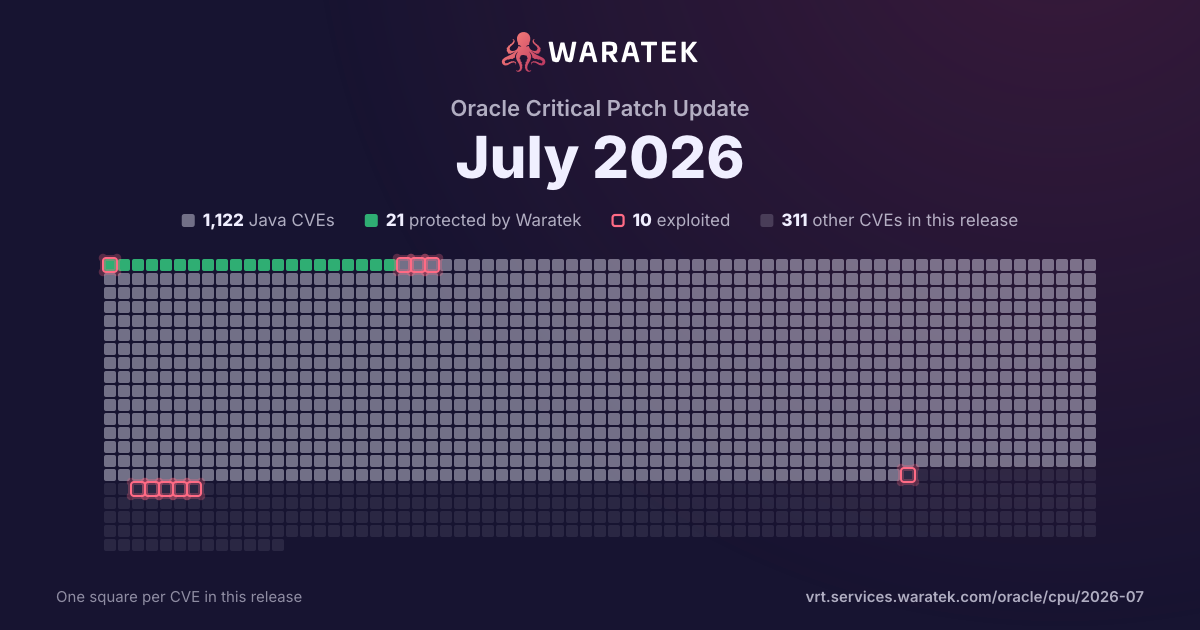
By status
21Protected by Waratek8Mitigation candidate1,095No exploit published13Outside Waratek scope296Not applicable
10Exploited, marked by the ring
No exploit published. For 971 of them, Oracle's security advisory is the source of public detail.
Protected by Waratek. Waratek RASP can block exploitation of these on systems that have not applied the patch yet.
Overview 19 matches · 0 protected · 0 exploited · 0 CISA KEV · 0 public PoC · 0 EPSS ≥ 0.5
19matches
0protected0.0%
0exploited0.0%
0CISA KEV0.0%
0public PoC0.0%
0EPSS ≥ 0.50.0%
Protected by Waratek
0
0.0%
Rule in development
0
0.0%
Mitigation candidate
2
10.5%
No exploit published
17
89.5%
blocked by ARMR today
0
0.0%
partly blocked
0
0.0%
not blocked
19
100.0%
not established
0
0.0%
unrecorded
0
0.0%
Exploited
0
0.0%
Working exploit published
0
0.0%
Proof of concept only
2
10.5%
Forecast only
0
0.0%
No public exploit
17
89.5%
split by
peak 10 / month
Jan 262
No exploit published2
Medium1
Low1
not blocked2
Proof of concept only1
No public exploit1
Feb 267
No exploit published7
Critical1
High3
Medium2
Low1
not blocked7
No public exploit7
Mar 2610
Mitigation candidate2
No exploit published8
Critical1
High6
Medium2
Low1
not blocked10
Proof of concept only1
No public exploit9
Jan 26Feb 26Mar 26
| CVE | Severity | Published▾ | Status | Exploitation | Description |
|---|---|---|---|---|---|
| CVE-2026-33871 | High | 2026-03-27 | No exploit published | No public exploit | Netty is an asynchronous, event-driven network application framework. In versions prior to 4.1.132.Final and 4.2.10.Final, a remote user can trigger a Denial of Service (DoS) against a Netty HTTP/2 server by sending a flood of `CONTINUATION` frames. The server's lack of a limit on the number of `CONTINUATION` frames, combined with a bypass of existing size-based mitigations using zero-byte frames, allows an user to cause excessive CPU consumption with minimal bandwidth, rendering the server unresponsive. Versions 4.1.132.Final and 4.2.10.Final fix the issue. |
| CVE-2026-33870 | High | 2026-03-27 | No exploit published | Proof of concept only | Netty is an asynchronous, event-driven network application framework. In versions prior to 4.1.132.Final and 4.2.10.Final, Netty incorrectly parses quoted strings in HTTP/1.1 chunked transfer encoding extension values, enabling request smuggling attacks. Versions 4.1.132.Final and 4.2.10.Final fix the issue. |
| CVE-2026-22737 | Medium | 2026-03-20 | No exploit published | No public exploit | Use of Java scripting engine enabled (e.g. JRuby, Jython) template views in Spring MVC and Spring WebFlux applications can result in disclosure of content from files outside the configured locations for script template views. This issue affects Spring Framework: from 7.0.0 through 7.0.5, from 6.2.0 through 6.2.16, from 6.1.0 through 6.1.25, from 5.3.0 through 5.3.46. |
| CVE-2026-22735 | Low | 2026-03-20 | No exploit published | No public exploit | Spring MVC and WebFlux applications are vulnerable to stream corruption when using Server-Sent Events (SSE). This issue affects Spring Foundation: from 7.0.0 through 7.0.5, from 6.2.0 through 6.2.16, from 6.1.0 through 6.1.25, from 5.3.0 through 5.3.46. |
| CVE-2026-22732 | Critical | 2026-03-19 | No exploit published | No public exploit | When applications specify HTTP response headers for servlet applications using Spring Security, there is the possibility that the HTTP Headers will not be written. This issue affects Spring Security Servlet applications using lazy (default) writing of HTTP Headers: : from 5.7.0 through 5.7.21, from 5.8.0 through 5.8.23, from 6.3.0 through 6.3.14, from 6.4.0 through 6.4.14, from 6.5.0 through 6.5.8, from 7.0.0 through 7.0.3. |
| CVE-2026-24308 | High | 2026-03-07 | Mitigation candidate | No public exploit | Improper handling of configuration values in ZKConfig in Apache ZooKeeper 3.8.5 and 3.9.4 on all platforms allows an attacker to expose sensitive information stored in client configuration in the client's logfile. Configuration values are exposed at INFO level logging rendering potential production systems affected by the issue. Users are recommended to upgrade to version 3.8.6 or 3.9.5 which fixes this issue. |
| CVE-2026-24281 | High | 2026-03-07 | Mitigation candidate | No public exploit | Hostname verification in Apache ZooKeeper ZKTrustManager falls back to reverse DNS (PTR) when IP SAN validation fails, allowing attackers who control or spoof PTR records to impersonate ZooKeeper servers or clients with a valid certificate for the PTR name. It's important to note that attacker must present a certificate which is trusted by ZKTrustManager which makes the attack vector harder to exploit. Users are recommended to upgrade to version 3.8.6 or 3.9.5, which fixes this issue by introducing a new configuration option to disable reverse DNS lookup in client and quorum protocols. |
| CVE-2026-29062 | High | 2026-03-06 | No exploit published | No public exploit | jackson-core contains core low-level incremental ("streaming") parser and generator abstractions used by Jackson Data Processor. From version 3.0.0 to before version 3.1.0, the UTF8DataInputJsonParser, which is used when parsing from a java.io.DataInput source, bypasses the maxNestingDepth constraint (default: 500) defined in StreamReadConstraints. A similar issue was found in ReaderBasedJsonParser. This allows a user to supply a JSON document with excessive nesting, which can cause a StackOverflowError when the structure is processed, leading to a Denial of Service (DoS). This issue has been patched in version 3.1.0. |
| CVE-2026-1605 | High | 2026-03-05 | No exploit published | No public exploit | In Eclipse Jetty, versions 12.0.0-12.0.31 and 12.1.0-12.0.5, class GzipHandler exposes a vulnerability when a compressed HTTP request, with Content-Encoding: gzip, is processed and the corresponding response is not compressed. This happens because the JDK Inflater is allocated for decompressing the request, but it is not released because the release mechanism is tied to the compressed response. In this case, since the response is not compressed, the release mechanism does not trigger, causing the leak. |
| CVE-2025-11143 | Medium | 2026-03-05 | No exploit published | No public exploit | The Jetty URI parser has some key differences to other common parsers when evaluating invalid or unusual URIs. Differential parsing of URIs in systems using multiple components may result in security by-pass. For example a component that enforces a black list may interpret the URIs differently from one that generates a response. At the very least, differential parsing may divulge implementation details. |
| CVE-2026-27100 | Medium | 2026-02-18 | No exploit published | No public exploit | Jenkins 2.550 and earlier, LTS 2.541.1 and earlier accepts Run Parameter values that refer to builds the user submitting the build does not have access to, allowing attackers with Item/Build and Item/Configure permission to obtain information about the existence of jobs, the existence of builds, and if a specified build exists, its display name. |
| CVE-2026-27099 | High | 2026-02-18 | No exploit published | No public exploit | Jenkins 2.483 through 2.550 (both inclusive), LTS 2.492.1 through 2.541.1 (both inclusive) does not escape the user-provided description of the "Mark temporarily offline" offline cause, resulting in a stored cross-site scripting (XSS) vulnerability exploitable by attackers with Agent/Configure or Agent/Disconnect permission. |
| CVE-2026-24734 | High | 2026-02-17 | No exploit published | No public exploit | Improper Input Validation vulnerability in Apache Tomcat Native, Apache Tomcat. When using an OCSP responder, Tomcat Native (and Tomcat's FFM port of the Tomcat Native code) did not complete verification or freshness checks on the OCSP response which could allow certificate revocation to be bypassed. This issue affects Apache Tomcat Native: from 1.3.0 through 1.3.4, from 2.0.0 through 2.0.11; Apache Tomcat: from 11.0.0-M1 through 11.0.17, from 10.1.0-M7 through 10.1.51, from 9.0.83 through 9.0.114. The following versions were EOL at the time the CVE was created but are known to be affected: from 1.1.23 through 1.1.34, from 1.2.0 through 1.2.39. Older EOL versions are not affected. Apache Tomcat Native users are recommended to upgrade to versions 1.3.5 or later or 2.0.12 or later, which fix the issue. Apache Tomcat users are recommended to upgrade to versions 11.0.18 or later, 10.1.52 or later or 9.0.115 or later which fix the issue. |
| CVE-2025-66614 | Critical | 2026-02-17 | No exploit published | No public exploit | Improper Input Validation vulnerability. This issue affects Apache Tomcat: from 11.0.0-M1 through 11.0.14, from 10.1.0-M1 through 10.1.49, from 9.0.0-M1 through 9.0.112. The following versions were EOL at the time the CVE was created but are known to be affected: 8.5.0 through 8.5.100. Older EOL versions are not affected. Tomcat did not validate that the host name provided via the SNI extension was the same as the host name provided in the HTTP host header field. If Tomcat was configured with more than one virtual host and the TLS configuration for one of those hosts did not require client certificate authentication but another one did, it was possible for a client to bypass the client certificate authentication by sending different host names in the SNI extension and the HTTP host header field. The vulnerability only applies if client certificate authentication is only enforced at the Connector. It does not apply if client certificate authentication is enforced at the web application. Users are recommended to upgrade to version 11.0.15 or later, 10.1.50 or later or 9.0.113 or later, which fix the issue. |
| CVE-2025-33042 | High | 2026-02-13 | No exploit published | No public exploit | Improper Control of Generation of Code ('Code Injection') vulnerability in Apache Avro Java SDK when generating specific records from untrusted Avro schemas. This issue affects Apache Avro Java SDK: all versions through 1.11.4 and version 1.12.0. Users are recommended to upgrade to version 1.12.1 or 1.11.5, which fix the issue. |
| CVE-2026-23901 | Low | 2026-02-10 | No exploit published | No public exploit | Observable Timing Discrepancy vulnerability in Apache Shiro. This issue affects Apache Shiro: from 1.*, 2.* before 2.0.7. Users are recommended to upgrade to version 2.0.7 or later, which fixes the issue. Prior to Shiro 2.0.7, code paths for non-existent vs. existing users are different enough, that a brute-force attack may be able to tell, by timing the requests only, determine if the request failed because of a non-existent user vs. wrong password. The most likely attack vector is a local attack only. Shiro security model https://shiro.apache.org/security-model.html#username_enumeration discusses this as well. Typically, brute force attack can be mitigated at the infrastructure level. |
| CVE-2026-23903 | Medium | 2026-02-09 | No exploit published | No public exploit | Authentication Bypass by Alternate Name vulnerability in Apache Shiro. This issue affects Apache Shiro: before 2.0.7. Users are recommended to upgrade to version 2.0.7, which fixes the issue. The issue only effects static files. If static files are served from a case-insensitive filesystem, such as default macOS setup, static files may be accessed by varying the case of the filename in the request. If only lower-case (common default) filters are present in Shiro, they may be bypassed this way. Shiro 2.1.0 and later has a new parameters to remediate this issue shiro.ini: filterChainResolver.caseInsensitive = true application.properties: shiro.caseInsensitive=true Shiro 3.0.0 and later makes this the default in shiro.ini-based configurations. Shiro 3.0.1 and later makes this the default in all configurations, including programmatic and Spring / Spring Boot. |
| CVE-2026-1225 | Low | 2026-01-22 | No exploit published | No public exploit | ACE vulnerability in configuration file processing by QOS.CH logback-core up to and including version 1.5.24 in Java applications, allows an attacker to instantiate classes already present on the class path by compromising an existing logback configuration file. The instantiation of a potentially malicious Java class requires that said class is present on the user's class-path. In addition, the attacker must have write access to a configuration file. However, after successful instantiation, the instance is very likely to be discarded with no further ado. |
| CVE-2026-1002 | Medium | 2026-01-15 | No exploit published | Proof of concept only | The Vert.x Web static handler component cache can be manipulated to deny the access to static files served by the handler using specifically crafted request URI. The issue comes from an improper implementation of the C. rule of section 5.2.4 of RFC3986 and is fixed in Vert.x Core component (used by Vert.x Web): https://github.com/eclipse-vertx/vert.x/pull/5895 Steps to reproduce Given a file served by the static handler, craft an URI that introduces a string like bar%2F..%2F after the last / char to deny the access to the URI with an HTTP 404 response. For example https://example.com/foo/index.html can be denied with https://example.com/foo/bar%2F..%2Findex.html Mitgation Disabling Static Handler cache fixes the issue. StaticHandler staticHandler = StaticHandler.create().setCachingEnabled(false); |