
Oracle Critical Patch Update July 2026
Released July 2026 · Oracle's advisory ↗ · ← Security Patch Update, June 2026 · Security Patch Update, August 2026 →
1,433 CVEs in this release, one square each
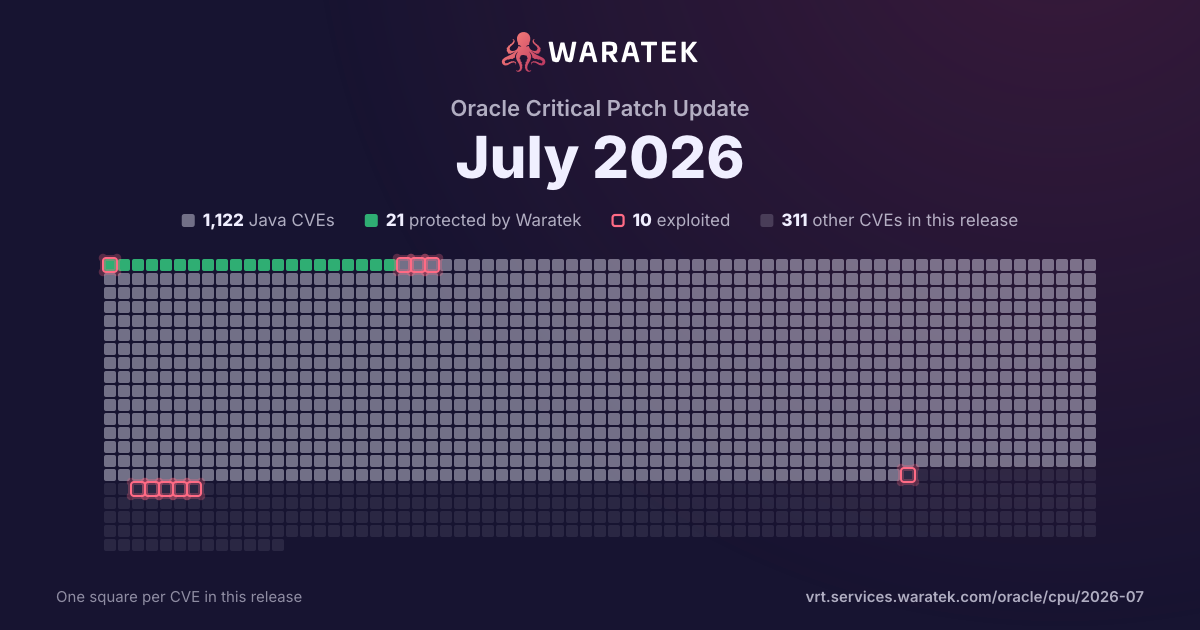
By status
21Protected by Waratek8Mitigation candidate1,093No exploit published16Outside Waratek scope295Not applicable
10Exploited, marked by the ring
No exploit published. For 971 of them, Oracle's security advisory is the source of public detail.
Protected by Waratek. Waratek RASP can block exploitation of these on systems that have not applied the patch yet.
Overview 295 matches · 0 in Waratek scope · 0 protected · 5 exploited · 2 CISA KEV · 9 public PoC · 6 EPSS ≥ 0.5
295matches
0in Waratek scope0.0%
0protected0.0%
5exploited1.7%
2CISA KEV0.7%
9public PoC3.1%
6EPSS ≥ 0.52.0%
Protected by Waratek
0
0.0%
Rule in development
0
0.0%
Mitigation candidate
0
0.0%
No exploit published
0
0.0%
Outside Waratek scope
0
0.0%
Not applicable
295
100.0%
Withdrawn CVE
0
0.0%
blocked by ARMR today
0
0.0%
partly blocked
0
0.0%
not blocked
295
100.0%
not established
0
0.0%
unrecorded
0
0.0%
split by
peak 121 / quarter
Q1 211
Not applicable1
High1
not blocked1
No public exploit1
Q2 210
Q3 210
Q4 210
Q1 221
Not applicable1
Critical1
not blocked1
Proof of concept only1
Q2 221
Not applicable1
High1
not blocked1
No public exploit1
Q3 221
Not applicable1
High1
not blocked1
No public exploit1
Q4 220
Q1 230
Q2 230
Q3 231
Not applicable1
High1
not blocked1
No public exploit1
Q4 231
Not applicable1
Medium1
not blocked1
No public exploit1
Q1 243
Not applicable3
High3
not blocked3
No public exploit3
Q2 246
Not applicable6
High2
Medium4
not blocked6
Proof of concept only2
No public exploit4
Q3 242
Not applicable2
High1
Medium1
not blocked2
No public exploit2
Q4 244
Not applicable4
Critical2
High2
not blocked4
Proof of concept only1
No public exploit3
Q1 254
Not applicable4
High3
Medium1
not blocked4
Proof of concept only2
No public exploit2
Q2 254
Not applicable4
High3
Medium1
not blocked4
No public exploit4
Q3 2521
Not applicable21
High7
Medium9
Low5
not blocked21
Working exploit published1
Proof of concept only8
No public exploit12
Q4 2512
Not applicable12
Critical2
High7
Medium2
Low1
not blocked12
Exploited1
Proof of concept only4
No public exploit7
Q1 2652
Not applicable52
Critical8
High25
Medium14
Low5
not blocked52
Proof of concept only8
No public exploit44
Q2 2660
Not applicable60
Critical9
High27
Medium16
Low8
not blocked60
Exploited4
Proof of concept only2
No public exploit54
Q3 26121
Not applicable121
Critical7
High38
Medium68
Low8
not blocked121
No public exploit121
Q1 21Q3 21Q1 22Q3 22Q1 23Q3 23Q1 24Q3 24Q1 25Q3 25Q1 26Q3 26
| CVE | Severity | Published▾ | Status | Exploitation | Description |
|---|---|---|---|---|---|
| CVE-2026-3381 | Critical | 2026-03-05 | Not applicable | No public exploit | Compress::Raw::Zlib versions through 2.219 for Perl use potentially insecure versions of zlib. Compress::Raw::Zlib includes a copy of the zlib library. Compress::Raw::Zlib version 2.220 includes zlib 1.3.2, which addresses findings fron the 7ASecurity audit of zlib. The includes fixs for CVE-2026-27171. |
| CVE-2026-27601 | High | 2026-03-03 | Not applicable | No public exploit | Underscore.js is a utility-belt library for JavaScript. Prior to 1.13.8, the _.flatten and _.isEqual functions use recursion without a depth limit. Under very specific conditions, detailed below, an attacker could exploit this in a Denial of Service (DoS) attack by triggering a stack overflow. Untrusted input must be used to create a recursive datastructure, for example using JSON.parse, with no enforced depth limit. The datastructure thus created must be passed to _.flatten or _.isEqual. In the case of _.flatten, the vulnerability can only be exploited if it is possible for a remote client to prepare a datastructure that consists of arrays at all levels AND if no finite depth limit is passed as the second argument to _.flatten. In the case of _.isEqual, the vulnerability can only be exploited if there exists a code path in which two distinct datastructures that were submitted by the same remote client are compared using _.isEqual. For example, if a client submits data that are stored in a database, and the same client can later submit another datastructure that is then compared to the data that were saved in the database previously, OR if a client submits a single request, but its data are parsed twice, creating two non-identical but equivalent datastructures that are then compared. Exceptions originating from the call to _.flatten or _.isEqual, as a result of a stack overflow, are not being caught. This vulnerability is fixed in 1.13.8. |
| CVE-2026-0540 | Medium | 2026-03-03 | Not applicable | No public exploit | DOMPurify 3.1.3 through 3.3.1 and 2.5.3 through 2.5.8, fixed in commit 2726c74, contain a cross-site scripting vulnerability that allows attackers to bypass attribute sanitization by exploiting five missing rawtext elements (noscript, xmp, noembed, noframes, iframe) in the SAFE_FOR_XML regex. Attackers can include payloads like </noscript><img src=x onerror=alert(1)> in attribute values to execute JavaScript when sanitized output is placed inside these unprotected rawtext contexts. |
| CVE-2025-15599 | Medium | 2026-03-03 | Not applicable | No public exploit | DOMPurify 3.1.3 through 3.2.6 and 2.5.3 through 2.5.8 contain a cross-site scripting vulnerability that allows attackers to bypass attribute sanitization by exploiting missing textarea rawtext element validation in the SAFE_FOR_XML regex. Attackers can include closing rawtext tags like </textarea> in attribute values to break out of rawtext contexts and execute JavaScript when sanitized output is placed inside rawtext elements. The 3.x branch was fixed in 3.2.7; the 2.x branch was never patched. |
| CVE-2026-23865 | Medium | 2026-03-02 | Not applicable | No public exploit | An integer overflow in the tt_var_load_item_variation_store function of the Freetype library in versions 2.13.2 and 2.13.3 may allow for an out of bounds read operation when parsing HVAR/VVAR/MVAR tables in OpenType variable fonts. This issue is fixed in version 2.14.2. |
| CVE-2026-27141 | High | 2026-02-26 | Not applicable | No public exploit | Due to missing nil check, sending 0x0a-0x0f HTTP/2 frames will cause a running server to panic |
| CVE-2026-1229 | Low | 2026-02-24 | Not applicable | No public exploit | The CombinedMult function in the CIRCL ecc/p384 package (secp384r1 curve) produces an incorrect value for specific inputs. The issue is fixed by using complete addition formulas. ECDH and ECDSA signing relying on this curve are not affected. The bug was fixed in v1.6.3 https://github.com/cloudflare/circl/releases/tag/v1.6.3 . |
| CVE-2026-27205 | Low | 2026-02-21 | Not applicable | No public exploit | Flask is a web server gateway interface (WSGI) web application framework. In versions 3.1.2 and below, when the session object is accessed, Flask should set the Vary: Cookie header., resulting in a Use of Cache Containing Sensitive Information vulnerability. The logic instructs caches not to cache the response, as it may contain information specific to a logged in user. This is handled in most cases, but some forms of access such as the Python in operator were overlooked. The severity and risk depend on the application being hosted behind a caching proxy that doesn't ignore responses with cookies, not setting a Cache-Control header to mark pages as private or non-cacheable, and accessing the session in a way that only touches keys without reading values or mutating the session. The issue has been fixed in version 3.1.3. |
| CVE-2026-26960 | High | 2026-02-20 | Not applicable | No public exploit | node-tar is a full-featured Tar for Node.js. When using default options in versions 7.5.7 and below, an attacker-controlled archive can create a hardlink inside the extraction directory that points to a file outside the extraction root, enabling arbitrary file read and write as the extracting user. Severity is high because the primitive bypasses path protections and turns archive extraction into a direct filesystem access primitive. This issue has been fixed in version 7.5.8. |
| CVE-2026-27171 | Medium | 2026-02-18 | Not applicable | Proof of concept only | zlib before 1.3.2 allows CPU consumption via crc32_combine64 and crc32_combine_gen64 because x2nmodp can do right shifts within a loop that has no termination condition. |
| CVE-2026-22860 | High | 2026-02-18 | Not applicable | No public exploit | Rack is a modular Ruby web server interface. Prior to versions 2.2.22, 3.1.20, and 3.2.5, `Rack::Directory`’s path check used a string prefix match on the expanded path. A request like `/../root_example/` can escape the configured root if the target path starts with the root string, allowing directory listing outside the intended root. Versions 2.2.22, 3.1.20, and 3.2.5 fix the issue. |
| CVE-2026-26007 | High | 2026-02-10 | Not applicable | No public exploit | cryptography is a package designed to expose cryptographic primitives and recipes to Python developers. Prior to 46.0.5, the public_key_from_numbers (or EllipticCurvePublicNumbers.public_key()), EllipticCurvePublicNumbers.public_key(), load_der_public_key() and load_pem_public_key() functions do not verify that the point belongs to the expected prime-order subgroup of the curve. This missing validation allows an attacker to provide a public key point P from a small-order subgroup. This can lead to security issues in various situations, such as the most commonly used signature verification (ECDSA) and shared key negotiation (ECDH). When the victim computes the shared secret as S = [victim_private_key]P via ECDH, this leaks information about victim_private_key mod (small_subgroup_order). For curves with cofactor > 1, this reveals the least significant bits of the private key. When these weak public keys are used in ECDSA , it's easy to forge signatures on the small subgroup. Only SECT curves are impacted by this. This vulnerability is fixed in 46.0.5. |
| CVE-2026-24051 | High | 2026-02-02 | Not applicable | No public exploit | OpenTelemetry-Go is the Go implementation of OpenTelemetry. The OpenTelemetry Go SDK in version v1.20.0-1.39.0 is vulnerable to Path Hijacking (Untrusted Search Paths) on macOS/Darwin systems. The resource detection code in sdk/resource/host_id.go executes the ioreg system command using a search path. An attacker with the ability to locally modify the PATH environment variable can achieve Arbitrary Code Execution (ACE) within the context of the application. A fix was released with v1.40.0. |
| CVE-2026-24842 | High | 2026-01-28 | Not applicable | Proof of concept only | node-tar,a Tar for Node.js, contains a vulnerability in versions prior to 7.5.7 where the security check for hardlink entries uses different path resolution semantics than the actual hardlink creation logic. This mismatch allows an attacker to craft a malicious TAR archive that bypasses path traversal protections and creates hardlinks to arbitrary files outside the extraction directory. Version 7.5.7 contains a fix for the issue. |
| CVE-2025-27821 | High | 2026-01-26 | Not applicable | No public exploit | Out-of-bounds Write vulnerability in Apache Hadoop HDFS native client. This issue affects Apache Hadoop: from 3.2.0 before 3.4.2. Users are recommended to upgrade to version 3.4.2, which fixes the issue. |
| CVE-2026-23954 | High | 2026-01-22 | Not applicable | Proof of concept only | Incus is a system container and virtual machine manager. Versions 6.21.0 and below allow a user with the ability to launch a container with a custom image (e.g a member of the ‘incus’ group) to use directory traversal or symbolic links in the templating functionality to achieve host arbitrary file read, and host arbitrary file write. This ultimately results in arbitrary command execution on the host. When using an image with a metadata.yaml containing templates, both the source and target paths are not checked for symbolic links or directory traversal. This can also be exploited in IncusOS. A fix is planned for versions 6.0.6 and 6.21.0, but they have not been released at the time of publication. |
| CVE-2026-23953 | High | 2026-01-22 | Not applicable | Proof of concept only | Incus is a system container and virtual machine manager. In versions 6.20.0 and below, a user with the ability to launch a container with a custom YAML configuration (e.g a member of the ‘incus’ group) can create an environment variable containing newlines, which can be used to add additional configuration items in the container’s lxc.conf due to newline injection. This can allow adding arbitrary lifecycle hooks, ultimately resulting in arbitrary command execution on the host. Exploiting this issue on IncusOS requires a slight modification of the payload to change to a different writable directory for the validation step (e.g /tmp). This can be confirmed with a second container with /tmp mounted from the host (A privileged action for validation only). A fix is planned for versions 6.0.6 and 6.21.0, but they have not been released at the time of publication. |
| CVE-2026-21637 | High | 2026-01-20 | Not applicable | No public exploit | A flaw in Node.js TLS error handling allows remote attackers to crash or exhaust resources of a TLS server when `pskCallback` or `ALPNCallback` are in use. Synchronous exceptions thrown during these callbacks bypass standard TLS error handling paths (tlsClientError and error), causing either immediate process termination or silent file descriptor leaks that eventually lead to denial of service. Because these callbacks process attacker-controlled input during the TLS handshake, a remote client can repeatedly trigger the issue. This vulnerability affects TLS servers using PSK or ALPN callbacks across Node.js versions where these callbacks throw without being safely wrapped. |
| CVE-2026-21636 | Critical | 2026-01-20 | Not applicable | No public exploit | A flaw in Node.js's permission model allows Unix Domain Socket (UDS) connections to bypass network restrictions when `--permission` is enabled. Even without `--allow-net`, attacker-controlled inputs (such as URLs or socketPath options) can connect to arbitrary local sockets via net, tls, or undici/fetch. This breaks the intended security boundary of the permission model and enables access to privileged local services, potentially leading to privilege escalation, data exposure, or local code execution. * The issue affects users of the Node.js permission model on version v25. In the moment of this vulnerability, network permissions (`--allow-net`) are still in the experimental phase. |
| CVE-2025-59466 | High | 2026-01-20 | Not applicable | No public exploit | We have identified a bug in Node.js error handling where "Maximum call stack size exceeded" errors become uncatchable when `async_hooks.createHook()` is enabled. Instead of reaching `process.on('uncaughtException')`, the process terminates, making the crash unrecoverable. Applications that rely on `AsyncLocalStorage` (v22, v20) or `async_hooks.createHook()` (v24, v22, v20) become vulnerable to denial-of-service crashes triggered by deep recursion under specific conditions. |
| CVE-2025-59465 | High | 2026-01-20 | Not applicable | No public exploit | A malformed `HTTP/2 HEADERS` frame with oversized, invalid `HPACK` data can cause Node.js to crash by triggering an unhandled `TLSSocket` error `ECONNRESET`. Instead of safely closing the connection, the process crashes, enabling a remote denial of service. This primarily affects applications that do not attach explicit error handlers to secure sockets, for example: ``` server.on('secureConnection', socket => { socket.on('error', err => { console.log(err) }) }) ``` |
| CVE-2025-55132 | Medium | 2026-01-20 | Not applicable | No public exploit | A flaw in Node.js's permission model allows a file's access and modification timestamps to be changed via `futimes()` even when the process has only read permissions. Unlike `utimes()`, `futimes()` does not apply the expected write-permission checks, which means file metadata can be modified in read-only directories. This behavior could be used to alter timestamps in ways that obscure activity, reducing the reliability of logs. This vulnerability affects users of the permission model on Node.js v20, v22, v24, and v25. |
| CVE-2025-55131 | High | 2026-01-20 | Not applicable | No public exploit | A flaw in Node.js's buffer allocation logic can expose uninitialized memory when allocations are interrupted, when using the `vm` module with the timeout option. Under specific timing conditions, buffers allocated with `Buffer.alloc` and other `TypedArray` instances like `Uint8Array` may contain leftover data from previous operations, allowing in-process secrets like tokens or passwords to leak or causing data corruption. While exploitation typically requires precise timing or in-process code execution, it can become remotely exploitable when untrusted input influences workload and timeouts, leading to potential confidentiality and integrity impact. |
| CVE-2025-55130 | Critical | 2026-01-20 | Not applicable | No public exploit | A flaw in Node.js’s Permissions model allows attackers to bypass `--allow-fs-read` and `--allow-fs-write` restrictions using crafted relative symlink paths. By chaining directories and symlinks, a script granted access only to the current directory can escape the allowed path and read sensitive files. This breaks the expected isolation guarantees and enables arbitrary file read/write, leading to potential system compromise. This vulnerability affects users of the permission model on Node.js v20, v22, v24, and v25. |
| CVE-2026-0861 | High | 2026-01-14 | Not applicable | No public exploit | Passing too large an alignment to the memalign suite of functions (memalign, posix_memalign, aligned_alloc) in the GNU C Library version 2.30 to 2.42 may result in an integer overflow, which could consequently result in a heap corruption. Note that the attacker must have control over both, the size as well as the alignment arguments of the memalign function to be able to exploit this. The size parameter must be close enough to PTRDIFF_MAX so as to overflow size_t along with the large alignment argument. This limits the malicious inputs for the alignment for memalign to the range [1<<62+ 1, 1<<63] and exactly 1<<63 for posix_memalign and aligned_alloc. Typically the alignment argument passed to such functions is a known constrained quantity (e.g. page size, block size, struct sizes) and is not attacker controlled, because of which this may not be easily exploitable in practice. An application bug could potentially result in the input alignment being too large, e.g. due to a different buffer overflow or integer overflow in the application or its dependent libraries, but that is again an uncommon usage pattern given typical sources of alignments. |
| CVE-2025-15224 | Low | 2026-01-08 | Not applicable | Proof of concept only | When doing SSH-based transfers using either SCP or SFTP, and asked to do public key authentication, curl would wrongly still ask and authenticate using a locally running SSH agent. |
| CVE-2025-15079 | Medium | 2026-01-08 | Not applicable | Proof of concept only | When doing SSH-based transfers using either SCP or SFTP, and setting the known_hosts file, libcurl could still mistakenly accept connecting to hosts *not present* in the specified file if they were added as recognized in the libssh *global* known_hosts file. |
| CVE-2025-14819 | Medium | 2026-01-08 | Not applicable | No public exploit | When doing TLS related transfers with reused easy or multi handles and altering the `CURLSSLOPT_NO_PARTIALCHAIN` option, libcurl could accidentally reuse a CA store cached in memory for which the partial chain option was reversed. Contrary to the user's wishes and expectations. This could make libcurl find and accept a trust chain that it otherwise would not. |
| CVE-2025-14524 | Medium | 2026-01-08 | Not applicable | No public exploit | When an OAuth2 bearer token is used for an HTTP(S) transfer, and that transfer performs a cross-protocol redirect to a second URL that uses an IMAP, LDAP, POP3 or SMTP scheme, curl might wrongly pass on the bearer token to the new target host. |
| CVE-2025-14017 | Medium | 2026-01-08 | Not applicable | No public exploit | When doing multi-threaded LDAPS transfers (LDAP over TLS) with libcurl, changing TLS options in one thread would inadvertently change them globally and therefore possibly also affect other concurrently setup transfers. Disabling certificate verification for a specific transfer could unintentionally disable the feature for other threads as well. |
| CVE-2025-13034 | Medium | 2026-01-08 | Not applicable | No public exploit | When using `CURLOPT_PINNEDPUBLICKEY` option with libcurl or `--pinnedpubkey` with the curl tool, curl should check the public key of the server certificate to verify the peer. This check was skipped in a certain condition that would then make curl allow the connection without performing the proper check, thus not noticing a possible impostor. To skip this check, the connection had to be done with QUIC with ngtcp2 built to use GnuTLS and the user had to explicitly disable the standard certificate verification. |
| CVE-2026-21441 | High | 2026-01-07 | Not applicable | No public exploit | urllib3 is an HTTP client library for Python. urllib3's streaming API is designed for the efficient handling of large HTTP responses by reading the content in chunks, rather than loading the entire response body into memory at once. urllib3 can perform decoding or decompression based on the HTTP `Content-Encoding` header (e.g., `gzip`, `deflate`, `br`, or `zstd`). When using the streaming API, the library decompresses only the necessary bytes, enabling partial content consumption. Starting in version 1.22 and prior to version 2.6.3, for HTTP redirect responses, the library would read the entire response body to drain the connection and decompress the content unnecessarily. This decompression occurred even before any read methods were called, and configured read limits did not restrict the amount of decompressed data. As a result, there was no safeguard against decompression bombs. A malicious server could exploit this to trigger excessive resource consumption on the client. Applications and libraries are affected when they stream content from untrusted sources by setting `preload_content=False` when they do not disable redirects. Users should upgrade to at least urllib3 v2.6.3, in which the library does not decode content of redirect responses when `preload_content=False`. If upgrading is not immediately possible, disable redirects by setting `redirect=False` for requests to untrusted source. |
| CVE-2025-13151 | High | 2026-01-07 | Not applicable | No public exploit | Stack-based buffer overflow in libtasn1 version: v4.20.0. The function fails to validate the size of input data resulting in a buffer overflow in asn1_expend_octet_string. |
| CVE-2025-68431 | High | 2025-12-29 | Not applicable | No public exploit | libheif is an HEIF and AVIF file format decoder and encoder. Prior to version 1.21.0, a crafted HEIF that exercises the overlay image item path triggers a heap buffer over-read in `HeifPixelImage::overlay()`. The function computes a negative row length (likely from an unclipped overlay rectangle or invalid offsets), which then underflows when converted to `size_t` and is passed to `memcpy`, causing a very large read past the end of the source plane and a crash. Version 1.21.0 contains a patch. As a workaround, avoid decoding images using `iovl` overlay boxes. |
| CVE-2025-14180 | High | 2025-12-27 | Not applicable | Proof of concept only | In PHP versions 8.1.* before 8.1.34, 8.2.* before 8.2.30, 8.3.* before 8.3.29, 8.4.* before 8.4.16, 8.5.* before 8.5.1 when using the PDO PostgreSQL driver with PDO::ATTR_EMULATE_PREPARES enabled, an invalid character sequence (such as \x99) in a prepared statement parameter may cause the quoting function PQescapeStringConn to return NULL, leading to a null pointer dereference in pdo_parse_params() function. This may lead to crashes (segmentation fault) and affect the availability of the target server. |
| CVE-2025-14178 | High | 2025-12-27 | Not applicable | Proof of concept only | In PHP versions:8.1.* before 8.1.34, 8.2.* before 8.2.30, 8.3.* before 8.3.29, 8.4.* before 8.4.16, 8.5.* before 8.5.1, a heap buffer overflow occurs in array_merge() when the total element count of packed arrays exceeds 32-bit limits or HT_MAX_SIZE, due to an integer overflow in the precomputation of element counts using zend_hash_num_elements(). This may lead to memory corruption or crashes and affect the integrity and availability of the target server. |
| CVE-2025-14177 | Medium | 2025-12-27 | Not applicable | Proof of concept only | In PHP versions:8.1.* before 8.1.34, 8.2.* before 8.2.30, 8.3.* before 8.3.29, 8.4.* before 8.4.16, 8.5.* before 8.5.1, the getimagesize() function may leak uninitialized heap memory into the APPn segments (e.g., APP1) when reading images in multi-chunk mode (such as via php://filter). This occurs due to a bug in php_read_stream_all_chunks() that overwrites the buffer without advancing the pointer, leaving tail bytes uninitialized. This may lead to information disclosure of sensitive heap data and affect the confidentiality of the target server. |
| CVE-2025-68480 | Medium | 2025-12-22 | Not applicable | No public exploit | Marshmallow is a lightweight library for converting complex objects to and from simple Python datatypes. In versions from 3.0.0rc1 to before 3.26.2 and from 4.0.0 to before 4.1.2, Schema.load(data, many=True) is vulnerable to denial of service attacks. A moderately sized request can consume a disproportionate amount of CPU time. This issue has been patched in version 3.26.2 and 4.1.2. |
| CVE-2025-14087 | Critical | 2025-12-10 | Not applicable | No public exploit | A flaw was found in GLib (Gnome Lib). This vulnerability allows a remote attacker to cause heap corruption, leading to a denial of service or potential code execution via a buffer-underflow in the GVariant parser when processing maliciously crafted input strings. |
| CVE-2025-66471 | High | 2025-12-05 | Not applicable | No public exploit | urllib3 is a user-friendly HTTP client library for Python. Starting in version 1.0 and prior to 2.6.0, the Streaming API improperly handles highly compressed data. urllib3's streaming API is designed for the efficient handling of large HTTP responses by reading the content in chunks, rather than loading the entire response body into memory at once. When streaming a compressed response, urllib3 can perform decoding or decompression based on the HTTP Content-Encoding header (e.g., gzip, deflate, br, or zstd). The library must read compressed data from the network and decompress it until the requested chunk size is met. Any resulting decompressed data that exceeds the requested amount is held in an internal buffer for the next read operation. The decompression logic could cause urllib3 to fully decode a small amount of highly compressed data in a single operation. This can result in excessive resource consumption (high CPU usage and massive memory allocation for the decompressed data. |
| CVE-2025-66418 | High | 2025-12-05 | Not applicable | No public exploit | urllib3 is a user-friendly HTTP client library for Python. Starting in version 1.24 and prior to 2.6.0, the number of links in the decompression chain was unbounded allowing a malicious server to insert a virtually unlimited number of compression steps leading to high CPU usage and massive memory allocation for the decompressed data. This vulnerability is fixed in 2.6.0. |
| CVE-2025-13837 | Low | 2025-12-01 | Not applicable | No public exploit | When loading a plist file, the plistlib module reads data in size specified by the file itself, meaning a malicious file can cause OOM and DoS issues |
| CVE-2025-64713 | High | 2025-11-25 | Not applicable | Proof of concept only | WebAssembly Micro Runtime (WAMR) is a lightweight standalone WebAssembly (Wasm) runtime. Prior to version 2.4.4, an out-of-bounds array access issue exists in WAMR's fast interpreter mode during WASM bytecode loading. When frame_ref_bottom and frame_offset_bottom arrays are at capacity and a GET_GLOBAL(I32) opcode is encountered, frame_ref_bottom is expanded but frame_offset_bottom may not be. If this is immediately followed by an if opcode that triggers preserve_local_for_block, the function traverses arrays using stack_cell_num as the upper bound, causing out-of-bounds access to frame_offset_bottom since it wasn't expanded to match the increased stack_cell_num. This issue has been patched in version 2.4.4. |
| CVE-2025-11953 | Critical | 2025-11-03 | Not applicable | Exploited | The Metro Development Server, which is opened by the React Native Community CLI, binds to external interfaces by default. The server exposes an endpoint that is vulnerable to OS command injection. This allows unauthenticated network attackers to send a POST request to the server and run arbitrary executables. On Windows, the attackers can also execute arbitrary shell commands with fully controlled arguments. |
| CVE-2025-62725 | High | 2025-10-27 | Not applicable | No public exploit | Docker Compose trusts the path information embedded in remote OCI compose artifacts. When a layer includes the annotations com.docker.compose.extends or com.docker.compose.envfile, Compose joins the attacker‑supplied value from com.docker.compose.file/com.docker.compose.envfile with its local cache directory and writes the file there. This affects any platform or workflow that resolves remote OCI compose artifacts, Docker Desktop, standalone Compose binaries on Linux, CI/CD runners, cloud dev environments is affected. An attacker can escape the cache directory and overwrite arbitrary files on the machine running docker compose, even if the user only runs read‑only commands such as docker compose config or docker compose ps. This issue is fixed in v2.40.2. |
| CVE-2025-9900 | High | 2025-09-23 | Not applicable | Proof of concept only | A flaw was found in Libtiff. This vulnerability is a "write-what-where" condition, triggered when the library processes a specially crafted TIFF image file. By providing an abnormally large image height value in the file's metadata, an attacker can trick the library into writing attacker-controlled color data to an arbitrary memory location. This memory corruption can be exploited to cause a denial of service (application crash) or to achieve arbitrary code execution with the permissions of the user. |
| CVE-2025-58767 | Low | 2025-09-17 | Not applicable | No public exploit | REXML is an XML toolkit for Ruby. The REXML gems from 3.3.3 to 3.4.1 has a DoS vulnerability when parsing XML containing multiple XML declarations. If you need to parse untrusted XMLs, you may be impacted to these vulnerabilities. The REXML gem 3.4.2 or later include the patches to fix these vulnerabilities. |
| CVE-2025-58050 | Medium | 2025-08-27 | Not applicable | Proof of concept only | The PCRE2 library is a set of C functions that implement regular expression pattern matching. In version 10.45, a heap-buffer-overflow read vulnerability exists in the PCRE2 regular expression matching engine, specifically within the handling of the (*scs:...) (Scan SubString) verb when combined with (*ACCEPT) in src/pcre2_match.c. This vulnerability may potentially lead to information disclosure if the out-of-bounds data read during the memcmp affects the final match result in a way observable by the attacker. This issue has been resolved in version 10.46. |
| CVE-2025-4877 | Medium | 2025-08-20 | Not applicable | No public exploit | There's a vulnerability in the libssh package where when a libssh consumer passes in an unexpectedly large input buffer to ssh_get_fingerprint_hash() function. In such cases the bin_to_base64() function can experience an integer overflow leading to a memory under allocation, when that happens it's possible that the program perform out of bounds write leading to a heap corruption. This issue affects only 32-bits builds of libssh. |
| CVE-2025-8961 | Low | 2025-08-14 | Not applicable | Proof of concept only | A weakness has been identified in LibTIFF 4.7.0. This affects the function main of the file tiffcrop.c of the component tiffcrop. Executing manipulation can lead to memory corruption. The attack can only be executed locally. The exploit has been made available to the public and could be exploited. |
| CVE-2025-8837 | Low | 2025-08-11 | Not applicable | Proof of concept only | A vulnerability was identified in JasPer up to 4.2.5. This affects the function jpc_dec_dump of the file src/libjasper/jpc/jpc_dec.c of the component JPEG2000 File Handler. The manipulation leads to use after free. An attack has to be approached locally. The exploit has been disclosed to the public and may be used. The patch is named 8308060d3fbc1da10353ac8a95c8ea60eba9c25a. It is recommended to apply a patch to fix this issue. |
| CVE-2025-8177 | Medium | 2025-07-26 | Not applicable | Proof of concept only | A vulnerability was found in LibTIFF up to 4.7.0. It has been rated as critical. This issue affects the function setrow of the file tools/thumbnail.c. The manipulation leads to buffer overflow. An attack has to be approached locally. The patch is named e8c9d6c616b19438695fd829e58ae4fde5bfbc22. It is recommended to apply a patch to fix this issue. This vulnerability only affects products that are no longer supported by the maintainer. |
| CVE-2025-8176 | Low | 2025-07-26 | Not applicable | Proof of concept only | A vulnerability was found in LibTIFF up to 4.7.0. It has been declared as critical. This vulnerability affects the function get_histogram of the file tools/tiffmedian.c. The manipulation leads to use after free. The attack needs to be approached locally. The exploit has been disclosed to the public and may be used. The patch is identified as fe10872e53efba9cc36c66ac4ab3b41a839d5172. It is recommended to apply a patch to fix this issue. |
| CVE-2025-5449 | Medium | 2025-07-25 | Not applicable | No public exploit | A flaw was found in the SFTP server message decoding logic of libssh. The issue occurs due to an incorrect packet length check that allows an integer overflow when handling large payload sizes on 32-bit systems. This issue leads to failed memory allocation and causes the server process to crash, resulting in a denial of service. |
| CVE-2025-4878 | Low | 2025-07-22 | Not applicable | No public exploit | A vulnerability was found in libssh, where an uninitialized variable exists under certain conditions in the privatekey_from_file() function. This flaw can be triggered if the file specified by the filename doesn't exist and may lead to possible signing failures or heap corruption. |
| CVE-2025-6965 | High | 2025-07-15 | Not applicable | Working exploit published | There exists a vulnerability in SQLite versions before 3.50.2 where the number of aggregate terms could exceed the number of columns available. This could lead to a memory corruption issue. We recommend upgrading to version 3.50.2 or above. |
| CVE-2025-6491 | Medium | 2025-07-13 | Not applicable | Proof of concept only | In PHP versions:8.1.* before 8.1.33, 8.2.* before 8.2.29, 8.3.* before 8.3.23, 8.4.* before 8.4.10 when parsing XML data in SOAP extensions, overly large (>2Gb) XML namespace prefix may lead to null pointer dereference. This may lead to crashes and affect the availability of the target server. |
| CVE-2025-1735 | High | 2025-07-13 | Not applicable | No public exploit | In PHP versions:8.1.* before 8.1.33, 8.2.* before 8.2.29, 8.3.* before 8.3.23, 8.4.* pgsql and pdo_pgsql escaping functions do not check if the underlying quoting functions returned errors. This could cause crashes if Postgres server rejects the string as invalid. |
| CVE-2025-1220 | Medium | 2025-07-13 | Not applicable | Proof of concept only | In PHP versions:8.1.* before 8.1.33, 8.2.* before 8.2.29, 8.3.* before 8.3.23, 8.4.* before 8.4.10 some functions like fsockopen() lack validation that the hostname supplied does not contain null characters. This may lead to other functions like parse_url() treat the hostname in different way, thus opening way to security problems if the user code implements access checks before access using such functions. |
| CVE-2025-6395 | Medium | 2025-07-10 | Not applicable | No public exploit | A NULL pointer dereference flaw was found in the GnuTLS software in _gnutls_figure_common_ciphersuite(). |
| CVE-2025-32990 | High | 2025-07-10 | Not applicable | No public exploit | A heap-buffer-overflow (off-by-one) flaw was found in the GnuTLS software in the template parsing logic within the certtool utility. When it reads certain settings from a template file, it allows an attacker to cause an out-of-bounds (OOB) NULL pointer write, resulting in memory corruption and a denial-of-service (DoS) that could potentially crash the system. |
| CVE-2025-32989 | Medium | 2025-07-10 | Not applicable | No public exploit | A heap-buffer-overread vulnerability was found in GnuTLS in how it handles the Certificate Transparency (CT) Signed Certificate Timestamp (SCT) extension during X.509 certificate parsing. This flaw allows a malicious user to create a certificate containing a malformed SCT extension (OID 1.3.6.1.4.1.11129.2.4.2) that contains sensitive data. This issue leads to the exposure of confidential information when GnuTLS verifies certificates from certain websites when the certificate (SCT) is not checked correctly. |
| CVE-2025-32988 | High | 2025-07-10 | Not applicable | No public exploit | A flaw was found in GnuTLS. A double-free vulnerability exists in GnuTLS due to incorrect ownership handling in the export logic of Subject Alternative Name (SAN) entries containing an otherName. If the type-id OID is invalid or malformed, GnuTLS will call asn1_delete_structure() on an ASN.1 node it does not own, leading to a double-free condition when the parent function or caller later attempts to free the same structure. This vulnerability can be triggered using only public GnuTLS APIs and may result in denial of service or memory corruption, depending on allocator behavior. |
| CVE-2025-5987 | High | 2025-07-07 | Not applicable | No public exploit | A flaw was found in libssh when using the ChaCha20 cipher with the OpenSSL library. If an attacker manages to exhaust the heap space, this error is not detected and may lead to libssh using a partially initialized cipher context. This occurs because the OpenSSL error code returned aliases with the SSH_OK code, resulting in libssh not properly detecting the error returned by the OpenSSL library. This issue can lead to undefined behavior, including compromised data confidentiality and integrity or crashes. |
| CVE-2025-5372 | High | 2025-07-04 | Not applicable | No public exploit | A flaw was found in libssh versions built with OpenSSL versions older than 3.0, specifically in the ssh_kdf() function responsible for key derivation. Due to inconsistent interpretation of return values where OpenSSL uses 0 to indicate failure and libssh uses 0 for success—the function may mistakenly return a success status even when key derivation fails. This results in uninitialized cryptographic key buffers being used in subsequent communication, potentially compromising SSH sessions' confidentiality, integrity, and availability. |
| CVE-2025-5351 | Medium | 2025-07-04 | Not applicable | No public exploit | A flaw was found in the key export functionality of libssh. The issue occurs in the internal function responsible for converting cryptographic keys into serialized formats. During error handling, a memory structure is freed but not cleared, leading to a potential double free issue if an additional failure occurs later in the function. This condition may result in heap corruption or application instability in low-memory scenarios, posing a risk to system reliability where key export operations are performed. |
| CVE-2025-5318 | High | 2025-06-24 | Not applicable | No public exploit | A flaw was found in the libssh library in versions less than 0.11.2. An out-of-bounds read can be triggered in the sftp_handle function due to an incorrect comparison check that permits the function to access memory beyond the valid handle list and to return an invalid pointer, which is used in further processing. This vulnerability allows an authenticated remote attacker to potentially read unintended memory regions, exposing sensitive information or affect service behavior. |
| CVE-2025-5222 | High | 2025-05-27 | Not applicable | No public exploit | A stack buffer overflow was found in Internationl components for unicode (ICU ). While running the genrb binary, the 'subtag' struct overflowed at the SRBRoot::addTag function. This issue may lead to memory corruption and local arbitrary code execution. |
| CVE-2025-3445 | High | 2025-04-13 | Not applicable | No public exploit | A Path Traversal "Zip Slip" vulnerability has been identified in mholt/archiver in Go. This vulnerability allows using a crafted ZIP file containing path traversal symlinks to create or overwrite files with the user's privileges or application utilizing the library. When using the archiver.Unarchive functionality with ZIP files, like this: archiver.Unarchive(zipFile, outputDir), A crafted ZIP file can be extracted in such a way that it writes files to the affected system with the same privileges as the application executing this vulnerable functionality. Consequently, sensitive files may be overwritten, potentially leading to privilege escalation, code execution, and other severe outcomes in some cases. It's worth noting that a similar vulnerability was found in TAR files (CVE-2024-0406). Although a fix was implemented, it hasn't been officially released, and the affected project has since been deprecated. The successor to mholt/archiver is a new project called mholt/archives, and its initial release (v0.1.0) removes the Unarchive() functionality. |
| CVE-2025-29088 | Medium | 2025-04-10 | Not applicable | No public exploit | In SQLite 3.49.0 before 3.49.1, certain argument values to sqlite3_db_config (in the C-language API) can cause a denial of service (application crash). An sz*nBig multiplication is not cast to a 64-bit integer, and consequently some memory allocations may be incorrect. |
| CVE-2025-30204 | High | 2025-03-21 | Not applicable | No public exploit | golang-jwt is a Go implementation of JSON Web Tokens. Starting in version 3.2.0 and prior to versions 5.2.2 and 4.5.2, the function parse.ParseUnverified splits (via a call to strings.Split) its argument (which is untrusted data) on periods. As a result, in the face of a malicious request whose Authorization header consists of Bearer followed by many period characters, a call to that function incurs allocations to the tune of O(n) bytes (where n stands for the length of the function's argument), with a constant factor of about 16. This issue is fixed in 5.2.2 and 4.5.2. |
| CVE-2025-30153 | High | 2025-03-19 | Not applicable | Proof of concept only | kin-openapi is a Go project for handling OpenAPI files. Prior to 0.131.0, when validating a request with a multipart/form-data schema, if the OpenAPI schema allows it, an attacker can upload a crafted ZIP file (e.g., a ZIP bomb), causing the server to consume all available system memory. The root cause comes from the ZipFileBodyDecoder, which is registered automatically by the module (contrary to what the documentation says). This vulnerability is fixed in 0.131.0. |
| CVE-2024-40635 | High | 2025-03-17 | Not applicable | No public exploit | containerd is an open-source container runtime. A bug was found in containerd prior to versions 1.6.38, 1.7.27, and 2.0.4 where containers launched with a User set as a `UID:GID` larger than the maximum 32-bit signed integer can cause an overflow condition where the container ultimately runs as root (UID 0). This could cause unexpected behavior for environments that require containers to run as a non-root user. This bug has been fixed in containerd 1.6.38, 1.7.27, and 2.04. As a workaround, ensure that only trusted images are used and that only trusted users have permissions to import images. |
| CVE-2025-26791 | Medium | 2025-02-14 | Not applicable | Proof of concept only | DOMPurify before 3.2.4 has an incorrect template literal regular expression, sometimes leading to mutation cross-site scripting (mXSS). |
| CVE-2024-36623 | High | 2024-11-29 | Not applicable | No public exploit | moby through v25.0.3 has a Race Condition vulnerability in the streamformatter package which can be used to trigger multiple concurrent write operations resulting in data corruption or application crashes. |
| CVE-2024-27532 | High | 2024-11-08 | Not applicable | Proof of concept only | wasm-micro-runtime (aka WebAssembly Micro Runtime or WAMR) 06df58f is vulnerable to NULL Pointer Dereference in function `block_type_get_result_types. |
| CVE-2024-48910 | Critical | 2024-10-31 | Not applicable | No public exploit | DOMPurify is a DOM-only, super-fast, uber-tolerant XSS sanitizer for HTML, MathML and SVG. DOMPurify was vulnerable to prototype pollution. This vulnerability is fixed in 2.4.2. |
| CVE-2024-47875 | Critical | 2024-10-11 | Not applicable | No public exploit | DOMPurify is a DOM-only, super-fast, uber-tolerant XSS sanitizer for HTML, MathML and SVG. DOMpurify was vulnerable to nesting-based mXSS. This vulnerability is fixed in 2.5.0 and 3.1.3. |
| CVE-2024-45801 | High | 2024-09-16 | Not applicable | No public exploit | DOMPurify is a DOM-only, super-fast, uber-tolerant XSS sanitizer for HTML, MathML and SVG. It has been discovered that malicious HTML using special nesting techniques can bypass the depth checking added to DOMPurify in recent releases. It was also possible to use Prototype Pollution to weaken the depth check. This renders dompurify unable to avoid cross site scripting (XSS) attacks. This issue has been addressed in versions 2.5.4 and 3.1.3 of DOMPurify. All users are advised to upgrade. There are no known workarounds for this vulnerability. |
| CVE-2024-39908 | Medium | 2024-07-16 | Not applicable | No public exploit | REXML is an XML toolkit for Ruby. The REXML gem before 3.3.1 has some DoS vulnerabilities when it parses an XML that has many specific characters such as `<`, `0` and `%>`. If you need to parse untrusted XMLs, you many be impacted to these vulnerabilities. The REXML gem 3.3.2 or later include the patches to fix these vulnerabilities. Users are advised to upgrade. Users unable to upgrade should avoid parsing untrusted XML strings. |
| CVE-2024-36129 | High | 2024-06-05 | Not applicable | Proof of concept only | The OpenTelemetry Collector offers a vendor-agnostic implementation on how to receive, process and export telemetry data. An unsafe decompression vulnerability allows unauthenticated attackers to crash the collector via excessive memory consumption. OTel Collector version 0.102.1 fixes this issue. It is also fixed in the confighttp module version 0.102.0 and configgrpc module version 0.102.1. |
| CVE-2024-21120 | Medium | 2024-04-16 | Not applicable | No public exploit | Vulnerability in the Oracle Outside In Technology product of Oracle Fusion Middleware (component: Outside In Core). Supported versions that are affected are 8.5.6 and 8.5.7. Easily exploitable vulnerability allows low privileged attacker with logon to the infrastructure where Oracle Outside In Technology executes to compromise Oracle Outside In Technology. Successful attacks of this vulnerability can result in unauthorized update, insert or delete access to some of Oracle Outside In Technology accessible data as well as unauthorized read access to a subset of Oracle Outside In Technology accessible data and unauthorized ability to cause a partial denial of service (partial DOS) of Oracle Outside In Technology. CVSS 3.1 Base Score 5.3 (Confidentiality, Integrity and Availability impacts). CVSS Vector: (CVSS:3.1/AV:L/AC:L/PR:L/UI:N/S:U/C:L/I:L/A:L). |
| CVE-2024-21119 | Medium | 2024-04-16 | Not applicable | No public exploit | Vulnerability in the Oracle Outside In Technology product of Oracle Fusion Middleware (component: Outside In Core). Supported versions that are affected are 8.5.6 and 8.5.7. Easily exploitable vulnerability allows low privileged attacker with logon to the infrastructure where Oracle Outside In Technology executes to compromise Oracle Outside In Technology. Successful attacks of this vulnerability can result in unauthorized update, insert or delete access to some of Oracle Outside In Technology accessible data as well as unauthorized read access to a subset of Oracle Outside In Technology accessible data and unauthorized ability to cause a partial denial of service (partial DOS) of Oracle Outside In Technology. CVSS 3.1 Base Score 5.3 (Confidentiality, Integrity and Availability impacts). CVSS Vector: (CVSS:3.1/AV:L/AC:L/PR:L/UI:N/S:U/C:L/I:L/A:L). |
| CVE-2024-21118 | Medium | 2024-04-16 | Not applicable | No public exploit | Vulnerability in the Oracle Outside In Technology product of Oracle Fusion Middleware (component: Outside In Core). Supported versions that are affected are 8.5.6 and 8.5.7. Easily exploitable vulnerability allows low privileged attacker with logon to the infrastructure where Oracle Outside In Technology executes to compromise Oracle Outside In Technology. Successful attacks of this vulnerability can result in unauthorized update, insert or delete access to some of Oracle Outside In Technology accessible data as well as unauthorized read access to a subset of Oracle Outside In Technology accessible data and unauthorized ability to cause a partial denial of service (partial DOS) of Oracle Outside In Technology. CVSS 3.1 Base Score 5.3 (Confidentiality, Integrity and Availability impacts). CVSS Vector: (CVSS:3.1/AV:L/AC:L/PR:L/UI:N/S:U/C:L/I:L/A:L). |
| CVE-2024-21117 | Medium | 2024-04-16 | Not applicable | No public exploit | Vulnerability in the Oracle Outside In Technology product of Oracle Fusion Middleware (component: Outside In Core). Supported versions that are affected are 8.5.6 and 8.5.7. Easily exploitable vulnerability allows low privileged attacker with logon to the infrastructure where Oracle Outside In Technology executes to compromise Oracle Outside In Technology. Successful attacks of this vulnerability can result in unauthorized update, insert or delete access to some of Oracle Outside In Technology accessible data as well as unauthorized read access to a subset of Oracle Outside In Technology accessible data and unauthorized ability to cause a partial denial of service (partial DOS) of Oracle Outside In Technology. CVSS 3.1 Base Score 5.3 (Confidentiality, Integrity and Availability impacts). CVSS Vector: (CVSS:3.1/AV:L/AC:L/PR:L/UI:N/S:U/C:L/I:L/A:L). |
| CVE-2024-0406 | High | 2024-04-06 | Not applicable | Proof of concept only | A flaw was discovered in the mholt/archiver package. This flaw allows an attacker to create a specially crafted tar file, which, when unpacked, may allow access to restricted files or directories. This issue can allow the creation or overwriting of files with the user's or application's privileges using the library. |
| CVE-2024-29018 | High | 2024-03-20 | Not applicable | No public exploit | Moby is an open source container framework that is a key component of Docker Engine, Docker Desktop, and other distributions of container tooling or runtimes. Moby's networking implementation allows for many networks, each with their own IP address range and gateway, to be defined. This feature is frequently referred to as custom networks, as each network can have a different driver, set of parameters and thus behaviors. When creating a network, the `--internal` flag is used to designate a network as _internal_. The `internal` attribute in a docker-compose.yml file may also be used to mark a network _internal_, and other API clients may specify the `internal` parameter as well. When containers with networking are created, they are assigned unique network interfaces and IP addresses. The host serves as a router for non-internal networks, with a gateway IP that provides SNAT/DNAT to/from container IPs. Containers on an internal network may communicate between each other, but are precluded from communicating with any networks the host has access to (LAN or WAN) as no default route is configured, and firewall rules are set up to drop all outgoing traffic. Communication with the gateway IP address (and thus appropriately configured host services) is possible, and the host may communicate with any container IP directly. In addition to configuring the Linux kernel's various networking features to enable container networking, `dockerd` directly provides some services to container networks. Principal among these is serving as a resolver, enabling service discovery, and resolution of names from an upstream resolver. When a DNS request for a name that does not correspond to a container is received, the request is forwarded to the configured upstream resolver. This request is made from the container's network namespace: the level of access and routing of traffic is the same as if the request was made by the container itself. As a consequence of this design, containers solely attached to an internal network will be unable to resolve names using the upstream resolver, as the container itself is unable to communicate with that nameserver. Only the names of containers also attached to the internal network are able to be resolved. Many systems run a local forwarding DNS resolver. As the host and any containers have separate loopback devices, a consequence of the design described above is that containers are unable to resolve names from the host's configured resolver, as they cannot reach these addresses on the host loopback device. To bridge this gap, and to allow containers to properly resolve names even when a local forwarding resolver is used on a loopback address, `dockerd` detects this scenario and instead forward DNS requests from the host namework namespace. The loopback resolver then forwards the requests to its configured upstream resolvers, as expected. Because `dockerd` forwards DNS requests to the host loopback device, bypassing the container network namespace's normal routing semantics entirely, internal networks can unexpectedly forward DNS requests to an external nameserver. By registering a domain for which they control the authoritative nameservers, an attacker could arrange for a compromised container to exfiltrate data by encoding it in DNS queries that will eventually be answered by their nameservers. Docker Desktop is not affected, as Docker Desktop always runs an internal resolver on a RFC 1918 address. Moby releases 26.0.0, 25.0.4, and 23.0.11 are patched to prevent forwarding any DNS requests from internal networks. As a workaround, run containers intended to be solely attached to internal networks with a custom upstream address, which will force all upstream DNS queries to be resolved from the container's network namespace. |
| CVE-2024-24557 | High | 2024-02-01 | Not applicable | No public exploit | Moby is an open-source project created by Docker to enable software containerization. The classic builder cache system is prone to cache poisoning if the image is built FROM scratch. Also, changes to some instructions (most important being HEALTHCHECK and ONBUILD) would not cause a cache miss. An attacker with the knowledge of the Dockerfile someone is using could poison their cache by making them pull a specially crafted image that would be considered as a valid cache candidate for some build steps. 23.0+ users are only affected if they explicitly opted out of Buildkit (DOCKER_BUILDKIT=0 environment variable) or are using the /build API endpoint. All users on versions older than 23.0 could be impacted. Image build API endpoint (/build) and ImageBuild function from github.com/docker/docker/client is also affected as it the uses classic builder by default. Patches are included in 24.0.9 and 25.0.2 releases. |
| CVE-2024-0553 | High | 2024-01-16 | Not applicable | No public exploit | A vulnerability was found in GnuTLS. The response times to malformed ciphertexts in RSA-PSK ClientKeyExchange differ from the response times of ciphertexts with correct PKCS#1 v1.5 padding. This issue may allow a remote attacker to perform a timing side-channel attack in the RSA-PSK key exchange, potentially leading to the leakage of sensitive data. CVE-2024-0553 is designated as an incomplete resolution for CVE-2023-5981. |
| CVE-2023-5981 | Medium | 2023-11-28 | Not applicable | No public exploit | A vulnerability was found that the response times to malformed ciphertexts in RSA-PSK ClientKeyExchange differ from response times of ciphertexts with correct PKCS#1 v1.5 padding. |
| CVE-2023-40577 | High | 2023-08-25 | Not applicable | No public exploit | Alertmanager handles alerts sent by client applications such as the Prometheus server. An attacker with the permission to perform POST requests on the /api/v1/alerts endpoint could be able to execute arbitrary JavaScript code on the users of Prometheus Alertmanager. This issue has been fixed in Alertmanager version 0.2.51. |
| CVE-2022-1941 | High | 2022-09-22 | Not applicable | No public exploit | A parsing vulnerability for the MessageSet type in the ProtocolBuffers versions prior to and including 3.16.1, 3.17.3, 3.18.2, 3.19.4, 3.20.1 and 3.21.5 for protobuf-cpp, and versions prior to and including 3.16.1, 3.17.3, 3.18.2, 3.19.4, 3.20.1 and 4.21.5 for protobuf-python can lead to out of memory failures. A specially crafted message with multiple key-value per elements creates parsing issues, and can lead to a Denial of Service against services receiving unsanitized input. We recommend upgrading to versions 3.18.3, 3.19.5, 3.20.2, 3.21.6 for protobuf-cpp and 3.18.3, 3.19.5, 3.20.2, 4.21.6 for protobuf-python. Versions for 3.16 and 3.17 are no longer updated. |
| CVE-2022-28948 | High | 2022-05-19 | Not applicable | No public exploit | An issue in the Unmarshal function in Go-Yaml v3 causes the program to crash when attempting to deserialize invalid input. |
| CVE-2022-25315 | Critical | 2022-02-18 | Not applicable | Proof of concept only | In Expat (aka libexpat) before 2.4.5, there is an integer overflow in storeRawNames. |
| CVE-2021-3283 | High | 2021-02-01 | Not applicable | No public exploit | HashiCorp Nomad and Nomad Enterprise up to 0.12.9 exec and java task drivers can access processes associated with other tasks on the same node. Fixed in 0.12.10, and 1.0.3. |