
Oracle Critical Patch Update July 2026
Released July 2026 · Oracle's advisory ↗ · ← Security Patch Update, June 2026 · Security Patch Update, August 2026 →
1,433 CVEs in this release, one square each
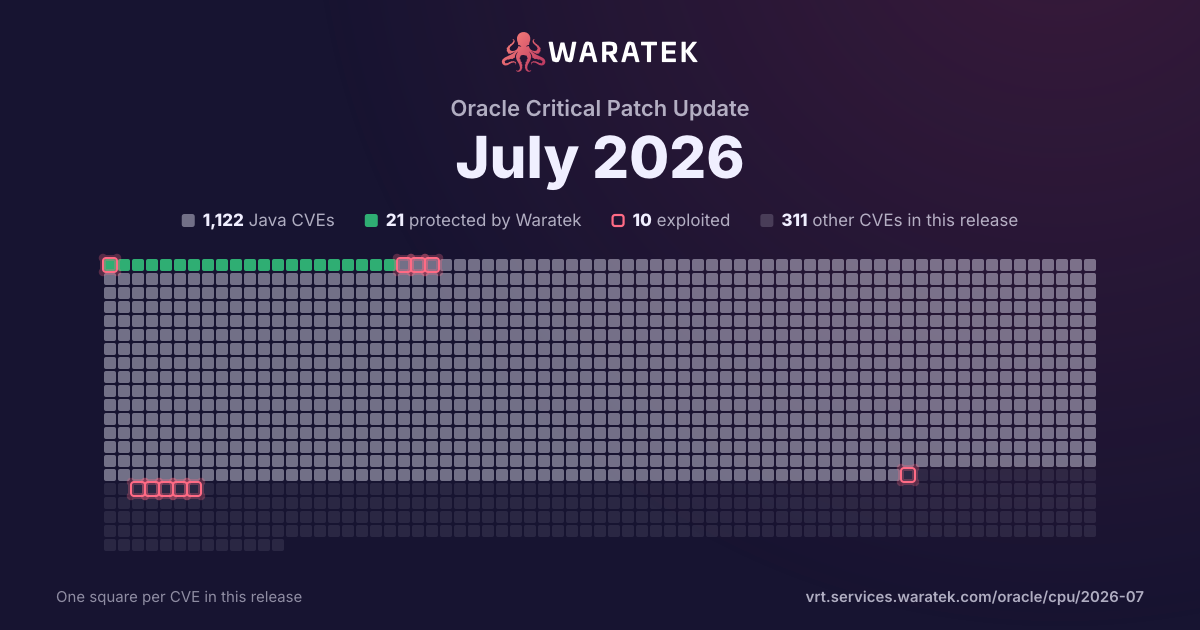
By status
21Protected by Waratek8Mitigation candidate1,093No exploit published16Outside Waratek scope295Not applicable
10Exploited, marked by the ring
No exploit published. For 971 of them, Oracle's security advisory is the source of public detail.
Protected by Waratek. Waratek RASP can block exploitation of these on systems that have not applied the patch yet.
Overview 57 matches · 28 in Waratek scope · 2 protected · 0 exploited · 0 CISA KEV · 6 public PoC · 0 EPSS ≥ 0.5
57matches
28in Waratek scope49.1%
2protected3.5%
0exploited0.0%
0CISA KEV0.0%
6public PoC10.5%
0EPSS ≥ 0.50.0%
Protected by Waratek
2
3.5%
Rule in development
0
0.0%
Mitigation candidate
2
3.5%
No exploit published
24
42.1%
Outside Waratek scope
1
1.8%
Not applicable
28
49.1%
Withdrawn CVE
0
0.0%
blocked by ARMR today
2
3.5%
partly blocked
0
0.0%
not blocked
55
96.5%
not established
0
0.0%
unrecorded
0
0.0%
Exploited
0
0.0%
Working exploit published
0
0.0%
Proof of concept only
57
100.0%
Forecast only
0
0.0%
No public exploit
0
0.0%
split by
peak 27 / year
20201
Mitigation candidate1
Critical1
not blocked1
Proof of concept only1
20210
20221
Not applicable1
Critical1
not blocked1
Proof of concept only1
20234
No exploit published4
High4
not blocked4
Proof of concept only4
20245
No exploit published1
Outside Waratek scope1
Not applicable3
High4
Medium1
not blocked5
Proof of concept only5
202519
No exploit published5
Not applicable14
High8
Medium8
Low3
not blocked19
Proof of concept only19
202627
Protected by Waratek2
Mitigation candidate1
No exploit published14
Not applicable10
Critical6
High14
Medium5
Low2
blocked by ARMR today2
not blocked25
Proof of concept only27
2020202120222023202420252026
| CVE | Severity | Published▾ | Status | Exploitation | Description |
|---|---|---|---|---|---|
| CVE-2026-60206 | Critical | 2026-07-21 | Mitigation candidate | Proof of concept only | Vulnerability in the Oracle WebLogic Server product of Oracle Fusion Middleware (component: Core). Supported versions that are affected are 12.2.1.4.0, 14.1.1.0.0, 14.1.2.0.0 and 15.1.1.0.0. Easily exploitable vulnerability allows low privileged attacker with network access via SAML to compromise Oracle WebLogic Server. While the vulnerability is in Oracle WebLogic Server, attacks may significantly impact additional products (scope change). Successful attacks of this vulnerability can result in takeover of Oracle WebLogic Server. CVSS 3.1 Base Score 9.9 (Confidentiality, Integrity and Availability impacts). CVSS Vector: (CVSS:3.1/AV:N/AC:L/PR:L/UI:N/S:C/C:H/I:H/A:H). |
| CVE-2026-54512 | High | 2026-06-23 | No exploit published | Proof of concept only | jackson-databind contains the general-purpose data-binding functionality and tree-model for Jackson Data Processor. From 2.10.0 until 2.18.8, 2.21.4, and 3.1.4, jackson-databind's PolymorphicTypeValidator (PTV) is the primary safety mechanism guarding polymorphic deserialization. When polymorphic typing is enabled and a type identifier contains generic parameters (i.e. the type ID string contains <), DatabindContext._resolveAndValidateGeneric() validates only the raw container class name (the substring before <) against the configured PTV. If the container type is approved, the method parses the full canonical type string via TypeFactory.constructFromCanonical() and returns the fully parameterized type without ever validating the nested type arguments against the PTV. The nested type arguments are then resolved, instantiated, and populated as beans during deserialization. An attacker who controls the type ID can therefore place a denied class as a generic type parameter of an allowed container — for example java.util.ArrayList<com.evil.Gadget> when only java.util.ArrayList is allow-listed. The container passes the PTV check; com.evil.Gadget is loaded via Class.forName(name, true, loader), instantiated, and its properties are set from attacker-controlled JSON. This completely bypasses an explicitly configured PTV allow-list. This vulnerability is fixed in 2.18.8, 2.21.4, and 3.1.4. |
| CVE-2026-49975 | High | 2026-06-08 | Not applicable | Proof of concept only | Memory Allocation with Excessive Size Value vulnerability in Apache HTTP Server's mod_http leads to denial of service via malicious HTTP requests. This issue affects Apache HTTP Server: from 2.4.17 through 2.4.67. |
| CVE-2026-42536 | High | 2026-06-08 | Not applicable | Proof of concept only | Heap-based Buffer Overflow vulnerability in Apache HTTP Server with mod_xml2enc, xml2StartParse, and untrusted content This issue affects Apache HTTP Server: from 2.4.0 through 2.4.67. Users are recommended to upgrade to version 2.4.68, which fixes the issue. |
| CVE-2026-42587 | High | 2026-05-13 | No exploit published | Proof of concept only | Netty is an asynchronous, event-driven network application framework. Prior to 4.2.13.Final and 4.1.133.Final, HttpContentDecompressor accepts a maxAllocation parameter to limit decompression buffer size and prevent decompression bomb attacks. This limit is correctly enforced for gzip and deflate encodings via ZlibDecoder, but is silently ignored when the content encoding is br (Brotli), zstd, or snappy. An attacker can bypass the configured decompression limit by sending a compressed payload with Content-Encoding: br instead of Content-Encoding: gzip, causing unbounded memory allocation and out-of-memory denial of service. The same vulnerability exists in DelegatingDecompressorFrameListener for HTTP/2 connections. This vulnerability is fixed in 4.2.13.Final and 4.1.133.Final. |
| CVE-2026-42585 | High | 2026-05-13 | No exploit published | Proof of concept only | Netty is an asynchronous, event-driven network application framework. Prior to 4.2.13.Final and 4.1.133.Final, Netty incorrectly parses malformed Transfer-Encoding, enabling request smuggling attacks. This vulnerability is fixed in 4.2.13.Final and 4.1.133.Final. |
| CVE-2026-42584 | Critical | 2026-05-13 | No exploit published | Proof of concept only | Netty is an asynchronous, event-driven network application framework. Prior to 4.2.13.Final and 4.1.133.Final, HttpClientCodec pairs each inbound response with an outbound request by queue.poll() once per response, including for 1xx. If the client pipelines GET then HEAD and the server sends 103, then 200 with GET body, then 200 for HEAD, the queue pairs HEAD with the first 200. The HEAD rule then skips reading that message’s body, so the GET entity bytes stay on the stream and the following 200 is parsed from the wrong offset. This vulnerability is fixed in 4.2.13.Final and 4.1.133.Final. |
| CVE-2026-42583 | High | 2026-05-13 | No exploit published | Proof of concept only | Netty is an asynchronous, event-driven network application framework. Prior to 4.2.13.Final and 4.1.133.Final, Lz4FrameDecoder allocates a ByteBuf of size decompressedLength (up to 32 MB per block) before LZ4 runs. A peer only needs a 21-byte header plus compressedLength payload bytes - 22 bytes if compressedLength == 1 - to force that allocation. This vulnerability is fixed in 4.2.13.Final and 4.1.133.Final. |
| CVE-2026-42582 | High | 2026-05-13 | No exploit published | Proof of concept only | Netty is an asynchronous, event-driven network application framework. Prior to 4.2.13.Final, when decoding header blocks, the non-Huffman branch of io.netty.handler.codec.http3.QpackDecoder#decodeHuffmanEncodedLiteral may execute new byte[length] for a string literal before verifying that length bytes are actually present in the compressed field section. The wire encoding allows a very large length to be expressed in few bytes. There is no check that length <= in.readableBytes() before new byte[length]. This vulnerability is fixed in 4.2.13.Final. |
| CVE-2026-42581 | Critical | 2026-05-13 | No exploit published | Proof of concept only | Netty is an asynchronous, event-driven network application framework. Prior to 4.2.13.Final and 4.1.133.Final, HttpObjectDecoder strips a conflicting Content-Length header when a request carries both Transfer-Encoding: chunked and Content-Length, but only for HTTP/1.1 messages. The guard is absent for HTTP/1.0. An attacker that sends an HTTP/1.0 request with both headers causes Netty to decode the body as chunked while leaving Content-Length intact in the forwarded HttpMessage. Any downstream proxy or handler that trusts Content-Length over Transfer-Encoding will disagree on message boundaries, enabling request smuggling. This vulnerability is fixed in 4.2.13.Final and 4.1.133.Final. |
| CVE-2026-42580 | Medium | 2026-05-13 | No exploit published | Proof of concept only | Netty is an asynchronous, event-driven network application framework. Prior to 4.2.13.Final and 4.1.133.Final, Netty's chunk size parser silently overflows int, enabling request smuggling attacks. This vulnerability is fixed in 4.2.13.Final and 4.1.133.Final. |
| CVE-2026-42579 | Critical | 2026-05-13 | No exploit published | Proof of concept only | Netty is an asynchronous, event-driven network application framework. Prior to 4.2.13.Final and 4.1.133.Final, Netty's DNS codec does not enforce RFC 1035 domain name constraints during either encoding or decoding. This creates a bidirectional attack surface: malicious DNS responses can exploit the decoder, and user-influenced hostnames can exploit the encoder. This vulnerability is fixed in 4.2.13.Final and 4.1.133.Final. |
| CVE-2026-42578 | Low | 2026-05-13 | No exploit published | Proof of concept only | Netty is an asynchronous, event-driven network application framework. Prior to 4.2.13.Final and 4.1.133.Final, Netty's HttpProxyHandler constructs HTTP CONNECT requests with header validation explicitly disabled. The newInitialMessage() method creates headers using DefaultHttpHeadersFactory.headersFactory().withValidation(false), then adds user-provided outboundHeaders without any CRLF validation. This allows an attacker who can influence the outbound headers to inject arbitrary HTTP headers into the CONNECT request sent to the proxy server. This vulnerability is fixed in 4.2.13.Final and 4.1.133.Final. |
| CVE-2026-41417 | Medium | 2026-05-06 | No exploit published | Proof of concept only | Netty allows request-line validation to be bypassed when a `DefaultHttpRequest` or `DefaultFullHttpRequest` is created first and its URI is later changed via `setUri()`. The constructors reject CRLF and whitespace characters that would break the start-line, but `setUri()` does not apply the same validation. `HttpRequestEncoder` and `RtspEncoder` then write the URI into the request line verbatim. If attacker-controlled input reaches `setUri()`, this enables CRLF injection and insertion of additional HTTP or RTSP requests, leading to HTTP request smuggling or desynchronization on the HTTP side and request injection on the RTSP side. This issue is fixed in versions 4.2.13.Final and 4.1.133.Final. |
| CVE-2026-42779 | Critical | 2026-05-01 | Protected by Waratek | Proof of concept only | The fix for CVE-2026-41635 was not applied to the 2.1.X and 2.2.X branches. Here was the original issue description: Apache MINA's AbstractIoBuffer.resolveClass() contains two branches, one of them (for static classes or primitive types) does not check the class at all, bypassing the classname allowlist and allowing arbitrary code to be executed. The fix checks if the class is present in the accepted class filter before calling Class.forName(). Affected versions are Apache MINA 2.1.0 <= 2.1.11, and 2.2.0 <= 2.2.6. The problem is resolved in Apache MINA 2.1.12, and 2.2.7 by applying the classname allowlist earlier. Affected are applications using Apache MINA that call IoBuffer.getObject(). Applications using Apache MINA are advised to upgrade. |
| CVE-2026-2332 | Critical | 2026-04-14 | No exploit published | Proof of concept only | In Eclipse Jetty, the HTTP/1.1 parser is vulnerable to request smuggling when chunk extensions are used, similar to the "funky chunks" techniques outlined here: * https://w4ke.info/2025/06/18/funky-chunks.html * https://w4ke.info/2025/10/29/funky-chunks-2.html Jetty terminates chunk extension parsing at \r\n inside quoted strings instead of treating this as an error. POST / HTTP/1.1 Host: localhost Transfer-Encoding: chunked 1;ext="val X 0 GET /smuggled HTTP/1.1 ... Note how the chunk extension does not close the double quotes, and it is able to inject a smuggled request. |
| CVE-2026-33870 | High | 2026-03-27 | No exploit published | Proof of concept only | Netty is an asynchronous, event-driven network application framework. In versions prior to 4.1.132.Final and 4.2.10.Final, Netty incorrectly parses quoted strings in HTTP/1.1 chunked transfer encoding extension values, enabling request smuggling attacks. Versions 4.1.132.Final and 4.2.10.Final fix the issue. |
| CVE-2026-30922 | High | 2026-03-18 | Not applicable | Proof of concept only | pyasn1 is a generic ASN.1 library for Python. Prior to 0.6.3, the `pyasn1` library is vulnerable to a Denial of Service (DoS) attack caused by uncontrolled recursion when decoding ASN.1 data with deeply nested structures. An attacker can supply a crafted payload containing thousands of nested `SEQUENCE` (`0x30`) or `SET` (`0x31`) tags with "Indefinite Length" (`0x80`) markers. This forces the decoder to recursively call itself until the Python interpreter crashes with a `RecursionError` or consumes all available memory (OOM), crashing the host application. This is a distinct vulnerability from CVE-2026-23490 (which addressed integer overflows in OID decoding). The fix for CVE-2026-23490 (`MAX_OID_ARC_CONTINUATION_OCTETS`) does not mitigate this recursion issue. Version 0.6.3 fixes this specific issue. |
| CVE-2025-70873 | High | 2026-03-12 | Not applicable | Proof of concept only | An information disclosure issue in the zipfileInflate function in the zipfile extension in SQLite v3.51.1 and earlier allows attackers to obtain heap memory via supplying a crafted ZIP file. |
| CVE-2026-27171 | Medium | 2026-02-18 | Not applicable | Proof of concept only | zlib before 1.3.2 allows CPU consumption via crc32_combine64 and crc32_combine_gen64 because x2nmodp can do right shifts within a loop that has no termination condition. |
| CVE-2026-24842 | High | 2026-01-28 | Not applicable | Proof of concept only | node-tar,a Tar for Node.js, contains a vulnerability in versions prior to 7.5.7 where the security check for hardlink entries uses different path resolution semantics than the actual hardlink creation logic. This mismatch allows an attacker to craft a malicious TAR archive that bypasses path traversal protections and creates hardlinks to arbitrary files outside the extraction directory. Version 7.5.7 contains a fix for the issue. |
| CVE-2026-23954 | High | 2026-01-22 | Not applicable | Proof of concept only | Incus is a system container and virtual machine manager. Versions 6.21.0 and below allow a user with the ability to launch a container with a custom image (e.g a member of the ‘incus’ group) to use directory traversal or symbolic links in the templating functionality to achieve host arbitrary file read, and host arbitrary file write. This ultimately results in arbitrary command execution on the host. When using an image with a metadata.yaml containing templates, both the source and target paths are not checked for symbolic links or directory traversal. This can also be exploited in IncusOS. A fix is planned for versions 6.0.6 and 6.21.0, but they have not been released at the time of publication. |
| CVE-2026-23953 | High | 2026-01-22 | Not applicable | Proof of concept only | Incus is a system container and virtual machine manager. In versions 6.20.0 and below, a user with the ability to launch a container with a custom YAML configuration (e.g a member of the ‘incus’ group) can create an environment variable containing newlines, which can be used to add additional configuration items in the container’s lxc.conf due to newline injection. This can allow adding arbitrary lifecycle hooks, ultimately resulting in arbitrary command execution on the host. Exploiting this issue on IncusOS requires a slight modification of the payload to change to a different writable directory for the validation step (e.g /tmp). This can be confirmed with a second container with /tmp mounted from the host (A privileged action for validation only). A fix is planned for versions 6.0.6 and 6.21.0, but they have not been released at the time of publication. |
| CVE-2026-1002 | Medium | 2026-01-15 | No exploit published | Proof of concept only | The Vert.x Web static handler component cache can be manipulated to deny the access to static files served by the handler using specifically crafted request URI. The issue comes from an improper implementation of the C. rule of section 5.2.4 of RFC3986 and is fixed in Vert.x Core component (used by Vert.x Web): https://github.com/eclipse-vertx/vert.x/pull/5895 Steps to reproduce Given a file served by the static handler, craft an URI that introduces a string like bar%2F..%2F after the last / char to deny the access to the URI with an HTTP 404 response. For example https://example.com/foo/index.html can be denied with https://example.com/foo/bar%2F..%2Findex.html Mitgation Disabling Static Handler cache fixes the issue. StaticHandler staticHandler = StaticHandler.create().setCachingEnabled(false); |
| CVE-2025-15224 | Low | 2026-01-08 | Not applicable | Proof of concept only | When doing SSH-based transfers using either SCP or SFTP, and asked to do public key authentication, curl would wrongly still ask and authenticate using a locally running SSH agent. |
| CVE-2025-15079 | Medium | 2026-01-08 | Not applicable | Proof of concept only | When doing SSH-based transfers using either SCP or SFTP, and setting the known_hosts file, libcurl could still mistakenly accept connecting to hosts *not present* in the specified file if they were added as recognized in the libssh *global* known_hosts file. |
| CVE-2026-21452 | High | 2026-01-02 | Protected by Waratek | Proof of concept only | MessagePack for Java is a serializer implementation for Java. A denial-of-service vulnerability exists in versions prior to 0.9.11 when deserializing .msgpack files containing EXT32 objects with attacker-controlled payload lengths. While MessagePack-Java parses extension headers lazily, it later trusts the declared EXT payload length when materializing the extension data. When ExtensionValue.getData() is invoked, the library attempts to allocate a byte array of the declared length without enforcing any upper bound. A malicious .msgpack file of only a few bytes can therefore trigger unbounded heap allocation, resulting in JVM heap exhaustion, process termination, or service unavailability. This vulnerability is triggered during model loading / deserialization, making it a model format vulnerability suitable for remote exploitation. The vulnerability enables a remote denial-of-service attack against applications that deserialize untrusted .msgpack model files using MessagePack for Java. A specially crafted but syntactically valid .msgpack file containing an EXT32 object with an attacker-controlled, excessively large payload length can trigger unbounded memory allocation during deserialization. When the model file is loaded, the library trusts the declared length metadata and attempts to allocate a byte array of that size, leading to rapid heap exhaustion, excessive garbage collection, or immediate JVM termination with an OutOfMemoryError. The attack requires no malformed bytes, user interaction, or elevated privileges and can be exploited remotely in real-world environments such as model registries, inference services, CI/CD pipelines, and cloud-based model hosting platforms that accept or fetch .msgpack artifacts. Because the malicious file is extremely small yet valid, it can bypass basic validation and scanning mechanisms, resulting in complete service unavailability and potential cascading failures in production systems. Version 0.9.11 fixes the vulnerability. |
| CVE-2025-14180 | High | 2025-12-27 | Not applicable | Proof of concept only | In PHP versions 8.1.* before 8.1.34, 8.2.* before 8.2.30, 8.3.* before 8.3.29, 8.4.* before 8.4.16, 8.5.* before 8.5.1 when using the PDO PostgreSQL driver with PDO::ATTR_EMULATE_PREPARES enabled, an invalid character sequence (such as \x99) in a prepared statement parameter may cause the quoting function PQescapeStringConn to return NULL, leading to a null pointer dereference in pdo_parse_params() function. This may lead to crashes (segmentation fault) and affect the availability of the target server. |
| CVE-2025-14178 | High | 2025-12-27 | Not applicable | Proof of concept only | In PHP versions:8.1.* before 8.1.34, 8.2.* before 8.2.30, 8.3.* before 8.3.29, 8.4.* before 8.4.16, 8.5.* before 8.5.1, a heap buffer overflow occurs in array_merge() when the total element count of packed arrays exceeds 32-bit limits or HT_MAX_SIZE, due to an integer overflow in the precomputation of element counts using zend_hash_num_elements(). This may lead to memory corruption or crashes and affect the integrity and availability of the target server. |
| CVE-2025-14177 | Medium | 2025-12-27 | Not applicable | Proof of concept only | In PHP versions:8.1.* before 8.1.34, 8.2.* before 8.2.30, 8.3.* before 8.3.29, 8.4.* before 8.4.16, 8.5.* before 8.5.1, the getimagesize() function may leak uninitialized heap memory into the APPn segments (e.g., APP1) when reading images in multi-chunk mode (such as via php://filter). This occurs due to a bug in php_read_stream_all_chunks() that overwrites the buffer without advancing the pointer, leaving tail bytes uninitialized. This may lead to information disclosure of sensitive heap data and affect the confidentiality of the target server. |
| CVE-2024-29371 | High | 2025-12-17 | No exploit published | Proof of concept only | In jose4j before 0.9.6, an attacker can cause a Denial-of-Service (DoS) condition by crafting a malicious JSON Web Encryption (JWE) token with an exceptionally high compression ratio. When this token is processed by the server, it results in significant memory allocation and processing time during decompression. |
| CVE-2025-67735 | Medium | 2025-12-16 | No exploit published | Proof of concept only | Netty is an asynchronous, event-driven network application framework. In versions prior to 4.1.129.Final and 4.2.8.Final, the `io.netty.handler.codec.http.HttpRequestEncoder` has a CRLF injection with the request URI when constructing a request. This leads to request smuggling when `HttpRequestEncoder` is used without proper sanitization of the URI. Any application / framework using `HttpRequestEncoder` can be subject to be abused to perform request smuggling using CRLF injection. Versions 4.1.129.Final and 4.2.8.Final fix the issue. |
| CVE-2025-66021 | High | 2025-11-26 | No exploit published | Proof of concept only | OWASP Java HTML Sanitizer is a configureable HTML Sanitizer written in Java, allowing inclusion of HTML authored by third-parties in web applications while protecting against XSS. In version 20240325.1, OWASP java html sanitizer is vulnerable to XSS if HtmlPolicyBuilder allows noscript and style tags with allowTextIn inside the style tag. This could lead to XSS if the payload is crafted in such a way that it does not sanitise the CSS and allows tags which is not mentioned in HTML policy. At time of publication no known patch is available. |
| CVE-2025-9624 | High | 2025-11-25 | No exploit published | Proof of concept only | A vulnerability in OpenSearch allows attackers to cause Denial of Service (DoS) by submitting complex query_string inputs. This issue affects all OpenSearch versions between 3.0.0 and < 3.3.0 and OpenSearch < 2.19.4. |
| CVE-2025-64713 | High | 2025-11-25 | Not applicable | Proof of concept only | WebAssembly Micro Runtime (WAMR) is a lightweight standalone WebAssembly (Wasm) runtime. Prior to version 2.4.4, an out-of-bounds array access issue exists in WAMR's fast interpreter mode during WASM bytecode loading. When frame_ref_bottom and frame_offset_bottom arrays are at capacity and a GET_GLOBAL(I32) opcode is encountered, frame_ref_bottom is expanded but frame_offset_bottom may not be. If this is immediately followed by an if opcode that triggers preserve_local_for_block, the function traverses arrays using stack_cell_num as the upper bound, causing out-of-bounds access to frame_offset_bottom since it wasn't expanded to match the increased stack_cell_num. This issue has been patched in version 2.4.4. |
| CVE-2025-9900 | High | 2025-09-23 | Not applicable | Proof of concept only | A flaw was found in Libtiff. This vulnerability is a "write-what-where" condition, triggered when the library processes a specially crafted TIFF image file. By providing an abnormally large image height value in the file's metadata, an attacker can trick the library into writing attacker-controlled color data to an arbitrary memory location. This memory corruption can be exploited to cause a denial of service (application crash) or to achieve arbitrary code execution with the permissions of the user. |
| CVE-2025-58057 | Medium | 2025-09-04 | No exploit published | Proof of concept only | Netty is an asynchronous event-driven network application framework for rapid development of maintainable high performance protocol servers & clients. In netty-codec-compression versions 4.1.124.Final and below, and netty-codec versions 4.2.4.Final and below, when supplied with specially crafted input, BrotliDecoder and certain other decompression decoders will allocate a large number of reachable byte buffers, which can lead to denial of service. BrotliDecoder.decompress has no limit in how often it calls pull, decompressing data 64K bytes at a time. The buffers are saved in the output list, and remain reachable until OOM is hit. This is fixed in versions 4.1.125.Final of netty-codec and 4.2.5.Final of netty-codec-compression. |
| CVE-2025-58050 | Medium | 2025-08-27 | Not applicable | Proof of concept only | The PCRE2 library is a set of C functions that implement regular expression pattern matching. In version 10.45, a heap-buffer-overflow read vulnerability exists in the PCRE2 regular expression matching engine, specifically within the handling of the (*scs:...) (Scan SubString) verb when combined with (*ACCEPT) in src/pcre2_match.c. This vulnerability may potentially lead to information disclosure if the out-of-bounds data read during the memcmp affects the final match result in a way observable by the attacker. This issue has been resolved in version 10.46. |
| CVE-2025-8961 | Low | 2025-08-14 | Not applicable | Proof of concept only | A weakness has been identified in LibTIFF 4.7.0. This affects the function main of the file tiffcrop.c of the component tiffcrop. Executing manipulation can lead to memory corruption. The attack can only be executed locally. The exploit has been made available to the public and could be exploited. |
| CVE-2025-8837 | Low | 2025-08-11 | Not applicable | Proof of concept only | A vulnerability was identified in JasPer up to 4.2.5. This affects the function jpc_dec_dump of the file src/libjasper/jpc/jpc_dec.c of the component JPEG2000 File Handler. The manipulation leads to use after free. An attack has to be approached locally. The exploit has been disclosed to the public and may be used. The patch is named 8308060d3fbc1da10353ac8a95c8ea60eba9c25a. It is recommended to apply a patch to fix this issue. |
| CVE-2025-8177 | Medium | 2025-07-26 | Not applicable | Proof of concept only | A vulnerability was found in LibTIFF up to 4.7.0. It has been rated as critical. This issue affects the function setrow of the file tools/thumbnail.c. The manipulation leads to buffer overflow. An attack has to be approached locally. The patch is named e8c9d6c616b19438695fd829e58ae4fde5bfbc22. It is recommended to apply a patch to fix this issue. This vulnerability only affects products that are no longer supported by the maintainer. |
| CVE-2025-8176 | Low | 2025-07-26 | Not applicable | Proof of concept only | A vulnerability was found in LibTIFF up to 4.7.0. It has been declared as critical. This vulnerability affects the function get_histogram of the file tools/tiffmedian.c. The manipulation leads to use after free. The attack needs to be approached locally. The exploit has been disclosed to the public and may be used. The patch is identified as fe10872e53efba9cc36c66ac4ab3b41a839d5172. It is recommended to apply a patch to fix this issue. |
| CVE-2025-6491 | Medium | 2025-07-13 | Not applicable | Proof of concept only | In PHP versions:8.1.* before 8.1.33, 8.2.* before 8.2.29, 8.3.* before 8.3.23, 8.4.* before 8.4.10 when parsing XML data in SOAP extensions, overly large (>2Gb) XML namespace prefix may lead to null pointer dereference. This may lead to crashes and affect the availability of the target server. |
| CVE-2025-1220 | Medium | 2025-07-13 | Not applicable | Proof of concept only | In PHP versions:8.1.* before 8.1.33, 8.2.* before 8.2.29, 8.3.* before 8.3.23, 8.4.* before 8.4.10 some functions like fsockopen() lack validation that the hostname supplied does not contain null characters. This may lead to other functions like parse_url() treat the hostname in different way, thus opening way to security problems if the user code implements access checks before access using such functions. |
| CVE-2025-30153 | High | 2025-03-19 | Not applicable | Proof of concept only | kin-openapi is a Go project for handling OpenAPI files. Prior to 0.131.0, when validating a request with a multipart/form-data schema, if the OpenAPI schema allows it, an attacker can upload a crafted ZIP file (e.g., a ZIP bomb), causing the server to consume all available system memory. The root cause comes from the ZipFileBodyDecoder, which is registered automatically by the module (contrary to what the documentation says). This vulnerability is fixed in 0.131.0. |
| CVE-2025-26791 | Medium | 2025-02-14 | Not applicable | Proof of concept only | DOMPurify before 3.2.4 has an incorrect template literal regular expression, sometimes leading to mutation cross-site scripting (mXSS). |
| CVE-2024-27532 | High | 2024-11-08 | Not applicable | Proof of concept only | wasm-micro-runtime (aka WebAssembly Micro Runtime or WAMR) 06df58f is vulnerable to NULL Pointer Dereference in function `block_type_get_result_types. |
| CVE-2024-6763 | Medium | 2024-10-14 | Outside Waratek scope | Proof of concept only | Eclipse Jetty is a lightweight, highly scalable, Java-based web server and Servlet engine . It includes a utility class, HttpURI, for URI/URL parsing. The HttpURI class does insufficient validation on the authority segment of a URI. However the behaviour of HttpURI differs from the common browsers in how it handles a URI that would be considered invalid if fully validated against the RRC. Specifically HttpURI and the browser may differ on the value of the host extracted from an invalid URI and thus a combination of Jetty and a vulnerable browser may be vulnerable to a open redirect attack or to a SSRF attack if the URI is used after passing validation checks. |
| CVE-2024-36129 | High | 2024-06-05 | Not applicable | Proof of concept only | The OpenTelemetry Collector offers a vendor-agnostic implementation on how to receive, process and export telemetry data. An unsafe decompression vulnerability allows unauthenticated attackers to crash the collector via excessive memory consumption. OTel Collector version 0.102.1 fixes this issue. It is also fixed in the confighttp module version 0.102.0 and configgrpc module version 0.102.1. |
| CVE-2024-0406 | High | 2024-04-06 | Not applicable | Proof of concept only | A flaw was discovered in the mholt/archiver package. This flaw allows an attacker to create a specially crafted tar file, which, when unpacked, may allow access to restricted files or directories. This issue can allow the creation or overwriting of files with the user's or application's privileges using the library. |
| CVE-2024-24824 | High | 2024-02-07 | No exploit published | Proof of concept only | Graylog is a free and open log management platform. Starting in version 2.0.0 and prior to versions 5.1.11 and 5.2.4, arbitrary classes can be loaded and instantiated using a HTTP PUT request to the `/api/system/cluster_config/` endpoint. Graylog's cluster config system uses fully qualified class names as config keys. To validate the existence of the requested class before using them, Graylog loads the class using the class loader. If a user with the appropriate permissions performs the request, arbitrary classes with 1-arg String constructors can be instantiated. This will execute arbitrary code that is run during class instantiation. In the specific use case of `java.io.File`, the behavior of the internal web-server stack will lead to information exposure by including the entire file content in the response to the REST request. Versions 5.1.11 and 5.2.4 contain a fix for this issue. |
| CVE-2023-43642 | High | 2023-09-25 | No exploit published | Proof of concept only | snappy-java is a Java port of the snappy, a fast C++ compresser/decompresser developed by Google. The SnappyInputStream was found to be vulnerable to Denial of Service (DoS) attacks when decompressing data with a too large chunk size. Due to missing upper bound check on chunk length, an unrecoverable fatal error can occur. All versions of snappy-java including the latest released version 1.1.10.3 are vulnerable to this issue. A fix has been introduced in commit `9f8c3cf74` which will be included in the 1.1.10.4 release. Users are advised to upgrade. Users unable to upgrade should only accept compressed data from trusted sources. |
| CVE-2023-34455 | High | 2023-06-15 | No exploit published | Proof of concept only | snappy-java is a fast compressor/decompressor for Java. Due to use of an unchecked chunk length, an unrecoverable fatal error can occur in versions prior to 1.1.10.1. The code in the function hasNextChunk in the fileSnappyInputStream.java checks if a given stream has more chunks to read. It does that by attempting to read 4 bytes. If it wasn’t possible to read the 4 bytes, the function returns false. Otherwise, if 4 bytes were available, the code treats them as the length of the next chunk. In the case that the `compressed` variable is null, a byte array is allocated with the size given by the input data. Since the code doesn’t test the legality of the `chunkSize` variable, it is possible to pass a negative number (such as 0xFFFFFFFF which is -1), which will cause the code to raise a `java.lang.NegativeArraySizeException` exception. A worse case would happen when passing a huge positive value (such as 0x7FFFFFFF), which would raise the fatal `java.lang.OutOfMemoryError` error. Version 1.1.10.1 contains a patch for this issue. |
| CVE-2023-34454 | High | 2023-06-15 | No exploit published | Proof of concept only | snappy-java is a fast compressor/decompressor for Java. Due to unchecked multiplications, an integer overflow may occur in versions prior to 1.1.10.1, causing an unrecoverable fatal error. The function `compress(char[] input)` in the file `Snappy.java` receives an array of characters and compresses it. It does so by multiplying the length by 2 and passing it to the rawCompress` function. Since the length is not tested, the multiplication by two can cause an integer overflow and become negative. The rawCompress function then uses the received length and passes it to the natively compiled maxCompressedLength function, using the returned value to allocate a byte array. Since the maxCompressedLength function treats the length as an unsigned integer, it doesn’t care that it is negative, and it returns a valid value, which is casted to a signed integer by the Java engine. If the result is negative, a `java.lang.NegativeArraySizeException` exception will be raised while trying to allocate the array `buf`. On the other side, if the result is positive, the `buf` array will successfully be allocated, but its size might be too small to use for the compression, causing a fatal Access Violation error. The same issue exists also when using the `compress` functions that receive double, float, int, long and short, each using a different multiplier that may cause the same issue. The issue most likely won’t occur when using a byte array, since creating a byte array of size 0x80000000 (or any other negative value) is impossible in the first place. Version 1.1.10.1 contains a patch for this issue. |
| CVE-2023-34453 | High | 2023-06-15 | No exploit published | Proof of concept only | snappy-java is a fast compressor/decompressor for Java. Due to unchecked multiplications, an integer overflow may occur in versions prior to 1.1.10.1, causing a fatal error. The function `shuffle(int[] input)` in the file `BitShuffle.java` receives an array of integers and applies a bit shuffle on it. It does so by multiplying the length by 4 and passing it to the natively compiled shuffle function. Since the length is not tested, the multiplication by four can cause an integer overflow and become a smaller value than the true size, or even zero or negative. In the case of a negative value, a `java.lang.NegativeArraySizeException` exception will raise, which can crash the program. In a case of a value that is zero or too small, the code that afterwards references the shuffled array will assume a bigger size of the array, which might cause exceptions such as `java.lang.ArrayIndexOutOfBoundsException`. The same issue exists also when using the `shuffle` functions that receive a double, float, long and short, each using a different multiplier that may cause the same issue. Version 1.1.10.1 contains a patch for this vulnerability. |
| CVE-2022-25315 | Critical | 2022-02-18 | Not applicable | Proof of concept only | In Expat (aka libexpat) before 2.4.5, there is an integer overflow in storeRawNames. |
| CVE-2020-8840 | Critical | 2020-02-10 | Mitigation candidate | Proof of concept only | FasterXML jackson-databind 2.0.0 through 2.9.10.2 lacks certain xbean-reflect/JNDI blocking, as demonstrated by org.apache.xbean.propertyeditor.JndiConverter. |