
Oracle Critical Patch Update July 2026
Released July 2026 · Oracle's advisory ↗ · ← Security Patch Update, June 2026 · Security Patch Update, August 2026 →
1,433 CVEs in this release, one square each
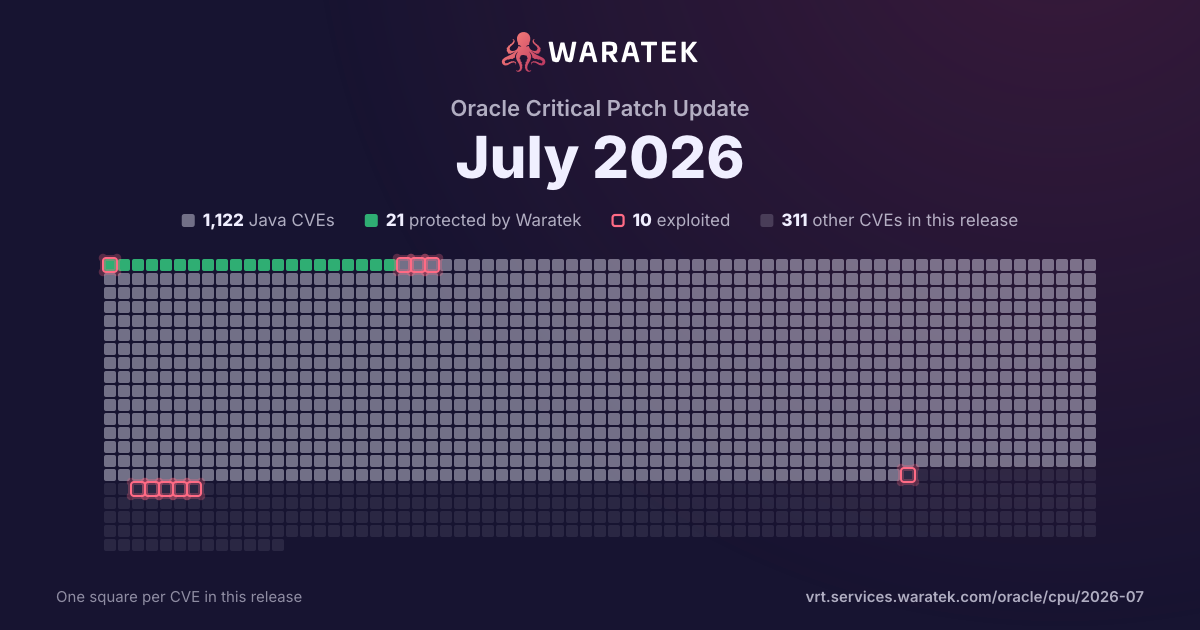
By status
21Protected by Waratek3Rule in development5Mitigation candidate1,095No exploit published13Outside Waratek scope296Not applicable
10Exploited, marked by the ring
No exploit published. For 968 of them, Oracle's security advisory is the source of public detail.
Protected by Waratek. Waratek RASP can block exploitation of these on systems that have not applied the patch yet.
Overview 13 matches · 2 protected · 1 exploited · 0 CISA KEV · 1 public PoC · 0 EPSS ≥ 0.5
Protected by Waratek
2
15.4%
Rule in development
1
7.7%
Mitigation candidate
0
0.0%
No exploit published
10
76.9%
blocked by ARMR today
2
15.4%
partly blocked
0
0.0%
not blocked
11
84.6%
not established
0
0.0%
unrecorded
0
0.0%
Exploited
1
7.7%
Working exploit published
0
0.0%
Proof of concept only
0
0.0%
Forecast only
0
0.0%
No public exploit
12
92.3%
| CVE | Severity | Published▾ | Status | Exploitation | Description |
|---|---|---|---|---|---|
| CVE-2026-41635 | Critical | 2026-04-27 | Protected by Waratek | No public exploit | Apache MINA's AbstractIoBuffer.resolveClass() contains two branches, one of them (for static classes or primitive types) does not check the class at all, bypassing the classname allowlist and allowing arbitrary code to be executed. The fix checks if the class is present in the accepted class filter before calling Class.forName(). Affected versions are Apache MINA 2.0.0 <= 2.0.27, 2.1.0 <= 2.1.10, and 2.2.0 <= 2.2.5. The problem is resolved in Apache MINA 2.0.28, 2.1.11, and 2.2.6 by applying the classname allowlist earlier. Affected are applications using Apache MINA that call IoBuffer.getObject(). Applications using Apache MINA are advised to upgrade. |
| CVE-2026-41409 | Critical | 2026-04-27 | Protected by Waratek | No public exploit | The fix for CVE-2024-52046 in Apache MINA AbstractIoBuffer.getObject() was incomplete. The classname allowlist of classes allowed to be deserialized was applied too late after a static initializer in a class to be read might already have been executed. Affected versions are Apache MINA 2.0.0 <= 2.0.27, 2.1.0 <= 2.1.10, and 2.2.0 <= 2.2.5. The problem is resolved in Apache MINA 2.0.28, 2.1.11, and 2.2.6 by applying the classname allowlist earlier. Affected are applications using Apache MINA that call IoBuffer.getObject(). Applications using Apache MINA are advised to upgrade |
| CVE-2026-41044 | High | 2026-04-24 | No exploit published | No public exploit | Improper Input Validation, Improper Control of Generation of Code ('Code Injection') vulnerability in Apache ActiveMQ, Apache ActiveMQ Broker, Apache ActiveMQ All. An authenticated attacker can use the admin web console page to construct a malicious broker name that bypasses name validation to include an xbean binding that can be later used by a VM transport to load a remote Spring XML application. The attacker can then use the DestinationView mbean to send a message to trigger a VM transport creation that will reference this malicious broker name which can lead to loading the malicious Spring XML context file. Because Spring's ResourceXmlApplicationContext instantiates all singleton beans before the BrokerService validates the configuration, arbitrary code execution occurs on the broker's JVM through bean factory methods such as Runtime.exec(). This issue affects Apache ActiveMQ: before 5.19.6, from 6.0.0 before 6.2.5; Apache ActiveMQ Broker: before 5.19.6, from 6.0.0 before 6.2.5; Apache ActiveMQ All: before 5.19.6, from 6.0.0 before 6.2.5. Users are recommended to upgrade to version 6.2.5 or 5.19.6, which fixes the issue. |
| CVE-2026-41043 | Medium | 2026-04-24 | No exploit published | No public exploit | Improper Neutralization of Script-Related HTML Tags in a Web Page (Basic XSS) vulnerability in Apache ActiveMQ, Apache ActiveMQ Web. An authenticated attacker can show malicious content when browsing queues in the web console by overriding the content type to be HTML (instead of XML) and by injecting HTML into a JMS selector field. This issue affects Apache ActiveMQ: before 5.19.6, from 6.0.0 before 6.2.5; Apache ActiveMQ Web: before 5.19.6, from 6.0.0 before 6.2.5. Users are recommended to upgrade to version 6.2.5 or 5.19.6, which fixes the issue. |
| CVE-2026-40466 | High | 2026-04-24 | Rule in development | Exploited | Improper Input Validation, Improper Control of Generation of Code ('Code Injection') vulnerability in Apache ActiveMQ Broker, Apache ActiveMQ All, Apache ActiveMQ. An authenticated attacker may bypass the fix in CVE-2026-34197 by adding a connector using an HTTP Discovery transport via BrokerView.addNetworkConnector or BrokerView.addConnector through Jolokia if the activemq-http module is on the classpath. A malicious HTTP endpoint can return a VM transport through the HTTP URI which will bypass the validation added in CVE-2026-34197. The attacker can then use the VM transport's brokerConfig parameter to load a remote Spring XML application context using ResourceXmlApplicationContext. Because Spring's ResourceXmlApplicationContext instantiates all singleton beans before the BrokerService validates the configuration, arbitrary code execution occurs on the broker's JVM through bean factory methods such as Runtime.exec(). This issue affects Apache ActiveMQ Broker: before 5.19.6, from 6.0.0 before 6.2.5; Apache ActiveMQ All: before 5.19.6, from 6.0.0 before 6.2.5; Apache ActiveMQ: before 5.19.6, from 6.0.0 before 6.2.5. Users are recommended to upgrade to version 5.19.6 or 6.2.5, which fixes the issue. |
| CVE-2026-33557 | Critical | 2026-04-20 | No exploit published | No public exploit | A possible security vulnerability has been identified in Apache Kafka. By default, the broker property `sasl.oauthbearer.jwt.validator.class` is set to `org.apache.kafka.common.security.oauthbearer.DefaultJwtValidator`. It accepts any JWT token without validating its signature, issuer, or audience. An attacker can generate a JWT token from any issuer with the `preferred_username` set to any user, and the broker will accept it. We advise the Kafka users using kafka v4.1.0 or v4.1.1 to set the config `sasl.oauthbearer.jwt.validator.class` to `org.apache.kafka.common.security.oauthbearer.BrokerJwtValidator` explicitly to avoid this vulnerability. Since Kafka v4.1.2 and v4.2.0 and later, the issue is fixed and will correctly validate the JWT token. |
| CVE-2026-5598 | High | 2026-04-15 | No exploit published | No public exploit | Covert timing channel vulnerability in Legion of the Bouncy Castle Inc. BC-JAVA core on all (core modules). This vulnerability is associated with program files FrodoEngine.Java. This issue affects BC-JAVA: from 1.71 before 1.80.2, from 1.81 before 1.81.1, from 1.82 before 1.84. |
| CVE-2026-5588 | Medium | 2026-04-15 | No exploit published | No public exploit | Use of a Broken or Risky Cryptographic Algorithm vulnerability in Legion of the Bouncy Castle Inc. BC-JAVA bcpkix on all (pkix modules), Legion of the Bouncy Castle Inc. BCPKIX-FIPS bcpkix on All (pkix modules), Legion of the Bouncy Castle Inc. BCPIX-LTS bcpkix on All (pkix modules). This vulnerability is associated with program files JcaContentVerifierProviderBuilder.Java, JcaContentVerfierProviderBuilder.Java. This issue affects BC-JAVA: from 1.67 before 1.80.2, from 1.81 before 1.81.1, from 1.82 before 1.84; BCPKIX-FIPS: from 2.0.6 before 2.0.11, from 2.1.7 before 2.1.11; BCPIX-LTS: from 2.73.7 before 2.73.11. |
| CVE-2026-0636 | Medium | 2026-04-15 | No exploit published | No public exploit | Improper neutralization of special elements used in an LDAP query ('LDAP injection') vulnerability in Legion of the Bouncy Castle Inc. BC-JAVA bcprov on all (prov modules). This vulnerability is associated with program files LDAPStoreHelper. This issue affects BC-JAVA: from 1.74 before 1.80.2, from 1.81 before 1.81.1, from 1.82 before 1.84. |
| CVE-2026-34481 | Medium | 2026-04-10 | No exploit published | No public exploit | Apache Log4j's JsonTemplateLayout https://logging.apache.org/log4j/2.x/manual/json-template-layout.html , in versions up to and including 2.25.3, produces invalid JSON output when log events contain non-finite floating-point values (NaN, Infinity, or -Infinity), which are prohibited by RFC 8259. This may cause downstream log processing systems to reject or fail to index affected records. An attacker can exploit this issue only if both of the following conditions are met: * The application uses JsonTemplateLayout. * The application logs a MapMessage, or logs an object directly (e.g., via Logger.info(Object), which wraps it in an ObjectMessage), where the message contains an attacker-controlled floating-point value. Users are advised to upgrade to Apache Log4j JSON Template Layout 2.25.4, which corrects this issue. Note: The fix released in version 2.25.4 did not cover all affected code paths. CVE-2026-49844 was assigned to the remaining issue, which concerns the MapMessage.asJson() serialization in Apache Log4j API and is fixed in versions 2.25.5 and 2.26.1. |
| CVE-2026-34480 | Medium | 2026-04-10 | No exploit published | No public exploit | Apache Log4j Core's XmlLayout https://logging.apache.org/log4j/2.x/manual/layouts.html#XmlLayout , in versions up to and including 2.25.3, fails to sanitize characters forbidden by the XML 1.0 specification https://www.w3.org/TR/xml/#charsets producing invalid XML output whenever a log message or MDC value contains such characters. The impact depends on the StAX implementation in use: * JRE built-in StAX: Forbidden characters are silently written to the output, producing malformed XML. Conforming parsers must reject such documents with a fatal error, which may cause downstream log-processing systems to drop the affected records. * Alternative StAX implementations (e.g., Woodstox https://github.com/FasterXML/woodstox , a transitive dependency of the Jackson XML Dataformat module): An exception is thrown during the logging call, and the log event is never delivered to its intended appender, only to Log4j's internal status logger. Users are advised to upgrade to Apache Log4j Core 2.25.4, which corrects this issue by sanitizing forbidden characters before XML output. |
| CVE-2026-34479 | Medium | 2026-04-10 | No exploit published | No public exploit | The Log4j1XmlLayout from the Apache Log4j 1-to-Log4j 2 bridge fails to escape characters forbidden by the XML 1.0 standard, producing malformed XML output. Conforming XML parsers are required to reject documents containing such characters with a fatal error, which may cause downstream log processing systems to drop or fail to index affected records. Two groups of users are affected: * Those using Log4j1XmlLayout directly in a Log4j Core 2 configuration file. * Those using the Log4j 1 configuration compatibility layer with org.apache.log4j.xml.XMLLayout specified as the layout class. Users are advised to upgrade to Apache Log4j 1-to-Log4j 2 bridge version 2.25.4, which corrects this issue. Note: The Apache Log4j 1-to-Log4j 2 bridge is deprecated and will not be present in Log4j 3. Users are encouraged to consult the Log4j 1 to Log4j 2 migration guide https://logging.apache.org/log4j/2.x/migrate-from-log4j1.html , and specifically the section on eliminating reliance on the bridge. |
| CVE-2026-34477 | Medium | 2026-04-10 | No exploit published | No public exploit | The fix for CVE-2025-68161 https://logging.apache.org/security.html#CVE-2025-68161 was incomplete: it addressed hostname verification only when enabled via the log4j2.sslVerifyHostName https://logging.apache.org/log4j/2.x/manual/systemproperties.html#log4j2.sslVerifyHostName system property, but not when configured through the verifyHostName https://logging.apache.org/log4j/2.x/manual/appenders/network.html#SslConfiguration-attr-verifyHostName attribute of the <Ssl> element. Although the verifyHostName configuration attribute was introduced in Log4j Core 2.12.0, it was silently ignored in all versions through 2.25.3, leaving TLS connections vulnerable to interception regardless of the configured value. A network-based attacker may be able to perform a man-in-the-middle attack when all of the following conditions are met: * An SMTP, Socket, or Syslog appender is in use. * TLS is configured via a nested <Ssl> element. * The attacker can present a certificate issued by a CA trusted by the appender's configured trust store, or by the default Java trust store if none is configured. This issue does not affect users of the HTTP appender, which uses a separate verifyHostname https://logging.apache.org/log4j/2.x/manual/appenders/network.html#HttpAppender-attr-verifyHostName attribute that was not subject to this bug and verifies host names by default. Users are advised to upgrade to Apache Log4j Core 2.25.4, which corrects this issue. |