
Oracle Critical Patch Update July 2026
Released July 2026 · Oracle's advisory ↗ · ← Security Patch Update, June 2026 · Security Patch Update, August 2026 →
1,433 CVEs in this release, one square each
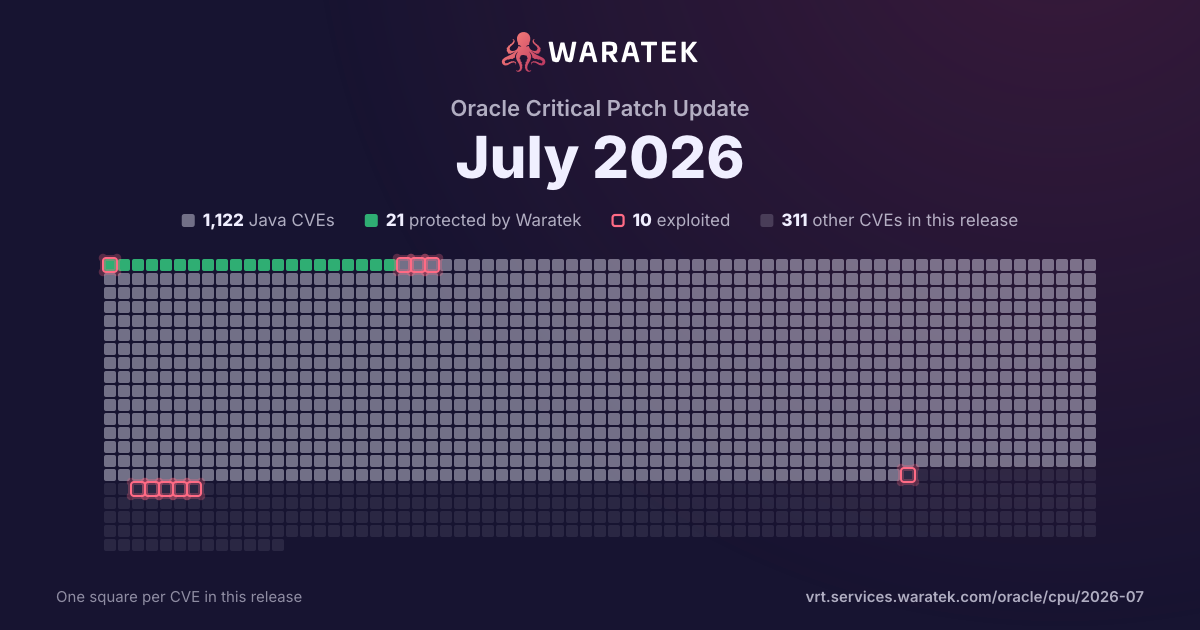
By status
21Protected by Waratek3Rule in development5Mitigation candidate1,095No exploit published13Outside Waratek scope296Not applicable
10Exploited, marked by the ring
No exploit published. For 968 of them, Oracle's security advisory is the source of public detail.
Protected by Waratek. Waratek RASP can block exploitation of these on systems that have not applied the patch yet.
Overview 8 matches · 1 protected · 0 exploited · 0 CISA KEV · 0 public PoC · 0 EPSS ≥ 0.5
Protected by Waratek
1
12.5%
Rule in development
0
0.0%
Mitigation candidate
0
0.0%
No exploit published
7
87.5%
blocked by ARMR today
1
12.5%
partly blocked
0
0.0%
not blocked
7
87.5%
not established
0
0.0%
unrecorded
0
0.0%
Exploited
0
0.0%
Working exploit published
0
0.0%
Proof of concept only
1
12.5%
Forecast only
0
0.0%
No public exploit
7
87.5%
split by
peak 4 / month
Dec 241
Protected by Waratek1
Critical1
blocked by ARMR today1
No public exploit1
Jan 250
Feb 250
Mar 250
Apr 251
No exploit published1
Critical1
not blocked1
No public exploit1
May 250
Jun 250
Jul 250
Aug 250
Sep 250
Oct 250
Nov 251
No exploit published1
Critical1
not blocked1
No public exploit1
Dec 250
Jan 260
Feb 261
No exploit published1
Critical1
not blocked1
No public exploit1
Mar 260
Apr 264
No exploit published4
Critical4
not blocked4
Proof of concept only1
No public exploit3
Dec 24Feb 25Apr 25Jun 25Aug 25Oct 25Dec 25Feb 26Apr 26
| CVE | Severity | Published▾ | Status | Exploitation | Description |
|---|---|---|---|---|---|
| CVE-2026-40976 | Critical | 2026-04-28 | No exploit published | No public exploit | In certain circumstances, Spring Boot's default web security is ineffective allowing unauthorized access to all endpoints. For an application to be vulnerable, it must: be a servlet-based web application; have no Spring Security configuration of its own and rely on the default web security filter chain; depend on spring-boot-actuator-autoconfigure; not depend on spring-boot-health. If any of the above does not apply, the application is not vulnerable. Affected: Spring Boot 4.0.0–4.0.5; upgrade to 4.0.6 or later per vendor advisory. |
| CVE-2026-33557 | Critical | 2026-04-20 | No exploit published | No public exploit | A possible security vulnerability has been identified in Apache Kafka. By default, the broker property `sasl.oauthbearer.jwt.validator.class` is set to `org.apache.kafka.common.security.oauthbearer.DefaultJwtValidator`. It accepts any JWT token without validating its signature, issuer, or audience. An attacker can generate a JWT token from any issuer with the `preferred_username` set to any user, and the broker will accept it. We advise the Kafka users using kafka v4.1.0 or v4.1.1 to set the config `sasl.oauthbearer.jwt.validator.class` to `org.apache.kafka.common.security.oauthbearer.BrokerJwtValidator` explicitly to avoid this vulnerability. Since Kafka v4.1.2 and v4.2.0 and later, the issue is fixed and will correctly validate the JWT token. |
| CVE-2026-2332 | Critical | 2026-04-14 | No exploit published | Proof of concept only | In Eclipse Jetty, the HTTP/1.1 parser is vulnerable to request smuggling when chunk extensions are used, similar to the "funky chunks" techniques outlined here: * https://w4ke.info/2025/06/18/funky-chunks.html * https://w4ke.info/2025/10/29/funky-chunks-2.html Jetty terminates chunk extension parsing at \r\n inside quoted strings instead of treating this as an error. POST / HTTP/1.1 Host: localhost Transfer-Encoding: chunked 1;ext="val X 0 GET /smuggled HTTP/1.1 ... Note how the chunk extension does not close the double quotes, and it is able to inject a smuggled request. |
| CVE-2026-29145 | Critical | 2026-04-09 | No exploit published | No public exploit | CLIENT_CERT authentication does not fail as expected for some scenarios when soft fail is disabled vulnerability in Apache Tomcat, Apache Tomcat Native. This issue affects Apache Tomcat: from 11.0.0-M1 through 11.0.18, from 10.1.0-M7 through 10.1.52, from 9.0.83 through 9.0.115; Apache Tomcat Native: from 1.1.23 through 1.1.34, from 1.2.0 through 1.2.39, from 1.3.0 through 1.3.6, from 2.0.0 through 2.0.13. Users are recommended to upgrade to version Tomcat Native 1.3.7 or 2.0.14 and Tomcat 11.0.20, 10.1.53 and 9.0.116, which fix the issue. |
| CVE-2025-66614 | Critical | 2026-02-17 | No exploit published | No public exploit | Improper Input Validation vulnerability. This issue affects Apache Tomcat: from 11.0.0-M1 through 11.0.14, from 10.1.0-M1 through 10.1.49, from 9.0.0-M1 through 9.0.112. The following versions were EOL at the time the CVE was created but are known to be affected: 8.5.0 through 8.5.100. Older EOL versions are not affected. Tomcat did not validate that the host name provided via the SNI extension was the same as the host name provided in the HTTP host header field. If Tomcat was configured with more than one virtual host and the TLS configuration for one of those hosts did not require client certificate authentication but another one did, it was possible for a client to bypass the client certificate authentication by sending different host names in the SNI extension and the HTTP host header field. The vulnerability only applies if client certificate authentication is only enforced at the Connector. It does not apply if client certificate authentication is enforced at the web application. Users are recommended to upgrade to version 11.0.15 or later, 10.1.50 or later or 9.0.113 or later, which fix the issue. |
| CVE-2025-12383 | Critical | 2025-11-18 | No exploit published | No public exploit | In Eclipse Jersey versions 2.45, 3.0.16, 3.1.9 a race condition can cause ignoring of critical SSL configurations - such as mutual authentication, custom key/trust stores, and other security settings. This issue may result in SSLHandshakeException under normal circumstances, but under certain conditions, it could lead to unauthorized trust in insecure servers (see PoC) |
| CVE-2025-31651 | Critical | 2025-04-28 | No exploit published | No public exploit | Improper Neutralization of Escape, Meta, or Control Sequences vulnerability in Apache Tomcat. For a subset of unlikely rewrite rule configurations, it was possible for a specially crafted request to bypass some rewrite rules. If those rewrite rules effectively enforced security constraints, those constraints could be bypassed. This issue affects Apache Tomcat: from 11.0.0-M1 through 11.0.5, from 10.1.0-M1 through 10.1.39, from 9.0.0.M1 through 9.0.102. The following versions were EOL at the time the CVE was created but are known to be affected: 8.5.0 though 8.5.100. Other, older, EOL versions may also be affected. Users are recommended to upgrade to version [FIXED_VERSION], which fixes the issue. |
| CVE-2024-52046 | Critical | 2024-12-25 | Protected by Waratek | No public exploit | The ObjectSerializationDecoder in Apache MINA uses Java’s native deserialization protocol to process incoming serialized data but lacks the necessary security checks and defenses. This vulnerability allows attackers to exploit the deserialization process by sending specially crafted malicious serialized data, potentially leading to remote code execution (RCE) attacks. This issue affects MINA core versions 2.0.X, 2.1.X and 2.2.X, and will be fixed by the releases 2.0.27, 2.1.10 and 2.2.4. It's also important to note that an application using MINA core library will only be affected if the IoBuffer#getObject() method is called, and this specific method is potentially called when adding a ProtocolCodecFilter instance using the ObjectSerializationCodecFactory class in the filter chain. If your application is specifically using those classes, you have to upgrade to the latest version of MINA core library. Upgrading will not be enough: you also need to explicitly allow the classes the decoder will accept in the ObjectSerializationDecoder instance, using one of the three new methods: /** * Accept class names where the supplied ClassNameMatcher matches for * deserialization, unless they are otherwise rejected. * * @param classNameMatcher the matcher to use */ public void accept(ClassNameMatcher classNameMatcher) /** * Accept class names that match the supplied pattern for * deserialization, unless they are otherwise rejected. * * @param pattern standard Java regexp */ public void accept(Pattern pattern) /** * Accept the wildcard specified classes for deserialization, * unless they are otherwise rejected. * * @param patterns Wildcard file name patterns as defined by * {@link org.apache.commons.io.FilenameUtils#wildcardMatch(String, String) FilenameUtils.wildcardMatch} */ public void accept(String... patterns) By default, the decoder will reject *all* classes that will be present in the incoming data. Note: The FtpServer, SSHd and Vysper sub-project are not affected by this issue. |